Western University Western University
Scholarship@Western
Scholarship@Western
Electronic Thesis and Dissertation Repository
9-23-2019 2:30 PM
Vertical Ionization Energies from the Average Local Electron
Vertical Ionization Energies from the Average Local Electron
Energy Function
Energy Function
Amer Marwan El-Samman
The University of Western Ontario
Supervisor
Viktor N. Staroverov
The University of Western Ontario
Graduate Program in Chemistry
A thesis submitted in partial fulfillment of the requirements for the degree in Master of Science © Amer Marwan El-Samman 2019
Follow this and additional works at: https://ir.lib.uwo.ca/etd
Part of the Numerical Analysis and Scientific Computing Commons, Other Chemistry Commons, and the Physical Chemistry Commons
Recommended Citation Recommended Citation
El-Samman, Amer Marwan, "Vertical Ionization Energies from the Average Local Electron Energy Function" (2019). Electronic Thesis and Dissertation Repository. 6633.
https://ir.lib.uwo.ca/etd/6633
This Dissertation/Thesis is brought to you for free and open access by Scholarship@Western. It has been accepted for inclusion in Electronic Thesis and Dissertation Repository by an authorized administrator of
Abstract
It is a non-intuitive but well-established fact that the first and higher vertical ionization
energies (VIE) of any N-electron system are encoded in the system’s ground-state electronic
wave function, ΨN. This makes it possible to compute VIEs of any atom or molecule from
its ground-state ΨN directly, without performing calculations on the (N−1)-electron states.
In practice, VIEs can be extracted from ΨN by using the (extended) Koopmans’ theorem or
by taking the asymptotic limit of certain wave-function-based quantities such as the ratio of
kinetic energy density to the electron density. However, whenΨN is expanded in a Gaussian
basis set, the latter method fails because the ratio diverges in ther→ ∞limit. We show that, in
such cases, the first VIE of any finite system can still be estimated by taking ther→ ∞limit
of the average local electron energy function. This function is constructed from an exact or
approximate ground-state wave function of the system and approaches a system- and
method-dependent constant in ther→ ∞ limit. For Hartree–Fock and density-functional theory, this
limit reduces to the eigenvalue of the highest-occupied molecular orbital and hence the first
VIE according to Koopmans’ theorem. We also show that, in the finite-basis approximations of
these theories, this constant will generally be more negative than the eigenvalue of the
highest-occupied molecular orbital. The results are generalized to finite-basis-set post-Hartree–Fock
theory.
Summary for Lay Audience
Consider the amount of energy it takes to kick out an electron from a molecule — the
ionization energy. The ionization energy is a measure of how tightly a molecule holds on
to its electrons. Molecules with low ionization energy tend to be more reactive as they lose
electrons easily to other molecules. Because the ionization energy explains a lot about chemical
reactivity, chemists have long tried to predict it from the quantum-mechanical model of atoms
and molecules.
The quantum-mechanical model revolves around the molecule’s wave function which
en-codes all the properties of the molecule, including its ionization energy. In fact, it turns out
that the ionization energy determines the shape of the furthest region of the wave function.
That means that just by knowing the shape of that region, quantum-chemists can predict the
ionization energy or vice versa. However, in common approximations to the wave function,
the outermost region suffers the most and predicts nonsensical ionization energies. We present
the average local electron energy (ALEE). The ALEE is calculated from the wave function but
shows more promising predictions of the ionization energy in its furthest region. In fact, we
also show that its deviation from exact ionization energy follows a certain law when the ALEE
Acknowledgements
This lab has given me the opportunity to explore the very fundamentals of chemistry. It
was a truly enjoyable intellectual journey filled with confusions and epiphanies. Thank you Dr.
Staroverov for guiding me through this journey and always believing in me. Thanks to you, I
learned how to think clearly, write precisely and to always take things one step at a time. The
skills you taught me are not just helpful for research and writing, these are principles to live by.
I want to thank my good friend and leader, Egor Ospadov, who is responsible for the
pre-liminary coding of my project and for teaching me the principles of coding, supercomputing,
researching and much more. And I also want to thank all my lab colleagues, Rongfeng Guan,
Liyuan Ye, Nick Hoffman and Egor Ospadov for always being there for me in times of need.
Lastly, my deepest gratitude goes to my family. First, for my parents, Marwan El-Samman
and Nojoud Ayoubi, who struggled very hard to raise four children, take care of me when I
was a young ill child, and bring us to Canada to give us this dream education. My whole life
I will be indebted to them. Thanks also to my siblings, Ahmad, Rand and Reem El-Samman
for always pledging their full support and believing in me. I do not know where I would be
Contents
Certificate of Examination ii
Abstract ii
Summary for lay audience iii
Acknowledgements iv
List of Figures vi
List of Tables vii
List of Abbreviations viii
1 Introduction 1
1.1 Vertical ionization energy . . . 2
1.2 Computing the VIE . . . 3
1.3 Koopmans’ theorem . . . 4
1.4 Extended Koopmans theorem . . . 9
1.5 VIE via asymptotic limits of wave-function quantities . . . 13
2 Average local electron energy 17 2.1 ALEE of the Hartree–Fock and Kohn–Sham methods . . . 17
2.2 ALEE of the post-Hartree–Fock methods . . . 20
2.3 Asymptotic limit of the average local electron energy . . . 21
2.3.1 Asymptotic limit of Kohn-Sham ALEE . . . 21
2.3.2 Asymptotic limit of Hartree–Fock ALEE . . . 22
2.3.3 Asymptotic limit of Post-Hartree–Fock ALEE . . . 23
3 Asymptotic limit of the ALEE 25 3.1 The case of Kohn–Sham ALEE . . . 25
3.2 Kohn–Sham ALEE in the basis set limit . . . 29
3.3 Hartree–Fock ALEE in the basis-set limit . . . 31
3.4 Asymptotic limit of generalized ALEE in a finite basis . . . 36
3.5 The most diffuse basis function must be in the HOMO . . . 40
3.6 Asymptotic limit of the ALEE in different directions . . . 45
3.7 Summary . . . 49
List of Figures
1.1 X-ray photoelectron spectrum of crystalline Fe2O3 . . . 1
1.2 Vertical ionization of a diatomic molecule . . . 2
1.3 Cancellation of error in the Hartree–Fock frozen-orbital VIE approximation . . . 9
1.4 The complete active space self-consistent field wave function . . . 10
1.5 τL(r)/ρ(r) for a hydrogen atom . . . 15
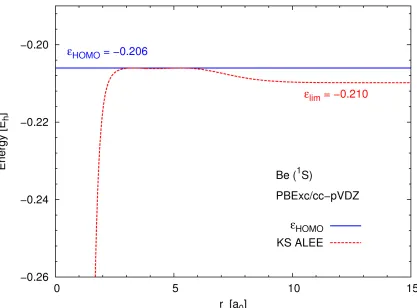
3.1 Kohn–Sham ALEE for the Be atom calculated using the PBEPBE functional and the cc-pVQZ basis set . . . 26
3.2 Detail of the Kohn–Sham ALEE for the Be atom using the PBEPBE functional and the cc-pVQZ basis set . . . 27
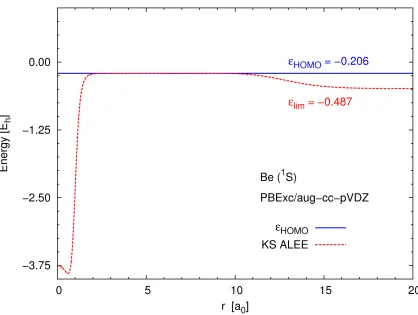
3.3 Kohn–Sham ALEE for the Be atom calculated using the PBEPBE functional and the aug-cc-pVQZ basis set . . . 28
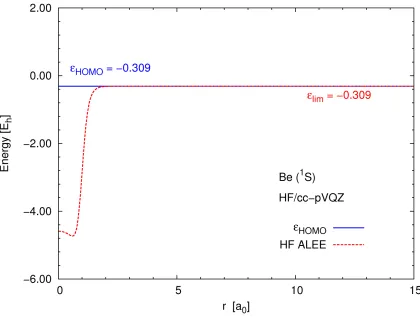
3.4 Hartree–Fock ALEE for the Be atom calculated using the cc-pVQZ basis set . . . 32
3.5 Hartree–Fock ALEE for the Be atom calculated using the aug-cc-pVQZ basis set . . . 33
3.6 Post-Hartree–Fock ALEE for the Be CAS(4,5) system calculated using the cc-pVQZ basis set . . . 37
3.7 Detail of the post-Hartree–Fock ALEE for Be CAS(4,5) system calculated using the cc-pVQZ basis set . . . 38
3.8 Post-Hartree–Fock ALEE for Be CAS(4,5) system calculated using the aug-cc-pVQZ basis set. In this basis set the asymptotic limit of the ALEE tends to a significantly more negative value in the limit. . . 39
3.9 Hartree–Fock ALEE for CH4using the cc-pVDZ basis set . . . 41
3.10 Hartree–Fock ALEE for CH4using the cc-pVDZ basis set modified by adding a diffuse p-type function on carbon atom . . . 43
3.11 Illustration of H2O’s HOMO . . . 45
3.12 Contour plot of the Hartree–Fock ALEE for H2O . . . 46
3.13 Illustration of NH3’s HOMO . . . 47
List of Tables
3.1 Asymptotic limit of Kohn–Sham ALEE in finite-basis approximation . . . 31 3.2 Asymptotic limit of the Hartee–Fock ALEE in finite-basis approximation . . . 35 3.3 Asymptotic limit of post-Hartree–Fock ALEE in the finite-basis approximation . . . . 37 3.4 Asymptotic limit of the ALEE when the most diffuse basis function is almost
List of Abbreviations
VIE Vertical Ionization Energy KT Koopmans’ Theorem
EKT Extended Koopmans Theorem HOMO Highest Occupied Molecular Orbital
CASSCF Complete-Active Space Self-Consistent Field ALEE Average Local Electron Energy
Chapter 1
Introduction
Chemistry primarily deals with the structure and properties of many-electron systems. One
way to understand such systems is to take them apart, one electron at a time. This is what makes
the ionization process fundamental. Consider, for instance, the various energies required to
re-move electrons from the surface of a material. These ionization energies (measured by x-ray
photoelectron spectroscopy or energy-dispersive x-ray spectroscopy) can be used to determine
the elemental composition of that surface [1–3] (Figure 1.1). Because different elements
re-quire distinct energies to remove electrons, the spectrum can be used as a chemical fingerprint.
As an example, the peaks at specific binding energies in Figure 1.1 is characteristic of iron and
is a result of ionization from the various orbitals of the iron atom.
Even more important is the fact that the ionization energy is strongly linked to chemically
relevant concepts such as electronegativity, polarizability and atomic-shell structure [5–7].
This means that the ionization reaction is key to understanding many other chemical reactions.
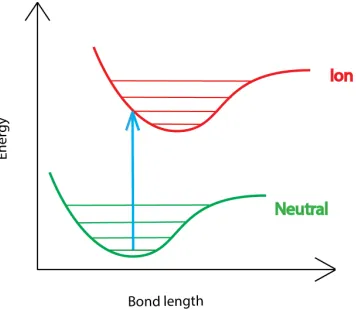
There are two types of ionization reactions: adiabatic and vertical ionization. The difference
is that the former involves changes in the molecular geometry while the latter does not. The
focus of this thesis is on the vertical ionization energy which happens to be the most common
type.
1.1
Vertical ionization energy
Vertical ionization is ionization which does not involve changes in the molecular geometry
(Figure 1.2)
M−→M++e− (1.1)
It is the most common type of ionization and that is because electrons, being much lighter than
the nuclei, move at a much faster rate [8–10].
The energy associated with vertical ionization is called thevertical ionization energy(VIE).
There has been much effort devoted to the accurate computation of the VIE because this
prop-erty is important for chemical exploration and because it determines the long-range behavior
of wave functions. This thesis will touch on both aspects: computing the VIE and studying the
role that the VIE plays in determining the behavior of the wave function and
wave-function-based quantities.
1.2
Computing the VIE
Several methods have been developed to obtain the VIE of a system. The most direct is
the∆SCF method, in which the VIE is computed as the difference between some ionic-state
energy and the neutral ground-state energy,
I=EN−1−EN. (1.2)
The energiesEN andEN−1are computed by solving the Schr¨odinger equation [12],
ˆ
HΨN(x1,x2,...,xN) = ENΨN(x1,x2,...,xN), (1.3)
whereΨN(x1,x2,...,xN) is the many-electron wave function,xi=(ri,si) represents the spin and
position coordinates of electroni, and the Hamiltonian operator, ˆH, is given by
ˆ
H = −1 2
N
X
i=1 ∇i2−
N
X
i=1 nuclei
X
A=1 ZA |ri−RA|+
N
X
i<j
1 |ri−rj|+
nuclei X
A<B
ZAZB |RA−RB|
, (1.4)
whereN is the total number of electrons, ∇2i is the Laplacian operator for theith electron and
Oppenheimer approximation [12], where nuclear and electronic wave functions are assumed to
be separable (because nuclei move at a much slower rate than electrons).
The∆SCF method requires two calculations to determine the VIE, one for theN-electron
system and one for the (N−1)-electron system. However, it has been argued [13] that as
an electron moves further and further away from an N-electron system, the N-electron wave
function should resemble the (N−1)-electron wave function, that is,
lim
|rN|→∞
ΨN(x
1,x2,...,xN)∼ΨN−1(x1,x2,...,xN−1). (1.5)
This implies that the VIE is encoded in the N-electron wave function itself. Section 1.3 and
1.4 introduce the (extended) Koopmans’ theorems, which are standard methods of extracting
the VIE from the wave function. Then in Section 1.5 we will delve into the important role
the VIE plays in governing the long-range behavior of wave functions. In that section we
will demonstrated that the VIE may also be extracted from the long-range behavior of certain
wave-function-based quantities.
1.3
Koopmans’ theorem
Koopmans’ theorem(KT) and theextended Koopmans theorem(EKT) allow one to extract
the VIE from theN-electron wave function alone. Koopmans’ theorem only works for the
spe-cial case of Hartree–Fock wave functions, whereas the extended Koopmans theorem is
appli-cable to any approximate or exact wave function (including Hartree–Fock). But to understand
the more general case it is first important to understand the original Koopmans’ theorem for
Hartree–Fock wave functions.
The Hartree–Fock wave function is the simplest approximation to the N-electron wave
spin-orbitals also known as the Hartree–Fock Slater determinant,
Φ(x1,x2,...,xN)=
1 √
N!
N! X
i=1
(−1)piPˆ
iψ1(x1)ψ2(x2)...ψN(xN)
= √1 N!
ψ1(x1) ψ2(x1) · · · ψN(x1)
ψ1(x2) ψ2(x2) · · · ψN(x2) ... ... ... ... ψ1(xN) ψ2(xN) · · · ψN(xN)
(1.6)
where ˆPiis the permutation operator,piis its parity, and each spin-orbital,ψi(x), is made up of
a spin-functionσi(which may take on a value of±1
2) and a spatial-functionφi(r),
ψi(x)=φi(r)σi. (1.7)
Finding the spin-orbitals of a system is done by using the variational principle. This principle
states that the wave function with the lowest energy is the closest to the exact ground-state
energy and exact wave function. So, finding the most accurate Hartree–Fock approximation
amounts to finding the set of spin-orbitals that give the lowest possible energy. Stated
mathe-matically, by minimizing the expectation value of ˆHfor the Hartree–Fock wave function with
respect to its spin-orbitals one can arrive at an eigenvalue equation for the minimum-energy
spin-orbitals,
ˆ
Fψi(x)=εiψi(x). (1.8)
Here ˆFis the Fock operator given by
ˆ
where
ˆ
h = −∇ 2 i
2 +v(ri) (1.10)
is the core (bare-nucleus) Hamiltonian,
ˆ J=
N
X
k=1 Z
ψk(x2)
1
r12ψk(x2) dx2 (1.11)
is the Coulomb repulsion operator, and ˆK is the exchange operator whose action on a
spin-orbital is defined by
ˆ
Kψi(x1)= N
X
k=1 ψk(x1)
Z
ψ∗ k(x2)
1 r12
ψi(x2) dx2. (1.12)
The spin-orbitals of the Hartree–Fock wave function are the lowest-energy eigenfunctions of
the Fock operator. In terms of these spin-orbitals, the total ground-state energy of the Hartree–
Fock system is given by
EN =
N
X
i=1 hii+1
2
N
X
i j=1
(Ji j−Ki j), (1.13)
where
hii=
Z
ψ∗
i(x1)ˆhψi(x1) dx1 (1.14)
corresponds to the kinetic energy and nuclear attraction of an electron inψi,
Ji j = Z
ψ∗
is the electron-electron repulsion integral, and
Ki j = Z
ψ∗
i(x1) ˆKψj(x1) dx1 (1.16)
is the exchange integral.
Now using the total energy in terms of spin-orbitals, the VIE can be written as the difference
in total energies between the ground-state N-electron Hartree–Fock wave function and some
ionic-state (N−1)-electron Hartree–Fock wave function at the same geometry
I = EN−1−EN =
N−1 X
i=1 hii+1
2
N−1 X
i j=1
(Ji j−Ki j)− N
X
k=1
hkk+1 2
N
X
kl=1
(Jkl−Kkl). (1.17)
Since the ground and ionic states have different spin-orbitals, calculation of the VIE requires
running two Hartree–Fock calculations: for the the N- and (N−1)-electron systems (∆SCF
method). To extract the VIE from theN-electron wave function alone, an assumption has to be
made.
The assumption is that the spin-orbitals remain frozen between theN- and (N−1)-electron
systems (i.e., they do not change shape). The only difference would be that the (N−1)-electron
system has one missing spin-orbital, denotedk, because of one missing electron. Then the VIE
is written with the same spin-orbitals on either side of the subtraction in Eq. (1.17)
I = EkN−1−EN =
N−1 X
i=1,i,k hii+1
2
N−1 X
i j,i,k,j,k
(Ji j−Ki j)− N
X
i=1 hii+1
2
N
X
i j=1
(Ji j−Ki j). (1.18)
Subtracting out the common spin-orbitals in both systems leaves behind
I=−(hkk+
N
X
i=1
which is just the eigenvalue of spin-orbitalk,
Ik=−εk. (1.20)
This was Koopmans’ result, a prescription for frozen-orbital VIEs within the Hartree–Fock
theory. Each occupied spin-orbital eigenvalue corresponds to one of the frozen-orbital VIEs of
the system. Thehighest occupied molecular spin–orbital (HOMO) eigenvalue corresponds to
the first VIE,
I1=−εHOMO. (1.21)
Koopmans’ theorem is the first successful attempt to seek out the ionization energy to various
(N−1)-electron states from theN-electron wave function alone. Even though the frozen-orbital
approximation is used in this method, Koopmans’ theorem gives reasonable estimates of the
experimental VIEs. For example, for an Ar atom, Koopmans’ first VIE is 0.590 Eh and the
experimental value is 0.579 Eh. For H2O, Koopmans’ theorem predicts 0.508 Eh while the
experimental value is 0.464Eh. This is aided by the fact that the errors known in Hartree–Fock
theory and in that inherent in the frozen-orbital approximation counteract each other (see Figure
1.3) [14]. In Figure 1.3, it is illustrated that the Hartree–Fock VIE generally underestimates
the exact VIE. This means that if relaxation was accounted for, the VIE would be even further
underestimated compared to the exact.
The main limitation of Koopmans’ theorem is that it is applicable only to Hartree–Fock
wave functions. Approximations for the N-electron wave function beyond the Hartree–Fock
theory are all collectively known as post-Hartree–Fock wave functions. The extended
Koop-mans theorem(EKT) is a generalization of the original Koopmans prescription which gives the
Figure 1.3: VIE calculated through Hartree–Fock theory is generally known to be less than the exact. This means that if relaxation is accounted for, the Hartree–Fock VIE will deviate even more from exact.
1.4
Extended Koopmans theorem
Koopmans’ theorem requires taking the negative of some Hartree–Fock occupied spin-orbital
eigenvalue. This prescription does not apply to post-Hartree–Fock wave functions because
they do not have distinct sets of occupied and unoccupied spin-orbitals. Take, for example,
the full configuration interaction wave function. This wave function is constructed not just
from one antisymmetrized product of occupied spin-orbitals, but from many; all the possible
antisymmetrized products of N occupied spin-orbitals that can be constructed out of set of K
spin-orbitals (occupied and unoccupied).
ΨFCI=cHFΦHF+ X
ra
craΦra+X
a<b r<s
crsabΦrsab+ X
a<b<c r<s<t
crstabcΦrstabc+... (1.22)
This is done by systematically substituting the reference Hartree–Fock occupied spin-orbitals
collection of antisymmetrized products are added together to construct the full configuration
interaction wave function [12]. This can get quite expensive with system size as the
computa-tion would have to handle an astronomical number of antisymmetrized products. Thecomplete
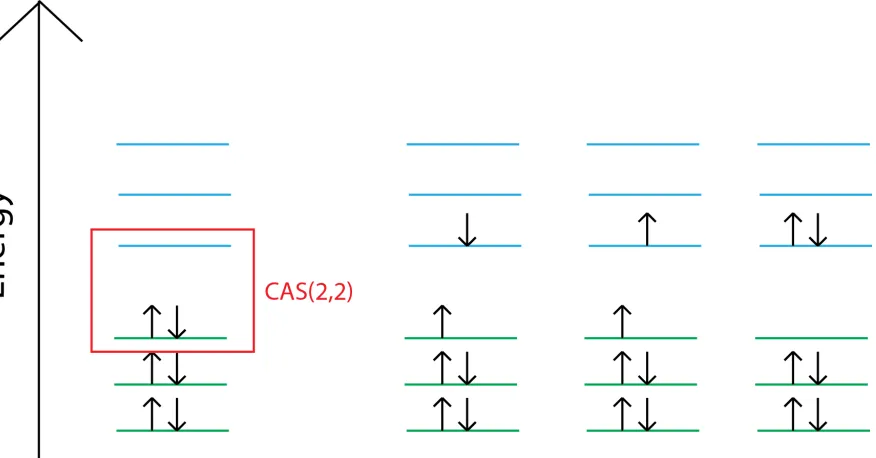
active space self-consistent field(CASSCF) method [15–17], which is one of the main
meth-ods used in this paper, allows one to choose a smaller subset of antisymmetrized products to
represent the post-Hartree–Fock wave function. An example of this is shown in Figure 1.4.
Figure 1.4: A complete active space (CAS) limits the number of configura-tions possible. It is done by choosing a subset of electrons and orbitals that are free for substitutions. The above is denoted as CAS(2,2) as the last two electrons in the last two orbitals are free to make multiple configurations.
The important thing to remember is that in post-Hartree–Fock wave functions, such as
CASSCF and full configuration interaction, there is no clear distinction between occupied and
unoccupied spin-orbitals. In fact, in the full configuration interaction wave function, all the
orbitals are partially occupied in the full set of antisymmetrized products formed. For this
While there is no inherent one-electron occupied spin-orbital in the definition of
post-Hartree–Fock wave functions, theextended Koopmans theorem(EKT) is a method to construct
this “removal orbital” from post-Hartree–Fock wave functions, such that it gives a variationally
stable (minimum of energy) (N−1)-electron wave function and corresponding VIE. The EKT
is the generalization of Koopmans’ theorem so it applies to Hartree–Fock wave functions also.
The EKT [18–21] is based on the assumption that the (N−1)-electron wave function can
be generated from theN-electron wave function using some suitably chosen removal orbital,
qi(xN),
ΨN−1
i (x1,x2,... ,xN−1)=
Z
qi(xN)ΨN(x1,x2,...,xN) dxN. (1.23)
Here we follow Morrison and Liu’s [19] derivation of the extended Koopmans theorem.
Equiv-alently, the assumption above can be written as
Ψ
N−1E =qˆ
Ψ
NE
, (1.24)
where
Ψ
NE is any wave function (exact, Hartree–Fock or post-Hartree–Fock), ˆq is a linear
combination of annihilation operators, ˆai,
ˆ q=
M
X
i=1
ciaˆi, (1.25)
andMis the dimension of space spanned by the spin-orbitals. Then by taking the difference in
energy between theN- and (N−1)-electron wave functions constructed according to Eq. (1.24)
we obtain the EKT matrix equation:
whereIk is one of the VIEs,c is the vector containing the coefficients of Eq. (1.25),Gis the
generalized Fock matrix with matrix elements defined as
Gi j= Z
Ψ∗
(x1,x2,...,xN)ˆa†i[ ˆHaˆj]Ψ(x1,x2,...,xN) dx1...dxN, (1.27)
andγis the one-electron reduced density matrix with matrix elements defined as
γi j = Z
Ψ∗
(x1,x2,...,xN)ˆa†iaˆjΨ(x1,x2,...,xN) dx1...dxN. (1.28)
By solving the EKT matrix equation, one is effectively finding the removal orbital that gives a
stationary ionic state.
The EKT, Eq. (1.26), is a generalization of the Koopmans’ theorem. If a Hartree–Fock
wave function is used in Eq. (1.26), one would find that the optimal coefficients, ci, are all
zero except for a single spin-orbital. Accordingly, the VIE would correspond to the eigenvalue
of that spin-orbital. This happens because the Hartree–Fock spin-orbital already represents a
minimum energy removal-orbital of the Hartree–Fock wave function (see Section 1.3).
The EKT method is not free from problems. For example, it has been reported [19–21]
that the EKT fails for systems where the one-electron reduced density matrix is sparse. Sparse
matrices are problematic as the solution of Eq. (1.26) requires inversion of the one-electron
reduced density matrix giving
γ−1/2Gγ−1/2c=−I
kc. (1.29)
If the numbers in the one-electron reduced density matrix are too small, numerical inversion
becomes ill-defined and can give nonsensical VIEs.
the VIE from the N-electron wave function. However, they are not the only ones. The VIE
plays an important role in governing the long-range behavior of the wave function. So, in the
next section we show that one may theoretically be able to extract the VIE from the long-range
behavior of the wave function or certain wave-function-based quantities. However, we will
also demonstrate that this ability to extract the VIE is not possible in practical computations.
1.5
VIE via asymptotic limits of wave-function quantities
Another route to the VIE is by investigating the long-range behavior of wave function and
wave-function-based quantities. Wang and Parr [22] found that the Hartree–Fock electron
densities show approximately piecewise exponential behavior. Morrell, Parr and Levy [23]
then demonstrated that, in general, the long-range behavior of the exact electron density in the
outermost region falls off exponentially according to the equation
ρ(r)∼exp(−2p2Iminr) r→ ∞. (1.30)
The above equation means thatImin may be extracted from the slope of lnρ(r) vs r,
lnρ(r)∼ −2p2Iminr. (1.31)
In theory, Eq. (1.31) could be used to extract the VIE from a logarithmic plot of the electron
density. However, in practical numerical calculations of the wave function, Gaussian basis
functions are used. This means that the long-range electron density decay rate is given by
where a is smallest pre-defined constant given in the basis set (as that is the one to decays
the slowest). This pre-defined constant may not be−2√2Imin and therefore, it is not possible
extract the VIE from a density expanded in a Gaussian basis set.
Another quantity that is also related to the VIE is the ratio of the kinetic energy density to
the electron density. The kinetic energy density is given by
τL(r) = −1 2[∇
2 rγ(r,r
0
)]r=r0, (1.33)
where γ(r,r0) is the one-electron reduced density matrix defined in terms of the N-electron
wave function as
γ(r,r0)=N Z
Ψ∗
(r,r2,...,rN)Ψ(r0,r2,...,rN) dr2...drN. (1.34)
Whenr0=r, theγ(r,r0) is the electron densityρ(r):
ρ(r)=γ(r,r). (1.35)
So, by evaluating the second derivative ofρ(r) to get the asymptotic kinetic energy density and
then dividing by the asymptotic electron density (Eq. 1.30) gives
lim
r→∞ τL(r)
ρ(r) =−Imin, (1.36)
revealing that the ratio theoretically approaches the first VIE of the system in ther→ ∞limit
[24].
However, in numerical approximations of the N-electron wave function where Gaussian
Substi-tution of this expression gives
τL(r) ρ(r) =−2a
2r2+4ba+6a, (1.37)
which means in ther→ ∞limit, ALEE diverges as−2a2r2 [24]. and never approaches a
con-stant. In the above evaluation, the exponential decay term cancelled out due to being common
on the numerator and denominator.
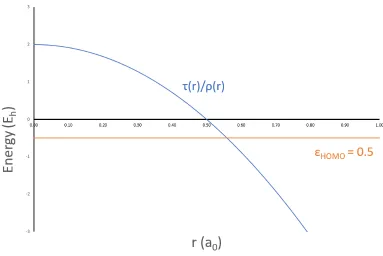
Figure 1.5 shows a graph of τL(r)/ρ(r) for the simplest system, a hydrogen atom with a
single Gaussian basis function.
Figure 1.5: τL(r)/ρ(r) for a hydrogen atom falls exponentially in the
asymptotic limit when Gaussian-type basis functions are used
It can be seen from this graph that the asymptotic limit is not the VIE of hydrogen. Therefore,
while theoretically the ratio of τL(r)/ρ(r) is supposed to approach the VIE of the system, in
In summary, both the kinetic energy density to electron density ratio and the density-tail
behavior cannot in practice give the first VIE. There is one quantity, however, which does not
show this behavior — the average local electron energy (ALEE). The ALEE approaches a
system- and method-dependent constant in ther→ ∞limit that is related to the first VIE of the
system. The focus of this thesis is on the investigating this property of the ALEE. Chapter 2
discusses the theory and background of the ALEE function and Chapter 3 examines itsr→ ∞
Chapter 2
Average local electron energy
2.1
ALEE of the Hartree–Fock and Kohn–Sham methods
Politzer and coworkers [25–29] introduced the following combination of the Hartree–Fock
occupied orbitals and orbital energies, called the average local orbital energy,
¯
εHF
(r) = 2
ρ(r)
N/2 X
i=1 εHF
i |ψ HF i (ri)|
2,
(2.1)
where the factor of two comes from the fact that there are two spin-orbitals for each of theN/2
doubly occupied spatial orbitals of the closed-shell system. Each eigenvalue contribution is
weighed according to the square of the orbital at positionrand thus gives the average energy
coming from all the orbitals at position r. This can equivalently be called the average local
electron energy since each occupied spin-orbital carries one electron. This term is more
appro-priate for the generalized version of this quantity (see Section 2.2) as post-Hartree–Fock wave
functions do not have distinct sets of occupied and unoccupied spin-orbitals. For this reason
The ALEE is a measure of the average local eigenvalue. Since spin-orbital eigenvalues
correspond to ionization energies, the negative of the ALEE gives the average local ionization
energy at positionr,
¯
I(r)=−ε¯(r). (2.2)
Politzer and coworkers used this quantity extensively in their research on chemical reactivity,
electronegativity and polarizability of systems [5–7, 27, 30–35].
Looking at Eq. (2.1) it is not clear whether the ALEE is invariant with respect to unitary
transformation of the occupied orbitals. This is important because all quantum-mechanical
observables must have this property. The invariance is demonstrated by casting Eq. (2.1) in an
equivalent form [24, 36],
εHF
(r) = τ
HF L (r)
ρ(r) +ν(r)+νH(r)+νS(r). (2.3)
Here ν(r) is the external potential of the nuclei, τHFL (r) is the Hartree–Fock kinetic-energy
density
τHF
L (r) = −
1 2[∇
2 rγ(r,r
0
)]r=r0, (2.4)
νS(r) is the Slater averaged exchange-charge potential
νS(r) = −
1 2ρ(r)
Z |γ
(r,r0)|2 |r−r0| dr
0,
andνH(r) is the Hartree potential
νH(r) =
Z ρ
(r2) |r−r2|
dr2, (2.6)
all expressed in terms of the one-electron reduced density matrix, γ(r,r0), defined by Eq.
(1.34).
The orbital-invariant form of the ALEE proves that it is a fundamental quantum-mechanical
property and for this reason it has appeared not only in Hartree–Fock theory but also in Kohn–
Sham density functional theory. In Kohn-Sham, ALEE has a definition that is almost identical
to that of Hartree–Fock ALEE except that Kohn–Sham orbitals and orbital eigenvalues are used
¯
εKS(r) = 2 ρ(r)
N/2 X
i=1 εKS
i |ψ KS i (ri)|
2, (2.7)
with orbital-invariant form being
εKS
(r) = τ
KS L (r)
ρ(r) +ν(r)+νH(r)+νXC(r), (2.8)
where the first three terms on the right-hand side are the same as in the Hartree–Fock ALEE
except for the last term, which is here replaced by the exchange-correlation potentialνXC(r) of
density-functional theory.
The ALEE found relevance in both Hartree–Fock and Kohn–Sham theories. It helped
ex-plain chemically relevant concepts such as electronegativity [30, 31] and polarizability, [27, 32]
and was a good predictor of molecular reactivity sites [5–7, 33–35]. In addition to all this,
it was demonstrated that the ALEE is a fundamental ingredient for the exact formulation of
density-functional’s exchange potential [36–38]. For these reasons, it was found necessary to
2.2
ALEE of the post-Hartree–Fock methods
The ALEE was only defined for Hartree–Fock and Kohn–Sham theories until Staroverov
and Ryabinkin [24] introduced an appropriate definition applicable to post-Hartree–Fock wave
functions. The post-Hartree–Fock ALEE is defined as the diagonal part of the kernel of the
generalized Fock operator ˆGdivided by the electron density
¯
εWF(r)= G(r,r)
ρ(r) , (2.9)
where the kernel is defined in terms of density matrices as
G(r,r0)=
−1 2∇
2 r+ν(r)
γ(r,r0)+2
Z Γ
(r,r2;r0,r2) |r−r2|
dr2. (2.10)
Since the post-Hartree–Fock ALEE only involves the diagonal elements of the above matrices,
it is written explicitly as
¯
εWF(r)= τ WF L (r)
ρ(r) +ν(r)+νH(r)+
Z υhole
XC(r,r2) |r−r2|
dr2, (2.11)
whereυholeXC(r,r2) is the exchange-correlation hole density. The post-Hartree–Fock ALEE was
purposely defined in the more general orbital-invariant form. But it can also be defined
specif-ically in terms of the orbitals and eigenvalues of the generalized Fock operator, fi(r) and λi,
respectively,
¯
εWF(r)= 2 ρ(r)
M
X
i=1
λi|fi(r)|2. (2.12)
This equation formally resembles the original definition of the Hartree–Fock ALEE, Eq. (2.1).
means that it reduces to the Hartree–Fock ALEE if a Hartree–Fock wave function is used.
This happens because the generalized Fock operator reduces to a Fock operator for Hartree–
Fock wave functions. In the next section it will be demonstrated that the theoretical r → ∞
limit for Hartree–Fock ALEE, exact density-functional ALEE, and post-Hartree–Fock ALEE
all approach exactly the first VIE of the system.
2.3
Asymptotic limit of the average local electron energy
The r → ∞ limit of the ALEE approaches a system- and method-dependent constant for
Hartree–Fock, post-Hartree–Fock and Kohn–Sham systems. This section will show this
con-stant is the first VIE for all these systems. Starting with the simplest case to analyze: the
Kohn–Sham case.
2.3.1
Asymptotic limit of Kohn-Sham ALEE
Consider first, the Kohn–Sham system which is made up of an antisymmetrized product of
Kohn–Sham spin-orbitals. These spin-orbitals have the following long-range behavior [39]:
ψi(r)∼rBiexp(−
p
−2εir) r→ ∞, (2.13)
whereBiis some constant that is largest for the HOMO. The above equation demonstrates that
the asymptotic behavior of each Kohn–Sham spin-orbital is determined by its own eigenvalue.
Since the HOMO has the smallest eigenvalue and the largest Bi, it follows that the HOMO is
also the last orbital to decay in the Kohn–Sham system. This means that Eq (2.7) for Kohn–
Sham ALEE reduces to
lim
r→∞ε¯
KS(r)=εKS
in the asymptotic limit. In exact density-functional theory, εKSHOMO is the negative of the first
VIE of the system,
εKS
HOMO=−Imin. (2.15)
However, in approximate density-functional theory it would only be an approximation to the
first VIE [39].
2.3.2
Asymptotic limit of Hartree–Fock ALEE
Now let us consider the Hartree–Fock wave function which is also made up of spin-orbitals.
However, Hartree–Fock spin-orbitals have subtly different properties than those of Kohn–
Sham. In particular, the long-range behavior of a Hartree–Fock spin-orbital is, in general, a
function of all eigenvalues of the system,
ψi(r)∼ N
X
i=1
rBiexp(−p−2ε
ir) r→ ∞, (2.16)
whereBi is some constant that is largest for the HOMO [40–42]. The above equation implies
that since the HOMO has the smallest spin-orbital eigenvalue, it determines the asymptotic
behavior of all the spin-orbitals,
ψi(r)∼rBHOMOexp(−p−2ε
HOMOr) (2.17)
This is a different result than that of Kohn–Sham spin-orbitals, where the asymptotic behavior
of each spin-orbital is determined by its own eigenvalue. While there is a subtle difference in
the long-range behavior between the Hartree–Fock and Kohn–Sham systems, the last orbital to
the Hartree–Fock ALEE would thus give a similar result to Kohn–Sham ALEE:
lim
r→∞ε¯
HF(r)=εHF
HOMO. (2.18)
Here,−εHF
HOMO, according to Koopmans’ theorem equals the first VIE.
2.3.3
Asymptotic limit of Post-Hartree–Fock ALEE
Lastly, for post-Hartree–Fock wave functions, the asymptotic limit is computed using the
right-hand side of Eq. (2.11). As one electron moves away from the nuclei, the external
po-tential of the nuclei,ν(r), the exchange-correlation hole density,υholeXC(r,r2), and the coulombic
repulsion from other electrons, νH(r), all vanish. Therefore, the only term left to analyze is τL(r)/ρ(r) in the asymptotic limit. Since it is known [23, 43, 44] that in the r → ∞ limit,
γ(r,r) (and electron density, ρ(r)) has an exponential fall-off factor given by exp(−cr) with
c= √2Imin, Eq. (2.4) gives
τWF
L (r)∼ −
1 2∇
2
rexp(−cr) r→ ∞, (2.19)
Then
lim
r→∞ε¯
WF
(r)= lim
r→∞ τWF
L (r)
ρ(r) =−Imin. (2.20)
Therefore, for post-Hartree–Fock wave functions the asymptotic limit of the ALEE approaches
the negative of the first VIE which would equal exactly the one given by EKT. Note that Eq.
(2.17) is not appropriate for the computation of the asymptotic limit of the ALEE because,
as was mentioned in section 1.4, in a Gaussian basis set, the asymptotic limit of this quantity
determined by the most diffuse basis function found on both the numerator and the
denomina-tor. Thus the basis function cancels out in the asymptotic limit and the ALEE will approach
a constant that approximates the first VIE of the system in that basis-set. This is significant
as other wave-function-based quantities diverge in a Gaussian-basis set (see section 1.4). The
next chapter of this thesis investigates the behavior of the asymptotic limit of the ALEE in a
Chapter 3
Asymptotic limit of the ALEE
The objective of this thesis is to explore the asymptotic limit of the ALEE within the Hartree–
Fock, post-Hartree–Fock and Kohn–Sham descriptions of the system. We demonstrated that
ther→ ∞limit of the ALEE theoretically approaches the first VIE at each of these levels of
theory. This section analyzes this behavior in numerical computations of the wave function
using Gaussian basis sets.
3.1
The case of Kohn–Sham ALEE
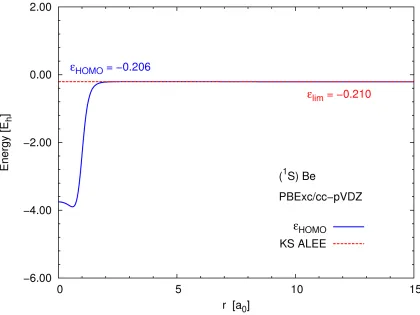
Figure 3.1 shows the asymptotic limit of the Kohn–Sham ALEE for a Be atom calculated
using the cc-pVQZ basis set. The Kohn–Sham ALEE seems to approach the eigenvalue of the
HOMO, as expected from Eq. (2.14). However, when zoomed in aroundεKSHOMO (see Figure
3.2), it is evident that the plot of the ALEE actually tends to a slightly more negative value in the
asymptotic limit. The actual limit varies with the basis set: for instance, in the aug-cc-pVQZ
basis, the ALEE reaches an even more negative value (see Figure 3.3).
The basis-set sensitivity suggests this has to do with the finite-basis-set approximation used
in the computation of the spin-orbitals. We will show that in the finite-basis approximation, the
ALEE will give a different asymptotic value than the theoretical one. This will account for the
3.2
Kohn–Sham ALEE in the basis set limit
This section will show that spin-orbitals expressed in a finite basis give a different equation
for the asymptotic limit of the Kohn–Sham ALEE than the theoretical limit, Eq. (2.14), where
no basis set approximation is considered.
In general, the Kohn–Sham spin-orbitals cannot be solved for analytically. This is
be-cause the one-electron Kohn–Sham Hamiltonian for a spin-orbital depends on the solutions
of all other spin-orbitals in the system which are initially unknown. In practice, the Kohn–
Sham equation is solved through an iterative numerical procedure called the self-consistent
field method [12]. In this method, an initial guess for all the spin-orbitals is assumed. This
guess is constructed from a finite set of fixed chosen basis functions
ψi(r)=
M
X
j=1
cjiχj(r). (3.1)
The variational coefficients cji specify the contribution of basis functions χj(r) in the
spin-orbitalψi(r). Then the initial guess of spin-orbitals is used to calculate the one-electron Kohn–
Sham Hamiltonian matrix and solve the eigenvalue equation for a second set of spin-orbitals.
This process is repeated until the spin-orbitals on output is the same as on input. This is when
the solution is said to be “self-consistent.”
However, in order to get the exact spin-orbitals from the initial guess, there must be an
infi-nite number of basis functions in the spin-orbital expansion. Of course, in reality, only a fiinfi-nite
number can be used. Therefore, all solutions to the one-electron Kohn–Sham Hamiltonian will
be limited by the finite basis set. Now we are in a position to prove that due to the finiteness of
the basis set, the Kohn–Sham ALEE will generally approach a different (always more negative)
constant than the theoretical value.
orbitals are expressed using a finite set of basis functions. Thus, the finite-basis Kohn–Sham
ALEE is written as
¯
εKS(r)= N/2
P
i=1 M
P
µ=1 M
P
ν=1 εKS
i cµicνiχµ(r)χν(r) N/2
P
i=1 M
P
µ=1 M
P
ν=1
cµicνiχµ(r)χν(r)
. (3.2)
Ther→ ∞limit of the above expression for the Kohn–Sham ALEE would depend solely on
the contributions of the most diffuse basis function,χω(r), employed in the calculation. So, in
the asymptotic limit, the above equation reduces to
aKSlim= lim
r→∞ε¯
KS(r)= N/2
P
i=1 εKS
i |cωi| 2
N/2 P
i=1 |cωi|2
, (3.3)
where cωi is the coefficient of the most diffuse basis function in the spin-orbital ψi(r). The
above equation for the asymptotic limit of the Kohn–Sham ALEE is notεHOMOas was derived
in section 2.3. Instead it is a linear combination of all the spin-orbital eigenvalues. This is
because the most diffuse basis function is found in all the spin-orbitals, meaning that all of
them spin-orbitals are found in the asymptotic region of the wave function. Additionally, since
the lower-lying eigenvalues are less than or equal to the HOMO energy,
εKS i ≤ε
KS
HOMO, (3.4)
the Kohn–Sham ALEE’s asymptotic limit will generally be less than the HOMO eigenvalue as
seen in Figure 3.2 and 3.3.
The constant will give exactly εKSHOMO only when the most diffuse basis function appears
is compared in two basis sets. The basis set which has the most diffuse basis function heavily
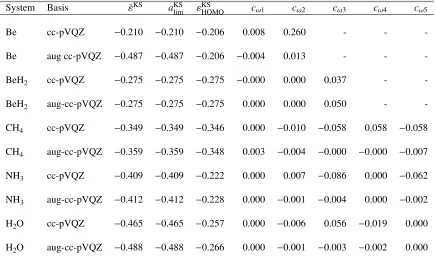
allocated to the HOMO relative to the other orbitals will give a value much closer toεKSHOMOin
ther→ ∞limit. The table also shows the value obtained using the finite-basis equation for the
ALEE, Eq. (3.3), to show that it gives exactly the same value as that obtained graphically.
Table 3.1: The asymptotic limit of the Kohn–Sham ALEE (Eh), the prediction of Eq. 3.3 (Eh) of the ALEE, the εKSHOMO (Eh), and coefficients of the most diffuse basis function in all the spin-orbitals. All computed using the PBEPBE functional at equilibrium geometry.
System Basis ε¯KS aKSlim εKSHOMO cω1 cω2 cω3 cω4 cω5
Be cc-pVQZ −0.210 −0.210 −0.206 0.008 0.260 - -
-Be aug cc-pVQZ −0.487 −0.487 −0.206 −0.004 0.013 - -
-BeH2 cc-pVQZ −0.275 −0.275 −0.275 −0.000 0.000 0.037 -
-BeH2 aug-cc-pVQZ −0.275 −0.275 −0.275 0.000 0.000 0.050 -
-CH4 cc-pVQZ −0.349 −0.349 −0.346 0.000 −0.010 −0.058 0.058 −0.058
CH4 aug-cc-pVQZ −0.359 −0.359 −0.348 0.003 −0.004 −0.000 −0.000 −0.007
NH3 cc-pVQZ −0.409 −0.409 −0.222 0.000 0.007 −0.086 0.000 −0.062
NH3 aug-cc-pVQZ −0.412 −0.412 −0.228 0.000 −0.001 −0.004 0.000 −0.002
H2O cc-pVQZ −0.465 −0.465 −0.257 0.000 −0.006 0.056 −0.019 0.000
H2O aug-cc-pVQZ −0.488 −0.488 −0.266 0.000 −0.001 −0.003 −0.002 0.000
3.3
Hartree–Fock ALEE in the basis-set limit
Figure 3.4 shows the ALEE for the Hartree–Fock Be atom calculated using the cc-pVQZ
basis set. In this figure, the Hartree–Fock ALEE reaches almost exactlyεHFHOMO in ther→ ∞
limit. However, in the aug-cc-pVQZ basis set (Figure 3.5), the limit of the Hartree–Fock
ALEE gives a more negative value than εHFHOMO. Therefore, the constant the Hartree–Fock
Figure 3.4: Hartree–Fock ALEE for Be atom calculated using the cc-pVQZ basis set. In this basis set the r → ∞ limit of the ALEE reaches
εHF
The basis-set sensitivity points again to the fact that the Hartree–Fock spin-orbitals, just
like those of Kohn–Sham, are computed using the finite-basis-set approximation. This means
that the Hartree–Fock ALEE, Eq. (2.1), when expressed explicitly in terms of basis functions
gives
¯
εHF
(r)=
N/2 P
i=1 M
P
µ=1 M
P
ν=1 εHF
i cµicνiχµ(r)χν(r) N/2
P
i=1 M
P
µ=1 M
P
ν=1
cµicνiχµ(r)χν(r)
, (3.5)
which in ther→ ∞limit gives an analogous expression for the Kohn–Sham ALEE in a finite
basis set
aHFlim= lim
r→∞ε¯
HF(r)= N/2
P
i=1 εHF
i |cωi| 2
N/2 P
i=1 |cωi|2
. (3.6)
This means that the Hartree–Fock ALEE will also in general reach a more negative constant
than εHFHOMO in a finite basis set due to the inclusion of other spin-orbitals in the asymptotic
region. The formula above is formally similar to that of Kohn–Sham ALEE. It may seem
redundant to state almost the same formula twice, but there is good reason to do this. As
mentioned in section 2.3, Kohn–Sham and Hartree–Fock spin-orbitals have subtly different
long-range behavior. A Kohn–Sham spin-orbital’s long-range behavior is determined by its
own eigenvalue, whereas a Hartree–Fock spin-orbital’s long-range behavior is determined by
all spin-orbital eigenvalues in the system. Although the spin-orbital behavior in both theories is
governed by different laws, the Kohn–Sham and Hartree–Fock ALEEs have the same
asymp-totic limit because the HOMO happens to be the last-decaying orbital in both theories [39–42].
Another similar observation can also be made about Hartree–Fock ALEE. Only when the
limit of the Hartree–Fock ALEE give exactly εHFHOMO. This pattern can be seen in Table 3.2,
which compares each system in two different basis sets. The basis set which has its most
diffuse function heavily allocated to the HOMO relative to the other orbitals will give a limit
of the ALEE that is much closer toεHFHOMO. The table also shows that the value obtained using
the finite-basis equation for the Hartree–Fock ALEE, Eq. (3.6), is the same as that obtained
graphically.
Table 3.2: The asymptotic limit of the Hartree–Fock ALEE (Eh), the prediction of Eq. 3.6
(Eh) of the ALEE, the εHFHOMO (Eh), and coefficients of the most diffuse basis function in all the spin-orbitals. All computed using the PBEPBE functional at equilibrium geometry.
System Basis ε¯HF(E
h) aHFlim(Eh) εHFHOMO(Eh) cω1 cω2 cω3 cω4 cω5
Be cc-pVQZ −0.309 −0.309 −0.309 0.001 0.294 - -
-Be aug cc-pVQZ −0.487 −0.487 −0.206 −0.024 0.088 - -
-BeH2 cc-pVQZ −0.456 −0.456 −0.448 −0.000 0.034 0.000 -
-BeH2 aug cc-pVQZ −0.447 −0.447 −0.447 0.000 0.000 0.184 -
-CH4 cc-pVQZ −0.547 −0.547 −0.544 0.000 0.009 0.052 0.052 0.052
CH4 aug-cc-pVQZ −0.544 −0.544 −0.543 0.000 0.000 −0.007 −0.007 −0.007
NH3 cc-pVQZ −0.621 −0.621 −0.431 0.000 0.004 −0.067 0.000 −0.008
NH3 aug-cc-pVQZ −0.621 −0.621 −0.429 0.000 −0.001 0.005 0.000 −0.001
H2O cc-pVQZ −0.695 −0.695 −0.507 −0.000 0.003 0.039 −0.014 0.000
H2O aug-cc-pVQZ −0.724 −0.724 −0.510 0.000 −0.001 −0.004 −0.001 0.000
In summary, the Hartree–Fock and Kohn–Sham ALEE approachεHOMOtheoretically.
How-ever, in the finite-basis numerical approximation, the Hartree–Fock and Kohn–Sham ALEE
approach a different constant given by Eqs. (3.3) and (3.5), respectively. This is significant as
other techniques of obtaining the VIE through asymptotic limits, such as the asymptotic limit
3.4
Asymptotic limit of generalized ALEE in a finite basis
We will now generalize the findings of the basis Hartree–Fock ALEE to the
finite-basis post-Hartree–Fock ALEE. Post-Hartree–Fock ALEE exhibits similar behavior to that of
Hartree–Fock and Kohn–Sham ALEE. Figure 3.6 and 3.7 show a beryllium CAS(4,5) system
computed using the cc-pVQZ basis set. While in Figure 3.6 it seems as if the post-Hartree–
Fock ALEE reaches exactly the first VIE, when enlarged (Figure 3.7), it shows there is a slight
deviation. And this deviation is again basis-set sensitive (Figure 3.8). In Figure 3.8, the−Imin
significantly deviates from exact in the aug-cc-pVQZ basis set.
CASSCF wave functions and many other post-Hartree–Fock wave functions also rely on
the use of a basis set of functions. Post-Hartree–Fock ALEE is written in a finite basis set as
¯
εWF
(r)= PN/2
i j=1
PM
µ=1
PM
ν=1cµicνjGi jχµ(r)χν(r) PN/2
i j=1
PM
µ=1
PM
ν=1cµicνjPi jχµ(r)χν(r)
. (3.7)
Since the r→ ∞ limit is given by the most diffuse basis function, χω(r), the above equation
becomes
aWFlim = lim
r→∞ε¯
WF(r)= PN/2
i j=1cωiGi jcωj PN/2
i j=1cωiPi jcωj
(3.8)
Table 3.3 shows how the equation above predicts the constant that will be reached in the
Table 3.3: The asymptotic limit of the post-Hartree–Fock ALEE (Eh) and the prediction of Eq. 3.8 (Eh). All computed using the cc-pVQZ basis set at equilibrium geometry.
System Active Space aWF
lim (Eh) ε¯ WF (E
h) Experimental (Eh) [11]
He (2,10) −0.901 −0.901 −0.903
Be (4,5) −0.359 −0.359 −0.342
H2 (2,10) −0.611 −0.611 −0.567
LiH (4,6) −0.688 −0.688 −0.300
H2O (8,10) −0.325 −0.325 −0.464
NH3 (8,14) −0.663 −0.663 −0.368
We have shown how to calculate the asymptotic limit of the ALEE function in the
finite-basis approximation of all theories (Hartree–Fock, Kohn–Sham and post–Hartree-Fock). In
general, the ALEE does not necessarily reach the theoretical value of−Imin but approximates
depending on the coefficients of the most diffuse basis function. Next we will show how to
construct a basis such that it gives exactly−Imin.
3.5
The most diffuse basis function must be in the HOMO
We have shown that the r → ∞ limit of the ALEE approaches a system- and
method-dependent constant. Furthermore, for Hartree–Fock and Kohn–Sham systems, this constant
depends on the basis set and generally has a more negative value thanεHOMO. Now we show
that it is possible to construct a basis that meets a condition which will giveεHOMOaccurately.
The finite-basis equation for the asymptotic limit of the Hartree–Fock and Kohn–Sham
ALEE, Eqs. (3.3) and (3.5) both reduce toεHOMO if the coefficients of the most diffuse basis
functions are zero for all orbitals except the HOMO. This condition is met approximately if
a basis set is constructed with a sufficiently diffuse basis function such that it will be almost
exclusively in the HOMO expansion.
For instance, consider the methane molecule computed at the Hartree–Fock level of theory
using the cc-pVDZ basis set (Figure 3.9). The constant reached by the ALEE is more negative
thanεHOMO. That is because in this basis set, hydrogen’s second s-type function is the most
cc-pVDZ basis set for the H atom
Exponent Contraction Coefficient
S
1.301000D+01 1.968500D-02
1.962000D+00 1.379770D-01
4.446000D-01 4.781480D-01
1.220000D-01 5.012400D-01
S
1.220000D-01 1.000000D+00
P
7.270000D-01 1.0000000
Figure 3.9: Hartree–Fock ALEE for CH4 using the cc-pVDZ basis set. The basis set exponents of hydrogen are shown above the graph. The most-diffuse basis function is being used in multiple spin-orbitals thus the ALEE reaches a more negative value thanεHOMO in the asymptotic limit. The
If an additional diffuse p-type basis function, from the aug-cc-pVDZ basis, is added to the
carbon atom in methane, then the asymptotic limit of the ALEE reaches exactlyεHOMO(Figure
3.10). This is because the additional diffuse function on carbon is not used by any orbitals other
than the triply degenerate HOMO of methane.
cc-pVDZ basis set for the C atom with an extra p-type function
Exponent Contraction Coefficient
S 6.665000D+03 6.920000D-04 1.000000D+03 5.329000D-03 2.280000D+02 2.707700D-02 6.471000D+01 1.017180D-01 2.106000D+01 2.747400D-01 7.495000D+00 4.485640D-01 2.797000D+00 2.850740D-01 5.215000D-01 1.520400D-02 1.596000D-01 -3.191000D-03 S 6.665000D+03 -1.460000D-04 1.000000D+03 -1.154000D-03 2.280000D+02 -5.725000D-03 6.471000D+01 -2.331200D-02 2.106000D+01 -6.395500D-02 7.495000D+00 -1.499810D-01 2.797000D+00 -1.272620D-01 5.215000D-01 5.445290D-01 1.596000D-01 5.804960D-01 S 1.596000D-01 1.000000D+00
P 4 1.00
9.439000D+00 3.810900D-02 2.002000D+00 2.094800D-01 5.456000D-01 5.085570D-01 1.517000D-01 4.688420D-01 P 1.517000D-01 1.0000000
P 1 1.00
4.041000D-01 1.0000000
D
Figure 3.10: Hartree-Fock ALEE for CH4 using the cc-pVDZ basis set modified by adding a p-type basis function on the carbon atom. This func-tion is used only in the triply degenerate HOMO and therefore give the asymptotic limit as exactlyεHOMO. The coefficients of the most diffuse
Therefore, it is possible to construct a basis in which the ALEE gives exactlyεHOMO, but
this basis must adhere to the condition that the most diffuse basis function is used almost
exclusively in the HOMO. Table 3.4 shows a list of other systems where an augmented basis
(from aug-cc-pVDZ basis set) was diffuse enough to give exactlyεHOMOor−Imin.
Table 3.4: Asymptotic ALEE limits computed using the cc-pVDZ basis and the same basis augmented with an additional diffuse funciton (cc-pVDZ*), in brackets is the added diffuse basis function exponent and angular momentum.
System Wave Function cc-pVDZ cc-pVDZ* −Imin Experimental [11]
CH4 Hartree–Fock −0.554 −0.525 (p: 0.040) −0.525 0.463 NH3 Hartree–Fock −0.445 −0.343 (p: 0.056) −0.343 0.370 CH4 CAS(8,8) −0.656 −0.525 (p: 0.040) −0.525 0.463 H2O CAS(8,10) −1.362 −0.515 (p: 0.069) −0.515 0.464 NH3 CAS(8,14) −1.244 −0.403 (p: 0.056) −0.403 0.370 HF CAS(8,9) −1.052 −0.604 (p: 0.085) −0.604 0.589
Thus, the asymptotic limit of the ALEE reveals an important difference between exact
and finite-basis wave function solutions. In exact Hartree–Fock and Kohn–Sham theory, the
HOMO is the slowest decaying orbital and it determines the asymptotic decay of the electron
density. For finite-basis wave functions, the rule that the HOMO determines the asymptotic
decay is violated because the most diffuse basis function is found in all spin-orbitals. In this
sense, all of the spin-orbitals determine the behavior of the asymptotic region of a finite-basis
wave function. The asymptotic limit of the ALEE will give εHOMO only when the
finite-basis wave function adheres to the condition that the last decaying orbital is the HOMO. This
happens precisely when the coefficients of the most-diffuse basis function is zero for all orbitals
except for the HOMO.
It is important to note that the asymptotic limit of the ALEE must be taken in a direction
that is not in the nodal plane of the HOMO to getεHOMO. For example, for H2O in the tables
above, the asymptotic limit was always evaluated in the x-axis to avoid theyz HOMO nodal
3.6
Asymptotic limit of the ALEE in different directions
In general, the asymptotic behavior of the electron density decay is non-uniform. The
pre-viously mentioned asymptotic behavior, r2bexp(−2√−2εHOMOr), is true for all directions of
the system except in a nodal plane of the HOMO. In a nodal plane the last orbital to decay is
some lower-lying orbital, HOMO−1 (assuming the HOMO−1 does not have the same nodal
place). This means that in that direction the asymptotic behavior of electron density is given
asr2bexp(−2√−2εHOMO-1r) [45, 46]. The asymptotic limit of the ALEE should be consistent
with this behavior and giveεHOMO-1 in the directions of nodal axis.
Consider, for example, the H2O molecule which has ayznodal plane in its HOMO.
Figure 3.11: Illustration of H2O’s HOMO
Due to the yz nodal plane it is expected that the asymptotic limit of the ALEE along the x
-axis will be εHOMO and along they- and z-axis it will beεHOMO−1. The contour plot shown
in Figure 3.12 for xy plane confirms this behavior. Along the x-axis, the ALEE approaches
The same is observed for NH3where there is anxynodal plane (Figure 3.13).
Figure 3.13: Illustration of NH3’s HOMO
Here, it is expected that the asymptotic limit of the ALEE along thez-axis will giveεHOMOand
along thex- andy-axis (due to thexynodal plane) will giveεHOMO−1. The contour plot shown
Figure 3.12 for theyz plane confirms this behavior. Along thez-axis, the asymptotic limit of
the ALEE approachesεHOMO (−0.419 Eh) of the system while along they-axis it approaches
εHOMO-1(−0.616Eh) due to theyznodal plane.
These results imply that the ALEE gives information about which orbital dominates the
asymptotic region. It confirms the fact that while in most directions the last decaying orbital
is usually the HOMO, in the nodal plane of the HOMO, the asymptotic behavior is dominated
by some lower-lying orbital. In this way, the asymptotic limit of the ALEE mimics the outer
3.7
Summary
The ALEE is a quantity derived from the ground-state N-electron wave function of the
system. For Hartree–Fock and Kohn–Sham systems, the ALEE theoretically approaches the
eigenvalue of the HOMO in ther→ ∞ limit. However, if the spin-orbitals are computed
us-ing the finite-basis approximation, the asymptotic limit of the Hartree–Fock and Kohn–Sham
ALEE will be a linear combination of all the occupied-orbital eigenvalues. For finite-basis
post-Hartree–Fock ALEE, the asymptotic limit is also determined by the most diffuse basis
function’s coefficients as given by Eq. (3.7).
Compared to many other wave-function-based quantities, the ALEE has the advantage that
it asymptotically approaches a constant instead of diverging in ther→ ∞limit. This constant
is exactly or approximately the first VIE. In exact Hartree–Fock and Kohn–Sham theory, the
HOMO is the slowest-decaying orbital and it determines the asymptotic decay of the electron
density, thus the ALEE would giveεHOMO. For finite-basis wave functions, that rule is violated
because the most diffuse basis function is found in all orbitals. In other words, all the
spin-orbitals determine the asymptotic decay of the system and the ALEE gives a linear combination
of eigenvalues for the asymptotic limit. Therefore, in order for a finite-basis wave function to
obey the rule that the HOMO decays last, the HOMO must have the most diffuse basis function
to itself. If this condition is met, the asymptotic limit of the ALEE will almost exactly the first
Bibliography
[1] K. Siegbahn and K. Edvarson. β-Ray spectroscopy in the precision range of 1:105.Nucl. Phys.1,8 (1956).
[2] D. W. Turner and M. I. Al Jobory. Determination of ionization potentials by photoelectron energy measurement.J. Chem. Phys.37, 3007 (1962).
[3] J. Goldestein. Scanning Electron Microscopy and X-ray Microanalysis. Kluwer Aca-demic/Plenum: London, New York; 2003.
[4] T. Yamashita and P. Hayes. Analysis of XPS of Fe2+ and Fe3+ ions in oxide materials. Appl. Surf. Sci.254, 8 (2008).
[5] J. S. Murray, T. Brinck and P. Politzer, in Theoretical Organic Chemistry, edited by C. P´ark´anyi. Elsevier, Amsterdam, 1996, pp. 189-202.
[6] P. Politzer and J. S. Murray, inTheoretical Aspects of Chemical Reactivity, edited by A. Toro-Labb´e. Elsevier, Amsterdam, 2007, pp. 119-137.
[7] P. Politzer, J. S. Murray and F. A. Bulat. Average local ionization energy: A review. J. Mol. Model.16, 1731 (2010).
[8] J. Franck. Elementary processes of photochemical reactions. J. Chem. Soc. Faraday Trans.21, 536 (1926).
[9] E. Condon. A theory of intensity distribution in band systems.Phys. Rev.28, 1182 (1926).
[10] E. Condon. Nuclear motions associated with electron transitions in diatomic molecules. Phys. Rev.32, 858 (1928).
[11] Notes on ionization energies. National Institute of Standards and Technology. https://cccbdb.nist.gov/adiabatic.asp (accessed April 09, 2009).
[12] A. Szabo and N.S. Ostlund, inModern Quantum Chemistry. (Dover Publications, New York, 1996), pp. 39-107.
[14] N. Heinrich, W. Koch and G. Frenking. On the use of Koopmans’ theorem to estimate negative electron affinities.Chem. Phys. Lett.124, 17 (1986).
[15] P. E. M. Siegbahn, A. Heiberg, B. O. Roos and B. Levy. A comparison of the super-CI and the Newton-Raphson scheme in the complete active space SCF method.Phys. Scr. 21, 323 (1980).
[16] B. O. Roos, P. R. Taylor and P. E. M. Siegbahn. A complete active space SCF method (CASSCF) using a density matrix formulated super-CI approach.J. Chem. Phys.48, 157 (1980).
[17] P. E. M. Siegbahn, J. Alml¨of, A. Heiberg and B. O. Roos. The complete active space SCF (CASSCF) method in a Newton-Raphson formulation with application to the HNO molecule.J. Chem. Phys74, 2384 (1981).
[18] O. W. Day, W. Smith and C. Garrod. Extension of Koopmans’ theorem. I. Derivation.Int. J. Quantum Chem.8, 501 (1974).
[19] R. C. Morrison and G. Liu. Extended Koopmans’ theorem: Approximate ionization en-ergies from MCSCF wave functions.J. Comput. Chem.13, 1004 (1992).
[20] M. Ernzerhof. Validity of extended Koopmans’ theorem.J. Chem. Theory Comput.5, 793 (2009).
[21] R. C. Morrison, C. M. Dixon and J. R. Mizell Jr. Examination of the limits of accuracy of the extended Koopmans’ theorem ionization potentials into excited states of ions LiH, He2and Li2· Int. J. Quantum Chem.52, 309 (1994).
[22] W. Wang and R.G. Parr. Statistical atomic models with piecewise exponentially decaying electron densities.Phys. Rev. A16, 891 (1977).
[23] M. M. Morell, R. G. Parr and M. Levy. Calculation of ionization potentials from density matrices and natural functions and the long-range behavior of natural orbitals and electron density.J. Chem. Phys.62, 549 (1975).
[24] V. N. Staroverov and I. G. Ryabinkin. The average local electron energy generalized to correlated wave functions.J. Chem. Phys.141, 084197 (2014).
[25] P. Sjoberg, J. S. Murray, T. Brinck and P. Politzer. Average local ionization energies on the molecular surfaces of aromatic systems as guides to molecular reactivity.Can. J. Chem. 68, 1440 (1990).
[26] J. S. Murray, J. M. Seminario, P. Politzer and P. Sjoberg. Average local ionization energies computed on the surfaces of some strained molecules. Int. J. Quantum Chem. 24, 645 (1990).
![Figure 1.1: X-ray photoelectron spectrum of crystalline Fe2O3taken from [4]](https://thumb-us.123doks.com/thumbv2/123dok_us/1894976.1247815/9.612.194.448.516.665/figure-x-ray-photoelectron-spectrum-crystalline-fe-taken.webp)