Advanced Interaction Model for autonomous
transportation system using Deep Learning
Methods
Thuzar Aung
Faculty of Information Technology Supporting and Maintenance, University of Computer
Studies (Meiktila), Meiktila City, Mandalay Division, Myanmar
[email protected]
Abstract:
Deep learning (DL) plays a major role for advancing transportation systems. Recently, the researchers have witnessed the advent and prospect of deep learning which has become a hot topic in ITS (Intelligent Transportation Systems). As a result, traditional learning models in many applications made a way for deep learning for its new learning techniques so that the landscape of ITS can be reshaped. Autonomous vehicles promise to improve road safety to protect the traffic congestion meanwhile, an increase fuel usage. This paper introduces how to plan advanced transportation system with autonomous vehicles in traffic. We model the interaction between the autonomous vehicle with the surrounded roads with Deep Inverse Reinforcement Learning (DIRL). We validate the proposed application with maximum entropy principle (MEP) to learn the effectives of proposed model. Simulated results prove that expected driving behaviors of an autonomous vehicle with DIRL gets the promising and competitive results compared with other works.
Keywords: Deep Learning, automatic vehicles, transportation system, maximum entropy principle
1.
Introduction
Machine learning technology usually works as core function of ITS, its accuracy and reliability are directly impact on developing a smart system. In recent years, deep Learning have had overwhelming success in computer vision and speed of recognition and also natural language processing area. They often broke new accuracy records in many applications. It is a natural way to apply deep learning models as ITS classifiers or predictors to improve accuracy. From that point of view, this study aims to create an automatic transportation system using cutting-edge technology called deep inverse reinforcement learning [1,2].
In autonomous vehicle system, they can detect the environment in various ways and navigate without the intervention of the driver. Along with advanced control, the development of detection technology such as radar, slider, ultrasound, positioning and computer vision. Techniques that can analyze sensory data to plan and achieve the desired path to the desired destination. It is expected that autonomous vehicles significantly improve traffic congestion, reduce collisions and reduce the resulting injuries. Provide mobility for children, the elderly and the disabled and reduce the need for parking space in the city [2]. Automatically for the rapid development of detection and computing technology has been started in the last 20 years. The vehicles have made great strides, and the technology related to autonomous driving vehicles has progressed considerably since recent years.
We classify the applications in ITS that really in a model of precise learning in visual recognition tasks, traffic flow prediction (TFP), traffic speed prediction (TSP), travel time prediction (TTP) and various tasks [1-5].
We summarize the technological evolution of machine learning models, i.e., how traditional ML methods such as the Support Vector Machine (SVM), Bayesian Network (BN) and Kalman Filter (KF) are used in the early stages and, subsequently, were revolutionized with the arrival of several deep learning models [6-10].
Although several researchers have proposed different versions of road system with different algorithms, these algorithms cannot be used to solve a problem without a model [11-14]. Specifically, we therefore use a deep neural network to approximate the action-state reward, instead of the state reward, as in most cases upon those existing transport formulations.
change, lane and speed maintenance, acceleration and braking by conducting of probabilistic conduction of environmental vehicles in transit.
The rest of the paper is organized as follows. Related works are described in Section 2, theory background for deep learning and autonomous transportation system are explored in section 3. The proposed method is presented in Section 4 and paper is concluded in Section 5.
2.
Related Works
Other techniques that use ideas of artificial intelligence (AI) to solve planning problems are also developed. For autonomous vehicles. It includes supervised learning [19], in-depth study [20] and reinforcement learning [21]. Lange et al. [22] uses the deep neural encoder to take representations of features from the raw visual input of the camera images for a vehicle race, and we successfully learned the best control measures (i.e, steering, acceleration and braking) using learning by reinforcement. The performance of control is better than that experienced by a human player, in his spirit The car can be transferred to a closed track as quickly as possible without crashing.
Loidl et al [4] defend the risk of getting sick between 5.5 and 12 times bigger for the cyclists. On the contrary, Yuan and Chen (2016) say that pedestrians have a greater risk of road traffic. Compared to cyclists, because vehicle drivers tend to be brisker in situations of conflict between motor vehicles and cyclists than crashed car to pedestrian; this study demonstrates that the night, the intersection, the older age of VRU and the elderly The speed of the vehicle increases the severity of shock damage.
Li et al. [7] also examines factors that affect the level of severity of injuries walking in different weather conditions based on the database of accidents in Great Britain. Important predictors of severity under good weather. Model conditions include speed limits, pedestrian age, lighting conditions and vehicle maneuvers under the bad weather conditions, meaningful predictors are pedestrian age, vehicle maneuvering and speed limit.
Chen and Shen [6] performed a study reporting environmental effects on the cyclical severity. Injuries related to car accidents. They determined that the severity of the injury was reduced to the density of the work;
Serious or deadly injuries are negatively associated with the use of the road through a variety of forms of mobility; Reflective clothing and street lighting may reduce the likelihood of cycling injuries; Positive posted speed is positive relates to the possibility of significant damage and serious injury or damage; The older cyclists seem to be more poorly in serious injury or death, and cyclists are
more likely to experience severe injuries when vehicles are large involved with clashes
3.
Theory Background
3.1. Autonomous transportation System
The roads can have plenty different routes to get to the same place, the animals should be done exchanges between different risks and resource sources, and handling the balances of a highway proximity to other cars and road features with the convenience of car control and overall speed. The exact exchanges made in these situations are usually guessed and followed researchers changed them to give them a behavior that matches the truth [15,17,21], but even.There are many situations where we may want to model or trust to replicate some naturally behavior. These include examples of road route navigation through taxis, search behavior of bees, or even the specifics of highway driving.
Cities are often arranged in terms of planning with special attention to motorized vehicles and not prepared for pedestrian and cyclist. To activate active modes, it is necessary to ensure the safety of vulnerable road users.
The concept of self-driving, autonomous vehicles has been discussed over the years. A common goal, whether from the automotive sector, to science fiction or big information people, the arrival of cars, trucks and buses that navigate and drive by themselves. However, the reality is approaching and, over the next decade, many are expected to see some of the major growths that have been introduced in size in some parts of the world, albeit at different speeds in different sectors and in different regions [6,8,12,15].
3.2. Deep Inverse Reinforcement Learning
The study by reverse reinforcement (IRL) provides a systematic way to formally declare and solve this problem mentioned above. Observed behavior is considered as if it were the solution problems with studying the patterns, and the problem is reduced to regaining relevance award for study of respect for artificial intelligence.The use of reinforcement learning requires knowledge about reward expenses, which must be carefully designed.
An alternative is to determine the optimal driving strategy by demonstrating the desired driving behavior. There are many researchers who use a driving simulator to collect two minutes of data from the driver of an expert driver, and assume that
expert driving policy, suggest the maximum margin algorithm along with the projection algorithm to solve the opposite problem when studying the study. While a person can regain expert driving behavior with this technique, the combination between the best policy / reward and the characteristics is unclear.
4.
Proposed Model
The problem of reinforcement learning is now easy to say: For an agent in an environment with unknown transition probabilities, find, by trial and error, the best policy.
The proposed model for autonomous transportation system with intelligence based deep learning algorithms, we first model the agent based Markov Decision Process (MDP) to analysis the patterns shared between autonomous vehicles and surrounding vehicles encountered in the traffic routes.
MDPs are intended to be a simple framework for problem-solving learning to achieve a goal. The agent and the environment are constantly in contact, the agent chooses the actions and the environment responds to these actions and introduces new agent situations.
In formally, a MDP is used to describe an environment for reinforcement learning, where the environment is quite remarkable. Almost all reinforcement learning problems can be formalized as MDPs.
The MDPs need to satisfy the Markov Property, that requires a mathematical framework to probabilistically models the interaction between two agents called vehicles and environment, in other words, they can be seen as state (V) in Markov if and only if.
]
,...,
|
[
]
|
[
V
t 1V
tP
V
t 1V
1V
tP
Eq (1)Where P means the probability of state V for time t and the next time t+1, which can reveal the history information of previous time frames. It then analyzes the state transitions to predict what can occur in the upcoming transactions with following equation.
]
|'
[
1'
P
V
s
V
v
P
ss
t
t
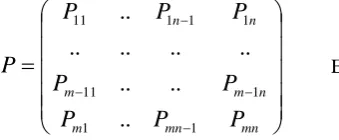
Eq (2)The resulted information is then put in the form of a matrix, where the summation of each row is equal to one.
mn mn m n m m n nP
P
P
P
P
P
P
P
P
1 1 1 11 1 1 1 11..
..
..
..
..
..
..
..
Eq (3)In MDP, a sequence of random states V1,
V2,……..,Vn with the Markov Property, it perform
chained transition process with the following concepts.
Markov Chain Tuple is represented as M(V,P), where V is a finite set of States, Vi: i=1,…,n and P is a probability of state transition from the matrix as shown in Eq (3).
State 1 State 1 Detect Traffic
Pattern Stop Vehicles Environment pause action reward state
Figure 1. Proposed Model for Vehicle and Its environment interaction detection
A MDP or so-called Markov Reward Process is a Markov process with value judgement to know how much reward accumulated through some particular state that we had shown in Figure 1. According to the figures and traditionally, MDP has a tuple with four
attributes called (V, P, R,
), where V is a finite set of states of possible states happened in interaction model which represents a dynamic environment, P is a state transition property matrix in Eq (3) and R is a reward function as Eq (4), which describes how much reward an agent should get by taking an action when the agent is in a given state of the MDP and
is a discount factor which is in the range 0 and 1, describes how much a given reward is worth one step into the future compared to getting the same reward now]
|
[
R
1V
v
R
s
t t
Eq (4)5.
Discussion and Simulations
Learning by reverse reinforcement (IRL) is the problem of finding the reward of the environment function given the observations of the behavior of an agent of optimal behavior, that is, given an optimal policy or sample routes from a next agent.
We develop the proposed model with Pygame to simulate our proposed model so as to prove how it effectively handle the traffic. Pygame is an open source python programming library that is developed for multimedia applications, especially for games. According to the model, the highway road is implemented using a series of connected straight road and curve road segments, where each segment has four lanes and distinguish the types of the vehicles occurred on those lanes such as truck, van and so on. We use the simulated data by implementing different parameters to learn the reward function.
We tested the maximum entropy algorithms in 64x64 object worlds with different numbers of sampled roads in traffic net with 50 objects were placed at random in the traffic.
A summary of the experimental results is shown in Table1. According to the results, our results outperform traditional model.
Table 1. Experimental Results.
Models Stages Time Behavioral
Pattern Detection
Traditional model
3 stages > 2 hours <84%
Our Proposed
Model
3 stages < 1.5 hours
>92%
6.
Conclusions
In this paper, we describe the reverse reinforcement learning for advanced human-free autonomous transportation system and tested the results with maximum entropy. For better results in future experiments, we could run more trials with better alternative methods especially cutting-edge methodologies, part of deep learning techniques. This was not possible in this paper because trials were relatively slow due to existence of limited computational power.
7.
References
[1] Y Wang, D Zhang, Y Liu, B Dai, LH Lee , Enhancing
transportation systems via deep learning: A survey, Transportation Research Part C: Emerging Technologies , Volume 99, February 2019, Pages 144-163.
[2] . D. Pendleton, H. Andersen, X. Du, X. Shen, M. Meghjani, Y. H. Eng, D. Rus, and M. H. Ang,“Perception, planning, control, and coordination for autonomous vehicles,”Machines, vol. 5, no. 1, p. 6, 2017.
[3] Adminaite, D., Allsop, R., Jost, G., 2015. Making Walking and Cycling on Europe’s Roads Safer – Pin Flash Report 29, European Transport Safety Council.
[4] Loidl, M., Traun, C., Wallentin, G., 2016. Spatial patterns and temporal dynamics of urban bicycle crashes – A case study from Salzburg (Austria). Journal of Transport Geography 52, 38-50.
[5] Chen, P., 2015. Built environment factors in explaining the automobile-involved bicycle crash frequencies: A spatial statistic approach. Safety Science 79, 336-343.
[6] Chen, P., Shen, Q., 2016. Built environment effects on
cyclist injury severity in automobile-envolved bicycle crashes. Accident Analysis and Prevention 86, 239-246
[7] Li, D., Ranjitkar, P., Zhao, Y., Yi, H., Rashidi, S., 2016. Analyzing pedestrian crash injury severity under different weather conditions. Traffic Injury Prevention, Volume 18, 427-430.
[8] European Commission, 2011. White paper 2011: Roadmap to a Single European Transport Area – Towards a competitive and resource efficient transport system.
[9] Heydari, S., Fu, L., Miranda-Moreno, L., Jopseph, L., 2017. Using a flexible multivariate latent class approach to model correlated outcomes: A joint analysis of pedestrian and cyclists injuries. Analytic Methods in Accident research 13, 16-27
[10] Hosmer, D. W., Lemeshow, S. (2013). Applied Logistic Regression, 3nd edition. New York: Wiley
[11] IGP: Instituto Geográfico Português, 2013. “Áreas das freguesias, municípios e distritos/ilhas da CAOP 2013”. Direção Geral do Território.
[12] Li, D., Ranjitkar, P., Zhao, Y., Yi, H., Rashidi, S., 2016. Analyzing pedestrian crash injury severity under different weather conditions. Traffic Injury Prevention, Volume 18, 427-430.
[13] M Vilaça, N Silva, MC Coelho , Statistical analysis of the occurrence and severity of crashes involving vulnerable road users Transportation research procedia, 2017 - Elsevier
[14] C You, J Lu, D Filev, P Tsiotras , Advanced planning for autonomous vehicles using reinforcement learning and deep inverse reinforcement learning, Robotics and Autonomous Systems, 2019 - Elsevier
[15] HTSA(2015), “Traffic safety facts 2015: A compilation of motor vehicle crash data from the fatality analysis reporting system and the general estimates system,” Department of Transportation, National Highway Traffic Safety Administration, Washington, DC, USA, Tech. Rep. DOT HS 812 384.
[16] NHTSA et al., “2015 motor vehicle crashes: overview,” Traffic Safety Facts Research Note, vol. 2016, pp. 1–9, 2016.
[17] D. Hendricks, J. Fell, and M. Freedman, “The relative frequency of unsafe driving acts in serious traffic crashes,” Report no: DOT-HS-809-206, 2001.
[19] T. Hastie, R. Tibshirani, and J. Friedman, “Overview of supervised learning,” in The Elements of Statistical Learning. Springer, 2009, pp. 9–41.
[20] Y. LeCun, Y. Bengio, and G. Hinton, “Deep learning,” Nature, vol. 521, no. 7553, pp. 436–444, 2015.
[21] R. S. Sutton and A. G. Barto, Reinforcement Learning: An Introduction. MIT Press Cambridge, 1998, vol. 1, no. 1.