Attacking Reduced Rounds of the ARIA Block Cipher
Ewan Fleischmann, Michael Gorski, and Stefan Lucks
Bauhaus-University Weimar, Germany
{Ewan.Fleischmann, Michael.Gorski, Stefan.Lucks}@uni-weimar.de
Abstract. ARIA [4] is a block cipher proposed at ICISC’03. Its design is very similar to the advanced encryption standard (AES). The authors propose that on 32-bit processors, the encryption speed is at least 70% of that of the AES. They claim to offer a higher security level than AES. In this paper we present two attacks of reduced round ARIA which shows some weaknesses of the cipher. Moreover, our attacks have the lowest memory requirements compared to existing attacks on ARIA with an increase in the time complexity.
Keywords:block ciphers, differential cryptanalysis, ARIA.
1
Introduction
The ARIA block cipher [4] was presented at ICISC’03. Its design is very similar to the advanced encryption standard (AES/Rijndael) [3]. The block size is 128-bit and the key size is either 128, 192 or 256 bits. It uses the same number of rounds as the AES, which are 10, 12 and 14 respectively. ARIA employs two kinds of S-Boxes and two types of substitution layers which are different between even and odd rounds. They skip using a MixComuns operation and use an 16×16 binary matrix with branch number 8 in their diffusion layer. The authors propose that ARIA can increase the efficiency in 8-bit and 32-bit software implementations in comparison to AES. Moreover, they claim to have better security against all existing attacks on block ciphers.
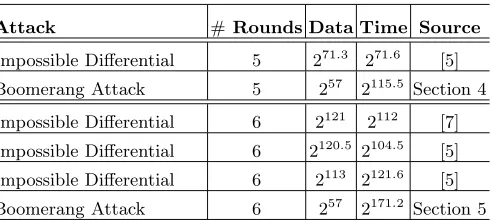
Wu et al. [7] showed that there exist good impossible differentials to break up to 6 rounds of ARIA. Later Li et al. [5] presented also some impossible differential attacks of up to 6 rounds of ARIA. In this paper we apply another technique on ARIA which is called the boomerang attack. We show that our attack can also break up to 6 rounds of ARIA but with the lowest data complexity compared to previous attacks. Our results should introduce a new technique for cryptanalysis on ARIA and should therefore leave some space for further research.
The boomerang attack [6] is a strong extension to differential cryptanalysis [1] in order to break more rounds than plain differential attacks can, since the cipher is treated as a cascade of two sub-ciphers, using short differentials in each sub-cipher. These differentials are combined in an adaptive chosen plaintext and ciphertext attack to exploit properties of the cipher that have a high probability. Biryukov [2] proposed a similar boomerang attack on the AES-128 which can break up to 5 and 6 out of 10 rounds.
Table 1.Comparison of attacks on ARIA
Attack #Rounds Data Time Source
Impossible Differential 5 271.3
271.6
[5] Boomerang Attack 5 257
2115.5
Section 4 Impossible Differential 6 2121
2112
[7] Impossible Differential 6 2120.5
2104.5
[5] Impossible Differential 6 2113
2121.6
[5] Boomerang Attack 6 257
2171.2
Section 5
on a 6-round attack that is applicable to ARIA-192 and ARIA-256 only. We conclude the paper in Section 6.
2
Description of ARIA
ARIA [4] uses data blocks of 128 bits with an 128, 192 or 256-bit cipher key. A different number of rounds is used depending on the length of the cipher key. ARIA has 10, 12 and 14 rounds when a 128, 192 or 256-bit cipher key is used respectively. The plaintexts are treated as a 4 x 4 byte matrix, which is called state. A round applies three operations to the state:
• Substitution layer (SL) is a non-linear byte-wise substitution applied on every byte of the state matrix in parallel, where two different substitution layer exist.
• Diffusion layer (DL)is a linear matrix multiplication of the state matrix with a 16×16 involution binary matrix.
• Round key addition (RK) is a XORing of the state and a 128-bit subkey which is derived from the cipher key.
Before the first round, an initial RK operation is applied and the DL operation is omitted in the last round. The bytes coordinates of a 4 x 4 state matrix are labeled as:
0 4 8 12 1 5 9 13 2 6 10 14 3 7 11 15
Substitution Layer (SL). ARIA uses two S-Boxes S1 and S2 and also their inverse
S−1
1 , S2−1. Each S-Box is defined to be an affine transformation of the inversion function over GF(28).
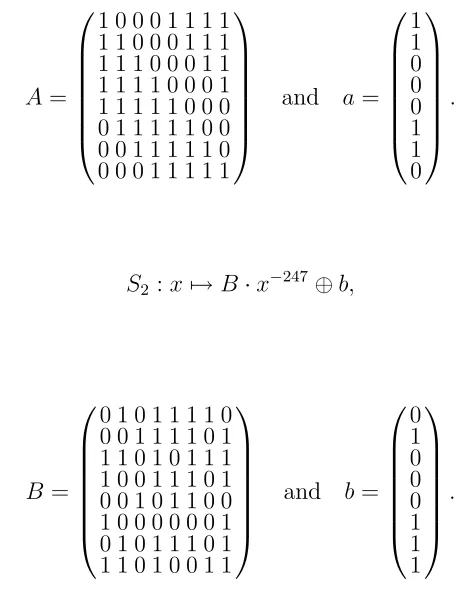
S1, S2 :GF(28)→GF(28)
where A=
1 0 0 0 1 1 1 1 1 1 0 0 0 1 1 1 1 1 1 0 0 0 1 1 1 1 1 1 0 0 0 1 1 1 1 1 1 0 0 0 0 1 1 1 1 1 0 0 0 0 1 1 1 1 1 0 0 0 0 1 1 1 1 1
and a =
1 1 0 0 0 1 1 0 .
S2 :x7→B·x−247⊕b,
where B =
0 1 0 1 1 1 1 0 0 0 1 1 1 1 0 1 1 1 0 1 0 1 1 1 1 0 0 1 1 1 0 1 0 0 1 0 1 1 0 0 1 0 0 0 0 0 0 1 0 1 0 1 1 1 0 1 1 1 0 1 0 0 1 1
and b=
0 1 0 0 0 1 1 1 .
ARIA has two types of S-Box layers for even and odd rounds as shown in Figure 1. Type 1 is used in the odd rounds and type 2 is used in the even rounds.
S-Box layer type 1
S-Box layer type 2
Fig. 1.The two types of S-Box layers
Diffusion Layer (DL). The function A: GF(28)16 → GF(28)16 is given by
where
y0=x3⊕x4⊕x6⊕x8⊕x9⊕x13⊕x14,
y1=x2⊕x5⊕x7⊕x8⊕x9⊕x12⊕x15,
y2=x1⊕x4⊕x6⊕x10⊕x11⊕x12⊕x15,
y3=x0⊕x5⊕x7⊕x10⊕x11⊕x13⊕x14,
y4=x0⊕x2⊕x5⊕x8⊕x11⊕x14⊕x15,
y5=x1⊕x3⊕x4⊕x9⊕x10⊕x14⊕x15,
y6=x0⊕x2⊕x7⊕x9⊕x10⊕x12⊕x13,
y7=x1⊕x3⊕x6⊕x8⊕x11⊕x12⊕x13,
y8=x0⊕x1⊕x4⊕x7⊕x10⊕x13⊕x15,
y9=x0⊕x1⊕x5⊕x6⊕x11⊕x12⊕x14,
y10=x2⊕x3⊕x5⊕x6⊕x8⊕x13⊕x15,
y11=x2⊕x3⊕x4⊕x7⊕x9⊕x12⊕x14,
y12=x1⊕x2⊕x6⊕x7⊕x9⊕x11⊕x12,
y13=x0⊕x3⊕x6⊕x7⊕x8⊕x10⊕x13,
y14=x0⊕x3⊕x4⊕x5⊕x9⊕x11⊕x14,
y15=x1⊕x2⊕x4⊕x5⊕x8⊕x10⊕x15.
Round Key Addition (RK). The round keys are derived from the cipher key using the key schedule which uses a 3-round 256-bit Feistel cipher. We skip its introduction since we do not need it for our attack. We refer to [4] for more details.
3
The Boomerang Attack
We now describe the boomerang attack [6] in more detail. But first, we give some definitions. Definition 1. LetP, P′ be two bit strings of the same length. The bit-wise xor of P and P′,
P⊕P′, is called the difference of P, P′. Let ′a′ be a known and ′∗′ an unknown non-zero byte difference.
Definition 2. α → β is called a differential if α is the plaintext difference P ⊕P′ before some non-linear operation f(·) and β is the difference after applying these operation, i.e,
f(P)⊕f(P′). The probability p is linked on a differential saying that an α difference turns into a β difference with probability p. The backward direction, i.e., α←β has probabilitypˆ.
Distinguisher Step. During the distinguisher step we treat the cipher as a cascade of two sub-ciphersEK(P) =EK1(P)◦EK0(P), whereKis the key used for encryption and decryption.
Since we always use the same key we omit the key K and write E(P) = E1(P)◦E0(P) instead. We assume that the differential α → β for E0 occurs with probability p, while the differential γ → δ for E1 occurs with probability q, where α, β, γ and δ are differences of texts. The backward direction E0−1
and E1−1
of the differential for E0 and E1 are denoted by α← β and γ ←δ and occur with probability ˆp and ˆq respectively. The attack works as follows:
1. Choose a pool ofs plaintextsPi,i∈ {1, . . . , s}uniformly at random and compute a pool
P′
i =Pi⊕α.
2. Ask for the encryption of Pi, i.e., Ci = E(Pi) and ask for the encryption of Pi′, i.e.,
C′ =E(P′
i).
3. Compute the new ciphertexts Di =Ci⊕δ and D′i =Ci′⊕δ.
4. Ask for the decryption of Di, i.e., Oi = E−1(Di) and ask for the decryption of Di′, i.e.,
O′
i =E−1(D′i).
– For each pair (Oi, Oj′),i, j ∈ {1, . . . , s}
5. If Oi⊕Oj′ equals α store the quartet (Pi, Pj′, Oi, Oj′) into a set M.
A pair (Pi, Pj′), i, j ∈ {1, . . . , s} with the difference α satisfies the differential α → β with
probabilityp. The output ofE0isAiandA′j, i.e.,E0(Pi) =AiandE0(Pj′) =A′j have a certain
difference β =Ai⊕A′j with probability p. Using the ciphertexts Ci and Cj′ we can compute
the new ciphertextsDi =Ci⊕δandD′j =Cj′⊕δ. LetBi =E1
−1
(Di) andB′j =E1
−1 (D′
j) are
the decryption of Di and D′j with E1
−1
i∈ {1, . . . s}. A difference δ turns into a difference
γ after passing E1−1
with probability ˆq. Since δ =Ci⊕Di and δ =Cj′ ⊕Dj′ we know that
γ =Ai⊕Bi andγ =A′j⊕Bj′ with probability ˆq2. Since we also know, thatAi⊕A′j =β with
probabilityp, it follows that (Ai⊕Bi)⊕(Ai⊕A′j)⊕(A′j⊕Bj′) =γ⊕β⊕γ =β = (Bi⊕B′j)
holds with probability p·qˆ2. A β difference turns into an α difference after passing the differential E0−1
with probability ˆp. Thus, a pair of plaintexts (Pi, Pj′) with Pi ⊕Pj′ = α
generates a new pair of plaintexts (Oi, O′j) where Oi⊕Oj′ =α with probability p·pˆ·qˆ2. A
quartet containing these two pairs is defined as:
Definition 3. A quartet (Pi, Pj′, Oi, O′j) which satisfies
Pi⊕Pj′ =α =Oi⊕Oj′,
Ai⊕A′j =β =Bi⊕Bj′,
Ai⊕Bi =γ =A′j ⊕Bj′,
Ci⊕Di =δ =Cj′ ⊕D′j,
is called a correct boomerang quartet which occurs with probability P rc = p·pˆ·qˆ2. A
quartet (Pi, Pj′, Oi, Oj′) which only satisfies the condition P ⊕Pj′ =α = Oi⊕Oj′ is called a
false boomerang quartet.
P
01,iP
s,i1P
02,iP
s,i2P
03,iP
s,i3P
04,iP
s,i4α
α
β
β
γ
γ
δ
δ
E
0
E
0
E
1
E
1
E
0
E
0
E
1
E
1
P
b,i1P
b,i2P
b,i3P
b,i4Fig. 2.The boomerang distinguisher
apply a chosen plaintext and ciphertext attack on the cipher. The set M which is the output of the boomerang distinguisher, therefore contains correct and false boomerang quartets. It is impossible to form another distinguisher which separates the correct and the false boomerang quartets, since the interior differences β and γ cannot be computed.
Key Recovery Step. The second step of the boomerang attack is the key recovery step. From now on, an attacker operates on the set M that was stored by the boomerang dis-tinguisher. Let k be some key bits of the last round keys derived from the cipher keys K. Letdk(C) be the one round partial decryption of C under the keyk. The key recovery step
works as follows:
- For each key-bit combination ofk
1. Initialize a counter for each key-bit combination with zero. - For all quartets (P, P′, O, O′) stored in M
2. Ask for the encryption ofP, P′, O, O′and obtain the ciphertext quartetC, C′, D, D′ respectively. Decrypt the ciphertextsC, C′, D, D′, i.e., ¯C=d
k(C),C¯′ =dk(C′),D¯ =
dk(D) and ¯D′ =dk(D′).
3. Test whether the differences ¯C⊕D¯ and ¯C′⊕D¯′have a desired difference an attacker would expect depending on the differential being used. Increase a counter for the used key-bits if the difference is fulfilled in both pairs.
4. Output the key-bits k with the highest counter as the correct one.
quartet encrypted with the correct key bits will have the desired difference needed to pass the test in Step 3 with probability 1. Hence, the counter for the correct key bits is increased. The three other cases are: a correct boomerang quartet is used with false key bits (P rcKf), a false boomerang quartet is used with the correct key-bits (P rf Kc) or a false boomerang quartet is used with a false key-bit combination (P rf Kf). We assume that the cipher acts like a random permutation. In these cases we assume that
P rcKf =P rf Kc =P rf Kf =:P rfilter.
The probability that a quartet in one of the three undesirable cases is counted for a certain key bit combination is P rfilter. The differentials have to be chosen such that the counter of
the correct key bits is significantly higher than the counter of each false key bit combination. If the differentials have a high probability the key recovery step outputs the correct key-bits in Step 4 with a high probability much faster than exhaustive search.
4
Boomerang Attack on 5-Round ARIA
In this section we mount a boomerang attack 5-round ARIA-128. The cipher is represented as E = E1 ◦E0. E0 is a differential containing rounds 1 to 3. E1 is a differential covering rounds 4 to 5. After applying the boomerang distinguisher forE1◦E0 using the differentials
E0 and E1 we apply it to recover 56 key-bits of the initial round-keys. We assumed, that the S-Box acts like a random permutation. Thus, all S-Box output differences will have the same probability for a given input difference. The notation used in our attack will be defined as:
– Pi, Pj′, Oi, Oj′ plaintexts.
– Ci, Cj′, Di, Dj′ ciphertexts.
– E0
Ki(·) 3-round ARIA encryption from round 1 to 3 under key Ki,i∈ {a, b, c, d}. – E1−1
Ki (·) 2-round ARIA decryption from round 5 to 4 under key Ki, i∈ {a, b, c, d}. – a is a known non-zero byte difference.
– ∗ is a variable unknown non-zero byte differences.
4.1 The Differential E0
The input difference α of E0 has a non-zero difference in bytes 3, 4, 6, 8, 9, 13 and 14. A non-zero difference∗transforms into an adifference throughSLwith probability 2−8. Thus, we have anadifference in bytes 3, 4, 6, 8, 9, 13 and 14 with probability 2−56.DL
1 then leaves an a difference in byte 0, while the remaining bytes become zero. Since RK is linear it will not alter this difference. SL2 produces a non-zero difference in byte 0 andDL2 spreads this difference in bytes 3, 4, 6, 8, 9, 13 and 14. At the end of the differential we obtain a difference calledβout where all the 16 bytes of the state difference are non-zero. The probability of the
differential E0, i.e., the transformation of an α difference into a β
out difference is given by
P r(α→βout) = 2−56.
α
∗ ∗ ∗ ∗ ∗ ∗ ∗
RK0,SL1
−→
a a a a a a a
DL1
−→
a
RK1
−→
a
SL2,DL2
−→ ∗ ∗
∗ ∗ ∗ ∗ ∗
RK2
−→ ∗ ∗
∗ ∗ ∗ ∗ ∗
SL3,DL3,RK3
−→
βout
∗ ∗ ∗ ∗ ∗ ∗ ∗ ∗ ∗ ∗ ∗ ∗ ∗ ∗ ∗ ∗
Fig. 3.The differentialE0
4.2 The Differential E1−1
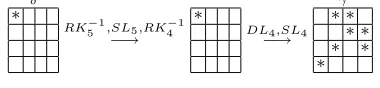
The input difference δ consists of one non-zero difference in byte 0 and and a zero difference in the remaining bytes. The non-zero difference remains after the the inverse of round 5. The DL4 operation spreads this non-zero difference to the bytes 3, 4, 6, 8, 9, 13 and 14. We call the remaining difference of the state γ. The probability of E1−1
is Pr(γ ← δ) = 1. The differential E1−1
is shown in Figure 4.
δ
∗
RK−1
5 ,SL5,RK− 1 4
−→ ∗
DL4,SL4
−→
γ
∗ ∗ ∗ ∗ ∗ ∗ ∗
Fig. 4.The differentialE1−1
4.3 The Differential E0−1
For the following steps we need that the output difference βout of the differential E0 is equal
to the input difference βin for the differential E0
−1
. Note that βin and βout are not only
equal in the same positions of non-zero differences but are also equal in each byte. We will shown how to construct such a case. From the boomerang condition inside the cipher for two differences γ1 and γ2 we know that
βout⊕γ1⊕γ2 =βin
holds with some probability. Since γ1 and γ2 are equal in each byte, we simply writeγ. Thus the above condition reduces to:
βout⊕γ⊕γ =βout=βin (1)
Using the differentials above, the differences βin and βout are equal with probability one.
Let A, A′, B, B′ be the internal state after SL
3 in forward direction when encrypting
P, P′, O, O′ respectively. The notation from Figure 2 is used. Since DL is linear γ can be expressed as
γ =K3⊕DL3(A)⊕K3⊕DL3(B) =DL3(A⊕B) (2)
and as
γ =K3⊕DL3(A′)⊕K3⊕DL3(B′) =DL3(A′⊕B′). (3)
Equation (2) and (3) can be combined, which leaves A⊕A′ =B⊕B′. In other words, DL 3 can be undone with the probability 1 due to the boomerang condition (1). This means that we know exactly that after DL3 in backward direction the bytes 3, 4, 6, 8, 9, 13 and 14 are non-zero while the remaining bytes are zero.SL3 ana difference in bytes 3, 4, 6, 8, 9, 13 and 14 with probability 2−56. DL
2 outputs an a difference in byte 0 and a zero difference in the remaining bytes. SL2 then transforms the a difference in byte 0 into a non-zero difference, which is spread into the bytes 3, 4, 6, 8, 9, 13 and 14 after DL1. The output difference α of the differential E0−1
contains these non-zero and zero differences. The differential E0−1 has the probability Pr(α←βin) = 2−56 to occur. It is shown in Figure 5.
βin
∗ ∗ ∗ ∗ ∗ ∗ ∗ ∗ ∗ ∗ ∗ ∗ ∗ ∗ ∗ ∗
RK−1
3 ,DL3
−→
∗ ∗ ∗ ∗ ∗ ∗ ∗
SL3
−→
a a a a a a a
RK−1
2 ,DL2
−→
a
SL2
−→ ∗
RK−1
1 .DL1,SL1
−→
∗ ∗ ∗ ∗ ∗ ∗ ∗
RK−1
0
−→
α
∗ ∗ ∗ ∗ ∗ ∗ ∗
Fig. 5.The differentialE0−1
4.4 The Attack
The attack first mounts a boomerang distinguisher to obtain all correct and false boomerang quartets which are stored inM. A key-search is then applied toM in order to find 56 bits of
K0. Let k0 be an 56-bit subkey in the position of bytes 3, 4, 6, 8, 9, 13 and 14. Let e0,k(X)
be the partially encryption of X under the subkey k before DL1 is applied. The attack is as follows:
1. Choose 258.5 structures S
1, S2, . . . , S258.5 of 256 plaintexts Pi, i∈ {1,2, . . . ,258} which have
all possible values in seven bytes (3, 4, 6, 8, 9, 13 and 14). With a chosen plaintext scenario ask for encryption of Pi to obtain the ciphertexts Ci, i.e., Ci =E(Pi).
2. For each ciphertext Ci compute a new ciphertext Di = Ci ⊕δ, where δ is a fixed 128-bit
value with a non-zero value in byte 0 and zero in the remaining bytes.
3. With a chosen ciphertext scenario ask for the decryption ofDi and obtain the new ciphertexts
4. Store only those quartets(Pi, Pj′, Oi, Oj′)in the setM whereOi⊕O′jhave a non-zero difference
in bytes 3, 4, 6, 8, 9, 13 and 14 and a zero difference in the remaining bytes. 5. For each 56-bit key k
For each quartet passing the test in Step 5:
5.1. Partially encrypt a plaintext quartet(Pi, Pj, Oi, Oj), i.e.,P¯i =e0,k(Pi),P¯j =e0,k(Pj),
¯
Oi =e0,k(Oi) and O¯j =e0,k(Oj).
5.2. Increase a counter for the used 56-bit subkey k by one ifP¯i⊕P¯j and O¯i⊕O¯j have an
a-difference in bytes 3, 4, 6, 8, 9, 13 and 14.
6. Output the 56-bit subkey k which counts at least two quartets as the correct one.
4.5 Analysis of the Attack
Two pools of 256 plaintexts can be combined to approximately (256 )2
2 = 2
111 quartets. Using 258.5 structures we obtain #P P ≈258.5·258.5 = 2169.5 quartets in total. A correct boomerang quartet occurs with probability
P rc= Pr(α →βout)·(Pr(γ ←δ))2·Pr(γ1 =γ2)·Pr(α ←βin)
= 2−56·1·2−56·2−56 = 2−168,
since all differential conditions are fulfilled. A random permutation of a difference Oi ⊕Oj
has 9 zero byte difference with probability P rf = 2−72. Thus, after Step 4 we have about
#C= #P P·P rc = 2169.5·2−168 = 21.5 correct and #F = #P P·P rf = 2169.5·2−72= 297.5false
boomerang quartets. A false boomerang quartet passes the test in Step 5.2 with probability
P rfilter = 2−112, since we have a 56-bit filtering condition on both pairs of a quartet. Thus
#CKc = 21.5 correct boomerang quartets and #F Kc = #F ·P rfilter = 297.5·2−112 = 2−14.5
false boomerang quartets are counted with the correct key bits. About #CKc + #F Kc =
21.5+ 2−14.5 ≈3 quartets are counted in Step 5.2 for the correct key bits.
About #CKf = #C · P rfilter = 21.5 · 2−112 = 2−110.5 correct boomerang quartets and
#F Kf = #F ·P rfilter = 297.5·2−112 = 2−14.5 false boomerang quartets are counted with the
false key bits, which are in total #CKf + #F Kf = 2−110.5+ 2−14.5 = 2−14.5 counts for each
false key bit combination.
Using the Poisson distribution we can compute the success rate of our attack. The prob-ability that the number of remaining quartets for each false key bit combination is larger than 1 isY ∼Poisson(µ= 2−14.5), Pr(Y ≥ 2)≈0. Therefore the probability that our attack outputs false key bits as the correct one is very low. We expect to have a count of 3 quartets for the correct key bits. The probability that the number of quartets counted for the correct key bits is larger than 1 is Z ∼Poisson(µ= 3), Pr(Z ≥2)≈0.8.
5
Boomerang Attack on 6-Round ARIA-192 and ARIA-256
The attack of the previous section can be easily extend to a 6-round attack on ARIA-192 and ARIA-256. Therefore we need the following property of ARIA.
Property 1. The round key addition (RK) and the diffusion layer (DL) can be interchanged, due to its linearity.
Using this property we can change the order of DL5 andRK5. Thus we can use our 5-round boomerang distinguisher to apply a 6-round attack in the following way. We add one round after the boomerang distinguisher as shown in Figure 6. We can guess 7 byte ofK6 at bytes 3,
φ
∗ ∗ ∗ ∗ ∗ ∗ ∗
RK−1
6 ,SL6
−→
a a a a a a a
DL5
−→
δ
a
Fig. 6.The round after the distinguisher
4, 6, 8, 9, 13 and 14. This will allow us to choose the desired difference φsuch that afterSL6 in backward direction a known differenceaoccurs in each of these bytes. TheDL5 operation then outputs an a difference in byte 0 while the remaining bytes become zero. From this point the 5-round boomerang distinguisher works as explained above. The data complexity of our 6-round attack remains the same as the 5-round attack which are 257chosen plaintexts and ciphertexts. The overall time complexity increases to 256·(5/6)·2115.5 ≈2171.2 six round ARIA-192 encryptions. This attack is also applicable to ARIA-256 but not on the 128 bit version.
6
Conclusion
In this paper we have shown how to attack ARIA using the boomerang attack, which is a strong extension of differential cryptanalysis. Our 5-round boomerang attack on ARIA-128 has a data complexity of 257 chosen plaintexts and ciphertexts. Its time complexity is of about 2115.5 five round encryptions. We extended this attack to mount a 6-round boomerang attack on ARIA-192 which has the same data complexity as our 5-round attack. The time complexity of our 6-round boomerang attack is about 2171.2 six round encryptions.
To the best of our knowledge there are no better attacks on ARIA in terms of data complexity or number of attacked rounds than the 6-round attack presented in this paper.
References
[2] Alex Biryukov. The Boomerang Attack on 5 and 6-Round Reduced AES. In Hans Dobbertin, Vincent Rijmen, and Aleksandra Sowa, editors,AES Conference, volume 3373 ofLecture Notes in Computer Science, pages 11–15. Springer, 2004.
[3] Joan Daemen and Vincent Rijmen.The Design of Rijndael: AES - The Advanced Encryption Standard. Springer, 2002.
[4] Daesung Kwon, Jaesung Kim, Sangwoo Park, Soo Hak Sung, Yaekwon Sohn, Jung Hwan Song, Yongjin Yeom, E-Joong Yoon, Sangjin Lee, Jaewon Lee, Seongtaek Chee, Daewan Han, and Jin Hong. New Block Cipher: ARIA. In Jong In Lim and Dong Hoon Lee, editors,ICISC, volume 2971 ofLecture Notes in Computer Science, pages 432–445. Springer, 2003.
[5] Peng Zhang Ruilin Li, Bing Sun and Chao Li. New Impossible Differential Cryptanalysis of ARIA. Cryptology ePrint Archive, Report 2008/227, 2008. http://eprint.iacr.org/.
[6] David Wagner. The Boomerang Attack. In Lars R. Knudsen, editor, FSE, volume 1636 of Lecture Notes in Computer Science, pages 156–170. Springer, 1999.