A Privacy-Flexible Password Authentication Scheme for
Multi-Server Environment
Jue-Sam Chou1*, Yalin Chen2, Chun-Hui Huang3,3
1Department of Information Management, Nanhua University Chiayi 622 Taiwan, R.O.C
[email protected] Tel: 886+ (0)5+272-1001 ext.56226
*: corresponding author
2Institute of information systems and applications, National Tsing Hua University
3Department of Information Management, Nanhua University Chiayi 622 Taiwan, R.O.C
Abstract
Since Kerberos suffers from KDC (Key Distribution Center) compromise and impersonation attack, a multi-server password authentication protocol which highlights no verification table in the server end could therefore be an alternative. Typically, there are three roles in a multi-server password authentication protocol: clients,servers, and a register center which plays the role like KDC in Kerberos. In this paper, we exploit the theoretical basis for implementing a multi-server password authentication system under two constraints: no verification table and user privacy protection. We found that if a system succeeds in privacy protection, it should be implemented either by using a public key cryptosystem or by a register center having a table to record the information shared with corresponding users. Based on this finding, we propose a privacy-flexible system to let a user can employ a random-looking dynamic identity or employ a pseudonym with the register center online or offline to login a server respectively according to his privacy requirement. Compared with other related work, our scheme is not only efficient but also the most conformable to the requirements that previous work suggest.
Keywords: password authentication, impersonation attack, user privacy protection, Kerberos, password guessing attack,smart card lost attack
1. Introduction
offering the correct password. In such system for convenience, a client may hope to access multiple servers by applying just one pair of account and password. For this purpose, Kerberos, which was originated by Massachusetts Institute of Technology (MIT) in the 1980s, was proposed and now becomes a popular solution adopted by current industry. Its version 5 appeared as RFC 1510 in 1993 was made obsolete by RFC 4120 in 2005. In 2007, MIT formed the Kerberos Consortium to foster continuous development. Many computer operating systems have used Kerberos, such as Windows 2000, FreeBSD, Apple’s Mac OS X, Red Hat Enterprise Linux 4, Sun’s Solaris, IBM’s AIX, and HP’s Open VMS, etc.
Kerberos [1] is based on symmetric Needham-Schroeder protocol and takes use of a trust third party termed as a key distribution center (KDC) to maintain a database of secret keys. In it, each entity–either a client or a server–shares a secret key known only between itself and the KDC. In fact, the secret key for a client is usually the hash result of his password, as in the system of UNIX. Knowledge of this secret key serves to prove the entity’s identity. However, some drawbacks of Kerberos are often concerned by researchers. Firstly, Kerberos is subject to a single point of failure; it requires continuous availability of a center server. Under this requirement, when the center server is down, no one can log in. Secondly, since all secret keys are stored in the KDC, a compromising of this authentication infrastructure will allow an attacker to launch an impersonation attack.
that any attacker can launch an offline password guessing or impersonation attack under the circumstance that a smart card is lost and the stored data is extracted (by an attacker by using some means as introduced in [16, 17]).
More recently, for responding to the increasing demand of user privacy protection demanded in many applications, some multi-server password authentication protocols [3, 13, 14] further cooperate an untraceability function into their schemes. Untraceability is a privacy notion which can prevent an attacker from inferring the user’s identity in a transcript and from linking any particular user to a specific transcript. The concept of dynamic identity (DID) is considered to be able to fulfill this untraceability purpose since it cannot be recognized and linked to any particular user by a network eavesdropper.
In this study, we are the first to exploit the theoretical basis for the implementation
of a multi-server password authentication system under two constraints: no
verification table anduser privacy protection. We found that if a system succeeds in privacy protection, it should be implemented through either introducing a public key cryptosystem (PKC) or employing a table in RC to record the information shared with corresponding users. From many observed facts, we see that our argument holds. For example, studies [3, 13] are two failed privacy protection systems since they introduce neither PKC nor any table in RC (The detailed analyses will be given in Section 2.3.). Hence, in this study we propose a privacy-flexible password authentication protocol using PKC. In our system, we let a user can employ a DID (encrypted by RC public key) or employ apseudonym (a random string authorized by RC) with RC online or offline to login a server respectively according to his privacy requirement.
The remainder of this paper is organized as follows. In Section 2, we give some preliminaries, including the design principle of multi-server password authentication protocols, the theoretical exploration on the implementation of privacy protection systems, and the reviews of some related privacy protection schemes. In Section 3, we show our scheme. And its merits and security features analyses are given in Section 4. In section 5, we demonstrate the performance comparisons among our scheme and other related work. Then, we show the discussion in Section 6. Finally a conclusion is given in Section 7.
2. Preliminaries
In this section, we introduce some preliminaries, including the design principle of multi-server password authentication protocols in Section 2.1, theoretical exploration on implementing systems with user privacy protection and table-free constraint in Section 2.2, and related work reviews and analyses in Section 2.3.
According to literatures [2-14], a multi-server password authentication system typically consists of a RC and some servers and clients. In it, RC is the only trusted node. The servers should not be assumed to be trustworthy and the client is usually equipped with a tamper-resistant smart card to attain a better protection for the stored authentication data. The systems highlight no usage of any verification table in RC and servers, and a client needs only one single registration while being able to login multiple servers. Based on these literatures, we show a conceptual model for an ideal multi-server password authentication system in Figure 1. In the registration phase of Figure 1, each client or server should register his identity to RC to obtain a secrecy shared between RC and itself. Here, we give this shared secrecy a generic formh(ID, x) (called credential in this paper), wherexis RC’s private master key,IDpresents the client or server’s identity, and h(·) is a secure one-way hash function. In the figure, credentialsAandB are belonging to clientiand serverj, correspondingly. Thus, RC needs not store each shared secrecy in its database because he can compute the secrecy on sight ofIDwhen the entity logins.
As for the authentication phase, some studies [2, 13, 14] require RC to be always online. However, we think such a design principle will consume more resource and communication cost, and be easily subject to a single point of failure (like Kerberos). Hence, we consider a RC-offline system [2, 4, 5, 7-14] would be more practical. Under such a consideration, in the authentication phase of Figure 1, we let RC be an intermediary when clientilogins serverjat first time. Through RC’s trust relationship, both the client and server can authenticate each other based on credential A and B
correspondingly. Meanwhile, the server distributes another credential C to the client for the client’s subsequent logins, where C = h(IDi, xj) and xj is server j’s private
Registeration Phase
Clienti RC
master key x
Serverj RC
=h(SIDj,x)
=h(IDi,x)
A
(secure channel)
(secure channel)
B
(a) Client i first logins Srever j
Clienti Serverj
master key xj =h(IDi,xj) intermediary
(b) Client i subsequently logins Srever j
Clienti Serverj
IDi,
IDi,
RC
C
A B
C
C Authentication Phase
Fig. 1. Conceptual model of an ideal multi-server password authentication protocol.
2.2 Theoretical exploration on implementing systems with user privacy protection and table-free constraint
In this section, we first demonstrate what a privacy protection system should be. Then, we consider how to fulfill such a privacy protection system without RC having any authentication table.
From studies [2, 13], we know that a system can be defined as a privacy protection system if and only if it possesses two properties: (a) a user’s ID (UID) should not be transferred in a clear way, and (b) a transcript can not be linked to any transcript to refer to a particular user. In other words, a user’s location cannot be traced by a third party (3rdP). To design such privacy protection systems, researchers usually introduce a random-looking DID in the authentication procedure which can be conceptually treated as a UID masked with a random string rs (written as UIDrs). Due to lack the knowledge of correspondingrs, DID cannot be distinguished by a 3rdP. It should only be identifiable by the intended recipient, i.e. RC. An intuitive implementation to
accord with this requirement is to let the client and RC keep the same rs
with the received DID to identify the user.
In the following, we further consider what a privacy protection system should be if RC is not allowed to have a table to store authentication-related data, such as <UID,
rs>. Under this situation, RC will lose the capability to recognize a DID. Hence, to implement such a system, it is reasonable to consider that DID should be formed by some means where only RC can deform it while others cannot. A possible way we suggest is to introduce a symmetric or public key cryptosystem (SKC or PKC). In a SKC, the user employs a secret key to encrypt his UID with a random rs to form a DID and RC applies the same secret key to decrypt the DID to authenticate the user. Or in a PKC, the user employs RC’s public key to encrypt his UID with a randomrs
to form a DID and RC applies his private key to decrypt the DID to authenticate the user. In both cases, a 3rdP is unable to recognize or trace a particular DID due to the security of SKC and PKC. However, if SKC is used, RC will need a table to store the symmetric keys shared with corresponding users. This conflicts with the table-free constraint. Therefore, only PKC can be used. In the following, we will use a series of statements to formally demonstrate above reasoning. (Notations: “”indicates implication,“”logical and, and“”logical or.)
A successful privacy protection system
RC can unmask DID withrs 3rdP can not unmask DID
DID is encrypted by using PKC (Statement I)
DID is encrypted by using SKC (Statement II)
rsis shared between RC and user by some other means (Statement III)
rsis encrypted by using PKC
RC has a table to record the information (symmetric keys or rses) shared with corresponding users
In the above reasoning, Statement III encompasses all possible means (except for
SKC and PKC) which can make RC be able to obtain the current rs for the
corresponding user. Many methods can be adopted to achieve this goal. As an example, a user and RC can both share a previous rs, and obtain current rs by performing PRNG (pseudo random number generator) or hash operation on previous
rs. All such means imply that RC needs a table to record related information (such as previousrs, initial value, etc.) for each user. As a result from Statement I,II, andIII, we can conclude that a successful privacy protection system implies that the system should use PKC or RC should have a table to record the related information shared with corresponding users. Therefore, we have the following argument.
record the information shared with corresponding users.
Proof: We prove this argument by contrapositive, i.e. show that if the system is neither implemented by using PKC nor by RC having a table, then the system would fail to be a privacy protection system. As we know, if the system is implemented neither by public cryptosystem encryption (on rs) nor by recording shared information (the symmetric keys or rses shared between RC and clients), then when a client sends a DID to RC, RC would have no idea about how to deform DID, since he can not obtain the corresponding symmetric keys or rs. Thus, the system fails. This completes the proof.
2.3. Related work reviews and analyses
In this section, we useArgument 1to investigate three multi-server privacy protection password authentication protocols, Liao-Wang’s [3], Hsiang-Shih’s [13], and Wang-Juang-Li’s [14]. We found that these investigations results support our argument. In the following, we will show the investigations. The corresponding schemes are shown in Figure 2 through 6. In these figures, we use SC to denote the abbreviation of smart card.
2.3.1 Liao-Wang’s scheme
Liao and Wang [3] developed a DID-based multi-server authentication scheme to achieve user privacy in 2009. In the setup phase of their scheme, RC chooses a random number xas its master key andyas a system common secrecy which will be shared among all registered entities. Figure 2 and 3 show the registration phase and authentication phase, respectively.
Ui RC
(1)IDi,PWi
SC
Li=H(IDi,x)
Vi=LiH(IDi,PWi)
Bi=h(PWi)h(x)
hi=H(Li)
Stores (Vi,Bi,hi,h(.),y)
inot a smart card
Sj y,h(x) RC
Fig. 2. Registration Phase of Liao-Wang’s Scheme
Ui Sj
SubmitsIDi,PWiandSIDj 1.Li*=ViH(IDi,PWi)
Hi*=h(Li*) check ifHi*=Hi 2.CIDi=h(PWi)h(Li,y,Ni)
Pij=Lih(y,Ni,SIDj)
Qi=h(Bi,y,Ni)
(1)CIDi,Pij,Qi,Ni
(note:Ni,Njare nonces)
1.Li=Pijh(y,Ni,SIDj)
H(PWi) =CIDih(Li,y,Ni)
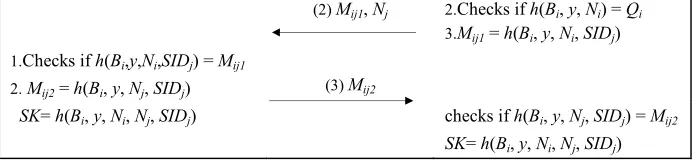
(2)Mij1,Nj 2.Checks ifh(Bi,y,Ni) =Qi 3.Mij1=h(Bi,y,Ni,SIDj) 1.Checks ifh(Bi,y,Ni,SIDj) =Mij1
2.Mij2=h(Bi,y,Nj,SIDj) (3)Mij2
SK=h(Bi,y,Ni,Nj,SIDj) checks ifh(Bi,y,Nj,SIDj) =Mij2
SK=h(Bi,y,Ni,Nj,SIDj)
Fig. 3. Authentication Phase of Liao-Wang’s Scheme
In Figure 2, we see that like in a generic multi-server authentication scheme, RC and user Ui (with identity IDi) share credential Li = h(IDi, x), but RC and server Sj
share onlyh(x) andy. By inspecting the authentication phase of the scheme (as shown in Figure 3), we found that without the appearance of RC, the only shared information between Ui and Sj is y. In other words, the substantive basis of Ui and Sj’s mutual
authentication is the system common secrecyy rather than credential Li. This design
method exposes a serious vulnerability that any entity in the system knowing y can launch an impersonation attack. Chen et al.’s study [18] and Hsiang-Shih’s study [13] pointed out such an attack respectively. We show it as follows. Suppose that insider clientEhas eavesdropped a login request {CIDi,Pij,Qi,Ni} thatUisent to Sj. He can
first computeh(x) =h(PWE)BE, whereBEis the secrecy stored inE’s smart card,Li
= Pijh(y||Ni||SIDj), h(PWi) =CIDih(Li||y||Ni), andBi =h(PWi)h(x). OnceE has
extracted Li, h(PWi), and Bi, he can impersonate Ui to login server Sj by first
randomly choosing a nonce NE, computing CIDi(E) = h(PWi)h(Li||y||NE), Pij(E) =
Lih(y||NE||SIDj), and Qi(E) =h(Bi||y||NE), and then sending {CIDi(E),Pij(E),Qi(E),NE}
to Sj.Sj will accept the request and regard it as being from Ui without any detection
sinceh(Bi,y,NE) =Qi(E).
Other than the above demonstrated vulnerability, we also use Argument 1 to examine Liao-Wang’s scheme as follows. Since their scheme only uses a common secrecy y as the basis for server Sj to identify DID (represented as CIDi in
Liao-Wang’s scheme), it does not introduce PKC or any table in RC or servers. Any entity in the system knowing the common secrecy y would have ability to identify a user. This violates Argument 1. That is, it fails to achieve user privacy protection. More precisely, when Sj receives message flow (1) in the authentication phase as
shown in Figure 3, any entity in the system who knows y can follow the steps as performed bySjto identify userUi.
Besides, we also found that Liao-Wang’s scheme suffers from the smart-card lost and offline password guessing attack. Since if an attacker obtains Ui’s smart card and
extracts the stored data Bi (=h(PWi)h(x)), he can first compute h(x) in the same
2.3.2 Hsiang-Shih’s scheme
Hsiang and Shih [13] proposed an improvement on Liao-Wang’s scheme. We briefly show their improvement’s registration phase and authentication phase in Figure 4 and 5, respectively.
Ui SC RC(secrecy:x,y,r) (1)IDi,PWi
chooses randombi,
computesh(biPWi)
(1)IDi,h(biPWi) computesLi=h(IDi,x)
Vi=Lih(IDi,h(biPWi))
Ai=h(h(biPWi),r)h(xr)
Bi=Aih(biPWi)
(2) Ri=h(h(biPWi),r),Hi=h(Li)
The smart card storesbi,Vi,Bi,Hi,Ri
ServerSj RC
Lj=h(SIDj,y)
Fig. 4 Registration Phase of Hsiang-Shih’s Scheme
Below, we useArgument 1to investigate the privacy protection in the improvement. Since it neither employs any table in RC nor introduces PKC to form DID, we therefore infer that it is not a successful privacy protection system. We show the evidence as follows. By eavesdropping on the transferred message, we can deduce all Ui’s secrets stored in his smart card. For instance, from messages (2):{CIDi,Pij,Qi,Di,
C0,Ni}, (3):{Mjr,SIDj,Du,C0,Ni}, and (4):{C1,C2,Njr'}, transmitted amongUi,Sjand
RC (as shown in Figure 5), we can deduceAi by computingAi=C2h(Mjr), and then
obtain Ri, Li, h(biPWi) by calculating Ri = DiSIDjNi, Li = Pijh(Ai,Ni,SIDj),
andh(biPWi) =CIDih(Li,Ai,Ni), respectively. Hence, we break the scheme.
Ui SC ServerSj RC
1)IDi,PWi,
SIDj
Li'=Vih(IDi,H(biPWi)),
Hi'=h(Li'), check ifHi=?Hi'
Ai'=Bih(biPWi)
CIDi=h(biPWi)h(Li',Ai',Ni)
Pij=Li'h(Ai',Ni,SIDj)
Qi=h(Bi,Ai',Ni)
Di=RiSIDjNi
C0=h(Ai',Ni+1,SIDj)
(note:Ni,Njr,Njare nonces)
(2)CIDi,Pij,Qi,
Di,C0,Ni
(3)Mjr,SIDj,
Di,C0,Ni
Mjr=LjNjr
(4)C1,C2,Njr'
(5)Mij,Nj
ChecksC1
Ai=C2h(Lj,Njr) Li=Pijh(Ai',Ni,SIDj)
Njr'=MjrLj
Ri'=DiSIDjNi
Ai'=Ri'h(xr)
C0'=h(Ai',Ni+1,SIDj) ChecksC0'=?C0
C1=h(Njr',Lj,Ni)
ChecksMij
h(biPWi) =CIDih(Li,Ai,Ni)
Bi=Aih(biPWi)
Checkh(Bi,Ai,Ni) =?Qi
Mij=h(Bi,Ni,Ai,SIDj)
Fig. 5. Login and Authentication Phase of Hsiang-Shih’s Scheme
In addition, we also demonstrate a smart-card lost and offline password guessing attack on Hsiang-Shih’s scheme as follows. When an attacker obtainsUi’s smart card
and extracts the stored data {bi,Vi,Bi,Hi (=h(Li)), Ri}, he can guess a password PW*
and computeLi*= Vih(IDi,h(biPW*). He then computes and compares to see if
h(Li*) is equal toHi.
2.3.3 Wang-Juang-Lei’s scheme
In 2009, Wang, Juang and Lei [14] proposed a multi-server privacy protection password authentication scheme based on quadratic residue encryption (also known as Rabin’s PKC). In their system setting phase, RC selects two large primes p and q as private key and computes n = pq as public key. In the user resister phase, RC computesLi=h(IDi,x) and distributes a smart card storing {IDi,Li,h(.),n} toUivia
a secure channel, and then Ui updatesLi by computingLi'=Lih(PWi). Other than
this, RC also computes and distributes credential Lj = h(SIDi,x) to server Sj. We use
Figure 6 to demonstrate the login and authentication phase of their scheme.
Ui SC ServerSj RC
1)IDi,PWi
2)GeneratesNi,Reqi=(IDi,
Li,SIDj,Ni)2modn 3)Reqi
9)RS2,RC3
10)
Retrieves
H(Nj')=h(IDi,SIDj,Ni)RS2
Checksh(Li,Ni,h(Nj')) =?RC3
RSi=h(h(Nj')+1)
SK=h(SIDj,h(Nj'),h(IDi,SIDj,Ni))
4)
GeneratesNj,
Reqj=LjNj
8)
Retrieves
NRC'=h(Lj,Nj) RC1 KSC=h(Lj,Nj)
Rij'=KSCRC2
Checksh(KSC,Rij',
RC3) =?RC4
RS2=Rij'h(Nj)
5)Reqi,SIDj,Reqj
7)RC1,RC2,
RC3,RC4
6)
DecryptsReqi(IDi,Li,
SIDj,Ni)
ChecksLi=?h(IDi,x)
ChecksSIDjinReqi
Lj=h(SIDj,x)
RetrievesNj' =LjReqj
GeneratesNRC
RC1=h(Lj,Nj')NRC
KSC=h(Lj,Nj',NRC)
Rij=h(IDi,SIDj,Ni)
RC2=KSCRij
RC3=h(Li,Ni,h(Nj'))
RC4=h(KSC,Rij,RC3)
11)RSi 12)
ChecksRSi=?h(h(Nj)+1)
SK=h(SIDj,h(Nj'),Rij')
From the figure, we can see that user privacy can be preserved because Reqi
containing user’s ID is protected by Rabin’s PKC; i.e., only RC knowing n’s factorizing can decrypt Reqi. Moreover,Reqi is randomized by random nonce Ni and
thus ensures the untraceability property. However, despite this, we found that there still exist two drawbacks. (But this does not violateArgument 1since our argument is an imply clause.) First, RC always needs to be online; this makes the system less efficient and vulnerable to the single point of failure like Kerberos. Second, the scheme violates the forward secrecy property. (Forward secrecy indicates that if a long-term private key is compromised, the security of any session key established earlier will not be affected [19, 20].) Since if an attacker knows the long-term secrecy (p,q), he can computes nonceNiin Reqi (message flow (3)) and compute Rij'=h(IDi,
SIDj,Ni) (in step (8)). From RS2 (message flow (9)), he can obtain h(Nj). Then he can
compute the session keySK=h(SIDj,h(Nj), h(IDi,SIDj,Ni)) (as in step (10)). That is,
the session key in any earlier conversation can be extracted.
3. Proposed Scheme
In this section, we will propose a user privacy protection system. From Argument 1, we know that if we want our system to possess both the goals of user privacy protection and no verification table in RC and servers, the only possible approach is to introduce a PKC. Moreover, for efficiency consideration, we only let RC have a pair of public and private keys; whereas the others (including servers) do not. Since by applying the encryption of RC’s public key to form a DID, a user can be identified only by RC rather than by other servers. Hence, for a user to be identified by a server without RC being online, we must introduce apseudonym into the system for the user to login the server. More precisely, the user should first login and registers a pseudonymto the server via RC’s help (online). Thereafter, the user can use the same pseudonym to login the server with RC offline any times until he wants to change it. That is, a user can decide the duration of his pseudonym which is randomly chosen by himself and authorized by RC. We characterize this design principle as flexible privacy. Our proposed scheme consists of five phases: (1) setup phase, (2) registration phase, (3) authentication with new pseudonym (RC online) phase, (4) authentication with RC offline phase, and (5) password change phase. Now, we describe it in details as follows.
(1) Setup phase
In the setup phase, RC chooses his public key and corresponding private key. It also chooses a secret master keyx, a public secure one-way hash functionh(·), and a group <g> with prime order p. In addition, a server Sj also chooses xj as his secret master
decryption by using RC’s public key and private key respectively. (2) Registration phase
In the registration phase as shown in Figure 7, RC computes credential Li = h(IDi,x)
and distributes Li' = Lih(PWi, ri) to client Ui, where IDi is Ui’s identity, PWi his
password, and ria random number chosen by Ui. Then,Ui’s smart card storesLi'and
ri. On the other hand, RC distributes credential Lj=h(SIDj,x) to serverSj, whereSIDj
isSj’s identity.
Ui SC RC(secrecy:x)
IDi,PWi
chooses randomri,
computesh(PWi,ri) IDi,h(PWi,ri)
Li'
computes
Li=h(IDi,x) Li'=Li⊕h(PWi,ri)
The smart card storesLi',ri
ServerSj RC
Lj=h(SIDj,x)
Fig. 7. The Registration Phase
(3) The authentication with new pseudonym phase
The authentication with new pseudonym phase of our scheme can be applied byUi in
two possible cases: (a) He has never logined into server Sj before and wants to
generate a pseudonym for subsequent login toSjwith RC offline, and (b) He wants to
renew his pseudonym relating with Sj. In this phase, Ui,Sj, and RC together perform
the following steps, which are also shown in Figure 8.
Ui SC ServerSj(secrecy:xj) RC
1)
IDi,PWi,
SIDj,“1”
RetrievesLi',ri
Generates a noncec, ComputesNc=gcmodp,
Generates pseudonymPIDi, Li=Li' h(PWi,ri)
Reqi=PKE(IDi,PIDi,SIDj, Li,Nc)
Reqi,Nc
2)
Generates a nonces, ComputesNs=gsmodp,
VS1=h(Lj,ReqiNc,Ns)
Reqi,SIDj,
VS1,Nc,Ns 3)
Lij',Ns,VS2 4)
RetrievesPIDi=
PIDi' h(Lj,Ns)
ChecksVR1=?
h(PIDi,SIDj,Lj,Ns,Nc).
Computes
Lij=h(PIDi,xj),
sks=(Nc)smodp, Lij'=Lijh(sk),
VS2=h(PIDi,Lij,VR2,
sks)
PIDi',VR1,VR2
Li,Nc).
Checks
Li=?h(IDi,x),
SIDjinReqi,
VS1=?h(h(SIDj,x),
Reqi,Nc,Ns).
Computes
PIDi'=PIDi
h(h(SIDj,x),Ns),
VR1=h(PIDi,SIDj,
h(SIDi,x),Ns,Nc),
VR2=h(PIDi,SIDj,
h(IDi,x),Nc,Ns).
5)
Computesskc=(Ns)cmodp
RetrievesLij*=Lij'h(sk)
Computes
VR2*=h(PID
i,SIDj,Li,Nc,Ns)
Checks
VS2=?h(PIDi,Lij,VR2*,skc)
Computes
Lij'=Lij*h(PW i,ri)
Stores or renewsSIDj,PIDi,Lij'
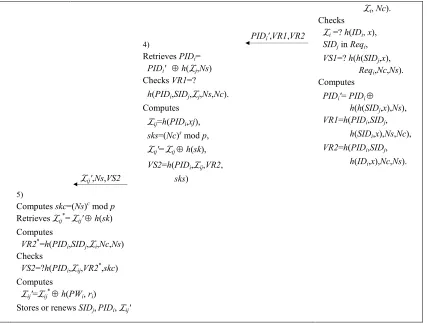
Fig. 8. Authentication with New Pseudonym Phase
Step 1.Ui keys {IDi,PWi,SIDj,“1”} to his smart card, where“1”indicatesUi logins
Sj with RC online. On receiving the message, smart card extracts the
corresponding Li' and ri, generates a random nonce c and pseudonym PIDi,
and computes Nc = gc mod p, Li = Li'h(PWi, ri) = h(IDi, x), and Reqi =
PKE(IDi,PIDi,SIDj,Li,Nc). Then, it sends {Reqi,Nc} toSjon behalf ofUi.
Step 2. On receiving {Reqi,Nc},Sjgenerates a random nonces, and computesNs=gs
modp andVS1 =h(Lj,Reqi,Ns) . Then, it sends {Reqi,SIDj,VS1,Nc,Ns} to
RC.
Step 3. On receiving {Reqi,SIDj,VS1,Nc,Ns}, RC decryptsReqito obtain {IDi,PIDi,
SIDj, Li, Nc}. It then performs three checks: (i) if Li= h(IDi, x) holds, (ii) if
the receivedSIDjis the same as the one inReqi, (iii) ifVS1=h(h(SIDi,x),Reqi,
Nc, Ns) holds. If all three checks succeed, RC authenticates both Ui and Sj’s
identities, and accepts the login request. Then RC computes PIDi' =
PIDih(h(SIDi, x), Ns), VR1 = h(PIDi,SIDj, h(SIDi, x), Ns,Nc), and VR2 =
h(PIDi,SIDj,h(IDi,x),Nc,Ns), and sends {PIDi',VR1,VR2} toSj.
Step 4. On receiving {PIDi', VR1, VR2}, Sj retrieves PIDi = PIDi'h(Lj, Ns), and
checks if VR1 = h(PIDi, SIDj, Lj, Ns, Nc) holds. If it holds, Sj authenticates
credential Lij = h(PIDi, xj) and session keysks= (Nc)s mod p, and calculates
Lij'=Lijh(sks) andVS2=h(PIDi,Lij,VR2,sks). It then sends {Lij',Ns,VS2}
toUi.
Step 5. On receiving {Lij', Ns, VS2}, Ui’s smart card computes skc = (Ns)c mod p,
retrieves Lij* = Lij'h(skc), computes VR2* = h(PIDi,SIDj,Lij,Nc, Ns), and
checks to see if VS2 = h(PIDi, Lij*, VR2*, skc) holds. If the check holds, Ui
authenticates both RC and Sj’s identities and accepts Lij* to be the credential
for the subsequent logins to Sj. Then, the smart card stores {SIDj,PIDi,Lij' =
Lij*h(PWi,ri)} into its storage or updates the corresponding old parameters
ifSIDjalready exists.
Step 6.UiandSjcan communicate by using the session keyskc(sks= (g)csmodp).
(4) Authentication with RC offline phase
We describe our authentication with RC-offline phase as follows which is also shown in Figure 9.
Step 1.Ui keys {IDi,PWi,SIDj,“0”} to his smart card, where“0”indicatesUi logins
Sjwithout RC online. On receiving the message, the smart card extracts {SIDj,
PIDi,Lij'} and ri from its storage, generates a random noncec, and computes
Nc=gcmodp,Lij=Lij'h(PWi,ri) =h(PIDi,xj), andVU1=h(PIDi,SIDj,Lij,
Nc). Then,it sends {PIDi,VU1,Nc} toSj.
Step 2. On receiving {PIDi,VU1,Nc},Sj computesLij=h(PIDi,xj) and checks to see
if VU1 = h(PIDi, SIDj, Lij, Nc) holds. If it holds,Sj identifies PIDi as a valid
pseudonym. It then generates a random nonce s, computes Ns = gs mod p, session key sks = (Ns)c mod p, and VS3 = h(SIDj,PIDi, h(PIDi,xj), sks), and
then sends {VS3,Ns} toUi.
Step 3. On receiving {VS3, Ns}, Ui computes session key skc = (Nc)s mod p and
checks to see ifVS3 = h(SIDj,PIDi,Lij,skc) holds. If it holds,Uiauthenticates
Sjas being valid.
Step 4.UiandSjcan communicate to each other by using the session keyskc(= sks=
(g)csmodp).
Ui SC ServerSj
1)
IDi,PWi,
SIDj,“0”
RetrivesPIDi,Lij',ri
Generates a noncec, ComputesNc=gcmodp,
Lij=Lij'h(PWi,ri)
Computes
PIDi,VU1,
Nc
VS3,Ns
2)
ComputesLij=h(PIDi,xj)
ChecksVU1=?
h(PIDi,SIDj,Lij,Nc)
Generates a nonces, ComputesNs=gs,sks=(Nc)s,
VS3=h(SIDj,PIDi,Lij,sks) 3)
Computesskc=(Ns)cmodp
ChecksVS3=?
h(SIDj,PIDi,Lij,skc)
Fig. 9. Authentication with RC Offline Phase
(5) Password change phase
Finally, our scheme provides a user with the ability to change his password freely without RC or servers’involvement. We describe the process as follows which is also depicted in Figure 10. In the figure, Ui keys {PWi,PWi(new)} to the smart card, where
PWi is the old password and PWi(new) the new one. Then, the smart card generates a
random number ri(new)and updates Li' = Li'h(PWi, ri)h(PWi(new), ri(new)). Then, it
replaces ri with ri(new) and updates each Lij' with Lij'h(PWi, ri)h(PWi(new),ri(new))
correspondingly.
Ui SC
PWi,PWi(new)
Generates random no.ri(new)
Updates
Li'=Li'h(PWi,ri) h(PWi(new),ri(new))
Updates each
Lij'=Lij'h(PWi,ri) h(PWi(new),ri(new))
Replaceriasri(new)
Fig. 10. Password Change Phase
4. Merits and Security Features Analyses of Our Scheme
In this section, we show the merits of our scheme in Section 4.1; then, analyze its security features in Section 4.2.
4.1. Merits
freely are obvious. In the following, we only give a detail discussion on other two merits.
(a) No verification table usage:It is obvious that not only RC but also the servers do
not require a table to store user authentication data. This is because the shared secrecy,Li =h(IDi,x), between RC and clientUi is and can only be computed by
RC. And, the shared secrecy,Lij=h(PIDi,xj), betweenUi and clientSj is and can
only be computed bySj. Hence, our scheme can prevent stolen-verifier attack.
(b) Flexible user privacy protection: In the authentication with new pseudonym
phase, both the user’s IDi and pseudonym PIDi are first randomized by nonce Nc
and then encrypted by PKE. Thus, the user privacy can be preserved on account of the security of PKE; i.e., no one except RC who possesses the private key could decrypt the encryption in polynomial time. On the other hand, in the authentication with RC offline phase,Ui can use his pseudonymPIDi(j)to loginSj,
where j = 1 to n andn is the number of servers. Those PIDi
(j)
s each is randomly chosen by Ui and has been authorized by RC. They are independent on the real
identity UID and have no relationship to each other. Thus, Ui cannot be traced
when he logins to different servers by using different pseudonyms. However, he could be traced when he uses the same pseudonym to login to the same server twice since this contradicts the definition of untraceability as described in Introduction (But the real identity ofUi still can not be revealed yet.). Hence, our
system is a privacy-flexible one where a user can decide the lifetime of his pseudonym by himself. If he wants to use a new pseudonym, he can renew one at any time by just performing phase (3), logining to a server through RC’s online authorization.
4.2 Security Features Analyses
In this section, we analyze the security features of our scheme.
(a) Mutual authentication. We first examine this feature in the login with new
pseudonym phase as shown in Figure 8 (the mutual authentication among the three parties, userUi, serverSj, and RC). For authenticatingUi, after receivingUi’s
login request, Sj sends {Reqi, SIDj, VS1, Ns} to RC. RC decrypts Reqi to obtain
{IDi, PIDi, SIDj, Li, Nc} and verifies the validities of both Li (=h(IDi, x)) and
VS1(=h(Lj, Reqi, Ns)). If they are valid, RC confirms that both Ui and Sj are
authentic. Here, if we use A
B to represent A authenticates B, or equivalently, B is regarded as being authentic by A, we can demonstrate these two relations by using the two solid arrows, and , as indicated in Figure 11. RC then sends {PIDi' (=PIDih(Lj, Ns)), VR1, VR2} to Sj. Sj verifies the validity of VR1(=h(PIDi,SIDj,Lj,Ns,Nc)). If it is valid,Sj confirms that RC is authentic. This is
Ns, VS2} to Ui. Also, Ui has to verify VS2 (=h(PIDi, Lij, VR2, sk)), where VR2
(=h(PIDi, SIDj,Li,Nc,Ns)) should be computed by RC and transmitted honestly
by Sj. If VS2 is valid, Ui confirms that RC is authentic. This is depicted by using
the solid arrowin the figure.
It is obvious that authenticity relationship has transitive property by way of an intermediate node when the identities of both communicating parties and their common secret are committed, e.g., to a hash function. For example, if A
B and B
C, then we obtain A
C by way of B. According to this fact, from Ui
RC (arrow ) and RC
Sj (arrow ), we obtain Ui
Sj (the dashed arrow); from Sj
RC (arrow) and RC
Ui (arrow), we obtain Sj
Ui (the dashed arrow ). As a result, we can see that the mutual authentications between each pair of the three parties are satisfied in this phase.
Fig. 11. Authenticity Relationship
Next, we examine the mutual authentication in the login with RC offline phase as shown in Figure 9, i.e., the mutual authentication between server Sj and an
anonymous user (Ui) who uses pseudonym PIDi. Before performing RC offline
login, Ui and Sj should have executed the authentication login with new
pseudonym phase (through RC). Hence, they already have shared a secrecy Lij.
Therefore, in this phase,Sj authenticates the anonymous user (Ui) by checking the
received VU1 to see if it contains Lij. If it does, Sj believes that the anonymous
user (Ui) is valid. This is because the anonymous user (Ui) can prove that he
knows secrecyLij which is distributed bySj before. Similarly, Ui authenticates Sj
through checking the received VS3 to see if it containsLij. If it does, Ui believes
that Sj is the intended party because he can proves the knowledge of secrecy Lij.
As a result, we can see that the mutual authentication betweenSj andUiwho uses
pseudonymPIDiis satisfied in this phase.
(b) Preventing offline password guessing attack. Each of the communication flows
in the authentication with new pseudonym phase (phase (3)) –{Reqi,Nc}, {Reqi,
SIDj,VS1,Ns}, {PIDi',VR1,VR2}, and {Lij',Ns,VS2}–are independent from the
login requester’s password PWi. More precisely, all the variables in the flows do
not contain PWi and thus this design can effectively prevent offline password
guessing attack. The same phenomenon also exists in the authentication with RC offline phase (phase (4)) of our scheme.
(c) Preventing smart-card-lost attack. Assume that an attackerEobtains Ui’s smart
card, he may extract the stored data in the card including Li' =h(IDi, x)h(PWi,
ri), ri, and multiple records of <SIDj,PIDi,Lij'= h(PIDi,xj)h(PWi,ri)>. Under
this situation, firstly, we discuss the case whyE cannot succeed in using the data
Li' and ri to launch an offline password guessing attack in phase (3). This is
because E does not have the knowledge of x and thus cannot determineh(IDi,x)
and thereforeh(PWi,ri). Hence, without the value ofh(PWi,ri), the guessing value
h(PWi(*), ri), where PWi(*) is the password guessed by E, will lose the basis of
matching. Similarly without the knowledge of xj, Ecannot succeed in using data
Lij'andrito launch an offline password guessing attack in phase (4) neither.
Secondly, we discuss the reason why E cannot succeed in impersonating Ui
when he obtains the data stored inUi’s smart card. We consider that in phase (3),
E can not employ his own secrecy (LE' (=h(IDE,x)h(PWE,rE)) andrE) and the
compromised data (Li' (=h(IDi,x)h(PWi,ri)) and ri) to impersonateUi. This is
because without the knowledge of x and Ui’s password PWi, E is not able to
extract correct Li (=Li'h(PWi,ri) = h(IDi, x)) from the two pairs (LE', rE) and
(Li', and ri). (We have shown that the password can hardly be guessed in last
paragraph). Similarly in phase (4), without the knowledge ofxjandPWi,Ecannot
extract Lij(=h(PIDi,xj)), which is the basis used bySj to identify PIDi, from his
own secrecy LEj' (=h(PIDE, xj)h(PWE, rE)) and rE, and from the compromised
dataLij'(=h(PIDi,xj)h(PWi,ri)) andri.
(d) Forward secrecy. This property indicates that the compromise of long-term keys
(i.e., RC’s private key, master key x, or Sj’s master key xj) will not affect the
security of earlier session keys. In our scheme, the session keysks(= (Nc)s= skc =(Ns)c=gcs), is composed by one-time secrecycandswhich are chosen by client Ui and serverSjrespectively. If an attacker compromisesp,q,x, andxj, all he can
obtain are Nc and Ns. However, without the secrecy c or s, he will fail in computingsksorskc.
(e) Preventing the insider-server spoofing attack. In the authentication with new
pseudonym phase (phase (3)), if server Sj+1wants to masquerade as Sj, he will be
rejected. Since without the knowledge of Lj (=h(SIDj, x)) shared only betweenSj
and RC, he cannot be authenticated by RC successfully. Similarly in the authentication without RC phase (phase(4)), without the knowledge of Lij
(=h(PIDi, xj)) shared only between Sj and Ui, Sj+1 cannot be authenticated by Ui
(f) Preventing replay attack. Sine our scheme uses fresh random nonces chosen by the two communicating parties in each session, it can prevent replay attack. In other words, an old nonceNc(old)=gc(old) (orNs(old)=gs(old)) in a request (or response) can not be used to deduce a new session keysk(new)((Ns(old))c(new)(Nc(old))s(new)) sincec(new)
(and s(new)) are computationally infeasible to be extracted from the eavesdropped Nc(new)(andNs(new)) due to Discrete Logarithm problem.
5. Performance Comparisons
After the discussion of merits and security features of our scheme, in the following, we compare these features with other three related work which we have reviewed in Section 2.3.
Firstly, we list both the function and security features comparisons among these schemes in Table 1 and 2, respectively. In Table 1, Liao-Wang’s and Hsiang-Shih’s schemes fail in user privacy protection (we have demonstrated this in Section 2.3),
and Hsiang-Shih’s and Wang et al.’s schemes do not provide RC-offline
authentication. As to the session key agreement, except ours is of Diffie-Hellman (DH) type, all others are non-DH key agreement schemes. Consequently, our scheme has the greatest degree of conformance to the listed functions.
Secondly, we compare the security features among these schemes and show the result in Table 2. Schemes [3, 13, 14] do not have the forward secrecy property since they are not DH type; the compromise of long-term keys will expose the content of earlier session keys. Conversely, our scheme adopting DH key agreement can achieve forward secrecy. We have analyzed this in just above Section 5. As for the feature of preventing smart-card lost attack, Liao-Wang’s and Hsiang-Shih’s work both suffer from the password guessing attack. We have demonstrated this in Section 2.3. From the above-mentioned, we can conclude that our scheme is the most secure among these compared schemes.
Table 1. Function comparison among our scheme and other related schemes
F e a t u r e s ours Liao-Wang[3] ’s Hsiang-Shih[13] ’s Wang et.al[14] ’s
No verification table in RC or server ○ ○ ○ ○
User privacy protection ○ × × ○ RC-off-line authentication ○ ○ × × No assuming servers to be trustworthy ○ ○ ○ ○
Increasing servers freely ○ ○ ○ ○ Changing password freely ○ × × ×(No offer)
DH key agreement ○ × × ×
F e a t u r e s ours Liao-Wang[3] ’s Hsiang-Shih[13] ’s Wang et.al[14] ’s
Mutual authentication ○ × × ○
Forward secrecy ○ × × ×
Preventing insider-server spoofing attack ○ × × ○ Preventing off-line password guessing attack ○ × ○ ○ Preventing smart-card-lost attack ○ × × ○
Table 3. Passes comparison among our scheme and other related scheme
ours Liao-Wang[3] ’s Hsiang-Shih[13] ’s Wang et.al[14] ’s
RC-online authentication 4 × 5 5
RC-offline authentication 2 3 × ×
Finally, we examine the number of needed passes in our scheme and related work and show the result in Table 3. In the table, Hsiang-Shih’s and Wang et al’s work each needs 5 passes and consumes much system overhead by only providing a RC-online protocol. Liao-Wang’s scheme seems to be the most efficient by always offering RC-offline login. But without RC transferring the trust, the scheme inherently suffers from the impersonation attack. Therefore, our scheme with 4 passes in phase (3) (RC online authentication) and 2 passes in phase (4) (RC offline authentication) has the best performance in communication efficiency.
6. Discussions
In this section, we discuss some concerns.
(a).Security of secret master keys x and xjs: It can be easily seen that most
multi-server password authentication schemes including ours should set the length of master key x to be sufficiently large. Otherwise, an insider attacker E can launch a password guessing attack as follows. First,E tries to read his smart card to obtain {LE',rE}, and then computes credential LE=LE' h(PWE,rE) =h(IDE,
x). Second, he guessesx*and checks whetherh(IDE,x*) = LE. If the master keyx
is truly random, then the searching space will be 2l, where l = |x|. Therefore, l should be large enough to ensure the security of the master key. On the other hand, considering the security of hash function, it is generally suggested that the output length ofh(·), i.e.k= |h(·)|, should be at least 160 bits to resist against the birthday attack.
(b).Tradeoff between smart card access control and smart card lost password
guessing attack: Smart card access control indicates that a user must provide a
cardholder’s password (hi =h(PWi)). Then it will respond to a user’s request only
when the user keys in a right passwordPWi*satisfyingh(PWi*) =hi. Studies [3, 13]
have such an access control mechanism. However, this would introduce a smart card lost and password guessing attack. Since when an attacker obtains the lost card and its storage content, he can guess the password by finding a match. On the other hand, without the basis of matching, a scheme without access control can prevent from a smart card lost and password guessing attack. In fact, many current commercial applications, such as financial IC card systems, do not adopt the strategy that the card itself verifies the user’s password.
(c).Smart card storage usage:Although in our scheme, RC or servers do not keep a
verification table and thus prevent the stolen-verifier attack; however, the smart card should consume additional storages to store RC-offline authentication data, such as server identity SIDj, pseudonym PIDi, and credential Lij. In contrast,
Wang et al.’s scheme [14] which also bases on PKC does not require such storage consumption but in their scheme, RC needs to be involved in each user authentication. This scarifies system efficiency and easily suffers from the single point of failure. Hence, we think this is a trade off betweensystem’s efficiencyand card’s storage usage efficiency. Let’s further estimate the storage usage in our scheme. We suppose thatSIDjandPIDieach are 64-bit strings, andLijis a 160-bit
string. Under this assumption, a tuple <SIDj, PIDi, Lij> would totally consume
288 bits, i.e. 36 bytes. Hence, if a smart card offers extra 1KB to store the RC-offline authentication data, it can totally store 28 records for login to 28 different servers. (Accordingly, when a user wants to access the 29th server, the smart card may overwrite the least frequently used record.) This extra card’s storage consumption makes our system more desirable in the consideration of system efficiency. In other words, our design is worthy in using additional card’s storage in an acceptable range to gain system efficiency.
7. Conclusion
login allowance, anduser privacy protection. According toArgument 1, we propose a privacy-flexible system possessing these three characteristics to let a user can employ a random-looking DID with RC online, or employ a pseudonym with RC offline, to login a server according to his privacy requirement. In addition to the characteristics, our scheme conforms to most of the merits that previous studies suggest, including no assumption of servers to be trustworthy, increasing server freely, Diffie-Hellman session key agreement, and changing password freely. Also, we have proved that our scheme can achieve mutual authentication and forward secrecy, and can prevent from offline password guessing attack, smart card lost attack, insider-server spoofing, and replay attack.
References
[1] Kerberos White Paper,http://www.kerberos.org/software/whitepapers.html. [2] J. L. Tsai,“Efficient multi-server authentication scheme based on one-way hash
function without verification table”,Computers & Security, Vol. 27, No. 3-4, pp. 115-121, May-June 2008.
[3] Y. P. Liao, S. S. Wang, “A secure dynamic ID based remote user authentication scheme for multi-server environment”, Computer Standards & Interfaces, Vol. 31, No. 1, pp. 24-29, Jan. 2009.
[4] W. J. Tsaur, C. C. Wu, W. B. Lee, “An enhanced userauthentication schemefor multi-serverInternetservices”,Applied Mathematics and Computation, Vol. 170, No. 1-1, pp. 258-266, Nov. 2005.
[5] W. J. Tsaur, C. C. Wu, W. B. Lee, “A smart card-based remote scheme for password authentication in multi-serverInternetservices”, Computer Standards & Interfaces, Vol. 27, No. 1, pp. 39-51, Nov. 2004.
[6] I. C. Lin, M. S. Hwang, L. H. Li, “A new remote userauthentication schemefor multi-serverarchitecture”,Future Generation Computer Systems, Vol. 19, No. 1, pp. 13-22, Jan. 2003.
[7] J. H. Lee, D. H. Lee, “Efficient and Secure Remote Authenticated Key Agreement Scheme for Multi-serverUsing MobileEquipment”,Proceedings of International Conference on Consumer Electronics, pp. 1-2, Jan. 2008.
[8] L. Hu, X. Niu, Y. Yang, “An EfficientMulti-server Password Authenticated Key Agreement Scheme Using Smart Cards”, Proceedings of International Conference on Multimedia and Ubiquitous Engineering, pp. 903-907, Apr. 2007. [9] C. C. Chang, J. Y. Kuo, “An efficientmulti-server password authenticated key
[10] R. J. Hwang, S. H. Shiau, “Password authenticated key agreementprotocolfor multi-serversarchitecture”,Proceedings of International Conference on Wireless Networks, Vol. 1, No. 13-16, pp. 279-284, Jun. 2005.
[11] C. C. Chang, J. S. Lee, “An efficient and secure multi-server password authentication scheme using smart cards”, Proceedings of International Conference on Cyberworlds, No. 18-20, pp. 417-422, Nov. 2004.
[12] W. S. Juang,“Efficientmulti-server password authenticated key agreement using smartcards”, IEEE Transactions on Consumer Electronics, Vol. 50, No. 1, pp. 251-255, Feb. 2004.
[13] H. C. Hsiang, W. K. Shih,“Improvement of the secure dynamic ID based remote user authentication scheme for multi-serverenvironment”, Computer Standards & Interfaces, Vol. 31, No. 6, pp. 1118-1123, Nov. 2009.
[14] R. C. Wang, W. S. Juang, C. L. Lei, “User Authentication Scheme with Privacy-Preservation for Multi-Server Environment”, IEEE Communications Letters, Vol. 13, No. 2, pp. 157-159, Feb. 2009.
[15] I.E.Liao,C.C.Lee,M.S.Hwang,“A password authentication schemeover insecurenetworks”,Journal of Computer and System Sciences, Vol. 72(4), Jun. 2006, 727-740.
[16] P. Kocher, J. Jaffe, B. Jun, “Differential power analysis”,Proceedings of Advances in Cryptology- CRYPTO 99, 1999, 388-397.
[17] T. S. Messerges, E. A. Dabbish, R. H.Sloan,“Examining smart-card security underthe threatofpoweranalysisattacks”,IEEE Transactions on Computers, Vol 51(5), 2002, 541-552.
[18] Y. Chen, C. H. Huang, J. S. Chou, “Comments on two multi-server
authentication protocols”, http://eprint.iacr.org/2008/544, December 2008.
[19] D.Z.Sun,J.P.Huai,J.Z.Sun,J.X.Li,J.W.Zhang,Z.Y.Feng,“Improvements ofJuang etal.’sPassword-Authenticated Key Agreement Scheme Using Smart Cards”,IEEE Transactions on Industrial Electronics, Vol. 56(6), Jun. 2009, 2284-2291.