International Journal of COPD
Dovepress
R e v I e w
open access to scientific and medical research
Open Access Full Text Article
Comparison of laboratory- and field-based
exercise tests for COPD: a systematic review
Iain Fotheringham1
Georgina Meakin1
Yogesh Suresh Punekar2
John H Riley2
Sarah M Cockle2
Sally J Singh3
1value Demonstration Practice,
Oxford PharmaGenesis, Oxford,
2GlaxoSmithKline, Uxbridge,
3Department of Respiratory Medicine,
University Hospitals of Leicester NHS Trust, Leicester, UK
Correspondence: Iain Fotheringham Oxford PharmaGenesis,
Tubney warren Barn, Tubney, Oxford, OX13 5QJ, UK
Tel +44 1865 390144
Fax +44 1865 390145
email iain.fotheringham@pharmagenesis. com
Abstract: Exercise tests are often used to evaluate the functional status of patients with COPD.
However, to the best of our knowledge, a comprehensive systematic comparison of these tests has not been performed. We systematically reviewed studies reporting the repeatability and/or reproducibility of these tests, and studies comparing their sensitivity to therapeutic intervention. A systematic review identified primary manuscripts in English reporting relevant data on the following exercise tests: 6-minute walk test (6MWT) and 12-minute walk test, incremental and endurance shuttle walk tests (ISWT and ESWT, respectively), incremental and endurance cycle ergometer tests, and incremental and endurance treadmill tests. We identified 71 relevant studies. Good repeatability (for the 6MWT and ESWT) and reproducibility (for the 6MWT, 12-minute walk test, ISWT, ESWT, and incremental cycle ergometer test) were reported by most studies assessing these tests, providing patients were familiarized with them beforehand. The 6MWT, ISWT, and particularly the ESWT were reported to be sensitive to therapeutic intervention. Protocol variations (eg, track layout or supplemental oxygen use) affected performance sig-nificantly in several studies. This review shows that while the validity of several tests has been established, for others further study is required. Future work will assess the link between these tests, physiological mechanisms, and patient-reported measures.
Keywords: 6MWT, 12MWT, COPD, walk test, repeatability, reproducibility, shuttle walk test,
cycle ergometer test
Introduction
COPD is a leading cause of death worldwide, and the prevalence of the disease is projected to increase as the population ages and as exposure to risk factors, such as smoking, continues.1–3 COPD is characterized by symptoms of breathlessness and
reduced exercise capacity.4,5 Decrements in exercise capacity can result in reduced
ability to perform activities of daily living, and the resultant inactivity and sedentary lifestyle can further exacerbate exercise impairment (the COPD “vicious circle”).6
In clinical practice, spirometry is recommended by the Global Initiative for Chronic Obstructive Lung Disease (GOLD) for the diagnosis of COPD.5 However, the results
of spirometry alone poorly predict disability and quality of life in patients with COPD7
and correlate only weakly with dyspnea, exercise capacity, and health status.8–10 Recent
guidelines on the diagnosis and treatment of COPD indicate that assessment of disease severity is improved by using additional functional criteria such as exercise capacity.4,5,11
Quantification of the degree of functional impairment is therefore important for the assessment of response to treatment and as an outcome for clinical trials.
There are a number of laboratory- and field-based tests currently used for the assessment of exercise capacity, including the 6- and 12-minute walk tests (6MWT
International Journal of Chronic Obstructive Pulmonary Disease downloaded from https://www.dovepress.com/ by 118.70.13.36 on 22-Aug-2020
For personal use only.
Number of times this article has been viewed
This article was published in the following Dove Press journal: International Journal of COPD
Dovepress
Fotheringham et al
and 12MWT, respectively), the incremental and endurance shuttle walk tests (ISWT and ESWT, respectively), the incremental and endurance cycle ergometer tests (ICET and ECET, respectively), and the incremental and endurance treadmill tests (ITT and ETT, respectively). However, there is no consensus about which test is the most appropriate for use in patients with COPD. These tests have different primary outcomes (eg, endurance time, distance, oxygen consump-tion) that may reflect different physiological parameters. It is therefore difficult to compare results across studies, lim-iting interpretation of the published literature in this field. Furthermore, the relative merits of different tests have not been established.
The systematic review presented here therefore evaluated evidence of the “repeatability” (defined as consistency of results when multiple tests are conducted on the same day) and the “reproducibility” (consistency of results when tests are conducted on different days) of the tests. The review also assessed the relative properties of the eight commonly used exercise tests and their sensitivity to therapeutic interven-tion (such as rehabilitative, pharmacological, or surgical procedures). In addition, the effect of protocol variations within each test was assessed across studies. When pos-sible, results were placed in the context of available minimal clinically important difference (MCID) values, which have thus far been ascertained for the 6MWT,12 ISWT,13 ESWT,14
and ICET.12 Investigation of these factors will be useful in
guiding test selection in clinical practice and for outcome measures in clinical trials. As these tests are often also used as interventions, evaluation of exercise testing modalities in patients with COPD will also inform the clinical development of optimal exercise rehabilitation strategies.
Methods
Search strategy
Literature searches were conducted using Ovid® (Ovid
Tech-nologies Inc., New York, NY, USA), incorporating Ovid Med-line® (US National Library of Medicine, Bethesda, MD, USA),
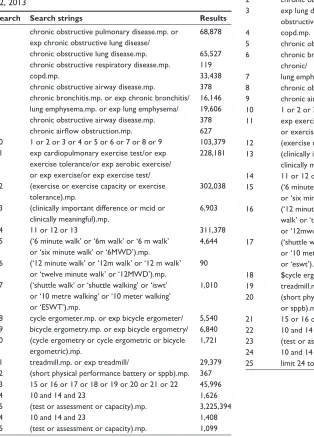
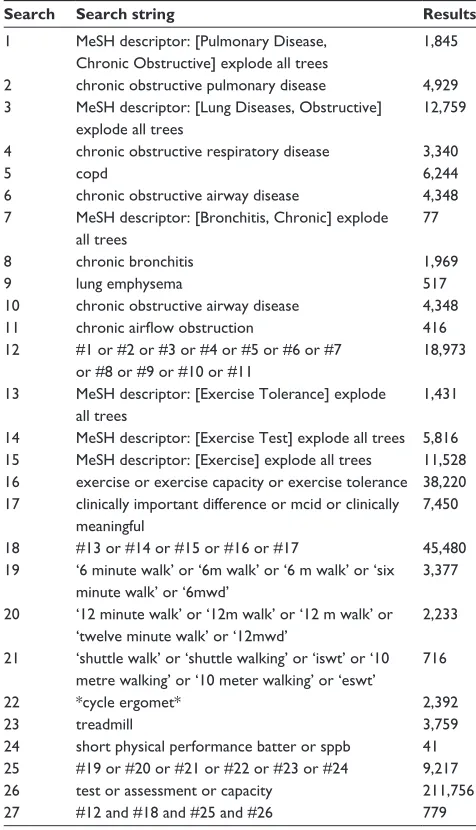
for the period from 1948 to January 22, 2013, Ovid Embase™ (Elsevier Inc., Philadelphia, PA, USA) for 1974 to January 22, 2013, and The Cochrane Library (John Wiley and Sons Ltd, Hoboken, NJ, USA) for 1962 to January 22, 2013 (see Tables S1–S3). Search strings were constructed to identify studies reporting primary data on the outcomes of the following exer-cise tests in patients with COPD: the 6MWT, 12MWT, ISWT, ESWT, ICET, ECET, ITT, and ETT. The full search strings are presented in the “Supplementary materials” section.
Study selection
Study selection followed the Preferred Reporting Items for Systematic Reviews and Meta-Analyses (PRISMA) guidelines for performing a systematic literature review.15
Review articles and studies not published in English were excluded using search-engine filters. Studies confounded by comorbidities (such as cancers, diabetes, and non-COPD respiratory-tract diseases) were excluded on review of title/ abstract. The remaining studies were screened based on titles and abstracts, and full articles were reviewed when their relevance was unclear from the abstract. Screening was performed by a single author (GM) and records were initially reviewed by title/abstract; a full paper review was subsequently undertaken for publications that could not be excluded by title/abstract. Included records were verified by a second author (IF). A 30% random sample of excluded records was also reviewed by the second author (IF). Disagreements were settled by consultation with the remaining authors.
When reviewing abstracts or full papers, records were excluded if they were reviews, were not in the English language, studied patients with confounding comorbidities (eg, cancers or diabetes), did not use an exercise test as an outcome measure, or examined an intervention other than our interventions of interest (pulmonary rehabilitation, broncho-dilator therapy, and lung-volume reduction surgery). Specific inclusion criteria included any definition of COPD (including emphysema- and bronchitis-specific studies); interventions were included only in our comparison of sensitivity and limited to pulmonary rehabilitation, bronchodilation, and lung-volume reduction surgery. Included test outcomes are outlined in the “Data abstraction” section. Following screen-ing, studies were subsequently included for assessment if they reported data on:
• repeatability (studies reporting data from two or more performances of the same test[s] on the same day under the same conditions)
• reproducibility (studies reporting data from two or more performances of the same test[s] on different days under the same conditions)
• comparisons of sensitivity (studies reporting responses of two or more tests to the following therapeutic interven-tions: pulmonary rehabilitation, bronchodilator therapy, or lung-volume reduction surgery)
• protocol variations (studies reporting two or more per-formances of a test when protocol parameters have been modified).
International Journal of Chronic Obstructive Pulmonary Disease downloaded from https://www.dovepress.com/ by 118.70.13.36 on 22-Aug-2020
Dovepress Systematic review of exercise tests in COPD
Data abstraction
Data were primarily abstracted by a single author (GM) and reviewed by all co-authors. A randomly generated selection of 30% of all articles was reviewed by a second author (IF) for quality-control purposes.
The following outcomes of exercise tests were recorded: distance or stages achieved for the 6MWT, 12MWT, and ISWT; duration of exercise for the ESWT, ECET, and ETT; and the highest recorded volume of oxygen consumption (peak VO2) and/or maximum workload (Wmax) for the ICET and ITT. Articles merited inclusion in this review if they reported: outcomes of the specified tests when performed repeatedly under the same conditions, either on the same day (repeatability) or on different days (reproducibility); changes in response before and after therapeutic intervention (com-parison of sensitivity); or effects of within-test variations in protocol (protocol variation).
Studies comparing the sensitivity of tests were also assessed for expression by the authors of preference for any specific test. When distances were reported in feet, values were converted to meters using standard conversion criteria stated by the International Bureau of Weights and Measures (0.3048 meters per foot). Within each publication, tests for which results are available are referred to as “test 1”, “test 2”, etc; occasions on which a test has been described by the authors, but results are not reported (such as for practice tests), are referred to as “familiarizations”.
Results
Overview of identified studies
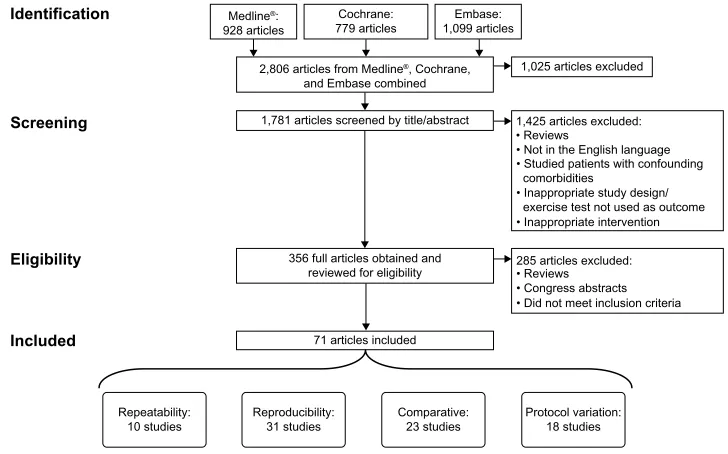
The search methodology used to identify relevant articles is summarized in Figure 1. Of 1,781 unique articles screened, 71 were ultimately deemed eligible for inclusion in this review.
Studies assessing the repeatability
and reproducibility of tests
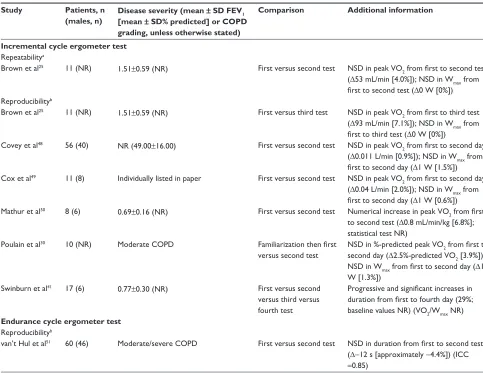
Clinical practice is influenced by factors such as the repeat-ability and reproducibility of exercise tests in patients with COPD. These factors have been extensively assessed for the 6MWT and 12MWT; data are more limited for the ISWT, ESWT, ITT, and ETT (23 references for the 6/12MWT; 12 for the IWST, ESWT, ITT, and ETT; seven for the ICET and ECET; this made 37 references in total owing to overlap of these categories). Table 1 summarizes the results of studies assessing the repeatability and reproducibility of the 6MWT and 12MWT; Table 2 focuses on the ISWT, ESWT, ETT, and ITT; and Table 3 presents data on the ICET and ECET.
Six studies presented repeatability data for the 6MWT (Table 1).16–21 Of these, five reported a significant increase
in 6MWT distance from the first to the second test;16–20
the remaining study found no differences between results, though patients had been previously familiarized with the tests.21 The three studies clearly reporting the results of
three 6MWTs performed on the same day found that there
Identification Medline®:
928 articles
Cochrane:
779 articles 1,099 articlesEmbase:
2,806 articles from Medline®, Cochrane,
and Embase combined
1,781 articles screened by title/abstract
1,025 articles excluded
1,425 articles excluded: • Reviews
• Not in the English language • Studied patients with confounding comorbidities
• Inappropriate study design/ exercise test not used as outcome • Inappropriate intervention
• Reviews • Congress abstracts • Did not meet inclusion criteria 356 full articles obtained and
reviewed for eligibility
71 articles included
Repeatability:
10 studies Reproducibility:31 studies Comparative:23 studies Protocol variation:18 studies
285 articles excluded:
Screening
Eligibility
Included
Figure 1 Preferred Reporting Items for Systematic Reviews and Meta-Analyses (PRISMA) diagram detailing the identification and inclusion process of the articles. Some
studies are included in more than one analysis category; consequently, the aggregate number of studies in the repeatability, reproducibility, comparative, and protocol variation groups adds up to more than 71.
International Journal of Chronic Obstructive Pulmonary Disease downloaded from https://www.dovepress.com/ by 118.70.13.36 on 22-Aug-2020
Dovepress
Fotheringham et al
Table
1
Repeatability and reproducibility of the 6- and 12-minute walk tests
Study
Patients, n (males, n)
Disease severity (mean
±
SD FEV
1
[mean
±
SD% predicted] or COPD
grading, unless otherwise stated)
Comparison
Additional information
6-minute walk test Repeatability
a
Andersson et al
16
47 (16)
1.20
±
0.49 (46.0
±
17.0)
First versus second test
Significant increase in distance from first to second test (∆22 m [5.3%]) (ICC
=
0.94)
Bansal et al
17
27 (15)
0.8
±
0.2 (38.1
±
14.3)
First versus second test
Significant increase in distance from first to second test, for linear (∆14 m [3.5%]) and circuit (∆12 m [3.0%]) track layouts
eiser et al
18
57 (30)
NR (35.0
±
12.0)
First versus second versus third test Significant increase in distance from first to second test (∆7 m [1.6%]); NSD from second to third test
Jenkins and Cecins
19
245 (162)
1.06
±
0.5 (41.0
±
18.0)
First versus second test
Significant increase in distance from first to second test (∆37 m [9.5%])
Stevens et al
20
21 (9)
1.07
±
0.53 (NR)
First versus second versus third test Hallway: significant increase in distance from first to second test (approximate ∆32.9 m [9.0%]); NSD in distance from second to third test Treadmill: significant increase in distance from first to second test (approximate ∆16.2 m [9.9%]); NSD in distance from second to third test
v
agaggini et al
21
18 (15)
NR (48.0
±
14.0)
Familiarization then first versus second test NSD in distance from first to second test after familiarization (∆15 m [3.4%])
Reproducibility
b
Bansal et al
17
27 (15)
0.8
±
0.2 (38.1
±
14.3)
First versus second test
NSD in distance from first to second day for straight (∆12 m [2.9%]) and circular (25 m [6.0%]) track layouts
Behnke et al
26
TG: 66 (51)
TG: 1.30
±
0.49 (41.9
±
13.9)
Familiarization then first versus mean of second and third tests TG: significant increase in distance from first to mean of second and third test (∆209.5 m [72.9%])
CG: 22 (20)
CG: 1.45
±
0.51 (46.9
±
15.1)
CG: significant increase in distance from first to mean of second and third test (∆57.5 m [18.9%])
Brooks et al
27
18 (10)
1.0
±
0.3 (42.0
±
8.0)
First versus second test
NSD in distance from first to second test (∆ NR)
Chatterjee et al
28
88 (37)
Median
±
IQR F
ev1
, L (mean
±
SD%)
1.21
±
0.55 (52.0
±
19.4)
First versus second versus third test NSD in distance from first to second test (∆32 m [9.8%]); NSD in distance from second to third test (∆4 m [1.1%])
eiser et al
18
57 (30)
NR (35.0
±
12.0)
First versus second versus third test Significant decrease in mean distance from first to second day (∆–9 m [–2.1%]); significant increase in mean distance from second to third day (∆8 m [1.9%])
Kozu et al
29
45 (38)
1.10
±
0.50 (45.0
±
12.0)
First versus second test
Significant increase in distance from first to second day (∆13 m [4.3%])
Poulain et al
30
10 (NR)
Moderate COPD
Familiarization then first versus second test NSD in distance from first to second day after familiarization (∆4.7 m [0.94%])
Rejeski et al
31
209 (117)
1.57; 0.58 (57.1
±
17.0)
First versus second test
Significant increase in distance from first to second day (∆22 m [4.6%]); significant correlation between tests (
r
=
0.91)
Roomi et al
32
15 (6)
NR (49.0
±
5.0)
First versus second test
NSD in distance from first to second day (∆
-1 m [0.0%])
Sciurba et al
33
470 (287)
0.75
±
0.24 (26.3
±
7.4)
First versus second test
Significant increase in distance from first to second day (∆20 m; baseline NR) (ICC
=
0.88)
International Journal of Chronic Obstructive Pulmonary Disease downloaded from https://www.dovepress.com/ by 118.70.13.36 on 22-Aug-2020
Dovepress Systematic review of exercise tests in COPD
Spencer et al
34
44 (22)
NR (56.0
±
19.0)
First versus second test
Significant increase in distance from first to second day (∆27 m [5.9%])
Troosters et al
35
20 (NR)
1.36
±
0.46 (45.0
±
14.0)
First versus second test
NSD in distance from first to second day (∆15 m [2.6%])
12-minute walk test Repeatability
a
O’Reilly et al
22
10 (10)
Chronic bronchitis or radiological emphysema Familiarization then first versus second test NSD in distance from first to second test after familiarization (mean variation 3.1%; distance NR)
Reproducibility
b
Arnardóttir et al
36
eIH group: 19 (8)
eIH group: 0.9
±
0.1 (34.6
±
2.4)
First versus second versus third test
EIH group: NSD in distance from first to second to third day
Non-eIH group:
38 (19)
Non-eIH group: 1.0
±
0.1 (38.9
±
1.8)
Non-EIH group: significant increase in distance from first to second day (∆92 m [12%]; baseline NR); significant increase in distance from second to third day (∆28 m [4%]; baseline NR)
Beaumont et al
37
12 (10)
1.03
±
0.27 (NR)
First versus second versus third test Significant increase in distance from first to second day (∆46 m [6.5%]); NSD in distance from second to third day (∆37 m [4.9%])
Berger and Smith
38
10 (10)
Moderate/severe COPD
Familiarization then first versus second test NSD in distance from first to second test after familiarization (∆13 m [2.2% using values from Beaumont et al
37])
McGavin et al
39
35 (35)
Chronic bronchitis
First versus second versus third test Significant increase in distance from first to second day (∆64 m [7.2%]); NSD in distance from second to third day (∆41 m [4.3%])
Mungall and Hainsworth
40
13 (13)
1.5
±
0.4 (NR); chronic bronchitis
or radiological emphysema
First versus second versus third test (with three further tests NR in detail) Significant increase in distance in third test compared with first and second; NSD distance on three subsequent tests (distances NR)
O’Reilly et al
22
10 (10)
Chronic bronchitis or radiological emphysema Familiarization then first versus second test NSD in distance from first to second day after familiarization (∆38 m [4.8%])
Swinburn et al
41
17 (6)
0.77
±
0.30 (NR)
First versus second versus third versus fourth test Progressive, significant increases in distance from first to fourth day (16%; baseline NR)
Notes:
aRepeatability
=
similarity of test results when performed on the same day;
breproducibility
=
similarity of test results when performed on different days.
Abbreviations:
CG,
control
group;
CI,
confidence
interval;
EIH,
exercise-induced
hypoxia;
FEV
1
, forced
expiratory
volume
(L)
in
1
second;
ICC,
intra-class
correlation
coefficient;
IQR,
interquartile
range;
NR,
not
reported;
NSD,
no
significant difference; SD, standard deviation; TG, training group; m, meters; min, minutes.
International Journal of Chronic Obstructive Pulmonary Disease downloaded from https://www.dovepress.com/ by 118.70.13.36 on 22-Aug-2020
Dovepress
Fotheringham et al
Table
2
Repeatability and reproducibility of incremental shuttle walk test, endurance shuttle walk test, incremental treadmill test, and endurance treadmill test
Study
Patients, n (males, n)
Disease severity (mean
± SD FEV 1 [mean ±
SD% predicted] or COPD
grading, unless otherwise stated)
Comparison
Additional information
Incremental shuttle walk test Repeatability
a
eiser et al
18
57 (30)
NR (35.00
±
12.00)
First versus second versus third test Significant increase in distance from first to second test (∆13 m; 4.7%]); NSD in distance from second to third test (∆6 m [2.1%])
McKeough et al
23
53 (34)
NR (55.00
±
19.00)
First versus second test
Significant increase in distance from first to second test (∆20 m [6.3%])
c
31 (NR)
NR (51.00
±
16.00)
Third versus fourth test
Significant increase in distance from third to fourth test (∆18 m [4.8%])
d
v
agaggini et al
21
18 (15)
NR (48.00
±
14.00)
Familiarization then first versus second test Significant increase in distance from first to second test, after familiarization (∆40 m [14.6%])
e
Reproducibility
b
Arnardóttir et al
44
93 (26)
Moderate/severe COPD
First versus second test
NSD in distance from first to second day (∆9 m [2.9%])
Campo et al
42
30 (18)
Mild/moderate/severe/ very severe COPD Familiarization then first versus second test
NSD in distance from first to second day (ICC
=
0.88) (distances NR)
eiser et al
18
57 (30)
NR (35.00
±
12.00)
First versus second versus third test
Significant increase in distance from first to second day (∆13 m; 4.6%]); NSD in distance from second to third day (∆
-1 m [0.3%])
Perrault et al
43 43 (36) 1.40 ± 0.50 (49.00 ± 16.00)
Familiarization then first versus second test
NSD in
v
O2
, HR,
ve , vT
from first to second test at each of the four cadences
(ICC
.
0.93); distance NR
Singh et al
45
35 (25)
Group A: 0.50 (0.36–1.45)
First versus second versus third test
Downgraded protocol: NSD in distance on first, second, and third day
Group B: 1.10 (0.60–2.10)
Modified protocol: significant increase in distance from first to second day (∆31 m [9.0%]); NSD in distance from second to third day
Endurance shuttle walk test Repeatability
a
Revill et al
24 44 (33) 0.94 ± 0.40 (37.00 ± 13.00)
First versus second test
NSD in duration from first to second test (∆12 s [6.2%])
McKeough et al
23
53 (34)
NR (55.00
±
19.00)
First versus second test
NSD in duration from first to second test (∆
-2 s [5.8%])
31 (NR)
NR (51.00
±
16.00)
Third versus fourth test
NSD in duration from third to fourth test (∆44 s [8.7%])
Reproducibility
b
Revill et al
47
44 (22)
Group A: 1.01
±
0.36 (35.00
±
4.00)
First versus second versus third test
Significant increase in duration from first to second day (∆59 s; 23.5%]); NSD in duration from second to third day (∆15 s [4.8%])
Group B: 0.79
±
0.21 (34.00
±
4.00)
Group C: 0.80
±
0.18 (35.00
±
8.00)
Revill et al
46 23 (13) 0.81 ± 0.27 (33.00 ± 12.00)
Familiarization then first versus second test NSD in duration from first to second test after familiarization (tests performed with supplemental oxygen)
Endurance treadmill test Reproducibility
b
Cooper et al
52
470 (NR)
Moderate/severe/very severe COPD
First versus second test
NSD in duration from first to second test (∆24 s [7.6%]) (ICC
=
0.85)
Incremental treadmill test Reproducibility Mathur et al
50
8 (6)
0.69
±
0.16 (NR)
First versus second test
Numerical increase in peak
v
O2
from first to second test (∆1.0 mL/min/kg
[8.3%]; statistical test NR)
Notes:
aRepeatability
=
similarity of test results when performed on the same day;
breproducibility
=
similarity of test results when performed on different days;
cP,
0.001;
dP
0.05;
eP
0.01. Ab br eviations: F ev1 , f or ced expirator y volume (L) in 1 second; HR, hear t rate; ICC , intra-class cor relation coefficient; NR, not repor ted; NSD , no significant diff er ence; SD , standa rd de viation; Ve , expir ed volume; v O2 , o xygen consumption; vT
, tidal v
olume; m, meters; min, min utes; s,
time in seconds.
International Journal of Chronic Obstructive Pulmonary Disease downloaded from https://www.dovepress.com/ by 118.70.13.36 on 22-Aug-2020
Dovepress Systematic review of exercise tests in COPD
Table 3 Repeatability and reproducibility of cycling tests
Study Patients, n
(males, n)
Disease severity (mean ± SD FEV1
[mean ± SD% predicted] or COPD grading, unless otherwise stated)
Comparison Additional information
Incremental cycle ergometer test
Repeatabilitya
Brown et al25 11 (NR) 1.51±0.59 (NR) First versus second test NSD in peak vO
2 from first to second test
(∆53 mL/min [4.0%]); NSD in Wmax from
first to second test (∆0 W [0%])
Reproducibilityb
Brown et al25 11 (NR) 1.51±0.59 (NR) First versus third test NSD in peak vO
2 from first to third test
(∆93 mL/min [7.1%]); NSD in Wmax from
first to third test (∆0 W [0%])
Covey et al48 56 (40) NR (49.00±16.00) First versus second test NSD in peak vO
2 from first to second day
(∆0.011 L/min [0.9%]); NSD in Wmax from
first to second day (∆1 W [1.5%])
Cox et al49 11 (8) Individually listed in paper First versus second test NSD in peak vO
2 from first to second day
(∆0.04 L/min [2.0%]); NSD in Wmax from
first to second day (∆1 W [0.6%])
Mathur et al50 8 (6) 0.69±0.16 (NR) First versus second test Numerical increase in peak vO
2 from first
to second test (∆0.8 mL/min/kg [6.8%]; statistical test NR)
Poulain et al30 10 (NR) Moderate COPD Familiarization then first
versus second test
NSD in %-predicted peak VO2 from first to
second day (∆2.5%-predicted VO2 [3.9%]);
NSD in wmax from first to second day (∆1
W [1.3%])
Swinburn et al41 17 (6) 0.77±0.30 (NR) First versus second
versus third versus fourth test
Progressive and significant increases in duration from first to fourth day (29%;
baseline values NR) (vO2/wmax NR)
Endurance cycle ergometer test
Reproducibilityb
van’t Hul et al51 60 (46) Moderate/severe COPD First versus second test NSD in duration from first to second test
(∆-12 s [approximately -4.4%]) (ICC
=0.85)
Notes: aRepeatability = similarity of test results when performed on the same day; breproducibility = similarity of test results when performed on different days.
Abbreviations: Fev1, forced expiratory volume (L) in 1 second; ICC, intra-class correlation coefficient; NR, not reported; NSD, no significant difference; SD, standard deviation; vO2, oxygen consumption; wmax, maximum workload; w, watts; min, minutes; s, time in seconds.
was no significant difference between the second and third tests.18,20,21 The only study that presented intra-class
correla-tion coefficients (ICCs) for repeated 6MWTs on the same day reported excellent repeatability (ICC =0.94), but also observed that the second test was significantly higher.16
For the 12MWT, the distance achieved was reported to be repeatable in the only study in which patients were retested on the same day.22 Equivocal results were reported for
the repeatability of the ISWT by three studies;18,21,23 one
found that the distance was repeatable after familiariza-tion,18 but the other two reported poor repeatability even
after familiarization (Table 2).21,23 For the ESWT, exercise
duration was reported to be repeatable in the two studies in which patients were retested on the same day.23,24 One
study reported that peak VO2 and Wmax were repeatable for the ICET (Table 3).25 No repeatability data were found for
the ECET, ITT, or ETT.
Reproducibility of the 6MWT was assessed in 12 studies,17,18,26–35 six of which reported that distances achieved
in the 6MWT demonstrated good reproducibility between the first and second tests (Table 1).17,27,28,32,35 Of two studies
presenting reproducibility results from three 6MWTs,18,28
only one reported reproducibility between the second and third tests.28 Two further studies reported results of tests
after familiarization;26,30 only one found 6MWT results to be
reproducible.30 The only study presenting ICC data between
the first and second 6MWT performance showed high repro-ducibility (ICC =0.88), but also that there was a significant increase in distance in the second 6MWT.33 Reproducibility
of the 12MWT was assessed in seven studies.22,36–41 Five
of these presented the results of three or more tests, and reported that the 12MWT distance increased significantly from the first to the second test;36,37,39–41 one of these studies
reported that in a subset of patients who readily experienced
International Journal of Chronic Obstructive Pulmonary Disease downloaded from https://www.dovepress.com/ by 118.70.13.36 on 22-Aug-2020
Dovepress
Fotheringham et al
exercise-induced hypoxia, the 12MWT distance did not significantly change from the first to the second to the third test.36 Two additional studies, in which there had been prior
familiarization with the test, reported no significant change in 12MWT distance between subsequent first and second tests.22,38 For the ISWT, five studies presented data assessing
reproducibility: from the first to the second test with prior familiarization,42,43 from the first to the second test without
prior familiarization,44,45 and from the second to the third test
without prior familiarization (Table 2).18 Two further studies
evaluating the ESWT reported reproducibility (either from the first to the second test with prior familiarization,46 or from
the second to the third test without familiarization).47 Good
reproducibility of the ICET from the first to the second test was reported by four studies both with30 and without prior
familiarization (Table 3).25,48,49 Two further studies reported
an increase in ICET duration from the first to the second test with no familiarization,41,50 with one of these studies
reporting progressive increases in ICET duration from the first through to the fourth test.41 In the only study reporting
data for the ECET, duration was found to have excellent reproducibility (ICC =0.85).51 Reproducibility was also
found to be excellent in the only study reporting such data for the ETT (no significant increases from the first to the second test, ICC =0.85),52 but less so for the ITT (increased
peak VO2 from the first to the second test, statistical test not reported).50
Several studies were identified that compared the repeat-ability and/or reproducibility of two or more exercise tests. One study observed that repeatability for the 6MWT and the ISWT was comparable, but that the ISWT was more reproducible.18 However, another study showed that the ISWT
was more repeatable than the 6MWT.21 One study reported
that both the 6MWT and the ICET were reproducible.30 The
ESWT was reported to be more repeatable than the ISWT in one study, when measured in two sessions before and two sessions after pulmonary rehabilitation.23 In another study,
both 12MWT distance and ICET performance were found to increase significantly and progressively over four tests; the ICET was found to have no obvious advantages over the 12MWT when assessing exercise performance.41 The final
study to report reproducibility of more than one test reported that peak VO2 increased from test 1 to test 2 in both the ICET and the ITT; however, the authors did not report the statistical tests used.50 Three studies18,28,30 were found that compared the
reproducibility of two or more exercise tests. Of these, two reported that the 6MWT was found to have similar reproduc-ibility to the ISWT18 and the ICET.30
Studies comparing responses to
interventions among exercise tests
In total, 23 studies were identified that compared responses of two or more exercise tests after one of the following interventions: pulmonary rehabilitation (16 studies),23,47,53–66
administration of bronchodilators (six studies),14,18,67–70 and
lung-volume reduction surgery (one study)71 (Table 4).
Of the 16 studies that assessed pulmonary rehabilitation in patients with COPD, the most commonly assessed test was the 6MWT, which was reported by eleven studies.53–55,57–59,61,63–66
Two studies compared the response to the 6MWT and ITT after pulmonary rehabilitation; both reported significant increases in 6MWT distance and ITT performance (peak VO253 and work-level completed).57 However, the latter study
did not observe a significant response in peak VO2 during the ITT after pulmonary rehabilitation.57 One further study
assessed the 6MWT and ITT during nutritional supplementa-tion and placebo, and reported that the 6MWT distance was sensitive to pulmonary rehabilitation (.MCID); but these authors did not present peak VO2 or Wmax data for the ITT.54
Another study assessed the 6MWT, ETT, and ITT, and found that both the ETT and the ITT were sensitive to pulmonary rehabilitation, whereas the 6MWT was not (again, the authors did not report peak VO2 or Wmax data for the ITT).58
Several further studies reported equivocal findings when comparing the 6MWT with the ICET55,63–65 after pulmonary
rehabilitation. All three studies comparing the ECET with the 6MWT found the ECET to be more responsive to pul-monary rehabilitation.63,65,66 One study assessing responses
to pulmonary rehabilitation reported similar sensitivities for the 6MWT and the ISWT, with both giving responses that exceeded the MCID.61 All four studies assessing the
sensitiv-ity of the ISWT and the ESWT to pulmonary rehabilitation reported a significant improvement in performance for both tests;23,47,60,62 however, in all four studies the response of
the ESWT was greater and in two the ISWT response did not reach the MCID.23,47 An additional study suggested that
although both tests showed a significant response that was above the MCID, the ESWT was more responsive to pulmo-nary rehabilitation than the 6MWT.59 Equivocal sensitivity
was observed in response to pulmonary rehabilitation when using the 12MWT and the ICET.56
Of the six studies comparing the responses of two or more exercise tests to bronchodilator therapy,14,18,67–70 one reported
the 6MWT to be more responsive to pharmacological inter-vention than the 12MWT67 and one reported the 6MWT
to be more responsive to pharmacological intervention
International Journal of Chronic Obstructive Pulmonary Disease downloaded from https://www.dovepress.com/ by 118.70.13.36 on 22-Aug-2020
Dovepress Systematic review of exercise tests in COPD
Table
4
Between-test comparisons of sensitivity to interventions
Study
N
Result
Additional information
Pulmonary rehabilitation 6-minute walk test Borghi-Silva et al
54
8 (Car)
Significant increase in distance: ∆87 m (19.8%) (
.
MCID)
Training with concomitant carnitine versus placebo; ITT conducted but peak
v O2 and wmax NR 8 (Pla)
Significant increase in distance: ∆34 m (7.3%) (
.
MCID)
Borghi-Silva et al
53
20
Significant increase in distance: ∆105 m (27.8%) (
.
MCID)
Training significantly improved peak VO
2
compared with control group
Carrieri-Kohlman et al
57
51
Significant increase in distance: ∆52.1 m (11.7%) and ∆50.3 m (12.7%) (
.
MCID)
Improvements were similar in both tests whether patients were given a monitored or coached pulmonary rehabilitation program
Cooper
55
7 (GPT)
Significant increase in distance: ∆32 m (6.9%) (
.
MCID)
Patients in IMT group showed significant improvement in pulmonary function test; increase in GPT group was not significant
9 (IMT)
IMT, ∆23 m (4.8%)
Cortopassi et al
58
71
NSD in distance
ITT and ETT both responded significantly to PR, but 6MWT did not
eaton et al
59
20
Significant increase in distance: ∆47 m (17%) (
.
MCID)
Standardized mean differences after PR: 6M
w
T, 0.32 versus
eS
w
T, 0.54
The authors note: “The
eS
w
T has potential advantages in that it may
be more responsive than the 6M
w
T”
v
alues taken from text (do not match
eaton et al)
59
Ngaage et al
61
14
Significant increase in distance: ∆68.3 m (36.3%) (
.
MCID)
IS
w
T values taken from
Ngage et al
;
61 changes in both 6M
w
T and IS
w
T after PR
were clinically significant
Ong et al
63
37
Significant increase in distance: ∆36 m (9.0%) (
.
MCID)
6M
w
T did not correlate with IC
eT or
eC
eT responses to PR; moderate correlation
between IC
eT
wmax
and
eC
eT duration (
r = 0.406; P = 0.013)
Ries et al
64
1,218
Significant increase in distance: ∆23.0 m (6.6%) (non-MCID)
Patients who had never previously received PR responded more favorably than those who had (∆6MW distance: 31.0 versus 18.5 m; ICET W
max
: 4.3 versus 2.4
w
)
v
an Helvoort et al
65
18
Significant increase in distance: ∆63 m (14.8%) (
. MCID) 6M w T, IC eT, and eC
eT had greater validity in assessing responses to PR than
cardiorespiratory measures
v
an Ranst et al
66
389
Significant increase in distance: ∆52 m (14.2%) (
.
MCID)
Clinically relevant response after PR for both tests; greater sensitivity in the
eC
eT
than in the 6M
w
T (not assessed statistically)
12-minute walk test Arnardóttir et al
56
28 (IT)
Significant increase in distance: ∆75 m (9.0%)
Similar improvements in 12M
w
T distance and
wmax
whether training was IT or CT;
peak
v
O2
was higher in CT, but
v
O2
values at isotime were lower in IT
32 (CT)
Significant increase in distance: ∆94 m (10.8%)
Incremental shuttle walk test Greening et al
60
601
Significant increase in distance: ∆61 m (28.9%) (
.
MCID)
Clinically relevant response after PR for both tests; greater sensitivity in the
eS
w
T
than in the IS
w
T (not assessed statistically)
McKeough et al
23
31
Significant increase in distance: ∆46 m (15%) (non-MCID)
Results are calculated from the better of two pre-PR test results versus the better of two post-PR test results values taken from
Table
2
Ngaage et al
61
14
Significant increase in distance: ∆57.1 m (52.9%) (
.
MCID)
IS
w
T values taken from
Ngage et al
;
61 changes in both 6M
w
T and IS
w
T after PR
were clinically significant
O’Farrell et al
62
85
Significant increase in distance: ∆52.9 m (33.3%) (
.
MCID)
eS
w
T more responsive than IS
w
T to determine improvements in exercise capacity
following PR
(
Continued
)
International Journal of Chronic Obstructive Pulmonary Disease downloaded from https://www.dovepress.com/ by 118.70.13.36 on 22-Aug-2020
Dovepress
Fotheringham et al
Table 4 ( Continued ) Study N Result Additional information
Revill et al
47
44
Significant increase in distance: ∆36 m (20.2%) (non-MCID)
Clinically relevant response after PR in
eS
w
T but not IS
w
T; greater sensitivity in
eS
w
T than in IS
w
T (effect size 2.90 versus 0.41)
endurance shuttle walk test eaton et al
59
20
Significant increase in distance: ∆302 m (92%) (
.
MCID);
significant increase in duration: ∆270 s (88%) (
.
MCID)
Standardized mean differences after PR: 6M
w
T, 0.32 versus
eS
w
T, 0.54
The authors note: “The
eS
w
T has potential advantages in that it may be more
responsive than the 6M
w
T”
v
alues taken from text (do not match
eaton et al
)
59
Greening et al
60
601
Significant increase in duration: ∆408 s (205.4%) (
.
MCID)
Clinically relevant response after PR for both tests; greater sensitivity in the
eS
w
T
than in the IS
w
T (not assessed statistically)
McKeough et al
23
31
Significant increase in duration: ∆182 s (58%)
Results are calculated from the better of two pre-PR test results versus the better of two post-PR test results values taken from
McKeough et al
23
O’Farrell et al
62
85
Significant increase in distance: ∆271.0 m (106.7%) (
.
MCID);
significant increase in duration: ∆293.1 s (no percentage change or baseline value provided) (
.
MCID)
eS
w
T more responsive than IS
w
T to determine improvements in exercise capacity
following PR
Revill et al
47
44
Significant increase in distance: ∆334 m (140%) (
.
MCID);
significant increase in duration: ∆404 s (150%) (
.
MCID)
Clinically relevant response after PR in
eS
w
T but not IS
w
T; greater sensitivity in
eS
w
T than in IS
w
T (effect size 2.90 versus 0.41)
Incremental cycle ergometry test Arnardóttir et al
56
28 (IT)
Significant increase in peak VO
2
: ∆53 mL/min (5.4%);
significant increase in W
max
: ∆11 W (18.0%) (
.
MCID)
Similar improvements in 12M
w
T distance and
wmax
whether training was IT or CT;
peak
v
O2
was higher in CT, but
v
O2
values at isotime were lower in IT
32 (CT)
Significant increase in peak VO
2
: ∆146 mL/min (15.0%);
significant increase in W
max
: ∆11 W (17.2%) (
.
MCID)
Cooper
55
7 (GPT)
NSD in peak
v
O2
or
wmax Patients in IMT group showed significant improvement in pulmonary function test, increase in GPT group was not significant
9 (IMT)
NSD in peak
v
O2
or
wmax
Ong et al
63
37
Significant increase in peak VO
2
: ∆172 mL/min (20.0%);
significant increase in W
max
: 6 W (12.0%) (
.
MCID)
6M
w
T did not correlate with IC
eT or
eC
eT responses to PR; moderate correlation
between IC
eT
wmax
and
eC
eT duration (
r = 0.406; P = 0.013)
Ries et al
64
1,218
Significant increase in W
max
: ∆3.1 W (8.6%)
(non-MCID)
Patients who had never previously received PR responded more favorably than those who had (∆6MWT distance: 31.0 versus 18.5 m; ICET W
max
: 4.3 versus 2.4
w
)
v
an Helvoort et al
65 18 NSD in wmax and peak v O2 6M w T, IC eT, and eC
eT had greater validity in assessing responses to PR than
cardiorespiratory measures
endurance cycle ergometry test Ong et al
63
37
Significant increase in duration: ∆322 s (73.5%)
6M
w
T did not correlate with IC
eT or
eC
eT responses to PR; moderate correlation
between IC
eT
wmax
and
eC
eT duration (
r = 0.406; P = 0.013) v
an Helvoort et al
65
18
Significant increase in duration: ∆6.5 min (166%)
6M
w
T, IC
eT, and
eC
eT had greater validity in assessing responses to PR than
cardiorespiratory measures
v
an Ranst et al
66
389
Significant increase in duration: ∆241 s (84.6%)
Clinically relevant response after PR for both tests; greater sensitivity in the
eC
eT
than in the 6M
w
T (not assessed statistically)
Incremental treadmill test Borghi-Silva et al
54 8 (Car) Peak v O2 and wmax NR
Training with concomitant carnitine versus placebo; ITT conducted but peak
v O2 and wmax NR 8 (Pla) Peak v O2 and wmax NR
International Journal of Chronic Obstructive Pulmonary Disease downloaded from https://www.dovepress.com/ by 118.70.13.36 on 22-Aug-2020
Dovepress Systematic review of exercise tests in COPD
Borghi-Silva et al
53
20
Significant increase in peak VO
2
: ∆2 mL/min/kg (14.3%)
Training significantly improved peak VO
2
compared with control group
Carrieri-Kohlman et al
57
51
NSD in peak
v
O2
in either group; significant increase
in maximum work (exercise stage): ∆1.6 levels (34.0%) and ∆1.5 levels (34.1%) Improvements were similar in both tests whether patients were given a monitored or coached pulmonary rehabilitation program
Cortopassi et al
58
71
Significant increase in duration: ∆184 s (27.4%); significant increase in distance: ∆190 m (22.1%); VO
2
and
wmax
NR
ITT and ETT both responded significantly to PR, but 6MWT did not
endurance treadmill test Cortopassi et al
58
71
Significant increase in duration: ∆534 s (106.0%); VO
2
and
wmax
NR
ITT and ETT both responded significantly to PR, but 6MWT did not
Bronchodilator therapy 6-minute walk test Cazzola et al
67
22
Significant increase in distance: ∆53.6 m (baseline values NR) (
.
MCID)
“6-M
w
T seems to be a more appropriate instrument than 12-M
w
T for assessing
the exercise response to a bronchodilator”
eiser et al
18
54 (6M
w
T)
Significant increase in distance: ∆37 m (8.7%) (
.
MCID)
Sensitivity index: 6M
w
T, 0.84; IS
w
T, 0.76; distance calculated by number of shuttles
performed (1 shuttle
=
10 m)
“There is no important difference in either the reproducibility or sensitivity of self- paced or externally paced walking tests”
Oga et al
68
38
Significant increase in distance: ∆6 m (1.2%) (non-MCID)
Percentage improvement: 6MWT, 1%; ICET, 3%; ECET, 19% “Among the frequently used post-PR exercise tests, the most responsive index, as measured by the percentage change from baseline, is the endurance time. The correlation between the post-PR changes in these exercise indices is poor”
Pepin et al
14
14
NSD in distance
“The endurance shuttle walk is more responsive to the acute effects of bronchodilation than the 6M
w
T”
12-minute walk test Cazzola et al
67
22
Significant increase in distance: ∆59.9 m (baseline values NR) (
.
MCID)
“6-M
w
T seems to be a more appropriate instrument than 12-M
w
T for assessing
the exercise response to a bronchodilator”
Incremental shuttle walk test eiser et al
18
50 (IS
w
T)
Significant increase in distance: ∆30 m (11.1%) (non-MCID)
Sensitivity index: 6M
w
T, 0.84; IS
w
T, 0.76; distance calculated by number of shuttles
performed (1 shuttle
=
10 m)
“There is no important difference in either the reproducibility or sensitivity of self- paced or externally paced walking tests”
endurance shuttle walk test Pepin et al
14
14
Significant increase in distance: ∆144 m (40.0%) (.MCID); duration NR “The endurance shuttle walk is more responsive to the acute effects of bronchodilation than the 6M
w
T”
Pepin et al
69
17
Significant increase in duration: 164 s (
.
MCID)
“Standardized response mean larger for walking than cycling (0.93 and 0.20, respectively)”; % change and baseline NR
Incremental cycle ergometry test Oga et al
68
38
NSD in peak
v
O2
; significant increase in
wmax
: 3 W (3.4%)
Percentage improvement: 6MWT, 1%; ICET, 3%; ECET, 19% “Among the frequently used post-PR exercise tests, the most responsive index, as measured by the percentage change from baseline, is the endurance time. The correlation between the post-PR changes in these exercise indices is poor”
(
Continued
)
International Journal of Chronic Obstructive Pulmonary Disease downloaded from https://www.dovepress.com/ by 118.70.13.36 on 22-Aug-2020
Dovepress
Fotheringham et al
Table
4
(
Continued
)
Study
N
Result
Additional information
endurance cycle ergometry test Oga et al
68
38
Significant increase in duration: 34 s (18.0%)
Percentage improvement: 6MWT, 1%; ICET, 3%; ECET, 19% “Among the frequently used post-PR exercise tests, the most responsive index, as measured by the percentage change from baseline, is the endurance time. The correlation between the post-PR changes in these exercise indices is poor”
Pepin et al
69
17
NSD in duration
“Standardized response mean larger for walking than cycling (0.93 and 0.20, respectively)”; % change and baseline NR
Zhang et al
70
20
Significant increase in duration: ∆157 s (47.1%)
v
alues taken from
Zhang et al
70 (percentage estimates in text are different); greater
percentage change in
eC
eT than in TT
endurance treadmill test Zhang et al
70
20
Significant increase in duration: ∆110 s (30.4%); wmax
NR
v
alues taken from
Table
4 (percentage estimates in text are different); greater
percentage change in
eC
eT than in TT
Lung-volume reduction surgery 6-minute walk test Lederer et al
71
23
Significant increase in distance: ∆38 m (9.1%) (.MCID)
Measurements taken 1 year after surgery; clinically relevant change in 6M
w
T;
greater percentage change in IC
eT than in 6M
w
T
Incremental cycle ergometry test Lederer et al
71
23
NSD in peak
v
O2
; significant increase in W
max
:
6 W (15.4%)
Measurements taken 1 year after surgery; clinically relevant change in 6M
w
T;
greater percentage change in IC
eT than in 6M
w
T
Abbreviations:
6M
w
T,
6-minute
walk
test;
12M
w
T,
12-minute
walk
test;
Car,
patients
receiving
carnitine
supplements;
CT,
continuous
training;
eC
eT,
endurance
cycle
ergometer
test;
eS
w
T,
endurance
shuttle
walk
test;
eTT,
endurance
treadmill
test;
GPT,
general
physical
training;
IC
eT,
incremental
cycle
ergometer
test;
IMT,
inspiratory
muscle
training;
IS
w
T,
incremental
shuttle
walk
test;
IT,
interval
training;
ITT,
incremental
treadmill
test;
MCID,
minimal
clinically
important
difference;
NR,
not
reported;
NSD,
no
significant
difference;
pla,
patients
receiving
placebo;
VO
2
, oxygen
consumption;
PR,
pulmonary
rehabilitation;
TT,
treadmill
test;
v
AS,
visual
analog
scale;
ve
, ventilation;
wmax
,
maximum workload;
w
, watt.
International Journal of Chronic Obstructive Pulmonary Disease downloaded from https://www.dovepress.com/ by 118.70.13.36 on 22-Aug-2020
Dovepress Systematic review of exercise tests in COPD
than the ISWT.18 The standardized (percentage) increase
in response to the ECET was higher than that of either the 6MWT or the ICET in one study,68 and higher than that of
the ETT in another.70 One study reported the response of
the ESWT to bronchodilation to be greater than that of the 6MWT14 and one study reported the response of the ESWT
to bronchodilation to be greater than that of the ECET.69
Finally, one study assessed exercise test performance 1 year after lung-volume reduction surgery, and reported a 9.1% increase in 6MWT distance and a 15.4% increase in ICET Wmax, but noted that ICET peak VO2 did not increase significantly.71
Minimal clinically important differences
in responses to interventions
MCIDs have been thus far ascertained for the 6MWT (26 meters),12 the ISWT (48 meters),13 the ESWT
(45 seconds–85 seconds or 60 meters–115 meters [MCID calculated after bronchodilatory intervention]),72 and the
ICET (4 watts).12 Of the eleven studies assessing the 6MWT
in response to pulmonary rehabilitation, nine reported an increase in excess of the recognized MCID,53–55,57,59,61,63,65,66
with another reporting a significant increase in distance of less than the MCID64 (the remaining study reported no
significant change in 6MWT distance after pulmonary reha-bilitation58); these increases ranged in magnitude from 4.8%
to 36.3%. Five studies reported a significant response of the ISWT to pulmonary rehabilitation ranging from 15.0% to 52.9%,23,47,60–62 with three finding that the distance observed
reached the MCID.60–62 All five studies assessing the
sensitiv-ity of the ESWT to pulmonary rehabilitation reported that distance and/or duration increased in excess of the MCID (increases ranged from 88.0% to 205.4% when expressed as time [seconds];23,47,59,60,62 and from 92.0% to 140.0%
when expressed as distance [meters]).47,59,62 Of five studies
assessing the ICET before and after pulmonary rehabilita-tion,55,56,63–65 two reported W
max responses in excess of the
MCID,56,63 and another reported significant changes in W max
that did not reach the MCID64 (the increased ICET
perfor-mance observed across these studies ranged from 5.4% to 20.0% for peak VO2 and 8.6% to 18.0% for Wmax). The two remaining studies did not observe a significant change in ICET peak VO2 or Wmax after pulmonary rehabilitation.55,65
All three studies reporting the response of the ECET to pulmonary rehabilitation observed significant increases in duration (ranging from 73.5% to 166.0%).63,65,66 Four studies
assessed the ITT before and after pulmonary rehabilitation; two did not present data for either peak VO2 or Wmax.54,58 Of
the remaining two studies, one reported a significant increase in peak VO2 of 14.3%,53 while the other found no significant
increase in peak VO2 after pulmonary rehabilitation.58 The
only study assessing the ETT before and after pulmonary rehabilitation reported significant increases in duration (27.4%) and distance (22.1%).58
Of the four studies assessing the 6MWT before and after bronchodilator therapy, two reported improvements in distance that exceeded the MCID (one found an increase in 6MWT distance of 8.7%;18 the other reported a higher
absolute distance increase [53.6 meters], but did not present baseline values; therefore the percentage increase cannot be calculated67). The third study reported a small (1.2%) but
significant increase in 6MWT distance,68 while the remaining
study found no significant difference in 6MWT distance.14
One study found a significant increase in 12MWT distance after bronchodilation in excess of the MCID (59.9 meters), but did not provide baseline values.67 One study reported a
significant increase in ISWT performance after bronchodila-tors (30 meters) that did not reach the MCID.18 Two studies
reported significant increases in ESWT performance above the MCID, of 144 meters14 and 164 seconds,69 respectively.
One study reported a small but significant improvement in ICET Wmax of 3.4% after bronchodilator therapy, but noted that peak VO2 did not increase significantly.68 Three studies
assessed ECET performance after bronchodilators; two found significant increases in duration of 18.0%68 and 47.1%,70 with
the remaining study reporting no significant improvement in ECET duration.69
In the only study assessing lung-volume reduction sur-gery, a 6MWT improvement in excess of the MCID was seen; however, ICET improvements (whether peak VO2 or Wmax) did not reach MCID.71
Studies assessing within-test variations
in protocol
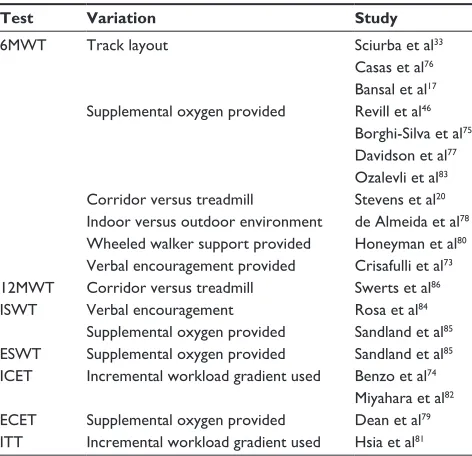
Eighteen studies were identified that assessed minor variations in protocol within a specific exercise test (Table 5).17,20,33,46,73–86
Variations (such as track environment or layout and the type of encouragement provided by the investigators to the patient) affected test outcomes (and consequently, their repeatability and reproducibility).
Discussion
A number of laboratory- and field-based exercise tests are used to assess the degree of functional impairment in patients with COPD. However, the choice of which test to use in clinical trials historically seems to have been made
International Journal of Chronic Obstructive Pulmonary Disease downloaded from https://www.dovepress.com/ by 118.70.13.36 on 22-Aug-2020
Dovepress
Fotheringham et al
Table 5 Protocol variations reported to affect performance of
exercise capacity test
Test Variation Study
6MwT Track layout Sciurba et al33
Casas et al76
Bansal et al17
Supplemental oxygen provided Revill et al46
Borghi-Silva et al75
Davidson et al77
Ozalevli et al83
Corridor versus treadmill Stevens et al20
Indoor versus outdoor environment de Almeida et al78
wheeled walker support provided Honeyman et al80
verbal encouragement provided Crisafulli et al73
12MwT Corridor versus treadmill Swerts et al86
ISwT verbal encouragement Rosa et al84
Supplemental oxygen provided Sandland et al85
eSwT Supplemental oxygen provided Sandland et al85
ICeT Incremental workload gradient used Benzo et al74
Miyahara et al82
eCeT Supplemental oxygen provided Dean et al79
ITT Incremental workload gradient used Hsia et al81
Abbreviations: 6MwT, 6-minute walk test; 12MwT, 12-minute walk test;
eCeT, endurance cycle ergometer test; eSwT, endurance shuttle walk test; ICeT, incremental cycle ergometer test; ISwT, incremental shuttle walk test, ITT, incremental treadmill test.
on a practical basis (tests such as the 6MWT and 12MWT require little time, organization, or equipment), or without necessarily taking into account how representative the exercise modality used is to activities of daily living for these patients (eg, cycling tests) or the likely impact of the intervention on the outcome of the test. Equally there are few data describing the relative merits of these tests employed simultaneously to evaluate interventions such as rehabilita-tion and bronchodilator therapy. Results from this systematic review indicate that there is an extensive body of published literature regarding the performance of the eight exercise tests that are widely used.
Repeatability data were found for only the 6MWT, 12MWT, ISWT, ESWT, and ICET. As could be anticipated, we did not identify studies assessing the repeatability of the ECET, ITT, or ETT; these studies test to exhaustion and would be impractical for patients with COPD to perform repeatedly on the same day. Of those reported, the 6MWT was by far the most thoroughly assessed. This may reflect its simplicity and relevance to daily life.87 However, a substantial
propor-tion of the reported data does not explicitly support 6MWT repeatability. Some studies suggested that the ISWT was more repeatable21 and reproducible18 than the 6MWT, while
another found that the ESWT was, in turn, more repeatable than the ISWT.23 The comparative results of exercise tests
are inconsistent. Furthermore, there are only very limited
data to support the repeatability and/or reproducibility of all cycle tests and treadmill tests. Repeatability and reproduc-ibility were generally improved with familiarization in all types of test. Although this review assesses the influence of protocol variations, it is possible that some studies in which variations were not the primary focus may not have been identified. However, it is clear that even in ostensibly identical tests (eg, two studies reporting the 6MWT), responses can be significantly affected by subtle variations in track layout or environment, or by encouragement from the researchers conducting the test.
When studies reporting the sensitivity of two or more exercise tests to therapeutic intervention were reviewed, there was no consistent evidence supporting the use of one test over any other. Nine of the eleven studies assessing the 6MWT after pulmonary rehabilitation,53–55,57,59,61,63,65,66 two of the four
studies assessing 6MWT after bronchodilators,18,67 and the
only study assessing the 6MWT after lung-volume reduction surgery71 all reported distance improvements greater than
the MCID. Additionally, three of the five studies assessing ISWT60–62 and all five of the studies assessing ESWT after
pulmonary rehabilitation23,47,59,60,62 reported distance
improve-ments greater than the MCID. Performance improveimprove-ments were also observed to be in excess of the MCID in the only two studies assessing the ESWT following bronchodilator therapy;14,69 this was therefore the only exercise test reported
by multiple papers that consistently responded to therapeutic interventions to a clinically relevant degree. It must be con-sidered that these exercise tests have differing physiological demands, and it may be that the benefits of each interven-tion are measured differently by each test. However, limited data for bronchodilator therapy and lung-volume reduction surgery make it difficult to identify any obvious differences in the responses of tests to these interventions.
The review has several limitations that must be acknowledged. As well as identifying whether or not test responses have exceeded the MCID, we have also reported percentage changes in exercise test performance whenever possible to enable a very crude comparison of test outcomes recorded in different units. However, we are aware that the validity of this comparison relies on a direct relationship between these test outcomes, which is unlikely to be true: a large percentage change in one test result may not be equivalent to a large percentage change in another.
In an attempt to assess the validity of exercise tests in patients with COPD as comprehensively as possible, we have collated data from studies that have used various definitions of COPD, which include distinct subcategories
International Journal of Chronic Obstructive Pulmonary Disease downloaded from https://www.dovepress.com/ by 118.70.13.36 on 22-Aug-2020