EPJ Web of Conferences116, 11004 (2016) DOI:10.1051/epjconf/201611611004
C
Owned by the authors, published byEDP Sciences, 2016
Results from IceCube
Tyce DeYoungafor the IceCube Collaboration
Dept. of Physics and Astronomy, Michigan State University, 567 Wilson Rd., East Lansing, MI 48824, USA
Abstract.Data from the IceCube Neutrino Observatory have revealed the existence of
a flux of high energy neutrinos of extraterrestrial origin, which is observed in a number of analyses spanning different energy ranges, fields of view, and neutrino flavors. The current data are consistent with an isotropic, equal-flavor flux described by a simple power law spectrum, but deviations from this simple model cannot yet be constrained with high precision. The existing observations in this area are reviewed, along with recent results on dark matter searches and observations of cosmic rays.
1. Introduction
The IceCube Neutrino Observatory is a gigaton-scale neutrino detector located at the U.S. Amundsen-Scott South Pole Station. Completed in 2011, it instruments a cubic kilometer of the Antarctic ice cap with 5,160 Digital Optical Modules (DOMs) consisting of 10” photomultiplier tubes and associated readout electronics, deployed at depths of 1,450 m to 2,450 m below the surface of the ice on 86 electrical cables, or strings. Most of these strings are deployed on a triangular grid with a characteristic spacing of 125 m, while eight of the strings form a denser array in the center of IceCube with a lower energy threshold, known as DeepCore. An additional 324 DOMs are installed in an array of 81 two-tank stations on the surface above the deep detector, known as IceTop. Detector operations have been extremely stable, with an overall duty factor of 99.6% since 2014. Subtracting maintenance periods and transient issues with individual DOMs, the ‘clean’ uptime of the detector is over 98%. No DOMs have failed during the past 2.5 years, and we project that more than 98% of the DOMs originally deployed will remain operational in 2020, ten years after completion.
The primary goal of IceCube is the detection of high energy neutrinos from astrophysical particle accelerators such as the sources of the cosmic rays. Secondary goals include cosmic ray studies, searches for dark matter and other exotica, and measurements of neutrino oscillations. Current and planned neutrino oscillation measurements are summarized elsewhere in these proceedings; highlights from the other areas are discussed here.
ae-mail:[email protected]
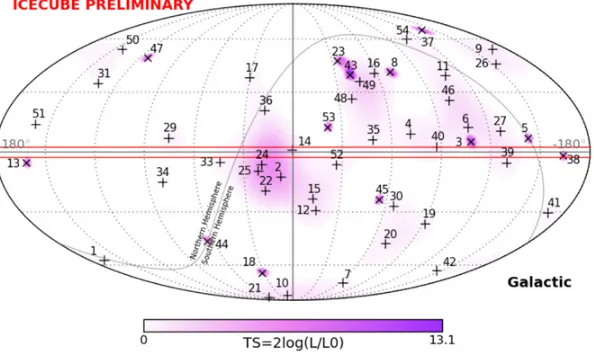
Figure 1. Arrival directions of the 52 high energy contained neutrino candidate events, in galactic coordinates. Crosses indicate cascade-like events while X’s show tracks. The color scale indicates the significance of the event excess at each point, which depends on the reconstruction uncertainty of each event. Events 28 and 32 are identified as background and are omitted.
2. Observations of astrophysical neutrinos
The first astrophysical neutrinos observed with IceCube [1] were discovered as anomalous high-energy cascade-like events in a search for ultrahigh-energy neutrinos produced through the Berezinsky-Zatsepin effect [2]. Track-like events are those with a muon track long enough to be separated from the hadronic shower produced at a neutrino interaction vertex; at extremely high energies, leptons could also be classified as track-like. Cascade-like events includeνecharged-current (CC) events, all neutral current (NC) events, andνCC events at energies low enough that thelepton decays before emerging from the vertex shower (unless thedecays to).
A follow-up analysis designed to detect high energy neutrinos interacting with nucleons inside the IceCube volume, sensitive to neutrinos of all flavors and incident from all directions, yielded 28 neutrino candidates with energies above 30 TeV [3], observed in the data taken from May 2010 to May 2012. With the inclusion of two more years of data, a total of 54 event were observed in this analysis (two of which can be clearly identified as background), with expected backgrounds of 12.6±5.1 atmospheric muons and 9.0+−8.02.2atmospheric neutrinos. A purely atmospheric origin of these events is now excluded at a significance of 6.5. A sky map of those events is shown in Fig.1.
Several other analyses [4,5] focused on events interacting in or near IceCube have extended these observations to lower energies or increased the sensitivity to cascade-like events. In parallel, a separate analysis searching for high energy up-going muon tracks produced primarily by neutrinos interacting outside of IceCube also produced 3.7evidence for astrophysical neutrinos in two years of data [6]. The excess of through-going muons at high energies is shown in Fig.2.
Very Large Volume Neutrino Telescope (VLVnT-2015) 10-2 10-1 100 101 102 103 104
103 104 105 106
Events
Muon Energy Proxy (arb. units) Conventional atmospheric
Prompt atmosphericAstrophysical Sum of predictions Experimental data
Figure 2. Spectrum of the up-going muon events, in arbitrary units. An excess above the atmospheric expectation is visible above 105. The green line indicates the best-fit power-law astrophysical neutrino spectrum, with a spectral
index of−2.2.
2.0 2.1 2.2 2.3 2.4 2.5 2.6 2.7 Neutrino spectral indexγ
10−11 10−10 10−9 10−8 10−7
E
2 0Φ
ν ( E0 ) (GeV cm − 2s − 1sr − 1) 90% 68%
(a)E >1 TeV, 2 years, best fit (b)E >60 TeV, 3 years, best fit (c)E >60 TeV, 3 years, forcedγ= 2
50 60 70 80 90 100 Exclusion CL (%)
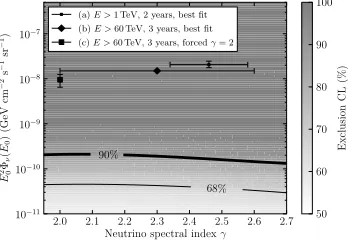
Figure 3. Upper limits on theνflux from known GRBs normalized atE0= 100 TeV, assuming an unbroken power
law spectrum, compared to measurements of the diffuse astrophysical neutrino flux [3,4]. The observed flux does not appear to originate from GRBs.
another popular class of candidate cosmic ray sources. A stacking analysis of blazars detected by Fermi-LAT suggests that less than 30% of the observed neutrino flux comes from these sources. This limit on blazars is considerably more model-dependent, however, due to the inherent variability of these sources. Observations from ANTARES limit the contribution from a single Galactic source, such as the Galactic center [9], but do not rule out the possibility of a population of Galactic sources or a spatially extended source associated with the Galaxy contributing to the observed flux. A weak correlation of neutrino arrival directions with the Galactic plane is observed, with ap-value of 2.5%, but only when the definition of the plane is extended to±7◦, substantially wider than would be expected in standard astrophysical models. At present, there is no compelling evidence for a Galactic contribution to the neutrino flux, but the possibility of a sub-dominant Galactic component cannot be ruled out.
Figure 4. Fitted normalization (in units of 10−8GeV cm−2s−1sr−1) and spectral index from several measurements
of the astrophysical neutrino flux targeting different neutrino flavors and energy ranges.
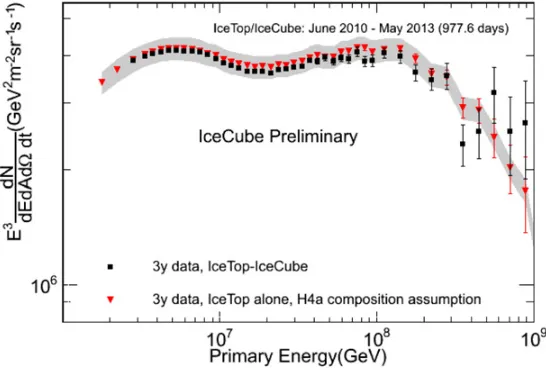
Figure 5. Comparison between the energy spectrum obtained by IceTop alone, with its 7% composition uncertainty indicated by the shaded band, and the energy spectrum obtained by the IceTop-IceCube analysis.
preferring softer ones, as indicated in Fig.4. This tension is not statistically significant, but if confirmed with additional data, it could be due to spectral features, anisotropies in the flux (e.g. due to a Galactic component), or differences between neutrino flavors due e.g. to source dynamics. It is quite possible that the flux discovered by IceCube is produced by multiple types of sources, but considerably more data will be required to explore such a complicated scenario.
3. Measurements of cosmic rays
Very Large Volume Neutrino Telescope (VLVnT-2015)
)
-2
/ GeV c
χ
( m
10
log
1 2 3 4
) 2 / cm SD,p σ ( 10 log -42 -41 -40 -39 -38 -37 -36
-35 MSSM incl. LUX (2014) ATLAS + CMS (2012)
DAMA no channeling (2008)
PICO2L 2015 SUPER-K (2015) ANTARES (2013) IceCube Limit IceCube Sens b b -W + W -τ + τ *IceCube Preliminary*
IC86 3 years: 1019 Days of Livetime
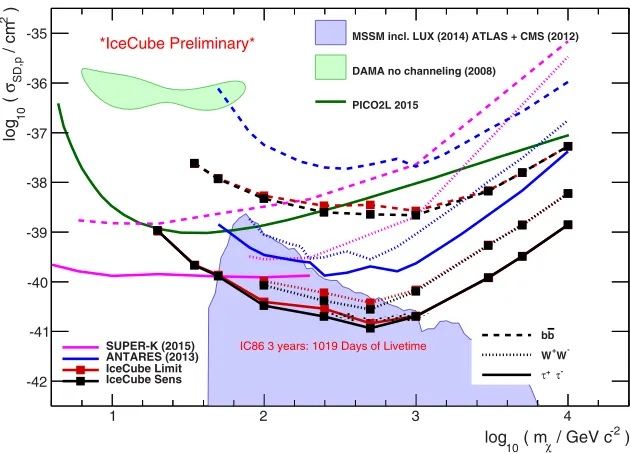
Figure 6. Sensitivities and upper limits on the spin-dependent WIMP-nucleon scattering cross section from a three-year IceCube search for solar dark matter annihilation. Black lines indicate IceCube sensitivities and red lines the actual upper limits, while blue and purple indicate limits from other indirect searches. In all cases, dotted, dashed, and solid lines indicate the assumed annihilation channel. The shaded regions indicate the allowed regions corresponding to the DAMA [20] measurement and the MSSM including direct detection and collider constraints on both SI and SD scattering.
measurement of the chemical compositions by comparison of the muonic and electromagnetic energy deposited in each shower. The measured composition becomes gradually heavier up to approximately 100 PeV, where there is a change in the trend. The second analysis used IceTop data alone, assuming a composition following the H4a model of Gaisser [11], which shares these features. The inferred spectra are very consistent, and clearly show a hardening of the spectrum around 20 PeV followed by a spectral break slightly above 100 PeV.
IceTop and IceCube data have also been used to measure the anisotropies in the cosmic ray flux first reported by EAS arrays [12, 13] and Super-Kamiokande [14] in the northern hemisphere. The origin of these anisotropies remains uncertain. IceCube and IceTop provide a unique view of these anisotropies in the southern sky, as well as the statistical power to investigate their energy dependence. At middle latitudes, the IceCube/IceTop observations [15,16] agree well with those from the north. The anisotropies extend at least to several PeV, and the pattern shifts as the energy increases from the 10 TeV scale to the PeV scale; regions of the sky which show a relative excess at lower energies have a deficit at higher energies and vice versa.
4. Searches for dark matter
Solar dark matter searches are of particular interest because of the Sun’s size, proximity, and light nuclear composition. Dark matter must scatter off regular matter to become trapped, and in general the scattering cross section may have both spin-independent (SI) and spin-dependent (SD) terms. For the latter, underground direct dark matter detectors lose the benefit of coherent scattering off heavy nuclei, and IceCube places some of the most stringent limits, particularly for heavier dark matter.
Two parallel searches for neutrinos from solar WIMP annihilation have been conducted with the IceCube-DeepCore detector. The results of the analyses are similar; limits from one, using three years of data from the full detector, are shown in Fig.6. The limits depend strongly on the assumed annihilation channel. Three scenarios are shown in Fig.6, where the WIMPs are assumed to annihilate exclusively to bb¯,W+W−, and +−, respectively. The latter two channels produce harder neutrino spectra which are more favorable for IceCube detection, and IceCube limits on these models provide interesting constraints on supersymmetric models not probed by current direct detection and collider searches. For WIMP masses above roughly 50 GeV, IceCube limits are more stringent than those from ANTARES [17], Super-Kamiokande [18], and (for several channels) PICO2L [19].
5. Outlook
The IceCube detector continues to take high-quality data, with excellent stability and longevity. The existence of a high-energy astrophysical neutrino flux has been confirmed via several analyses targeting different energy ranges, fields of view, and neutrino flavors. These observations are consistent and there is no compelling evidence for deviations from the simplest scenario of an isotropic, equal-flavor power-law flux. However, constraints on more complex scenarios are relatively weak and additional data may reveal additional details. IceCube also provides interesting measurements of the spectrum and composition of the cosmic rays and limits on dark matter scenarios.
References
[1] M. G. Aartsen et al. [IceCube Collaboration], Phys. Rev. Lett. 111, 021103 (2013) [2] V. S. Berezinsky and G. T. Zatsepin, Phys. Lett. B 28, 423 (1969)
[3] M. G. Aartsen et al. [IceCube Collaboration], Science 342, 1242856 (2013)
[4] M. G. Aartsen et al. [IceCube Collaboration], Phys. Rev. D 91, no. 2, 022001 (2015) [5] M. G. Aartsen et al. [IceCube Collaboration], Phys. Rev. Lett. 114, no. 17, 171102 (2015) [6] M. G. Aartsen et al. [IceCube Collaboration], Phys. Rev. Lett. 115, no. 8, 081102 (2015) [7] For a recent review, see K. Asano and K. Murase, Adv. Astron. 2015, 568516 (2015) [8] M. G. Aartsen et al. [IceCube Collaboration], Astrophys. J. 805, no. 1, L5 (2015) [9] S. Adrián-Martínez et al. [ANTARES Collaboration], Astrophys. J. 786, L5 (2014) [10] M. G. Aartsen et al. [IceCube Collaboration], Astrophys. J. 809, no. 1, 98 (2015) [11] T. K. Gaisser, Astropart. Phys. 35, 801 (2012)
[12] M. Amenomori [Tibet AS-Collaboration], Science 314, 439 (2006)
[13] A. A. Abdo et al. [Milagro Collaboration], Phys. Rev. Lett. 101, 221101 (2008) [14] G. Guillian et al. [Super-Kamiokande Collaboration], Phys. Rev. D 75, 062003 (2007) [15] R. Abbasi et al. [IceCube Collaboration], Astrophys. J. 746, 33 (2012)
[16] M. G. Aartsen et al. [IceCube Collaboration], Astrophys. J. 765, 55 (2013)
[17] S. Adrián-Martínez et al. [ANTARES Collab.], J. Cosmol. Astropart. Phys. 1311, 032 (2013) [18] K. Choi et al. [Super-Kamiokande Collaboration], Phys. Rev. Lett. 114, no. 14, 141301 (2015) [19] C. Amole et al. [PICO Collaboration], Phys. Rev. Lett. 114, no. 23, 231302 (2015)