Movement rules revisited"
Eva Haji~ov~
Institute
of Formal and Applied Linguistics
Charles Univeristy
Malos~'anskd n/un~st|
25
118 00 Prague, Czech Republic
0. I n t r o d u c t i o n
The Praguian approach to formal description of language (in detail, see Sgall et aI. 1986), works with dependency syntax and includes the topic- focus articulation into the (underlying, tectogrammatical) syntactic representations of sentences, using the left-to-right order of the nodes of the dependency tree for that purpose. The edges of the tree denote the dependency relations and the nodes carry complex labels indicating their lexical and morphological values (e.g. Preterite). No nonterminals and no nodes corresponding to function words (auxiliaries, prepositions, conjunctions, articles) are present in the tree. Counterparts of function words (and function morphemes) are parts of the complex symbols of the nodes. Instead of using the notion of phrase, we work with subtrees (i.e. the governor and its dependents, or all its subordinate nodes, where "subordinate" is the transitive closure of "dependent").
The present paper concentrates on a motivating discussion pointing out the reasons for distinguishing three layers of the order of lexical occurrences (Sect. 1), presenting a characterization of movement rules (Sect. 2), discussing certain relevant relationships between the level of syntax and that of morphernics (Sect. 3), and sketching a possibility how to proceed from surface (morphemics) to (underlying) syntax (Sect. 4). A way how to formalize the description of (underlying) syntactic slructure is briefly outlined in Section 5.
1. T h r e e layers of w o r d o r d e r
1.1 As has been argued in detail in Sgall et al. (1986), there are good reasons (concerning the semantic relevance as well as syntactic constraints of the topic-focus articulation, see below) to distinguish three layers of the order of the occurrences of lexical (autosemantic) items in the sentence:
(i) the surface word order, which can be understood as the order of items on the level of morphemics; on that level the sentence representation has the shape of a string of word-forms (rather than that of a tree); ( i i ) the communicative dynamism (underlying
word order), i.e. the order of nodes in an underlying (tectogrammatical) representation (TR), which has the shape of a dependency tree; the topic of the sentence is characterized as consisting of items which are less dynamic than those belonging to its focus; thus, if A belongs to the topic in all TRs of a given sentence S and B belongs to the focus in some o f the TRs of S, then A is less dynamic than B;
(iii)the systemic ordering of valency slots (kinds of dependency relation), which is specified in the valency frames (included in the lexical entries), see Sgall et al. 0986),
Sgall (in press).
Let us illustrate
the mentioned three layers
by
thefollowing example (with the capitals denoting
the intonation center of the sentence):"The work on this paper was supported by the grant o f the Czech Grant Agency GA~R 405/96/K214.
!
i
I
I
I
I
I
I
I
i
I
i
i
(1) My sister was visited by a painter in PARIS last week.
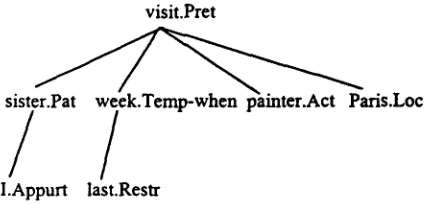
A difference between (i) and (ii) - the surface word order and the communicative dynamism - concerns here the fact that the most dynamic item (the bearer o f the intonation center) does not occupy its prototypical position at the end o f the sentence. Since the temporal adverbial at the end follows the intonation center, it can only be understood as belonging to the topic o f the sentence, i.e. as less dynamic than the focus. Let us assume that the preferred reading o f (1) - see Fig.1 - can be paraphrased as "As for the last week in my sister's life, (she) was (then) visited by a painter in Paris"; the order of the valency slots (the communicative dynamism) o f the (tectogrammatical) syntactic tree representing this reading is, in ascending order, Patient (Objective) - Temporal-when - Actor - Locative (with the Patient being the least dynamic item, i.e. the topic proper, and the verb being less dynamic than the Actor and more dynamic than the temporal adverbial).
visit.Pret
s i s t ~ a r i s Loc
/ /
[image:2.612.102.315.374.476.2]I.Appurt last.Restr
Fig. 1. A simplified TR of the sentences (1) and (2).
As a matter of fact, another surface order corresponding to this underlying wee may be that of(2):
(2) Last week, my sister was visited by a painter in PARIS.
The relationship between (ii) and (iii) is reflected in (1) by the fact that the above mentioned ascending order o f valency slots is in accordance with the systemic ordering within the focus (Actor preceding Locative), while this is not the case with the .position of Actor with regard to the two valency slots in the topic: Actor follows both Temporal and Objective, although the systemic ordering of these three
valemcy slots is Temporal - Actor - Objective (see Haji6owi and Sgall 1987; Haji6ovfi 1991). This difference is determined by the fact that the parts of the topic are less dynamic than those o f the focus, even if the degrees of dynamism are then not in accordance with systemic ordering. The restriction that the communicative dynamism within the focus part of the sentence is in accordance with systemic ordering, is crucial for the specification o f syntactic representations, as will be seen in paragraph (ii)Co) in Sect. 5.3.
1.2 The differences in communicative dynamism are relevant not only for the appropriateness o f the use of the given sentence in this or that context, but also semantically, even in the narrow sense of differences in truth conditions. This clearly concerns sentences with certain kinds o f complex quantification, such as (3), but also sentences without such (overt) quantifiers, such as (4) - (7) (I mostly use examples taken fi, om earlier linguistic discussions):
(3) (a) Two languages are known by everybody in this ROOM.
Co) Everybody in this room knows two LANGUAGES.
(4) (a) He wrote his dissertation on SUNDAYS. Co) On Sundays he wrote his
DISSERTATION.
(5) (a) I exercise in the MORNINGS. Co) In the mornings I EXERCISE. (6) (a) John saw an EXPLOSION.
Co) Mary saw an EXPLOSION.
(c) John and Mary saw an EXPLOSION.
(7)
(a) An explosion was seen by JOHN. Co) An explosion was seen by MARY. (c) An explosion was seen by JOHN ANDMARY.
(d) An EXPLOSION was seen by Johri and Mary.
With (6c) John and Mary could have seen different explosions, which is not the case with (7c), at least on the preferred reading. It is worth noting that the mere change of the position of the intonation center in (7d) gives a reading different
from (7c), namely the same reading as that of (6c).
Examples in which the degrees of dynamism within topic are relevant can be presented e.g. from Czech:
(8) (a) Tady byla loni MILENA. here was last-year Milena E. Here was MILENA last year. (b) Byla tady loni MILENA.
was here last-year Milena E. Last year, MILENA was here.
While (8a), with 'tady' [here] in the position of topic proper (i.e. the least dynamic word), which may carry a (contrastive) phrasal stress, can be paraphrased as "The place we are now is where MILENA was last year", (8b) means "R happened that MILENA was here (not necessarily in the place we are now, but in a broader sense) last year."
In the sequel, we argue first for the usefulness to work with movement rules between syntax and morphemics (Section 2), we characterize our approach to these two levels of grammar (Section 3), focussing then on the transition from morphemics to syntax (Section 4) and on a formal specification of syntactic (tectogrammatical) representations and their transduction to morphemic ones (Section 5).
2. M o v e m e n t rules
The examples from Section I show that it is necessary to work with an order of items also in the (underlying) syntactic representation. This is much easier with dependency syntax than with the constituency based descriptions where order is handled as closely connected with the determination of syntactic re'[ations. However, it is impossible to straightforwardly copy in these representations the surface order, due to the differences between these two layers, as illustrated in I.I above, in the discussion of example (I).
These differences may be described by means of movement rules, or perhaps e.g. o f numerical indices for underlying positions and o f specific topic and focus slots, as Starosta (1993; in press) proposes. It would deserve a systematic investigation to find whether such an approach allows to account in a natural way not only for
51
the subtle relationships between surface word order, communicative dynamism and the systemic ordering, but also for those concerning the different positions of quantifiers or of 'focalizers', cf. Haji~ov~i et al. (in press). Of course, an important methodological requirement is to minimize the number o f movement rules, and o f all distinctions between morphemic strings and syntactic representations, be they treated as constituting two layers o f description or as corresponding to different subsets of symbols within complex node values. In any case, at least the following issues have to be accounted for, and we indicate below how this can be done by means of movement rules (cf. Sect. 5.4):
(a) Sentences with a secondary (other than rightmost) placement of the intonation center, which marks the position of focus, cf. (1) and its TR in Fig. 1 above; see also (7d); for Czech, the rule may transfer the righmost item of the TR to the leftmost position, marking the moved item as the bearer of the intonation center o f the sentence (which then, in phonemics, gets a falling stress).
(b) Grammatically determined positions of verbs, adjectives, clitics, and so on, in different languages; the adjective primarily is more dynamic than its head noun, but it is placed to its left in English surface word order; in Czech clities usually are placed in the "second" (Wackemagel's) position, even if they depend on an infinitive standing after the main verb:
(9) Martin mi ji tu chtel U K J ~ A T . Martin to-me her here wanted to-show E. Martin wanted to SHOW me her here.
chtel.Pret
Martin.Act tddzat.Pat
n'nSLoc
I
I
I
I
I
!
i
!
I
i
I
i
i
I
i
I
I
This also concerns other dependents of an infinitive, if they belong to the topic: (l 0) Martin mi Milenu zam3~lel ~ T .
Martin to-me MilenaA,~ intended to-show
E. Martin intended to SHOW me Milena. Wackernagers position, into which the moved items usually are placed, is the position just after the lefanost node o f the uppermost part o f the tree (and, if the lei~most node differs from the verb, also after all nodes subordinated to the lefanost one).
(c) Positions o f function words (articles, prepositions, conjunctions, auxiliaries), which need not have any nodes as their underlying counterparts (just indices within node labels, see Section 4 below): in the morphemic sizing (i.e. in the surface word order) they are usually placed at the beginning of their word groups; the rules describing these movements are to be c o m b i n e d with changing the indices in the complex node labels into symbols o f articles, prepositions, etc.
(l l) Jim visited me, since he wanted to ask me for ADVICE.
(d) Also other cases of apparent non- projectivity (i.e. peripheral, strongly limited cases) can be described by movement rules concerning morphemics:
(12) I met a man yesterday, who asked me for your ADDRESS.
The order in the TR: I - yesterday - met - a man, who... (see Fig. 3).
(13) a largcr town than Boston:
The order in the TR: larger - than Boston -
town.
The use o f movement rules, rather than o f numerical indices for underlying positions enables us to work with perspicuous syntactic representations reflecting all the differences illustrated in the above quoted examples, including an economical handling of systemic ordering and dynamism.
Even when attempting at a ' m o n o s t r a t a l description, it is always necessary to distinguish between morphemics and syntax, e.g. by using abstract symbols in the complex labels of nodes;
52
thus, also with such an approach the problem stressed by Starosta (1993) is still present, namely the danger that abstract symbols might get too far from the empirical properties o f language. As mentioned in Section 2 above, the requirement o f the minimalization of the number o f rules (or symbols) is to be given due attention.
meet.Pret
I.Act yesterday.Temp-when man.Pat
ask.Pret.Res~
/ 2
who.Act I.Addr address.Pat
/
you.Appurt
Fig.3. A simplified TR of sentence (12).
3. Syntax and morphemics
Using movement rules to describe relationships between syntax and morphemics makes it possible to treat these two levels apart, with simple strings of (complex) symbols as morphemic representations, and trees (or more complex networks) as syntactic ones. It is necessary to distinguish these two levels at least for two reasons:
(i) the relation between a function word and its autosemantic 'partner' differs essentially from the dependency relation: a preposition or article cannot occupy any other position than that of accompanying a noun; an auxiliary or (typically) a conjunction always accompanies a verb; in this point they are similar to endings, rather than to adjuncts; it is essentially more economical to have just
i!
(ii)
indices in complex node labels than large numbers of nodes;
to work with a node for every surface lexical occurrence (and to use no other nodes) is difficult, not only with respect to the description o f deletions of different kinds, but first of all with surface word forms such as French du, au, or German
rum, beim; these forms show that the boundary between surface word forms is not reliable. Such cases can be found in many languages, of. e.g. in Czech the conjunction
-li 'if (occurring only after a verb form and attached to it by a hyphen, so that the intermediate position between a function word and a suffix of the verb is clearly manifested), or the clitic s (auxiliary of the 2nd Person Sing. Preterite), written together with (any!) preceding word form, not only after a verb as in dostals 'you got' or after the subject pronoun as in tys DOSTAL 'you GOT', but also e.g. after the object noun as in knihus DOSTAL 'you GOT the book'. 4. F r o m s u r f a c e ( m o r p h e m i c s ) to
( u n d e r l y i n g ) s y n t a x
In the primary unmarked situation, morphemes (endings, prepositions, other function words) express dependency relations and values o f morphological categories (number, definitness, tense, aspect, modalities, degrees of comparison), whereas surface (morphemic) word order expresses the basic scale of the topic-focus articulation, i.e. that of communicative dynamism. Prototypically these two orders are identical, the differences - described by movement rules - are relatively rare and can be described by a limited number of rules.
The core of the transition from morphemic strings to syntactic representations (preliminary formulations of implemented procedures for which can be found with Kirschner 1987; Haji~ovfi et al. 1994) then is to describe the transition from endings and function words to their functions. Thus, a Genitive typically depends on the adjacent noun, a prepositional group usually expresses an adverbial (dependent on the verb), prepositions have either their primary 'meanings', as e.g. E. with:
Accompaniment or Means, from: Directional.I,
through: Directional.3, or they have their syntactic functions (they express certain kinds of dependency relation; perhaps it would be more exact to see dependency as a family of relations)
- to: Addressee, by: Actor with Passive.
Another part o f the task is to proceed from surface word order and certain properties of sentence prosody (positions o f the intonation center or the main stress of the sentence, and of phrasal stress) to the scale of dynamism. In non- prototypical (not just marginal) cases the word order expresses syntactic (dependency) relations. Among such cases there is the English 'configurationality' with the order Actor, verb and Objective; however, even in English, as soon as other kinds o f the dependency relations are encountered, it is necessary to take morphemes into account (in English - prepositions, see above; in most Continental languages - case endings; in the agglutinating languages of Asia and other regions - suffixes; verb categories are practically always expressed by morphemes, etc.).
Furthermore, it is necessary to restore the deleted items; this task has often been discussed with different frameworks, but an adequate solution still seems to be connected with many open questions. One of them is that it is not easy to draw the boundary line between those cases in which the deleted lexical unit is to be inserted as such, and cases in which just an anaphoric or indexical item is appropriate. The former case clearly concerns at least the basic kinds of coordination deletion (e.g. with blue and yellow flag it is appropriate to restore blue flag in the TR). The latter case can be illustrated by the deleted Directional with George has arrived on Sunday - either here or there is present in the TR, i.e. the sentence is ambiguous in this point.
5. F o r m a l i s a t i o n o f dependency syntax
5.1 A descriptive framework meeting the conditions specified in the preceding sections can now be briefly characterized. We present first an illustration o f how the complex tectogrammatical networks can be formally described (Sect. 5.1), then we characterize the form o f a lexical entry (5.2) and proceed to a brief sketch of a specification o f the set o f TRs (5.3), adding a partial illustration of movement
!
I
I
I
I
I
I
I
I
I
I
i
I
I
I
i
I
i
I
rules used in transducing TRs to morphemic representations (5.4).
A dependency tree is not sufficient, since it cannot reflect the complex relationships between dependency and coordination, if we do not want to neglect the difference between the binary dependency relations and the coordinated (and appositional) constructions having an indefinite number of members. However, even a network with a greater number of dimensions, which in this sense can serve as the shape of a TR, can be formally described in the form of its one-to-one linearization (see Petkevi6 1995; Sgall 1997), cf. examples (14) and (15); every dependent item or group is enclosed in a pair of parentheses and the subscripts, indicating the dependency relations, are placed at the parenthesis that is closer to the head and can be read as Restrictive (adjunct), Directional, Appurtenance (broader than just possession); Conjunction is understood as a kind of coordination:
(14) My younger brother arrived there YESTERDAY.
(14') ((mY)Restr (younger)Restr brother)Act arrive.Pret (Dir there) (Temp yesterday)
(15) Mary and John, our neighbors, who are a nice pair, ARRIVE.
(15') (((Mary John)Con j (we)Appur t neighbor)Appos (Restr (Rel)Act be.ires (Obj (nice)Restr pair)))Act (here)Dir arrive.Ires
5.2 The relationship between lexical and grammatical information can be characterized by including much of grammatical information in the lexicon (especially in the valency frames or grids). The lexical entry contains the following parts:
(a) the lexical meaning, which itself has its internal structure; in the cases of lexical ambiguity there are several representations, i.e. several lexical units;
(b) the slots for values of relevant grammatical categories, i.e. of grammatemes; while e.g. gender with nouns is specified here, other grammatemes (number and definiteness with nouns, or tense, aspect, modalities with verbs, degrees of comparison with
(c)
54
adjectives) get their values only for individual occurrences of the word forms in discourses;
the valency frame: optional and obligatory dependents are ordered in accordance with systemic ordering; arguments or 'inner participants' (occurring at most once with a head node) and obligatory adjuncts are indicated (e.g. arrive at a place, behave somehow, last how long,...); optional adjuncts may be indicated by lists concerning individual word classes; surface deletability is indicated (e.g. Directional.2
with to arrive is deletable, Objective with to meet is not (We met there is a case of reciprocity, rather than of deletion); further data concern an optional or obligatory controller (e.g. Actor is an obligatory controller with to try, an optional one with to decide; Addressee is an optional controller
with to advise, to forbid), the dependent's ability to occupy certain syntactic positions (e.g. of Subject with Passivization, of a wh-
element) or to constitute barriers for movement, and subcategorization conditions.
5.3 The class of syntactic representations can be specified by means of a small number of general principles describing the core of grammar and by specific rules for peripheral patterns.
The general part of this specification can have the shape of a generative procedure (first formulated by Haji~ov6 et al. 1991):
(i) generate a node:
(a) create the node either as the root of the representation, or as a node dependent on another one and placed to the right of all its sister nodes;
Co) choose its lexical value and the values of its grammatemes, taking into account (by unification) the subcategorization conditions of the mother node and the restrictions on the combinations of grammatemes as specified in the lexical entry of the head or in the data concerning the respective word class;
in focus); the node that has just been generated is considered as node n in the next step;
(ii) if the frame o f node n contains a complementation, then it is possible to generate (ii) (a) either a left daughter o f n, assign it 'CB'
and a complementation value chosen from the frame of n,
(ii) Co) or a right daughter of n, and assign it a complementation value from the left end of n's frame (this ensures that the underlying order o f the complementations in the focus part of the sentence will obey the systemic ordering, see the end o f Sect. 1.1 above).
NOTE: If the chosen complementation value is an inner participant, it is deleted in the frame of n (as saturated); "from the left end" means that optional complementations can be skipped and deleted in the frame o f n.
(iii) if the frame of n contains no complementation, then the mother node of n is considered as node n; if no mother node is present; the procedure (generating the tree from the top down and from the left to the right) is finished;
(iv) only representations containing a focus are accepted, i.e. only those whose branch going from the root to the rightmost daughter of the rightmost daughter of ... of the root includes a non-bound node.
A declarative specification of the
syntactic
representations is well possible, if the concept of unification is so complemented as
(a) to distinguish saturated items (cf. the Note above) and
(b) to check the correspondence of the order of non-bound sister nodes with the systemic ordering.
Then it can be checked whether the tree unifies with conditions stated in the lexicon, i.e. whether all obligatory complementations o f the heads present in the representation are among the daughters of the heads, whether only complementations contained in the frame of any head (or in the relevant list of free modifications) occur as the bead's dependents, and whether subcategorization (and similar) restrictions are met.
As we mentioned, this specification covers the core of sentence syntax; it can be completed
to cover coordinated structures (see Petkevi~ 1995), negation and other focalizers ('only', 'also', 'willingly', etc.), in specific positions (prototypically they occur at the beginning of the focus; see Haji~ovk, Partee and Sgall, in press).
The relatively very simple form of the representations (strings of bracketted and indexed symbols) may be helpful in explaining the easiness o f the child's acquisition of the mother tongue, although the representations contain all semantically relevant information immediately comprised in the structure of the sentence.
5.4 TRs o f the form described in 5.3 can be transduced to morphemic representations (sUings) in that prototypically the left-to-right order of their nodes is retained, being changed only in specific cases.
One type o f such movement rules takes care of placing the most dynamic item (the bearer of the intonation center of the sentence) more to the left. In English this concerns first of all those cases in which the syntactic functions of participants (arguments) and adjuncts dete,~-~-~ine certain restrictions of their surface positions. Thus, e.g. sentence (1), repeated here for convenience, can be handled with the use of the following rule (presented here with many simplifications):
(1) My sister was visited by a painter in PARIS last week.
Rule M I : I f x.Loc as the rightmost item o f a TR is preceded by y.Temp (which is placed between x and the verb), then y.Temp will be moved to the right of xF.Loc in the morphemic string; with the chosen linearization of TRs (see Sect. 5.1) the rule can be technically written (with many simplifications) as follows:
X (U y.Temp W) Y (Z x.Loc) --> X Y (Z xF.Loc) (U y.Temp W)
where X and Y are well parenthesized strings, x stands for a noun, pronoun or verb, y stands for a noun, adverb or verb (again, with their dependents), the superscript F denotes the placement of the intonation center of the sentence, Z, W, U, V are (possibly empty) strings of well parenthesized items (dependents of x and y), X (U y.Temp W) Y (Z x.Loc) is a
I
I
I
I
I
I
I
I
I
I
I
I
I
I
I
i
I
i
well formed TR (according to Sect. 5.3), and the parentheses are supposed to be removed by one of the last steps of the procedure transducing TRs into morphemic strings.
Rules of a similar kind can determine the movement of the subject (be it derived from Actor, or, with passivization, from Patient or Addressee) to the left of the verb in case its tectogrammatical source is more dynamic than the verb and thus stands to the right of the verb in the underlying order.
Another kind of rules concerns the changes of tectogrammatieal values such as Plural, Preterite, Feminine, Comparative into morphemic items (endings, alternations, affixes, function words) and the placement of these morphemic items. Thus, e.g. for the treatment of nouns rules as the following one are needed:
Rule M2: If x in a node label x.Num.Def is a noun, Num the value of Number (Sg or P1) and Def that of Definiteness (+ or-), then
(i) rewrite + (-) into Artdf (Arfin) and place this symbol to the left of the nodes subordinated to node x (including x itself); recall that 'subordinated' is the transitive closure of 'depending'; Artdf will be transduced into the phonemic and phonetic (or graphemic) shapes of the, and Artin into a, an, or (with plural) into zero,
(ii) rewrite PI (Sg) into -s (0) (this certainly requires to take into account also several specific sets of exceptions before Rule M2 is applied, cf. forms like mice, oxen, loaves); -s will be then changed into the surface shape of the Plural (or 3rd Person Singular) ending by the subsequent components of the procedure.
The simplified technical form of M2 is: (Z x.Num.Def W) - , (Art Z x.End W) where x stands for a noun or a pronoun, Z and W are (possibly empty) slrings of well parenthesized items (dependents of x), Art is Artdef (Artin) if Defis + (-), End is -s (0) ifNum is PI (Sg).
Still another type of movement rules is
needed for apparently non-projective con.structions, illustrated by ex. (13), repeated here for convenience:
(13) a larger town than Boston
M3: ((Art 2 X A.Comp (than U Art I N1.End) W N2.End Z) --~ Art 2 X A.Comp W N2.End 2 Z than Art 1 U N 1.End 1
where N 1 and N 2 are nouns, A is an adjective, X, Z, U and W are (possl~oly empty) strings of well parenthesized items, Art i is Artdef or Artin (or zero, with a proper name), End i is -s or 0 for
i-- 1,2.
Rules of the last mentioned type are supposed to be applied after rules of the types M 1 and M2. Many technical as well as empirical issues are still open and constitute interesting topics for further research.
References:
Haji~,ovfi E. (1991): "Free" word order described without unnecessary complexity. Theoretical Linguistics 17:99-106.
Hajifovfi E., Panevovfi J. and P. Sgall (1991): Why do we use dependency grammar? In: Buffalo Working Papers in Linguistics, Special Issue for Paul Garvin (ed. by W. W61ck). Buffalo:State University of New York, 90-93. Hajifovfi E., Partee B. and P. Sgall (in press):
Topic-focus articulation, tripartite structures, and semantic content. To be published by Kluwer, Amsterdam.
Hajifovfi E. and P. Sgall (1987): The ordering principle. Journal of Pragmatics 11,435-454. Hajifovfi E., P. Sgall and H. Skoumalovfi (1994):
An automatic procedure for topic-focus identification. Computational Linguistics 21:81-94.
Kirschner Z. (1987): APAC3-2: An English-to- Czech machine translation system. Explizite Beschreibung der Sprache mad automatische Textbearbeitung XIII. Prague: Faculty of Mathematics and Physics, Charles University. Petkevi6 V. (1995): A new formal specification
of underlying structures. Theoretical Linguistics 21:7-61.
Text Theory. Amsterdam/ Philadelphia: Benjamins, 149-166.
Sgall P. (in press): On the usefulness of movement rules. In: Caron
B. (ed.),
Acres du16e Congr~s International des Linguistes (Paris 20-25 juillet 1997), Oxford: Elsevier Sciences.
Sgall
P., Haji~ovA E. and J. Panevov/l (1986):
The meaning of the sentence in its semantic and pragmatic aspects, ed. by J. L. Mey, Dordrecht:Reidel - Prague:Academia.
Starosta S. (1993): Word order and focus in constrained dependency grammar. In: Haji~ov~ E. (ed.), Functional description of language. Prague: Charles University, 237- 252.
Starosta S. (in press): Comments on Petr Sgall's "On the usefulness of movement rules". In: Caron B. (ed.), Acres du 16e Congr s International des Linguistes (Paris 20-25 juillet 1997), Oxford: Elsevier Sciences.