Thesis by
Fei-Fei Li
In Partial Fulfillment of the Requirements for the Degree of
Doctor of Philosophy
California Institute of Technology Pasadena, California
c
2005
Acknowledgements
I would like to thank my two advisors, Professor Pietro Perona and Professor Christof Koch, for all their help and advice during my studies at Caltech.
Over the past five years it has been my great honor to collaborate with (in alphabetical order) Rob Fergus, Asha Iyer, Silvio Savarese, Rufin VanRullen and Dirk Walther.
Abstract
Object and scene recognition is one of the most essential functionalities of human vision. It is also of fun-damental importance for machines to be able to learn and recognize meaningful objects and scenes. In this thesis, we explore the following four aspects of object and scene recognition.
It is well known that humans can be “blind” even to major aspects of natural scenes when we attend elsewhere. The only tasks that do not need attention appear to be carried out in the early stages of the visual system. Contrary to this common belief, we show that subjects can rapidly detect animals or vehicles in briefly presented novel natural scenes while simultaneously performing another attentionally demanding task. By comparison, they are unable to discriminate large T’s from L’s, or bisected two-color disks from their mirror images under the same conditions. We explore this phenonmenon further by removing color from the natural scenes, or increasing the number of images peripherally. We find evidence that suggests that familiarity and meaningfulness might be among the factors that determine attentional requirements for both natural and synthetic stimuli.
So what exactly do we see when we glance at a natural scene? And does what we see change as the glance becomes longer? We asked naive subjects to report what they saw in nearly a hundred briefly presented photographs. After each presentation subjects reported what they had just seen as completely as possible. Afterward, another group of sophisticated individuals who were not aware of the goals of the experiment were instructed to score each of the descriptions produced by the subjects in the first stage. Individual scores were assigned to more than a hundred different attributes. Given the evaluation of the responses, we show that within a single glance, much object and scene level information is perceived by human subjects. But the richness of our perception seems asymmetrical. Subjects tend to have a bias to natural scenes being perceived as outdoor rather than indoor.
In computer vision, it is commonly known that learning visual models of object categories notoriously requires thousands of training examples. We show that it is possible to learn much information about a category from just one image, or a handful of images. The key insight is that, rather than learning from scratch, one can take advantage of knowledge coming from previously learnt categories, no matter how different these categories might be. We explore a Bayesian implementation of this idea. Object categories are represented by probabilistic models. Prior knowledge is represented as a probability density function on the parameters of these models. The posterior model for an object category is obtained by updating the prior in the light of one or more observations. We test a simple implementation of our algorithm on a database of 101 diverse object categories. We compare category models learnt by a simple implementation of our Bayesian approach to models learnt from maximum likelihood (ML) and maximum a posteriori (MAP) methods. We find that in a database of more than 100 categories the Bayesian approach produces informative models when the number of training examples is too small for other methods to operate successfully.
Contents
Acknowledgements iv
Abstract v
Table of Contents vii
List of Figures xi
I
Introduction
1
II
Natural Scene Categorization in the Near Absence of Attention
3
1 Introduction 4
1.1 Background . . . 4
1.2 Contribution . . . 5
2 General Method 6 2.1 Subjects . . . 6
2.2 Apparatus . . . 6
2.2.1 Database . . . 6
2.2.2 Equipment . . . 6
2.3 Procedure . . . 7
2.3.1 Experimental Paradigm . . . 7
2.3.2 Central Letter Discrimination Task . . . 7
2.3.3 Peripheral Task . . . 8
2.3.4 Training Procedure . . . 8
2.3.5 Data Analysis . . . 8
3 Experiments and Results 10 3.1 The Main Experiment: Natural Scene Categorization without Attention . . . 10
3.1.1 Method . . . 10
3.1.2 Results . . . 11
3.1.3 Discussion . . . 15
3.2 Control Experiment 1: Effects of Training . . . 16
3.2.1 Method . . . 17
3.2.2 Results . . . 18
3.2.3 Discussion . . . 21
3.3 Control Experiment 2: Effect of Color . . . 21
3.3.1 Method . . . 21
3.3.2 Results . . . 22
3.4 Control Experiment 3: Evidence for Parallel Processing . . . 23
3.6 Control Experiment 5: Evidence for Well-learned Categories of Objects Entailing Less At-tentional Load During Recognition . . . 30
III
Gist of Natural Scenes: Perception in a Glance
39
5 Introduction 407 Experiments and Results 52 7.1 Experiment I: The ‘Content’ of a Single Fixation . . . 52
7.3 Experiment III: Sensory-level Recognition vs. Object/Scene-level Recognition . . . 61
7.5.2 Results and Discussion . . . 69
8 Summary 73 8.1 The Gist of Gist . . . 73
8.2 Shapes, Objects and Scenes . . . 74
8.3 Two Puzzling Asymmetries? . . . 75
IV
Computational Models I: Object Recognition
77
9 Introduction 78 9.1 Introduction and Motivation . . . 789.2 Literature Review . . . 79
9.3 Contribution . . . 80
10 A Bayesian Model 81 10.1 Overall Bayesian Framework . . . 81
10.2 The Object Category Model . . . 82
10.2.0.1 Appearance . . . 83
10.2.0.2 Shape . . . 84
10.2.1 Discussion of model . . . 85
10.2.2 Form of the Parameter Posterior . . . 86
10.2.3 Maximum Likelihood (ML) and Maximum A Posteriori (MAP) . . . 86
10.2.3.1 Other Inference Methods . . . 87
10.2.4 Conjugate Densities . . . 88
10.3 Recognition Using a Conjugate Density Parameter Posterior . . . 88
10.3.1 Parameter Distribution . . . 88
10.3.2 Closed-form Calculation ofR . . . 89
10.4 Learning Using a Conjugate Density Parameter Posterior . . . 89
11 Experiments and Results 91 11.1 Implementation . . . 91
11.1.1 Feature detection and representation . . . 91
11.1.2 Learning . . . 91
11.1.2.1 Choice of Prior . . . 91
11.1.2.2 Details of Bayesian One-Shot algorithm . . . 92
11.2 Experimental Results . . . 93
11.2.1 Datasets . . . 93
11.2.2 Experimental Setup . . . 94
11.2.3 Walkthrough for the Motorbike Category . . . 94
11.2.4 Caltech 4 Dataset . . . 98
11.2.5 101 Object Categories . . . 99
11.2.5.1 Overall Results: ML vs. MAP vs. Bayesian . . . 99
11.2.5.2 Good models and Bad models . . . 104
11.2.5.3 A Further Investigation on Prior Models and Feature Detectors . . . 108
11.2.5.4 Bayesian One-Shot Algorithm: Shape-Only vs. App-Only vs. Shape-App models . . . 109
11.2.5.5 Bayesian One-Shot Algorithm: Discrimination Amongst 101 Categories . 109 11.2.5.6 Discussions . . . 111
V
Computational Model II: Natural Scene Classification
116
13 Introduction 117
13.1 Background . . . 117
13.2 Contributions . . . 118
14 Hierarchical Bayesian Model and Learning 119 14.1 Model Structure . . . 119
14.1.1 The Theme Models . . . 120
14.1.2 Bayesian Decision . . . 123
14.1.3 Learning: Variational Inference . . . 124
14.1.4 A Brief Comparison . . . 125
14.2 Features and Codebook . . . 125
14.2.1 Local Region Detection and Representation . . . 125
14.2.2 Codebook Formation . . . 126
15 Experiments & Results 127 15.1 Dataset and Experimental Setup . . . 127
15.2 Results . . . 129
16 Summary 135 Bibliography 137 A 149 A.1 Definition of Various Densities and Functions . . . 149
A.1.1 Dirichlet Distribution . . . 149
A.1.2 Normal-Wishart Distribution . . . 149
A.1.3 Gamma Distribution . . . 150
A.1.4 Multivariate Student’s T Distribution . . . 150
A.1.5 Kullback-Leibler Distance . . . 150
A.1.6 Digamma Function . . . 150
A.2 Learning using a conjugate density parameter posterior . . . 150
A.2.1 Variational methods . . . 151
A.2.2 Variational Bayesian EM . . . 151
A.2.3 The E-step of Bayesian One-Shot . . . 152
A.2.4 The M-step in Bayesian One-Shot . . . 152
A.3 MAP learning . . . 153
List of Figures
2.1 Dual-Task experimental setup for a single trial. . . 7
3.1 Experimental Protocol. . . 12
3.2 Main Results. . . 13
3.3 Normalized performances of several experiments. . . 14
3.4 Cross-Training experiment I and results. . . 18
3.5 Cross-Train experiment II and results. . . 19
3.6 Natural scene categorization without color. . . 22
3.7 Experimental setup for single-image versus double-image experiment. . . 24
3.8 Results of the single-image versus double-image experiment. . . 27
3.9 Multiple stimuli experiment. . . 29
3.10 Rotated versus fixed rotation versus upright letter experiments. . . 32
6.1 46 images of outdoor scenes in our dataset of 90 grayscale images. . . 44
6.2 44 images of indoor scenes in our dataset of 90 grayscale images. . . 45
6.3 A single trial in Stage I. . . 47
6.4 Attribute Tree. . . 48
6.5 Experiment Stage II: Evaluating the free recall responses. . . 48
6.6 A sample score plot for the building attribute. . . 50
7.1 Subject description samples. . . 53
7.2 Results of single fixation experiment. . . 55
7.3 Power spectral analysis of indoor and outdoor scenes. . . 57
7.4 Template analysis for indoor and outdoor scenes. . . 58
7.5 Categorization results of indoor and outdoor scenes. . . 59
7.6 Categorization results of manmade outdoor and natural outdoor scenes. . . 59
7.7 Summary plot of average categorization performances of all 7 SOAs. . . 60
7.8 Sensory information and object perception in outdoor and indoor scenes. . . 60
7.9 Samples of subjects’ free recall responses to images at different SOAs. . . 62
7.10 Perceptual performances of different attributes across all7presentation times. . . 63
7.11 Perceptual performances of different object attributes across all7presentation times. . . 65
7.12 Perceptual performances of different scene attributes across all7presentation times. . . 65
7.13 Object recognition performance versus scene recognition performance at various different SOAs. 70 7.14 Overall correlation coefficients for scene versus objects and breakdowns. . . 70
10.1 Schematic comparison of ML and MAP methods. . . 87
11.1 Output of the feature detector on samples images from four categories. . . 92
11.2 The 101 object categories and the background clutter category. . . 95
11.3 Training images for the motorbike category. . . 96
11.4 A visualization of the prior parameter density. . . 97
11.5 The learning process for motorbike category. . . 98
11.7 Summary of the face model. . . 100
11.8 Summary of the motorbike model. . . 101
11.9 Summary of the spotted cat model. . . 102
11.10 Summary of the airplane model. . . 103
11.11 Performance on 101 categories using three different learning methods. . . 105
11.12 Results for the grand-piano category. . . 106
11.13 Results for the “cougar face” category. . . 107
11.14 Two categories with poor performance. . . 107
11.15 Effect of prior models on object categorization. . . 108
11.16 Quality of feature detection compared with object detection performances. . . 108
11.17 Full model versus shape only and appearance only models. . . 109
11.18 Discrimination experiment. . . 112
11.19 A toy example to illustrate the effect of prior knowledge. . . 113
14.1 Flow chart of the algorithm. . . 120
14.2 Different models of scene categorization. . . 121
14.3 Codebook of textons. . . 122
15.1 13 categories of natural scenes. . . 128
15.2 Internal structure of the models learnt for each category. . . 130
15.3 Examples of testing images for each category. . . 131
15.4 Confusion and rank statistics tables of Theme Model 1. . . 132
15.5 Example of themes for the forest category. . . 132
15.6 Dendrogram of the relationships of the13category models. . . 133
15.7 Codeword number vs. category number and performance comparison of the 3 algorithms. . . 133
Part I
To understand how humans see and to build machines to see are two important goals in science and engineer-ing. The purpose of this thesis is two-fold. On the human vision side, we explore properties of natural scene recognition through psychophysics experiments. On the computer vision side, we propose two algorithms that learn and recognize objects and natural scenes.
We will introduce the significance of our questions as well as our contribution separately in each of the following part:
In Part II, we present a series psychophysics studies that shows rapid natural scene categorization requires very little attention. We further explore various aspects of this astonishing ability.
In Part III, we take the question of natural scene recognition further by studying what human subjects perceive in a glance of a real-world image.
In Part IV, a computer vision model is proposed for learning object categories with very few training examples. We use Bayesian learning technique to incorporate useful prior information to achieve this goal.
Part II
Natural Scene Categorization in the
Chapter 1
Introduction
1.1
Background
Psychologists have long known that certain visual search tasks require minimal or no attention. A hallmark of preattentive vision is that it is achieved in a seemingly parallel fashion: a preattentive task may be carried out simultaneously with other visual tasks [17]; target detection does not become significantly more difficult when the number of distractors is increased [15, 140]. However, none of the known preattentive tasks approaches the sophistication of everyday vision where complex scenes must be scrutinized in order to assess high level properties such as the presence of danger and the structure of a social interaction. Virtually all of the visual tasks that may be performed preattentively have been explained, either in detail or in principle, by quasi-linear models that replicate mechanisms found in the early stages of our visual system [7, 83]. While much can be accomplished by these simple mechanisms, it is quite clear that they are inadequate for explaining “high level” perception such as recognition and categorization, i.e., visual processes that rely on neural activities in the inferior temporal cortex and beyond [43, 68, 78]. This would suggest that there is no sophisticated property of the scene that we can see without paying attention. In agreement with this view, change blindness and inattentional blindness studies demonstrate that without visual attention, significant changes in a large part of the visual field can easily escape our awareness [82, 96, 115, 128].
On the other hand, some complex visual tasks can be rapidly accomplished by our visual system. RSVP (rapid serial visual presentation) experiments have demonstrated that natural objects belonging to a specified category may be classified remarkably fast [109, 130]. Thorpe and colleagues have found that complex natural scenes can be categorized in as little as 150ms [22, 29, 135, 136, 146]. This astonishing speed relative to the time constant of information processing and transmission in networks of neurons raises the question of whether attention plays a critical role in this type of rapid visual processing.
visual attention. More specifically, we ask whether a complex scene recognition task require much attention and to what extent attention plays a role in various types of visual tasks.
1.2
Contribution
To the surprise of current attention theories [140], we find that there is little or no attentional cost in rapid visual categorization of complex, natural images [77]: detecting the presence of an animal, or a vehicle, in a natural photograph, a genuinely challenging task for today’s computer vision algorithms, can be carried out by human observers in the near-absence of attention. Subjects could perform this task equally well alone or simultaneously with another attention-demanding task (i.e., deciding whether 5 randomly rotated Ts and Ls presented at fixation were all identical or whether one of them differed from the others). Under the same dual-task conditions, subjects could not perform apparently simpler discrimination tasks involving synthetic stimuli (discriminating between a single peripherally rotated T or L, or discriminating between red-green and green-red bisected disks).
Chapter 2
General Method
2.1
Subjects
Fifteen highly motivated California Institute of Technology undergraduates and graduate students (from 20 to 26 years old) served as subjects in all or part of the following experiments. Each subject enrolled for at least 15 daily sessions of 1 hour and received payment. Subjects reported normal color vision and visual acuity (sometimes with corrective lenses or glasses), but underwent no tests in this respect. All subjects were right-handed. All subjects were naive about the purpose of the experiments.
2.2
Apparatus
2.2.1
Database
The pictures were complex color scenes taken from a large commercially available CD-ROM library allowing access to several thousand stimuli. The animal category images included pictures of mammals, birds, fish, insects and reptiles. The vehicle category images included pictures of cars, trucks, trains, airplanes, ships and hot-air balloons. There was also a very wide range of distractor images, which included natural landscapes, city scenes, photos of food, fruits, plants, houses and artificial objects.
2.2.2
Equipment
2.3
Procedure
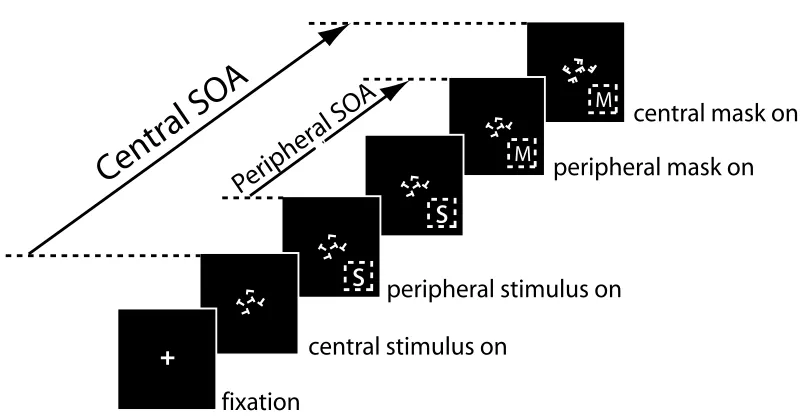
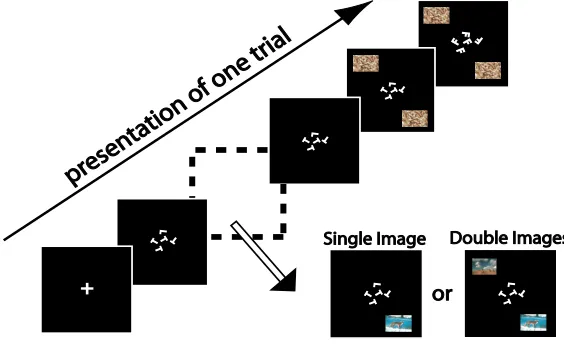
Figure 2.1: Dual-Task experimental setup for a single trial. A fixation cross of 1-degree visual angle is flashed for 300ms at the onset of each trial, started by the subject. After that, the central letter discrimination task stimuli are presented for a Central SOA (Stimulus Onset Asynchrony) amount of time. The central stimuli are then masked by an appropriate perceptual mask. Central SOA is determined individually for each subject so that the performances of the central letter discrimination task center around 80%correctness. 52ms after the onset of the central stimuli, a peripheral stimulus is presented randomly at a peripheral location centering at 6-degree eccentricity. For different experiments reported in this paper, peripheral stimuli vary. Each peripheral stimulus is then masked by its corresponding perceptual mask, after Peripheral SOA amount of time. It is important to note that to ensure that attention is properly withdrawn by the central task under the dual task condition, the peripheral mask always onsets earlier than or at the same time as the central stimulus mask.
We use a Dual-Task paradigm in all of our experiments [15, 129]. Each experiment consists of three different conditions: the primary task– an attentionally demanding central task (identical in all experiments), a secondary peripheral task (in which the role of attention is investigated) and a dual task condition in which both the central and peripheral tasks are performed concurrently. In each experiment, all trials are organized in the same way irrespective of the experimental condition (i.e., single-task condition or dual-task condition). Only the number of required responses varies between conditions.
2.3.2
Central Letter Discrimination Task
Each letter is randomly rotated. After the central SOA (Stimulus Onset Asynchrony, the time between the appearance of the central stimulus and the onset of the central mask), each stimulus letter is masked by the letter ‘F’ rotated according to the random orientation of the stimulus letter. For a given subject, the central SOA is the same for both single-task and dual-task conditions. All trial types are presented with equal probability. Subjects are instructed to respond by pressing ‘S’ on the keyboard if the five letters are the same, or ‘D’ if one of the letters differs from the other four. Fig. 1 illustrates schematically the setup of a sample trial of the dual task paradigm. In earlier studies it was found that the central task performance is quite a sensitive measure to indicate the allocation of attentional resources [15]. Subjects’ performances on this central task decreased drastically if the SOA was slightly decreased [77].
2.3.3
Peripheral Task
In each peripheral task, the stimulus is always presented 53ms after the central stimulus onset. Subjects respond to these tasks in a speeded fashion. They are instructed to continuously hold down the mouse button and release it as fast as possible (within 1000ms) when they have detected the target. For a given trial, the location of the peripheral stimulus is randomly determined, keeping a distance of 6-degree eccentricity (Fig. 2.1).
2.3.4
Training Procedure
Each novel subject to the dual task paradigm underwent a training process. It usually took more than 10 hours for a new subject to coordinate his/her motor responses well enough to answer both a speeded peripheral task and the central task. The central SOA, starting at 500ms, was decreased after each block where the performance of this task exceeded 85% correct. The training procedure was terminated after the subject’s performance had stabilized and the central SOA was below 250ms. This value is chosen to limit the possibility of switching attention or eye movement during stimulus presentation. Central task and peripheral task always received the same amount of training.
2.3.5
Data Analysis
attention under the dual-task condition. Each of these two performances consists of performances of 9-15 blocks (depending on the experiment) of 96-trial experiments unless otherwise specified. T-tests are computed for each experiment to compare single- and dual-task performances. An alpha value of 0.05 is used for all statistical tests.
To visualize results, we summarize each of the experiment using a “normalized performance” figure. The “normalized performance” for each task is obtained in the following way. The averages of the two baseline performances are linearly scaled to 100%such that chance level performance remains at 50%. Then the same scaling factor for each subject is used to obtain normalized performance levels of the two tasks under the dual-task condition. In other words,
Normalized performance = 0.5[(Pd−0.5)/(Ps−0.5)] + 0.5 (2.1)
wherePdandPsrefer to performance in the dual-task and single-task conditions, respectively. It is important
Chapter 3
Experiments and Results
In this chapter, we present first the main experiment of our study. The key question of our investigation is whether natural scene categorization requires visual attention. Following the main experiments, we present a series of control experiments targeted to investigate various aspects of our findings in the main experiments.
3.1
The Main Experiment: Natural Scene Categorization without
At-tention
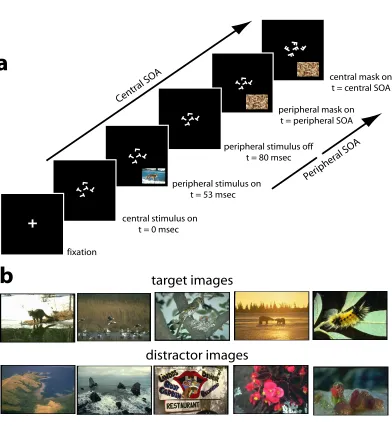
We studied the role of attention in natural scene categorization using a dual task paradigm, in which a natural scene categorization task, where target scenes were defined by the presence of one or more animals, was performed concurrently with another visual task that required visual attention [17, 74, 129] (Fig. 3.1). The idea is to compare subjects’ performances of the categorization task under two conditions: the “single task” condition where attention is available, and the “dual task” condition where attention is drawn away by the other task. If the rapid natural scene categorization task demands attention, we should observe a significant decrease in performance under the dual task condition. If the rapid natural scene categorization does not entail much attentional cost, performances should be comparable.
3.1.1
Method
82%, Fig. 3.2). This value can be used as a reference for the dual task condition: if a subject has continuously engaged full attention to the central task, we expect the performance to be maintained at the same level; any significant distraction or withdrawing of attention would decrease performance.
The peripheral task is our locus of interest–natural scene categorization. It is a modification of the one used by Thorpe and colleagues [135]. A picture was flashed for only 27ms at a random location in the periphery of the visual field, followed by a perceptual mask (Fig. 3.1). Subjects had to decide whether the image contained an animal (or animals) or not, as fast and accurately as possible [135]. When subjects performed this task alone, their performance averaged around 76%(ranging from 75%to 79%; Fig. 3.2).
3.1.2
Results
Under the dual task condition, subjects were instructed to focus attention at the center of the display, and to try to perform both tasks as accurately as possible. Since we were interested in the reaction times of the natural scene categorization task, we asked subjects to respond as fast as possible to the peripheral task before answering the central one. For each subject, the central task performance under the dual task condition showed no difference (p>0.05) from its counterpart under the single task condition (Fig. 3.2). This is a clear indication that attention was locked at the center under the dual task condition. Furthermore, for each individual subject the average peripheral categorization performance under the dual task condition was not significantly (p >0.05, t-test) different from the corresponding performance under the single task condition (Fig. 3.2), suggesting that natural scene categorization can still be performed when attention is drawn away (see also Fig. 3.3a-c).
One might argue that subjects could first attend to the peripheral stimulus before switching attention to the central one. In that case, however, the time available to process the central stimulus would be much shorter by at least 80ms than the actual central SOA (the peripheral stimulus is turned off 80ms after the onset of the central stimulus). This strategy would result in a strong decrease in performance of the central task. Indeed, in a separate control experiment, we asked all six subjects to perform the central letter task with an SOA shortened by only 66ms. Their average performance dropped from 77%to 66%(individual t-test for each subject,p= 0.01). This confirms that our results do not reflect a systematic switch of attention between the two tasks.
a
50 60 70 80
Figure 3.2: Main Results. Individual subject’s results for dual vs. single task performance (5 subjects). The horizontal axis represents performance of the central task (attentionally demanding letter discrimination task). The vertical axis represents performance of the peripheral task (natural scene categorization). Each solid•represents the performance of one block (96 trials/block) under the dual task condition. All images used for testing were novel for the subjects. Each open◦represents the average performance under the single task condition. For each subject, performances of the letter discrimination task do not differ significantly (t-test, p>0.05) under the single and dual task conditions, suggesting that attention was fully allocated to the center in the dual task condition. Furthermore, the performances of the natural scene categorization task do not differ significantly (t-test, p>0.05) either under the single and dual task conditions, suggesting that the task may be performed while attention is engaged elsewhere.
were never presented during training. Furthermore, we show later (Fig. 3.3d and 3.3e) that the same amount of training in other dual tasks did not reduce attentional demands. This makes it unlikely that our results are a direct consequence of the training process. In addition to our experiments, a study done by Rousselet et al. reaches a compatible conclusion with untrained subjects [120].
Reaction times measured under the single task condition are compatible with results observed by Thorpe and colleagues, suggesting that our natural scene categorization task is performed in an ultra-rapid mode [135]. Note that this task involves a speeded response under both single and dual task conditions. Under the dual task condition, while categorization performance is unaffected, we observe an average delay of 117ms in response times compared to the single task condition (single task: 491ms; dual task: 608ms). This delay is likely to arise due to central rather than perceptual attentional competition [100]. Indeed, when subjects are required to perform two tasks simultaneously, interference is known to occur at several different stages: task preparation [50], response selection [99, 154] and response production [57, 92]. These limitations, often referred to as the “psychological refractory period” [134], could easily account for the observed delay [100]. Moreover, a number of studies have shown that the presence of attention decreases perceptual latencies [58] and reaction times to a significant extent [69, 107, 112]. This could also explain the observed delay.
40
normalized central perf. (%) normalized central perf. (%) normalized central perf. (%)
normalized central perf. (%) normalized central perf. (%)
nor
(Fig. 3.2 and Fig. 3.3a), with the exception that50%of the distractor images contained vehicles (Fig. 3.3b). The two tasks were presented in alternation and all stimuli were masked. Our results show that for each individual subject there is no significant decrease in categorization performance under the dual task condition compared to the single task condition in both cases (Fig. 3.3b - c, t-test,p >0.05). This result suggests that categorization of natural scenes in the near absence of attention might well be a general phenomenon not limited to evolutionarily relevant object categories. Another possible confound is that the subjects may not be performing an animal (or vehicle) detection task, but rather may be detecting the presence of a “foreground object.” Foreground objects may be more frequent in images containing animals or vehicles than in images containing scenery only. However, the fact that animal photographs were used as distractors for the vehicle task and vice versa makes this possibility implausible since “foreground objects” were contained both in the target and distractor images.
The interpretation of our findings relies on the assumption that attention is allocated to the center of the visual field under the dual task condition. This assumption is supported by the fact that there is no decrease in the central performance under dual task compared to single task conditions. This implies that when the peripheral task does demand attention, performance should suffer. To examine this question, we conducted two control experiments in which the peripheral tasks involved either discriminating a briefly presented letter followed by a mask (T or L followed by F; Fig. 3.3d) or discriminating a briefly presented and masked color disk (red/green or green/red; Fig. 3.3e). These tasks have been shown by Braun and colleagues to require attention [74]. In both of these control experiments, the central task was the same as in our previous experiments (five Ts and Ls discrimination). We observed a sharp drop in performance of both peripheral tasks (p < 0.0001in Fig. 3.3d; p < 0.0001in Fig. 3.3e). While subjects can perform at 74%and78%
in peripheral single letter and color tasks, respectively, they cannot do any better than chance (individual paired t-test for each subject,p >0.05; average over all subjects is51%for letter task;51%for color task) during the dual task scenarios. These results demonstrate that attention is effectively allocated to the central task and provide further evidence that extensive training does not necessarily result in an improvement of performances. Subjects performing these dual tasks received the same amount of training as those performing the natural categorization tasks.
3.1.3
Discussion
appearance is highly variable. It thus appears that a sophisticated high level of representation (e.g. semantic) can be accessed outside the focus of attention. It has already been argued that the “gist” of a visual scene could be available preattentively [8, 157]. In this context, the contents of the “gist” could in fact be extended to include information about the presence of a complex target category whose appearance is not known in advance.
3.2
Control Experiment 1: Effects of Training
We had demonstrated the human visual system’s amazing efficiency in natural scene categorization with little or no attention [77]. In these experiments, an average training period of 10-15 hours on dual-task was necessary for each subject. It is likely that this training helps sharpen the executive control necessary for performing different tasks, particularly when they are carried out simultaneously [100, 126]. However, training sometimes also decreases the attentional demand on perceptual processing [65]. So, could it be that this superb efficiency in natural scene processing is mainly due to the training process that each subject had received in these experiments? We had argued that this is unlikely since the same amount of training was applied both to the natural scene categorization and the seemingly simpler synthetic stimuli tasks (rotated single T versus L, bisected disk versus its mirror image). Our data showed, however, a large discrepancy between the attentional requirements of these two types of tasks. It is difficult to explain this by the same training process.
3.2.1
Method
We tested this hypothesis in two separate experiments. In the first experiment, we divided a group of 6 subjects into 2 groups. Both groups received the same amount of training in all tasks. Specifically, both groups were trained on the central letter discrimination task (see Chapter 2.3.2) and a natural scene categorization task under both single- and dual-task conditions. Recall that the “single-task” condition refers to the situation where attention is available to perform the current peripheral task, while the “dual-task” condition refers to the situation where attention is drawn to the center, leaving the peripheral task in the near absence of attention. There are 96 trials in any given block of task under all conditions. In Group I, the 3 subjects were trained on the “animal vs. non-animal” categorization task. They were instructed to categorize natural scenes with or without animals in a go/no-go fashion by releasing a mouse button. The task was speeded so that any lack of response after 1000ms was automatically registered as a “no target” answer. The test data were then acquired by having them perform vehicle vs. non-vehicle categorization without any additional training. Similarly to the animal categorization task, subjects responded by releasing the mouse button when a target (vehicle(s)) was detected. In Group II, the 3 subjects were trained on vehicle categorization and tested on animal categorization (Fig. 3.4). Previous experiments [77] have already established that a trained natural scene categorization task requires little attention. We are, therefore, interested in seeing whether such performance can be transferred from one type of categorization (e.g., animal) to another (e.g., vehicle). Namely, will the performance of vehicle categorization without attention be comparable to the performance of animal categorization without attention for Group I subjects, and vice versa for Group II?
group II
Figure 3.4: Cross-Training experiment. In this experiment 6 subjects are divided into 2 groups of 3 each. In Group I, illustrated on the left, the subjects are trained with central letter discrimination and animal catego-rization task, as well as the dual task condition using these two tasks. After training, they are immediately tested on the vehicle categorization task in both the single task condition (with attention) and the dual task condition (without attention). Results are shown in normalized performance plots. In Group II, illustrated on the right, the subjects are trained with central letter discrimination and vehicle categorization task, as well as the dual task condition using these two tasks. After training, they are immediately tested on the animal categorization task in both the single task condition (with attention) and the dual task condition (without at-tention). Results are shown in normalized performance plots. Our results illustrate that subjects need not be trained for the specific natural scene categorization task in order to perform it without attention, suggesting category-specific training is not necessary to carry out this high-level task without attention.
3.2.2
Results
The bottom panels of Fig. 3.4 illustrate the normalized performance results from the cross-training experiment between two groups of subjects. In Group I, three subjects were trained on animal categorization and then tested on vehicle categorization. Their central performances during the training phase show that under the dual task condition, they had successfully maintained their attention at the central task (single central task, average over 9 blocks: 75.9±3.5%, 85.4±3.9%and83.2±2.5% for each subject, respectively; dual central task, average over 9 blocks:70.3±5.5%,86.11±2.7%and80.8±4.1%, respectively; t-test results: t(16) < 1.75, p > 0.05 for each subject). During the testing condition, only one subject has a slight drop in central task performance under the dual task condition (single central task, average over 9 blocks:
75.9±3.6%,85.4±3.9%and83.2±2.5%for each subject, respectively; dual central task, average over 9 blocks: 71.2±2.9%,87.6±3.7%and81.3±4.1%; t-test results: t(16) = 2.40,p = 0.01for the first subject;t(16)<1.75,p >0.05for the rest). During the training phase, the subjects performed the animal categorization task without any interference when comparing the performances under the dual task condition with the single task condition (single peripheral task, average over 9 blocks:79.5±0.6%,84.3±0.6%and
100
50
50 100
50 50 100
100
nor
maliz
ed p
er
i. p
er
f. (
%)
nor
maliz
ed p
er
i. p
er
f. (
%)
normalized central perf. (%) normalized central perf. (%)
Trained gender discrim.
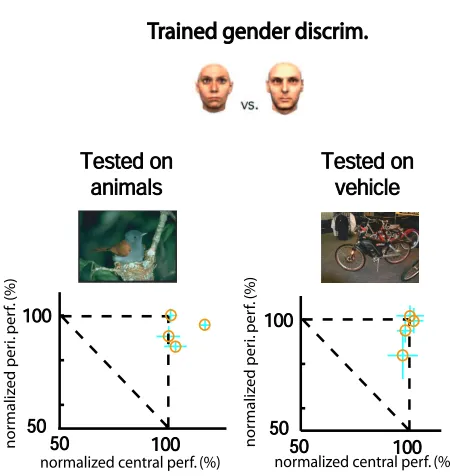
Figure 3.5: Gender-Train Dual-Task experiment. In this experiment, 4 subjects are trained on the central letter discrimination task, gender discrimination as well as the dual task condition using these two tasks. Two examples of the stimuli of the gender discrimination task are shown here [141]. Subjects are instructed to respond whether a briefly presented, then masked hair-less face peripherally is of a female or a male face [114]. After the training process is completed, subjects are tested on two natural scene categorizations without attention: animal and vehicle. Normalized performances of the single and dual task conditions are presented for each natural scene categorization. Our results show little training on natural scenes is needed to perform natural scene categorization.
subjects during the testing phase, in which they were put directly on the vehicle categorization task without any prior training (single peripheral task, average over 9 blocks:83.2±4.5%,87.3±4.4%and80.2±2.6%; dual peripheral task, average over 9 blocks: 82.2±2.1%,79.3±3.9%and77.3±3.7%; t-test results:
t(16) = 3.22,p = 0.003for the second subject; t(16)< 1.75,p > 0.05for the rest). Note that there is
a slight drop in the vehicle categorization task under dual task condition for the second subject. This small decrease, although significant, should be viewed in the light of the results of [74] and [77]: when attention is taken away, performances for a simple rotated T versus L task (or Red-Green disk versus Green-Red disk) dropped much more dramatically, often to chance level (50%). Compared to Group I, Group II subjects went through reversed training and testing categorization tasks. During the training stage, three subjects were trained on vehicle categorization only. All of them have successfully allocated attention at the center under both the single task and dual task condition (single central task, average over 9 blocks:68.6±4.6%,
78.5±6.1%, and88.9±3.2%; dual central task, average over 9 blocks: 67.9±2.8%,78.6±7.2%, and
blocks:72.2±7.9%,77.4±1.2%and81.6±1.6%; dual peripheral task, average over 9 blocks:70.0±4.8%,
78.3±5.0%and81.4±4.7%; t-test results:t(16)<1.75,p >0.05for each subject). During the testing stage, where subjects were tested directly on animal categorization without any prior training (training was done using vehicle categorization), they maintained good performances on central task under both conditions just as they did during the training sessions (single central task, average over 9 blocks:68.6±4.6%,78.5±6.1%
and88.9±3.2%; dual central task, average over 9 blocks:68.6±4.2%,88.3±2.7%and88.4±3.4%; t-test results: t(16) = 3.79,p = 0.001for the second subject;t(16)<1.75,p > 0.05for the rest). Similarly, all three subjects performed the animal categorization task under the dual task condition as well as under the single task condition (single peripheral task, average over 9 blocks: 74.8±5.8%, 84.2±1.8% and
81.1±4.3%; dual peripheral task, average over 9 blocks:70.4±4.5%,81.5±3.0%and77.8±5.1%; t-test results:t(16)<1.75,p >0.05for each subject).
Fig. 3 illustrates the results from the second experiment in this section. Four new subjects were trained on the dual task paradigm with the same central letter discrimination task but a peripheral face gender discrim-ination task [114]. Testing of whether animal categorization and vehicle categorization require attention fol-lowed after the training phase. In all but one case, all of the four subjects showed natural scene categorization performances (both animal and vehicle) in the near absence of attention statistically indistinguishable from the same tasks performed with attention available (single peripheral animal categorization task performance, averaged over 9 blocks for each:83.0±3.2%,81.9±0.6%,83.3±3.4%and76.9±4.3%; dual peripheral animal categorization task performance, averaged over 9 blocks:79.9±4.3%,77.4±3.7%,74.3±3.3%and
77.1±3.4%, t-test results: t(16) = 4.46,p= 0.0002for the third subject;t(16)<1.75,p > 0.05for the rest. Single peripheral vehicle categorization task performance, averaged over 9 blocks for each:81.8±3.9%,
83.0±4.5%,85.1±2.6%and78.1±7.3%; dual peripheral vehicle categorization task performance, averaged over 9 blocks:79.6±2.5%,80.0±2.7%,73.6±14.8%and77.8±6.4%, t-test results:t(16)<1.75,p >0.05
for each subject). Note that one subject showed a small decrease in animal categorization performance when attention was drawn away (single task performance, average over 9 blocks: 83.3±3.4%; dual task perfor-mance, average over 9 blocks:74.3±3.3%; t-test results:t(16) = 4.46,p= 0.0002). Here again, this slight decrease is much smaller than those observed on known “attentionally-demanding” tasks [74, 77]. Note that the same subject’s performance on vehicle categorization was not significantly different in the single and dual task conditions.
3.2.3
Discussion
The first experiment in this section has shown that when trained on animal categorization (or vehicle) in the near absence of attention, subjects can perform vehicle categorization (or animal) with no further training. This effect is even more dramatically demonstrated by the second experiment, in which a totally different type of stimulus is used during training. But as soon as subjects have learned to perform this recognition task under the dual task paradigm, they can apply this ability to a natural scene categorization task. On the contrary, our previous experiments have shown that single letter discrimination or color disk discrimination cannot be performed without attention given the same amount of training as the natural scene categorization task [77]. Hochstein and colleagues argue that “higher-level” tasks can be more easily transferred than “lower-level” tasks [59]. Could it be that less attentional resource is needed because natural scene categorization is carried out in “higher” areas of the visual system than the other synthetic tasks? We will revisit this point in both Control Exp 3 and Control Exp 5.
3.3
Control Experiment 2: Effect of Color
We set out to explore different factors that might contribute to the fast recognition of natural scene categories with little or no attention. A simple question to ask is whether some low-level features might have been useful cues to the categorization task. For example, it has been shown that color histograms are very informative for natural scene recognition in both human and computer vision [93, 97, 111]. In today’s computer vision field, some image retrieval algorithms have utilized color information to categorize different images [123]. Delorme and colleagues have shown that color is not a critical component in fast categorization, under conditions where attention was not explicitly controlled [22]. In the present experiment, we question the role of color information in natural scene categorization with little or no attention, by changing the stimuli to grayscale.
3.3.1
Method
sample target images
sample distractor images
60
80
100
60
80
100
50
Normalized Central Perf (%)
N
o
rmaliz
ed P
er
i. P
er
f (%)
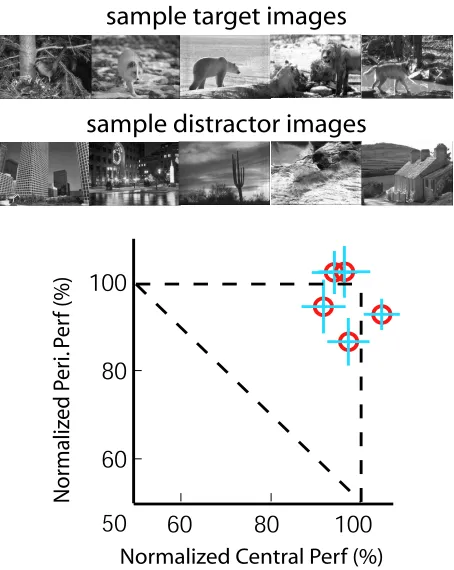
Figure 3.6: Natural scene categorization without color. In this experiment, the peripheral task is animal categorization with grayscale natural scene images. All experimental conditions remain identical to the one introduced in [77]. The only difference is that all peripheral task stimuli as well as the masks are presented in grayscale. The top two rows show some samples of the target stimuli and distractor stimuli, respectively. The bottom panel indicates subjects’ normalized performances of this task, showing that there is little cost in grayscale natural scene categorization when attention is withdrawn elsewhere.
3.3.2
Results
It is first interesting to observe that individual SOAs for the natural scene categorization task are not much different from the ones observed in [77] where color information was included in the images (average natural scene categorization SOA of 5 subjects in [77]: 61msec; average SOA of 5 subjects in current experiment: 85msec; t-test result:t(8)<1.86,p >0.05). Fig. 3.6 illustrates the normalized performances of the subjects’ dual task performances. Note that each subject has achieved a central task performance at his/her baseline level in dual task (single central task, average over 12 blocks for each subject: 76.9±6.1%,76.0±3.2%,
74.2±4.9%,75.0±4.4%and74.3±6.6%; dual central task, average over 15 blocks for each subject:
(single peripheral task, average over 12 blocks for each subject: 79.3±2.7%,73.2±7.1%,76.9±6.5%
and74.2±7.4%; dual peripheral task, average over 15 blocks for each subject:75.2±4.7%,74.4±5.1%,
71.7±5.9%and72.9±5.8%; t-test results: t(25)<1.71,p > 0.05for each subject). Only one subject’s natural scene categorization task performance decreases slightly while attention is allocated elsewhere (single peripheral task, average over 12 blocks:71.9±5.6%; dual peripheral task, average over 15 blocks:66.1±
5.3%; t-test results:t(25) = 3.82,p= 0.0004). Overall, grayscale natural scene images can be categorized rather efficiently in the near absence of attention.
3.3.3
Discussion
Our results indicate that when much of their attention is locked elsewhere, subjects can perform rapid natural scene categorization task without using color information. This result suggests that color information is not critical in performing such a task in the near absence of attention. Dunai and colleagues have also found that color cues are only more informative at a longer time scale to an attentionally demanding detection task [26]. In addition, Delorme and colleagues have already shown that color information is not critical in the initial recognition of the same set of natural scenes that we are using [22]. These findings, together with ours, suggest that natural scene categorization might be carried out by a rapid and efficient process that does not require much of the slower color information. Torralba and colleagues suggested that some natural scene images can be categorized based on second order statistics derived from power spectral analysis [138]. It would be fruitful to test their hypothesis on object recognition such as animal or vehicle categorizations. To conclude, removal of color information failed to make natural scene categorization an “attentionally demand-ing” task. Thus, if this type of natural scene processing only relies on low-level features, color cannot be counted as one such feature.
3.4
Control Experiment 3: Evidence for Parallel Processing
conditions in order to understand the underlying neuronal mechanisms.
3.4.1
Method
The attentionally demanding central letter discrimination task remained the same as in the previous experi-ments. Five Subjects performed a letter discrimination task at the central SOAs individually adjusted for each of them. The peripheral task was a colored animal scene categorization. Each block consisted of 48 trials. In half of the trials, there were two peripheral natural scene images (“double-image” condition), with two equally likely configurations-either one of the two images contained a scene with animal(s); or neither image contained an animal. In the other half of the trials, there was only one image, just like in the previous experi-ments on scene categorization (“single-image” condition). Subjects are told to respond by lifting the mouse button when they detect the presence of an animal (or animals) in both conditions. These two types of trials were intermixed randomly throughout the experiment. Fig. 3.7 shows the schematic setup of this experiment. For the double-image condition, the separation between the two images varied randomly between 4 and 12 degrees (each maintaining an eccentricity of 6 degrees, just as in the previous experiments). Subjects were informed before the experiments of the two different possible conditions. No one reported any confusion or difficulty with the instructions. There was a total of 15 blocks for the dual task condition and 15 blocks for each single task condition.
3.4.2
Results
All 5 subjects were able to categorize novel natural scenes without attention. The top two panels of Fig. 3.8 illustrate the normalized dual task performances for the single-image condition and double-image condition, respectively. First we observe that all subjects maintained their central letter discrimination task performances under single task and dual task conditions (single central task performance, average over 15 blocks for each subject:75.4±3.3%,71.5±1.3%,67.7±5.0%,77.6±4.9%and77.1±3.8%; dual central task performance, average over 15 blocks for each subject:73.8±5.4%,71.5±5.5%,67.3±4.3%,75.0±6.0%and77.3±
5.9%; t-test results: t(28) < 1.70,p > 0.05for each subject). These results indicate that attention was successfully locked at the central task for all these subjects. Now we are interested in comparing subjects’ natural scene categorization performances with or without attention under single-image and double-image conditions. Fig. 3.8 shows the performance pattern of double-image categorization (single task performance, average over 15 blocks for each subject:64.6±3.1%,71.7±5.8%,74.7±7.6%,75.4±6.1%and73.6±8.4%; dual task performance, average over 15 blocks for each subject: 64.0±6.4%,68.1±6.5%,70.2±5.8%,
72.3±6.3%and70.7±6.0%; t-test results:t(28)<1.70,p >0.05for each subject) as well as the single-image case (single task performance, average over 15 blocks for each subject: 77.1±5.4%,80.1±7.1%,
87.5±6.9%,81.9±4.1%and79.2±11.0%; dual task performance, average over 15 blocks for each subject:
76.3±4.9%,74.0±4.3%,79.0±8.3%,83.8±5.9%and70.4±9.0%; t-test results:t(28) = 2.48,p= 0.01
Since we have randomly varied the visual angle distance between the two images under the double-image condition, we can ask whether the subjects performances differ for different visual angle separations. The bottom two panels of Fig. 3.8 show double-image condition performances sorted by the visual angle separation. The left panel corresponds to the condition where attention is available (single task condition), whereas the right panel corresponds to no-attention condition (dual task condition). The two leftmost bars in each panel, placed at the 0 degree angles, indicate the average single-image performances of the subjects with or without attention, respectively. We investigated the effects of visual angle separation between the two stimulus images with a 2-way ANOVA (attentional condition vs. inter-stimulus separation). In accordance with our previous results, there was no main effect of attention on performances (single task condition vs. dual task condition:F(1,96) = 1.2112,p >0.05). There was no main effect of the visual angle separations between stimuli either (F(11,96) = 0.5817,p > 0.05). Additionally, there was no significant interaction between these two factors (F(11,96) = 1.1654,p >0.05). Note that due to the size of the image itself, the minimal separation distance between two images is 4 degrees.
3.4.3
Discussion
Our finding suggests that natural scene categorization task not only demands little attentional resource, but is also highly parallel. When two images are presented simultaneously, subjects are able to process both of the images in search of a target object in a comparable fashion as when there is only one image. Physiolog-ical data from ERP recording also supports this finding. Rousselet et al. found that subjects are as fast for animal categorization with two images as with one image [120]. Together our results suggest that high-level information can be accessed by the visual system in a parallel fashion with little attentional assistance. It suggests that some categorical information might be able to reach higher areas of the visual hierarchy rather efficiently, without much serial focal-attention selection.
3.5
Control Experiment 4: Multiple Copies of the Synthetic Stimuli
0 5 10
Visual Angle (in degree) Visual Angle (in degree) Double-Image performance: with vs. without attention
50 100
Normalized Central Perf (%) Normalized Central Perf (%)
Categorization without attention: Single Image vs. Double Images
Figure 3.8: Results of the single-image versus double-image experiment. The top two panels illustrate nor-malized performances of the single-image dual task and the double-image dual task, respectively. Five sub-jects participated in this experiment. The results show that there is little difference between the single-image case and the double-image case, suggesting that natural scene categorization without attention is a highly parallel process. The bottom two panels break down the performances of the double-image case by the angle of separation between the two images. The two leftmost bars in each panel, placed at the 0 degree angles, indicate the average single-image performances of the subjects with or without attention, respectively. The left panel shows the result when attention is available; whereas the right panel shows when attention is with-drawn. For each attentional condition, there is no apparent pattern of performance difference as a function of visual angle separation.
task “easier” without attention?
or a Green-Red disk by detecting the color on half of the disk. The only “diagnostic feature” is the junction between the two colored semicircles. Hence we predict that if the advantage of scene categorization without attention lies in the higher probability of detecting one or more of the possible “diagnostic features,” then increasing the number of stimuli in the synthetic stimulus task could result in an increase of performance.
3.5.1
Method
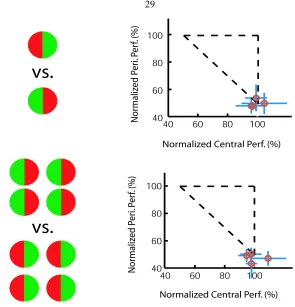
We test this hypothesis using the bisected color disks. Four subjects participated in this experiment. The basic setup remained the same. The attentionally demanding central task was letter discrimination. In the periphery, subjects were instructed to respond when the bisected disk(s) was (were) arranged in a red-green fashion, as opposed to an equally likely green-red pattern. In half of the trials, there were four identical disks. Subjects were assured of the fact that all stimuli were redundant. In the other half of the trials, there was only one such bisected disk (which is the same condition as in [77]). These two types of trials were intermixed randomly within a block of trials. All disks were the same size. Fig. 3.9 illustrates the arrangement of the stimuli. In the single-disk condition, the disk was centered at 6-degree eccentricity. In the four-disk condition, the center of the 4-disk array was located at 6-degree eccentricity. Each block consisted of 96 trials. Subjects performed 18 blocks of experiments.
3.5.2
Results
The hypothesis described above predicts that an increased number of peripheral stimuli might result in an increase of dual-task performance for recognition of the color disks. The intuition is that there are more potential “diagnostic features” to be sampled by the visual system when the number of redundant stimuli is greater. Contrary to our prediction, we observe no improvement in dual-task performances for the trials where there are four disks rather than one. For both the single-disk and the four-disk conditions, subjects’ dual task performances of the peripheral color disk recognition are not significantly better than chance (one-disk performance under dual-task condition, averaged over 18 blocks for each subject:50.4±7.63%,49.3±6.6%,
48.9±8.0%, and52.4±6.2%; four-disk performance under dual-task condition, averaged over 18 blocks for each subject: 47.9±8.1%,49.7±6.1%,50.5±3.4%and46.9±7.4%; t-test results: t(17)< 1.74, p >0.05for each subject and each task). Note that when the peripheral color disk recognition task is carried out with attention available, subjects’ performances center around85%at their individual SOAs (one-disk performance under single task condition, average over 18 blocks for each subject:88.8±8.5%,81.3±5.0%,
89.6±3.3%and77.0±7.5%; four-disk performance, averaged over 18 blocks:91.7±6.3%,87.1±5.1%,
40 60 80 100
Figure 3.9: Multiple stimuli experiment. The basic setup of this experiment is also Dual-Task paradigm. A color disk discrimination task is used peripherally. Two types of peripheral stimuli are mixed randomly during the experiment. The top row shows the first peripheral stimulus and the normalized dual task performances. Peripheral recognition task is a red-green color disk versus its mirror image, green-red color disk. Subjects’ performances of this task without attention is at chance level compared to their baseline performances, cen-tered around80%before normalization. The bottom row shows the second type of peripheral stimulus and the corresponding normalized dual task performances. In this case, the recognition task remains the same as the top row, with the exception that there are four copies of the same stimuli arranged in the indicated pattern. We show here that subjects’ performances of this task without attention is also at chance level, no better than the case with one copy of the stimulus.
possible “diagnostic features,” even when attention is fully available.
3.5.3
Discussion
Exp 3, we left the amount of “target signal” (or probability of the presence of an “animal” scene) constant while doubling the amount of “distracting noise” (or probability of the presence of a “non-animal” scene). Here the absolute number of potential “diagnostic features” is increased through having multiple, redundant copies of stimuli. Our results show clearly that such increase of potential diagnostic features did not help at all in recognition of synthetic stimuli without attention. This observation implies that it is unlikely that the bottleneck of such synthetic stimuli recognition without attention is the number of available “diagnostic features.” Natural scenes might have an overall advantage over the synthetic stimuli used here due to the intrinsic image statistics or different processing mechanisms.
An alternative explanation also deserves further investigation. It is true that we have replicated the target four times in each trial. But if one imagines that features related to the targets and distractors for the stimuli live in a high dimensional “feature space.” Then it is possible that “diagnostic features” in the synthetic stimuli case might lie too closely to the “distractor features” of the synthetic stimuli in the “feature space”. On the other hand, in the rich natural scene stimuli case, the “diagnostic features” of the targets might be much more easily isolated from the distractors than the synthetic stimuli case. If this hypothesis were true, simply repeating the number of targets in the synthetic stimuli task would not increase the discriminability of the target from the distractor, just as what we have observed here.
3.6
Control Experiment 5: Evidence for Well-learned Categories of
Objects Entailing Less Attentional Load During Recognition
hypothesis?
We test here in this experiment two independent hypotheses by using the letter discrimination task as the peripheral task. The first hypothesis is that stimulus predictability might affect the attentional requirement in recognition. It is conceivable that less attention is required when subjects know beforehand the exact shapes of the stimuli to be discriminated. The second hypothesis is that well learned object categories can be recognized with significantly less attentional load. Evidence from the visual search paradigm using familiar and unfamiliar letter-like patterns indicates that visual search speed is strongly facilitated by more familiar objects [127, 151]. Peripheral letter discrimination task in dual task paradigm has previously been set up in such a way that the single peripheral letter stimulus is randomly rotated on each trial [16, 77]. Though these letters can be considered as well-learned categories of objects, letter recognition is better trained for upright letters for obvious reasons (try reading this page upside down). Hence we might observe some performance difference under the dual task condition between upright letter discrimination and the original, rotated letter discrimination.
3.6.1
Method
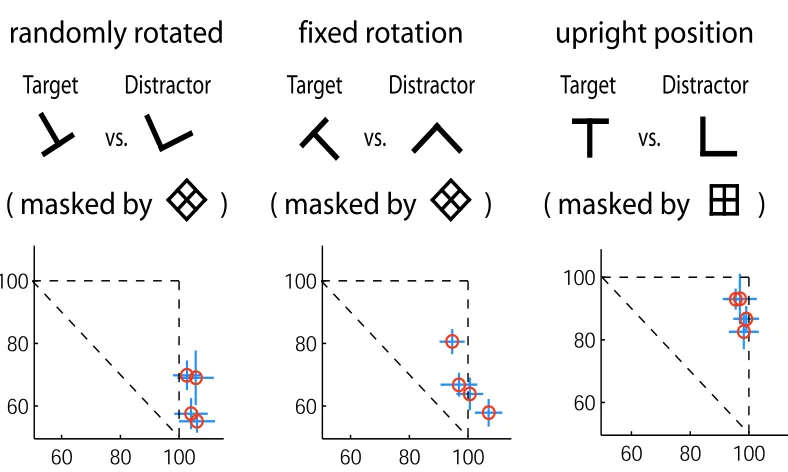
We use the Dual-Task paradigm to test these hypotheses. As usual, we use the central letter discrimination task as the attention-demanding central task. Three conditions are tested for the peripheral letter discrimina-tion task: randomly rotated letter, fixed rotadiscrimina-tion and upright posidiscrimina-tions. For all condidiscrimina-tions, the letter discrim-ination task is between T and L (L is the target in a go/no-go setup where subjects have to release a mouse button when the target is detected). The letter and its mask are located at a random position at 6-degree eccentricity. For a given block of 96 trials, one of the three different tasks is run, and subjects are informed beforehand about the block task. There are 10 blocks tested for each of the three conditions. Fig. 3.10 depicts the three different conditions. Four subjects participated in this experiment. A short training period of 3-4 hours proceeded the actual testing. During this period only the randomly rotated letter discrimination was trained concurrently with the central discrimination task. All three conditions were presented for an equal amount of time in the subsequent real data collection. For each subject, the peripheral letter task SOA was determined based solely on their single task performance on the randomly rotated letter discrimination task.
3.6.2
Results
randomly rotated
fixed rotation
upright position
Target
Distractor
( masked by
)
Target
Distractor
( masked by
)
Target
Distractor
( masked by
)
vs.
vs.
vs.
60 80 100
60 80 100
60 80 100
60 80 100
60 80 100
60 80 100
Figure 3.10: Rotated versus fixed rotation versus upright letter experiments. The basic setup of this experi-ment is also Dual-Task paradigm. A letter discrimination task is used peripherally. Three different peripheral conditions and their corresponding performances are shown in three columns. In the first column, the periph-eral task is a randomly rotated T versus randomly rotated L, masked by a perceptual mask. Subjects perform barely at or above chance when attention is not available. This result confirms [16, 77]. The second column shows the peripheral task of a fixed rotation of T versus L, indicated in the figure. Subjects’ performances of this task without attention are slightly better than the randomly rotated letter condition. In the last column, we show results of subjects’ performances for the peripheral task in which the letter T and L are in their upright position, a configuration that is familiar and well-learned for all of our subjects. The normalized per-formances indicate a clear advantage of this condition, showing a near-baseline performance when attention is withdrawn. This result suggests that tasks that are meaningful and well-learned can be carried out by the visual system in a much more efficient manner.
4.8%; pair-wise t-test shows no statistically significant difference between each pair of the three different tasks (t(9) < 1.83,p > 0.05for all cases)). This suggests when there is abundant attentional resource, carrying out the letter discrimination task for all rotation conditions is similar. It is important to point out that the fixed rotation and upright conditions have similar performances as the randomly rotated condition. This indicates that the SOA that was determined for each subject for the peripheral task was effective for all conditions. We observed, however, different performance results under the dual-task paradigm. For the randomly rotated letter task, subjects’ performances were congruent with what is reported in previous studies [16, 77]. Two subjects’ performances were not significantly different from chance (randomly rotated letter task performance under single-task condition, average over 10 blocks for each of the 2 subjects:74.2±3.3%
than chance, but significantly lower than their baseline performances obtained when attention was available (randomly rotated letter task performance under single-task condition, average over 10 blocks for each of the 2 subjects:70.6±4.4%and78.9±4.1%; randomly rotated letter task performance under dual task condition, average over 10 blocks for each of the 2 subjects: 57.8±7.2%and61.5±5.5%; t-test results comparing dual-task condition performances with single-task condition performances:t(18)>3.61,p <0.001for each subject). For the fixed but uncommon rotation (non-upright), subjects’ performances varied more than the random rotation condition. Three subjects’ dual-task performances were comparable to chance level or just slightly higher (fix-rotation letter task performance under dual task condition, average over 10 blocks for each of the 3 subjects:56.0±4.5%,56.0±6.7%and59.1±4.2%, t-test results: t(9)<1.83,p >0.05for the first two subject;t(9)>4.30,p <0.01for the third subject). One subject performed at81%of his baseline level performance (single task condition: 78.1±8.1%; dual task condition:67.2±4.6%). We should then compare this result to the last condition: upright letter discrimination. Here all subjects performed above
80%of their baseline performance level (single task condition performance, average over 10 block for each subject:85.2±4.4%,87.2±5.7%,78.1±8.1%and89.1±4.3%; dual task condition performance, average over 10 blocks for each subject: 72.9±7.9%,77.3±6.1%,74.2±9.1%and83.6±5.3%). One subject’s performance was not significantly different from her performance when attention was available (single-task condition: 78.1±8.1%; dual-task condition: 74.2±9.1%; t-test result: t(18)< 1.73,p > 0.05). There is thus a clear pattern that the least amount of attention resource is needed when letters are in their upright positions.
3.6.3
Discussion
Two independent hypotheses were tested in this set of experiments. We found that subjects could not recog-nize rotated letters without attention even when the rotation is fixed to one angle throughout the entire testing period of several hours. This result indicates that stimulus predictability alone cannot reduce much of the attentional load required for such a task.
Chapter 4
Summary
4.1
Natural Scene Categorization Requires Little Attention
Natural scene categorization is one of the most evolutionarily relevant tasks of the human visual systems. The superb efficiency of this task has stimulated much research across the fields of neural psychophysics, physiology and modeling [8,77,109,135,138]. Contrary to the daily experience of the effortlessness of natural scene recognition, it is one of the hardest tasks that the modern state-of-the-art computer vision algorithms have yet to accomplish. This difficulty is mostly due to the vast variability across similar categories of the natural scenes. Unlike low-level tasks such as orientation discrimination or texture recognition, in which much of the tasks can be accomplished through filtering of the primary visual cortex [83], understanding the categorical information across different examples of natural scenes is usually thought to be a high-level visual task. In an effort to understand the processing of natural scene categorization, we have chosen an approach to study the efficiency of this process in the near absence of attention.
Visual attention is considered to be one of the first and foremost means of controlling the flow of informa-tion between different levels of visual processing. Numerous studies have probed the funcinforma-tion of atteninforma-tion, demonstrating much attentional control over stimuli with complex and conjugate features [140, 157]. Need-less to say, the function of attention is tightly associated with the computational function of recognition in the human visual system. We hope that by manipulating the attentional condition of various natural scene categorization tasks, as well as comparing it with other recognition tasks, much light can be shed in the under-standing of the fundamental mechanisms that enable us such a rapid and fast ability of scene categorization.
can be accessed outside the focus of attention. It has already been argued that the “gist” of a visual scene could be available preattentively [8, 157]. In this context, the contents of the “gist” could in fact be extended to include information about the presence of a complex target category whose appearance is not known in a