Perspectives
Anecdotal, Historical and Critical Commentaries on Genetics
Edited by James F. Crow and William F. Dove
Navigating Without a Road Map
Michael R. Culbertson
1Laboratories of Genetics and Molecular Biology, University of Wisconsin, Madison, Wisconsin 53706
H
ISTORY shows that unplanned, unanticipated dis-coveries in model organisms have had a major impact on the creation of new knowledge leading to a deeper understanding of human disease. By definition, unanticipated discoveries fall outside the boundaries of prospective road maps. I will use my own research path to illustrate the point, but not because my story is exceptional. It derives power from the fact that it is commonplace.When I was a young scientist in the 1970s, one of my mentors made a statement I never forgot. It went some-thing like this: ‘‘It does not matter where you start, even if the starting point seems mundane. With good train-ing, plus a little luck, the avenues that you travel along will lead into unanticipated and unexplored territory. You will not know what the terrain looks like until you get there.’’ I took this to mean that I was authorized to practice science without a road map, although it was also pointed out that this was not the recommended formula for getting a fundable score on a federal grant and that navigating without a road map was the method of choice only for a small cadre of scientists called geneticists.
In 1975 I began my postdoctoral experience with Gerry Fink at Cornell University. I was shown a refrig-erator with a handwritten sign on the door that said ‘‘Legacies.’’ I was told that I would find a project in that refrigerator. Inside was a box full of vials containing strains ofSaccharomyces cerevisiaewith a sign on it that said ‘‘Charnas.’’ I later co-authored an article with Larry Charnas (Culbertson et al. 1977), a Cornell
under-graduate, but we never met. He had left for medical school before I arrived at Cornell. Larry made strains that carried mutations induced with ICR-170, a muta-gen related to ICR-191, which was known to cause
frame-shift mutations in bacteria (Yournoand Health1969).
He also found extragenic suppressors mapping at two loci. I spent 3 years as a Jane Coffin Childs Fellow working on frameshift suppressors in the belief that this starting point could serve as an entrance into poorly understood mechanisms of post-transcriptional control of gene expression. I realized that translation did not take place in a vacuum and that gene expression was likely also to be regulated by translational mechanisms. Beginning in 1978 as an assistant professor at the University of Wisconsin, Madison, I characterized frame-shift mutations and suppressors. Several dozen ICR-induced mutations, mostly at theHIS4locus, were cloned and sequenced. All of them were11 insertions in runs of G/C base pairs (Mathisonand Culbertson1985).
Twenty-seven suppressor genes were identified (Gaber
et al.1983), including tRNA and protein-coding genes. Three glycine and two proline tRNA multi-gene families were described. We learned a lot about the intricacies of coding by studying how altered tRNAs suppressed 11 insertions (Gaberand Culbertson1984).
The glycine tRNA suppressors contained an extra nucleotide in the anticodon loop (Figure 1A). These tRNAs had 5 bp in the anticodon stem and eight un-paired bases in the anticodon loop instead of the normal seven bases (Gaber and Culbertson 1982;
Mendenhallet al.1987). The proline tRNAs revealed
an interesting relationship between tRNA introns and frameshift suppression. One of the proline isoacceptors was produced from a redundant set of genes containing an intron in the anticodon loop that was spliced out to form the mature tRNA (Figure 1B) (Cummins et al.
1985). The suppressor alleles always produced a tRNA containing a base substitution in the bottom base pair of the anticodon stem rather than an insertion in the an-ticodon loop. This resulted in a shortened stem with 4 bp and an anticodon loop that, after splicing, con-tained nine unpaired bases. The anticodon loop was expanded without a base insertion, and this led to
1Address for correspondence:Robert M. Bock Laboratories, 1525 Linden
Dr., University of Wisconsin, Madison, WI 53706. E-mail: [email protected]
suppression (Wineyet al.1986). By analyzing
suppres-sor tRNAs with eight- or nine-base anticodon loops in the context of structural models, the mechanism of suppression came to be understood in considerable detail (Culbertsonet al. 1990). By inference,
knowl-edge of the universal triplet code was enriched. Some suppressor genes encoded proteins: the trans-lation termination factor RF3, the global transcription factor Mbf1p, and ribosomal protein S3 (Wilsonand
Culbertson1988; Hendricket al.2001). Some genes
were not immediately found due to redundancy or be-cause suppressor mutations were rare. Using specialized screens, frameshift suppressor mutations were found in
TEF2, one of two redundant genes coding for EF1a, the elongation factor that controls translational proofead-ing (Sandbaken and Culbertson 1988), and EBS1,
whose product inhibits translation initiation (Fordet al.
2006). In the accepted parlance of National Institutes of Health summary statements, useful information was forthcoming on mechanisms of translational fidelity, but all things considered, nothing earth shattering was discovered. However, the early work on frameshift sup-pressors led to future insights that shed light on human disease mechanisms.
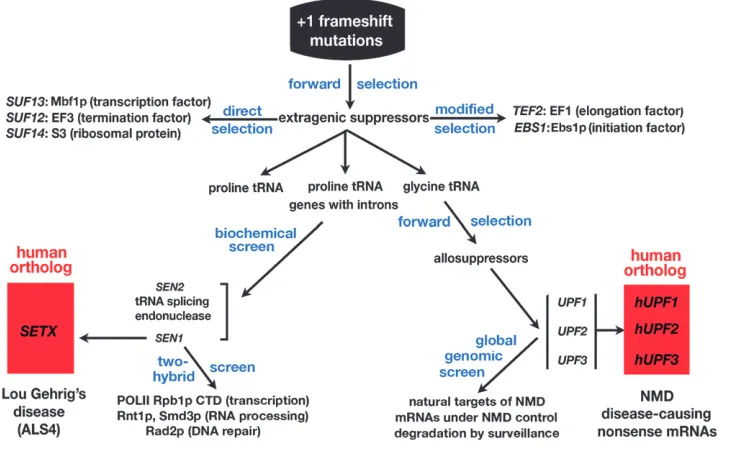
Looking backward, the forks in the road that define my contributions were driven by curiosity. Major changes in direction were established by two exceptional grad-uate students in the mid-1980s (Figure 2). One, Mark Winey, was intrigued with tRNA splicing on the basis of what we knew about the intron-containing proline tRNAs. He devised an in vitro biochemical assay for tRNA-splicing endonuclease activity, which required scaling down a partial enzyme purification to a sample that could fit into a table-top centrifuge tube. He assayed 400 mutagenized strains from the ‘‘Hartwell collection,’’ the same strains that yielded the cell division cycle mutants, and found splicing-defective mutants defining two genes,
SEN1and SEN2(Wineyand Culbertson1988). The
latter turned out to encode a subunit of tRNA-splicing
endonuclease (Trottaet al.1997), whereas the product
of the former was not part of the enzyme.
I decided to pursue SEN1. It was more enigmatic because mutations inSEN1conferred pleiotropic phe-notypes (Ursic et al. 1997). It was later shown that
Sen1p interacts with a wide variety of proteins, including the C-terminal domain of Rpb1p, the largest subunit of RNA polymerase II (Ursicet al.2004).SEN1mutations
affect transcription, DNA repair, and RNA processing (Rasmussenand Culbertson1998; Ursicet al.2004;
Steinmetz et al. 2006). Knowledge about Sen1p
sud-denly became important on a more global scale when it was reported that mutations in the human ortholog of yeastSEN1, calledSETX(senataxin), were implicated in amyotrophic lateral sclerosis (ALS4), the syndrome made famous by the baseball player Lou Gehrig, who died of ataxia (Chenet al.2004; Duquetteet al.2005).
Many of the human mutations reside in the N-terminal segment of the protein where we knew that domains for protein–protein interactions are located. In recent ex-periments, some of the human mutations were recon-structed in yeast SEN1 and shown to impair specific protein–protein interactions. Most notably, one muta-tion impairs the ability of Sen1p to bind to the c-terminal domain of Rpb1p (D. Ursic and M. R. Culbertson,
unpublished results). The payoff is clear for years of work on yeastSEN1, performed without knowing when or how it would be useful. This fork in the road led directly to human disease. Basic knowledge about SEN1 function obtained through studies in yeast will guide future efforts to understand the specific biochemical defects in patients withSETX-related forms of ALS4.
When Mark Winey began work onSEN1in the 1980s, someone who looked like a student, but older than average, came to my office, wanting to quit his job as a computer programmer and become a geneticist. He would pay his own way as a special student, take the re-quired courses, and apply to graduate school. After the apprenticeship period for this student, I had to find a
Figure 1.—Altered tRNAs suppress
project for Peter Leeds, the computer programmer turned geneticist, who had a background in physics. I did not anticipate that he would make a ground-breaking discovery.
In my own postdoctoral studies, I observed that cer-tain allelic combinations of frameshift mutations and suppressors like the one shown in Figure 1A were pe-culiar because suppression was temperature sensitive, a phenotype not typical of mutant tRNAs. I observed that, when a lawn ofhis4-38 SUF1cells was left for a week at the restrictive temperature, colonies grew on the back-ground of nongrowing cells. The variants harbored mutations at two unlinked loci, which I named UPF1
andUPF2(forup-frameshift) (Culbertsonet al.1980).
They were allosuppressors, requiring the presence of the suppressor tRNA to be phenotypically visible (Table 1). I saved the allosuppressors for almost 10 years in a box of ‘‘Legacies’’ in honor of Gerry Fink. I gave Peter the box and said that, if he could figure out what they were, he would have a thesis.
Peter observed that most of the his4frameshift mu-tations brought a stop codon into register immediately after the site of the frameshift insertion. He found an article published from the laboratory of Francois Lacroute, showing that nonsense mutations in theURA3
gene caused reduced abundance of URA3 mRNA
(Lossonand Lacroute1979). Lossonand Lacroute
(1979) hypothesized that nonsense mutations trigger accelerated mRNA decay. However, no genes were iden-tified to link premature translation termination with mRNA decay. Putting the observations together, Peter argued that the normally out-of-frame stop codon fol-lowing a11 insertion might behave like the premature stop codons inURA3, triggering rapid mRNA decay and reduced abundance. The allosuppressors might be mu-tations in genes required for the decay pathway. This molecular explanation was consistent with the allosup-pressor phenotype (Table 1). Growth at 37° resulted from the combined action of the frameshift suppressor tRNA and the increased abundance of the mRNA caused by mRNA stabilization in the absence of a functional decay pathway.
Peter cloned theUPF1gene. At the same time, Mark Winey clonedSEN1.When they scanned the databases, no other genes that resembledUPF1orSEN1were found. In an act of serendipity, Peter and Mark comparedUPF1
andSEN1sequences with each other and found a long segment of close similarity due to the presence of con-served motifs in both proteins.SEN1andUPF1became the founding members of what are now called the superfamily I DNA/RNA helicases (Demarini et al.
1992; Koonin1992; Leedset al.1992).
To test the model that UPF genes are required for mRNA decay, we collaborated with Allan Jacobson and colleagues at the University of Massachusetts Medical School because of their expertise in measuring RNA
Figure 2.—A road map from
yeast to human disease. The forks in the road were made possible by curiosity-driven experiments.
TABLE 1
A curiosity-driven experiment leads to the discovery of the genes required for NMD in yeast
Growth without histidine
Genotype 30° 37°
Wild type 1 1
his4-38 suf1wtUPF1wt
his4-38 SUFIfsUPF1wt 1
his4-38 SUF1fsupf1D 1 1
his4-38 suf1wtupf1D
decay rates. The results from the collaboration and from Peter’s thesis were published in 1991 and 1992 (Leeds
et al.1991, 1992). We demonstrated that theUPFgenes were required for the phenomenon described earlier by Lossonand Lacroute(1979) where premature
termi-nation of translation was thought to trigger rapid mRNA decay. The pathway that required theUPFgenes came to be known as nonsense-mediated mRNA decay (NMD).
A colleague at the University of Wisconsin, Phil Anderson, and his student, Rock Pulak, also stumbled upon the NMD pathway inCaenorhabditis eleganswith no premeditated intention of studying mRNA decay. They got there by a circuitous route similar to ours emanat-ing from an interest in muscle development in worms (Hodgkin et al. 1989). I recall a joint lab meeting at
which we realized that we were working on the same pathway in different organisms. They published a model in which NMD was an RNA surveillance pathway that prevented the accumulation of truncated proteins that might be deleterious (Pulakand Anderson1993). This
made sense for two reasons: (1) Errors in gene expres-sion could produce deleterious truncated proteins and (2) diploid organisms carry potentially deleterious alleles in heterozygous condition that constitute what is called the hidden genetic load. NMD ensured the recessive na-ture of heterozygous nonsense alleles, thereby preventing negative effects when present in heterozygous condition (Grimsonet al.2004).
In C. elegans, seven genes required for NMD were identified (SMG-1–SMG-7) (Caliet al.1999; Pageet al.
1999; Anderset al.2002), but in yeast only threeUPF
genes were found. The novelC. elegansgenes included
SMG-1, a PI3K kinase that phosphorylatesSMG-2 (UPF1)
and genes coding for components of protein phospha-tase PP2A, which dephosphorylatesSMG-2 (UPF1).The cycle of phosphorylation and dephosphorylation is re-quired for NMD inC. elegans. In mammals, Lynn Maquat at the University of Rochester has worked since the early 1980s studying the phenomenon of rapid decay of non-sense mRNAs (Maquat et al.1981). Her work was
in-spired by her mentor, Jeff Ross, a professor in the McArdle Labs at the University of Wisconsin, whom I recognize as the pioneer of biochemical studies on mRNA decay mechanisms. As sequences from mamma-lian genome projects became available, both human and mouse orthologs of the yeastUPFgenes were iden-tified (Applequistet al.1996; Perlicket al.1996; Lykke
-Andersen et al. 2000; Serin et al. 2001). The genes
coding for human kinase and phosphatase components involved in NMD were also identified by looking for orthologs of theC. elegansgenes (Denninget al.2001;
Yamashitaet al.2001; Chiuet al.2003).
The contributions from model organisms went be-yond the identification of the genes. For example, to show thathUPF1was required for NMD in an era before RNA interference methods were available,hUPF1alleles carrying dominant-negative mutations were introduced
into human cell lines to ask whether they conferred phenotypes expected for loss of function of the NMD pathway (Sun et al. 1998). The study was guided by
dominant-negative mutations found earlier in yeast
UPF1 by Peter Leeds (Leeds et al. 1992). The study
showed thathUPF1and yeastUPF1not only were related by sequence comparison, but also were likely to be functionally equivalent.
In the mid-1990s, the cellular distribution and the association of Upf proteins with polyribosomes were established in yeast. It was suggested then that they might form subcomplexes that undergo sequential as-sembly on nonsense transcripts engaged in translation (Atkinet al.1997). One of the yeast proteins, Upf3p,
was found to shuttle between the nucleus and cyto-plasm (Shirleyet al. 1998, 2002), suggesting that it
might be the first to assemble and might be involved in transcript selection and recruitment (Culbertsonand
Neeno-Eckwall2005). When the human orthologs of
the yeastUPFgenes were identified, similar observations were made. Human Upf3p (which is encoded by two dis-tinct genes), also a shuttling protein, was found to be a subunit of a protein complex that assembles at exon– exon junctions (called the exon junction complex, or the EJC) following splicing in the nucleus (Kimet al.2001).
The EJC exits the nucleus with mRNAs. Since most, if not all, exon junctions are marked with an EJC, multiple Upf3p molecules are distributed across the mRNAs at locations defined by the locations of the spliced introns. This fact caught the eye of a population geneticist at Indiana University, Michael Lynch, who published evi-dence suggesting a link between the evolution of introns and NMD (Lynchand Richardson2002).
In the late 1990s, I got a call from Phil Hieter, who was then at Johns Hopkins University Medical School. He found that suppressors of a temperature-sensitive allele of CTF13, an essential gene coding for a kinetochore protein, were distributed among the three UPFgenes required for NMD. We collaborated and found that the accumulation of wild-typeCTF13mRNA was dependent on the NMD pathway (Dahlseidet al.1998). However,
there were no in-frame premature stop codons in the protein-coding sequence. This was a hint that NMD was important for something in addition to RNA surveil-lance. There had been other earlier indications of this, but as a geneticist, I was convinced much more by the biological appearance of suppressors than by Northern blots.
Using DNA arrays, it was shown that NMD is part of the normal repertoire of gene expression in addition to its role in RNA surveillance (Leliveltand Culbertson
1999; Heet al.2003). In a recent study, the decay rates of
all RNAs in yeast were measured and compared in wild-type and Nmd strains, using arrays (Guanet al.2006). It
mRNAs and the expression level of several hundred more that respond indirectly to NMD. Several targeting mechanisms that involve special features of the selected mRNAs were described, such as the presence of a trans-lated upstream open reading frame in the 59UTR that can trigger NMD (Gabaet al.2005). The natural targets
of NMD in yeast fall into two broadly defined functional groups: those affecting chromosome structure and be-havior and those affecting cell surface dynamics, sug-gesting that NMD might play a role in the response of yeast to changes in the environment.
Contributions to NMD have also been forthcoming from other model organisms. InArabidopsis thalania, it was recently shown thatupf1mutants cause phenotypes indicative of a role in plant development. Furthermore, NMD may be linked with RNA interference (Arciga
-Reyeset al.2006). InDrosophila melanogaster,UPF1,UPF2,
and SMG-1 have been shown to play a role in de-velopment (Metzstein and Krasnow 2006). Studies
on the function ofUPFandSMGgenes in processes in addition to RNA surveillance have been reported for mice and humans. Genetic rearrangements that occur during T-cell-mediated immunity generate nonsense transcripts that are degraded by NMD (Gudikote and
Wilkinson 2002). Also, NMD degrades alternatively
spliced transcripts that contain premature stop codons. Endogenous transposons and retroviruses are targets of NMD (Mendellet al.2004; Panet al.2006).
The UPF genes are ubiquitous in eukaryotes. In all likelihood, NMD is an ancient pathway that began to evolve when the ancestors of Archea and eukaryotes separated (Culbertson2003). As our understanding of
NMD in humans continues to emerge, what has been crystal clear is the reliance for new ideas on information from multiple model organisms representing diverse branches of the tree of life (Figure 3). Over the past few decades, contributions to our understanding of NMD
have been made from model organisms representing plants, fungi, invertebrates, vertebrates, and insects.
The way in which the NMD story has unfolded un-derscores the value of parallel studies in multiple model organisms to bring about a richer understanding of the biology of all organisms. The real power of genetics comes from a combination of phenotype-driven for-ward genetics in multiple model organisms coupled with candidate molecule-driven analyses of informative mutations in humans. One-third of all of the disease-causing alleles that have been sequenced from human patients with cancer or other genetic disorders are ei-ther frameshift or nonsense alleles (Culbertson1999).
Many of them trigger NMD. A diagnostic test for human nonsense mutations has been described (Noensieand
Dietz 2001), clinical issues related to NMD discussed
(Kuzmiakand Maquat2006), and companies formed
to exploit the possible therapeutic value of NMD. Who would have predicted that the study of frameshift muta-tions three decades ago would lead to a body of funda-mental knowledge important in mechanisms of human disease?
In my research, there was no prospective road map leading directly from frameshift mutations to human disease. The road map looks clear enough in retrospect, but when broken into its component parts, my research path consisted of groups of hypothesis-driven experi-ments interspersed with curiosity-driven selections and screens where the goal was to get new mutants and/or find new genes. The branch points depended critically on the outcome of the curiosity-driven experiments, which frequently yielded unanticipated results. The hypothesis-driven experiments were merely the reduc-tionist analyses of the biological gadgets uncovered by curiosity-driven, forward genetics experiments. When forward genetics is used as the primary driving force in research, it is possible to create new knowledge by navigating without a road map.
LITERATURE CITED
Anders, K. R., A. Grimsonand P. Anderson, 2002 SMG-5, required for nonsense-mediated mRNA decay, associates with SMG-2 and
protein phosphatase 2A. EMBO J.22:641–650.
Applequist, S. E., M. Selg, C. Ramanand H. Jack, 1996 Cloning
and characterization of HUPF1, a human homolog of the
Saccha-romyces cerevisiae nonsense mRNA-reducing UPF1 protein.
Nu-cleic Acids Res.25:814–821.
Arciga-Reyes, L., L. Wootton, M. Kiefferand B. Davies, 2006 UPF1 is required for nonsense-mediated mRNA decay (NMD) and RNAi
in Arabidopsis. Plant J.47:480–490.
Atkin, A. L., L. R. Schenkman, M. Eastham, J. N. Dahlseid, M. J.
Leliveltet al., 1997 Relationship between yeast polyribosomes and Upf proteins required for nonsense mRNA decay. J. Biol.
Chem.272:22163–22172.
Cali, B. M., S. L. Kuchma, J. Lathamand P. Anderson, 1999 smg-7
is required for mRNA surveillance in Caenorhabditis elegans.
Genetics151:605–616.
Chen, Y. Z., C. L. Bennett, H. M. Huynh, I. P. Blair, I. Pulset al.,
2004 DNA/RNA helicase gene mutations in a form of juvenile
amyotrophic lateral sclerosis (ALS4). Am. J. Hum. Genet.74:
1128–1135.
Figure 3.—A road map leading from parallel studies of
Chiu, S. Y., G. Serin, O. O’Haraand L. E. Maquat, 2003 Char-acterization of human Smg5/7a: a protein with similarities to
Caenorhabditis elegansSMG5 and SMG7 that functions in the
de-phosphorylation of Upf1. RNA9:77–87.
Culbertson, M., 1999 RNA surveillance: unforeseen consequences for gene expression, inherited genetic disorders and cancer.
Trends Genet.15:74–80.
Culbertson, M. R., 2003 Looking at mRNA decay pathways
through the window of molecular evolution. Curr. Opin. Genet.
Dev.13:207–214.
Culbertson, M. R., and E. Neeno-Eckwall, 2005 Transcript
selec-tion and the recruitment of mRNA decay factors for NMD in
Sac-charomyces cerevisiae.RNA11:1333–1339.
Culbertson, M. R., L. Charnas, M. T. Johnsonand G. R. Fink,
1977 Frameshifts and frameshift suppressors inSaccharomyces
cerevisiae.Genetics86:745–764.
Culbertson, M. R., K. M. Underbrinkand G. R. Fink, 1980 Frame-shift suppression inSaccharomyces cerevisiae.II. Genetic properties
of group II suppressors. Genetics95:833–853.
Culbertson, M. R., P. Leeds, M. G. Sandbakenand P. G. Wilson, 1990 Frameshift Suppression.American Society for Microbiology, Washington, DC.
Cummins, C. M., M. R. Culbertsonand G. Knapp, 1985 Frameshift suppressor mutations outside the anticodon in yeast proline
tRNAs containing an intervening sequence. Mol. Cell. Biol. 5:
1760–1771.
Dahlseid, J. N., J. Puziss, R. L. Shirley, A. L. Atkin, P. Hieteret al.,
1998 Accumulation of mRNA coding for the Ctf13p
kineto-chore subunit ofSaccharomyces cerevisiaedepends on the same
fac-tors that promote rapid decay of nonsense mRNAs. Genetics150:
1019–1035.
DeMarini, D. J., M. Winey, D. Ursic, F. Webband M. R. Culbertson,
1992 SEN1, a positive effector of tRNA-splicing endonuclease
inSaccharomyces cerevisiae.Mol. Cell. Biol.12:2154–2164. Denning, G., L. Jamieson, L. E. Maquat, E. A. Thompsonand A. P.
Fields, 2001 Cloning of a novel phosphatidylinositol kinase-related kinase: characterization of the human SMG-1 RNA
sur-veillance protein. J. Biol. Chem.276:22709–22714.
Duquette, A., K. Roddier, J. McNabb-Baltar, I. Gosselin, A. St-Deniset al., 2005 Mutations in senataxin responsible for
Quebec cluster of ataxia with neuropathy. Ann. Neurol. 57:
408–414.
Ford, A., Q. Guan, E. Neeno-Eckwall and M. R. Culbertson,
2006 Ebs1p: a global negative regulator of gene expression
con-trolled by the Upf proteins in yeast. Eukaryot. Cell5:301–312.
Gaba, A., A. Jacobsonand M. S. Sachs, 2005 Ribosome occupancy
of the yeastCPA1upstream open reading frame termination
co-don modulates nonsense-mediated mRNA decay. Mol. Cell20:
449–460.
Gaber, R. F., and M. R. Culbertson, 1982 The yeast frameshift
sup-pressor geneSUF16–1encodes an altered glycine tRNA
contain-ing the four base anti-codon 39–CCCG–59. Gene19:163–172.
Gaber, R. F., and M. R. Culbertson, 1984 Codon recognition
dur-ing frameshift suppression inSaccharomyces cerevisiae.Mol. Cell.
Biol.4:2052–2061.
Gaber, R. F., L. Mathison, I. Edelmanand M. R. Culbertson,
1983 Frameshift suppression inSaccharomyces cerevisiae.VI.
Com-plete genetic map of twenty-five suppressor genes. Genetics103:
389–407.
Grimson, A., S. O’Connor, C. L. Newman and P. Anderson,
2004 SMG-1 is a phosphatidylinositol kinase-related protein
ki-nase required for nonsense-mediated mRNA decay in
Caenorhab-ditis elegans.Mol. Cell. Biol.24:7483–7490.
Guan, Q., W. Zheng, S. Tang, X. Liu, R. A. Zinkel et al.,
2006 Impact of nonsense-mediated mRNA decay on the global
expression profile of budding yeast. PLoS Genet.2:1924–1943.
Gudikote, J. P., and M. F. Wilkinson, 2002 T-cell receptor sequen-ces that elicit strong down-regulation of premature termination
codon-bearing transcripts. EMBO J.21:125–134.
He, F., X. Li, P. Spatrick, R. Casillo, S. Donget al., 2003 Genome-wide analysis of mRNAs regulated by the nonsense-mediated and
59to 39mRNA decay pathways in yeast. Mol. Cell12:1439–1452.
Hendrick, J. L., P. G. Wilson, I. Edelman, M. G. Sandbaken, D. Ursic et al., 2001 Yeast frameshift suppressor mutations in the genes coding for transcription factor MBF1 and ribosomal
protein S3: evidence for autoregulation of S3 synthesis. Genetics
157:1141–1158.
Hodgkin, J., A. Papp, R. Pulak, V. Ambrosand P. Anderson, 1989 A
new kind of informational suppression in the nematode
Caeno-rhabditis elegans.Genetics123:301–313.
Kim, V. N., N. Kataokaand G. Dreyfuss, 2001 Role of the
nonsense-mediated decay factor hUpf3 in the splicing-dependent
exon-exon junction complex. Science293:1832–1836.
Koonin, E. V., 1992 A new group of putative RNA helicases. Trends
Biochem. Sci.17:495–497.
Kuzmiak, H. A., and L. E. Maquat, 2006 Applying nonsense-medi-ated mRNA decay research to the clinic: progress and challenges.
Trends Mol. Med.12:306–316.
Leeds, P., S. W. Peltz, A. Jacobson and M. R. Culbertson,
1991 The product of the yeastUPF1gene is required for rapid
turnover of mRNAs containing a premature translational
termi-nation codon. Genes Dev.5:2303–2314.
Leeds, P., J. M. Wood, B. S. Leeand M. R. Culbertson, 1992 Gene
products that promote mRNA turnover inSaccharomyces cerevisiae.
Mol. Cell. Biol.12:2165–2177.
Lelivelt, M. J., and M. R. Culbertson, 1999 Yeast Upf proteins re-quired for RNA surveillance affect the global expression of the
yeast transcriptome. Mol. Cell. Biol.19:6710–6719.
Losson, R., and F. Lacroute, 1979 Interference of nonsense muta-tions with eukaryotic messenger RNA stability. Proc. Natl. Acad.
Sci. USA76:5134–5137.
Lykke-Andersen, J., M. D. Shuand J. A. Steitz, 2000 Human Upf proteins target an mRNA for nonsense-mediated decay when
bound downstream of a termination codon. Cell103:1121–1131.
Lynch, M., and A. O. Richardson, 2002 The evolution of
spliceo-somal introns. Curr. Opin. Genet. Dev.12:701–710.
Maquat, L. E., A. J. Kinniburgh, E. A. Rachmilewitzand J. Ross,
1981 Unstable beta-globin mRNA in mRNA-deficient b
thalas-semia. Cell27:543–553.
Mathison, L. M., and M. R. Culbertson, 1985 Suppressible and
non-suppressible11 G:C base-pair insertions induced by ICR–
170 at the his4 locus inSaccharomyces cerevisiae.Mol. Cell. Biol.
5:2247–2256.
Mendell, J. T., N. A. Sharifi, J. L. Meyers, F. Martinez-Murillo
and H. C. Dietz, 2004 Nonsense surveillance regulates
expres-sion of diverse classes of mammalian transcripts and mutes
geno-mic noise. Nat. Genet.36:1073–1078.
Mendenhall, M. D., P. Leeds, H. Fen, L. Mathison, M. Zwicket al.,
1987 Frameshift suppressor mutations affecting the major glycine
transfer RNAs ofSacchacromyces cerevisiae.J. Mol. Biol.194:41–58. Metzstein, M. M., and M. A. Krasnow, 2006 Functions of the
non-sense-mediated mRNA decay pathway inDrosophiladevelopment.
PLoS Genet.2:2143–2154.
Noensie, E. N., and H. C. Dietz, 2001 A strategy for disease gene identification through nonsense-mediated mRNA decay
inhibi-tion. Nat. Biotechnol.19:434–439.
Page, M. F., B. Carr, K. R. Anders, A. Grimsonand P. Anderson,
1999 SMG-2 is a phosphorylated protein required for mRNA
surveillance in Ceanorhabditis elegans and related to Upf1p in
yeast. Mol. Cell. Biol.19:5943–5951.
Pan, Q., A. L. Saltzman, Y. K. Kim, C. Misquitta, O. Shaiet al.,
2006 Quantitative microarray profiling provides evidence
against widespread coupling of alternative splicing with non-sense-mediated mRNA decay to control gene expression. Genes
Dev.20:153–158.
Perlick, H. A., S. M. Medghalchi, F. A. Spencer, R. J. Kenndzior
and H. C. Dietz, 1996 Mammalian orthologues of a yeast
reg-ulator of nonsense transcript stability. Proc. Natl. Acad. Sci. USA
93:10928–10932.
Pulak, R., and P. Anderson, 1993 mRNA surveillance by the
Caeno-rhabditis eleganssmg genes. Genes Dev.7:1885–1897.
Rasmussen, T. P., and M. R. Culbertson, 1998 The putative nucleic acid helicase Sen1p is required for formation and stability of ter-mini and for maximal rates of synthesis and levels of
accumula-tion of snoRNAs inSaccharomyces cerevisiae.Mol. Cell. Biol. 18:
6885–6896.
Sandbaken, M. G., and M. R. Culbertson, 1988 Mutations in
elon-gation factor EF1–aaffect the frequency of amino acid
misincor-poration and frameshifting inSaccharomyces cerevisiae. Genetics
Serin, G., A. Gersappe, J. D. Black, R. Aronoffand L. E. Maquat,
2001 Identification and characterization of human orthologues
toSaccharyomyces cerevisiaeUpf2 protein and Upf3 protein ( Caeno-rhabditis elegansSMG-4). Mol. Cell. Biol.21:209–223.
Shirley, R. L., L. R. Schenkman, M. J. Lelivelt, J. N. Dahlseid
and M. R. Culbertson, 1998 A factor required for
nonsense-mediated mRNA decay in yeast is exported from the nucleus to the cytoplasm by a nuclear export signal sequence. J. Cell.
Sci.14:3129–3143.
Shirley, R. L., A. S. Ford, R. Richards, M. Albertiniand M. R. Culbertson, 2002 Nuclear import of Upf3p is mediated by importin-a/b and export to the cytoplasm is required for a func-tional nonsense-mediated mRNA decay pathway in yeast.
Genet-ics161:1465–1482.
Steinmetz, E. J., C. L. Warren, J. N. Kuehner, B. Panbehi, A. Z. Ansariet al., 2006 Genome-wide distribution of yeast RNA
poly-merase II and its control by Sen1 helicase. Mol. Cell24:735–746.
Sun, X., H. A. Perlick, H. C. Dietzand L. E. Maquat, 1998 A
mu-tated human homologue to yeast Upf1 protein has a dominant-negative effect on the decay of nonsense-containing mRNAs in
mammalian cells. Proc. Natl. Acad. Sci USA95:10009–10014.
Trotta, C. R., F. Miao, E. A. Arn, S. W. Stevens, C. K. Hoet al.,
1997 The yeast tRNA splicing endonuclease: a tetrameric
en-zyme with two active site subunits homologous to the archaeal
tRNA endonucleases. Cell89:849–858.
Ursic, D., K. L. Himmel, K. A. Gurley, F. Webband M. R. Culbertson,
1997 The yeastSEN1gene is required for the processing of
di-verse RNA classes. Nucleic Acids Res.25:4778–4785.
Ursic, D., K. Chinchilla, J. S. Finkel and M. R. Culbertson,
2004 Multiple protein/protein and protein/RNA interactions
suggest roles for yeast DNA/RNA helicase Sen1p in transcrip-tion, transcription-coupled DNA repair and RNA processing.
Nu-cleic Acids Res.32:2441–2452.
Wilson, P., and M. R. Culbertson, 1988 SUF12 suppressor protein of yeast: a fusion protein related to the EF1 family of elongation
factors. J. Mol. Biol.199:559–573.
Winey, M., and M. R. Culbertson, 1988 Mutations affecting the
tRNA-splicing endonuclease activity of Saccharomyces cerevisiae.
Genetics118:609–617.
Winey, M., M. D. Mendenhall, C. M. Cummins, M. R. Culbertson
and G. Knapp, 1986 Splicing of a yeast proline tRNA containing
a novel suppressor mutation in the anticodon stem. J. Mol. Biol.
192:49–63.
Yamashita, A., T. Ohnishi, I. Kashima, Y. Taya and S. Ohno,
2001 Human SMG-1, a novel phosphatidylinositol 3-kinase
re-lated protein kinase, associates with components of the mRNA surveillance complex and is involved in the regulation of
nonsense-mediated mRNA decay. Genes Dev.15:2215–2228.
Yourno, J., and S. Health, 1969 Nature of the hisD3018 frameshift