HITCHCOCK, MONICA RENEE. Monte Carlo simulations of complete phase equilibria
for binary mixtures. (Under the direction of Carol K. Hall.)
The objective of this thesis is to study the phase equilibria of binary mixtures
us-ing molecular simulation. Vapor-liquid, vapor-solid, liquid-liquid, and liquid-solid
coexistence lines are calculated for binary mixtures of Lennard-Jones spheres
us-ing Monte Carlo simulation and the Gibbs-Duhem integration technique. Complete
phase diagrams,i.e., showing all types equilibrium between vapor, liquid, and solid
phases are constructed. The calculations presented in this thesis mark the first
time that molecular simulation has been used to obtain phase diagrams describing
all types of equilibria between vapor, liquid, and solid phases. We present
com-plete phase diagrams for binary Lennard-Jones mixtures with diameter ratios
rang-ing from 0.85 to 0.95 and attractive well-depth ratios rangrang-ing from 0.45 to 1.6, at
reduced pressures ranging from 0.002 to 0.1. The Lorentz-Berthelot combining rules
are used to calculate the cross-species interaction parameters. We systematically
ex-plore how the complete phase diagrams change as a function of the diameter ratio,
well-depth ratio, binary interaction parameter, and system pressure.
We first calculate complete phase diagrams for several binary mixtures at a
sin-gle pressure and find that for well-depth ratios of unity (equal attractions among
species) there is no interference between the vapor-liquid and solid-liquid
coexis-tence regions. As the well-depth ratio increases or decreases from unity, the
the solid-liquid lines have a shape characteristic of a solid solution (with or without
a minimum melting temperature); as the diameter ratio decreases the solid-liquid
lines fall to lower temperatures until they eventually drop below the solid-solid
co-existence region, resulting in either a eutectic or peritectic three-phase line.
We then vary the binary interaction parameter in the Berthelot combining rule to
study the effect of unlike pair attractions on binary mixture phase behavior. When
the binary interaction parameter is unity we find a vapor-liquid coexistence region
with a eutectic solid-liquid coexistence region. These two regions are separated
by a completely miscible liquid phase. When the binary interaction parameter is
less than unity we find that the vapor-liquid and solid-liquid coexistence regions
interfere. This interference results in the appearance of a vapor-solid coexistence
region bounded above and below by solid-liquid-vapor coexistence lines. We also
find that when the binary interaction parameter is less than unity, there is a region
of liquid-liquid immiscibility that is metastable with respect to the solid-fluid phase
equilibria.
Next we calcuate temperature versus composition phase diagrams for one
mix-ture at five reduced pressures in order to examine the effects of pressure on
com-plete phase behavior. We observe interference between the vapor-liquid and
solid-liquid coexistence regions at the lowest pressure. As the pressure increases, the
vapor-liquid coexistence region shifts to higher temperatures, while the solid-liquid
coex-We then present pressure versus temperature projections for several mixtures to
explore how the three-phase loci change with variations in diameter ratio and
well-depth ratio. We find that as the diameter ratio decreases, the maximum pressure
in the liquid-vapor locus decreases and the characteristic shape of the
solid-liquid coexistence region changes from peritectic to eutectic. As the well-depth ratio
EQUILIBRIA FOR BINARY MIXTURES
by
MONICA RENEE HITCHCOCK
A thesis submitted to the Graduate Faculty of North Carolina State University
in partial fulfillment of the requirements for the Degree of
Doctor of Philosophy
Chemical Engineering
Raleigh, NC 27695
2000
APPROVED BY:
Carol K. Hall Robert E. Funderlic Chair of Advisory Committee
Biography
The author was born in Montrose, Pennsylvania on February 10, 1971. She is the
elder daughter of Leonard and Lorraine Hitchcock and has one sister, Lesley
Hitch-cock Tewksbury. She received a B. S. degree in Chemical Engineering from Syracuse
University in December, 1993. In January, 1994, she was admitted to North Carolina
State University to pursue graduate studies in Chemical Engineering. She received
an M. S. degree in Chemical Engineering in December, 1998. On October 7, 2000,
Acknowledgements
It is a pleasure to acknowledge the many people who have contributed their wisdom,
support, and encouragement to the preparation of this thesis.
First, I thank my thesis advisor, Professor Carol Hall, for her guidance and
un-failing confidence in my abilities to conduct scientific research. Professor Hall is
extremely committed to advising graduate students and I feel fortunate to have
been one of her students.
I take this opportunity to warmly acknowledge Professor Cynthia Hirztel who
first inspired me to pursue graduate studies while I was an undergraduate at
Syra-cuse University.
I gratefully acknowledge helpful discussions with Professor David Kofke (State
University of New York at Buffalo) who was instrumental in helping me get started
with the Gibbs-Duhem integration method. I also thank Professor Cor Peters (Delft
University of Technology, The Netherlands), Professor Gerhard Schneider
(Univer-sity of Bochum, Germany), and Professor Leonid Boshkov (Academy of
Refrigera-tion, Ukraine) who promptly answered my questions regarding the topic of phase
equilibria.
I thank the GAANN Computational Sciences Fellowship Program of the U.S.
De-partment of Education, the Office of Energy Research, Basic Sciences, Chemical
Sci-ence Division of the U.S. Department of Energy, and the Donors of the Petroleum
Research Fund administered by the American Chemical Society for financial
I am indebted to the Hall research group’s past and present computer system
ad-ministrators: Harpreet Gulati, Nirupama Kenkare, Julie McCormick, Brian Attwood,
and Andrew Schultz. None of the work in presented in this thesis would have been
possible without their incredible talent, sacrifice, and hard work.
To the members of my research group, as well as my other colleagues in the
department with whom I have interacted, both at work and at play, I thank you for
your friendship and for the fond memories of intramural teams, cycling outings,
and camping trips you have helped create. Special thanks to my former roommates,
Florence Henon and Anne Voegler Smith, for making life outside of school enjoyable.
I am especially thankful for the love and support of family and friends during my
graduate school career. My parents, Leonard and Lorraine Hitchcock, have always
been a source of love and encouragement and I am forever thankful. I would like to
thank my sister, Lesley, her husband, Kevin, and their wonderful children, Susanne,
Seth, and Travis, for all the lively, refreshing visits to their home. A very special thank
you to the Lamm family and to my friends Kenneth and Ivy Parker, for providing a
’home away from home’ in North Carolina. Finally, I thank my husband, David,
for always believing in me, always finding a way to make me laugh, and always
Table of Contents
Page
List of Tables ix
List of Figures xi
Chapter 1 Introduction 1
1.1 Overview . . . . 4
1.2 References . . . . 10
Chapter 2 Molecular simulationof complete phase diagrams for binary mix-tures 11 2.1 Introduction . . . . 11
2.2 Gibbs-Duhem integration . . . . 18
2.2.1 Initial condition . . . . 19
2.2.2 Integration . . . . 21
2.2.3 Simulations . . . . 24
2.3 Results and Discussion . . . . 26
2.4 Summary. . . . 36
2.5 References . . . . 39
Chapter 3 The effect of the binary interaction parameter on complete phase
behavior of binary mixtures 49
3.1 Introduction . . . . 49
3.2 Method . . . . 53
3.2.1 Gibbs-Duhem integration . . . . 53
3.2.2 Simulations . . . . 56
3.3 Results . . . . 58
3.4 Summary. . . . 61
3.5 References . . . . 63
3.6 Figures . . . . 66
Chapter 4 The effect of pressure oncomplete phase behavior of binary mix-tures 72 4.1 Introduction . . . . 72
4.2 T-xphase diagrams for binary mixtures . . . . 73
4.3 P-T projections for binary mixtures . . . . 76
4.4 Summary. . . . 78
4.5 References . . . . 79
4.6 Figures . . . . 80
Chapter 5 Pressure-temperature projection for a binary Lennard-Jones mix-ture 91 5.1 Introduction . . . . 91
5.3 Results . . . . 94
5.4 Summary. . . . 96
5.5 References . . . . 97
5.6 Figures . . . . 99
Chapter 6 Future Work 102 6.1 References . . . . 106
6.2 Figures . . . . 108
Appendices 110 Appendix A Solid-liquid phase equilibrium for binary Lennard-Jones mix-tures 111 A.1 Introduction . . . . 111
A.2 Method . . . . 121
A.2.1 Initial condition . . . . 123
A.2.2 Integration . . . . 125
A.2.3 Simulations . . . . 127
A.3 Results and Discussion . . . . 129
A.3.1 Comparison with molecular theory and experiment . . . . 130
A.3.2 Influence of attractions on phase behavior . . . . 133
A.4 Summary. . . . 140
A.5 References . . . . 142
Appendix B Code Listing 162
List of Tables
Page
Chapter 1 Introduction 1
Chapter 2 Molecular simulationof complete phase diagrams for binary
mix-tures 11
Chapter 3 The effect of the binary interaction parameter on complete phase
behavior of binary mixtures 49
Chapter 4 The effect of pressure oncomplete phase behavior of binary
mix-tures 72
Chapter 5 Pressure-temperature projection for a binary Lennard-Jones
mix-ture 91
Chapter 6 Future Work 102
Appendix A Solid-liquid phase equilibrium for binary Lennard-Jones
A.1 Diameter ratios for binary hard-sphere mixtures that exhibit
solid-liquid phase diagrams of the solid solution, azeotrope, and eutectic
types. . . . . 147 A.2 Range of diameter ratios at which binary hard-sphere mixtures form
stable substitutionally ordered solid solutions. . . . . 148 A.3 Lennard-Jones potential parameters for argon, krypton, and methane. 148
List of Figures
Page
Chapter 1 Introduction 1
Chapter 2 Molecular simulationof complete phase diagrams for binary
mix-tures 11
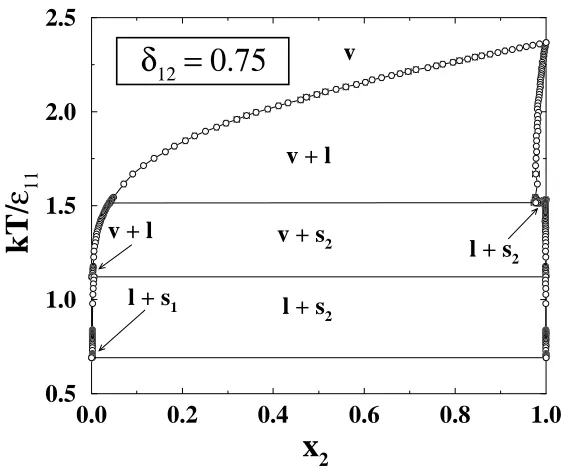
2.1 Illustration of the procedure used to determine a solid-liquid-vapor
coexistence line.. . . . 44 2.2 T-xphase diagrams for Lennard-Jones binary mixtures with diameter
ratioσ11/σ22 = 0.95 atP∗=0.002. . . . . 45
2.3 T-xphase diagrams for Lennard-Jones binary mixtures with diameter
ratioσ11/σ22 = 0.90 atP∗=0.002. . . . . 46
2.4 T-xphase diagrams for Lennard-Jones binary mixtures with diameter
ratioσ11/σ22 = 0.85 atP∗=0.002. . . . . 47
2.5 Schematic diagrams illustrating the interference between vapor-liquid,
solid-liquid, and solid-solid coexistence regions. . . . . 48
Chapter 3 The effect of the binary interaction parameter on complete phase
3.1 Illustration of the procedure used to determine a solid-liquid-vapor
coexistence line.. . . . 67 3.2 T-xphase diagram atP∗=0.05 forσ11/σ22=0.85,11/22=0.45, and
δ12=1.0. . . . . 68
3.3 T-xphase diagram atP∗=0.05 forσ11/σ22=0.85,11/22=0.45, and
δ12=0.9. . . . . 69
3.4 T-xphase diagram with metastable vapor-liquid and liquid-liquid
coex-istence points. . . . . 70 3.5 T-xphase diagram atP∗=0.05 forσ11/σ22=0.85,11/22=0.45, and
δ12=0.9. . . . . 71
Chapter 4 The effect of pressure oncomplete phase behavior of binary
mix-tures 72
4.1 Temperature vs. composition phase diagram for a binary mixture with
σ11/σ22= 0.85 and 11/22= 1.6 at P∗=0.002. . . . . 81
4.2 Temperature vs. composition phase diagram for a binary mixture with
σ11/σ22= 0.85 and 11/22= 1.6 at P∗=0.01. . . . . 82
4.3 Temperature vs. composition phase diagram for a binary mixture with
σ11/σ22= 0.85 and 11/22= 1.6 at P∗=0.025. . . . . 83
4.4 Temperature vs. composition phase diagram for a binary mixture with
σ11/σ22= 0.85 and 11/22= 1.6 at P∗=0.05. . . . . 84
4.5 Temperature vs. composition phase diagram for a binary mixture with
4.6 Schematic T-xdiagrams forσ11/σ22= 0.85 and11/22 = 1.6. . . . . . 86
4.7 Pressure-temperature projection for a binary mixture with σ11/σ22 =
0.85 and11/22 = 1.6. . . . . 87
4.8 Pressure-temperature projection for a binary mixture with σ11/σ22 =
0.85 and11/22 = 0.45. . . . . 88
4.9 Pressure-temperature projection for a binary mixture with σ11/σ22 =
0.90 and11/22 = 0.45. . . . . 89
4.10 Pressure-temperature projection for a binary mixture with σ11/σ22 =
0.95 and11/22 = 0.45. . . . . 90
Chapter 5 Pressure-temperature projection for a binary Lennard-Jones
mix-ture 91
5.1 T-xphase diagram atP∗= 0.05 . . . . 100 5.2 P-T projection summarizing the solid (s), liquid (l), and vapor (g) phase
coexistence lines. . . . . 101
Chapter 6 Future Work 102
6.1 Schematic diagram illustrating a series of constant pressure and
con-stant temperature paths that could be used to locate closed-loop
liquid-liquid immiscibility. . . . . 109
Appendix A Solid-liquid phase equilibrium for binary Lennard-Jones
A.1 The sixtypes of solid-liquid phase diagrams. . . . . 150 A.2 Temperature vs. composition phase diagram for argon-methane system 151
A.3 Temperature vs. composition phase diagram for krypton-methane
sys-tem . . . . 152 A.4 Temperature vs. composition phase diagram for argon-krypton system 153
A.5 Temperature vs. composition phase diagram: σ11/σ22=1.0. . . . . . 154
A.6 Temperature vs. composition phase diagrams: 11/22 =1.0. . . . . . 155
A.7 Temperature vs. composition phase diagrams: σ11/σ22=0.925. . . . 156
A.8 Temperature vs. composition phase diagrams: σ11/σ22=0.9. . . . . . 157
A.9 Temperature vs. composition phase diagrams: σ11/σ22=0.875. . . . 158
A.10 Temperature vs. composition phase diagrams: σ11/σ22=0.85. . . . . 159
A.11 Phase regimes.. . . . 160 A.12 Schematic phase diagrams. . . . . 161
Chapter
1
Introduction
This thesis describes a study of the phase equilibria of binary mixtures using
molec-ular simulation. Of particmolec-ular interest to us is equilibria involving a solid phase.
Our motivation for studying solid-fluid equilibria in mixtures stems from our
in-terest in chiral drug separations. Many chiral drugs are prepared and sold as an
equimolar mixture of both enantiomers; in this case the chiral drug is termed a
racemate and the 50/50 mixture is described as a racemic mixture. The enzymes
and cell surface receptors in our body are also chiral and usually absorb and
de-grade the two enantiomers present in a racemic chiral drug at different rates. In
fact, the two enantiomers in the drug may not have equal levels of
pharmacologi-cal activity. It is not unusual for just one of the enantiomers to provide the drug’s
intended therapeutic function, while the other enantiomer remains inactive, causes
side effects, or has a different kind of therapeutic function. The enantiomers of the
racemate, ketoprofen, are an example of the latter possibility. (S)-Ketoprofen is an analgesic/anti-inflammatory agent and(R)-ketoprofen provides no analgesic effect but has been shown to slow bone loss in periodontal disease1.
di-rectives to encourage the pharmaceutical industry to produce and sell single
enan-tiomer chiral drugs rather than the racemic drugs that now exist in the
market-place1–3. The rationale behind this directive is multi-fold. First, often only one of
the enantiomers in a racemic drug is the potent ingredient. For example, ibuprofen
pain-reliever is sold as a racemic mixture ofS- andR-ibuprofen, but the only phar-macologically active ingredient is theS-ibuprofen. Second, a single enantiomer drug often performs better than its counterpart racemic drug. Removing the unwanted
enantiomer reduces the dosage amount and decreases the time needed for the drug
to take effect in the body4. Third, side effects are reduced or eliminated completely
in many cases by switching from a racemate to a single enantiomer drug. Finally,
patients diagnosed with diseases such as arthritis, diabetes, hypertension, and
neu-rological illnesses often take medicines to treat these conditions for the remainder
of their lives. Removing the non-effective enantiomer from these drugs reduces the
chance of unforeseen health problems caused by extended drug treatment.
To comply with the FDA directive, pharmaceutical companies now include
syn-thesis and separation steps designed to isolate enantiomers whenever they develop
a new chiral drug. Many companies are also redesigning their existing processes
for making racemic drugs to produce enantiomerically pure counterparts. Despite
the large interest in producing single enantiomer drug compounds, the majority
of separation schemes have been developed through trial-and-error
experimenta-tion5. Fundamental research focused on methods for producing enantiomerically
pro-duction of more single enantiomer drugs.
Enantiomers pose a unique separation problem because they have identical
physical properties. This means that traditional separation techniques such as
dis-tillation, extraction, or crystallization cannot be used to separate an enantiomer
mixture. One method for separating racemic mixtures on an industrial scale is
di-astereomeric crystallization.4,6,7In this process, the enantiomers are first converted
to diastereomers by chemical reaction with a chiral resolving agent in a solvent.
Un-like enantiomers, diastereomers are isomers with different physical properties and
are separable by conventional methods. Here the solubility difference between the
two diastereomers is utilized and the reaction mixture is cooled to crystallize the
least soluble diastereomer from the solution. The resulting diastereomeric solid is
then treated by further chemical reactions to remove the resolving agent and retrieve
the pure enantiomer.
Currently, there are no theories available to govern the selection of the solvent
and chiral resolving agent used to separate a given pair of enantiomers. The
ulti-mate goal of this research is to predict the phase behavior for a mixture of chiral
molecules using molecular simulation. Achieving this goal will require the following
developments in molecular simulation tools:
• Develop a molecular simulation method to calculate solid-liquid equilibria for binary mixtures of spherical molecules.
• Extend the simulation method to ternary mixtures of spherical molecules.
• Apply the method to ternary mixtures consisting of a pair of model diastere-omers and a solvent.
The work we present in this thesis represents the first step toward predicting
solid-liquid phase diagrams for mixtures of chiral molecules via molecular simulation.
1.1
Overview
In this section, we provide a short summary of the subsequent chapters in this
thesis. Chapter 2 has been submitted for publication, Chapter 3 has been accepted
for publication, Chapter 4 will be submitted shortly, and Chapter 5 has been accepted
for publication. All of the chapters are self-contained units complete with literature
review and bibliography.
Chapter 2 explores the effect of both molecular size and intermolecular
attrac-tions on the complete phase behavior of a mixture. We calculate complete phase
diagrams for binary Lennard-Jones mixtures with diameter ratios ranging from 0.85
– 0.95 and attractive well-depth ratios ranging from 0.625 – 1.6, at a reduced
pres-sureP∗≡P σ113/11 =0.002, which is equivalent to atmospheric pressure for argon.
The cross-species interaction parameters are obtained from Lorentz-Berthelot
com-bining rules. We restrict ourselves to diameter ratios ranging from 0.85 to 0.95
because in this region the only kind of solid phase that can form is a
substitution-ally disordered fcc solid solution (the two species pack onto the same fcc crystalline
lattice and can substitute for one another in any order on the lattice). At
crystalline phases are possible, necessitating the calculation of each phase’s free
energy to determine the most stable crystalline structure. Vapor-liquid, solid-liquid,
and solid-vapor lines are calculated for each mixture by integrating the Clapeyron
differential equation for binary mixture phase equilibria at constant pressure. The
initial conditions for the integrations are the vapor-liquid and solid-liquid
coexis-tence data for a single component Lennard-Jones system at P∗ = 0.002 obtained via Gibbs-Duhem integration8,9. The properties of each phase at subsequent
in-tegration points are determined by semigrand canonical Monte Carlo simulations
(constant temperature, pressure, total number of molecules, and fugacity fraction)
on the vapor, liquid, and solid phases. We find that for well-depth ratios of unity
(equal attractions among species) there is no interference between the vapor-liquid
and solid-liquid coexistence regions. As the well-depth ratio increases or decreases
from unity, the vapor-liquid and solid-liquid phase envelopes widen and interfere
with each other leading to a solid-vapor coexistence region. For all well-depth ratios
and a diameter ratio of 0.95, the solid-liquid lines have a shape characteristic of a
solid solution (with or without a minimum melting temperature); as the diameter
ratio decreases the solid-liquid lines fall to lower temperatures until they
eventu-ally drop below the solid-solid coexistence region, resulting in either a eutectic or
peritectic three-phase line.
Chapter 3 explores the effect of the binary interaction parameter, δ12, on the
complete phase behavior of a mixture. We present complete phase diagrams for
ra-tio 11/22 = 0.45, and binary interaction parameters δ12 = 1.0,0.9,and 0.75, at
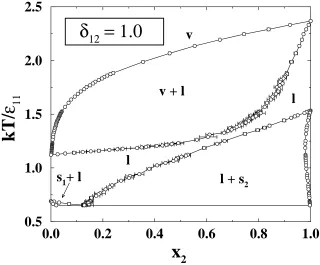
reduced pressure, P∗ = P σ113/11 = 0.05. For the mixture with δ12 = 1 we find a
completely miscible vapor-liquid coexistence region with a eutectic solid-liquid
co-existence region. These two regions are separated by a completely miscible liquid
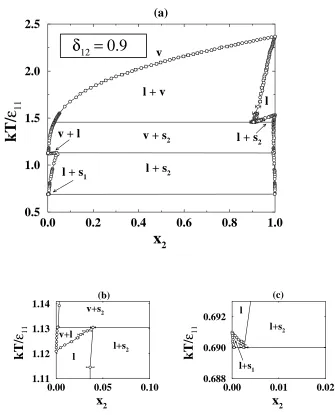
phase. For the mixtures withδ12 <1 we find that the vapor-liquid and solid-liquid
coexistence regions interfere. This interference results in a vapor-solid coexistence
region bounded above and below by solid-liquid-vapor coexistence lines. We also
find that the mixtures withδ12 <1 have a region of liquid-liquid immiscibility that
is metastable with respect to the solid-fluid phase equilibria.
Chapter 4 explores the effect of pressure on the complete phase behavior of
a mixture. We present complete,T −x phase diagrams for binary Lennard-Jones mixtures with diameter ratio σ11/σ22 = 0.85 and 11/22 = 1.6 at reduced
pres-suresP∗= 0.002, 0.01, 0.025, 0.05, and 0.1. We find that as pressure increases, the vapor-liquid coexistence region first shifts to higher temperatures and then begins
to disappear as the pressure approaches critical conditions. We summarize these
results on aP−T projection that identifies the three-phase coexistence features of the mixture (solid-liquid-vapor and solid-solid-liquid) in addition to the pure
compo-nent vapor-liquid, solid-liquid, and vapor-solid coexistence curves. We then present
three moreP −T projections for mixtures with σ11/σ22 = 0.85, 0.9, and 0.95, and
11/22 = 0.45 so that we can observe how the features on these phase diagrams
change with variations in diameter ratio σ11/σ22 and well-depth ratio 11/22. We
solid-liquid-vapor coexistence pressures decreases and the locus of solid(1)-solid(2)-liquid
tem-peratures shifts from temtem-peratures above the solid-liquid temperature of pure
com-ponent 1 to temperatures below the solid-liquid coexistence temperature of pure
component 1. We find that as well-depth ratio decreases the coexistence curves for
pure component 2 shift from temperatures and pressures below those of pure
com-ponent 1 to temperatures and pressures above those of pure comcom-ponent 1 and that
the maximum in the locus of solid-liquid-vapor coexistence pressures increases.
Chapter 5 is a study of a binary Lennard-Jones mixture with the following
pa-rameters: σ11 = σ22 = 1.0, σ12 = 0.85, 11 = 1.0, 12 = 0.82, and 22 = 1.2. We
calculate completeT−x phase diagrams for this mixture at reduced pressuresP∗
= 0.007, 0.05, and 0.1. Using these results we construct aP −T projection showing the three-phase loci for heteroazeotropes (l1l2v), monotectics (l1l2s), and eutectics
(s1s2l). Fluid phase coexistence points for this mixture have also been calculated
by Canongia Lopes10 using Gibbs ensemble Monte Carlo. They found a locus of
heteroazeotrope temperatures that coincides with our heteroazeotrope locus but
disappears above T∗ = 1.1 and below T∗ = 0.9. Canongia Lopes interpreted this disappearance of liquid-liquid immiscibility aboveT∗ =1.1 and belowT∗= 0.9 as evidence for the presence of upper and lower critical endpoints, respectively. Based
on these inferred upper and lower critical endpoints, Canongia Lopes concluded that
this mixture displays Type VI behavior (closed-loop liquid-liquid immiscibility). In
our calculations we did not observe any evidence of Type VI phase behavior and
For completeness, an earlier study on solid-liquid equilibria for binary
Lennard-Jones mixtures has been included in Appendix A. This work was defended as part
of my Master of Science research in October, 1998. To our knowledge, these were
the first direct simulations of solid-liquid equilibrium in binary Lennard-Jones
mix-tures. We calculated solid-liquid phase diagrams for binary Lennard-Jones mixtures
with diameter ratios ranging from 0.85 to 1 and attractive well-depth ratios ranging
from 0.45 to 1.6, at a reduced pressureP∗=0.002. In a test of the cell theory pre-dictions11for model argon-methane, argon-krypton, and krypton-methane systems,
we found that cell theory can qualitatively predict the shape of phase diagrams
for Lennard-Jones mixtures. Comparison of our simulation results for the
argon-krypton Lennard-Jones system with hard sphere results at the same diameter ratio
indicated that the presence of attractive interactions can change the type of phase
diagram observed from azeotrope (hard sphere) to solid solution (Lennard-Jones).
This suggested that attractive interactions are an important factor in determining
the type of solid-liquid phase behavior observed and prompted a more thorough
investigation of the effect of variations in well-depth ratio on solid-liquid phase
dia-grams. We simulated 56 binary Lennard-Jones mixtures over the range of parameters
listed above to determine how solid-liquid phase diagrams change as a function of
diameter ratio and well-depth ratio. We found that for well-depth ratios of unity
(equal attractions among species) phase behavior indicative of azeotropes and
eu-tectics is observed for diameter ratios ranging from 0.85 to 1. We then varied the
transitions from azeotrope to solid solution, from azeotrope to eutectic, and from
solid solution to simple peritectic. Using our simulation results, we were able to
map out the boundaries separating regimes of solid solution, azeotrope and
eutec-tic solid-liquid phase behavior in the space spanned by the Lennard-Jones diameter
ratio and well-depth ratios.
Chapters 2 through 5 and AppendixA have been adapted from the following
publications:
Chapter 2 M. H. Lamm and C. K. Hall, “Molecular simulation of complete phase diagrams for binary mixtures”,AIChE Journal, (submitted, 2000).
Chapter 3 M. H. Lamm and C. K. Hall, “Monte Carlo simulations of complete phase diagrams for binary Lennard-Jones mixtures”,Fluid Phase Equilibria, (accepted,
2000).
Chapter 4 M. H. Lamm and C. K. Hall, “The effect of pressure on complete phase behavior for binary mixtures”,Journal of Chemical Physics, (to be submitted).
Chapter 5 M. R. Hitchcock and C. K. Hall, “Complete phase diagrams for binary mix-tures via Gibbs-Duhem integration”,Proceedings of the Foundations of
Molecu-lar Modeling and Simulation Conference, Keystone, CO, 2000, (accepted, 2000).
1.2
References
[1] S. C. Stinson, Chemical and Engineering News,71, 38+ (1993).
[2] S. C. Stinson, Chemical and Engineering News,73, 44+ (1995).
[3] S. C. Stinson, Chemical and Engineering News,72, 38+ (1994).
[4] C. R. Bayley and N. A. Vaidya. inChirality in Industryedited by A. N. CollinsG. N.
Sheldrake and J. Crosby, pages 69–77, (1992).
[5] J. Jacques, A. Collet, and S. H. Wilen,Enantiomers, Racemates, and Resolutions.
(Krieger Publishing Company, Malabar, Florida, 1981).
[6] J. Crosby, Tetrahedron,47(27), 4789–4846 (1991).
[7] F. J. J. Leusen, J. H. Noordik, and H. R. Karfunkel, Tetrahedron, 49(24), 5377– 5396 (1993).
[8] D. A. Kofke, Journal of Chemical Physics,98(5), 4149–4162 (1993).
[9] R. Agrawal and D. A. Kofke, Molecular Physics,85(1), 43–59 (1995).
[10] J. N. C. Lopes, Molecular Physics,96(11), 1649–1658 (1999).
Chapter
2
Molecular simulation of complete phase
diagrams for binary mixtures
2.1
Introduction
Knowledge of the phase behavior of mixtures is crucial to the successful design
and operation of countless processes encountered in chemical engineering practice.
Design engineers need to know, for example, whether they will encounter
precipi-tates in pipelines, liquid-liquid separation in a distillation column, or cosolvency in a
supercritical fluid extraction column. Although the phase equilibrium of a mixture
can, in principle, be measured at any condition of interest, ultimately, one would
like to be able to predict mixture phase behavior based solely upon knowledge of
the components’ molecular architecture and intermolecular forces.
The prediction of phase equilibria for mixtures has been the subject of
inten-sive investigation for decades. Two kinds of studies have been conducted: (1) those
aimed at developing accurate predictions of phase equilibria for specific substances
at providing general intuition about the overall topography of phase diagrams for
broad classes of substances, with particular focus on how intermolecular forces
impact phase diagram shape. The latter type of study is exemplified by the work
of van Konynenburg and Scott1,2, who analyzed how the types of phase diagrams
predicted by the van der Waals equation of state for binary mixtures depend on
the values of the van der Waals size and energy parameters. Remarkably, the
sim-ple van der Waals equation of state was found to exhibit five of the six types of
fluid phase behavior observed experimentally. This landmark study has been
fol-lowed by similar analyses for other equations of state, such as the Redlich-Kwong3,
the Carnahan-Starling-Redlich-Kwong4, the Guggenheim5, and the Ree6equations of
state.
Most of the research aimed at understanding how intermolecular interactions
affect phase behavior has focused exclusively on fluid phase equilibria. However
in real systems solid phases form and often interrupt the complexphase behavior
exhibited by fluids7,8. Phenomenological descriptions of complete phase behavior
(i.e., showing equilibrium between vapor, liquid, and solid phases) have been given
by Luks9, Peters et al.10, and Valyashko11,12. Luks and Peters et al. describe four
types of complete phase diagrams observed for binary mixtures of solvent (methane,
ethane, carbon dioxide) and a homologous series of solutes (n-alkanes). Valyashko proposes a classification scheme for twelve types of complete diagrams. Eight of
these types result from the analysis of experimental data for water-inorganic salt
topological transformation, which involves making educated guesses about the
tran-sitions in topography between the eight known types. This method is based on the
idea that there are continuous transitions between all types of phase behavior13.
A quantitative description of complete phase behavior has been given by Luks
and coworkers14,15. Garcia and Luks14 calculate the solid-liquid-vapor locus for
bi-nary mixtures of solvent and a homologous series of solutes using the van der Waals
equation of state for the fluid phase and a simple fugacity model for the solid phase.
This work was extended by Labadie et al.15 who calculated the fluid phase critical
loci for these mixtures, offering a picture of how the multiphase topography
pro-gresses with changes in the solute properties. They found examples of solid-fluid
phase behavior in keeping with what has been observed in real systems, as well as
solid-fluid phase behavior that has yet to be verified by experiment. As with any
analytical equation of state, there exists the possibility that the new topographies
are mathematical artifacts stemming from the approximations made in the
devel-opment of the equation of state. Nonetheless, the new possibilities for complete
phase behavior calculated by Luks and coworkers are intriguing and invite further
investigation.
The most accurate way to determine how molecular size, shape, and energy of
interaction influence phase equilibria is with molecular simulation, since molecular
simulations provide exact results for the model system being studied16. A significant
advance was made in the simulation of phase equilibria when Panagiotopoulos17,18
are simulated independently, yet are coupled thermodynamically in order to satisfy
the criteria of phase equilibrium: equal temperatures, pressures, and species
chem-ical potentials. These conditions are satisfied by simulating each phase at the same
temperature and pressure, and performing particle transfers between the phases to
maintain chemical potential equality.
Although the Gibbs ensemble method has been widely adopted for studying
fluid phase equilibria, it is not an efficient method for studying solid phase
equi-libria because a large number of successful particle transfers between each phase
are required for chemical potential equilibration. Inspired by the Gibbs ensemble
method, Kofke19,20 introduced the Gibbs-Duhem integration technique for direct
simulation of phase equilibria. As in the Gibbs ensemble method, two or more
co-existing phases are simulated independently at the same temperature and pressure.
However, instead of using particle transfers, the chemical potential equality among
each phase is maintained by integrating along the Clapeyron differential equation
for coexistence during the simulations. Eliminating the need for particle transfers
between phases makes the Gibbs-Duhem integration method well-suited for
calcu-lating phase equilibrium for cases in which one of the phases is a solid. The method
requires an initial coexistence condition to begin the integration of the Clapeyron
equation; this initial condition can be obtained from simulation data (e.g., a Gibbs
ensemble simulation or a previous Gibbs-Duhem integration), a reliable theory, or
experimental data.
behavior has been the Lennard-Jones fluid, the quintessential model of a system
containing spherically symmetric molecules. The Lennard-Jones intermolecular
po-tential is given by
uij(r )=4ij
σ
ij r
12
−
σ
ij r
6
, (2.1)
where uij is the potential energy of interaction between particles iand j, r is the
distance between particles i and j, ij is the Lennard-Jones attractive well-depth,
andσij is the Lennard-Jones diameter. Simulations of the fluid phase behavior for
Lennard-Jones mixtures have proven useful for testing theories21–23 as well as for
developing general intuition regarding the influence of molecular size and
inter-molecular interactions on phase behavior24–28.
In AppendixA we used the Gibbs-Duhem integration method combined with
semigrand canonical Monte Carlo simulations to calculate solid-liquid phase
dia-grams for binary Lennard-Jones mixtures over a range of diameter ratiosσ11/σ22=
0.85−1.0 and well-depth ratios11/22=0.45−1.6. The cross-species interaction
pa-rameters were calculated using the Lorentz-Berthelot30 combining rules. We found
that for well-depth ratios of unity (equal attractions among species), phase behavior
indicative of eutectics and solid solutions with minimum melting points is observed
for diameter ratios ranging from 0.85 to 1. We then varied the well-depth ratio of
the mixtures at several constant diameter ratios and observed transitions from solid
solution to solid solution with a minimum melting point, from solid solution with a
minimum melting point to eutectic, and from solid solution to peritectic. Using our
solid solution, solid solution with a minimum melting point, eutectic, and peritectic
solid-liquid phase behavior in the space spanned by the Lennard-Jones diameter and
well-depth ratios.
More recently, we have demonstrated that the Gibbs-Duhem integration method
can be used to calculate complete phase diagrams31,32where by “complete” we mean
containing all possible phases: solid, liquid, and vapor. Prior to that, complete
phase diagrams for symmetric (equal diameters, σ11 = σ22; equal attractive
well-depths, 11 = 22) Lennard-Jones mixtures were calculated by Vlot et al.33 using
a combination of molecular simulation and semiempirical models. In their work,
Monte Carlo simulations were conducted for each phase at selected state points
to determine the excess free energy as a function of composition. The resulting
free energy versus composition data was fit with a two-parameter Redlich-Kister
polynomial and the convexenvelope construction method was used to determine the
phase diagram. In comparison to this somewhat indirect method, the Gibbs-Duhem
integration method can be applied to the calculation of complete phase diagrams
with relative ease.
Our objective in this chapter is to explore the effect of both molecular size and
intermolecular attractions on the complete phase behavior of a mixture. We calculate
complete phase diagrams for binary Lennard-Jones mixtures with diameter ratios
ranging from 0.85 – 0.95 and attractive well-depth ratios ranging from 0.625 – 1.6,
at a reduced pressureP∗ ≡ P σ113/11 = 0.002, which is equivalent to atmospheric
Lorentz-Berthelot combining rules. We restrict ourselves to diameter ratios ranging
from 0.85 to 0.95 because in this region the only kind of solid phase that can form is
a substitutionally disordered fcc solid solution (the two species pack onto the same
fcc crystalline lattice and can substitute for one another in any order on the lattice).
(At diameter ratios less than 0.85, the calculation is more complexbecause several
ordered crystalline phases are possible, necessitating the calculation of each phase’s
the free energy to determine the most stable crystalline structure.) Vapor-liquid,
solid-liquid, and solid-vapor lines are calculated for each mixture by integrating the
Clapeyron differential equation for binary mixture phase equilibria at constant
pres-sure. The initial conditions for the integrations are the vapor-liquid and solid-liquid
coexistence data for a single component Lennard-Jones system at P∗ = 0.002 ob-tained via Gibbs-Duhem integration19,34. The properties of each phase at subsequent
integration points are determined by semigrand canonical Monte Carlo simulations
(constant temperature, pressure, total number of molecules, and fugacity fraction)
on the vapor, liquid, and solid phases.
Highlights of our results are the following. We find that for well-depth ratios of
unity (equal attractions among species) there is no interference between the
vapor-liquid and solid-vapor-liquid coexistence regions. As the well-depth ratio increases or
decreases from unity, the vapor-liquid and solid-liquid phase envelopes widen and
interfere with each other leading to a solid-vapor coexistence region. For all
well-depth ratios and a diameter ratio of 0.95, the solid-liquid lines have a shape
the diameter ratio decreases the solid-liquid lines fall to lower temperatures until
they eventually drop below the solid-solid coexistence region, resulting in either a
eutectic or peritectic three-phase line.
The remainder of the chapter is organized as follows. In the next section we
outline the Gibbs-Duhem integration method and describe how we applied the
pro-cedure to the calculation of mixture phase behavior for solid, liquid, and vapor
phases. We then present the complete phase diagrams, followed by a discussion of
the results. Finally, we conclude with a brief summary and further discussion.
2.2
Gibbs-Duhem integration
In this section we describe how we calculated phase equilibria for binary
Lennard-Jones mixtures using the Gibbs-Duhem integration method. We begin by
presenting a brief review of the Gibbs-Duhem integration method. We then discuss
our procedures for determining an initial coexistence condition and integrating the
Clapeyron equation. Finally, we describe the details of the semigrand ensemble
sim-ulations used throughout the integration procedure to determine the properties of
each of the coexisting phases.
The coexistence lines were calculated using Gibbs-Duhem integration20,35. In
this method, phase coexistence is determined by numerically integrating the
Clapey-ron differential equation appropriate to the system of interest. ClapeyClapey-ron equations
describe how field variables (variables that must be equal among coexisting phases)
between two phases (αandγ) of a binary mixture containing components 1 and 2 at constant pressure is
dβ dξ2 =
(x2α−x2γ) ξ2(1−ξ2)(hα−hγ)
, (2.2)
whereβis the reciprocal temperature, 1/kT, withkthe Boltzmann constant and T
the absolute temperature,ξ2is the fugacity fraction of species 2,ξ2≡f2/ fi, with
fi, the fugacity of speciesiin solution,x2is the mole fraction of species 2, andhis
the molar enthalpy. The right-hand side of Eq. (2.2) can be integrated numerically to
find an equation forβas a function of ξ2if we have an initial condition describing
the temperature, fugacity fraction, enthalpies and compositions at one coexistence
point.
2.2.1 Initial condition
An initial coexistence condition is necessary to begin a Gibbs-Duhem
integra-tion calculaintegra-tion for phase equilibrium in a binary mixture. A convenient choice for
the initial coexistence condition is the vapor-liquid or solid-liquid equilibrium
con-dition for either of the pure Lennard-Jones components. Here, we used literature
data obtained via Gibbs-Duhem integration for the vapor-liquid19and solid-liquid34
coexistence conditions. The integrand in Eq. (2.2) is undefined for pure components
(ξ2=0, x2=0 andξ2=1, x2=1) but it can be estimated using the limiting case of
infinite dilution. Here we follow Mehta and Kofke36, who used the infinite dilution
case to start their Gibbs-Duhem integration calculations of vapor-liquid equilibria in
The limiting value of the integrand whenx2approaches zero,(dβ/dξ2)x2=0, can be estimated by supposing that the real mixture displays ideal solution behavior
at the limit of infinite dilution of species 2. With this assumption, the abundant
component (species 1) in the ideal solution follows the Lewis Randall rule
f1=x1f1, (2.3)
while the dilute component (species 2) obeys Henry’s law
f2=x2H2, (2.4)
where f1 is the fugacity of pure component 1 at the temperature and pressure of
the mixture, andH2 is the Henry’s law constant for species 2. Letting x1 →1 and
x2 → 0, the fugacity fraction of species 2 becomes, ξ2 = x2H2/f1. After making
these substitutions into Eq. (2.2) and rearranging terms29 we get
dβ dξ2
x2=0
= f1(1/H2α−1/H
γ
2)
(hl−hs) . (2.5)
This gives us an estimate for the integrand at the initial condition of ξ2 = 0 and
coexistence (e.g., solid-liquid, vapor-liquid) temperature, T1, of pure species 1. A
similar formula can be derived in the limit of infinite dilution of species 1.
We can calculate all of the quantities on the right-hand side of Eq. (2.5) with
u+P v NPT, where uis the configurational energy of the system and the brackets, NPT, denote an NPT ensemble average. The quantityf1/H2can be calculated from36
f1
H2 =
exp(−β∆u1→2) NPT (2.6)
where ∆u1→2 is the exchange energy associated with switching a particle from
species 1 to 2. The exchange energy, ∆u1→2, can be obtained by conducting trial
identity switches during the simulation; these involve randomly selecting a particle
and calculating the energy that would result if we were to switch the particle from
species 1 to species 2. This is done without actually changing the particle’s identity.
2.2.2 Integration
Once we have an initial coexistence condition, the Gibbs-Duhem integration
pro-cedure may be performed over the entire range of fugacity fractions,ξ2= 0 toξ2 =
1, using a predictor-corrector algorithm to integrate Eq. (2.2). Starting at the initial
condition, β0, (ξ2)0, we step to the next fugacity fraction, (ξ2)1, and estimate the
associated reciprocal temperature,β1, using the trapezoid-rule predictor formula
β(10)=β0+[(ξ2)1−(ξ2)0] F (β0, (ξ2)0), (2.7)
where the superscript “0” indicates that β(10) (a predicted value) is our zeroth iter-ation attempt at finding the reciprocal temperatureβ1and F is the right-hand side
fugacity fraction (ξ2)1, two semigrand canonical (NPTξ2) Monte Carlo simulations
(one for the αphase and one for the γ phase) are conducted in order to calculate the enthalpies and mole fractions of each phase at the new state point. (Details of
the NPTξ2simulations will be given in Section 2.2.3.)
After the enthalpies and mole fractions at the new state point are calculated we
refine the estimate forβ1at(ξ2)1by performing a loop of corrector iterations until
β1converges within an acceptable tolerance. The general form of the trapezoid-rule
corrector for this loop is given by
β(i1+1)=β0+
[(ξ2)1−(ξ2)0]
2
F1(i)(β(i)1 , (ξ2)1)+F0(β0, (ξ2)0) , (2.8)
where the superscripts(i)and (i+1) denote the iterations of the corrector, the sub-scripts “0” and “1” denote the initial and current state point, respectively, andF1(i)
is calculated from simulation averages of the enthalpies and mole fractions during
the ith iteration of the corrector at β(i)
1 and (ξ2)1. After β1 converges a
produc-tion segment of simulaproduc-tions are run to obtain the final average enthalpies and mole
fractions for the coexistence point. Once the production runs are completed, the
fugacity fraction is incremented and the predictor-corrector algorithm described
above is repeated to obtain the next state point,β2,(ξ2)2.
Higher order predictor-corrector equations are used as we obtain more state
points. The midpoint predictor-corrector is used once two state points are known,
β(in++11)=βn−1+
[(ξ2)n+1−(ξ2)n]
3
Fn(i)+1+4Fn+Fn−1 , (2.10)
and the modified Adams predictor-corrector37 is used once three or more state
points are known,
β(n0+)1=βn+
[(ξ2)n+1−(ξ2)n]
24 [55Fn−59Fn−1+37Fn−2−9Fn−3] , (2.11)
β(in++11)=βn+
[(ξ2)n+1−(ξ2)n]
24
9Fn(i)+1+19Fn−5Fn−1+Fn−2 . (2.12)
In these sets of equations the predictor is listed first and the corrector second. The
subscripts denote the coexistence state points with(n+1) being the current state point and the superscripts denote the iterations of the corrector for the current
coexistence state point. By repeating the predictor-corrector algorithm fromξ2=0
toξ2=1 we can map out the entire temperature versus composition phase diagram.
In some of the mixtures, we encountered interference between two different
two-phase coexistence regions e.g., the vapor-liquid and solid-liquid coexistence
curves overlapped, resulting in a three-phase solid-liquid-vapor coexistence line. In
this case, two Gibbs-Duhem integrations were conducted, the first starting from the
vapor-liquid coexistence temperature for one of the pure components and the
sec-ond starting from the solid-liquid coexistence temperature for the same pure
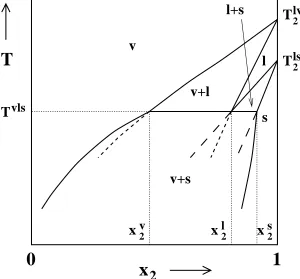
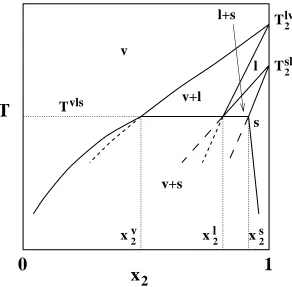
com-ponent. For example, in Figure 2.1 vapor-liquid and solid-liquid coexistence curves
can be calculated starting from the vapor-liquid and solid-liquid coexistence
temper-atures (T2lv andT2ls, respectively) of pure component 2. At someξ2(unknown at the
set of coexistence curves will cross, thus, determining the temperature, fugacity
frac-tion, and coexistence compositions of the three coexisting phases: vapor, liquid, and
solid. In Figure 2.1 the liquid lines cross atTvls andxl
2. BelowTvls the inner
vapor-liquid and solid-vapor-liquid coexistence curves (shown by short-dashed and long-dashed
lines, respectively) are metastable with respect to the outer vapor-solid coexistence
curves, according to the boundary curvature rule38,39, which states that the
bound-aries of one-phase regions must meet at a three-phase line with curvatures such
that the boundaries extrapolate into the two-phase coexistence regions.. The
vapor-solid coexistence curve is determined by a Gibbs-Duhem integration starting from
Tvls at x2v andx2s. Other types of three-phase coexistence lines (heteroazeotropes, eutectics, etc.) can be determined in a similar manner.
2.2.3 Simulations
The enthalpies and mole fractions needed as input to the integration of Eq. (2.2)
are obtained from semigrand canonical (constant NPTξ2) Monte Carlo computer
sim-ulations40. In this work, all simulations were run with a system size of 500 particles
at a reduced pressure P∗ = 0.002. The temperature and fugacity fraction were fixed at the values specified by the Gibbs-Duhem integration predictor-corrector
al-gorithm. There are three types of Monte Carlo trial moves in semigrand canonical
simulations: particle displacements, volume change moves, and particle identity
ex-changes. The particle displacements and volume change moves are conducted just
a particle is selected at random and given a trial species identity switch, which is
accepted according to the ratio of the species fugacity fractions,ξ1andξ2. The
over-all acceptance probability36 for the moves in the NPTξ
2ensemble is min[1,exp(Λ)]
where
Λ= −β(Utrial−Uold)−βP (Vtrial−Vold)+NlnV
trial
Vold +mln
ξ2
1−ξ2
. (2.13)
In Eq. (2.13),Utrial andUold, andVtrial andVold, are the configurational energies and
volumes of the trial and existing states, respectively, m = +1 if the trial identity switch is from species 1 to 2, andm= −1 if the trial identity switch is from species 2 to 1. In NPTξ2simulations the choice of the type of Monte Carlo move is made
ran-domly but weighted such that the ratio of attempted moves is 1 volume change toN
particle displacements toNidentity switches. The length of the simulation is given in cycles, where one cycle represents 1 volume change attempt,Ndisplacement at-tempts, andN identity switch attempts. In our work, a typical NPTξ2simulation is
equilibrated for 3000 cycles and then followed by a production run of 5000 cycles
to compute the average enthalpy and mole fraction. The only difference between
fluid and solid phase simulations is that to maintain an fcc crystalline structure in
the solid phase simulations we impose a single occupancy constraint41,42on the trial
displacements of particles in the solid,i.e., any displacements that put the particle
outside its lattice cell are rejected.
Other details of the NPTξ2 simulations are as follows. The simulation volume
Lennard-Jones potential model. We determine the cross-species interaction
param-eters (σ12, 12) by using the Lorentz-Berthelot30mixing rulesσ12=(σ11+σ22)/2 and
12 =√1122. The potential interactions are truncated at a cutoff radius of half the
boxlength. To compensate for this truncation, a long range correction is applied
to the energy calculations during the simulation by assuming a uniform density
distribution beyond the cutoff radius16.
2.3
Results and Discussion
In this section, we present the results of our Gibbs-Duhem integration
calcu-lations of complete phase behavior for binary Lennard-Jones mixtures. All of the
phase diagrams were calculated at reduced pressure,P∗≡P σ113/11=0.002, which
is equivalent to atmospheric pressure for argon. We calculated nine phase diagrams
for diameter ratios σ11/σ22 = 0.85, 0.9, and 0.95, and well-depth ratios 11/22 =
0.625, 1.0, and 1.6. For these diameter ratios, the solid phase has a substitutionally
disordered fcc crystalline structure.
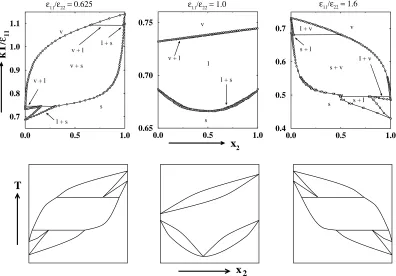
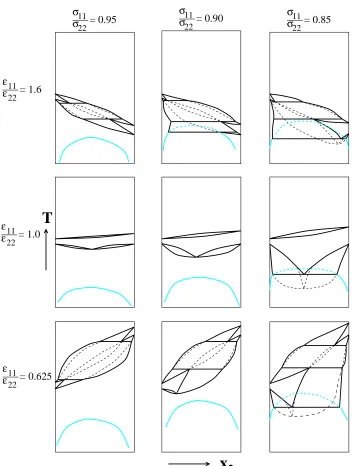
In the first series, we calculated phase diagrams for binary mixtures with
σ11/σ22= 0.95 and11/22= 0.625, 1.0, and 1.6. Figure 2.2 shows the
temperature-composition phase diagrams obtained via Gibbs-Duhem integration (row 1) along
with not-to-scale schematic diagrams (row 2) drawn to illustrate the smaller features
of the actual phase diagram more clearly. On the phase diagram for11/22=0.625,
vapor-liquid coexistence lines originate from pure component 2 (x2 = 1, T∗ ≡
Solid-liquid coexistence lines originate from pure component 2 (x2=1, T∗=1.099)
and decrease in temperature with decreasing fugacity fractionξ2. The liquid-vapor
and solid-liquid curves meet at T∗ = 1.093 and form a three-phase, solid-liquid-vapor equilibrium line. Solid-solid-liquid-vapor coexistence lines originate from this three-phase
line and decrease in temperature with decreasing fugacity fractionξ2. Vapor-liquid
curves originate from pure component 1 (x2 = 0, T∗ = 0.732) and increase in
temperature with increasing fugacity fractionξ2. The vapor-liquid and vapor-solid
curves meet at T∗ = 0.745 and form a three-phase, vapor-liquid-solid equilibrium line. Liquid-solid coexistence lines originate from this three-phase line and decrease
in temperature with decreasing fugacity fractionξ2until they reach the solid-liquid
coexistence temperature for pure component 1 (x2 = 0, T∗ = 0.687). A miscible
solid phase exists below the solid-liquid curves.
On the phase diagram for11/22=1.0, vapor-liquid coexistence lines originate
from pure component 2 (x2=1, T∗=0.742) and decrease in temperature with
de-creasing fugacity fraction until they reach the vapor-liquid coexistence temperature
for pure component 1 (x2=0, T∗=0.732). A miscible liquid phase exists below the
vapor-liquid curves. Solid-liquid coexistence lines originate from pure component 2
(x2=1, T∗=0.687) and decrease in temperature with decreasing fugacity fraction
ξ2to a minimum melting point (x2=0.508, T∗=0.666). The solid-liquid lines then
increase in temperature with decreasing fugacity fraction ξ2 until they reach the
solid-liquid coexistence temperature for pure component 1 (x2=0, T∗ =0.687). A
On the phase diagram for11/22=1.6, liquid-vapor coexistence lines originate
from pure component 1 (x2 = 0, T∗ = 0.732) and decrease in temperature with
increasing fugacity fraction ξ2. Solid-liquid coexistence lines originate from pure
component 1 (x2 = 0, T∗ = 0.687) and decrease in temperature with increasing
fugacity fractionξ2. The liquid-vapor and solid-liquid curves meet atT∗=0.681 and
form a three-phase, solid-liquid-vapor equilibrium line. Solid-vapor coexistence lines
originate from this three-phase line and decrease in temperature with increasing
fugacity fractionξ2. Liquid-vapor coexistence lines originate from pure component
2 (x2=1, T∗=0.485) and increase in temperature with decreasing fugacity fraction
ξ2. The liquid-vapor and solid-vapor curves meet at T∗ = 0.495 and form another
three-phase, solid-liquid-vapor equilibrium line. Solid-liquid lines originate from
this three-phase line and decrease in temperature with increasing fugacity fraction
ξ2 until they reach the solid-liquid coexistence temperature for pure component 2
(x2=0, T∗=0.429). A miscible solid phase exists below the solid-liquid curves.
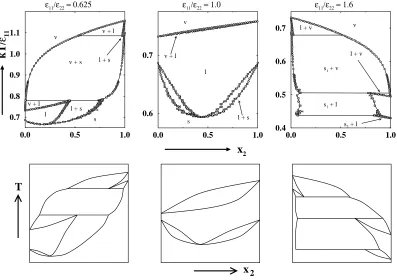
In the second series, we calculated phase diagrams for binary mixtures with
σ11/σ22 = 0.9 and11/22 = 0.625, 1.0, and 1.6. Figure 2.3 shows the
temperature-composition phase diagrams obtained via Gibbs-Duhem integration (row 1) along
with not-to-scale schematic diagrams (row 2) drawn to illustrate the smaller features
of the actual phase diagram more clearly. On the phase diagram for11/22=0.625,
vapor-liquid coexistence lines originate from pure component 2 (x2=1, T∗=1.157)
and decrease in temperature with decreasing fugacity fractionξ2. Liquidsolid coex
temperature with decreasing fugacity fraction ξ2. The vapor-liquid and liquid-solid
curves meet at T∗ = 1.086 and form a three-phase, vapor-liquid-solid equilibrium line. Vapor-solid coexistence lines originate from this three-phase line and decrease
in temperature with decreasing fugacity fraction. Vapor-liquid curves originate from
pure component 1 (x2=0, T∗=0.732) and increase in temperature with increasing
fugacity fraction. The vapor-liquid and vapor-solid curves meet atT∗= 0.770 and form another three-phase, vapor-liquid-solid equilibrium line. Liquid-solid
coexis-tence lines originate from this three-phase line and decrease in temperature with
de-creasing fugacity fraction ξ2to a minimum melting point (x2= 0.195, T∗=0.665).
The solid-liquid lines then increase in temperature with decreasing fugacity fraction
ξ2 until they reach the solid-liquid coexistence temperature for pure component 1
(x2=0, T∗=0.687). A miscible solid phase exists below the solid-liquid curves.
On the phase diagram for11/22=1.0, vapor-liquid coexistence lines originate
from pure component 2 (x2=1, T∗=0.753) and decrease in temperature with
de-creasing fugacity fraction until they reach the vapor-liquid coexistence temperature
for pure component 1 (x2=0, T∗=0.732). A miscible liquid phase exists below the
vapor-liquid curves. Solid-liquid coexistence lines originate from pure component 2
(x2=1, T∗=0.687) and decrease in temperature with decreasing fugacity fraction
ξ2to a minimum melting point (x2=0.440, T∗=0.593). The solid-liquid lines then
increase in temperature with decreasing fugacity fraction ξ2 until they reach the
solid-liquid coexistence temperature for pure component 1 (x2=0, T∗ =0.687). A
On the phase diagram with11/22 = 1.6, liquid-vapor coexistence lines
origi-nate from pure component 1 (x2=0, T∗=0.732) and decrease in temperature with
increasing fugacity fraction. Solid(1)-liquid coexistence lines originate from pure
component 1 (x2=0, T∗ =0.687) and decrease in temperature with increasing
fu-gacity fractionξ2. The liquid-vapor and solid(1)-liquid curves meet at T∗ = 0.679
and form a three-phase, solid(1)-liquid-vapor equilibrium line. Solid(1)-vapor
coex-istence lines originate from this three-phase line and decrease in temperature with
increasing fugacity fraction ξ2. Liquid-vapor coexistence lines originate from pure
component 2 (x2=1, T∗ =0.494) and increase in temperature with decreasing
fu-gacity fractionξ2. The liquid-vapor and solid(1)-vapor curves meet at T∗ = 0.505
and form another three-phase, solid(1)-liquid-vapor equilibrium line. Solid(1)-liquid
lines originate from this three-phase line and decrease in temperature with
increas-ing fugacity fractionξ2. Liquid-solid(2) coexistence lines originate from pure
com-ponent 2 (x2=1, T∗=0.429) and increase in temperature with decreasing fugacity
fraction ξ2. The solid(1)-liquid and liquid-solid(2) curves meet at T∗ = 0.437 and
form a three phase, solid(1)-solid(2)-liquid equilibrium line. This line is also known
as a peritectic. Below this temperature (not shown in Figure 2.3) solid(1) and solid(2)
are in equilibrium. Although Gibbs-Duhem integration method we employ can be
readily applied to solid-solid equilibria we have not calculated solid(1)-solid(2)
coex-istence lines in this work since they are not necessary for classifying the solid-liquid
behavior.