
Parking Navigation System Based on RFID and IR
Sensor
Prof.Gayatri Bhandari1, Mrinal Bari2,Shweta Borse3,Ashwini Gaikwad4,Reshma Kadam5
1,2,3
Department of Computer Engineering BSIOTR, Pune.
4,5
Savitribai Phule Pune University Faculty of Engineering, Pune,Maharashtra
Abstract— In large busy cities, to find a empty parking slot is very not easy. We are also unaware of the existing parking slots in the necessary area. Therefore in this paper,we proposes a Smart parking system. In this system, we will maintain a central server, in which information about the registered parking is stored. This system proposes a safe and efficient parking system which will work on sensor communication and secured wireless network. The central server will also maintain the count of the empty slots in the parking facility and it will show it to the user. Accordingly, the user will select suitable parking zone. Based on this, the estimated shortest path to the selected parking will be calculated and showed to the driver. Using this system, we can easily find vacant space for parking and parking waiting time is reduced efficiently.In this system, we solve the problem of traffic congestion using navigation method. We offer a system that can easily find vacant space for parking. We design a central server that maintain information about the registered parking zones. It also maintain the count up of available space in the parking capability and transmit it to the user. So the user can easily take decision based on the nearest parking available. Thus by using navigation method,the user can get the shortest path to the selected parking zone to avoid congestion.Therefore the parking waiting time is reduced efficiently.
Keywords—Android,Navigation,IRsensor,RFIDtag,Wireless network.
I. INTRODUCTION
In major cities, there are inadequate parking areas which consequences in traffic blocking, air pollution and also irritation of driver. Also in huge parking area, a driver may way out lacking the information of the new existing parking that have just become free. But if a new car gets parked before the driver reaches, which eventually leads to driver dissatisfaction. The driver does not have awareness about the existing available space before entering the parking facility. Also if the car gets trapped in the traffic blockage, it will take extra time to come out of that area.
In this system, we explain the difficulty of traffic jamming using routing method. We suggest a system that can find available space for parking with ease. We propose a central server that preserve database about the registered parking areas. It also retain the count of free space in the parking facility and show it to the user. So the user can simply take judgment based on the nearby parking vacant .
Thus by using navigation method,the user can get the shortest path to the chosen parking region to avoid blockage.Therefore the overall parking waiting time is reduced.
II. PROPOSED SYSTEM
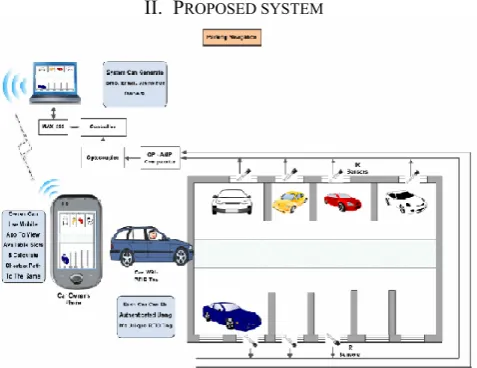
Figure 1.Parking navigation of proposed system
III.IMPLEMENTATION
Fig.1 shows the system architecture for parking navigation. As seen in the fig.,there is a central server installed in each parking zone. The server contains the information of all the registered parking existing in that area. It has IR sensors installed in each parking sector. Sensors detects only the high and low values. When the car is parked,it will show low value and when sector is empty, sensor will show high value.MAX 232 is the level convertor which convert from TTL to RS232 and vice versa.Microcontroller is used as analog-to-digital convertor and it sends its value to PC using serial communication.We use RFID tag for validation of the car. RFID i.e. Radio frequency identification is the wireless to send data, for the function to recognize and follow tags attached to the objects automatically. Owner can use mobile application to view existing slot and calculate shortest path to the same effortlessly
It models the evaluation index of energy consumption at each node, which is the weight of each edge in a WSN, by introducing energy consumption at both node and transmission process, and employs a Dijkstra-based routing algorithm to efficiently search the reliable shortest path with least energy consumption.The shortest path with the least energy consumption from the origin node to the object node as follows:
firstly searches the path sets including the least nodes, and then select the path with the least energy. Thus, the idea starts with the hop that begins at the origin node and spreads to around neighbours by flooding. At the beginning, all the nodes in a WSN are marked as least-hop. Then, in the course of searching the object node, the previous nodes in the path that consumes the least energy are marked. And when the object node is marked, the shortest path with least energy consumption is backward searched from all the marked previous nodes.
Example: in Fig. 2, the Exp(rpr) of route rpr including
zones pz1, pz2, pz3 can be calculated as following: Exp(rpr) = 0.5 · (2 + 1) + (1 − 0.5)(0.3 · (7 + 1)) +(1 − 0.5)(1 − 0.3)(0.2 · (12 + 1)) = 3.61
A. HARDWARE COMPONENTS
1.ADC (Analog to Digital Converter):ADC0808 IC is used to convert analog to digital all sensors are connect to ADC IC.It is used for sensor values.
2.Microcontroller 89C51 IC:8 bit microcontroller.It has 8-bit bidirectional ports that are P0,P1,P2,P3.It has inbuilt UART for serial communication.
3.MAX 232:It converts signals from an RS-232 serial port to signal suitable for us in TTL compatible digital logic circuit.
4.ULN2803:It uses the low level(TTL) signal to switch on/turn off the higher voltage/current.
5.Sensors:We use Infrared Sensors for car detection in the parking zones. each of the sensor nodes determines the occupancy status of a parking space without regard to the types of sensors involved.
The sensor nodes should read sensor data at a relatively high sampling rate to tell whether a car is entering or leaving a parking space.
The sensor node in a parking space measures the values of the AMR sensor periodically (e.g., 3 seconds) and wirelessly transmits the sensor values only when they
A server receives the data from all sensor nodes via a sink node and a gateway and determines whether each parking space is occupied based on the received sensor values and reference values maintained by the server 6.PC:It will be available on server side for maintaining the
database of the registered parking zones and also the count of the vacant available spaces.
7.Mobile:It act as a client which displays the information about the parking zones.It should be android based. 8.RFID: On receiving the signal, gate will be opened to
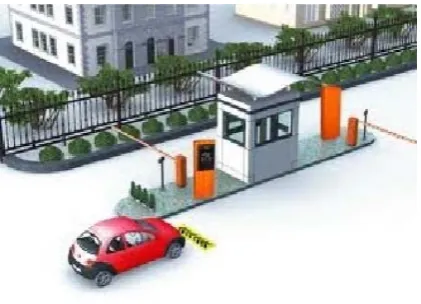
allow the authorized vehicle to pass. It closes automatically when the vehicle passes the gate from the below figure.
Figure 3. Automatic Boom barrier functioning Long range RFID reader installed at the gate reads encoded data on card and passed to the application software. Identity of the vehicle will be verified and open signal will be send to the boom barrier.
Figure 4. Vehicle Identification
On receiving the signal, gate will be opened to allow the authorized vehicle to pass. It closes automatically when the vehicle passes the gate
B.SOFTWARE COMPONENT 1.Windows 7/8:
2.Android OS:
Android is a Linux based operating system design primarily for touch screen mobile device such as smart phones and Tablet computers.Initially developed by Android,Inc,which Google backed financially and later bought in 2005,Android was unveiled in 2007 along with the founding of the Open Handset Alliance:consortium of hardware,software and telecommunication companies devoted to advancing open standards for mobile devices.The first Android powered phone was sold in October 2008.
C.OBJECTIVES
1. Install the parking application on the client side.
The user needs to install the parking application on his/her Android phone.
2.Register to system for parking.
There is necessary to register every customer with the unique RFID.
3.System generates the information and update database of register user.
4.The system automatically generates the information and data is updated to database of respected registered user. 5.User can check the availability of parking slots.
The system maintains the availability of the vacant parking slots in the parking zones.
6.Maintains the status of the car.
The system maintains the status of the car entering the parking zones,whether the car is entering or exiting the parking.
IV.SYSTEM ARCHITECTURE
The RFID consists of a reader, and RFID tags. the RFID tag proceedings a unique ID and fixed information. The tag is triggered when it approaches the RFID reader. The information recorded in the tag is transmit to the RFID reader.
A RFID reader will pass the signal into the digital and computing content. In the proposed RFID Parking system the RFID reader is deployed at the gate. In addition ,the RFID tags are placed in the car. Considering the probability, the RFID System should overcome the accuracy affection of weather and sunshade-paster of car, and the RFID tag type. When an RFID Parking Management System user’s car approaches the gate, the induction and communication between RFID tag inside the car and antenna of RFID System is automatically established. Then the reader of RFID System translates the signal information to the digital content. Fig.5 presents the work flowchart of the parking System.
NO
YES
Figure5:The work flowchart of parking system START
Input-Reader has receivedthe signal fromthe RFIDtag
RFID will judge the
card
Car=Regist red
Display information in registration form
Make entry in system
The output is display on screen
Assign the parking slot
V.WORKING 1.SERVER PART
Figure 6:Hardware interface of parking system
Above Figure shows parking navigation of the system using android mobile application.the system which cantain the hardwarepart RFID tags, IR sensors,microcontroller. There are parking slots in which the IRsensors are to be placed in every slots.the time in which the customer want to parked the car he will easily find the available parking slots in zone by using the parking client application he can use this application
Effortlessly. using dijestra algorithm the shortest path are shown to the customer.
2. CLIENT PART
Figure 7 shows the application.from these application the user can easily view the available parking slots on there mobile.it shown by login successfully. When a car enters the parking facility, it finds its position by an existing positioning method based on the RSSIs from WiFi anchors[9]. It then communicate with the central server and finds the parking route. Cars periodically send its position and status (running, parked or leaving a parking space) to the server and receive the parking occupancy information. Once a car needs a recommended parking route
Figure8: parking client application
The above figure shows the client side application for parking navigation system .for this the customer need to installed the application on the mobile.the customer required the wifi or internet to run the application.with the help of this application customer able to known the vacant slots in the parking zone. When user open parking client app in mobile he have to enter IP Address of server. For controlling devices remotely.server part send the password through the sms alert.He need password for security purpose.
VI.STRENGTH
1.In this system, we solve the problem of traffic congestion using navigation method.
2.We propose a system that can easily find vacant space for parking.
3.We design a central server that maintain information about the registered parking zones.
4.It also maintain the count of vacant space in the parking facility and broadcast it to the user. So the user can easily take decision based on the nearest parking available.
VII.OPPURTUNITIES
1.User can easily find vacant space for parking in large crowded areas.
2User is also aware of the available parking zones in that area.
3.we solve the problem of traffic congestion using navigation method.
4.Thus by using navigation method,the user can get the shortest path to the selected parking zone to avoid congestion.
5.Therefore the parking waiting time is reduced efficiently.
VIII.SCOPE
One application of the system can be installed at the Parking slots of Offices, Malls or Toll plazas.
1. In the project, we have all the vehicles which have a unique RFID tages are emotationally attached to it. 2. It can be implemented for not only two wheelers but also
four wheelers.
3. When the vehicle passes from the RFID Reader, the Reader reads the RFID Tag.
4.After the RFID Reader reads the RFID Tag, it sends the RFID tag information to the Database.
5.The Database has stored the vehicle information in such as: Vehicle color, model no,vehicle type etc.
6.Using the RFID technology, we can not only use it for checking the authorization of a certain driver, we can also use it to debit money.
7.An example of this technology is Salik.
Salik is the name given to the electronic toll road system in Dubai, United Arab Emirates
IX.CONCLUSION
In this paper we proposed a secured and bright parking system using central server. The vacant space for parking can be easily viewed to the driver using the mobile parking client application.
In large parking facility, we propose a navigation system which ultimately reduces the parking waiting time.firstly the user can select the efficient parking zone from the available parking slots along with available vacant space after selecting the desired parking zone, the user can get the path for the parking zone.fast parking spot finding time.The parking reservation is safe
It is An ultimate solution for today’s car parking .
REFERENCES
[1] V. Tang, Y. Zheng, and J. Cao, ”An intelligent car park management system based on wireless sensor networks”, in Proc. of the First International Symposium on PervasiveComputing and Applications, Urumchi, Xinjiang, P.R. China,pp. 65-70, August 2006.
[2] J. Chinrungrueng, U. Sunantachaikul, and S. Triamlumlerd,”Smart parking: an application of optical wireless sensor network”, in Proc. of the the 2007 International Symposium on Applications and the Internet Workshops (SAINTW 07),Hiroshima, Japan, pp. 66-69, January 2007.
[3] Y. Peng, Z. Abichar, and J. M. Chang, ”Roadside-aided routing (RAR) in vehicular networks”, in Proc. IEEE ICC 2006, Vol. 8, pp. 3602-3607, Istanbul, Turkey, June 2006.
[4] J. P. Hubaux, S. Capkun, and J. Luo, ”The security and privacy of smart vehicles”, IEEE Security and Privacy Magazine,Vol. 2, No. 3, pp. 49- 55, 2004.
[5] M. Lott, R. Halfmann, E. Schultz, and M. Radimirsch,”Medium access and radio resource management for ad hoc networks based on UTRA TDD”, in Proc. ACM MobiHoc 2001, pp. 76-86, October 2001. [6] R. Lu, X. Lin, H. Zhu, and X, Shen, ”SPARK: A New VANET-based
Smart Parking Scheme for Large Parking Lots”, in Proc. IEEE INFOCOM2009, pp. 1413-1421, 19-25 April 2009.
[7] Y. Gu, A. Lo, and I Niemegeers, ”A Survey of Indoor Positioning Systems for Wireless Personal Networks”, IEEE Communications Surveys & Tutorials, pp. 11:13-32, 2009.
[8] N. Priyantha, A. Chakraborty, and H. Balakrishnan,”The cricket location support system”, Proceedings of ACM MobiCom, pp. 32-43, 8, 2000.
[9] D. Niculescu and B. Nath, ”Ad hoc positioning system(APS)”, In Proceedings of IEEE GLOBECOM, pp. 2926-2931, 2001.
![Figure 7 shows the application.the parking facility, it finds its position by an existing positioning method based on the RSSIs from WiFi anchors[9]](https://thumb-us.123doks.com/thumbv2/123dok_us/7852209.1302116/4.595.61.300.82.321/figure-application-parking-facility-position-existing-positioning-anchors.webp)
