1 Synthesis of Thymidine Phosphorylase Inhibitor Based on Quinoxaline Derivatives and Their Molecular Docking Study
Noor Barak Almandila, Muhammad Tahaa, Rai Khalid Farooqb, Amani Alhibshib, Mohamed Ibrahima, El Hassane Anouarc, Mohammed Gollapallid, Fazal Rahime, Muhammad Nawazf, Syed
Adnan Ali Shahg,h, Qamar Uddin Ahmedi, Zainul Amiruddin Zakaria*j,k
aDepartment of clinical pharmacy, institute for research and medical consultations (IRMC), Imam Abdulrahman Bin Faisal University, P. O. Box 1982, Dammam 31441, Saudi Arabia.
bDepartment of Neuroscience Research, Institute for Research and Medical Consultations (IRMC), Imam Abdulrahman Bin Faisal University, P.O. Box 1982, Dammam 3144, Saudi Arabia.
cDepartment of Chemistry, College of Sciences and Humanities, Prince Sattam bin Abdulaziz University, P.O. Box 83, Al-Kharij 11942, Saudi Arabia
dCollege of Computer Science & Information Technology (CCSIT) Imam Abdulrahman Bin Faisal University P.O. Box 1982, Dammam 31441, Saudi Arabia.
eDepatment of Chemistry, Hazara university, Mansehra-21300, Khyber Pakhtunkhwa, Pakistan
fDepartment of Nano-Medicine Research, Institute for Research and Medical Consultations (IRMC), Imam Abdulrahman Bin Faisal University, P.0. Box 1982, Dammam 31441, Saudi Arabia;
gFaculty of Pharmacy, Universiti Teknologi MARA Puncak Alam Campus, 42300 Bandar Puncak Alam, Selangor D.E., Malaysia.
hAtta-ur-Rahman Institute for Natural Products Discovery (AuRIns), Universiti Teknologi MARA Puncak Alam Campus, 42300 Bandar Puncak Alam, Selangor D.E., Malaysia.
iDepartment of Pharmaceutical Chemistry, Kulliyyah of Pharmacy, International Islamic University Malaysia, Pahang DM, Kuantan 25200, Malaysia.
jDepartment of Biomedical Science, Faculty of Medicine and Health Sciences, Universiti Putra Malaysia, 43400 Serdang, Selangor, Malaysia kHalal Institute Research Institute, Universiti Putra Malaysia, 43400 Serdang, Selangor, Malaysia
Abstract:
We have synthesized quinoxaline analogs (1-25), characterized by 1HNMR and HREI-MS and evaluated for thymidine phosphorylase inhibition. Among the series, nineteen analogs showed better inhibition when compared with the standard inhibitor 7-Deazaxanthine (IC50 = 38.68 ± 4.42 µM). The most
potent analog among the series is analog 25with IC50 value 3.20 ± 0.10 µM. Sixteen analogs 1, 2, 3, 4, 5, 6, 7, 12, 13, 14, 15, 16, 17, 18, 21and 24 showed outstanding inhibition which is many folds better than the standard 7-Deazaxanthine. Two analogs 8 and 9 showed moderate inhibition. A structure-
activity relationship has been established mainly based upon the substitution pattern on the phenyl
ring. The binding interactions of the active compounds were confirmed through molecular docking
studies.
Keywords: Quinoxaline Analogs, Synthesis, Thymidine phosphorylase inhibition, Molecular docking
Correspondence and reprints
E-mail: E-mail: [email protected] and [email protected]: 00966502057370
*Correspondence 2: [email protected] (Tel.: +603-8947 2111; Fax: +603-89436178)
2 1.0. Introduction:
Thymidine phosphorylase (TP), an enzyme involved in catabolism, exists in both prokaryotic and eukaryotic organisms [1-3]. TP speeds up the initial step in catabolism and converts thymidine nucleoside into thymine and 2-deoxy-D-ribose-1-phosphate by cleaving glycoside bond [4, 5]. The intermediate
obtained through dephosphorylation is 2-deoxy-D-ribose that plays a significant role in prompting the tumor
angiogenesis and hence favors cancer metastasis [6–8]. With respect to tumor angiogenesis, TP play a major role, it helps in the proliferation process of endothelial cells throughout the body in cancer metastasis [9-10]. TP performs the same function as platelet endothelial cell growth factor (PD-ECGF) [11, 12]. TP belonging to mammalians shares 39% sequence similarity with TP of E. coli, while the enzyme of mammalians also shares 65% resemblance with the active sites of residues of E. coli enzyme [13]. The production of 2՜-deoxy-D-ribose can be limited through TP inhibitors which in turn suffocate the growth of tumor cells [14, 15]. Therefore, medicinal chemists have tried to synthesize novel inhibitors of thymidine phosphorylase which have the potential to overcome the formation of new blood vessels and decline the tumor cells growth. Various attempts have been reported to developed TP inhibitor [16-23]. The most potent inhibitor belong to human TP known up-to-now is 5-chloro-6-[1-(2-iminopyrrolidinyl)methyl] uracil hydrochloride (TPI), while 7-deazaxanthine (7DX) is the first purine analog labeled as TP inhibitor [24-26].
Nitrogen-containing heterocycles have attracted considerable attention due to their wide range of
pharmacological importance. Quinoxaline has a six-membered cyclic ring with two nitrogen atoms
inside the cyclic ring. Quinoxaline and their analogs have attracted the medicinal chemists over
the decades. Quinoxalines are used as antimicrobial [27], antibacterial [28], antifungal [29, 30],
anti-protozoan [31], anti-inflammatory, antianalgesic [32], anti-cancer [33, 34], antidiabetic and
as anti-proliferative agents [35, 36]. Our research group has been working on the design and
synthesis of heterocyclic compounds in search of potential lead compounds for many years and
had found promising results [37-42]. Thus, we decided to screen a library of quinoxaline for
thymidine phosphorylase inhibitory activity. Here in this study, we are reporting the synthesis of
3 2. Results and Discussion
2.1. Chemistry
Synthesis of quinoxaline derivatives (1-25) started with treating quinoxaline-2-carbohydrazide (I) with potassium thiocyanate in the presence of acid to form quinoxaline thiosemicarbazone (II) which was treated with basic solution to cyclize to form 5-(quinoxalin-3-yl)-4H-1,2,4-triazole-3-thiol (III) which was treated with different substituted phenacyl bromide to afford (1-25) target compounds. The crude product was washed with water and recrystallized in methanol to afford pure product in 80-75%. All synthesized compounds were characterized by different spectroscopic methods given in scheme 1.
N N O N H NH2
KSCN, H+
N N O N H H N S NH2 HO -N N N H N N SH N N N N N N N N H N N SH
1) RCOCH2Br, DMSO
2) H2SO4
S I II III 1-25 III R
Scheme. 1: synthesis of 2-(5-arylthiazolo[2,3-c][1,2,4]triazol-3-yl)quinoxaline 1-25 derivatives
Table-1: Different substituent of Quinoxaline Derivatives (1-25) and their Thymidine
Phosphorylaseinhibitory activity.
S.No. R IC50 (mM ± SEMa) S.No. R IC50 (mM ±
SEMa)
1 13.60 ± 0.4 14
4
2 26.10 ± 0.70 15 15.20 ± 0.50
3 18.10 ± 0.50 16 3.50 ± 0.20
4 27.40 ± 0.60 17 24.20 ± 0.70
5 33.40 ± 0.80 18 16.90 ± 0.60
6 24.40 ± 0.60 19 N. A.
7 34.70 ± 0.80 20 N. A.
8 47.50 ± 0.90 21 26.20 ± 0.50
9 56.40 ± 1.20 22 N. A.
10 N. A. 23 N. A.
11 N. A. 24 13.10 ± 0.30
5
13 18.30 ± 0.55 - - -
7-Deazaxanthine (7DX) 38.68 ± 4.42 mM
2.2. In vitro Thymidine Phosphorylase Inhibitory Activity:
We have synthesized twenty-five analogs of 5-phenyl-3-quinoxalin (1-25) and screened for inhibitory potential against thymidine phosphorylase enzyme. With respect to inhibitory potential, many analogs of the series showed a variable degree of inhibition with IC50 values ranging between 3.50 ± 0.20 to 56.40 ±
1.20 μM when compared with standard 7-Deazaxanthine (IC50 = 38.68 ± 1.12 μM). The analogs 1, 2, 3, 4,
5, 6, 7, 12, 13, 14, 15, 16, 17, 18, 21, 24 and 25 showed excellent inhibitory potential with IC50 values 13.60
± 0.4, 26.10 ± 0.70, 18.10 ± 0.50, 27.40 ± 0.60, 33.40 ± 0.80, 24.40 ± 0.60, 34.70 ± 0.80, 33.20 ± 0.75, 18.30 ± 0.55, 13.20 ± 0.40, 15.20 ± 0.50, 3.50 ± 0.20, 24.20 ± 0.70, 16.90 ± 0.60, 26.20 ± 0.50, 13.10 ± 0.30 and 3.20 ± 0.10 μM respectively by comparing with standard 7-Deazaxanthine. Two analogs 8 and 9 showed moderate inhibitory activity with IC50 values 47.50 ± 0.90 and 56.40 ± 1.20 μM respectively, while
six analogs 10, 11, 19, 20, 22 and 23 were found inactive. Structure activity relationship has been established for all compounds, mainly based on substituents pattern of phenyl ring.
Compound 25, a 2,3-dihydroxy analog was found the most active analog among the series with IC50 value
3.20 ± 0.10 μM. If we compare analog 25 with other dihydroxy analogs like 14, a 2,4-dihydroxy analog (IC50 = 13.20 ± 0.40 μM) 15, a 2,5-dihydroxy analog (IC50 = 15.20 ± 0.50 μM) and 16, a 2,4-dihydroxy
analog (IC50 = 3.50 ± 0.20 μM), analog 25 was found superior. Although all the four analogs have two
6
By comparing dihydroxy analogs with monohydroxy analog like 12, 13, 17, 18, 21 and 24 the dihydroxy analogs were found to be more potent. This greater potential seems due to the greater number of hydroxy groups on the phenyl ring.
Similarly, a pattern was also observed in flouro substituted analogs like 1, 2 and 3 IC50 value 13.60 ± 0.4,
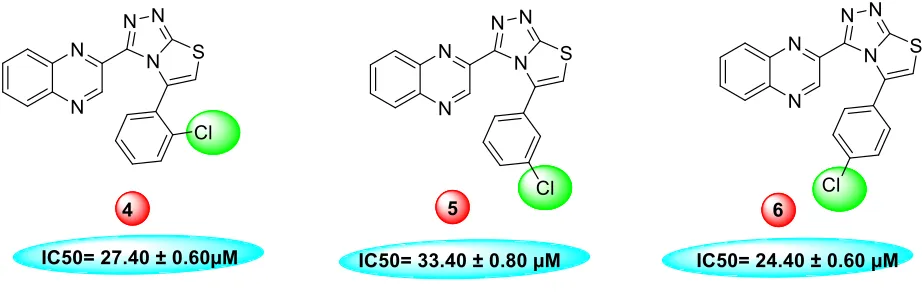
7 The same trend of difference in inhibitory activity was found in chloro substituted analogs 4, 5 and 6 with IC50 value 27.40 ± 0.60, 33.40 ± 0.80 and 24.40 ± 0.60 μM respectively. All three analogs have chloro group
but their attachment on phenyl ring differs from each other, and the difference in inhibitory activity it seems due to attachment of chloro group at variable position on the phenyl part.
So, it was concluded that in our designed molecules the position, nature, and number of substituent play critical role in thymidine phosphorylase inhibition.
Molecular docking
The IC50 values of quinoxaline derivatives as thymidine phosphorylase inhibitors are showed in
Table 1. The thymidine phosphorylase inhibition by the synthesized derivatives is mainly due to
the type, number and positions of the functional group in the substitute group R of the basic
skeleton (Table 1). For a better understanding of the enzyme inhibition by the synthesized
compounds, molecular docking study has been carried out to shed light on the established binding
modes of the five selected synthesized compounds 14, 15, 16 and 25. The selected compounds
differ by the substitution position of the hydroxyl group in the aromatic ring (Scheme 1).
Compounds 16 and 25 with OH groups in ortho position to each other show higher activity than
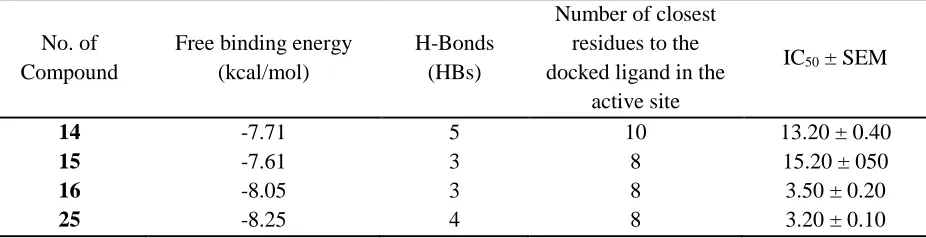
14 and 15 where OH groups are in meta position to each other (Table 1). Table 2 summarized the
calculated binding energies of the stable complex's ligand- thymidine phosphorylase, number of
established intermolecular hydrogen bonding between the synthesized compounds (14, 15, 16 and
8
Table 2 IC50, docking binding energies, hydrogen bonding and the number of closest residues to
the docked ligands in the active site of the selected quinoxaline derivatives 14, 15, 16 and 25 within
the active binding site of thymidine phosphorylase.
No. of Compound
Free binding energy (kcal/mol)
H-Bonds (HBs)
Number of closest residues to the docked ligand in the
active site
IC50 ± SEM
14 -7.71 5 10 13.20 ± 0.40
15 -7.61 3 8 15.20 ± 050
16 -8.05 3 8 3.50 ± 0.20
25 -8.25 4 8 3.20 ± 0.10
The complexes formed between the docked selected compounds and amino acids of the
binding active site of thymidine phosphorylase exhibited negative bending energies, which is a
signpost that the inhibition of thymidine phosphorylase by the selected compounds is
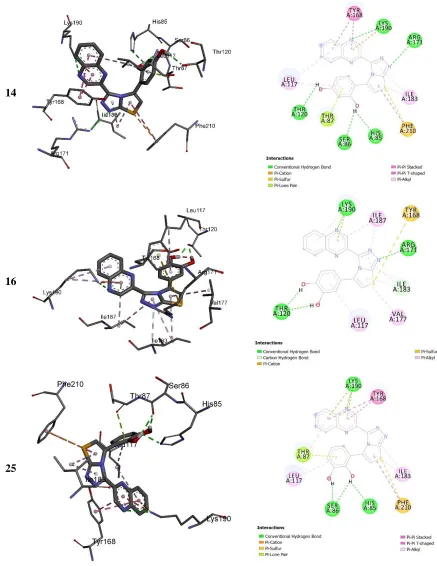
thermodynamically favorable (Table 2). As can be seen from the docking results in Table 2 and
Figure 1, the highest activity of 16 and 25 compared with 14 and 15 mainly refers to the stability
of the formed complexes between the docked compounds (16 and 25) and thymidine
phosphorylase compared with the formed complexes between the docked compounds (14 and 15)
and thymidine phosphorylase ones. The higher activity of 25 compared with 16 may refer to the
number intermolecular hydrogen bonding formed with substituted OH groups in the complex 25
-receptor compared to 16-receptor one. Indeed, three hydrogen bonds are formed between OH
groups of 25 and SER 86 and HIS 85 of the active site of thymidine phosphorylase of 1.71, 2.24
and 3.38 Å, respectively. However,two hydrogen bonds are formed between OH groups of 16 and
9 14
16
25
Figure 1: 3D (right) and 2D (left) closest interactions between active site residues of
10
3.0. Experimental Section
3.1. General Methods
All nuclear magnetic resonance experiments had been carried out using on Avance Bruker 500
MHz. Electron impact mass spectra (EI-MS) were recorded on a Finnigan MAT-311A, Germany.
Thin layer chromatography (TLC) was performed on pre-coated silica gel aluminum plates
(Kieselgel 60, 254, E. Merck, Germany). Chromatograms were visualized by UV at 254 and 365
nm.
3.1.1 Thymidine phosphorylase assay
Since human TP is not easy to get, we used commercially available recombinant E. coli TP. The
primary sequence of TP is frequently preserved throughout evolution as mammalian TP is reported
to share 39% sequence resemblance with the TP of E. coli. The mammalian enzyme as well shared
up to 70% resemblance with the active site residues, and three-dimensional structure of E. coli TP
enzyme [43]. The Thymidine phosphorylase/PD-ECGF (E. coli) activity was determined by
measuring the absorbance at 290 nm spectrophotometrically. The original method was described
by Krenitsky and Bushby [44]. In brief, the total reaction mixture of 200 µL contained 145 µL of
potassium phosphate buffer (pH 7.4), 30 µL of enzyme (human and E. coli) at concentration 0.05
and 0.002 U, respectively, were incubated with 5 µL of test materials for 10 min at 25 °C in a
microplate reader. After incubation, pre-read at 290 nm was taken to deduce the absorbance of
substrate particles. The substrate (20 µL, 1.5 mM), dissolved in potassium phosphate buffer, was
immediately added to the plate and continuously read after 10, 20, and 30 min in a microplate
reader (spectra max, molecular devices, CA, USA). All assays were performed in triplicate.
3.1.2. Calculations
Reactions for above mentioned biological activities were carried out in triplicate. Results were
then processed using SoftMax Pro 4.8 software (Molecular Devices, CA, USA) and then by
Microsoft Excel. The percent inhibition for above mentioned biological activities was calculated
by following formula:
11
3.1.3 Synthesis of quinoxaline thiosemicarbazone (II)
quinoxaline-2-carbohydrazide (5 g, 26.60 mmol), potassium thiocyanate (2.61 g, 26.90 mmol)
and 4 ml of conc. HCl in 40 ml of water were refluxed for 4 h. The reaction progress was monitored
by TLC. After completion of the reaction, reaction mixture was left for cooling and white solid
ppts appeared then the solid was filtered and dried. Yield 5.62 g (85.6%); mp 289-290 °C.
3.1.4. Synthesis of 5-(quinoxalin-3-yl)-4H-1,2,4-triazole-3-thiol (III)
The 5-(quinoxalin-3-yl)-4H-1,2,4-triazole-3-thiol (III) was synthesized as reported in [45].
3.5. General procedure for synthesis of quinoxaline derivatives (1-25)
5-(quinoxalin-3-yl)-4H-1,2,4-triazole-3-thiol (III) (1 mmol) was refluxed with appropriate arylacyl bromide (1 mmol) in 15 ml ethanol for 12 h. The reaction was monitored by TLC. On completion of the reaction, the product was left for cooling. The solid was filtered, and the crude products were recrystallized from methanol.
4.2.1. 5-(2-flourophenyl)-3(Quinoxalin-2yl)thiazolo[2,3-c][1,2,4]triazole
Yield: 81%. m.p.: 299-300°C; 1H NMR (500 MHz, DMSO-d6): δ 8.32 (s, 1H), 8.02 (d, J = 8.0 Hz,
1H), 7.88 (d, J = 7.0 Hz, 1H), 7.70-7.67 (m, 3H), 7.52-7.48 (m, 2H), 7.30-7.26 (m, 2H). 13C-NMR
(150 MHz, DMSO -d6): 158.5, 155.5, 145.9, 145.4, 144.5, 142.4, 142.3, 141.11, 130.5, 129.8,
129.7, 129.5, 129.4, 129.3, 124.10, , 123.7, 115.7, 114.9. HR-ESI-MS: m/z calcd for C18H10FN5S,
[M]+ 347.0641; Found 347.0623.
4.2.2. 5-(3-flourophenyl)-3(Quinoxalin-2yl)thiazolo[2,3-c][1,2,4]triazole
Yield: 80%. m.p.: 304-305 °C. 1H NMR (500 MHz, DMSO-d6): δ 8.10 (s, 1H), 7.90 (d, J = 7.5
Hz, 1H), 7.67 (d, J = 7.5 Hz, 2H), 7.61 (d, J = 8.0 Hz, 1H), 7.56 (d, J = 7.5 Hz, 1H), 7.50–7.46 (m,
2H), 7.22 (t, J = 8.0 Hz, 1H), 7.18-7.16 ( m, 1H); 13C NMR (150 MHz, DMSO -d6): 162.2,
155.5, 145.9, 145.4, 144.5, 142.4, 142.3, 141.11, 134.8, 129.8, 129.7, 129.5, 129.4, 127.7, 115.7,
123.3, 115.10, 115.7. HR-ESI-MS: m/z calcd for C18H10FN5S, [M]+ 347.0641; Found 347.0625.
12
Yield: 77%. m.p.: 308-309 °C. 1H NMR (500 MHz, DMSO-d6): δ 8.11(s, 1H), 7.90 (d, J = 7.5 Hz,
1H), 7.80 (d, J = 8.0 Hz, 2H), 7.72–7.68 (m, 2H), 7.50–7.45 (m, 2H), 7.24 (d, J = 7.5 Hz, 2H); 13C
NMR (150 MHz, DMSO -d6): 162.9, 155.5, 145.9, 145.5, 144.5, 142.4, 142.3, 141.11, 130.8,
130.7, 129.8, 129.7, 129.5, 129.4, 128.8, 116.3, 116.2, 115.7. HR-ESI-MS: m/z calcd for
C18H10FN5S, [M]+ 347.0641; Found 347.0617.
4.2.4. 5-(2-chlorophenyl)-3(Quinoxalin-2yl)thiazolo[2,3-c][1,2,4]triazole
Yield: 82%. m.p.: 280-281°C. 1H NMR (500 MHz, DMSO-d6): δ 8.50 (s, 1H), 8.12 (d, J = 7.0 Hz,
1H), 7.90 (d, J = 7.0 Hz, 1H), 7.72-7.68 (m, 3H), 7.54–7.49 (m, 2H), 7.42–7.38 (m, 2H); 13C NMR
(150 MHz, DMSO -d6): 155.5, 145.9, 145.4, 144.5, 142.4, 142.3, 141.11, 132.7, 132.4, 130.8,
130.3, 129.9, 129.8, 129.7, 129.5, 129.4, 128.9, 115.7. HR-ESI-MS: m/z calcd for C18H10ClN5S,
[M]+ 363.0345; Found 363.0319.
4.2.5. 5-(3-chlorophenyl)-3(Quinoxalin-2yl)thiazolo[2,3-c][1,2,4]triazole
Yield: 80%. m.p.: 285-286 °C. 1H NMR (500 MHz, DMSO-d6): δ 8.90 (s, 1H), 8.57 (d, J = 6.5
Hz, 1H), 8.16 (d, J = 7.5 Hz, 1H), 8.05 (s, 1H), 7.86 (d, J = 8.0 Hz, 1H), 7.70 (d, J = 7.5 Hz, 2H),
7.50-7.47 (m, 2H), 7.42 (d, J = 8.0 Hz, 1H); 13C NMR (150 MHz, DMSO -d6): 155.5, 145.9,
145.4, 144.5, 142.4, 142.3, 141.11, 134.9, 134.6, 129.9, 129.8, 129.7, 129.6, 129.5, 129.4, 128.9,
125.8, 115.7. HR-ESI-MS: m/z calcd for C18H10ClN5S, [M]+ 363.0345; Found 363.0323.
4.2.6. 5-(4-chlorophenyl)-3(Quinoxalin-2yl)thiazolo[2,3-c][1,2,4]triazole
Yield: 89%. m.p.: 249-250 °C. 1H NMR (500 MHz, DMSO-d6): δ 8.08 (s, 1H), 7.88 (d, J = 7.5
Hz, 1H), 7.70 (d, J = 8.5 Hz, 2H), 7.69-7.64 (m, 2H), 7.52-7.45 (m, 4H). 13C NMR (150 MHz,
DMSO -d6): 155.5, 145.9, 145.4, 144.5, 142.4, 142.3, 141.11, 134.5, 131.3, 129.9, 129.8, 129.7,
129.6, 129.5, 129.4, 128.9, 127.9, 115.7. HR-ESI-MS: m/z calcd for C18H10ClN5S, [M]+ 363.0345;
Found 363.0327.
4.2.7. 5-(2-nitrophenyl)-3(Quinoxalin-2yl)thiazolo[2,3-c][1,2,4]triazole
Yield: 83%. m.p.: 310-311°C. 1H NMR (500 MHz, DMSO-d6): δ 8.26 (d, J = 7.0 Hz, 1H), 7.98
(d, J = 7.5 Hz, 1H), 7.90 (d, J = 7.5 Hz, 1H), 7.74 (d, J = 7.0 Hz, 1H), 7.70 (d, J = 7.0 Hz, 1H),
7.63 (d, J = 7.0 Hz, 1H), 7.61 (d, J = 7.0 Hz, 1H), 7.50-7.46 (m, 2H), 7.43 (s, 1H); 13C NMR (150
13
129.8, 129.7, 129.5, 129.4, 125.4, 124.6,115.7. HR-ESI-MS: m/z calcd for C18H10N6O2S, [M]+
374.0586; Found 374.0568.
4.2.8. 5-(4-nitrophenyl)-3(Quinoxalin-2yl)thiazolo[2,3-c][1,2,4]triazole
Yield: 81%. m.p.: 315-316°C. 1H NMR (500 MHz, DMSO-d6): δ 8.22 (d, J = 8.3 Hz, 2H), 8.18
(s, 1H), 7.98 (d, J = 8.0 Hz, 2H), 7.90 (d, J = 7.5 Hz, 1H), 7.70-7.65 (m, 2H), 7.54 (d, J = 7.0 Hz,
1H), 7.44 (s, 1H); 13C NMR (150 MHz, DMSO -d6): 155.5, 147.9, 145.9, 145.4, 144.5, 142.4,
142.3, 142.1, 141.9, 141.8, 139.3, 129.8, 129.7, 129.5, 129.4, 126.4, 126.3, 124.6,124.5,115.7.
HR-ESI-MS: m/z calcd for C18H10N6O2S, [M]+ 374.0586; Found 374.0559.
4.2.9. 3-(quinoxalin-2-yl)-5-o-tolylthiazolo[2,3-c][1,2,4]triazole
13C NMR (150 MHz, DMSO -d6): 155.5, 145.9, 145.4, 144.5, 142.4, 142.3, 141.11, 136.9, Yield:
88%. m.p.: 265-266 °C. 1H NMR (500 MHz, DMSO-d6): δ 8.40 (s, 1H), 7.89 (d, J = 8.0 Hz, 2H),
7.68 (d, J = 7.0 Hz, 2H), 7.48-7.42 (m, 2H), 7.35-7.22 (m, 3H), 2.49 (s, 3H); 13C NMR (150 MHz,
DMSO -d6): 130.1, 129.9, 129.8, 129.7, 129.5, 129.4, 128.8, 126.4, 122.9, 115.7, 18.9.
HR-ESI-MS: m/z calcd for C19H13N5S, [M]+ 343.0892; Found 343.0864.
4.2.10. 3-(quinoxalin-2-yl)-5-m-tolylthiazolo[2,3-c][1,2,4]triazole
Yield: 84%. M.P.: 270-271 °C. 1H NMR (500 MHz, DMSO-d6): δ 8.08 (s, 1H), 7.90 (d, J = 8.0
Hz, 1H), 7.72-7.68 (m, 2H), 7.57 (s, 1H), 7.52 (d, J = 7.0 Hz, 1H), 7.43 (s, 1H), 2.46 (s, 3H); 13C
NMR (150 MHz, DMSO -d6): 155.5, 145.9, 145.4, 144.5, 142.4, 142.3, 141.11, , 139.1, 133.1,
130.6, 129.9, 129.8, 129.7, 129.5, 129.4, 128.9, 124.6, 115.7, 21.8. HR-ESI-MS: m/z calcd for
C19H13N5S, [M]+ 343.0892; Found 343.0871.
4.2.11. 3-(quinoxalin-2-yl)-5-p-tolylthiazolo[2,3-c][1,2,4]triazole
Yield: 81%. m.p.: 280-281 °C. 1H NMR (500 MHz, DMSO-d6): δ 8.10 (s, 1H), 7.88 (d, J = 8.0
Hz, 1H), 7.71-7.65 (m, 4H), 7.47-7.42 (m, 2H), 7.27 (d, J = 7.9 Hz, 2H), 2.49 (s, 3H); 13C NMR
(150 MHz, DMSO -d6): 155.5, 145.9, 145.4, 145.3, 144.5, 142.4, 142.3, 141.11, 130.2, 131.9,
129.9, 129.8, 129.7, 129.5, 129.4, 129.3, 125.9, 125.7, 115.7, 21.5. HR-ESI-MS: m/z calcd for
14
4.2.12. 3-(3-(quinoxalin-2-yl)thiazolo[2,3-c][1,2,4]triazol-5-yl)phenol
Yield: 85%. m.p.: 289-290 °C. 1H NMR (500 MHz, DMSO-d6): δ 9.05 (s, 1H, OH), 8.04 (s, 1H),
7.90 (d, J = 7.5 Hz, 1H), 7.70-7.65 (m, 2H), 7.49-7.43 (m, 2H), 7.25 (d, J = 7.5 Hz, 1H), 7.19-7.15
(m, 1H), 7.15 (d, J = 7.0 Hz, 1H), 6.81 (d, J = 7.0 Hz, 1H); 13C NMR (150 MHz, DMSO -d6):
157.7, 155.5, 145.9, 145.4, 144.5, 142.4, 142.3, 141.11, 134.6, 130.8, 129.8, 129.7, 129.5, 129.4,
120.3, 115.10, 115.9, 115.7. HR-ESI-MS: m/z calcd for C18H11N5OS, [M]+ 345.0684; Found
345.0666.
4.2.13. 4-(3-(quinoxalin-2-yl)thiazolo[2,3-c][1,2,4]triazol-5-yl)phenol
Yield: 82%. m.p.: 297-298 °C. 1H NMR (500 MHz, DMSO-d6): δ 9.82 (s, 1H, OH), 8.03 (s, 1H),
7.88 (d, J = 8.0 Hz, 1H), 7.65-7.62 (m, 2H), 7.58 (d, J = 7.5 Hz, 2H), 7.46-7.40 (m, 2H), 6.80 (d,
J = 8.0 Hz, 2H). 13C NMR (150 MHz, DMSO -d6): 158.7, 155.5, 145.9, 145.5, 144.5, 142.4,
142.3, 141.11, 129.8, 129.7, 129.5, 129.4, 128.9, 128.7, 125.7, 116.6, 116.4,115.7. HR-ESI-MS:
m/z calcd for C18H11N5OS, [M]+ 345.0684; Found 345.0661.
4.2.14. 4-(3-(quinoxalin-2-yl)thiazolo[2,3-c][1,2,4]triazol-5-yl)benzene-1,3-diol
Yield: 79%. m.p.: 299-300 °C. 1H NMR (500 MHz, DMSO-d6): δ 10.70 (s, 1H, OH), 9.80 (s, 1H,
OH), 8.18 (s, 1H), 7.86 (d, J = 8.0 Hz, 1H), 7.71-7.65 (m, 3H), 7.50-7.43 (m, 2H), 6.32 (d, J = 7.0,
6.0 Hz, 2H). 13C NMR (150 MHz, DMSO -d6): 160.1, 156.2, 155.5, 145.9, 145.5, 144.5, 142.4,
142.3, 141.11, 133.4, 129.8, 129.7, 129.5, 129.4, 113.3, 109.0, 105.8, 115.7. HR-ESI-MS: m/z
calcd for C18H11N5O2S, [M]+ 361.0633; Found 361.0615.
4.2.15. 2-(3-(quinoxalin-2-yl)thiazolo[2,3-c][1,2,4]triazol-5-yl)benzene-1,4-diol
Yield: 87%. m.p.: 301-302 °C. 1H NMR (500 MHz, DMSO-d6): δ 9.72 (s, 2H, OH), 8.30 (s, 1H),
7.88 (d, J = 8.0 Hz, 1H), 7.74-7.65 (m, 2H), 7.52-7.40 (m, 2H), 7.17 (d, J = 6.0 Hz, 1H), 6.75 (d,
J = 8.0 Hz, 1H), 6.68 (d, J = 7.0 Hz, 1H); 13C NMR (150 MHz, DMSO -d6): 155.5, 150.3, 147.9,
145.9, 145.5, 144.5, 142.4, 142.3, 141.11, 129.8, 129.7, 129.5, 129.4, 122.1, 117.9, 117.5, 115.7,
114.5. HR-ESI-MS: m/z calcd for C18H11N5O2S, [M]+ 361.0633; Found 361.0617.
4.2.16. 4-(3-(quinoxalin-2-yl)thiazolo[2,3-c][1,2,4]triazol-5-yl)benzene-1,2-diol
Yield: 83%. m.p.: 293-294 °C. 1H NMR (500 MHz, DMSO-d6): δ 9.30 (s, 1H, OH), 9.10 (s, 1H,
OH), 7.96 (s, 1H), 7.82 (d, J = 8.0 Hz, 1H), 7.68(d, J = 6.0 Hz, 2H), 7.53-7.40 (m, 2H), 7.20 (s,
15
147.5, 145.9, 145.7, 145.5, 144.5, 142.4, 142.3, 141.11, 129.8, 129.7, 129.5, 129.4, 127.2, 121.7,
116.4, 115.7, 114.5. HR-ESI-MS: m/z calcd for C18H11N5O2S, [M]+ 361.0633; Found 361.0612.
4.2.17. 5-methoxy-2-(3-(quinoxalin-2-yl)thiazolo[2,3-c][1,2,4]triazol-5-yl)phenol
Yield: 86%. m.p.: 305-306 °C. 1H NMR (500 MHz, DMSO-d6): δ 10.87 (s, 1H, OH), 8.30 (s, 1H),
7.82 (d, J = 7.5 Hz, 1H), 7.62 (s, 2H), 7.55 (d, J = 8.0 Hz, 1H), 7.46-7.40 (s, 2H), 6.51 (d, J = 8.0
Hz, 1H), 6.42 (d, J = 6.0 Hz, 1H), 3.75 (s, 3H); 13C NMR (150 MHz, DMSO -d6): 162.2, 156.2,
155.5, 145.9, 145.5, 144.5, 142.4, 142.3, 141.11, 132.9, 129.8, 129.7, 129.5, 129.4, 115.7, 112.9,
107.6, 104.4, 55.9. HR-ESI-MS: m/z calcd for C19H13N5O2S, [M]+ 375.0790; Found 375.0772.
4.2.18. 2-methoxy-5-(3-(quinoxalin-2-yl)thiazolo[2,3-c][1,2,4]triazol-5-yl)phenol
Yield: 83%. m.p.: 293-294 °C. 1H NMR (500 MHz, DMSO-d6): δ 9.22 (s, 1H, OH), 8.04 (s, 1H),
7.88 (d, J = 8.0 Hz, 1H), 7.76-7.69 (m, 2H), 7.46-7.41 (m, 2H), 7.28 (d, J = 6.0Hz, 1H), 7.04 (d, J
= 8.0 Hz, 1H), 6.94 (d, J = 8.0 Hz, 1H), 3.77 (s, 3H); 13C NMR (150 MHz, DMSO -d6): 155.5,
145.7, 147.5, 147.4, 145.5, 144.5, 142.4, 142.3, 141.11, 129.8, 129.7, 129.5, 129.4, 126.9, 121.7,
114.1, 115.7, 111.6, 56.3. . HR-ESI-MS: m/z calcd for C19H13N5O2S, [M]+ 375.0790; Found
375.0768.
4.2.19. 5-(3-methoxyphenyl)-3-(quinoxalin-2-yl)thiazolo[2,3-c][1,2,4]triazole
Yield: 75%. m.p.: 179-180 °C. 1H NMR (400 MHz, DMSO-d6): δ 8.10 (s, 1H), 7.90 (d, J = 8.0
Hz, 1H), 7.70-7.59 (m, 3H), 7.46-7.40 (m, 2H), 7.30 (d, J = 6.5 Hz, 2H), 6.96- 6.89 (m, 1H), 3.80
(s, 3H); 13C NMR (150 MHz, DMSO -d6): 161.2, 155.5, 145.7, 145.5, 144.5, 142.4, 142.3,
141.11, 134.2, 130.3, 129.8, 129.7, 129.5, 129.4, 119.9, 115.7, 114.1, 113.8, 55.9. HR-ESI-MS:
m/z calcd for C19H13N5OS, [M]+ 359.0841; Found 359.0843.
4.2.20. 5-(4-methoxyphenyl)-3-(quinoxalin-2-yl)thiazolo[2,3-c][1,2,4]triazole
Yield: 87%. m.p.: 301-302 °C. 1H NMR (400 MHz, DMSO-d6): δ 8.07 (s, 1H), 7.88 (d, J = 8.0
Hz, 2H), 7.70 (d, J = 8.0 Hz, 2H), 7.62 (d, J = 7.0 Hz, 1H), 7.47-7.42 (s, 2H), 7.02 (d, J = 8.0 Hz,
2H), 3.81 (s, 3H); 13C NMR (150 MHz, DMSO -d6): 160.8, 155.5, 145.7, 145.5, 144.5, 142.4,
142.3, 141.11, 129.8, 129.7, 129.5, 129.4, 128.7, 128.5, 125.5, 115.7, 114.9, 114.7, 55.9.
16
4.2.21. 4-methoxy-2-(3-(quinoxalin-2-yl)thiazolo[2,3-c][1,2,4]triazol-5-yl)phenol
Yield: 83%. m.p.: 308-309 °C. 1H NMR (500 MHz, DMSO-d6): δ 9.98 (s, 1H, OH), 8.40 (s, 1H),
7.88 (d, J = 8.2 Hz, 1H), 7.72-7.67 (m, 2H), 7.47-7.42 (m, 2H), 7.30 (s, 1H), 6.82 (d, J = 2.0 Hz,
2H), 3.79 (s, 3H); 13C NMR (150 MHz, DMSO -d6): 155.5, 153.9, 145.7, 147.5, 145.4, 144.5,
142.4, 142.3, 141.11, 129.8, 129.7, 129.5, 129.4, 121.7, 117.6, 115.7, 115.5, 112.9, 55.9.
HR-ESI-MS: m/z calcd for C19H13N5O2S, [M]+ 375.0790; Found 375.0772.
4.2.22. 5-(pyridin-3-yl)-3-(quinoxalin-2-yl)thiazolo[2,3-c][1,2,4]triazole
Yield: 82%. m.p.: 276-277 °C. 1H NMR (400 MHz, DMSO-d6): δ 8.42 (s, 1H), 8.12 (d, J = 8.0
Hz, 1H), 7.90 (d, J = 7.0 Hz, 1H), 7.70-7.65 (m, 4H), 7.51 (d, J = 7.0 Hz, 1H), 7.47-7.42 (m, 2H).
13C NMR (150 MHz, DMSO -d6): 147.9, 145.7, 147.5, 145.4, 144.5, 143.4, 142.4, 142.3, 141.11,
134.2, 133.2, 129.8, 129.7, 129.5, 129.4, 124.2,120.3. HR-ESI-MS: m/z calcd for C17H10N6S, [M]+
330.0688; Found 330.0667.
4.2.23. 5-(pyridin-4-yl)-3-(quinoxalin-2-yl)thiazolo[2,3-c][1,2,4]triazole
Yield: 86%. m.p.: 276-277 °C. 1H NMR (500 MHz, DMSO-d6): δ 8.60 (d, J = 7.0 Hz, 2H), 8.13
(s, 1H), 7.92 (d, J = 7.9 Hz, 1H), 7.74-7.66 (m, 4H), 7.50-7.42 (m, 2H). 13C NMR (150 MHz,
DMSO -d6): 149.9, 149.8, 145.7, 145.5, 144.5, 143.4, 142.4, 142.3, 141.11, 140.5, 129.8, 129.7,
129.5, 129.4, 121.5, 121.5, 120.3. HR-ESI-MS: m/z calcd for C17H10N6S, [M]+ 330.0688; Found
330.0670.
4.2.24. 2-(3-(quinoxalin-2-yl)thiazolo[2,3-c][1,2,4]triazol-5-yl)phenol
Yield: 82%. m.p.: 286-287 °C. 1H NMR (500 MHz, DMSO-d6): δ 10.54 (s, 1H, OH), 8.20 (s, 1H),
7.90 (d, J = 7.5 Hz, 1H), 7.72 (d, J = 7.0 Hz, 1H), 7.65 (d, J = 8.0 Hz, 2H), 7.52-7.44 (m, 2H),
7.25-7.20 (m, 2H), 6.90 (d, J = 6.5 Hz, 1H). 13C NMR (150 MHz, DMSO -d6): 155.5, 155.3,
145.7, 145.5, 144.5, 142.4, 142.3, 141.11, 131.7, 130.3, 129.8, 129.7, 129.5, 129.4, 120.7, 117.9,
121.7, 115.7. HR-ESI-MS: m/z calcd for C18H11N5OS, [M]+ 345.0684; Found 345.0668.
4.2.25. 3-(3-(quinoxalin-2-yl)thiazolo[2,3-c][1,2,4]triazol-5-yl)benzene-1,2-diol
Yield: 82%. m.p.: 309-310 °C. 1H NMR (500 MHz, DMSO-d6): δ 10.08 (s, 1H, OH), 9.35 (s, 1H,
OH), 8.40 (s, 1H), 7.88 (d, J = 8.0 Hz, 1H), 7.64 (d, J = 6.0 Hz, 2H), 7.45-7.40 (m, 2H), 7.14 (d, J
= 7.0 Hz, 1H), 6.80 (d, J = 7.0 Hz, 1H), 6.70 (t, J = 7.5 Hz, 1H); 13C NMR (150 MHz, DMSO
-d6): 155.5, 145.7, 145.5, 145.4, 144.5, 143.7, 142.4, 142.3, 141.11, 129.8, 129.7, 129.5, 129.4,
124.3, 123.4, 122.1, 117.5, 115.7. HR-ESI-MS: m/z calcd for C18H11N5O2S, [M]+ 361.0633; Found
17
3.3. Molecular docking details
The intermolecular binding modes between the docked selected synthesized quinoxaline
derivatives and the active residues of thymidine phosphorylase have been explored using
Autodock package [46]. The geometries of thymidine phosphorylase and the original docked
ligand 3'-azido-2'-fluoro-dideoxyuridine were obtained from the RCSB data bank website (PDB
code 4EAD) [47]. Water molecules were removed; polar hydrogen atoms and Kollman charge
were added to the extracted receptor using the automated tool in AutoDock Tools 4.2. The active
site is identified based on the co-crystallized receptor-ligand complex structure of thymidine
phosphorylase. The re-docking of the original ligand 3'-azido-2'-fluoro-dideoxyuridine into the
active site is well reproduced with an RMSD value less than 1.14 Å and a binding energy of -6.63
kcal/mol. The molecular structures geometries of quinoxaline derivatives were minimized at
Merck molecular force field 94 (MMFF94) level44. The optimized structures were saved as PDB
files. Nonpolar hydrogens were merged, and rotatable bonds were defined for each docked ligand.
Docking studies were performed by the Lamarckian genetic algorithm, with 500 as a total number
of the run for binding site for original ligand the synthesized derivatives. In each particularrun, a
population of 150 individuals with 27000 generations and 250000 energy evaluations were
employed. Operator weights for crossover, mutation, and elitism were set to 0.8, 0.02, and 1,
respectively. The binding site was defined using a grid of 35 × 35 × 35 points each with a grid
spacing of 0.375 Å. The docking calculation has been carried out using an Intel (R) Core (TM)
i5-3770 CPU @ 3.40 GHz workstation.
4.0. Conclusion:
Twenty-five quinoxaline analogs (1-25) have been synthesized, characterized through different
spectroscopic techniques such as 1H NMR and HREI-MS and were screened against thymidine
phosphorylase. Result profile obtained through in vitro activity showed that hydroxyl and halogen
groups on the phenyl part showed a significant role in inhibitory potential against thymidine
phosphorylase much folds better than when compared with standard 7-Deazaxanthine. The binding
18
Acknowledgement
Authors would like to Knowledge institute for research and medical consultations (IRMC), Imam
Abdulrahman Bin Faisal University for providing excellent lab facilities for Research.
References:
1. Esteban, G.A.; Balzarini, J.; Esnouf, R.; Clercq, E.D.; Camarasa, M.J.; Pérez-Pérez, M.J.
Design, Synthesis, and Enzymatic Evaluation of Multisubstrate Analogue Inhibitors of
Escherichia coli Thymidine Phosphorylase. J. Med. Chem.2000, 43, 971-983.
2. Friedkin, M.; Roberts, D. Der Stoffwechsel der Purine und Pyrimidine. J. Biol. Chem.
1954, 207, 245–256.
3. Krenitsky, T.A.; Barclay, M.; Jacquez, J.A. Specificity of mouse uridine phosphorylase.
J. Biol. Chem.1964, 239, 805–812.
4. Iltzsch, M.H.; el-Kouni, M.H.; Cha, S. Kinetic studies of thymidine phosphorylase from
mouse liver. Biochemistry1985, 24, 6799–6807.
5. Brown, N.S.; Bicknell, R. Thymidine phosphorylase, 2-deoxy-D-ribose and angiogenesis.
Biochem. J. 1998, 334, 1–8.
6. Furukawa, T.; Yoshimura, A.; Sumizawa, T.; Haraguchi, M.; Akiyama, S.I.; Fukui, K.;
Ishizawa, M.; Yamada, Y. Angiogenic factor. Nature1992, 356, 668.
7. Haraguchi, M.; Miyadera, K.; Uemura, K.; Sumizawa, T.; Furukawa, T.; Yamada, K.;
Akiyama, S.I.; Yamada, Y. Angiogenic activity of enzymes. Nature 1994, 368, 198.
8. Takao, S.; Akiyama, S.; Nakajo, A.; Yoh, H.; Kitazono, M.; Natsugoe, S.; Miyadera, K.;
Fukushima, M.; Yamada, Y.; Aikou, T. Suppression of metastasis by thymidine
phosphorylase inhibitor. Cancer Res.2000, 60, 5345–5348.
9. Bronckaers, A.; Gago, F.; Balzarini J.; Liekens, S. The dual role of thymidine
phosphorylase in cancer development and chemotherapy. Med. Res. Rev. 2009, 29,
903-953.
10.Akiyama, S.I.; Furukawa, T.; Sumizawa, T.; Takebayashi, Y.; Nakajima, Y.; Shimaoka,
S.; Haraguchi, M. The role of thymidine phosphorylase, an angiogenic enzyme, in tumor
19
11.Sumizawa, T.; Furukawa, T.; Haraguchi, M.; Yoshimura, A.; Takeyasu, A.; Ishizawa, M.;
Yamada, Y.; Akiyama, S.I. Thymidine phosphorylase activity associated with
platelet-derived endothelial cell growth factor. J. Biochem.1993, 114, 9–14.
12.Usuki, K.; Saras, J.; Waltenberger, J.; Miyazono, K.; Pierce, G.; Thomason, A.; Heldin,
C.H. Platelet-derived endothelial cell growth factor has thymidine phosphorylase activity.
Biochem. Biophys. Res. Commun.1992, 184, 1311–1316
13.Bronckaers, A.; Gago, F.; Balzarini, J.; Liekens, S. The dual role of thymidine
phosphorylase in cancer development and chemotherapy. Med. Res. Rev. 2009, 29, 903–
953.
14.Matsushita, S.; Nitanda, T.; Furukawa, T.; Sumizawa, T.; Tani, A.; Nishimoto, K.; Akiba,
S.; Miyadera, K.; Fukushima, M.; Yamada, Y.; Yoshida, H.; Kanzaki, T.; Akiyama, S. The
effect of a thymidine phosphorylase inhibitor on angiogenesis and apoptosis in tumors.
Cancer Res.1999, 59, 1911.
15.Focher, F.; Spadari, S. Thymidine phosphorylase: a two-face Janus in anticancer
chemotherapy. Curr. Cancer Drug Targets2001, 1, 141.
16.Miyadera, K.; Emura, T.; Suzuki, N.; Akiyama, S.; Fukushima, M.; Yamada, Y. Novel
functional antitumor nucleoside TAS-102, combined from of F3Rhd and its modulator (2)
: inhibitory effect of TPI on tumor-derived angiogenesis and metasis. Proc. Am. Assoc.
Cancer Res.1998, 39, 609.
17.Pomeisl, K.; Votruba, I.; Holy, A.; Pohl, R. Nucleosides, Syntheses of pyrimidine acyclic
nucleoside phosphonates as potent inhibitors of thymidine phosphorylase (PD-ECGF)
from SD-lymphoma, Nucleotides Nucleic Acids2007, 26, 1025.
18.Gbaj, A.; Edwards, P.N.; Reigan, P.; Freeman, S.; Jaffar, M.; Douglas, K.T. Thymidine
phosphorylase from Escherichia coli: Tight-binding inhibitors as enzyme active-site
titrants. J. Enzyme Inhib. Med. Chem.2006, 21, 69.
19.Nencka, R.; Votruba, I.; Hrebabecky, H.; Jansa, P.; Tloustova, E.; Horska, K.;
Masojidkova, M.; Holy, A. Discovery of 5-substituted-6-chlorouracils as efficient
inhibitors of human thymidine phosphorylase. J. Med. Chem.2007, 50, 6016.
20.McNally, V.A.; Rajabi, M.; Gbaj, A.; Stratford, I.J.; Edwards, P.N.; Douglas, K.T.; Bryce,
20
imidazolyluracil derivatives as inhibitors of human thymidine phosphorylase. J. Pharm.
Pharmacol.2007, 59, 537.
21.Liekens, S.; Balzarini, J.; De Hernández, A.I.; Clercq, E.; Priego, E.M.; Camarasa, M.J.;
Pérez-Pérez, M.J. Thymidine Phosphorylase is Noncompetitively Inhibited by
5′-O-Trityl-Inosine (KIN59) and Related Compounds. Nucleosides, Nucleotides Nucleic Acids2006,
25, 975.
22.Casanova, E.; Hernandez, A.I.; Priego, E.M.; Liekens, S.; Camarasa, M.J.; Balzarini, J.;
Pérez-Pérez, M.J. 5′-O-tritylinosine and analogues as allosteric inhibitors of human
thymidine phosphorylase. J. Med. Chem.2006, 49, 5562.
23.Pérez-Pérez, M.J.; Priego, E.M.; Hernandez, A.I.; Camarasa, M.J.; Balzarini, J.; Liekens,
S. Thymidine phosphorylase inhibitors: recent developments and potential therapeutic
applications. Mini Rev. Med. Chem.2005, 5, 1113–1123.
24.Sun, L.; Bera, H.; Chui, W.K. Synthesis of pyrazolo[1,5-a][1,3,5]triazine derivatives as
inhibitors of thymidine phosphorylase. Eur. J. Med. Chem.2013, 65, 1.
25.Yano, S.; Kazuno, H.; Sato, T.; Suzuki, N.; Emura, T.; Wierzba, K.; Yamashita, J.I.; Tada,
Y.; Yamada, Y.; Fukushima, M.; Asao, T. Synthesis and evaluation of
6-methylene-bridged uracil derivatives. Part 2: Optimization of inhibitors of human thymidine
phosphorylase and their selectivity with uridine phosphorylase. Bioorg. Med. Chem. Lett.
2004, 12, 3443.
26.Balzarini, J.; Gamboa, A.E.; Esnouf, R.; Liekens, S.; Neyts, J.; De Clercq, E.; Camarasa,
M.J.; Pérez-Pérez, M.J. 7‐Deazaxanthine, a novel prototype inhibitor of thymidine
phosphorylase, FEBS Lett.1998, 438, 91.
27.Vieira, M.; Pinheiro, C.; Fernandes, R.; Noronha, J. P.; Prudêncio, C. Antimicrobial
activity of quinoxaline 1,4-dioxide with 2- and 3-substituted derivatives. Microbiological
Research2014, 169 (4), 287-293.
28.Suresh, M.L.P.; Suchakar, D.; Vashu, K.; Rao, C.V. Synthesis and biological activity of
8-chloro-[1, 2,4]triazolo[4,3-a]quinoxalines. J. Chem. Pharm. Res.2010, 2, 8.
29.Patidar A.J.M.; Mobiya A.; Selvam G. Internat. Exploring potential of quinoxaline moiety.
J. Pharm. Tech. Res.2011, 3, 386-392.
30.Ammar, Y.A.; Ismail, M.M. El-Gaby, U.S.A.; Zahran, M.A. Indian J. Chem.2002, 4IB,
21
31.Mohammad, A.A. Synthesis, characterization and antiamoebic activity of 1-(thiazolo [4,
5-b] quinoxaline-2-yl)-3-phenyl-2-pyrazoline derivatives. Bioorg. Med. Chem. Lett.2006,
16, 4.
32.Abu-Hashem, A.A.; Gouda, M.A.; Badria, F.A. Synthesis of some new pyrimido [2′, 1′: 2,
3] thiazolo [4, 5-b] quinoxaline derivatives as anti-inflammatory and analgesic agents.
Euro. J. Med. Chem.2010, 45(5), 1976-1981.
33.Belén Z.A.J.; Ignacio A.; Antonio M. Synthesis and anticancer activity evaluationnof new
2-alkylcarbonyl and 2-benxoyl-3-trifluoromethyl-quinoxaline 1, 4-do-N-oxide derivatives.
Bioorganic & Medicinal Chemistry2004, 12, 10.
34.Asif, H.; Madhesia, D. Recent advances in pharmacological activities of quinoxaline
derivates, Journal of pharmacy research2011, 4(3), 924-929.
35.Deepika, Y.N.P.; Sachin, K.; Shewta, S. Biological activity of quinoxaline derivatives.
International Journal of Current Pharmaceutical Review and Research2011, 1(3), 33-46.
36.Chung, H.O.J.; Chae, M.J.; Hong, S.; Chung, K.; Lee, S.K.; Ryu, C. Synthesis and
biological evaluation of quinoxaline-5, 8-diones that inhibit vascular smooth muscle cell
proliferation. Bioorg. Med. Chem. Lett.2005, 15, 5.
37.(a) Noreen, T.; Taha, M.; Imran, S.; Chigurpati, S.; Rahim, F.; Selvaraj, M.; Ismail, N. H.;
Mohammad, J.I.; Ullah, H.; Javid, M.T.; Nawaz, F.; Irshad, M.; Ali, M. Synthesis of Alpha
Amylase Inhibitors Based on Privileged Indole Scaffold. Bioorg. Chem. 2017, 72,
248-255.
(b) Rahim, F.; Ali, M.; Ullah, S.; Rashid, U.; Ullah, H.; Taha, M.; Javed, M.T.; Rehman,
W.; Abid, O.U.R.; Khan, A.A.; Bilal, M. Development of bis-Thiobarbiturates as
Successful Urease Inhibitors and their Molecular Modeling Studies. Chin. Chem. Lett.
2016, 27, 693-697.
38. (a) Taha, M.; Sultan, S.; Nuzar, H.A.; Rahim, F.; Imran, S.; Ismail, N.H.; Naz, H.; Ullah,
H. Synthesis and biological evaluation of novel N-arylidenequinoline-3-carbohydrazides
as potent β-glucuronidase inhibitors. Bioorg. Med. Chem. 2016, 24, 3696-3704.
(b) Rashid, U.; Rahim, F.; Taha, M.; Arshad, M.; Ullah, H.; Mahmood, T.; Ali, M.
Synthesis of 2-Acylated and Sulfonated 4-hydroxycoumarins: In vitro Urease Inhibition
22
39. Taha, M.; Imran, S.; Ismail, N.H.; Selvaraj, M.; Rahim, F.; Chigurupati, S.; Ullah, H.;
Khan, F.; Salar, U.; Javid, M.T.; Vijayabalan, S.; Zaman, K.; Khan, K.M. Biology-oriented
drug synthesis (BIODS) of 2-(2-methyl-5-nitro-1Himidazol-1-yl)ethyl aryl ether
derivatives, in vitro α-amylase inhibitory activity and in silico studies. Bioorg. Chem.2017,
74, 1-9.
40.(a) Rahim, F.; Ullah, K.; Ullah, H.; Wadood, A.; Taha, M.; Rehman, A.; din, I.U.; Ashraf,
M.; Shaukat, A.; Rehman, W.; Hussain, S.; Khan, K.M. Triazinoindole analogs as potent
inhibitors of α-glucosidase: Synthesis, biological evaluation and molecular docking
studies. Bioorg. Chem.2015, 58, 81-87.
(b) Taha, M.; Ismail, N.H.; Imran, S.; Rahim, F.; Wadood, A.; Khan, H.; Ullah, H.; Salar,
U.; Khan, K. M. Synthesis, β-Glucuronidase Inhibition and Molecular Docking Studies of
Hybrid Bisindole-Thiosemicarbazides Analogs. Bioorg. Chem.2016, 68, 56-63.
41.(a) Rahim, F.; Ullah, H.; Javid, M.T.; Wadood, A.; Taha, M.; Ashraf, M.; Shaukat, A.;
Junaid, M.; Hussain, S.; Rehman, W.; Mehmood, R.; Sajid, M.; Khan, M.N.; Khan, K.M.
Synthesis, in vitro evaluation and molecular docking studies of thiazole derivatives as new
inhibitors of α-glucosidase. Bioorg. Chem.2015, 62, 15-21.
(b) Rahim, F.; Javid, M.T.; Ullah, H.; Wadood, A.; Taha, M.; Ashraf, M.; Aine, Q.U.;
Khan, M.A.; Khan, F.; Mirza, S.; Khan, K.M. Synthesis, Molecular Docking,
Acetylcholinesterase and Butyrylcholinesterase Inhibitory Potential of Thiazole Analogs
as New Inhibitors for Alzheimer Disease. Bioorg. Chem.2015, 62, 106–116.
42.(a) Rahim, F.; Malik, F.; Ullah, H.; Wadood, A.; Khan, F.; Javid, M.T.; Taha, M.; Rehman,
W.; Rehman, A.U.; Khan, K.M. Isatin based Schiff bases as inhibitors of α-glucosidase:
Synthesis, characterization, in vitro evaluation and molecular docking studies. Bioorg.
Chem.2015, 60, 42-48.
(b) Rahim, F.; Ullah, H.; Taha, M.; Wadood, A.; Javid, M.T.; Rehman, W.; Nawaz, M.;
Ashraf, M.; Ali, M.; Sajid, M.; Ali, F.; Khan, M.N.; Khan, K.M. Synthesis and in vitro
Acetylcholinesterase and Butyrylcholinesterase Inhibitory Potential of Hydrazide based
Schiff Bases. Bioorg. Chem.2016, 68, 30-40.
43.Bronckaers, A.; Gago, F.; Balzarini, J.; Liekens, S. The dual role of thymidine
phosphorylase in cancer development and chemotherapy. Med. Res. Rev.2009, 29,
23
44.Krenitsky, T.A.; Bushby, S.R.M. United States Patent1979, 4,178, 212, 1-8, Burroughs
Wellcome Co., Research Triangle Park, NC
45.Saramet, I.; Banciu, M.D.; Draghici, C. Rev. Roum. Chim.1991, 36, 135-143.
46.Morris, G.M.; Huey, R.; Lindstrom, W.; Sanner, M.F.; Belew, R.K.; Goodsell, D.S.; Olson,
A.J. AutoDock4 and AutoDockTools4: Automated docking with selective receptor
flexibility. Journal of computational chemistry 2009, 30, 2785-2791.
47.Thymidine phosphorylase from E.coli with 3'-azido-2'-fluoro-dideoxyuridine,