Article
An agent-based model simulation of human mobility
based on mobile phone data: how commuting relates
to congestion
Hao Wu1, Lingbo Liu2*, Yang Yu2*, Zhenghong Peng1, Hongzan Jiao2 and Qiang Niu2
1 Department of Graphics and Digital Technology, School of Urban Design, Wuhan University,
Wuhan 430072, China; [email protected] (H.W.); [email protected] (Z.P.) 2 Department of Urban Planning, School of Urban Design, Wuhan University,
Wuhan 430072, China; [email protected] (H.J.); [email protected] (Q.N.)
* Correspondence: [email protected] (L.L.); [email protected] (Y.Y.); Tel.: +86-27-6877-3062
Abstract:
Commuting of residents in big city often brings tidal traffic pressure or
congestions. Understanding the causes behind this phenomenon is of great significance for
urban space optimization. Various spatial big data make possible the fine description of urban
residents travel behaviors, and bring new approaches to related studies. The present study
focuses on two aspects: one is to obtain relatively accurate features of commuting behaviors
by using mobile phone data, and the other is to simulate commuting behaviors of residents
through the agent-based model and inducing backward the causes of congestion. Taking the
Baishazhou area of Wuhan, a local area of a mega city in China, as a case study, travel
behaviors of commuters are simulated: the spatial context of the model is set up using the
existing urban road network and by dividing the area into travel units; then using the mobile
phone call detail records (CDR) of a month, statistics of residents' travel during the four time
slots in working day mornings are acquired and then used to generated the OD matrix of
travels at different time slots; and then the data are imported into the model for simulation.
By the preset rules of congestion, the agent-based model can effectively simulate the traffic
conditions of each traffic intersection, and can also induce backward the causes of traffic
congestion using the simulation results and the OD matrix. Finally, the model is used for the
evaluation of road network optimization, which shows evident effects of the optimizing
measures adopted in relieving congestion, and thus also proves the value of this method in
urban studies.
Keywords: mobile phone data; residents commuting behavior; agent-based model; urban planning; traffic congestion
1. Introduction
With the expansion of urban scale and the rapid growth of motor vehicles, traffic congestion has become an increasingly serious urban problem, and the tidal traffic generated by the commuting of residents is believed to be one of the major causes of traffic congestion [1, 2]. Traffic congestion not only brings energy waste, environmental pollution[3], but is also believed to negatively affect public health[4]. To address this problem, common approaches include economic or policy measures based on econometric models, such as congestion pricing[1, 5-7], encouraging the use of public transport[8-10], etc. However, models used in these approaches are mostly static models in which residents’
distribution and mobility in space are seldom 6availability and utilization of urban spatial big data, especially location-based service (LBS) data from GPS devices, smart cards, and mobile phones, make it possible to describe urbans residents travels more accurately on a finer scale[11]. Data of residents’ mobility over time and space can be used for urban geographic mapping[12], epidemiological analysis[13, 14], real-time urban monitoring[15], etc. and can also be used for recognition of urban spatial features[16-18] and measurement of urban vibrancy[19]. Another important scenario of application is the study of residents’ commuting and urban transport, including the identification of commuting areas and commuting distances[20, 21], and the acquisition of commuter OD matrices[22, 23]. Results of studies using these new data are proved to have high accuracy compared with statistical data or measured data, proving the effectiveness of big data application in urban studies. But in general, most of these studies remain at an early stage of describing urban phenomena through data, few studies attempt to go further such as using big data to identify the connection between residents' travel and traffic congestion, or to predict and evaluate measures for traffic improvement[24, 25].
After obtaining relatively accurate data of residents’ commuting, modelling and simulation can be an approach to identifying the mechanism and rules behind the functioning of urban spaces. The agent-based model (ABM) is considered one of the most effective techniques for simulating complex systems and thus has great advantage in studies of cities which are typically complex systems[26]. The distributed characteristics of ABM enable it to reflect differences in behaviors of different types of individuals[27]. Therefore, the model can be used to simulate traffic flow and residents' behaviors in urban transport, including the residents' choice of travel modes[28] and carpooling models[29]; other research applications are found in the optimization of bus routes[30, 31], the simulation of the functioning of the urban composite transportation system[32], and the evaluation of the impact of the intercity high-speed railway on the ecological environment[33], etc. From the perspective of development trends in researches, studies are moving from the simulation of individual decision-making to that of the composite flow of urban traffic, with increasing complexity of simulation. However, most of these simulations are still based on survey data which not only are expensive and time-consuming to acquire but also lack details of residents' travel behaviors. For these reasons, big data is considered to be a better data source for studies of residents' travel behaviors [34].
Among others, call detail records (CDRs) are commonly employed as a kind of urban spatial big data. Compared with traditional survey data, it has higher sample coverage, time efficiency in acquisition and higher time resolution[35]; on the other hand, as an effective tool for studying urban spaces, ABM has long been fettered by the lack of data in its earlier developments and it sees great potential in the current context of smart city development[36]. Therefore, using CDRs in ABM offers great promises for traffic simulation that reflects actual urban spatial environment and the spatial distribution of residents. The simulation, in turn, can be used to analyze the causes of traffic congestion and even to predict traffic conditions under different application scenarios. In previous studies, although big data is gradually applied to generate the OD matrix of the residents’ travels and to predict traffic pressure in the actual urban road network, the following problems still exist: First, most of these studies are conducted on a macro scale of the whole city. At such a scale, road capacity is often ignored, despite the fact that it is crucial for relieving traffic congestion; second, most studies presume that all commuting travels begin simultaneous, without addressing the differences in traffic volume in different time periods. Apparently, considerable errors may occur in the prediction of traffic conditions on the micro scale. Therefore, these two points are taking into consideration in the model employed in the present study.
2. Materials and Methods
The present research comprises two major parts: the acquisition of the features of residents’ commuting behavior and simulation of commuting behavior of urban residents.
As mobile phone call data is directly related to the spatial distribution of the base stations, it accuracy in positioning is also determined by the density of base stations and tends to vary across different areas. In addition, due to the different way of work and life of various users, the acquired phone call behavior is also a fuzzy data with an uneven distribution over time. The current mainstream approach to recognizing travel behaviors is mainly based on identifying changes in base stations during phone calls where the base station that is used the most frequently in a specific period is identified as the spatial location point. Data is processed in combination with the Arcgis platform, and the raw mobile phone data comprise phone call records of 7 million users in the case city over a time period of one month (see Table 1). The frequency of base stations used for phone calls is calculated for each hour of the 24 hours on working days and non-working days. Then the ID number of the base station with highest use frequency of each user in each hour is identified, and is regarded as the spatial location of the user (Table 2). Raw data is then processed, removing invalid entries and those with a frequency of less than 3 calls a moth. After this processing, 3.8 million valid entries remain, in which each user is assigned with specific base station over each of the 24 hours on working days. But at this point, the result is not yet associated with the urban spatial location. The association is then realized in Arcgis: a spatial unit number is assigned to each base station ID based on the zoning and numbering of spatial units in the study (Figure 1). After determining the spatial unit in which a user ID is located at a time period, the spatial movement statistics at different time periods can be obtained, along with the numbers of residents who travel from a spatial unit to different destinations, i.e. the OD matrix of residents’ travels in the case area. These statistics are to be imported into the ABM as basic data.
Table 1. Sample of mobile phone call data
User ID Time of Phone Call Base Station ID
10000001 2016-03-09-9.11.49.000000 287305843
10000002 2016-03-09-9.15.24.000000 5760859194
10000003 2016-03-09-9.15.18.000000 2872636812
10000004 2016-03-09-9.15.49.000000 2893525929
10000005 2016-03-09-9.24.13.000000 2871037354
Table 2. Sample statistics of base stations assigned to user ID at different hours of a day
User ID Base station ID at 7 o’clock Base station ID at 8 o’clock Base station ID at 9 o’clock Base station ID at 10 o’clock Base station ID at 11 o’clock
10000001 2897825643 2870117513 2870117513 2870140338 2897825643
10000002 2871865415 2871865415 2871865415 2871865415 2871865415
10000003 2870124605 2870125269 2893463025 2893410062 2893463025
10000004 2896212261 2870140337 2870129511 2870129511 2870129511
10000005 2897112172 2897112173 2897112172 2897155404 0
10000006 2896857636 2896840168 2896829356 2873044533 2896851574
10000007 2919549932 2919543433 2919549932 2919549932 2919440084
2.2 Agent-based model
The Agent-Based Modeling (ABM) is often used in complex giant systems such as cities. Generally speaking, a Multi-Agent System (MAS) contains many types of agents, including mobile agents such as urban residents and static agents such as urban roads. Agents run by pre-defined rules and interact with one another, producing movement and dynamic changes starting from an individual agent to the whole. As this mechanism resembles the interaction between human individuals, human and space in the city, ABM is considered as one
of the best tools to understand urban functioning[1]. The model in the present study is established on the Repast
S platform, and the settings of external environment and agent mobility draw reference from the open source
model RepastCity[2-4]. Since residents’ traveling is the only behavior studies in the research, the modeling of
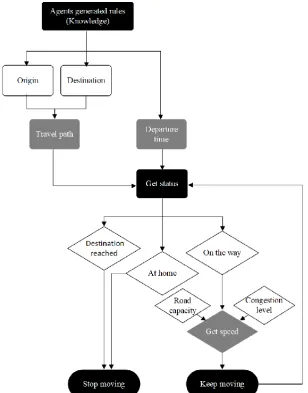
urban environment can be simplified into the spatial units of travel (i.e. origin and destination) as well as urban roads. All the agents’ behavior rules mentioned below were coded by Java and added to the model RepastCity to make it running as we designed. The rules for model running are that a resident agent moves from one spatial unit (origin) to another spatial unit (destination) at a specific time point. When the resident agent runs on the road, it may lower its speed of movement due to preset traffic congestion conditions (Figure 2).
Figure 2. Diagram of rules for resident Agent behavior
2.3 Model Hypothesis and Parameter Setting
The following hypothesis and rules are made regarding the generation of Agent in the model and its behaviors:
Second, on each plot, a certain number of Agents is generated which is calculated using the number of residents acquired through phone data, then divided by operator's market share, and finally multiplied by the ratio of motor vehicle travel of residents.
Thirdly, traffic congestion emerges when a certain number of resident Agents concentrate in the same road section, and the traveling speed of residents varies in accordance to the level of congestion.
Fourth, residents choose the shortest route to their destination and do not change route before their arrival. There are three major parameter variables in the commuting travel model of urban residents in the study area:
The first one is the commuter travel data of residents in each plot acquired from OD travel matrix, and the number travels of the corresponding Agent. The number of Agents is decided based on two factors: first, the number of residents acquired through phone data is converted to get the number of commuting residents is then converted to get the number of travels by motor vehicles. As the Baishazhou area is located in the outskirt of the city, near the third ring road of the city, where there is no subway and the number of bus lines is far less than those in the inner city area, it is assumed that the majority of travels are done with private cars; the number of residents acquired through phone data is divided by the market share of the telecom operator and then the number of private car travels is acquired at a conversion factor of 1 to 1. The second factor is the ratio of the number of Agents in the simulation to the actual number of residents traveling by cars. In the statistics, we can see that there are about 15,000 people traveling at the 9 to 10 o’clock period when the amount of travels it at the lowest in the study area. Previous test modelling showed that, with increasing number of Agents, the speed of simulation drops significant, while the precision of simulation results does not increase accordingly. Therefore, in the present simulation, the number of Agents is reduced so as to improve the efficiency of simulation and the traffic capacity of roads has been adjusted proportionally. The final residents to Agent ratio is set at 1: 10, that is, one Agent represents 10 residents.
The second parameter is the speed setting. Considering the hierarchy of roads in the study area, such as urban expressways, artery roads etc., the speeds of Agents on the roads is also differentiated. In the study, two different speeds are set, i.e. the expressway speed, at 50 km/h and the artery road speed, at 30 km/h. This parameter is achieved by specifying the field of road attribute in GIS, corresponding to the speed parameters of 13.9 m/s and 8.3 m/s respectively. The speed setting also correlates Agent’s travelling speed with the actual time unit, that is, each operation cycle (1 tick in simulation) is equal to 1 second of real time.
The third parameter is the road congestion settings. As the present study is conducted on a meso to macro scale area, roads are not categorized on a finer level, nor is the overlapping of vehicles considered. Instead, traffic congestion status is determined by the instantaneous Agent density. Rather, congestion is defined by instantaneous density of Agents on the road as vehicle density can directly demonstrate the congestion level on a road and road occupancy is often used as a quantitative indicator in traffic analysis[5, 6].According to some scholars’ method[7],the present study defines road occupancy at 0.5-1 as serious congestion, 0.3-0.5 as slight congestion and below 0.3 as no congestion.
3 Case study
This Baishazhou area in Wuhan is selected as the case study of commuting simulation based on the following considerations: first, Baishazhou is a new area of Wuhan which is mostly residential in function. Therefore, the study of the impact of commuting on traffic condition in this area is of practical value. Second, since the area is still under construction and development, follow-up observations are possible to identify the differences between the simulation results of various planning programs and the reality. Thus, the proposed optimization and improvement measures may be of great practicality. Finally, as there is a city-level artery road in this area, i.e. the Baishazhou Avenue, the overall urban layout is distributed along the road in a belt-like shape. With frequent and extensive interactions with the surrounding areas and evident concentration of vehicle traffic, the area is believed to be a valid case to evaluate the effectiveness of the model.
3.1 Data acquisition and processing
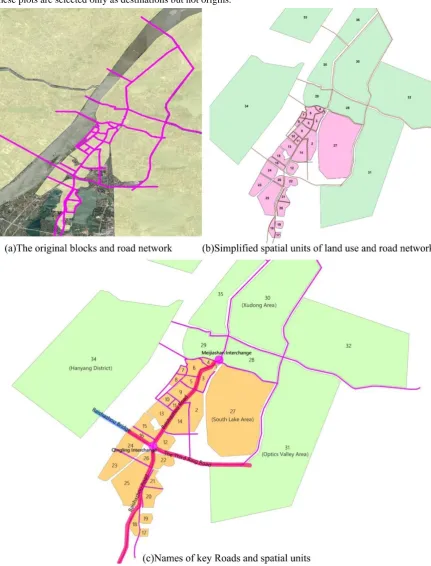
space is minimized to reduce the total number of spatial units. Finally, 34 space units were generated (see Figure 3). Based on these space units, statistics were extracted for the four rush hours on each workday morning. Among these units, plot No. 1 to No. 27 are taken as the core research objects, in which commuting data of residents are acquired. Since the accurate travel routes in other plots cannot be obtained without a fine division, these plots are selected only as destinations but not origins.
Figure 3. Road network and division of urban spatial units
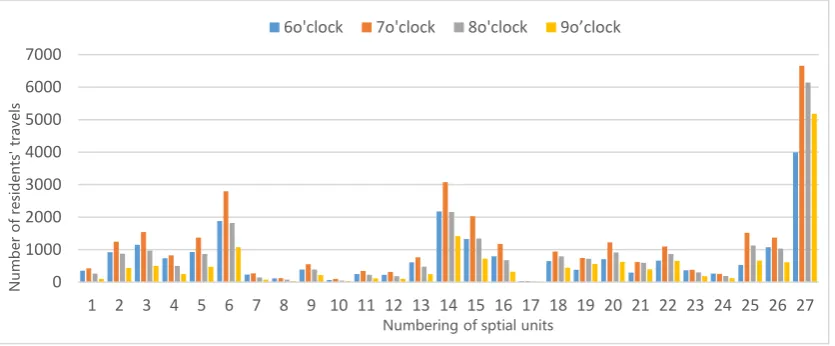
base station data in the four hours of 6, 7, 8 and 9 o’clock, the number of plots at 11 o'clock, the number of travels at each hour and at each plot was generated and thus the OD matrix (Table 3). Numbers of residents' travels in each core space unit at different hours is separately are acquired (Figure 4). The ranking of the numbers for the four time slots is 7 o’clock >8 o’clock >6 o’clock >9 o’clock, which is consistent with our daily experience: Since most employers in China have working hours from 9 am to 5 pm, leaving home for work between 7 am to 8 am means reserving enough time for commuting even in face of the possible traffic jam during morning rush hours. Therefore, this period is the most popular departure time for commuters.
Table 3. Sample statistics of travel volume at each hour and at each plot
Departure Lot No.
Destination Lot No.
Departure at 6 o’clock
Departure at 7 o’clock
Departure at 8 o’clock
Departure at 9 o’clock
1 3 20 10 10 0
1 4 20 20 20 0
1 9 10 0 0 0
1 14 0 10 0 0
Figure 4.Comparison of residents’ travels at different hours in different spatial units
3.2 Model Simulation and Result Verification
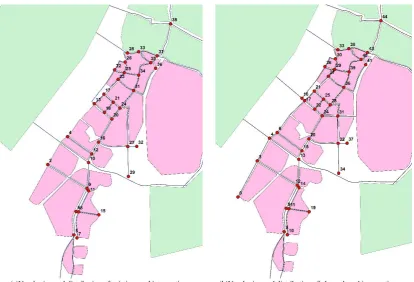
Figure 5 presents real-time screenshot images at several time nodes during the running of the model. As the visual interface could not offer quantified traffic features, road intersections are numbered and the number of Agents at each running cycle is obtained in order to detect the occurrence, the time and the level of traffic congestions. The numbering of road intersection is shown in Figure 6(a).
0 1000 2000 3000 4000 5000 6000 7000
1 2 3 4 5 6 7 8 9 10 11 12 13 14 15 16 17 18 19 20 21 22 23 24 25 26 27
Num
ber
of
resi
den
ts'
t
ra
vel
s
Numbering of sptial units
Figure 5. Real-time Screenshots during model running and simulation
Figure 6. Numbering and distribution of road intersections
residents at each hour. Specifically, for road intersections, the peak in the line chart represents the maximum number of traffic generated, and the duration of time indicates the occurrence of congestion. Therefore, it can be seen that the most obvious congestion occurs at Intersection 10, that is, the intersection of Baishazhou Avenue and the Third Ring Road. Other more congested ones include No.6, No.9 and No.37 intersections.
Figure 7. Changes in the number of agents at intersections
Further, the causes of congestion at each intersection can be analyzed, combining the presentation of congestion process at each intersection in the visual interface, and the number of residents departing from each block in different time periods (Table 4). Traffic in the surrounding area along the Baishazhou Avenue consists of two parts: commuting traffic from the area adjacent to Intersection 10 (the Qingling Interchange) to Plot 27 (the South Lake Area) and the Plot 31 (the Optics Valley Area); while traffic in Intersection 37 (the Meijiashan interchange) comes from the commuting to Plot 31 and Plot 30 (the Xudong Area). As a result, the commuting traffic flows have great impacts on the road intersections near the two interchanges. In addition, as cross-river traffic in the entire area is still mainly directed to Plot 34, so tension in traffic is mostly concentrated along the cross-river bridge (the Baishazhou Bridge) route.
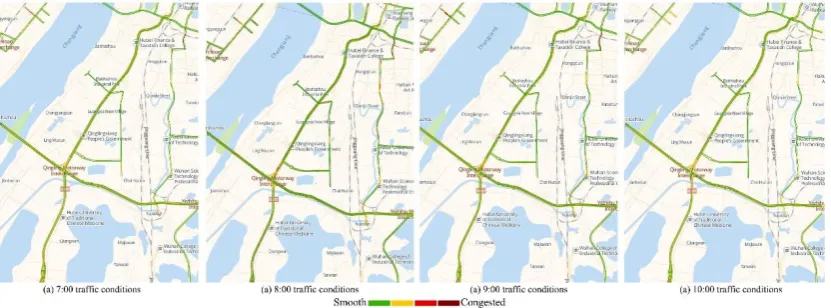
Chinese web map providers, such as Gaode, Baidu, etc., provide not only navigation information, but also traffic forecasting based on their historical traffic data and projections of traffic conditions at different periods of a day. In the present study, traffic forecasts for the case study, the Baishazhou area, at the four time nodes, i.e. 7, 8, 9 and 10 o'clock, are extracted from Gaode map as shown in Figure 8. Since these traffic forecasts are generated based on historical data, they can be considered as road traffic conditions with highest probability of each road in the past years, and therefore, they are used in the study to verify the results of the model simulation.
Figure 8. Traffic Forecasts for the four studied hours based on big data of Gaode
Source: Gaode Map
o’clock is used to compare with the traffic forecast for 7 o’clock and so on. It can be seen from the traffic forecast of Gaode that it covers only the city artery roads and above but not the secondary roads or below, and the dark red, red, yellow and green colors in the diagram represent increasingly better traffic conditions, form serious congestion to smooth flow. Therefore, it can be seen that traffic condition is the worst at 8 o'clock when a dark red section appears at the Qingling Interchange at the intersection of Baishazhou Avenue and Third Ring Road, and the section is in yellow at the other three time nodes, which indicates slight congestion. Another congestion occurs in sections along the Baishazhou Avenue before and after the Meijishan Interchange, where the the heaviest traffic, in dark red color, also appears at the 8 o’clock time node while it is in yellow at the other three time nodes. the rest of the time point is yellow. Compared with the roads in the model, the intersections corresponding to Qingling Interchange are Intersection 10, 12 and 16, while those corresponding to Meijiahan Interchange are Intersection 35 and 37. It can be seen that most sections of congestion projected by Gaode accord with the congested intersections as simulated in the model. Based on the above analysis, the results of the present model simulation are consistent with traffic forecasts of Gaode.
4. Discussion
Statistics in the OD matrix of residents’ travels at different hours show that, most of the spatial units follow the pattern of a minimum traffic at 9 o’clock, but there are also a few plots that do not match the major pattern of travel numbers such as Plot 27. Serving mainly residential functions in South Lake area, Plot 27 is one of the most congested areas in Wuhan during rush hours. A possible explanation is that the residents of the area choose to delay their departure time to 9 o'clock in order to avoid the traffic congestion period from 7 to 8 o'clock, or they are stalled in traffic for too long and are considered as having not departed from the area in the statistics. This result, to some extent, verifies the significance of OD statistics and simulation by each hour: when the travel patterns of each space unit during the four hours change, traffic pressure at each intersection may also vary and the causes behind these changes demand further analysis with the support of simulations. This is also why this study divides the unit time span of commuting travels into an hour.
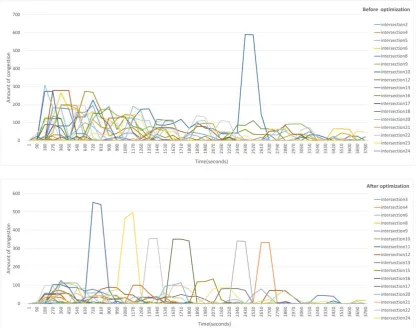
Fig 9. Comparison of traffic conditions before and after the optimization of road network
a waterfront north-south road along the Yangtze river and the road to the South Lake area are planned (Figure 6b); the planned and optimized road network is simulated in the model and compared with the original one. In this simulation, it is assumed that the population in this area remains unchanged and so do the places of residence and work. Comparing the simulation results of the two schemes (Figure 9), it can be seen that the optimized scheme is evidently better than the scheme before optimization: first, traffic has been distributed to multiple road intersections instead of being concentrated at an intersection before the optimization. Second, duration of traffic congestion is significantly shortened, which means congestions can be alleviated quickly even if they do occur.
5. Conclusions
According to Gaode’s Traffic Report on Major Cities in China, 81% of them suffer from congestions during rush hours of residents’ commuting[44]. Therefore, studying the commuting of residents as a starting point to address the wider problem of urban traffic congestion bears practical significance, not only for China but also for the world at large.
Previous studies prove that mobile phone call data can more accurate reflect of the features of the commuting of urban residents. But most studies focus on the overall analysis of cities on a macro scale and the visual representations. Few studies are found on the micro scale dynamic analysis of the commuting of residents, nor the way to relate it to urban transport. In the present study, the agent-based model is used to simulate traffic condition during commuting hours in a local urban area. First, commuting demand of residents calculated by mobile phone data is used to simulate congestions on the existing urban road network; then, data backtracking is used to identify the causes of congestion and the simulation; finally, the results of simulation are proven to be consistent with the actual traffic conditions.
Currently, the era of big data has been coming. When it is less difficult to acquire data, how to use them in urban research becomes an issue that more urgently needs to be considered[45]. Although the data used are simplified for the easiness of processing and modelling, the study is still believed to be a positive endeavor of combining big data and agent based model in urban study, and it offers a valuable approach to studying residents’ commuting and urban traffic.
There are aspects in the study that need to be improved: First, because mobile phone CDR data is a relatively sparse data in recording the travel trajectory of residents. It is difficult to obtain the traffic mode (or speed) of residents' travel through statistical analysis. Thus, the specific correlations between commuter vehicles and mobile phone users are not discussed in the present study. Besides, vehicles other than commuter cars, such as buses are not considered. Prospect studies are expected to incorporate data from field surveys and machine learning approaches to further specify modes of commuter travels and include bus as a major means of transportation. Second, in the present model construction, lanes and traffic flow directions on the roads are not specified; in congestion setting, only the density of vehicles in a certain section is considered while neglecting the overlapping of vehicles; which cannot sufficient reflect traffic conditions in reality and also lead to the fact that the simulation results cannot be analyzed at a finer level for deduction of the processes. Prospect studies are expected to further refine the road and traffic system of the model.
Supplementary Materials: The following are available online at www.mdpi.com/xxx/s1, Figure S1: title, Table S1: title, Video S1: title.
Author Contributions: Conceptualization, Yang Yu; Methodology, Lingbo Liu; Validation, Hao Wu and Lingbo Liu; Formal Analysis, Hongzan Jiao; Data Curation, Zhenghong Peng; Writing-Original Draft Preparation, Hao Wu; Writing-Review & Editing, Yang Yu; Project Administration, Hao Wu; Supervision, Zhenghong Peng; Funding Acquisition, Hao Wu and Qiang Niu.
Funding: The research is funded by China Postdoctoral Science Foundation (No. 2016M600609); The MOE Layout Foundation of Humanities and Social Sciences (No.19YJCZH187);National Natural Science Fund for Young Scholars (No. 51708425); Natural Science Fund of China (No. 51778503).
References
2. Jiangping Zhou,Enda Murphy, Ying Long. Commuting efficiency in the Beijing metropolitan area: an exploration combining smartcard and travel survey data. Journal of Transport Geography, 2014. 41(41): p. 175-183.
3. Darren M Scott,Pavlos S Kanaroglou, William P Anderson. Impacts of commuting efficiency on congestion and emissions: case of the Hamilton CMA, Canada. Transportation Research Part D Transport & Environment, 1997. 2(4): p. 245-257.
4. M. S. Friedman,K. E. Powell,L. Hutwagner,L. M. Graham, W. G. Teague. Impact of changes in transportation and commuting behaviors during the 1996 Summer Olympic Games in Atlanta on air quality and childhood asthma. Jama-Journal Of the American Medical Association, 2001. 285(7): p. 897-905. 5. Jan K. Brueckner. Urban Sprawl: Diagnosis and Remedies. International Regional Science Review, 2000.
23(2): p. 160-171.
6. R. Arnott,A. Depalma, R. Lindsey. A STRUCTURAL MODEL OF PEAK-PERIOD CONGESTION - A TRAFFIC BOTTLENECK WITH ELASTIC DEMAND. American Economic Review, 1993. 83(1): p. 161-179. 7. A. Anas,R. Xu. Congestion, land use, and job dispersion: A general equilibrium model. Journal Of Urban
Economics, 1999. 45(3): p. 451-473.
8. E. J. Gonzales,C. F. Daganzo. Morning commute with competing modes and distributed demand: User equilibrium, system optimum, and pricing. Transportation Research Part B-Methodological, 2012. 46(10): p. 1519-1534.
9. D. G. Chatman. Does TOD Need the T?: On the Importance of Factors Other Than Rail Access. Journal Of the American Planning Association, 2013. 79(1): p. 17-31.
10. D. Salon. Neighborhoods, cars, and commuting in New York City: A discrete choice approach. Transportation Research Part a-Policy And Practice, 2009. 43(2): p. 180-196.
11. C. M. Song,T. Koren,P. Wang, A. L. Barabasi. Modelling the scaling properties of human mobility. Nature Physics, 2010. 6(10): p. 818-823.
12. Carlo Ratti,Dennis Frenchman,Riccardo Maria Pulselli, Sarah Williams. Mobile Landscapes: Using Location Data from Cell Phones for Urban Analysis. Environment & Planning B Planning & Design, 2006. 33(5): p. 727-748.
13. A. Wesolowski,N. Eagle,A. J. Tatem,D. L. Smith,A. M. Noor,R. W. Snow, C. O. Buckee. Quantifying the Impact of Human Mobility on Malaria. Science, 2012. 338(6104): p. 267-270.
14. L. Bengtsson,X. Lu,A. Thorson,R. Garfield, J. von Schreeb. Improved Response to Disasters and Outbreaks by Tracking Population Movements with Mobile Phone Network Data: A Post-Earthquake Geospatial Study in Haiti. Plos Medicine, 2011. 8(8): p. 8.
15. F. Calabrese,M. Colonna,P. Lovisolo,D. Parata, C. Ratti. Real-Time Urban Monitoring Using Cell Phones: A Case Study in Rome. Ieee Transactions on Intelligent Transportation Systems, 2011. 12(1): p. 141-151. 16. Anto Aasa. Application of mobile phone location data in mapping of commuting patterns and functional
regionalization: a pilot study of Estonia. Journal of Maps, 2013. 9(1): p. 10-15.
17. K. S. Kung,K Greco,S Sobolevsky, C Ratti. Exploring Universal Patterns in Human Home-Work Commuting from Mobile Phone Data. Plos One, 2014. 9(6): p. e96180.
18. Wei Tu,Jinzhou Cao,Yang Yue,Shih Lung Shaw,Meng Zhou,Zhensheng Wang,Xiaomeng Chang,Yang Xu, Qingquan Li. Coupling mobile phone and social media data: a new approach to understanding urban functions and diurnal patterns. International Journal of Geographical Information Science, 2017. 31(4): p. 1-28.
19. Yang Yue,Yan Zhuang,Anthony G. O. Yeh,Jin Yun Xie,Cheng Lin Ma, Qing Quan Li. Measurements of POI-based mixed use and their relationships with neighbourhood vibrancy. International Journal of Geographical Information Systems, 2017. 31(4): p. 658-675.
20. J. Doyle,P. Hung,R. Farrell, S. McLoone. Population Mobility Dynamics Estimated from Mobile Telephony Data. Journal Of Urban Technology, 2014. 21(2): p. 109-132.
21. Tao Pei,Stanislav Sobolevsky,Carlo Ratti,Shih-Lung Shaw,Ting Li, Chenghu Zhou. A new insight into land use classification based on aggregated mobile phone data. International Journal of Geographical Information Science, 2014. 28(9): p. 1988-2007.
22. M. S. Iqbal,C. F. Choudhury,P. Wang, M. C. Gonzalez. Development of origin-destination matrices using mobile phone call data. Transportation Research Part C-Emerging Technologies, 2014. 40: p. 63-74. 23. L. Alexander,S. Jiang,M. Murga, M. C. Gonzalez. Origin-destination trips by purpose and time of day
24. Çolak S,A Lima, M. C. González. Understanding congested travel in urban areas. Nature Communications, 2016. 7: p. 10793.
25. Y. Yao,Y. Hong,D. Q. Wu,Y. T. Zhang, Q. F. Guan. Estimating the effects of "community opening" policy on alleviating traffic congestion in large Chinese cities by integrating ant colony optimization and complex network analyses. Computers Environment And Urban Systems, 2018. 70: p. 163-174.
26. Quoc Tuan Nguyen,Alain Bouju, Pascal Estraillier. Multi-agent Architecture with Space-time Components for the Simulation of Urban Transportation Systems. Procedia - Social and Behavioral Sciences, 2012. 54(4): p. 365-374.
27. Arnaud Doniec,Sylvain Piechowiak. A behavioral multi-agent model for road traffic simulation. Engineering Applications of Artificial Intelligence, 2008. 21(8): p. 1443-1454.
28. Francesco Ciari,Michael Balmer,Eth Zürich Kay, W. Axhausen. A new mode choice model for a multi-agent transport simulation. 2008.
29. L. Knapen,D. Keren,A. U. H. Yasar,S. Cho,T. Bellemans,D. Janssens, G. Wets. Analysis of the Co-routing Problem in Agent-based Carpooling Simulation, in Ant 2012 And Mobiwis 2012, E. Shakshuki and M. Younas, Editors. 2012, Elsevier Science Bv: Amsterdam. p. 821-826.
30. Ihab Kaddoura,Benjamin Kickhöfer,Andreas Neumann,Alejandro Tirachini, Ihab Kaddoura. Optimal Public Transport Pricing: Towards an Agent-based Marginal Social Cost Approach. Journal of Transport Economics & Policy, 2016. 49(2): p. 200-218.
31. Stavri Dimitrov,Avishai Ceder,Subeh Chowdhury, Mikaël Monot. Modeling the interaction between buses, passengers and cars on a bus route using a multi-agent system. Transportation Planning & Technology, 2017. 40(2).
32. Jun Liu,Kara M. Kockelman,Patrick M. Boesch, Francesco Ciari. Tracking a system of shared autonomous vehicles across the Austin, Texas network using agent-based simulation. Transportation, 2017. 44: p. 1-18. 33. Miaojia Lu,Shu Chien Hsu,Miaojia Lu, Shu Chien Hsu. Spatial Agent-based model for environmental
assessment of passenger transportation. Journal of Urban Planning & Development, 2017. 143(4): p. 04-17016-1-11.
34. T. Bellemans,S. Bothe,S. Cho,F. Giannotti,D. Janssens,L. Knapen,C. Korner,M. May,M. Nanni,D. Pedreschi,H. Stange,R. Trasarti,A. U. H. Yasar, G. Wets. An Agent-Based Model to Evaluate Carpooling at Large Manufacturing Plants, in Ant 2012 And Mobiwis 2012, E. Shakshuki and M. Younas, Editors. 2012, Elsevier Science Bv: Amsterdam. p. 1221-1227.
35. Francesco Calabrese,Laura Ferrari, Vincent D Blondel. Urban Sensing Using Mobile Phone Network Data: A Survey of Research. Acm Computing Surveys, 2014. 47(2): p. 1-20.
36. M. Batty,K. W. Axhausen,F. Giannotti,A. Pozdnoukhov,A. Bazzani,M. Wachowicz,G. Ouzounis, Y. Portugali. Smart cities of the future. European Physical Journal Special Topics, 2012. 214(1): p. 481-518. 37. Sara Levy,Karel Martens, Rob Van Der Heijden. Agent-based models and self-organisation: : addressing
common criticisms and the role of agent-based modelling in urban planning. Town Planning Review, 2016. 87(3): p. 321-338.
38. Nick Malleson. Extending RepastCity. 2012;
https://code.google.com/p/repastcity/wiki/ExtendingRepastCity3.
39. Nick Malleson. RepastCity - Model Structure. 2012;
https://code.google.com/p/repastcity/wiki/RC3ModelStructure.
40. Nick Malleson. RepastCity - A demo virtual city. 2012;
https://code.google.com/p/repastcity/wiki/RepastCity3.
41. Jaime Kopf,John M. Ishimaru,Jennifer Nee, Mark E. Hallenbeck. Central Puget Sound Freeway Network Usage and Performance, 2003 Update. Highway Traffic Control, 2005.
42. Tim Lomax,David Schrank,Shawn Turner, Richard Margiotta. SELECTING TRAVEL RELIABILITY MEASURES. 2003.
43. Dwi H. Widyantoro,M. D. Enjat Munajat. Fuzzy traffic congestion model based on speed and density of vehicle. in Advanced Informatics: Concept, Theory and Application. 2015.
44. Gaode Map. Traffic Report on Major Cities in China 2017. 2018; http://cn-hangzhou.oss-pub.aliyun-inc.com/download-report/download/yearly_report/2017/.