
ISSN 2286-4822
www.euacademic.org DRJI Value: 5.9 (B+)
Development of mobile image processing suite for
producing merged single image of dynamic
machinery using android platform
AZIM UN NISA
Department of Software Engineering University of Engineering and Technology, Taxila Pakistan
ABDUL WASY ZIA1
Institute of Micro and Nanotechnology Faculty of Electrical Engineering and Information Technology Technical University Ilmenau Germany
Abstract:
This research reports the development of Mobi Image Processing Suite (MIPS) which is an executable android application, that takes two images at run time and a single merged image is produced as a result by discarding the overlapping information. This application is especially designed to accommodate missing persons in a group photo. A complete group image can be constructed by merging two images captured back to back under same environmental and physical conditions and manipulating the missing human information. Enhancement techniques sharpening, converting into gray scale inverting, darkening the image has included. Face detection functionality is also integrated in the application. Besides entertainment photography, the application is highly accepted for real world engineering applications for inspection and fault analysis of dynamic complex machines where machine elements are partially hidden. For example a gear box and crankcase, a single image can be
made by capturing two back to back images at rotation of 1800 for easy
analysis. However, for better understanding of wide range audience,
the development, processing and results are discuss on base of entertainment photography example. The application has successfully passed unit test, integrated and several system tests. The quantitative analysis was performed to suggest better conditions and to highlight parameters for best performance and accuracy.
Key words: Image Merging; Face Detection; Stitching Missing Persons; Enhancement Techniques
1 Introduction
Humans use their eyes and brains to gain the visual perspective of the environment. Visual information is received by eyes and processed by brains to meaningful features such as lines, segments, boundaries, shapes etc. On the basis of these extracted features human get understanding of the particular information which helps him to take next action.
Now-a-days, intelligent machines have made the human life easy which can understand the received information and perform extended computations. The computer vision technology (CVT) had brought a vital advancement in intelligent machines which help them to understand the images. Machines use camera instead of eyes and computations can be performed to understand the visual data received from cameras. Computations are being performed by the processor which shows that processor acts like a brain in human. CVT also enables machines to take intelligent decisions or make a new representation based on the data received from the image or a video.
applications (Android, iOS, etc.). This situation opens several possibilities for the implementation of computer vision applications in these devices. The new development in technology increased the computing capabilities of mobile phones.
Several programming tools were developed which communicate in CVT and intelligent machines for image processing. Open Source Computer Vision (OpenCV) introduced by Berkeley Software Distribution is a library have 2500 optimized algorithms [1] that provides functions to implement real time computer vision for example Human –Computer Interaction(HCI), Object Detection and Identification, Image Segmentation, Gesture Recognition, Face Recognition, Motion Tracking and Motion Understanding, Structure From Motion (SFM), Camera Calibration and Depth Computation and Mobile Robotics.
artificial intelligence, advanced image processing and computer vision based applications. The developers are aiming to introduce real time applications. As smart phones are equipped with cameras, microphone, GPS (Global Positioning System), and other sensors, so they have a high potential to become a cost-effective intelligent agent.
AutoStitch [6,7] is a stitching tool on Iphone platform. It works from unordered collection of images find match between them and the use blending algorithms to merge the relevant images together.
Now the need is to designing an Image Manipulation Suite for Android Platform which construct a complete image with all the family and friends. In each image one person is always missing who is capturing the image. Hence, getting rid from manual stitching and merging there is need to develop an intelligent image processing app that can merge two simultaneous pictures captured with gap of few seconds i.e., two picture, captured by two different people at same location but both persons have different position.
In this research, the authors had developed a Mobi Image Processing Suite (MIPS) based on computer vision technology. The main functionality of this application is image merging in which we combine information of two images and discard the overlapping information. The application takes two images, construct an image by manipulating the missing human information. Once the image is merged enhancement techniques and face detection technique are applied on the resultant image.
Method and Strategy:
The research reports the development of android based image merging application with enhancement techniques and face detection feature. It merges two images to find the missing information and discard the overlapping information. The application accepts the image with the following constraints:
The image with one row of humans.
The missing person must be standing on the right or left side of the image.
The images are captured from the same position.
To build our MIPS app, Dell Inspiron Laptop, core I5, processor speed 2.5 GHz Turbo Boost Up to 3.1 GHz, 4 GB RAM, 750 GB hard drive, DDR3 memory, 1GB graphics memory, Windows 7 64 bit was used. The mobile phone had Android operating system with application programming interface (API) level higher than 2.3.3 and installed with OpenCvManager. Eclipse, SDK (software development kit), JDK (java development kit) and OpenCV for android were used for app development.
OpenCV was imported in Java API, working with camera and mixing Java and OpenCV API in a single application. OpenCv does not have any relation to computer vision. It implements basic image processing functions. It has powerful Core and Improc modules which are useful in a wide range of vision based applications. OpenCv4Android is available as a SDK with a set of samples and Javadoc documentation for OpenCV Java API. It also contains prebuilt apk-files, which can run on device instantly. OpenCV4Android SDK package enables development of Android applications with use of OpenCV library.
The application development have three distinct modules, service layer and data access layer The layered architecture is helpful because it divides the program into modules which makes the application systematic, reduces the complexity, avoids linearity which makes the execution slow and each layer can be re used because of low dependency.
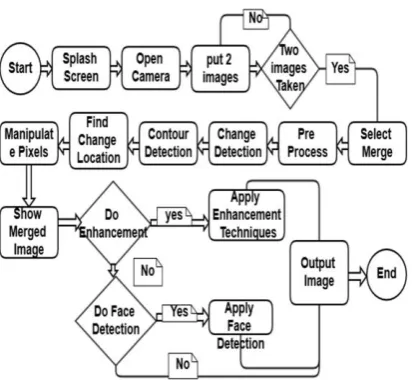
detected. Then the change area pixels are manipulated to one of the two images based on location. Finally a complete merge image with everyone present in it is extracted and shown on the interface. Some important user required options for example detect face or perform some enhancement techniques on an image like grey scale, sharpen, invert and reflect which are also provide in MIPS app and after all computations the completed image finally returns to the image object through service to presentation layer.
Fig. A, explains the methodology of MIPS development. The technique of image acquisition in this application is that first one person suppose A takes the image of the other person suppose B and leaves an empty space for his own position. Now the other person that is B will takes the picture from same place while person A will stand on same designated place that he reserved for him before. Then the merge button is pressed to get instant merged image which will present both A and B in same picture.
Images are converted into gray scale to reduce the computations that are required for RGB image. Now each image contains pixel values. Image acquisition converts the bitmap images to MAT which is capable of faster image processing. Every pixel has an associated RGB value, which consists of three color components R, G, B which are integers between 0 and 255. Gray scale is calculated by following equation 1, [8]
(1)
So the value now becomes from (r,g,b) to (x,x,x).
Now the gray scale images are passed to the function of change detection which subtracts an image from another image using two methods: Subtracting first image from second image which will give the missing elements in second image which are present in the first one. Missing part is shown in white and the similar portion in black. The number of the pixels should be same for subtracting the images. Let P(x,y) and Q(x,y) be first and second images respectively and R(x,y) [8] be the resultant image as given in equation 2.
(2)
Now this image will be converted into binary so it will only have two intensity levels as given by equation 3.
(3)
missing information in the first image. Images are divided into 256 levels that take a lot of computations. Threshold is applied to obtain binary information which reduces computations and speed of algorithm increases. The designated algorithm finds the x and y coordinates of the contour. The starting point of the contour is initialized as x variable and last point is initialized with the last value of the contour. As the contour does not cover the whole area so y coordinate are taken from 0 to image height. While the edges and corner were detected based on Harris corner’s definition [9] which is calculated using second derivative, correlation and Eigen values.
After locating the biggest contour, the changes were computed in first image. The pixel values at contour location by considering the corner points and edge points are collected from the first image and assigned to the second one at that particular location. These values are assigned from x initial value to x final value. Now by manipulating the information through pixel by pixel as shown in Fig B, the merged image is constructed and saved to gallery successfully. The other options are also available in menu for image enhancement for example, gray scale, sharpen, invert, reflect and darken.
Testing and Results:
Software testing is an essential step for the development of a reliable and error-free app. The developed app was evaluated by unit test, integrated test and system test. The primary goal of unit testing is to take the smallest piece of testable software in the application, isolate it from the remainder of the code, and determine whether it behaves exactly as you expect. Each unit of MIPS was tested separately before integrating them into modules to test the inter module interfaces and removed almost all the bugs and errors of the system. We have also done error handling to make our system behave properly when encountering unexpected conditions. After testing each unit we concluded that:
Merging of images is performed in a manner so that it does not seem to be 2 pictures merged together.
All the enhancement techniques were applied and they really enhances the details of the images and make them more acceptable and pleasing to the user
Application is reliable and efficient.
Error handling is done at every point in order to remove the ambiguity from the Application.
detection test (2 sec) were performed and all test gave successful results. We also test the application by entering inappropriate data and information just to see how the application will respond to incorrect input.
It is worth to mention that, the accuracy of MIPS app is also depends on user. The quantitative analysis for several tests suggested that the accuracy reduced to 15% for abrupt background, 70% for difference in light conditions and 60% by reducing distance. Hence, for best performance and high accuracy of output, its compulsory keep constant environmental and physical parameters. Table 1 presents the summary of few tests conducted on different parameters.
Table 1. Summary of qualitative analysis conducted on different parameters.
Parameters Image Acquisition Merged Image Image enhancement Face detection Result
Same light effects and background
Yes Yes Yes Yes Pass
Variation in Distance from camera to person in both pictures
Yes No No No Fail
Unsuitable Lightning conditions
Yes Yes Yes No Fail
If person changed pose during 1st or 2nd
picture
Yes Yes Yes Yes Pass
Conclusions:
both images. Some enhancement tools are also added in applications for example, image inversion, grey scale, image sharpening, reflect image etc. Special attention is paid to computational cost and robustness under controlled condition. Unit test, integrated test and several type of systems test approved the efficient and error free working of MIPS. The quantitative analysis was also performed to evaluated app performance under different environmental conditions. However, it is highly suggested to capture images of same dimensions. Lightning in both the input images should have minimal variation. A big lightning variation of two input images will affect the result accuracy. There should be some gap between the standing person on left and right side to avoid overlapping and the background of images should be static or least turbulence for best performance of MIPS.
The Research is being extended to overcome previously mentioned constraints. A standard dataset can be developed for this kind of app. The more complex images in which the distance constraints are avoided can be developed especially for real world industrial maintains and instrumental applications. The main problem is the low computational power of smart phone devices. There are many libraries which help to implement the vision concept in android. Hence, by extending reported research concept an advanced app can be developed with optimized computational capabilities of new smartphones on android platform.
REFERENCES
Gansawat, D., W. Sinthupinyo, Panorama Images Stitiching on Android Phones, In Proc. IEEE Int. Conf., Mobile IT Convergence (ICMIC), 2011, pp. 39-42. [2]
Chen, X., J. Chen and Y. Yamaguchi, Soft Image Segmentation Model, In Proc. IEEE Int. Conf. Computer Vision in Remote Sensing (CVRS), 2012, pp. 90-93. [3]
Zhou, C. and C. Liu. “Interactive Image Segmentation Based on Region Merging Using Hierarchical Match Mechanism” In Proc. IEEE Int. Conf. on Computer Science & Service System (CSSS), 2012, pp. 1781-1784. [4]
Zhang, Y. et al. “Adaptive Image Segmentation Based on Fast Thresholding and Image Merging” In Proc. 16th Int. Conf. on Artificial Reality and Telexistence (ICAT), 2006, pp. 1-4. [5]
Brown, M. and D. Lowe, Automatic Panoramic Image Stitching using Invariant Features. Int. J. of Computer Vision. 74, 2007, pp. 59-73. [6]
Brown, M. and D. G. Lowe, Recognising Panoramas. Int. Conf. on Computer Vision (ICCV2003), France, 2003, pp. 1218-1225. [7]
Gonzalez and Woods. Digital Image Processing, 3rd Ed., Prentice Hall, 2008. [8]
Carballo, Francisco Villalba. Thesis, Computer Engineering degree, Faculty of Mathematics, University of Barcelona, January, 2013 [9]
![Fig B. Pixel Manipulation [10]](https://thumb-us.123doks.com/thumbv2/123dok_us/7782753.1286275/9.439.79.363.407.550/fig-b-pixel-manipulation.webp)
