Security Evaluation of Rakaposhi Stream Cipher
Mohammad Ali Orumiehchiha1, Josef Pieprzyk1, Elham Shakour2 and Ron Steinfeld3
1
Center for Advanced Computing, Algorithms and Cryptography, Department of Computing, Faculty of Science, Macquarie University, Sydney, NSW 2109, Australia
(mohammad.orumiehchiha,josef.pieprzyk)@mq.edu.au 2Faculty of Mathematics, Amirkabir University,Tehran, Iran
[email protected] 3Clayton School of Information Technology
Monash University, Clayton VIC 3800, Australia
Abstract. Rakaposhi is a synchronous stream cipher, which uses three main components a non-linear feedback shift register (NLFSR), a dynamic linear feedback shift register (DLFSR) and a non-linear filtering function (N LF). NLFSR consists of 128 bits and is initialised by the secret keyK. DLFSR holds 192 bits and is initialised by an initial vector (IV). N LF takes 8-bit inputs and returns a single output bit. The work identifies weaknesses and properties of the cipher. The main observation is that the initialisation procedure has the so-called sliding property. The property can be used to launch distinguishing and key recovery attacks. The distinguisher needs four observations of the related (K, IV) pairs. The key recovery algorithm allows to discover the secret keyKafter observing 29 pairs of (K, IV). In the proposed related-key attack, the number of related (K, IV) pairs is 2(128+192)/4pairs. The key recovery algorithm allows to discover the secret keyKafter observing 29 related (K, IV) pairs.
Further the cipher is studied when the registers enter short cycles. When NLFSR is set to all ones, then the cipher degenerates to a linear feedback shift register with a non-linear filter. Consequently, the initial state (and Secret Key andIV) can be recovered with complexity 263.87.
If DLFSR is set to all zeros, then N LF reduces to a low non-linearity filter function. As the result, the cipher is insecure allowing the adversary to distinguish it from a random cipher after 217 observations of keystream bits. There is also the key recovery algorithm that allows to find the secret key with complexity 254.
Keywords:Rakaposhi Stream Cipher, Related Key Attack, Weak State, Cryptanalysis, Distinguish-ing Attack, Key Recovery Attack.
1 Introduction
Stream ciphers are symmetric cipher systems, which provide confidentiality in many applications ranging from mobile phone communication to private virtual networks. They may be implemented efficiently in software and hardware and are a preferred choice when dealing with an environment that has restricted computing resources (such as smart cards, RF tags). The inner work of stream ciphers is controlled normally by two parameters: an initialisation vector (IV) and a key (K). The initialisation vector is public and the key is secret.
There are many tools for analysis of stream ciphers. The most two prominent are the linear and differential attacks. There are also many more “exotic” tools for analysis. One such tool is the related key attack. This attack is especially dangerous when an adversary has access to many pairs of (IV, K). This may happen if the adversary is able to experiment with a stream cipher device that has been left unattended (so-called midnight or lunchtime attacks). The adversary may modify the unknown secret key by forcing changes on few key bits, may try differentIVs or may modify the clock procedure.
The Rakaposhi stream cipher was designed by Cid, Kiyomoto, and Kurihara in 2009 (see [1]). The cipher is based on a non-linear feedback shift register (NLFSR) and a dynamic linear shift register (DLFSR). The design was crafted to be suitable for lightweight implementations, where computing, power and time resources are in short supply. The cipher offers the 128-bit security and has been designed to complement the eStream portfolio for hardware-oriented stream ciphers. The designers of the cipher claim that Rakaposhi is an efficient synchronous stream cipher that resists all known attacks and they conjecture that it is also secure against other yet unknown attacks.
– examine the resistance of the cipher against the related key attack, where the adversary can access related pairs (IV, K),
– study the security implications when NLFSR enters a short cycle,
– investigate the security level when DLFSR enters a short cycle.
1.1 Related Works
The related key attack is studied in the context the Rakaposhi cipher and its initialization procedure. Similar analysis tools can be found in [3, 4, 8] but in a different context. The related key attack can be seen as a member of the differential cryptanalysis toolbox. We use the slide attack published by Canniere et. al. in [2] to launch the related key attack. The second part of our work is influenced by the paper by Zhang and Wang [9], in which the authors study the security of the Grain stream cipher [5, 6]. While working on the paper, we have become aware of a paper by [7] that shows a similar analysis of the initialization procedure of Rakaposhi.
The rest of the paper is structured as follows. Section 2 describes briefly the Rakaposhi stream cipher. Section 3 presents the weaknesses of the cipher and investigate the security of the initialisation procedure under the related key attack. Section 4 discusses the security implications when one of the registers (either NLFSR or DLFSR) enters a short cycle. Section 5 concludes the work.
2 Description of Rakaposhi Stream Cipher
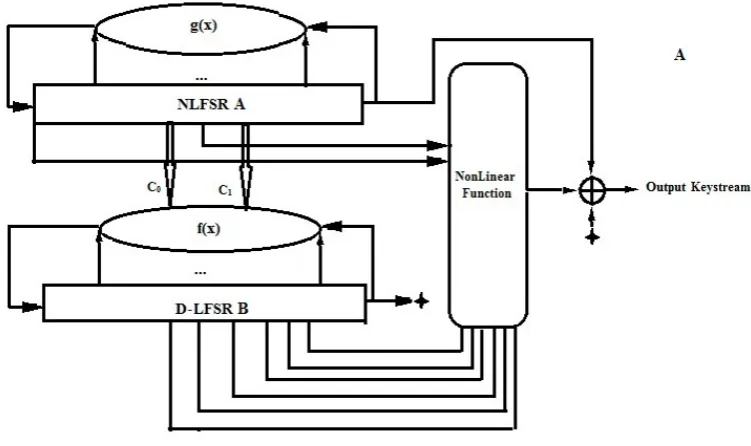
The Rakaposhi stream cipher consists of the following three building blocks (see Figure 1) :
– a 128-bit NLFSR also called the register A,
– a 192-bit DLFSR also called the register B,
– a non-linear functionN LF
Fig. 1.Rakaposhi Stream Cipher
The NLSFR register A is defined by its feedback function:
where at+128 = g(at, at+6, at+7, at+11, at+16, at+28, at+36, at+45, at+55, at+62) and at+i is ith bit of the registerA at clockt.
The DLFSR registerB is controlled by two bits (c0, c1) taken from the state of NLFSR. The bits choose one of four possible characteristic polynomials of DLFSR. The form of the polynomials is as follows:
f(x) =x192⊕x176⊕c0x158⊕(1⊕c0)x155⊕c0c1x136⊕
c0(1⊕c1)x134⊕c1(1⊕c0)x120⊕(1⊕c0)(1⊕c1)x107⊕ (1) x93⊕x51⊕x49⊕x41⊕x37⊕x14⊕1,
where the bits (c0, c1) are the 42thand 90thbits of the registerAat clockt, respectively. The recursive relation for DLFSR is as follows:
bt+192=bt⊕bt+14⊕bt+37⊕bt+41⊕bt+49⊕bt+51⊕
bt+93⊕c0·c1·bt+107⊕c0·c1·bt+120⊕c0·c1·bt+134⊕c0·c1·bt+136⊕ (2) c0·bt+155⊕c0·bt+158⊕bt+176
whereci = 1⊕ci denotes the negation ofci and bt+i is theith bit ofB at clockt.
Rakaposhi uses a non-linear filtering functionN LF :GF(28)→GF(2), which is based on the AES S-Box. The function N LF is a balanced Boolean function of its algebraic degree equal to 7. N LF takes 8-bit inputs (2 bits fromA and 6 bits fromB) according to the following relation
st=N LF(at+67, at+127, bt+23, bt+53, bt+77, bt+81, bt+103, bt+128),
where the two bits at+67, at+127 are taken from A and the other bits fromB. Finally, the keystream output is generated by linear combination of the outputs of both registers A and B with the output of the N LF function. The reader interested in more detail is referred to the original paper [1].
2.1 Initialisation Procedure
The goal of the initialisation procedure is to mixIV and the secret keyK. Assume thatIV = [iv0,· · · , iv191] and K = [k0,· · · , k127]. IV and K are loaded to NLFSR and DLFSR, respectively so
ai=ki for 0≤i≤127 bj =ivj for 0≤j≤191,
where the bits of registersAandB areaiand bj, respectively. The registersAand B are then clocked 448 times without producing output keystream bits. This stage is divided into two phases:
Phase 1: the output of N LF is linearly combined with the feedback of the register B for the first 320 clocks.
Phase 2: the output of N LF is linearly combined with the feedback of the register A for the next 128 clocks.
After finishing Phase 2, the cipher starts producing keystream outputs.
3 Cryptanalysis of Rakaposhi Stream Cipher
3.1 Properties of Rakaposhi Cipher
We present some cryptographic properties of the Rakaposhi stream cipher that corroborate the pro-posed attacks.
1. The secret key and IV are loaded in two registersA and B, respectively. Consequently, at clock t= 0,A containsK and B – IV.
2. The initialisation procedure applies the same primitives that are used during the keystream gen-eration stage. This implies that the initialisation for the key andIV is similar to the initialisation for the key and IV when they are shifted by one position. We refer to this characteristics as the sliding property.
3. The register A (NLFSR) has a short cycle of the length 1. When the state of Abecomes all ones, thenA stays in this state forever.
4. The registerB (DLFSR) has a short cycle of the length 1. When the state ofB becomes all zeros, thenB stays in this state forever.
The first two properties mean that the adversary may find related (K, IV) pairs, which produce keystream outputs that are shifted. The third and fourth properties can be exploited by the adversary so they can distinguish the cipher from a truly random binary source and recover internal state of the cipher and finally corresponding secret key.
3.2 Related Key Attack on Rakaposhi
In our sliding attack we assume that we have two related pairs (K, iv) and (K,b iv). Consider theb
initialisation procedure for the two pairs. Let K = (k0,· · ·, k127) and iv = (iv0, ..., iv191) be loaded into the registersA and B, respectively. Denote the states of the registers A and B at the clock tby At and Bt, respectively. The evolution of states over time is described below.
A0 = [k0,· · · , k127] B0= [iv0,· · · , iv191]
A1 = [k1,· · · , k127, a128] B1= [iv1,· · · , iv191, b192] ..
. ...
P hase2 of Initialization
================⇒A192= [a192,· · ·, a319] B192= [b192,· · ·, b383] ..
. ...
Initialization f inished
==============⇒ A320= [a320,· · ·, a447] B320= [b320,· · ·, b511] Key Generation started
===============⇒A321= [a321,· · ·, a448] B321= [b321,· · ·, b512] A322= [a322,· · ·, a449] B322= [b321,· · ·, b512]
The keystream output bitszi;i≥0, are computed as follows:
z0=a321⊕b321⊕N LF(a320+67, a320+127, b320+23, b320+53, b320+77, b320+81, b320+103, b320+128) z1=a322⊕b322⊕N LF(a321+67, a321+127, b321+23, b321+53, b321+77, b321+81, b321+103, b321+128)
.. .
The relation between keystreams generated by the cipher when initialised by the related pairs is described by the following theorem.
Theorem 1. Given two pairs (K, iv) and (K,b iv), whereb K = (k0,· · · , k127) and iv= (iv0, ..., iv191).
If the pair (K,b iv)b satisfies the following equations
( b
ki =ki+1 0≤i≤126, kˆ127=a128
c
ivi =ivi+1 0≤j ≤190, ivb191=b192
(3)
Proof. By satisfying Equation (3), the internal states of [A191, B191] are equal to [
b
A190,
b
B190]. But at the next clock, the states may not be identical because the state [Ab191,Bb191] is still at the first step
while [A192, B192] is running at the second step. If ˆb383=b382, which occurs with probability 1/2, then
[Ab191,Bb191] = [A192, B192].
The same argument is valid for the states [A320, B320] and [Ab319,Bb319]. The states are identical, when
ˆ
a446 = b447, which also happens with probability 1/2. Consequently, zib = zi+1 for i ≥ 0 with total
probability 1/4.
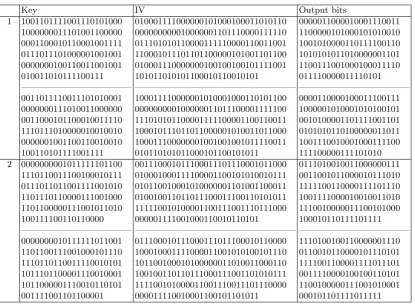
Table 1 presents some (K, IV) pairs, which produce shifted identical key stream outputs. According to Theorem 1, the adversary can use this weakness to generate the same butl−bit shifted keystream outputs by defining related (K, IV) pairs with probability 2−2·l. The discovered weakness allows the
Table 1.Shifted identical key stream outputs corresponding two related (K, IV) pairs
Key IV Output bits
1 1001101111001110101000 1000000011101001100000 0001100010110001001111 0111011101000001001001 0000000100110011001001 010011010111100111 010001111000000101000100011010110 000000000010000001101110000111110 011101010110000111110000110011001 110001011101101100000101001101100 010001110000000100100100101111001 101011010101100010110010101 0000011000010001110011 1100000101000101010010 1001010000110111100110 1010101011010000001101 1100111001000100011110 011110000011110101 ———————————— —————————————————– ———————————— 0011011110011101010001 0000000111010011000000 0011000101100010011110 1110111010000010010010 0000001001100110010010 100110101111001111 100011110000001010001000110101100 000000000100000011011100001111100 111010101100001111100001100110011 100010111011011000001010011011000 100011100000001001001001011110011 010110101011000101100101011 0000110000100011100111 1000001010001010100101 0010100001101111001101 0101010110100000011011 1001110010001000111100 111100000111101010 2 0000000001011111101100 1110110011100100010111 0111011011001111001010 1101110110000111001000 1101100000111001011010 100111100110110000 001110001011100011101110001011000 010001000111100001100101010010111 010110010001010000001101001100011 010010011011011100011100110101011 111110010100001100111001110111000 000001111001000110010110101 0111010010011000000111 0011001011000010111010 1111100110000111101110 1001111000010010011010 1110010000011100101000 100010110111101111 ———————————— —————————————————– ———————————— 0000000010111111011001 1101100111001000101110 1110110110011110010101 1011101100001110010001 1011000001110010110101 001111001101100001 011100010111000111011100010110000 100010001111000011001010100101110 101100100010100000011010011000110 100100110110111000111001101010111 111100101000011001110011101110000 000011110010001100101101011 1110100100110000001110 0110010110000101110101 1111001100001111011101 0011110000100100110101 1100100000111001010001 000101101111011111
adversary to distinguish the cipher from a random bit generator. Assume that the adversary can apply related (K, IV) pairs, which does not know the exact values of secret key. Then, after applying m ( 4) different ( randomly generated ) related (K, IV) pairs, on average m/4 of generated key stream outputs have identical sequences with just one bit shift.
3.3 Recovery of Secret Keys
Now, we propose a key recovery attack that exploits the sliding property of pairs (K, IV). We show an algorithm that allows to recover the 128-bit key after O(29) initialisation operations. The algorithm needs 512 related (K, IV) pairs and it can find the secret key with probability one.
Assume that both (K, IV) and (K,b IVc) generate almost identical keystream bits, where the second
isb192, which is equal to:
b192 =b0⊕b14⊕b37⊕b41⊕b49⊕b51⊕b93⊕(1⊕c0)(1⊕c1)b107
⊕(1⊕c0)c1b120⊕c0(1⊕c1)b134⊕c0c1b136⊕(1⊕c0)b155⊕c0b158⊕b176
⊕N LF(a67, a127, b23, b53, b77, b81, b103, b128),
where c0 = a41 and c1 = a89. Since the contents of bi (0 ≤ i ≤ 191) are known and can be cho-sen by the adversary, then Equation (4) is a non-linear relation based on only 4 unknown variables a41, a89, a67, a127. We now take a closer look at the equation (4):
b192=b0⊕b14⊕b37⊕b41⊕b49⊕b51⊕b93⊕(1⊕a41)(1⊕a89)b107
⊕(1⊕a41)a89b120⊕a41(1⊕a89)b134⊕a41a89b136⊕(1⊕a41)b155⊕a41b158⊕b176
⊕a67a127b23b53b77b81b103⊕a67a127b23b53b77b81⊕a67a127b23b53b77b103
⊕a67a127b23b53b81b103b128⊕a67a127b23b53b81b103⊕a67a127b23b53b81b128
⊕a67a127b23b53b81⊕a67a127b23b53b103b128⊕a67a127b23b77b81b103
⊕a67a127b23b77⊕a67a127b23b81b103⊕a67a127b23b81b128⊕a67a127b23b128
⊕a67a127b23⊕a67a127b53b77b81b103b128⊕a67a127b53b77b81b128
⊕a67a127b53b77b81⊕a67a127b53b77b128⊕a67a127b53b77⊕a67a127b53b103
⊕a67a127b77b81b103b128⊕a67a127b77b81b103⊕a67a127b77b81b128⊕a67a127b77b103b128
⊕a67a127b77b128⊕a67a127b81b103b128⊕a67a127b81b103⊕a67a127b81⊕a67a127b103 (4)
⊕a67a127⊕a67b23b53b77b81b103⊕a67b23b53b77b81b128⊕a67b23b53b77⊕a67b23b53b81b103b128
⊕a67b23b53b81b103⊕a67b23b53b81b128⊕a67b23b53b103⊕a67b23b77b81b103b128⊕a67b23b81b103
⊕a67b23b81⊕a67b23b103b128⊕a67b23b128⊕a67b53b77b81b103b128⊕a67b53b77b81b103
⊕a67b53b77b81b128⊕a67b53b77b81⊕a67b53b77b128⊕a67b53b81b103b128⊕a67b53b81
⊕a67b53b103⊕a67b53⊕a67b77b81b103⊕a67b77b103b128⊕a67b81b103
⊕a67b103⊕a67⊕a127b23b53b77⊕a127b23b53b81b103⊕a127b23b53b81b128
⊕a127b23b53b81⊕a127b23b53⊕a127b23b77b81b103⊕a127b23b77b103⊕a127b23b77
⊕a127b23b81⊕a127b23⊕a127b53b77b81b103b128⊕a127b53b77b81b128⊕a127b53b77b103b128
⊕a127b53b77b103⊕a127b53b77⊕a127b53b81b103⊕a127b53b81⊕a127b53b103
⊕a127b53b128⊕a127b77b81b103b128⊕a127b77b81b128⊕a127b81b103⊕a127b81b128⊕a127b81
⊕a127b103b128⊕a127b103⊕a127⊕N LF0(b23, b53, b77, b81, b103, b128)
where N LF0 is a Boolean function including all monomials of N LF, in which variables a67, a127 do not exist. Note that the adversary does not need to solve the equation. Instead, the adversary can recover four bits of the secret key by choosing appropriate bits forIVs. For example, if
(
bi = 0 i∈Φ b158= 1
where Φ={0,14,37,41,49,51,93,107,120,134,136,155,176,23,53,77,81,103,128}, then b192 =a41. Consequently, ivb191 = k41. In this way, the adversary is able to retrieve other four secret key bits.
The number of the required related pairs (K, IV) is 4. On the average, to find the valid pairs, the adversary needs 16 pairs. In other words, to retrieve 4 secret key bits, the adversary should run the initialisation algorithm 16 times for the related (K, IV) pairs. Now, the adversary can keep going and continue the attack finding consecutive 4-bit parts of the secret key. Finally, to determine the whole 128-bit secret key, the adversary needs to apply 512 = 32×16 related (K, IV) pairs on the average.
4 Weak (K, IV) Pairs
cipher is clocked 448 times. At the end of the initialisation, the cipher can be set in the following weak states:
– the register A contains all ones and the state loops forever. To identify the collection of pairs (K, IV) that leads to this state of A, it is enough to set A = 1 and to set B to an arbitrary 192-bit vector and clock backwards. This process will generate 2192 pairs (K, IV) that leads the initialisation to weak states.
– the register B contains all zeros and the state loops forever. Again, to identify the collection of pairs (K, IV) that leads to this state ofB, it is enough to setB =0 and to setA to an arbitrary 128-bit vector and clock backwards. This process will generate 2128 pairs (K, IV) that leads the initialization to weak states.
– both registersA=1and B =0. There is a single pair of (K, IV) only. To identify it, set registers appropriately and clock backwards. This case is not very interesting as it can be easily identified.
4.1 Weak (K, IV) Pairs Leading to A= 1
It may happen that after the initialisation, the pair (K, IV) leads toA=1. An immediate consequence of this is that the register A contains all ones and it stays in this state for all clocks. The adversary is able to identify this case and they are also able to recover the weak pair (K, IV) that has led to A=1. Clearly, if the adversary knows IV, then the task of findingK is easier.
Note that the cipher with the register A in the state of all ones is equivalent to a 192-bit LFSR whose outputs are filtered by a non-linear Boolean functionh with an 6-bit input. The functionh is the non-linear functionN LF with two bits set to ones (those that are coming fromA). The function is a balanced function fromh:GF(26)→GF(2) of degree 5 and non-linearity 20 and it is given below.
h(x1, x2, x3, x4, x5, x6) = 1⊕x1⊕x1x2⊕x3⊕x1x3⊕x1x4⊕x3x4⊕x2x3x4⊕x5
⊕x1x2x5⊕x2x3x5⊕x1x4x5⊕x3x4x5⊕x1x3x4x5⊕x2x3x4x5
⊕x1x6⊕x2x6⊕x1x3x6⊕x1x2x3x6⊕x4x6⊕x1x4x6⊕x1x2x4x6
⊕x3x4x6⊕x1x3x4x6⊕x2x3x4x6⊕x1x2x3x4x6⊕x5x6⊕x2x3x5x6
⊕x4x5x6⊕x2x4x5x6⊕x1x2x4x5x6⊕x2x3x4x5x6
The function can be approximated by a linear Boolean function 1⊕x1⊕x1⊕x6 with probability:
P r(h= (1 +x1+x2+x6)) = 44
64 = 0.6875 = 0.5 + 2
−2.415
The algebraic immunity of the function is 3 and the number of the annihilators is 10. To recover the contents of the register B, we may apply a basic algebraic attack the needs 222.75 observations of the keystream bits and whose complexity is 263.87. Once the adversary knows the contents ofB at the end of the initialization, they can clock backwards to recover the weak pair (K, IV).
4.2 Weak (K, IV) Pairs Leading to B = 0
The second class of weak (K, IV) pairs leads to the state with B=0. In this case the registerB stays in the zero state for all clocks. Consequently, all the outputs of DLFSR are zeros, which is equivalent to removal of the registerB from the cipher. The goal of the adversary is to recover the pair (K, IV). Now we show that the adversary is able to recover the initial state (and the secret key by clocking NLFSR backwards) faster than in 254 steps.
Note that the N LF function is now used with its 6 bits coming from the register B set to zero. Consequently, the keystream output function that is a linear combination of the least significant bit of the registerA with the output of theN LF function. The keystream output function is denoted by `:{0,1}3 → {0,1}and is of the following form:
The function`is a non-linear balanced Boolean function of degree 2. One of the best approximations of` is the linear functionx3. It is easy to check that
P r(l=x3) = 6
8 = 0.75 = 0.5 + 2
−2 (5)
Distinguishing Attack If B=0, then the adversary may distinguish the generated keystream bits from a random bit generator. Consider the keystream output bits at clockst+ 0,t+ 6, t+ 7, t+ 11, t+ 16, t+ 28, t+ 36, t+ 45, t+ 55, t+ 62. If we use the approximation (see Equation (5)) then we can write
P r(zt+128=g(zt+0, zt+6, zt+7, zt+11, zt+16, zt+28, zt+36, zt+45, zt+55, zt+62))≈0.502 (6)
This means that the adversary requires around 217 observations of the keystream output bits to tell apart the cipher from a random bit generator with negligible error probability.
Recovery Attack To recover the pair (K, IV), the adversary may use the linear approximation of `and try to guess the contents of A. The probability of the correct guess for the state is (0.75)128 = 2−53.12, which is so far from the probability 2−128. In other words, the cipher has at most 54 bits security.
5 Conclusions
In this paper, we analysed the initialisation algorithm of the Rakaposhi stream cipher. We started from observations about cryptographic weak points of the cipher. We discovered the so-called sliding property of the pairs (K, IV). This property can be exploited by launching distingushing and key recovery attacks. We showed that there is a distinguishing attack that needs four related (K, IV) pairs only. Our key recovery attack recovers all bits of the secret key K after observing 29 related (K, IV) pairs.
In the second part of the work, we studied the security of Rakaposhi when either the registerAor B enters a short cycle at the end of the initialisation procedure. When the register Aloops in the all-ones state, then the adversary is able to recover the pair (K, IV). Rakaposhi in this case degenerates to a LFSR cipher with a non-linear filter function. It is shown that the initial state of the registerB can be discovered by an algorithm of time complexity 263.87.
If the register B enters the zero state at the end the initialisation procedure, then we showed two efficient algorithms: one to distinguish Rakaposhi from a random bit generator and the other to recover the pair (K, IV). The distinguisher needs 217 keystream bit observations. The key recovery algorithm requires around 254 operations. Note that this cryptographic weakness can be explored by the adversary when they have access to the cipher device and are allowed to play with the device by running it for differentIVs.
References
1. C. Cid, S. Kiyomoto, and J. Kurihara,The rakaposhi stream cipher, in Proceedings of the 11th international conference on Information and Communications Security, ICICS’09, Berlin, Heidelberg, 2009, Springer-Verlag, pp. 32– 46.
2. C. De Canni`ere, O. K¨uc¸¨uk, and B. Preneel,Analysis of grain’s initialization algorithm, in Proceedings of the Cryptology in Africa 1st international conference on Progress in cryptology, AFRICACRYPT’08, Berlin, Heidelberg, 2008, Springer-Verlag, pp. 276–289.
3. H. Englund, T. Johansson, and M. Snmez Turan,A framework for chosen iv statistical analysis of stream ciphers, in Progress in Cryptology INDOCRYPT 2007, K. Srinathan, C. Rangan, and M. Yung, eds., vol. 4859 of Lecture Notes in Computer Science, Springer Berlin / Heidelberg, 2007, pp. 268–281.
5. M. Hell, T. Johansson, and W. Meier,Grain - a stream cipher for constrained environments, ECRYPT Stream Cipher Project.
6. ,Grain ; a stream cipher for constrained environments, Int. J. Wire. Mob. Comput., 2 (2007), pp. 86–93. 7. T. Isobe, T. Ohigashi, and M. Morii,Slide cryptanalysis of lightweight stream cipher rakaposhi, in Advances in
Information and Computer Security, G. Hanaoka and T. Yamauchi, eds., vol. 7631 of Lecture Notes in Computer Science, Springer Berlin Heidelberg, 2012, pp. 138–155.
8. M. juhani O. Saarinen,Chosen-iv statistical attacks on estream stream ciphers, in eSTREAM, ECRYPT Stream Cipher Project, Report 2006/013, 2006, pp. 5–19.