Encryption Scheme
Peng Wang1 and Wenling Wu2 and Liting Zhang1
1 State Key Laboratory of Information Security
Institute of Information Engineering of Chinese Academy of Sciences 2 Institution of Software of Chinese Academy of Sciences
[email protected], {wwl,zhangliting}@is.iscas.ac.cn
Abstract. Alomair proposed a new authenticated encryption scheme
OKH at ACNS 2012, and proved its security, i.e. authenticity and privacy.
Our research shows that it is not the case. We only need one query to break the authenticity of OKH with success probability of 1, and two
queries to break the privacy of OKH with success probability of 1−1/2n,
where n is the block-length of underlying blockcipher.
Keywords. authenticated encryption, universal hash function family,
cryptanalysis.
1
Introduction
Authenticated encryption (AE) schemes achieve the security functions of mes-sage authentication codes and that of encryption schemes at the same time, i.e. authenticity and privacy. Simply speaking, authenticity guarantees that the ci-phertext is really delivered from the sender and not modified by the adversary during the transmission. Privacy guarantees that the adversary can not gain any information (except the length) about plaintext from the view of ciphertext. Due to its wide applications, during the past few years, considerable effort has been made to construct AE schemes, e.g. IAPM [7], OCB [11], CCM [12], EAX [2], CWC [8], GCM [9].
Recently, Alomair proposed a new composed AE scheme OKH [1] in E&M style. The main observation of OKH is that, in the E&M or EtM scheme, the security requirements of authenticity can be relaxed, which can improve the efficiency of the overall construction.
Typical MACs are based on blockciphers, such as CBC-MAC [5], CMAC [10] and PMAC [4], but more efficient MACs are based on universal hash function families, in which the message is first compressed into a fixed-length string by a universal hash function and then encrypted to be the tag, e.g. UMAC [3], and MACs in CWC [8] and GCM [9]. The universal hash function family is a group of hash functions without any cryptographic requirement, but satisfying some combinatorial properties. The MAC in OKH is also based on a hash function family called the Odd Key Hash Family, but as mentioned by the author [1] it does not even satisfy the basic property of universal hash family, i.e. property of being universal3.
Alomair proved the security of OKH by the reduction method with the assumption that the underlying blockcipher is a pseudorandom permutation (PRP). Unfortunately it is not true.
Our Contributions. In this paper we show that both authenticity and privacy of OKH do not hold in the usual security models. As to authenticity, we only need to query a special message to the encryption algorithm of OKH, and then forgery a new ciphertext and its tag that can pass the decryption algorithm of OKH successfully with probability of 1. As to authenticity, we only need to query two special messages to distinguish the ciphertexts from the random strings with probability of 1−1/2n, where n is the block-length of underlying blockcipher.
2
Description of OKH
2.1 Notations
– For a binary string M, |M| denotes the length of M in bits.
– For a non-empty set S, we denote by s←− S$ the selection of a member ofS uniformly at random and assigning it to s.
– A blockcipher is a function E :{0,1}kl× {0,1}bl → {0,1}bl, where bl and kl are the block-length and key-length respectively, and EK(·) = E(K,·) is a permutation for all K ∈ {0,1}kl.
3 A hash function family F = {f
K|K ∈ K} is ε-almost-universal if #{K|fK(X) =
– X ⊕Y denotes the exclusive or (XOR) of two string X and Y. When the lengths of X and Y are not equal, we pad some 0s after the short one to make them equal and then do the usual XOR operation. E.g. 11⊕1001 = 1100⊕1001 = 0101.
– We denote by · the multiplication, 0n the n-bit string of all 0s, Z2n =
{0,1,2,· · · ,2n−1} the set of all none-negative integers less than 2n, and Z∗
2n the set of all odd integers in Z2n. Without confusion, we often use a
string or a integer number interchangeably.
2.2 The Odd Key Hash function family
The Odd Key hash function family is a crucial component of OKH, which makes use of basic modular arithmetic operations within Z2n. For an input message
M with bit-length of multiples of n, partition it into a sequence of n-bit blocks,
M =M1M2· · ·Ml, then the compressed image of M is given by
OK-HASHKh(M) =
l
i=1
Ki ·Mi mod 2n,
where the key Kh =K1· · ·Kl, Ki ∈ Z∗2n, i = 1,· · · , l.
Remark 1. As mentioned in [1], OK-HASH is not an almost universal hash func-tion family, because OK-HASHKh(02n) = OK-HASHKh(10n−110n−1) for any
Kh.
2.3 OKH Authenticated Encryption
OKH is a nonce-based authenticated encryption scheme, combining an encryp-tion scheme SE = (E,D) and a special message authentication code OK-MAC based on the function family OK-HASH mentioned above. We can view OKH as an E&M composition AE scheme, and divide it into three components: OKH = (OKH.Key, OKH.Enc, OKH.Dec), where OKH.Key is a key generation al-gorithm, OKH.Enc is an encryption algorithm and OKH.Dec is a decryption algorithm.
Encryption Algorithm. Both SE and OK-MAC only handle messages of full blocks. In order to treat arbitrary length messages, OKH.Enc pads the bit 1 and minimal bits of 0, making the length of the messages be multiples of block-length. We simply write the result of this procedure as M10∗. OKH uses E to get the ciphertext and OK-MAC to get the authentication tag:
OKH.EncKe,Kh(N, M) = (EKe(N, M),OK-MACKh,Ke(N, M)),
where E encrypts the message block by block using the underlying blockcipher with different key Ke⊕(N||i),
EKe(N, M) = EKe⊕(N||1)(M1)||EKe⊕(N||2)(M2)|| · · · ||EKe⊕(N||l)(Ml10∗),
and
OK-MACKh,Ke(N, M) =EKe(OK-HASHKh(M10∗)⊕N),
when the length of input to the blockcipher EKe is less than one block, we pad some zeros to fill it.
Decryption Algorithm. OKH.Dec recovers the plaintext, and uses OK-MAC to regenerate the tag to decide whether to return the plaintext or not.
OKH.DecKe,Kh(N, C, T) =
⎧ ⎨ ⎩
⊥ if OK-MACKh,Ke(N, M)=T ,
M else, where M =DKe(N, C),
where D is the inverse of E,
DKe(N, C) =DKe⊕(N||1)(C1)||DKe⊕(N||2)(C2)|| · · · ||DKe⊕(N||l)(Cl).
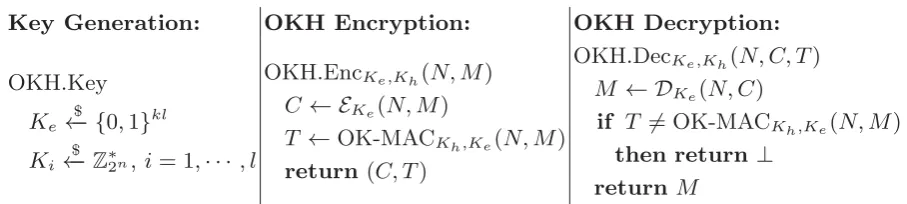
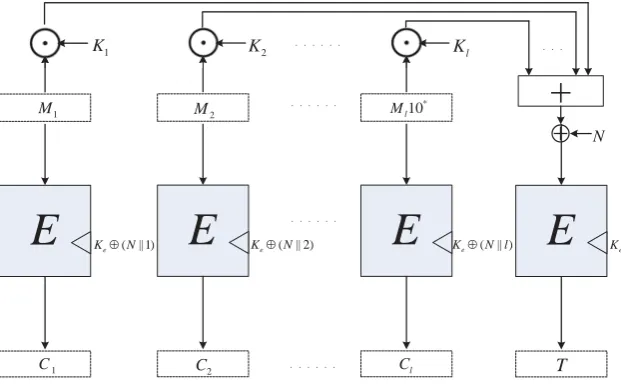
As a summery, we conclude OKH in pseudocodes as in fig. 1, and illustrate it in fig. 2.
Key Generation: OKH Encryption: OKH Decryption:
OKH.Key
Ke←− {$ 0,1}kl
Ki←−$ Z∗2n, i= 1,· · · , l
OKH.EncKe,Kh(N, M)
C ← EKe(N, M)
T ← OK-MACKh,Ke(N, M) return (C, T)
OKH.DecKe,Kh(N, C, T)
M ← DKe(N, C)
if T = OK-MACKh,Ke(N, M)
then return ⊥ return M
E
1 C 1 M ( ||1) eK N
E
2
C
2
M
( || 2)
e
KN
E
l C * 10 l M ( || ) e
K N l
E
T e K N
+
2K Kl
1 K
Fig. 2. The OKH Authenticated Encryption Scheme, when the block-length of the
underlying blockcipher and that in the OK-HASH are equal.
Remark 2. In the original description of OKH [1], the block-length of the under-lying blockcipher and that in the OK-HASH may not be equal, the former is no less than the later. In the following discussion, we only consider the situation that the two lengths are equal (i.e. bl =n), just as illustrated in fig. 2.
3
Security Models
We adopt the standard security models as those mentioned in [1].
Authenticity Model. The adversaryAis given oracle access to the encryption algorithm OKH.Enc. A queries OKH.Enc with a pair of nonce and message with restriction that he never repeats the nonce, or in other words he is nonce-respecting, observing the output. After some queries (current query may depend on past queries), he returns a triple of nonce, ciphertext and tag (N, C, T), which does not appear before in the previous answers to the queries. If (N, C, T) is valid, i.e. OKH.Dec(N, C, T) =⊥, we say that A makes a successful forgery. Formally, the advantage of A is defined by
AdvauthOKH(A) = Pr[AOKH.Enc(·,·) forges].
and message, observing the outputs, trying to distinguish it from random bits. Formally, the advantage of B is defined by
AdvprivOKH(B) = |Pr[BOKH.Enc(·,·) ⇒1]−Pr[B$(·,·) ⇒1]|,
where $(N, M) returns a random string with the same length of OKH.Enc(N, M).
4
Cryptanalysis of OKH
4.1 Some Properties
We first notice some properties of a special binary integer number 10n−1 inZ2n.
Property 1. For any odd integers Ki and Kj,
10n−1 ·Ki ≡10n−1 mod 2n, (1) 10n−1·Ki+ 10n−1 ·Kj ≡0n mod 2n. (2)
Using these properties, we construct two pairs of messages which have the same authentication tag under OK-MAC with the same or different nonces.
Property 2. For arbitrary blocks Mi ∈ {0,1}n (i = 1,· · · , l), we have
OK-MAC(N, M1· · ·Ml10n−110n−1) = OK-MAC(N, M1· · ·Ml), (3) OK-MAC(N, M1· · ·Ml10n−1) = OK-MAC(N, M1· · ·Ml), (4)
where N ⊕N = 10nl−1, nl is the length of the nonce.
Proof. It is easy to verify the following two equations about OK-HASH,
OK-HASH(M1· · ·Ml10n−110n−110n−1) = OK-HASH(M1· · ·Ml10n−1),
OK-HASH(M1· · ·Ml10n−110n−1) = OK-HASH(M1· · ·Ml10n−1)⊕10n−1. By the definition of OK-MAC, the equations of (3) and (4) follow.
4.2 Breaking Authenticity of OKH
We give the following authenticity attacking algorithm. This attack only makes one special query to the encryption oracle OKH.EncKe,Kh(·,·), then returns a valid triple of nonce, ciphertext and tag which does not appear before.
Authenticity attacking algorithm A:
1) Query (N, M1· · ·Ml10n−110n−1) to the encryption oracle, where Mi (i = 1,· · · , l) are arbitrary blocks, and get (C1C2· · ·Cl+3, T), where Ci (i = 1,· · · , l+ 3) are ciphertext blocks, T is the tag.
2) Return (N, C1C2· · ·Cl+1, T).
Analysis of algorithm A. The ciphertext blocks to the query areCi =EKe⊕(N||i)(Mi),
i = 1,· · · , l, Cl+1 = EKe⊕(N||(l+1))(10n−1), j = 1,2,3. So the corresponding plaintext blocks of Ci (i = 1,· · · , l) and Cl+1 under same nonce N are Mi (i = 1,· · · , l) and 10n−1. 10n−1is interpreted as the padding, therefore the final plain-text isM1· · ·Ml. Equation (3) shows that the tags of (N, M1· · ·Ml10n−110n−1) and (N, M1· · ·Ml) are the same. So (N, C1C2· · ·Cl+1, T) is valid, which does not appear before. Therefore AdvauthOKH(A) = 1.
Remark 3. In the proof of authenticity in [1], the author did not consider the situation that one plaintext may be the prefix of the other. The security proof lies on the fact that the corresponding plaintexts of two different ciphertext differ in single block or several blocks. This is obvious not true.
4.3 Breaking Privacy of OKH
In equation (4), two messages have the same authentication tag under different nonces. Therefore we can make two nonce-respecting queries, resulting in two equal tags, which can be used to distinguish ciphertexts from random strings.
Privacy attacking algorithm B:
1) Query (N, M1· · ·Ml10n−1), and get (C1C2· · ·Cl+2, T).
2) Query (N, M1· · ·Ml) where N ⊕N = 10nl−1, and get (C1C2 · · ·Cl+1, T). 3) If T =T, then return 1, else return 0.
Analysis of algorithm B. If the oracle is OKH.Enc(·,·). By equation (4), we know thatT =T always holds. If the oracle is $(·,·),T andT are two random strings. The probability of T =T is 1/2n, therefore AdvprivOKH(B) = 1−1/2n.
is not secure. In this model, the adversary can query (N, M),(N, M) with re-striction that |M| = |M|, the oracle only returns left or right ciphertext, and after several queries the adversary must guess this one-bit information about left-or-right. In this model, the adversary can attack as following: 1) Query (N, M1· · ·Ml10n−1),(N, M1· · ·Ml0n); 2) Query (N, M1· · ·Ml),(N, M1· · ·Ml) where N ⊕N = 10nl−1; 3) If the two returned tags are equal, the adversary guesses it is left, else guesses right. It is easy to verify that the success probability is 1.
Remark 5. The proof of privacy in [1], the security lies only on the pseudorandom of the underlying blockcipher, which assumes that once the key of the blockcipher is randomly selected, the blockcipher is indistinguishable from a uniformly ran-dom permutation, i.e. the blockcipher is a pseudoranran-dom permutation (PRP). The encryption component of OKH is similar to the ECB mode, with exception that the keys to the underlying blockcipher are Ke⊕(N||i) (i = 1,· · · , l), which are all related by the key Ke. The only assumption of PRP can not guarantee the independence between the blockcipher invocations. With the assumption of PRP, it is easy to construct a new block cipher like [6], which is also a PRP, but the same under two different related keys such as Ke⊕(N||1) and Ke⊕(N||2). Then first two block encryptions of OKH are the same, which also can be used to break the privacy of OKH. Algorithm B only makes use of the weakness of OKH-MAC.
5
Conclusion
Although the security proofs were given in [1], the OKH authenticated encryp-tion scheme is not secure at all. Both authenticity and privacy of OKH do not hold in the common security models. We only need one or two queries to break the security of OKH with success probability of 1 or almost 1.
References
1. Alomair, B.: Authenticated encryption: How reordering can impact performance.
In: Bao, F., Samarati, P., Zhou, J. (eds.) ACNS. Lecture Notes in Computer Sci-ence, vol. 7341, pp. 84–99. Springer (2012)
2. Bellare, M., Rogaway, P., Wagner, D.: The EAX mode of operation. In: Roy, B.K.,
Meier, W. (eds.) FSE. Lecture Notes in Computer Science, vol. 3017, pp. 389–407.
3. Black, J., Halevi, S., Krawczyk, H., Krovetz, T., Rogaway, P.: UMAC: Fast and
secure message authentication. In: Wiener, M.J. (ed.) CRYPTO. Lecture Notes in Computer Science, vol. 1666, pp. 216–233. Springer (1999)
4. Black, J., Rogaway, P.: A block-cipher mode of operation for parallelizable message
authentication. In: Knudsen, L.R. (ed.) EUROCRYPT. Lecture Notes in Computer Science, vol. 2332, pp. 384–397. Springer (2002)
5. FIPS-133: Federal information processing standards publication (FIPS 133).
com-puter data authentication (1985)
6. Iwata, T., Kurosawa, K.: On the correctness of security proofs for the 3GPP confidentiality and integrity algorithms. In: Paterson, K.G. (ed.) Cryptography
and Coding. Lecture Notes in Computer Science, vol. 2898, pp. 306–318. Springer
(2003)
7. Jutla, C.S.: Encryption modes with almost free message integrity. In: Pfitzmann, B.
(ed.) EUROCRYPT. Lecture Notes in Computer Science, vol. 2045, pp. 529–544.
Springer (2001)
8. Kohno, T., Viega, J., Whiting, D.: CWC: A high-performance conventional
au-thenticated encryption mode. In: Roy, B.K., Meier, W. (eds.) FSE. Lecture Notes
in Computer Science, vol. 3017, pp. 408–426. Springer (2004)
9. McGrew, D.A., Viega, J.: The galois/counter mode of operation (GCM) (2004),
http://csrc.nist.gov/groups/ST/toolkit/BCM/
10. NIST: Recommendation for block cipher modes of operation: The CMAC mode
for authentication. NIST Special Publication 800-38B (2005), http://csrc.nist.
gov/publications/nistpubs/800-38B/SP_800-38B.pdf
11. Rogaway, P., Bellare, M., Black, J., Krovetz, T.: OCB: a block-cipher mode of
operation for efficient authenticated encryption. In: Reiter, M.K., Samarati, P. (eds.) ACM Conference on Computer and Communications Security. pp. 196–205.
ACM (2001)
12. Whiting, D., Housley, R., Ferguson, N.: Counter with CBC-MAC (CCM) (2002),