Protocols for Multiparty Coin Toss With Dishonest Majority
∗Amos Beimel†
Department of Computer Science Ben Gurion University
Be’er Sheva, Israel
Eran Omri‡
Department of Computer Science Bar Ilan University
Ramat Gan, Israel Ilan Orlov§
Department of Computer Science Ben Gurion University
Be’er Sheva, Israel
October 4, 2012
Abstract
Coin-tossing protocols are protocols that generate a random bit with uniform distribution. These pro-tocols are used as a building block in many cryptographic propro-tocols. Cleve [STOC 1986] has shown that if at least half of the parties can be malicious, then, in anyr-round coin-tossing protocol, the malicious parties can cause a bias ofΩ(1/r)to the bit that the honest parties output. However, for more than two decades the best known protocols had bias √t
r, wheretis the number of corrupted parties. Recently, in
a surprising result, Moran, Naor, and Segev [TCC 2009] have shown that there is anr-round two-party coin-tossing protocol with the optimal bias ofO(1/r). We extend Moran et al. results to themultiparty modelwhen less than 2/3 of the parties are malicious. The bias of our protocol is proportional to1/r and depends on the gap between the number of malicious parties and the number of honest parties in the protocol. Specifically, for a constant number of parties or when the number of malicious parties is somewhat larger than half, we present anr-roundm-party coin-tossing protocol with optimal bias of O(1/r).
Keywords. Fair Coin Tossing, Multiparty Computation, Dishonest Majority, Secure with Abort; Cheat Detection.
∗A preliminary version of this version has appeared inAdvances in Cryptology – CRYPTO 2010, volume 6223 ofLecture Notes in Computer Science, pages 538–557. Springer-Verlag, 2010.
†Supported by ISF grant 938/09.
‡This research was generously supported by the European Research Council as part of the ERC project “LAST”. Part of the research was done while the author was a post-doctoral fellow at BGU supported by the ISF grant 860/06.
Contents
1 Introduction 2
1.1 Our Results . . . 3
1.2 The Idea of Our Protocol . . . 4
1.3 Follow-up Works . . . 4
2 Preliminaries 5 2.1 The Real vs. Ideal Paradigm . . . 5
2.1.1 1/p-Indistinguishability and1/p-Secure Computation . . . 6
2.2 Security with Abort and Cheat Detection . . . 7
2.3 Cryptographic Tools . . . 8
2.4 The Two-Party Protocol of Moran et al. . . 9
3 Coin Tossing with Dishonest Majority – A Warm-Up 10 3.1 Multiparty Coin Tossing When Half of the Parties Can Be Malicious . . . 10
3.2 A 5-Party Protocol that Tolerates up to 3 Malicious Parties . . . 11
3.2.1 Eliminating the Dealer for the 5-Party Protocol . . . 12
4 Our Main Construction 16 5 A Protocol with an On-Line Dealer 16 5.1 The Simulator for the On-Line Dealer Protocol . . . 19
5.2 Proof of the Correctness of the Simulation . . . 20
6 Omitting the On-Line Dealer 27 6.1 The Protocol Without the Dealer . . . 27
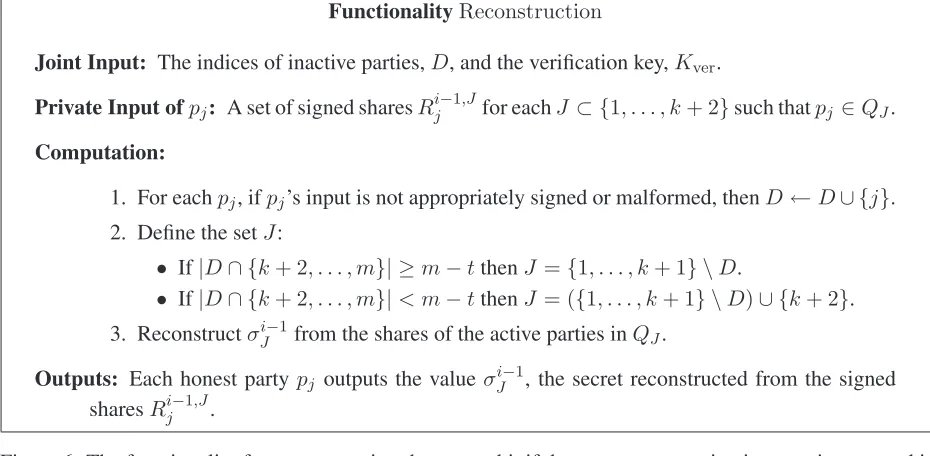
6.1.1 Proving the Feasibility of the Reconstruction . . . 28
6.2 The Simulator for the Protocol Without a Dealer . . . 31
6.3 Proof of the Correctness of the Simulation . . . 34
6.3.1 The Initialization Step . . . 35
6.3.2 The Interaction Rounds of the Protocol . . . 36
6.3.3 The Termination Step . . . 37
6.3.4 Concluding the Proof of Theorem 6 . . . 39
7 Coin-Tossing Protocol for any Constant Fraction of Corrupted Parties 39
References 43
1 Introduction
Secure multiparty computation in the malicious model allows distrustful parties to compute a function se-curely. Designing such secure protocols is a delicate task with a lot of subtleties. An interesting and basic functionality for secure computation is coin tossing – generating a random bit with uniform distribution. This is a simple task where the parties have no inputs. However, already this task raises questions of fair-ness and how malicious parties can bias the output. Understanding what can be achieved for coin tossing in various settings can be considered as a step towards understanding general secure and fair multiparty computation. Indeed, some of the early works on secure computation were on coin tossing, e.g., [5, 6, 9]. Furthermore, coin tossing is used as a basic tool in constructing many protocols that are secure in the mali-cious model. Secure protocols for coin tossing are a digital analogue of physical coin tossing, which have been used throughout history to resolve disputes.
The main problem in designing coin-tossing protocols is the prevention of a bias of the output. The bias of a coin-tossing protocol measures the maximum influence of the adversary controlling a subset of malicious parties on the output of the honest parties, where the bias is0if the output is always uniformly distributed and the bias is1/2if the adversary can force the output to be always (say) 1. To demonstrate the problems of designing a coin-tossing protocol, we describe Blum’s two-party coin-tossing protocol [5].
Example 1.1(Blum’s coin-tossing protocol [5]). To toss a coin, Alice and Bob execute the following proto-col.
• Alice chooses a random bitaand sends a commitmentc= commit(a)to Bob. • Bob chooses a random bitband sends it to Alice.
• Alice sends the bitato Bob together withde-commit(c).
• If Bob does not abort during the protocol, Alice outputsa⊕b, otherwise she outputs a random bit. • If Alice does not abort during the protocol and c is a commitment to a, then Bob outputs a⊕b,
otherwise he outputs a random bit.
If Alice is malicious, then she can bias the output toward (say) 1. Ifa⊕b= 1, she opens the commitment and Bob outputs 1. However, ifa⊕b= 0, Alice aborts, and Bob outputs 1 with probability1/2. Altogether, the probability that the honest Bob outputs 1 is3/4. It can be proved that this is the best that Alice can do in this protocol, and, hence, the bias of the protocol is1/4. This protocol demonstrates the problems caused by parties aborting the protocol and the need to define how the output of the other parties is computed after such aborts.
While the above protocol is a significant improvement over naive protocols whose bias is 1/2, the protocol still has a constant bias. If more than half of the parties are honest, then, using general secure multiparty protocols, there are constant-round protocols with negligible bias (assuming a broadcast channel), e.g., the protocol of [20]. Cleve [9] proved that when at least half of the parties can be malicious, the bias of every protocol withr rounds isΩ(1/r). In particular, this proves that without honest majority no protocol with polynomial number of rounds (in the security parameter) can have negligible bias. On the positive side, it was shown in [2, 9] that there is a two-party protocol with biasO(1/√r). This can be generalized to an m-party protocol that tolerates any number of malicious parties and has biasO(t/√r), wheret is a bound on the number of malicious parties. Cleve and Impagliazzo [10] have shown that, in a model where commitments are available only as black-box (and no other assumptions are made), the bias of every coin-tossing protocol isΩ(1/√r).1 The protocols of [5, 2, 9] are in this model.
The question if there is a coin-tossing protocol without an honest majority that has biasO(1/r) was open for many years. Recently, in a breakthrough result, Moran, Naor, and Segev [18] have shown that there is anr-round two-party coin-tossing protocol with biasO(1/r). Moran et al. ask the following question:
“An interesting problem is to identify the optimal trade-off between the number of parties, the round complexity, and the bias. Unfortunately, it seems that several natural variations of our approach fail to extend to the case of more than two parties. Informally, the main reason is that a coalition of malicious parties can guess the threshold round with a pretty good probability by simulating the protocol among themselves for any possible subset.”
1.1 Our Results
Our main contribution is a multi-party coin-tossing protocol that has small bias when less than2/3of the parties are malicious.
Theorem 1(Informal). Letm, t, andrbe integers such that m/2 ≤ t < 2m/3. There exists anr-round m-party coin-tossing protocol toleratingtmalicious parties that has biasO(22k+1
/r0), wherek= 2t−m andr0 =r−O(k+ 1).
The above protocol nearly has the desired dependency onr, i.e., the dependency implied by the lower bound of Cleve [9]. However, its dependency on k (where k is the difference between the number of malicious parties and the number of honest parties) has, in general, a prohibitive cost. Nevertheless, there are interesting cases where the bias isO(1/r).
Corollary 2(Informal). Letmandtbeconstantssuch thatm/2 ≤t < 2m/3andr be an integer. There exists anr-roundm-party coin-tossing protocol toleratingtmalicious parties that has biasO(1/r).
For example, we construct an r-round 5-party coin-tossing protocol tolerating 3 malicious parties that has bias8/(r−O(1))(this follows from our general construction in Sections 4–6).
Notice that the protocol of Theorem 4 depends onkand not on the number of malicious partiest. Thus, it is efficient whenkis small.
Corollary 3 (Informal). Let m, r be integers and t = m/2 +O(1). There exists an r-round m-party coin-tossing protocol toleratingtmalicious parties that has biasO(1/r).
For example, for any even m we construct an r-round m-party coin-tossing protocol toleratingm/2
malicious parties that has bias1/(2r−O(1)). Furthermore, even whent= 0.5m+ 0.5 log logm−1, the bias of our protocol is small, namely,O(m/(r−O(log logm))).
We also reduce the bias compared to previous protocols when more than 2/3 of the parties are malicious. The bias of them-party protocol of [2, 9] isO(t/√r). We present in Section 7 a protocol whose bias is
O(1/√r)whent/mis constant, that is, when the fraction of malicious parties is constant we get rid of the factortin the bias.
Communication Model. We consider a communication model where all parties can only communicate through an authenticated broadcast channel. On one hand, if a party broadcasts a message, then all other parties seethe samemessage. This ensures some consistency between the information the parties have. On the other hand, there are no private channels and all parties see all messages. We assume a synchronous model; however, the adversary is rushing.2 That is, in this model, in each round each party broadcasts a
message. However, the adversary can wait until it sees the messages sent by the honest parties before it broadcasts the messages of the malicious parties (that is, these messages can depend on the honest parties’ messages).
We note that our results can be translated to a model with authenticated point-to-point channels with a PKI infrastructure (in anm-party protocol, the translation will increase the number of rounds by a mul-tiplicative factor ofO(m)). Thus, our results hold in the two most common models for secure multiparty computation.
1.2 The Idea of Our Protocol
We generalize the two-party protocol of Moran et al. [18] to the multi-party setting. In the protocol of [18], in each round Alice and Bob get bits that are their output if the other party aborts: If a party aborts in round
i, then the other party outputs the bit it got in roundi−1. Furthermore, there is a special roundi∗; prior to roundi∗ the bits given to Alice and Bob are random independent bits and from roundi∗ onward the bits
given to Alice and Bob are the same fixed bit. The adversary can bias the output only if it guessesi∗. In our
protocol, in each round there are many bits. We define a collection of subsets of the parties and each subset gets a bit. The bits are chosen similarly to [18]: prior toi∗ they are independent; fromi∗ onward they are
fixed. In our case we cannot give the bits themselves to the parties. We rather use a few layers of secret-sharing schemes to store these bits. For every subset in the collection, we use a first secret-secret-sharing scheme to share the bit of the subset among the parties of the subset. We use an additional secret-sharing scheme to share the shares of the first secret-sharing scheme. The threshold in the latter secret sharing scheme is chosen such that the protocol can proceed until enough parties aborted. In the round when the number of aborted parties ensures that there is an honest majority, an appropriate subset in the collection is chosen, its bit is reconstructed, and this bit is the output of the honest parties. The description of how to implement these ideas appears in Sections 4–6.
The construction of Moran et al. [18] is presented in two phases. In the first phase they present a protocol with a trusted dealer, for which an adversary can only inflict biasO(1/r). Then, they show how to implement this protocol in the real-world, using a constant round secure-with-abort multiparty protocol, as well as secret-sharing and authentication schemes. This can be seen as a general transformation from any two-party coin-tossing protocol with a trusted dealer, into a real world two-party coin-tossing protocol. We observe that the transformation of Moran et al. to a real-world protocol requires some further care for the multiparty case generalization. We show how this can be achieved by adopting the definition of secure multiparty computation of [1], which requires the protocol to detect a cheating party, that is, at the end of the protocol either the honest parties hold a correct output or all honest parties agree on a party (or parties) that cheated during the protocol.
1.3 Follow-up Works
protocols presented in this paper and these presented in [16]. In addition, the bias of the protocol of [4] is
O(1/√r).
Multiparty protocols for coin-tossing in the preprocessing model. Ishai et al. [15] constructed a new type of secret-sharing scheme in which the reconstruction algorithm informs each honest player of the correct set of cheaters, i.e., each honest player gets a list of all the parties that input a wrong share in the reconstruction phase. This scheme can be used to convert our multiparty coin-tossing protocols into
unconditional multiparty coin-tossing protocols in thepreprocessing model, namely, assuming that there exist an off-line dealer which computes some values in a preprocessing phase, gives them to the parties, and halts. Such a transformation eliminates the cryptographic assumptions and the need of a broadcast channel, while the bias of the resulted protocols is not effected.
Organization. In Section 2, we provide security definitions in multi-party protocols, a description of the cryptographic tools used in this paper, and a brief overview of the result by Moran et al. [18]. In Section 3, we present two warm-up constructions for multiparty coin-tossing with biasO(1/r)wherer is the number of rounds in the protocol. In Sections 4–6 we present our main result – a coin-tossing protocol that has nearly optimal bias and can tolerate up to2/3fraction of malicious parties. In Section 7 we describe anr-round
m-party coin-tossing protocol that tolerates up to tdishonest parties, wheretis some constant fraction of
m.
2 Preliminaries
A multi-party coin-tossing protocol withmparties is defined usingmprobabilistic polynomial-time Turing machinesp1, . . . , pm having the security parameter 1n as their only input. The coin-tossing computation
proceeds in rounds, in each round, the parties broadcast and receive messages on a broadcast channel. The number of rounds in the protocol is typically expressed as some polynomially-bounded function r in the security parameter. At the end of protocol, the (honest) parties should hold a common bitw. We denote by
CoinToss()the ideal functionality that gives the honest parties the same uniformly distributed bitw, that is,
Pr[w= 0] = Pr[w= 1] = 1/2. In our protocol, the output bitwmight have some bias.
In this work we consider a malicious static computationally-bounded adversary, i.e., a non-uniform that runs in a polynomial-time. The adversary is allowed to corrupt some subset of the parties. That is, before the beginning of the protocol, the adversary corrupts a subset of the parties that may deviate arbitrarily from the protocol, and thereafter the adversary sees the messages sent to the corrupt parties and controls the messages sent by the corrupted parties. The honest parties follow the instructions of the protocol.
The parties communicate in a synchronous network, using only a broadcast channel. The adversary is rushing, that is, in each round the adversary hears the messages sent by the honest parties before broadcasting the messages of the corrupted parties for this round (thus, the messages broadcast by corrupted parties can depend on the messages of the honest parties broadcast in this round).
2.1 The Real vs. Ideal Paradigm
simulator) such that the global output of an execution of the protocol with A in the real-world model is distributed similarly to the global output of runningS in the ideal model. In the coin-tossing protocol, the parties do not have inputs. Thus, to simplify the definitions, we define secure computation without inputs (except for the security parameters).
The Real Model. LetΠbe anm-party protocol computingF. LetAbe a non-uniform probabilistic poly-nomial time adversary with auxiliary inputaux. LetREALΠ,A(aux)(1n)be the random variable consisting
of the view of the adversary (i.e., its random input and the messages it got) and the output of the honest parties, following an execution ofΠ, where each partypj begins by holding the input1n.
The Ideal Model. The basic ideal model we consider is a model without abort. Specifically, there are parties{p1, . . . , pm}, and an adversarySwho has corrupted a subsetIof them. An ideal execution for the
computingF proceeds as follows:
Inputs: Partypjholds a security parameter1n. The adversaryS has some auxiliary inputaux.
Trusted party sends outputs: The trusted party computesF(1n)with uniformly random coins and sends
the appropriate outputs to the parties.
Outputs: The honest parties output whatever they received from the trusted party, the corrupted parties output nothing, andS outputs an arbitrary probabilistic polynomial-time computable function of its view (the outputs of the corrupted parties).
LetIDEALF,S(aux)(1n)be the random variable consisting of the output of the adversarySin this ideal
world execution and the output of the honest parties in the execution.
In this work we consider a few formulations of the ideal-world, and consider composition of a few protocols, all being executed in the same real-world, however, each secure with respect to a different ideal-world. We prove the security of the resulting protocol, using the hybrid model techniques of Canetti [7].
2.1.1 1/p-Indistinguishability and1/p-Secure Computation
As explained in the introduction, the ideal functionalityCoinToss()cannot be implemented when there is no honest majority. We use1/p-secure computation, defined by [14, 16], to capture the divergence from the ideal world. This notion applies to general secure computation. We start with some notation.
A function µ(·) isnegligible if for every positive polynomialq(·) and all sufficiently largenit holds thatµ(n) < 1/q(n). A distribution ensembleX = {Xa,n}a∈{0,1}∗,n∈Nis an infinite sequence of random variables indexed bya∈ {0,1}∗andn∈N.
Definition 2.1(Statistical Distance and1/p-indistinguishability). We define thestatistical distancebetween two random variablesAandB as the function
SD(A, B) = 1 2
X
α ¯ ¯
¯Pr[A=α]−Pr[B=α] ¯ ¯ ¯.
For a functionp(n), two distribution ensemblesX ={Xa,n}a∈{0,1}∗,n∈NandY ={Ya,n}a∈{0,1}∗,n∈N
arecomputationally1/p-indistinguishable, denotedX ≈1/p Y, if for every non-uniform polynomitime al-gorithmDthere exists a negligible functionµ(·)such that for everynand everya∈ {0,1}∗,
¯ ¯
¯Pr[D(Xa,n) = 1]−Pr[D(Ya,n)) = 1] ¯ ¯ ¯≤ 1
Two distribution ensembles arecomputationally indistinguishable, denotedX ≡C Y, if for everyc∈N
they are computationally 1
nc -indistinguishable.
We next define the notion of 1/p-secure computation [14, 16, 4]. The definition uses the standard real/ideal paradigm [11, 7], except that we consider a completely fair ideal model (as typically considered in the setting of honest majority), and require only1/p-indistinguishability rather than indistinguishability.
Definition 2.2(perfect 1/p-secure computation). Anm-party protocolΠ is said toperfectly 1/p-secure compute a functionalityFif for every non-uniform adversaryAin the real model, there exists a polynomial-time adversarySin the ideal model such that for everyn∈Nand for everyaux∈ {0,1}∗
SD(IDEALF,S(aux)(1n),REALΠ,A(aux)(1n))≤ 1
p(n).
Definition 2.3 (1/p-secure computation [14, 16, 4]). Letp = p(n) be a function. Anm-party protocol Πis said to1/p-securely compute a functionalityFif for every non-uniform probabilistic polynomial-time adversary A in the real model, there exists a non-uniform probabilistic polynomial-time adversaryS in the ideal model corrupting the same parties asA such that the following two distribution ensembles are computationally1/p(n)-indistinguishable
©
IDEALF,S(aux)(1n)ªaux∈{0,1}∗,n∈N
1/p
≈ ©REALΠ,A(aux)(1n)ªaux∈{0,1}∗,n∈N.
We next define the notion ofsecure computationand notion ofbias of a coin-tossing protocolby using the previous definition.
Definition 2.4(Secure computation). Anm-party protocolΠis said tosecurely computea functionalityF, if for everyc∈N, the protocolΠis(1/nc)-securely compute the functionalityF.
Definition 2.5. We say that a protocol is a coin-tossing protocol with bias1/pif it is a1/p-secure protocol for the functionalityCoinToss().
2.2 Security with Abort and Cheat Detection
We present here a definition of secure multiparty computation that is more stringent than standard definitions of secure computation with abort. This definition extends the definition for secure computation as given by Aumann and Lindell [1]. Roughly speaking, our definition requires that one of two events is possible: If at least one party deviates from the prescribed protocol, then the adversary obtains the outputs of these parties (but nothing else), and all honest parties are notified by the protocol that these parties have aborted. Otherwise, the protocol terminates normally, and all parties receive their outputs. Again, we consider the restricted case where parties hold no private inputs. The formal definition uses the real vs. ideal paradigm as discussed in Section 2.1. We next describe the appropriate ideal model.
Execution in the ideal model. LetD⊆[m]denote the indices of the corrupted parties, controlled by an adversaryA. An ideal execution proceeds as follows:
Inputs: Each party obtains a security parameter1n. The adversaryAreceives an auxiliary input denoted aux.
Trusted party sends outputs to adversary: The trusted party computesF(1n)with uniformly random
Adversary instructs the trusted party to continue or halt: Asends either a“continue” message or
{“abortj”}j∈J to the trusted party on behalf of a set of corrupt parties indexed by J. If it sends
a“continue” message, the trusted party sends the appropriate output to the partiespj forj /∈ D
(i.e., to all honest parties). Otherwise, if it sends{“abortj”}j∈J for some set of indices of corrupt
partiesJ ⊆D, then the trusted party sends the setJ to all partiespjforj /∈D.
Outputs: An honest party always outputs the message it obtained from the trusted party. The corrupted parties output nothing. The adversaryAoutputs an probabilistic polynomial-time computable func-tion of the auxiliary inputaux, and the outputs obtained from the trusted party.
We let IDEALCD
F,S(aux)(1n) and REALΠ,A(aux)(1n) be defined as in Section 2.1 (where in this case
IDEALCDF,S(aux)(1n)refers to the above execution with cheat detection ofF). This ideal model is different from the ideal world without cheat detection (see, e.g., [11]); without cheat detection, the trusted party sends a⊥symbol when the trusted party gets an abort message. With cheat detection, the honest partiesknowthe identities of the corrupted parties that cause the abort. This cheat detection is achieved by most multiparty protocols, including that of [12], but not all (e.g., the protocol of [13] does not meet this requirement). Using this notation we define secure computation with abort and cheat detection.
Definition 2.6. LetF andΠ be as above. A protocolΠ is said tosecurely computeF with abort and cheat detection if for every non-uniform polynomial-time adversaryAfor the real model, there exists a non-uniform polynomial-time adversarySfor the ideal model corrupting the same parties asA, such that
n
IDEALCDF,S(aux)(1n) o
aux∈{0,1}∗,n∈N
C
≡ ©REALΠ,A(aux)(1n)ªaux∈{0,1}∗,n∈N.
2.3 Cryptographic Tools
We next informally describe two cryptographic tools that we use in our protocols.
Signature Schemes. A signature on a message proves that the message was created by its presumed sender, and its content was not altered. A signature scheme is a triple (Gen,Sign,Ver) containing the key generation algorithmGen, which gets as input a security parameter1nand outputs a pair of keys, the
signing keyKS and the verification keyKv, the signing algorithmSign, and the verifying algorithmVer. We assume that it is infeasible to produce signatures without holding the signing key.
Secret-Sharing Schemes. Anα-out-of-msecret-sharing scheme is a mechanism for sharing data among a set of parties such that every set of parties of sizeαcan reconstruct the secret, while any smaller set knows nothing about the secret. In this paper, we use Shamir’s α-out-of-m secret-sharing scheme [21]. In this scheme, for everyα−1parties, the shares of these parties are uniformly distributed and independent of the secret. Furthermore, given at most suchα−1shares and a secrets, one canefficientlycomplete them tom
shares of the secrets.
In order to simplify the presentation of our protocols, we construct the following way to share a secret in a threshold secret- sharing schemewith respect to a certain party.
1. Choose shares(s(1), s(2)) of the secret sin a two-out-of-two secret-sharing scheme, that is, select
s(1) ∈ Funiformly at random and computes(2) =s−s(1). Denote these shares bymask
j(s)and comp (s), respectively.
2. Generate shares (λ(1), . . . , λ(j−1), λ(j+1), . . . , λ(m)) of the secret comp (s) in an (α−
1)-out-of-(m−1)Shamir’s secret-sharing scheme. For each`6=j, denotecomp`(s) =λ(`).
Output:
• The share of partypj ismaskj(s). We call this share,pj’smaskingshare.
• The share of each partyp`, where`6=j, iscomp`(s). We call this share,p`’scomplementshare.
In the above, we shared the secret samong the parties inP in a secret-sharing scheme such that any set of size at leastαthat containspj can reconstruct the secret. In addition, similarly to the Shamir secret-sharing scheme, the following property holds: for any set ofβ < αparties (regardless if the set containspj),
the shares of these parties are uniformly distributed and independent of the secret. Furthermore, given such
β < αshares and a secret s, one canefficiently complete them tomshares of the secretsandefficiently
select uniformly at random one vector of shares competing theβ shares tomshares of the secrets.
2.4 The Two-Party Protocol of Moran et al.
Moran, Naor, and Segev [18] present a two-party coin-tossing protocol with optimal bias with respect to the round complexity (i.e., meeting the lowerbound of Cleve [9]). We next briefly review their protocol, which later serves as the basis for our construction. Following the presentation of [18], we first describe a construction that uses an on-line trusted party called the dealer. Later, we describe how the dealer can be eliminated.
The main underlying idea is that the dealer chooses a special round during which the parties actually unknowingly learn the output of the protocol. If the adversary guesses this round, it can bias the output by aborting. If the adversary aborts (or behaves maliciously) in any other time, then there is no bias. However, this special round is uniformly selected (out ofrpossible rounds) and then concealed such that the adversary is unable to guess it with probability exceeding1/r. Therefore, the bias of the protocol isO(1/r).
More specifically, for two parties Alice and Bob to jointly toss a random coin, the protocol proceeds as follows. In a preprocessing phase, the dealer selects a special round numberi∗ ∈ {1, . . . , r}, uniformly at
random, and selects bitsa1, . . . , ai∗−1, b1, . . . , bi∗−1, independently, uniformly at random. It then uniformly selects a bitw∈ {0,1}and setsai =bi =wfor alli∗ ≤i≤r. Thereafter, the protocol proceeds in rounds:
In roundi, the dealer gives Alice the bitai and Bob the bitbi. If none of the parties abort, then at the end
of the protocol both outputar = br = w. If a party prematurely aborts in some roundi, the honest party outputs the bit it received in the previous round (i.e.,ai−1 orbi−1 respectively). If one party aborts before
the other party received its first bit (i.e.,a1orb1), then the other party outputs a random bit.
The security of the protocol follows from the fact that, unless the adversary aborts in roundi∗, it cannot
bias the output of the protocol. The view of any of the parties up to roundi < i∗is independent of the value
ofi∗, hence, any adversary corrupting a single party can guessi∗ with probability at most1/r.
To eliminate the trusted party, Moran et al. first turn the trusted party from an on-line dealer into an off-line dealer, i.e., one that computes some values in a preprocessing phase, gives them to the parties, and halts. To achieve this, they use a2-out-of-2secret-sharing scheme and an authentication scheme. The trusted party selectsi∗, bitsa
1, . . . , ai∗−1, b1, . . . , bi∗−1, and a bitw∈ {0,1}as before. It then selects random shares for
the beginning of the protocol, the trusted party sends to Alice her shares of theai’s, that is,a(iA), and the
sharesb(iA) together with an authentication of the bitb(iA) with a keykA(i.e., authenticated shares of the bi’s), and sends to Bob his shares of thebi’s and authenticated shares of theai’s with a keykB. The keykA
is given to Bob and the keykBis given to Alice. The protocol now proceeds in rounds. In each roundiBob
sends to Alice his authenticated share ofai, so Alice can reconstruct the bitai. Alice then sends to Bob her
authenticated share ofbi. An adversary cannot forge with noticeable probability an authentication, and is,
thus, essentially limited to aborting in deviating from the prescribed protocol.
The off-line dealer is then replaced by a (constant round) secure-with-abort two-party protocol of [17] for computing the preprocessing functionality. That is, at the end of the initialization protocol, the parties get the authenticated shares of theai’s and thebi’s, while the underlyingi∗ stays secret. The security of the 2-party preprocessing protocol guarantees that a polynomial-time adversary is essentially as powerful as in a computation with an off-line dealer.
3 Coin Tossing with Dishonest Majority – A Warm-Up
In this section we present two warm-up constructions of multiparty protocols coin-tossing with biasO(1/r)
whereris the number of rounds in the protocol. The first construction considers the case that at most half of the parties are malicious (however, there is no majority of honest parties). The second construction solves the problem of coin tossing with 5 parties, where at most 3 are malicious. These two protocols demonstrate the main difficulties in constructing multiparty coin-tossing protocols with dishonest majority, alongside the techniques we use to overcome these difficulties. In Sections 4–6, we present a construction for the general case that combines ideas from the two constructions presented in this section.
The main issue of any coin-tossing protocol is how to deal with premature aborts. The protocol must instruct any large enough subset of parties (i.e., at least as large as the set of honest parties) how to jointly reconstruct a bit if all other parties abort the protocol. Since there is no honest majority, an adversary controlling some set of parties can compute the output of this set assuming that the other parties abort. The problem in designing a protocol is how to ensure that this information does not enable the adversary to bias the output.
3.1 Multiparty Coin Tossing When Half of the Parties Can Be Malicious
In this section we present a protocol with optimal (up to a small constant) bias with respect to round com-plexity, when up to half the parties may be corrupt. We next give an informal description of the protocol with an on-line trusted party who acts as a dealer. In this protocol, the parties simulate the2-party protocol of [18]. That is, we partition the parties into two setsAandB, one will simulate Alice and the other will simulate Bob. The main difficulty is that the adversary is not restricted to corrupting parties only in one of these sets. To overcome this problem, in our partitionAcontains a single partyp1, and the setBcontains
the partiesp2, . . . , pm. If the adversary corruptsp1, it gains full access to the view of Alice in the 2-party
protocol; however, in this case a strict majority of the parties simulating Bob is honest, and the adversary will gain no information about the bits of Bob, i.e., thebi’s.
We next describe the protocol. We assume for simplicity that m is even. In a preprocessing phase, the dealer uniformly selectsi∗ ∈ {1, . . . , r} and then uniformly and independently selectsa
1, . . . , ai∗−1,
b1, . . . , bi∗−1. Finally, it uniformly selectsw ∈ {0,1}and sets ai = bi = w for alli∗ ≤ i ≤ r. In each roundi, the dealer sendsaitoA, selects random shares ofbiin Shamir’sm/2-out-of-(m−1)secret-sharing
adversary), the dealer first sends the malicious parties their messages, allows them to abort, and proceeds as described below.
During the execution, some parties might abort; we say that a party is active if it has not aborted. If a partypj prematurely aborts, then the trusted party notifies all currently active parties thatpj has aborted.
We next describe the actions when a party aborts:
• Ifp1aborts in roundi, then the parties inBreconstructbi−1, output it, and halt. In this case, sincep1
is corrupt, at leastm/2honest parties exist inBand, thus, they will be able to reconstruct the output.
• If in round i less than m/2 active parties remain in B, then p1 broadcasts ai−1 to the remaining
m/2−1parties inBand all (honest) parties outputai−1and halt. In this casep1must be honest, and
hence, can be trusted to broadcastai−1.
• While there are still at leastm/2active parties inB (i.e., at mostm/2−1of them abort) andp1 is active, the protocol proceeds without a change.
To prevent cheating, the dealer needs to sign the messages given to the parties inB. We omit these details in this subsection.
Recall that at most m/2 out of the m parties are malicious. Thus, if p1 is corrupted, then at most
(m/2)−1parties inBare corrupted, and they cannot reconstructbi. The argument that the above protocol isO(1/r)-secure is now straightforward. An adversary wishing to bias the protocol must cause premature termination. To do so, it must either corruptp1 (and gain no information on the bi’s) or otherwise corrupt m/2parties inB (hence, leavingp1 uncorrupted). Thus, for any adversary in the multi-party protocol there is an adversary corrupting Alice or Bob in the two party protocol with dealer of [18] that is, essentially, as powerful. An important feature that we exploit in our protocol is the fact that in the two-party protocol Bob does not need its bitbi−1 if Alice does not abort. Thus, in our protocol the parties inB do not reconstruct
bi−1unlessp1aborts in roundi.
More work is required in order to eliminate the trusted dealer; the details are a special case of those described in Section 6.
3.2 A 5-Party Protocol that Tolerates up to 3 Malicious Parties
In this section we consider the case where m = 5and t = 3, i.e., a 5-party protocol where up to3 of the parties may be malicious. The protocol we present in this section inferior compared to the protocol in Sections 4–6. As in previous protocols, we first sketch our construction assuming there is a special on-line trusted dealer. This dealer interacts with the parties in rounds, sharing bits to subsets of parties, and proceeds with the normal execution as long as at least4of the parties are still active.
Denote the trusted dealer byT and the parties byp1, . . . , p5. In this protocol, for each interaction round,
the dealer produces a bit for each one of the10 possible triplets of parties; this bit is recovered if in case of a premature termination of at least 2 parties occurs. Formally, for each triplet J ⊂ {1, . . . ,5} (i.e.,
|J| = 3), denotePJ = {pj :j∈J}and byσiJ a bit to be recovered by2or3active parties in PJ if the
protocol terminates in round i+ 1. In a preprocessing phase, the dealer T selects uniformly at random
i∗ ∈ {1, . . . , r}, indicating the special round in this five-party protocol. Then, for every0 ≤ i < i∗ it
selectsσi
J independently and uniformly at random for each tripletJ ⊂ {1, . . . ,5}. Finally, it independently
and uniformly selects a random bitw and sets σi
J = w, for every i ∈ {i∗, . . . , r} and for every triplet J ⊂ {1, . . . ,5}.
The peeking phase. The dealer sends to the adversary all the bitsσi
J such that there is a majority of
cor-rupted parties inPJ, i.e., at least2partiespj s.t.j∈Jare controlled by the adversary.
The abort and premature termination. The adversary sends toT a list of parties that abort in the current round. If there are less than 4 active parties (i.e., there are either2or3active parties),3T sendsσi−1
J
to the active parties, whereJ is the lexicographically first triplet that contains all the indices of the active parties. The honest parties output this bit and halt.
The main phase. If at least 4 parties are active, T notifies the active parties that the protocol proceeds normally.
If after r rounds, there are at least 4 active parties, T simply sends wto all active parties and the honest parties output this bit.
As an example of a possible execution of the protocol, assume thatp1 aborts in round4andp3andp4
abort in round37. In this case,T sendsσ36
{1,2,5} top2andp5, which output this bit.
Recall that the adversary obtains the bit of the tripletJ if at least two parties inPJ are malicious. If the
adversary causes the dealer to halt, then, either there are two remaining active parties, both of them must be honest, or there are three active parties and at most one of them is malicious. In either case, the adversary does not know σJi−1 in advance. Furthermore, the dealer reveals the appropriate bitσi−J 1 to the active parties. Jumping ahead, these properties are later preserved in a real world protocol by using a2-out-of-3
secret-sharing scheme.
We next argue that any adversary can bias the output of the above protocol by at mostO(1/r). As in the protocol of Moran et al., the adversary can only bias the output by causing the protocol to terminate in roundi∗. In contrast to the protocol of [18], in our protocol if in some round there are two bitsσiJ and
σi
J0 that the adversary can obtain such thatσJi 6=σiJ0, then the adversary can deduce thati6=i∗. However, there are at most7 bits that the adversary can obtain in each round (i.e., the bits of setsPJ containing at least two malicious parties). For a roundisuch thati < i∗, the probability that all these bits are equal to (say) 0 is(1/2)7. Such rounds are indistinguishable to the adversary from roundi∗. Intuitively, the best an
adversary can do is guess one of these rounds, and therefore cannot succeed guessing with probability better than1/27. Thus, the bias the adversary can cause is27/r.
3.2.1 Eliminating the Dealer for the 5-Party Protocol
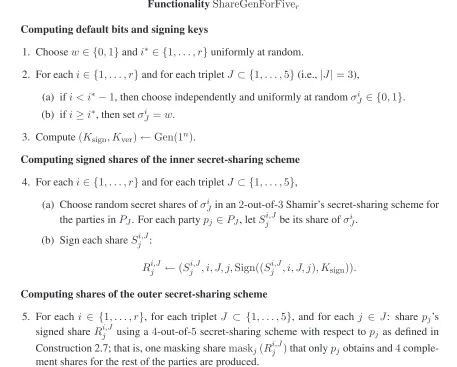
We eliminate the trusted on-line dealer in a few steps using a few layers of secret-sharing schemes. First, we change the on-line dealer, so that in each roundiit shares the bitσi
J among the parties in PJ using a 2-out-of-3secret-sharing scheme – calledinnersecret-sharing scheme. In fact, the dealer first signs the bit share to prevent cheating. The same requirements onσi
J as in the above protocol are preserved using this
inner secret-sharing scheme. That is, the adversary is able to obtain information onσi
J only if it controls
at least two of the parties inPJ. On the other hand, if the adversary does not control at least two parties in somePJ (i.e., there is an honest majority inPJ), then, in roundi, the honest parties can reconstructσi−J 1(if
so instructed by the protocol).
Next we turn the on-line dealer into an off-line dealer. That is, we show that it is possible for the dealer to only interact with the parties once, sending each party some input, so that thereafter, the parties interact in rounds (without the dealer) and in each roundieach party learns its shares in theith inner secret-sharing scheme. That is, in each roundi, each partypj learns a share ofσi
J in a2-out-of-3secret-sharing scheme,
for every tripletJ such thatj ∈ J. For this purpose, the dealer computes, in a preprocessing phase, the appropriate shares for the inner secret-sharing scheme. The shares of each round for each party pj are
then shared in a 2-out-of-2 secret-sharing scheme, where pj gets one of the two shares (this serves as a mask, allowing only pj to later reconstruct its shares of the appropriateσiJ’s while other shares are sent
on a broadcast channel). All parties exceptpj get shares in a3-out-of-4Shamir secret-sharing scheme of
the other share of the 2-out-of-2 secret sharing. See Construction 2.7 for a formal description. We call the resulting secret-sharing scheme theouterscheme.
The use of the4-out-of-5secret-sharing scheme plays a crucial role in eliminating the on-line dealer. It guarantees that an adversary, corrupting at most three parties, cannot reconstruct the shares of roundibefore roundi. However, if at least two parties do not reveal their shares, then they prevent a reconstruction of the outer scheme (this is why we cannot proceed after2parties aborted); in this case there is an honest majority. Hence, the protocol proceed normally as long as at least4parties are active. If, indeed, at least two parties abort (in roundi), then the remaining parties use their shares of the inner scheme to reconstruct the bitσJi−1
for the appropriate tripletJ.
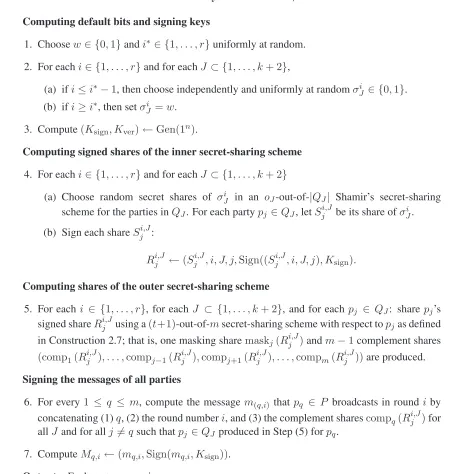
To prevent malicious parties from cheating, by say, sending false shares and causing reconstruction of wrong secrets, every message that a party should send during the execution of the protocol is signed in the preprocessing phase (together with the appropriate round number and with the party’s index). Furthermore, all shares in the inner secret-sharing scheme are signed (as they are used as messages if reconstruction is required). In addition, the dealer sends a verification key to each of the parties. To conclude, the off-line dealer gives each party the signed shares for the outer secret sharing scheme together with the verification key. A formal description of the functionality of the off-line dealer, calledShareGenForFiver, is given in
Figure 1. In order to simplify the presentation, we use slightly different notations compared to the notations used in the presentation of the general construction in Sections 4–6.
The protocol with the off-line dealer proceeds in rounds. In roundiof the protocol, all parties broadcast their (signed) shares in the outer (4-out-of-5) secret-sharing scheme. Thereafter, each party can unmask the message it receives (with its share in the appropriate2-out-of-2secret-sharing scheme) to obtain its signed shares in the2-out-of-3sharing of the bitsσi
J (for the appropriate tripletsJ’s to which the party belongs). If
a party stops broadcasting messages or broadcasts improperly signs messages, then all other parties consider it as aborted and will ignore all messages it will send in the future. If two or more parties abort, the remaining parties reconstruct the bit of the lexicographically first triplet that contains all of them, as described above. In the special case of premature termination already in the first round, the remaining parties engage in a fully secure protocol (with honest majority) to toss a completely random coin. In Figure 2 we formally define the 5-party coin-tossing protocol tolerating up-to 3 malicious parties.
Finally, we replace the off-line dealer by using a secure-with-abort protocol with cheat-detection com-puting the functionality computed by the dealer, that is, FunctionalityShareGenForFiver. Obtaining the
outputs of this computation, an adversary is unable to infer any information regarding the output of the coin-tossing protocol (as the functionality does not give any information to an adversary controlling at most 3 parties). The adversary, however, can prevent the execution, at the price of at least one malicious party being detected by all other parties. In such an event, the remaining parties will start over. This can go on at most twice, before there is a honest majority and a completely fair coin can be obtained. The details of this final step are given in Section 6.
The above construction can be generalized in a straightforward manner to any numbermof parties and any numbertof malicious parties such thatt < 2m/3(where there is a bit for every set Qof sizet; the outer secret-sharing is a(t+ 1)-out-of-mscheme and the inner secret-sharing scheme is(m−t)-out-of-t
FunctionalityShareGenForFiver
Computing default bits and signing keys
1. Choosew∈ {0,1}andi∗∈ {1, . . . , r}uniformly at random.
2. For eachi∈ {1, . . . , r}and for each tripletJ ⊂ {1, . . . ,5}(i.e.,|J|= 3),
(a) ifi < i∗−1, then choose independently and uniformly at randomσi
J ∈ {0,1}.
(b) ifi≥i∗, then setσi J =w.
3. Compute(Ksign, Kver)←Gen(1n).
Computing signed shares of the inner secret-sharing scheme
4. For eachi∈ {1, . . . , r}and for each tripletJ ⊂ {1, . . . ,5},
(a) Choose random secret shares ofσJi in an2-out-of-3Shamir’s secret-sharing scheme for the parties inPJ. For each partypj ∈PJ, letSji,J be its share ofσiJ.
(b) Sign each shareSji,J:
Ri,Jj ←(Sji,J, i, J, j,Sign((Sji,J, i, J, j), Ksign)).
Computing shares of the outer secret-sharing scheme
5. For each i ∈ {1, . . . , r}, for each tripletJ ⊂ {1, . . . ,5}, and for eachj ∈ J: sharepj’s
signed shareRi,Jj using a4-out-of-5secret-sharing scheme with respect to pj as defined in
Construction 2.7; that is, one masking sharemaskj(Ri,Jj )that onlypjobtains and4
comple-ment shares for the rest of the parties are produced.
Signing the messages of all parties
6. For every1≤q≤5, compute the messagem(q,i)thatpq ∈ {p1, . . . , p5}broadcasts in round
iby concatenating (1)q, (2) the round numberi, and (3) the complement sharescompq(Ri,Jj )
for all tripletsJ and for allj6=qsuch thatj ∈J produced in Step (5) forpq.
7. ComputeMq,i←(mq,i,Sign(mq,i, Ksign)).
Outputs:Each partypjreceives
• The verification keyKver.
• The messagesMj,1, . . . , Mj,r thatpjbroadcasts during the protocol.
• pj’s private masksmaskj(Rji,J)which were produced in Step (5) for each1 ≤i ≤r
and each tripletJ ⊂ {1, . . . ,5}such thatj ∈J.
A5-party protocolFivePartyCoinTossr
Joint input:Security parameter1n.
Preliminary phase:
• The parties engage in a secure-with-abort and cheat-detection protocol in order to computing the functionality ShareGenForFiver. If a single party aborts, then this phase is repeated.
This may happen at most twice before an honest majority is guaranteed. If at least two parties aborted (and detected), the parties use multiparty secure computation (with full security) to toss a fair coin, output this resulting bit, and halt.
In each roundi= 1, . . . , rdo:
1. Each active party pj ∈ {p1, . . . , p5}broadcastsM(j,i) (its share of thepq’s share of the bit
σi
J for each tripletJ ⊂ {1, . . . ,5}(i.e.,|J|= 3) and eachq∈J whereq6=j)
2. For each active partypj ∈ {p1, . . . , p5}, ifVer(M(j,i), Kver) = Failor ifpj broadcasts an
invalid or no message, then all parties markpjas inactive.
3. If at least2parties were marked inactive:
• Ifi = 1(i.e., the parties aborted during the first round), then the active parties use a multiparty secure protocol (with full security) to toss a fair coin, output this resulting bit, and halt.
• Otherwise, the active parties reconstruct the bitσJi−1 whereJ is the lexicographically first triplet that contains all the indices of the active parties, output it, and halt.
At the end of round r: Each active party pj broadcasts the signed share Rr,Jj , for each triplet
J ⊂ {1, . . . ,5}, such that,j∈J, in order to reconstructσr
J =w. All honest parties outputw.
this is done using a better way for distributing bits to subsets.
4 Our Main Construction
In Sections 4–6 we present our main result – a coin-tossing protocol that has nearly optimal bias and can tolerate up to2/3fraction of malicious parties. More specifically, we prove the following theorem:
Theorem 4. If enhanced trap-door permutations exist, then for anym,t, andr =r(n)such thatm/2 ≤
t < 2m/3, there is anr-roundm-party coin-tossing protocol tolerating up totmalicious parties that has biasO
³
22k+1/r0 ´
, wherek= 2t−mandr0 =r−O(k+ 1).
In the above theorem, kis the difference between the number of malicious parties and the number of honest parties, i.e.,k= t−(m−t) = 2t−m. For example, ift =m/2, then the number of honest and malicious parties are equal andk= 0,
Following [18], we describe our protocol in two steps. In Section 5, we describe ProtocolCTWithDr
that uses an online trusted party, called dealer. In Section 6, we get rid of the on-line dealer. This simplifies the description and understanding of our protocols. More importantly, we prove the security of our main protocol in a modular way. In Section 5, we prove
Theorem 5. ProtocolCTWithDris anr-roundm-party coin-tossing protocol with an on-line dealer tol-erating up totmalicious parties and has biasO
³ 22k+1
/r ´
.
We then consider the on-line dealer of ProtocolCTWithDras an ideal functionality. In this protocol,
the honest parties do not send any messages and in each round the dealer sends messages to the parties; we consider an interactive functionality sending the messages that the dealer sends. We prove
Theorem 6. Lett <2m/3. If enhanced trap-door permutations exist, then ProtocolCoinTossr0 presented
in Section 6, is a computationally-secure implementation (with full security) of the dealer functionality in ProtocolCTWithDr. ProtocolCoinTossr0 hasr0 =r+O(k+ 1)rounds.
Proof of Theorem 4. This theorem follows from Theorem 5 and Theorem 6 by the composition theorem of Canetti [7]: Consider the (ideal) functionalityFD of the dealer in Protocol CTWithDr. By Theorem 6,
ProtocolCTWithDr is a computationally-secure implementation ofFD (with full security). Consider the protocolΠFDwhich simply executes the functionalityF
D. By Theorem 5,ΠFDis a1/p-secure
implementa-tion ofCoinToss(). By the composition theorem of Canetti [7],ΠCTWithDr is a1/p-secure implementation
ofCoinToss().
We stress that constructing fair coin-tossing protocols assuming a trusted dealer is an easy task, e.g., the trusted party can choose a random bit and send it to each party. However, when considering a rushing adversary, one cannot eliminate the trusted party in this protocol. The coin-tossing protocol we describe, ProtocolCTWithDr, is designed such that it is possible to transform it to a protocol with no trusted party.
5 A Protocol with an On-Line Dealer
trusted partyT selects the prescribed output bitwand a special round numberi∗ uniformly at random. In
each round of interaction, the trusted partyT selects a bit for each subset in a predetermined collection (this collection is part of the design of the protocol). The bits of all subsets for any round before roundi∗ are
uniformly and independently chosen; the bits of all subsets for all rounds from roundi∗and on all equalw.
These bits are not given to honest parties. However, if the number of corrupted parties in a subsetQis larger than some predefined threshold, then the corrupted parties get the bit ofQ.
In the real world these bits are secret-shared. Since in the real world the adversary is rushing, the corrupted parties in the real world receive their shares before the honest parties do. Hence, in the protocol with the dealer, interaction between the parties andT in each round has three phases. In the first phase, for each subsetQthat contains enough malicious parties, the trusted party sends the bit of the subset to the malicious parties in the subsetQ. In the second phase, malicious parties may abort the computation (and by that prevent later reconstruction of some of the information). To do so, these parties send toT an “abort” message. Finally, in the third phase, a “proceed” message is sent to the parties (this can be considered as an “ideal” secret sharing).
The protocol proceeds normally as long as less thanm−tparties abort. If at mosttparties are active in roundi, the trusted party reveals the value of the bit of some subsetQin roundi−1, i.e.,σSi−1. The subset
Qis chosen in a way that guarantees that the adversary does not know the value of this bit before instructing parties to abort. Jumping ahead, in the real worldQwill also hold the additional property that the adversary cannot prevent the reconstruction of the bit ofQfrom roundi−1.
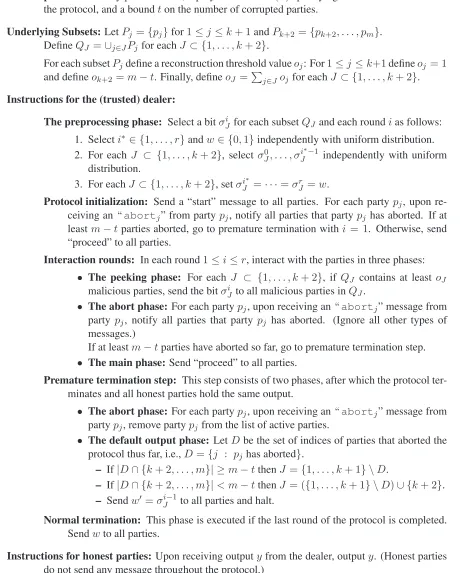
In order to simplify the presentation of this protocol, we assume that there are private channels between each party and the on-line dealer. The formal description of the protocol calledCTWithDr is given in
Figure 3. In Sections 5.1–5.2, we prove that ProtocolCTWithDr, described in Figure 3, is anO(22
k+1 /r) -secure protocol for computing theCoinToss()functionality. Our proof follows the real vs. ideal paradigm. We consider a malicious adversary A that corrupts at mostt < 2m/3 of the parties in an execution of ProtocolCTWithDr. In Section 5.1 we present a simulatorSthat corrupts the same subset of parties in the
ideal world with access to the trusted partyTCoinTossfor computing theCoinToss()functionality (that is,
TCoinTossgives the same uniformly chosen bit to all parties). The simulatorShas black-box access toAand at the end of the computation it outputs a view of the adversaryA. In Section 5.2 we bound the statistical distance between the random variable describing the view of the real-world adversaryAconcatenated with the output of the honest parties in the appropriate execution and the random variable describing the output of the simulatorSconcatenated with the bit selected by the ideal-world trusted party.
The bias of the protocol – an informal argument. We next informally explain why the protocol has small bias, that is, we give a sketch of the proof of Theorem 5. First, we claim that the adversary can bias the output only if the premature termination occurs in roundi∗:
1. If the premature termination occurs after roundi∗(or does not occur at all), then the output is already
fixed.
2. If the premature termination occurs before roundi∗, then the adversary does not know the random bit σJi−1, which is the output of the honest parties, as there are less thanoJ malicious parties inQJ (as
shown in the formal analysis of this event in Section 5.2).
Thus, the adversary can bias the output only if it guessesi∗. Ifσi
J 6= σiJ0 for two bits that the adversary gets from the trusted party, then it can learn thati < i∗. It can be shown that the adversary gets2k+1 such
bits (out of the2k+2 bits). With probability1/22k+1
Joint Input: The security parameter1n, a polynomialr =r(n)specifying the number of rounds in
the protocol, and a boundton the number of corrupted parties.
Underlying Subsets:LetPj ={pj}for1≤j≤k+ 1andPk+2 ={pk+2, . . . , pm}.
DefineQJ =∪j∈JPjfor eachJ ⊂ {1, . . . , k+ 2}.
For each subsetPjdefine a reconstruction threshold valueoj: For1≤j≤k+1defineoj = 1
and defineok+2=m−t. Finally, defineoJ =Pj∈Joj for eachJ ⊂ {1, . . . , k+ 2}.
Instructions for the (trusted) dealer:
The preprocessing phase: Select a bitσi
J for each subsetQJ and each roundias follows:
1. Selecti∗ ∈ {1, . . . , r}andw∈ {0,1}independently with uniform distribution.
2. For each J ⊂ {1, . . . , k+ 2}, select σJ0, . . . , σiJ∗−1 independently with uniform distribution.
3. For eachJ ⊂ {1, . . . , k+ 2}, setσi∗
J =· · ·=σrJ =w.
Protocol initialization: Send a “start” message to all parties. For each partypj, upon
re-ceiving an“abortj” from partypj, notify all parties that partypj has aborted. If at
leastm−tparties aborted, go to premature termination withi = 1. Otherwise, send “proceed” to all parties.
Interaction rounds: In each round1≤i≤r, interact with the parties in three phases:
• The peeking phase: For each J ⊂ {1, . . . , k+ 2}, if QJ contains at least oJ
malicious parties, send the bitσi
J to all malicious parties inQJ.
• The abort phase:For each partypj, upon receiving an“abortj” message from
partypj, notify all parties that party pj has aborted. (Ignore all other types of
messages.)
If at leastm−tparties have aborted so far, go to premature termination step.
• The main phase:Send “proceed” to all parties.
Premature termination step: This step consists of two phases, after which the protocol ter-minates and all honest parties hold the same output.
• The abort phase:For each partypj, upon receiving an“abortj” message from
partypj, remove partypj from the list of active parties.
• The default output phase:LetDbe the set of indices of parties that aborted the protocol thus far, i.e.,D={j : pj has aborted}.
– If|D∩ {k+ 2, . . . , m}| ≥m−tthenJ ={1, . . . , k+ 1} \D.
– If|D∩ {k+ 2, . . . , m}|< m−tthenJ = ({1, . . . , k+ 1} \D)∪ {k+ 2}.
– Sendw0 =σi−1
J to all parties and halt.
Normal termination: This phase is executed if the last round of the protocol is completed. Sendwto all parties.
Instructions for honest parties:Upon receiving outputyfrom the dealer, outputy. (Honest parties do not send any message throughout the protocol.)
the adversary cannot distinguish such round fromi∗. By [14, Lemma 2], this implies that the adversary can
guessi∗with probability at most22k+1
/r. Therefore, the bias isO(22k+1 /r).
5.1 The Simulator for the On-Line Dealer Protocol
We next describe the simulatorS for ProtocolCTWithDr. LetBbe the subset of corrupted parties in the execution. On input(1n,aux), the simulatorSobtainswS = CoinToss()from the trusted partyTCoinToss
(i.e.,wS is uniformly selected from{0,1}). The simulatorSinternally applyAwith input(1n,aux). The
simulatorSwill interact withAplaying the role ofT, by proceeding as follows:
Simulating the preprocessing phase: Sselects a bitσi
Jfor every subsetQJfor which the corrupted parties
getσi
J (i.e., for which|B∩QJ| ≥oJ), and every roundias follows:
1. Selectsi∗ ∈ {1, . . . , r}with uniform distribution.
2. For eachJ ⊂ {1, . . . , k+ 2}, the simulatorS selects uniformly and independently at random
σ1
J, . . . , σi
∗−1
J .
3. For eachJ ⊂ {1, . . . , k+ 2}, the simulatorS setsσi∗
J =. . .=σrJ =wS.
Simulating protocol initialization: S sends a “start” message to all corrupt parties (that is,S sends the messages for the corrupt parties to the adversaryA). For each partypj, upon receiving an“abortj”
message from partypj, the simulator notifies all corrupted parties that party pj has aborted. If at
leastm−tparties aborted, S setsi = 1and proceeds to simulate the premature termination step. Otherwise,S sends “proceed” to all corrupt parties.
Simulating interaction rounds: In each round1≤i≤r, the simulatorSinteracts with the corrupt parties, in three phases:
• The peeking phase: For each J ⊂ {1, . . . , k+ 2}, ifQJ contains at leastoJ corrupt parties,
thenSsends the bitσi
J to all corrupt parties inQJ (i.e., to the adversary).
• The abort phase:For each partypj, upon receiving an“abortj” message from partypj, the
simulator notifies all parties that partypj is inactive.
If at leastm−tparties have aborted so far,Ssimulates the premature termination step. • The main phase:S sends “proceed” to all parties.
Simulating the premature termination step: This round consists of two phases, after which the simula-tion terminates.
• The abort phase: For each party pj, upon receiving an “abortj” message from party pj, remove partypjfrom the list of active parties.
• The default output phase: Regardless of the subset of set of aborted parties, the simulator sendswSto all parties and halts the interaction withA.
Simulating normal termination: If the last round of the protocol is completed, thenS sends wS to all
parties.