Solution of Economic Load Dispatch Problem
using Hybrid Particle Swarm and Grey Wolf
Optimization Algorithm
Mahavir Kashyap1, Anant Thakur2
PG Student [PS], Department of Electrical and Electronics Engineering, IES College of Technology, Bhopal, India1 Department of Electrical and Electronics Engineering, IES College of Technology, Bhopal, India2
ABSTRACT:In this paper, a hybrid algorithm based on particle swarm optimization (PSO) and grey wolf optimization (GWO) algorithm is used to solve economic load dispatch problem (ELDP). PSO is an efficient algorithm but it lacks global exploration and are often trapped in local minima while GWO efficiently handles global exploration. A hybrid PSO-GWO is proposed where initial population is updated by PSO and the updated solutions are again updated by GWO. The proposed algorithm eradicates the disadvantages of PSO and at the same time utilizes the advantages of GWO algorithm. To test the efficiency of the proposed algorithm, two different cases of standard test systems with diverse number of generating units are considered. The ELDP with smooth and non-smooth cost characteristics (considering valve-point loading) are taken into account for all cases. To prove the supremacy of the proposed algorithm, a comparative assessment for all cases is carried out by comparing the proposed algorithm with GWO and PSO algorithm. The results obtained prove the superior and efficient performance of the proposed algorithm in solving ELDP.
KEYWORDS:Cost minimization;economic load dispatch; equality and inequality constraints; grey wolf optimization; particle swarm optimization; valve-point loading effects.
I.INTRODUCTION
Due to increasing power demand, the modern power systems are getting interconnected with each other [1]. In this interconnected power system, the vital task is to schedule the total load demand among available generating units in such a way that the total cost incurred is minimum after all system constraints satisfied [2]. The above stated process is considered as economic load dispatch problem (ELDP) in power system [3].
In the past, various conventional techniques are applied in order to solve ELDP using mathematical programming and conventional optimization methods. Some of these conventional techniques are the lambda iteration (LI) method [1], branch and bound technique (BBT)[4], gradient method [5] etc. Out of these methods, the LI method has been applied prominently because of its easy implementation. The feasibility of all above mentioned methods are only for linear cost estimation. In practical, the power system has many discontinuities and inherent nonlinearities due to prohibited operating zones (POZ) [6], ramp rate limits (RRL) [7], valve-point loading (VPL) [8], and multi fuel options. Owing to these inherent discontinuities and nonlinearities, ELDP, in practical, is converted into a complex and non-convex optimization problem having both complex as well as non-convex features. So, practical ELDP will come across multiple minima which pose difficulty in obtaining global optima. In this scenario, the conventional techniques fail to attain global optimum solution.
kinetic gas molecules optimization (KGMO) [20], exchange market algorithm (EMA) [21], back tracking search (BTS) algorithm [22] etc. A comprehensive literature survey of modern day evolutionary and swarm-based can be found in [23].
PSO is proposed in 1995 by Eberhart and Kennedy [24] and successfully applied to solve complex engineering problems. Mirjalili et al. in the year 2014 proposed GWO algorithm [25]. It is a meta-heuristic algorithm for global optimization. It was inspired by the hunting behaviour of grey wolves. A hybrid version of PSO and GWO algorithm is proposed in this study to solve practical ELDP with smooth and non-smooth cost characteristics satisfying different system constraints. The solution to the problem is carried out for system without transmission loss where two different standard test systems are considered. The results obtained from hybrid PSO-GWO are compared to the results obtained from GWO and PSO algorithm in order to test the supremacy and efficiency of the proposed algorithm.
The rest of the paper is organized as follows. Section II discusses the problem definitions. The proposed algorithm is described in section III. Section IV discusses the simulation results. The work is concluded in section V.
II.PROBLEM DEFINITION
A. Generator operating cost
The overall cost of operation of plants consists of fuel cost, labour cost, maintenance and supplies. In general way, the labour cost, maintenance and supply do not change. Thus, the fuel costs are always taken into consideration for ELD problem. The objective of economic load dispatch is to minimize the total generation cost (including fuel cost, plus emission cost, plus operation/maintenance cost, plus network loss cost) by meeting operational constraints. In practical cases, the formulation of fuel cost of generators is taken in the form of quadratic function of generated output real power. However, the cost characteristic can be classified on the basis of smooth and non-smooth nature as smooth cost characteristic and non-smooth characteristic curve.
1) Smooth cost function
It depicts the simplest cost function. It can be mathematically expressed as a quadratic function
2m m m m m m m
F P a P b P c (1)
where,am, bm and cm are the cost coefficients of mth generating unit. Pmis the generated power of the mth unit.
2) Non-smooth cost function
It involves numerous non-differentiable positions to show the VPL effects that are present in EDP. VPL effect is a process that appears in power plants that generally consist of multiple valves for controlling the output power of the units. The steam entering valves in thermal units are first opened, then there is a abrupt increase in losses which leads to the appearance of ripples in cost characteristics curve. It can be formed as a quadratic and a sinusoidal function:
2 sin
min
m m m m m m m m m m m
F P a P b P c e f P P (2)
where, em and fm are the fuel cost coefficients of the mth unit.
min
m
P is the minimum generation limit of the mth unit.
The total generation cost (in $/hr) of the plant is given as
1N
m m r
TC F P
(3)B. System Constraints
As it is stated before, the solution of ELD problem can be near to practical solution if the system constraints are satisfied. The system constraints are defined below.
1) Power balance constraint
The power generated has to be equal to the power demand required. It is defined as:
1
N
m D
r
P P
(4)where, PDis the total power demand.
2) Generator limit constraint
The generating units of thermal power plants operate within their limits.
min max
m m m
P P P (5)
where, min
m
P and max
m
P are the minimum and maximum generating limits of the mth generating unit.
III.PROPOSED ALGORITHM
A. Particle Swarm optimization
PSO was developed by James Kennedy and Russell Eberhart in 1995 [24]. The inspiration behind PSO is the bird flocking behaviour. It is a population based algorithm and is categorized in nature-inspired optimization algorithms. In PSO, the initial population is subjected to fitness evaluation and the best solution is regarded as pbest. The other solution try to update their position based on pbest with certain velocity. After, some iteration, the better values are stored in archive and regarded as gbest. From the knowledge of pbest and gbest, the solution are modified at each iteration until global optima is found. The particle updates its velocity and positions with following equations based on
pbest and gbest:
, , 1 () , , 2 () , ,
new
r j r j r j r j r j r j
v v c rand pbest x c rand gbest x (6)
where, ,
new r j
v is the updated velocity of the jth decision variable of the rth population. vr j, is the old velocity of the
th
j decision variable of the rth population. c1andc2 are the learning factors whose value is taken as 2. rand()is any
random number evenly distributed in the range
0,1
. pbestr j, andgbestr j, are the local and global best particle for jthdecision variable of the rth population. xr j, is the present value of the particle.
and
, , ,
new new
r j r j r j
x x v (7)
where, new, r j
x is the new particle that will take part in the next generation.
B. Grey wolf optimization
1) Social hierarchy
In the design of GWO, the social hierarchy of wolves is considered. Alpha () is the leader of the pack of wolves so it is equivalent to the best solution. Similarly, beta () and delta ( ) which comes after alpha are equivalent to second and third best values respectively. The rest of solutions are assigned to be omega ().
2) Encircling prey
The encircling of prey by grey wolves is accomplished during the hunt. This encircling behavior can be mathematically expressed as follows.
r
M NX t X t (8)
1
r
X t X t L M (9)
where, t is the current iteration, L and N are coefficient vectors, Xr
is the position vector of the prey (global
solution), and X is the position vector of a gray wolf. The vectors L and N are evaluated as follows.
1 2
L lrl (10)
2 2
N r (11)
where, components of l are linearly decreased from 2 to 0 according to iterations and r r1, 2 are random vectors in [0, 1].
3) Hunting
The hunting behavior is common in wolves. The hunt for a prey is initiated by alpha with the help of beta and delta wolves. The others wolves update their position accordingly. The update of their agent position can be formulated as follows.
1
M N X X
(12)
1
M N XX (13)
1
M N X X
(14)
1 1
X X L M
(15)
2 1
X XL M (16)
3 1
X X L M
(17)
1
1 2 33
X X X
X t
(18)
4) Attacking prey and search for prey (exploitation and exploration):
It has been seen that the ability of any wolves can be rated on the basis of type of prey hunted. That means, the ability of algorithm lies in finding the optimal solution. Since the value of l is decreased from 2 to 0, L is also decreased by. In other words, L is a random value in the interval [-2l, 2l]. When L 1, the prey has to be attacked by wolves. The
C. Hybrid PSO-GWOalgorithm
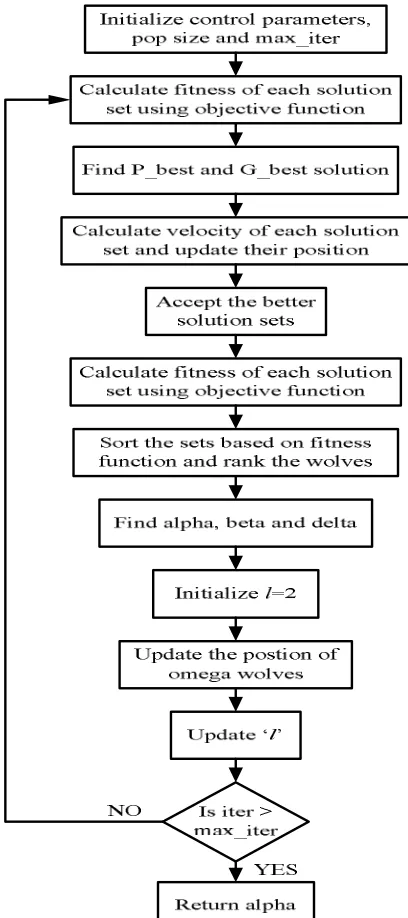
The proposed hybrid PSO-GWO algorithm is formed by hybridization of basic PSO and GWO algorithm. The advantage of this hybridization is to eradicate the disadvantage associated with basic PSO algorithm and to use the advantage of GWO algorithm. The hybridized algorithm starts with the random initialization of the population. Then, the population is updated by the PSO algorithm and the better solution is selected. The selected solution are then fine-tuned and updated by then GWO algorithm. The better solution are selected and fed to the next iteration. This process is repeated until any termination criterion is met. The flowchart of proposed hybrid PSO-GWO algorithm is presented in Fig. 1.
D. Implementation of hybrid PSO-GWO algorithm to ELDP
Step 1: Read system data. Input population size and maximum iteration.
Step 2: Initialize random population Xof generated power of the units within their limits using following for each solution.
min max min
()
m m m m
P P rand P P (19)
The resultant initial population Xwill be as follows.
11 1
1
POP POP
N
N N N
P P
X
P P
(20)
where, POP
N is the population and Nis the number of units.
Step 3: Evaluate fitness function for each solution in the population using (3).
Step 4: Select pbest and gbest solutions.
Step 5: Update the velocity and position of the solution using (6)and (7), respectively.
Step 6: Select better solutions and evaluate objective function.
Step 4: Sort the solutions based on evaluated objective function and rank the dispatch solution.
Step 5: Determine alpha, beta and delta dispatch solution.
Step 6: Initialize l2 and obtain L.
Step 7: Update each solution using (18) depending upon the value of L.
Step 8: Select the better solution based on fitness function evaluation.
Step 9: Update l.
Step 10: Repeat steps 3 to 9 until any termination criteria is met.
IV. SIMULATION RESULTS AND DISCUSSION
In this paper, hybrid PSO-GWO algorithm is proposed to solve a non-convex ELDP neglecting transmission line losses. Throughout the study, a population size of 20 is considered while maximum iteration is taken to be 500. Two standard IEEE test systems of 3 generators and 13 generators with and without VPL are considered for the simulation and the results so obtained from the proposed algorithm are compared with PSO and GWO. The system data are taken from [26]. The social learning factors c1 and c2 are taken to be 2 and 2, respectively whereas inertia weight wis
considered to be 0.9 for PSO algorithm. All simulation studies are studied in MATLAB environment.
A. A three generator system
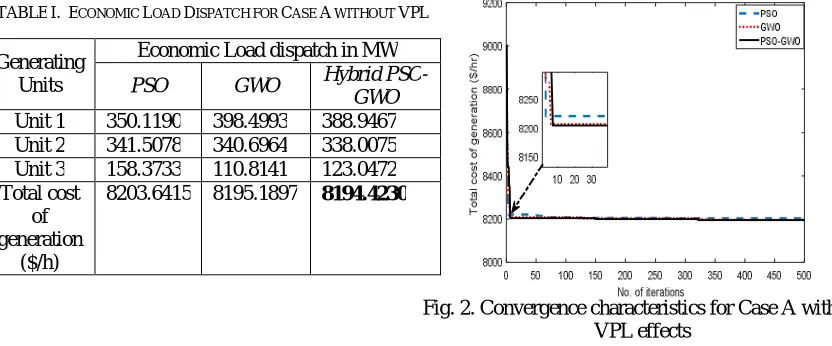
Fig. 2. Convergence characteristics for Case A without VPL effects
.
When the non-smooth nature of the cost is considered, the total cost of generation is ought to increase. Table II shows the comparative results obtained for ELD for the system considering the VPL effects with transmission losses neglected. From the table, it can be inferred that the minimum total cost of generation i.e. 8234.2826 $/h is obtained with hybrid PSO-GWO while GWO is incurring 8243.1671 $/h and PSO is incurring 8417.6868 $/h. This suggests that hybrid PSO-GWO is more superior to PSO and GWO in obtaining optimal power dispatch. Also in this case, it can be seen that the total cost of generation is increased with the inclusion of VPL effects in the problem. Fig. 3 shows the convergence characteristics of total generation cost. From the figure, it can be observed that hybrid PSO-GWO converges to minimum value faster in comparison to PSO and GWO.
Fig. 3. Convergence characteristics for Case A with VPL effects.
B. A thirteen generator system
In this system, the total load demand is 1800 MW. Table III lists the ELD for the system without considering transmission losses and the VPL effects. The results obtained from hybrid PSO-GWO are compared with PSO and GWO in this case also. From this table, it can be clearly observed that the minimum total cost of generation i.e. 17936.1918 $/h is obtained with hybrid PSO-GWO while GWO is incurring 17972.8078 $/h and PSO is incurring 17987.1516 $/h. This suggests that hybrid PSO-GWO is more superior to PSO and GWO in obtaining optimal power dispatch. Fig. 4 shows the convergence characteristics of the algorithms for the taken system. From the figure, it can be inferred that the convergence rate of hybrid PSO-GWO is higher in comparison to PSO and GWO.
TABLEII. ECONOMIC LOAD DISPATCH FOR CASE A WITH VPL Generating
Units
Economic Load dispatch in MW
PSO GWO Hybrid PSO-GWO
Unit 1 299.5854 499.6636 299.7240
Unit 2 350.8043 250.4032 400.1770
Unit 3 199.6103 99.9690 150.1042
Total cost of generation
($/h)
8417.6868 8243.1671 8234.2826
TABLEI. ECONOMIC LOAD DISPATCH FOR CASE A WITHOUT VPL Generating
Units
Economic Load dispatch in MW
PSO GWO Hybrid PSO-GWO
Unit 1 350.1190 398.4993 388.9467
Unit 2 341.5078 340.6964 338.0075
Unit 3 158.3733 110.8141 123.0472
Total cost of generation
($/h)
Fig. 4. Convergence characteristics for Case B without VPL effects.
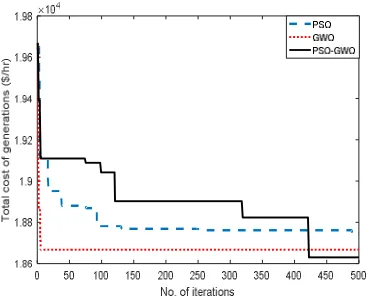
When the non-smooth nature of the cost is considered, the total cost of generation is ought to increase. Table IV shows the comparative results obtained for optimal power dispatch for the system considering the VPL effects with transmission losses neglected. From the table, it can be inferred that the minimum total cost of generation i.e. 18630.7654 $/h is obtained with hybrid PSO-GWO while GWO is incurring 18667.2100 $/h and PSO is incurring 18740.3033 $/h. This suggests that hybrid PSO-GWO is more superior to PSO and GWO in obtaining optimal power dispatch. Also in this case, it can be seen that the total cost of generation is increased with the inclusion of VPL effects in the problem. Fig. 5 shows the convergence characteristics of the algorithms for the studied system. From the figure, it can be observed that hybrid PSO-GWO converges to minimum value faster in comparison to PSO and GWO which again confirms the superior performance of the proposed algorithm over other.
Fig. 5. Convergence characteristics for Case B with VPL effects.
V.CONCLUSION
In this work, a non-convex ELDP is solved with a novel proposed algorithm. The proposed algorithm is a hybrid version of particle swarm and grey wolf optimization. In PSO, the local search exploration was not that much convincing and it is often subjected to local minima trappings. However, GWO is found to be very much capable of
TABLEIV.ECONOMIC LOAD DISPATCH FOR CASE B WITH VPL Generating
Units
Economic Load dispatch in MW
PSO GWO Hybrid PSO-GWO
Unit 1 658.4667 324.2137 407.8611 Unit 2 47.1279 213.2025 250.8120 Unit 3 157.7738 332.9281 79.5851 Unit 4 77.0871 153.5162 168.1617 Unit 5 91.5161 105.6721 163.1247 Unit 6 120.0854 110.0197 67.8759 Unit 7 92.5560 60.0000 141.4854 Unit 8 138.6376 103.7928 78.1028 Unit 9 95.8549 60.0000 117.5905 Unit 10 70.9015 103.0895 38.1364 Unit 11 94.1169 40.0000 86.7132 Unit 12 62.8156 112.4845 102.2184 Unit 13 94.4486 83.6138 102.8422 Total cost of
generation ($/h)
18740.3033 18667.2100 18630.7654
TABLEIII.ECONOMIC LOAD DISPATCH FOR CASE B WITHOUT VPL Generating
Units
Economic Load dispatch in MW
PSO GWO Hybrid PSO-GWO
Unit 1 453.8478 630.4293 512.6230 Unit 2 143.8530 53.0428 255.5768 Unit 3 236.0105 280.1076 218.9758 Unit 4 120.1254 93.4711 102.4349 Unit 5 126.0762 99.2055 125.4245 Unit 6 126.5154 129.0343 106.0419 Unit 7 102.8327 87.6559 96.2335 Unit 8 100.3922 98.5773 91.9451 Unit 9 133.3605 123.6202 101.7415 Unit 10 46.4585 48.0685 37.5856 Unit 11 79.5560 41.7148 40.0000 Unit 12 73.9108 59.9395 56.4998 Unit 13 57.0648 55.1975 55.0000 Total cost of
generation ($/h)
local and global explorations. Thus, hybrid PSO-GWO algorithm is proposed by combining the two algorithms. To prove the efficiency of the proposed algorithm, two different cases of IEEE standard generator system with and without VPL effects are considered and the proposed algorithm is compared with GWO and PSO. The main conclusions are: (i) the hybridization of PSO and GWO enhances the local search exploration capability of the algorithm, (ii) The convergence rate of the algorithm is higher for hybrid GWO in comparison to GWO and PSO, (iii) hybrid PSO-GWO is well efficient in solving the ELD problem, since in all cases; the minimum total cost of generation is obtained from this algorithm, (iv) PSO algorithm is found to be the worst performer in comparison to others, and (v) the performance of hybrid PSO-GWO is not affected from the change in test systems.
REFERENCES
[1] A. J. Wood and B. F. Wollenberg, Power generation, operation, and control. John Wiley & Sons, 2012. [2] P. Kundur, N. J. Balu, and M. G. Lauby, Power system stability and control. McGraw-hill New York, 1994. [3] D. P. Kothari and I. Nagrath, Modern power system analysis. Tata McGraw-Hill Education, 2011.
[4] C.-L. Chen and S.-C. Wang, "Branch-and-bound scheduling for thermal generating units," IEEE transactions on energy conversion, vol. 8, no. 2, pp. 184-189, 1993.
[5] D. P. Kothari and I. Nagrath, Modern power system analysis. Tata McGraw-Hill Education, 2003.
[6] S. Orero and M. Irving, "Economic dispatch of generators with prohibited operating zones: a genetic algorithm approach," IEE Proceedings-Generation, Transmission and Distribution, vol. 143, no. 6, pp. 529-534, 1996.
[7] C. Wang and S. Shahidehpour, "Effects of ramp-rate limits on unit commitment and economic dispatch," IEEE Transactions on Power Systems, vol. 8, no. 3, pp. 1341-1350, 1993.
[8] A. Bhattacharya and P. K. Chattopadhyay, "Hybrid differential evolution with biogeography-based optimization for solution of economic load dispatch," IEEE Transactions on Power Systems, vol. 25, no. 4, pp. 1955-1964, 2010.
[9] Z.-X. Liang and J. D. Glover, "A zoom feature for a dynamic programming solution to economic dispatch including transmission losses," IEEE Transactions on Power Systems, vol. 7, no. 2, pp. 544-550, 1992.
[10] H.-T. Yang, P.-C. Yang, and C.-L. Huang, "Evolutionary programming based economic dispatch for units with non-smooth fuel cost functions," IEEE Transactions on Power Systems, vol. 11, no. 1, pp. 112-118, 1996.
[11] D. C. Walters and G. B. Sheble, "Genetic algorithm solution of economic dispatch with valve point loading," IEEE Transactions on Power Systems, vol. 8, no. 3, pp. 1325-1332, 1993.
[12] W.-M. Lin, F.-S. Cheng, and M.-T. Tsay, "An improved tabu search for economic dispatch with multiple minima," IEEE Transactions on Power Systems, vol. 17, no. 1, pp. 108-112, 2002.
[13] J.-B. Park, K.-S. Lee, J.-R. Shin, and K. Y. Lee, "A particle swarm optimization for economic dispatch with nonsmooth cost functions," IEEE Transactions on Power Systems, vol. 20, no. 1, pp. 34-42, 2005.
[14] K. Wong and C. Fung, "Simulated annealing based economic dispatch algorithm," in IEE proceedings C (generation, transmission and distribution), 1993, vol. 140, pp. 509-515: IET.
[15] N. Noman and H. Iba, "Differential evolution for economic load dispatch problems," Electric Power Systems Research, vol. 78, no. 8, pp. 1322-1331, 2008.
[16] S. Biswal, A. Barisal, A. Behera, and T. Prakash, "Optimal power dispatch using BAT algorithm," in Energy Efficient Technologies for Sustainability (ICEETS), 2013 International Conference on, 2013, pp. 1018-1023: IEEE.
[17] S. Hemamalini and S. P. Simon, "Artificial bee colony algorithm for economic load dispatch problem with non-smooth cost functions," Electric Power Components and Systems, vol. 38, no. 7, pp. 786-803, 2010.
[18] M. Pradhan, P. K. Roy, and T. Pal, "Grey wolf optimization applied to economic load dispatch problems," International Journal of Electrical Power & Energy Systems, vol. 83, pp. 325-334, 2016.
[19] M. Basu and A. Chowdhury, "Cuckoo search algorithm for economic dispatch," Energy, vol. 60, pp. 99-108, 2013.
[20] M. Basu, "Kinetic gas molecule optimization for nonconvex economic dispatch problem," International Journal of Electrical Power & Energy Systems, vol. 80, pp. 325-332, 2016.
[21] N. Ghorbani and E. Babaei, "Exchange market algorithm for economic load dispatch," International Journal of Electrical Power & Energy Systems, vol. 75, pp. 19-27, 2016.
[22] M. Modiri-Delshad, S. H. A. Kaboli, E. Taslimi-Renani, and N. A. Rahim, "Backtracking search algorithm for solving economic dispatch problems with valve-point effects and multiple fuel options," Energy, vol. 116, pp. 637-649, 2016.
[23] N. Sinha, R. Chakrabarti, and P. Chattopadhyay, "Evolutionary programming techniques for economic load dispatch," IEEE Transactions on evolutionary computation, vol. 7, no. 1, pp. 83-94, 2003.
[24] R. Eberhart and J. Kennedy, "A new optimizer using particle swarm theory," in Micro Machine and Human Science, 1995. MHS'95., Proceedings of the Sixth International Symposium on, 1995, pp. 39-43: IEEE.
[25] S. Mirjalili, S. M. Mirjalili, and A. Lewis, "Grey wolf optimizer," Advances in Engineering Software, vol. 69, pp. 46-61, 2014.