An Improved Content Based Image Retrieval
Using A Multi-Scale Saliency Model
Gaurav Mandloi1 , Prof. Abhishek Raghuvanshi2,
1
PG Scholar, 2
Associate Professor & Head,
1,2
Department of Information Technology, Mahakal Institute Of Technology Behind Air Strip, Dewas Road Ujjain(M.P)-456001
Abstract— The data retrieval process needs a storage and search methodology to find the data according to the query inputs. The presented work is focused on the image data retrieval using the query inputs. There are two different kinds of input are frequently used for image search namely text or images. But the text query can be misguiding the search outcomes and search process but the query by image can be used for accurate data identification. Therefore the content based image retrieval technique is proposed for study using the image query inputs. The proposed content based image retrieval process need to identify the image contents using their valuable features by which the image and their properties. Therefore the image contents are evaluated using the edge histogram for shape feature extraction, grid color movement analysis is performed for color feature evaluation and the local binary pattern is estimated for texture analysis. These features are normalized and stored for extraction of image. Therefore the query image is also extracted for comparison and accurate image extraction. But for enhancing more the multi-scale saliency feature is also used with the feature extraction. These features are help to identify the image groups by which the noisy images are separated and only the good images are considered for image comparison and extraction. Additionally that features also helps to improve the time and space complexity by reducing the number of comparison during the KNN based images search. The implementation of the proposed technique is performed using JAVA technology and their performance is evaluated in different performance parameters i.e. precision, recall, f-measures, time complexity, and space complexity. The obtained performance of the system shows the improved outcomes and accurate image retrieval as described in the query image.
Keywords— image retrieval, multi-scale saliency model, content based image analysis, feature extraction, implementation
I.
I
NTRODUCTIONIn content based image retrieval techniques the term “Content-based" means the search made by analysing the contents of stored images in database rather than their associated text i.e. keywords, or other kind of descriptors. In this context the content may refers to colors, shapes, and textures features. Additionally, that can also include any other information that derived from image can be used as content of the image. The key reason behind development of CBIR is the limitation of text based image retrieval systems. Textual information about images can be easily
searched using various existing technology, but this requires huge human efforts to describe image and their contents. Additionally due to lingual issues such as use of different words in different regions for description can also affect the performance of image search. Therefore search by text in image context is not much suitable.
Therefore in this presented work, the image search is performed using the query by image, and by the content based analysis of image data. The key reason behind to use the query by image is that an image describes better, their own content as compared to the descriptor or keyword. Thus first of all query image is produced over the retrieval system and their content features i.e. shape using edge detection technique, color using color movement technique and texture using the available binary pattern is estimated. In addition of for defining the domain of the given images the saliency features of the images are also recovered. By using these features the similar feature images are extracted from the data base.
During the entire process the a significant amount of time complexity is required, thus in order to reduce the complexity of the retrieval system the implementation of the system is given in two major modules. In first the training process is performed in this process during the storage of images the features of images are evaluated and preserve the images with their feature vectors. On the other hand during retrieval of images only the query image features are evaluated and compared with the target images. This process reduces the time and space complexity effectively. Thus the following steps of work are included with the proposed work.
The key aim of the proposed work is to enhance the image retrieval technique by enhancing the feature extraction form color images thus in order to make a positive effort on the image retrieval the following task are involved in the proposed work.
2. Study of different feature extraction techniques:
in this phase the different image feature extraction techniques are studied by which the image contents are identified more accurately.
3. Design and implementation of the enhanced image retrieval technique: in this phase a new technique of image retrieval by identifying the effective parameters are developed and designed. 4. Performance study of the proposed image
retrieval technique: in this phase the performance of the proposed approach is evaluated in terms of time and space complexity. In addition of the proposed model is also evaluated for finding the relevancy of image search thus precision, recall and f-measure is computed.
This section provides the basic overview of the proposed work and the next section includes the proposed methodology of the system design.
II.
P
ROPOSEDW
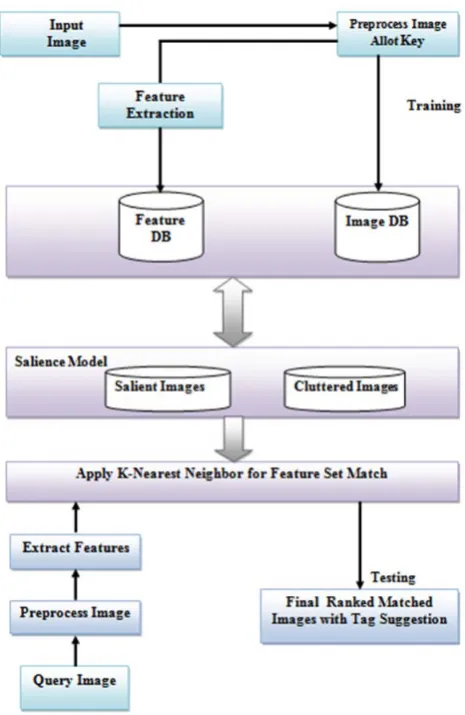
ORKThe proposed methodology for finding the accurate image retrieval using query by image process is demonstrated in figure 1. In this diagram the two different processes first named as training and then searching of image is demonstrated. During the training process the image data is preserved in data with their unique identity and evaluated features, and in next phase the search operation is reported, where the user provide the input query as image and system perform the search or retrieval based on the previously evaluated properties.
Input image: during training the system need some images on the database, therefore to store and manage huge amount of images in database the user provide image to store them in the system defined manner. Here the input image is provided by the users which further processed for store and retrieve them efficiently and accurately from the database.
Pre-process image and allot a key: in further processes the images are identified using their unique identity thus in this phase the image is prepared for utilization of image thus the images are trimmed and a unique identifier is assigned to each input image.
Feature extraction: the images are representation of real word objects and data using the mathematical models or a matrix of numerical data known as pixels. For retrieving the images from the database according to the objects available in the image that is required to identify the image features from the content of image. Thus here the image features are extracted namely shape, color and texture. In order to estimate the edge or shape feature from image the edge histogram technique is utilized, further for the obtaining the color features from image the color grid movement is analysed. And finally for extracting the image texture features from the target image the local binary pattern is used.
Figure 1 Proposed System
Feature database: the extracted image features are required to store in the data base for with their assigned identity. Therefore first the extracted features of image are normalized and then after stored in the feature database with their assigned identity as follows:
For example the input image is evaluated using three different feature extraction techniques namely edge features, color features and the texture, and their features are ,
and . For normalized image the image is defined as
, +
Image database: that is storage of image which contains just images with their newly assigned ID.
Image refinement: the stored images and their features stored in the database and further the images are refined in two major groups:
Salience image Cluttered images
Query image: the search or retrieval of image required to provide a query to the search interface for process the query using the developed methodology of retrieval and extract the relevant images as defined in the query image. Therefore user provides a query image to the system for making search over the system.
Extract features: after pre-processing of image and for identifying the available features or properties in image features namely shape, color and texture is evaluated and normalized features are prepared.
Apply KNN: the normalized feature of the query image is now used to make comparison with the stored features in the database. Thus the query features are compared using the KNN technique for retrieving the similar feature images using the Euclidean distance.
Ranked results: finally the extracted features based images are ranked according to the Euclidean distance outcomes and provided as the results or the search outcomes.
In this section the primary effort is made to prepare the complete methodology for making accurate search over the image databases.
The proposed technique is previously defined in two different phases and in this section the summarized step of data evaluation retrieval is reported.
Input: input image I and the query image Q Output: list of images Ls
Process:
1.
Read image I2.
Pre_process_image(I);3.
_4.
_ _5.
_ _6.
_7.
_ _ ,8.
9.
Pre_process_image(Q);10.
_11.
_ _12.
_ _13.
_14.
Euclidean distance _ , _
15.
0.2516.
Add to results list17.
Else18.
Return19.
End if20.
Return results listIn this section the methodology and algorithm is presented in detail and in next section the performance analysis of the system is provided.
III.
P
ERFORMANCE ANALYSISThe implemented enhanced image retrieval technique is evaluated on the basis of the different experimental scenarios and different sets of data. The evaluated performance of the obtained system is described in this chapter with their evaluation and outcomes.
A. Precision
In any data retrieval or search applications the precision is a fraction of search results which is most relevant to the input query.
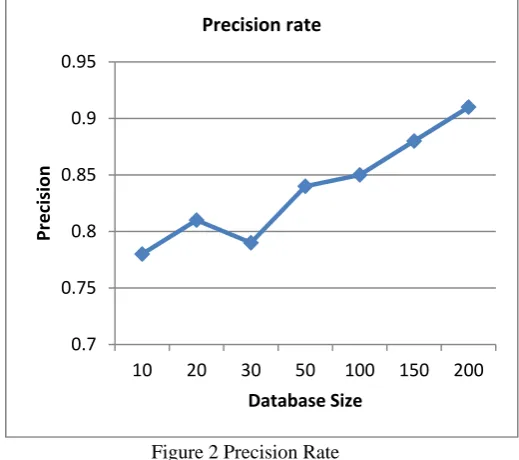
Figure 2 Precision Rate
The provided precision of the proposed content based image retrieval system are given using figure 2. This can be evaluated using the user feedback basis and can be evaluated by the following formula.
∩
The precision rate of the implemented system is described in the figure 2, the computed precision values are demonstrated using the Y axis of the given figure and the X axis of the figure shows the amount of training images in the database. According to the obtained results the performance of the proposed system is increases as the amount of data in database is increases. In addition of the precision rate is growing continuously as the similar kinds of images are also increases in data base.
B. Recall
In data retrieval application or the search application recall values are measured for accuracy measurement in terms of relevant document retrieved or relevant data obtained according to the input user query. This can be evaluated using the following formula.
∩
The figure 3 shows the recall values of the proposed image retrieval application. In order to represent the performance of the proposed image retrieval system the X axis contains the amount of images in database and the Y axis reports the obtained recall rate of the implemented system. According to the obtained results the performance of the proposed system is enhances as the amount of data is increases in the database. The retrieval accuracy with the increasing amount of data is also increases thus the proposed concept is adoptable for the image search applications.
0.7 0.75 0.8 0.85 0.9 0.95
10 20 30 50 100 150 200
Precision
Database Size
Figure 3 Recall Rate
C. F-measures
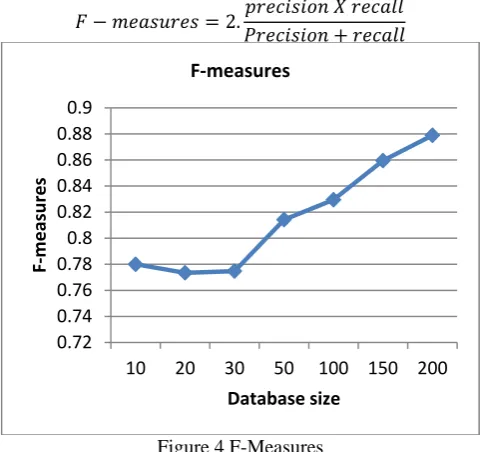
The f-measures of the system demonstrate the fluctuation in the computed performance in terms of precision and recall rates. The f-measures of the system can be approximated using the following formula.
2.
Figure 4 F-Measures
The figure 4 shows the performance of the system in terms of f-measures. To demonstrate the performance of the system the X axis shows the amount of data is placed in storage during experiments and the Y axis shows the obtained performance in terms of f-measures. According to the obtained results the performance of the system is much stable and enhancing in progressive manner as the amount of data base is increases. Thus the obtained results are adoptable and efficient for the image retrieval applications.
D. Memory used
The memory used sometimes also called the memory consumption or the space complexity. That amount of main memory required to execute a given algorithm with the amount of data is known as the memory consumption or
space complexity of algorithm. The figure 5 shows the performance of the system in terms of space complexity, in this diagram the X axis shows the amount of data available in data base and the Y axis shows the amount of memory consumed in terms of KB (kilo bytes). According to the obtained results the performance of the system becomes consistent and not consuming more memory even when the amount of data to be process is increases in the database but that produces a small amount of effect in memory consumption.
Figure 5 Space Complexity
D. Time consumption
The amount of time required to complete the retrieval task after providing input to the system is termed as time consumption of the algorithm. The time consumption of the proposed technique is given using figure 6. According to the demonstrated results the X axis contains the amount of images available in the database and the Y axis shows the amount of time consumed during the retrieval process in terms of milliseconds. According to the obtained results the performance of the system is fluctuating with the amount of data produced in the data base thus as the amount of data is increases the amount of comparison time is increases. therefore the outcomes of the retrieval system takes long time as the amount of data in database is increases.
Figure 6 Time Complexity
0.68 0.7 0.72 0.74 0.76 0.78 0.8 0.82 0.84 0.86
10 20 30 50 100 150 200
Recall
Rate
Database size
Recall
0.72 0.74 0.76 0.78 0.8 0.82 0.84 0.86 0.88 0.9
10 20 30 50 100 150 200
F
‐
measures
Database size
F‐measures
26000 27000 28000 29000 30000 31000 32000 33000
10 20 30 50 100 150 200
Memory
in
KB
Dataset Size
Space complexity
0 5 10 15 20
10 20 30 50 100 150 200
Time
in
MS
Database size
IV.
C
ONCLUSIONSThe implementation of the proposed image retrieval system using the saliency feature extraction for query by image technique is performed successfully. Additionally their performance is also evaluated based on their experimentations some facts are concluded that are reported in this chapter. Furthermore the future extension of the work is also included.
A. Conclusion
In this era of technology the need of data and computation is increases continuously. Each and every hand is mounted with the new generation gadgets and smart devices. Additionally these devices are internet enabled thus user continuously search data from the internet and other sources of data. Due to this the need of multimedia contents i.e. image and video contents are also increases by these users. There are two kinds of methods are popular for making search text based techniques and content based techniques. The text based techniques are working on the basis of text and description associated with these multimedia data but the content based techniques are finding the contents that are actually hidden in the multimedia data. Therefore the content based techniques are much effective then the text based techniques.
In this presented work the content based technique is studied in detail and using the available image features i.e. shape, texture and color distribution the images are searched. In addition of that for improving the quality of image search the method is extended with the saliency features computation. That technique helps to group the similar image contents in a group, in addition of the proposed technique is works on the basis query by image technique thus that make more promising outcomes from the retrieval.
The implementation of the proposed technique is performed by the JAVA based technology and their performances in different performance parameters are evaluated. These performance parameters and obtained outcomes are summarized using the given table 1.
S. No. Parameters Remark
1 Precision
The obtained precision rate is effective and improving as the amount of data is increases in database
2 Recall
The recall rate is also improving with the amount of data in database
3 f-measures
That provides the much stable rate of increment thus the performance of the proposed technique is stable and less fluctuating
4 Space complexity
The space complexity is not much fluctuating and also not much affected by the amount of data to be process
5 Time complexity
Time complexity is effectively increases with the amount of data to be compare
Table 1 Performance Summary
According to the obtained results the performance and relevancy of the proposed technique is adoptable due to less fluctuating accuracy in terms of precision, recall and f-measures. Additionally the method produces the less time and space complexity.
B. Future work
The proposed technique is implemented successfully and their performance in different parameters are estimated, according to results the performance of the proposed technique is adoptable and efficient thus the following expected extensions are possible with the proposed method extension.
1. The computational complexity in terms of time complexity is required to enhance because the time complexity of the system is increases with the amount of data
2. The presented work is only works for the image based query for similarity computation that can also be implemented for text based query processing
The method can also be extended with the semantic annotation based techniques for improving the image retrieval performance for text based processing.
R
EFERENCES[1] Jun Huang, Xiaokang Yang, Xiangzhong Fang, Weiyao Lin, and Rui Zhang, “Integrating Visual Saliency and Consistency for Re-Ranking Image Search Results”, IEEE TRANSACTIONS ON MULTIMEDIA, VOL. 13, NO. 4, AUGUST 2011
[2] Minsu Cho, Jungmin Lee, and Kyoung Mu Lee,“Reweighted Random Walks for Graph Matching”, Computer Vision–ECCV 2010, 2010 – Springer
[3] Priti Maheswary, Dr. Namita Srivastava, “Retrieval of Remote Sensing Images Using Colour & Texture Attribute”,(IJCSIS) International Journal of Computer Science and Information Security,Vol. 4,No. 1&2, 2009
[4] S. Oraintara, T. T. Nguyen, “Using Phase and Magnitude Information of the Complex directional Filter Bank for Texture Image Retrieval”, IEEE International Conference on Image Processing, Vol. 4, Pages 61-64, Oct. 2007
[5] P. S. Hiremath and Jagadeesh Pujari. “Content Based Image Retrieval based on Color, Texture and Shape features using Image and its complement”, International Journal of Computer Science and Security, Volume (1) : Issue (4)
[6] Philipp Sandhaus, Mohammad Rabbath, and Susanne Boll,“Employing Aesthetic Principles for Automatic PhotoBook Layout”,Advances in Multimedia Modeling, 2011 – Springer [7] Michele Saad, “Low-Level Color and Texture Feature Extraction
for Content-Based Image Retrieval”, Final Project Report, EE 381K: Multi-Dimensional Digital Signal Processing, Pages: 20-28, May 2008
[8] Ji Wan, Dayong Wang, Steven C.H. Hoi, Pengcheng Wu, Jianke Zhu, Yongdong Zhang, Jintao Li, “Deep Learning for Content-Based Image Retrieval: A Comprehensive Study”, Copyright 2014 ACM 978-1-4503-3063-3/14/11
[9] Kai Chen and Jean Hennebert, “Content-Based Image Retrieval with LIRe and SURF on a Smartphone-Based Product Image Database”, MCPR 2014, LNCS 8495, pp. 231–240, 2014 c Springer International Publishing Switzerland 2014
[10] Satish Tunga, D. Jayadevappa & C. Gururaj, “A Comparative Study of Content Based Image Retrieval Trends and Approaches”, International Journal of Image Processing (IJIP), Volume (9) : Issue (3) : 2015
[11] Sandeep Singh, Er.Rachna Rajput, “Content Based Image Retrieval using SVM, NN and KNN Classification”, International Journal of Advanced Research in Computer and Communication Engineering Vol. 4, Issue 6, June 2015
cloud data center”, State Key Laboratory of Networking and Switching Technology, Beijing University of Posts and Telecommunications, P.O. Box 296, Beijing 100876, China
[13] Hanwang Zhang, Zheng-Jun Zha, Yang Yang, Shuizheng Yan, Yue Gao, and Tat-Seng Chua, “Attribute-Augmented Semantic Hierarchy: Towards a Unified Framework for Content-Based Image Retrieval”, ACM Trans. Multimedia Comput. Commun. Appl. 11, 1s, Article 21 (September 2014), 21 pages.
[14] Sunkari Madhu, “Content based Image Retrieval: A Quantitative Comparison between Query by Color and Query by Texture”, Journal of Industrial and Intelligent Information Vol. 2, No. 2, June 2014
[15] Xiaofan Zhang, Wei Liu, Murat Dundar, Sunil Badve, and Shaoting Zhang, “Towards Large-Scale Histopathological Image Analysis: Hashing-Based Image Retrieval”, IEEE Transactions On Medical Imaging, Vol. 34, No. 2, February 2015
[16] Ashwani Kr. Yadav, R. Roy, Vaishali and Archek Praveen Kumar, “Survey on Content-based Image Retrieval and Texture Analysis with Applications”, International Journal of Signal Processing, Image Processing and Pattern Recognition Vol. 7, No. 6 (2014), pp. 41-50
[17] Romain Negrel, David Picard, Philippe-Henri Gosselin, “Dimensionality Reduction of Visual Features Using Sparse
Projectors For Content-Based Image Retrieval”, IEEE International Conference on Image Processing, Oct 2014, Paris, France. pp.2192-2196.
[18] Yu-Gang Jiang, Jun Yang, Chong-Wah Ngo, Alexander G. Hauptmann, “Representations of Key point-Based Semantic Concept Detection: A Comprehensive Study”, IEEE, 2008
[19] Canny Edge Detection, March 23, 2009
[20] Masoud Nosrati, Ronak Karimi, Mehdi Hariri, “Detecting Circular Shapes From Areal Images Using Median Filter and CHT”, World Applied Programming, Vol (2), Issue (1), . 49-54,January 2012 [21] Zhenhua Guo,Lei Zhang,David Zhang, “A Completed Modeling of
Local Binary Pattern Operator for Texture Classification”, IEEE transaction on image processing, 2010
[22] S. Mallat, “A Wavelet Tour of Signal Processing : The Sparse Way”, 3 edition, 2009
[23] Joni-Kristian Kamarainen, “Gabor Features in Image Analysis”, Machine Vision and Pattern Recognition Laboratory, Lappeenranta University of Technology (LUT Kouvola)
[24] Larnaca, Cyprus, “An MPEG-7 Image Retrieval Systemof Atherosclerotic Carotid Plaque Images”, IEEE 12th International Conference on Bioinformatics& Bioengineering (BIBE), 11-13 November 2012