International Journal of Scientific Research in Computer Science, Engineering and Information Technology © 2018 IJSRCSEIT | Volume 3 | Issue 1 | ISSN : 2456-3307
An Approach to Hide Information Using Wavelet Based
Method
Tanusree Podder*1, Purbani Kar2, Lalita Kumari2
*1Department of Computer Science and Engineering, Techno India Agartala, Agartala, Tripura, India 2Department of Computer Science and Engineering, NIT Agartala, Agartala, Tripura, India
ABSTRACT
Steganography is a way of invisible communication through a cover media so as not to look suspicion on an eavesdropper’s eyes. It is a way to provide security with the help of multimedia object.The characteristics of a steganographic method is describable using it’s imperceptibility towards counter measure(attacks).A high level secure steganographic method is proposed in Discrete Wavelet Domain to hide secret image with accepted level of distortion.Visual difference between the cover and stego object is null.To demonstrate the performance of the algorithm experimental results have been shown using PSNR and MSE.
Keywords : Steganography, Spatial Domain, Frequency Do-main, Discrete Wavelet Transform, PSNR, MSE
I.
INTRODUCTION
Secure Data transfer become essential with the advancement of internet technology. To provide security, Cryptography and Steganography [1] are the most widely used. Cryptographic technique concerns with transforming data from one form to another, known as encryption whereas only intended receiver can do the decryption. On the other hand Steganography [2], [3] is the art of convert communication, means it makes the existence of the data invisible. It uses multimedia object like audios, videos or images for secure transmission of data. The multimedia object in which the information will be hidden is known as cover object. In this proposed method, we will use image as cover object for secretly sending confidential information. Spatial and frequency domain methods are two categories where steganographic techniques can be applied. Least Significant Bit technique is the first steganographic method, which was in spatial domain. We directly deal with pixel values in spatial domain, which increases the chances of attack. Performance of
various steganographic methods can be rated by three Parameters: capacity, security and imperceptibility. So to offer more security we are proposing a frequency domain technique, which helps to spread the data in the entire image and makes steganalysis more difficult.
II.
LITERATURE REVIEW
LSB is one of the widely popular spatial domain [4], [5] steganographic technique. In LSB steganography, the least significant bits of the cover medias digital data are used to conceal the message. The simplest of the LSB techniques is LSB replacement. LSB replacement steganography flips the last bit of each of the data values to reflect the message that needs to be hidden.
Al-Naima[9] proposed a modified high capacity image steganography based on wavelet transform.Their method applies DWT on the cover image and based on the threshold selects the pixel where redundant information can be hidden.Hemalatha et al.[11] proposed a color image steganography using DWT where they are converting RGB image into YCbCr colorspace and making a block matching on Cr component of the cover image with a gray scale secret image and hiding the index as key using LSB,but as we know there are no of steganalysis technique which can detect LSB hiding.Amitava Nag et al.[10] proposed a steganographic technique using DWT where the secret image is encoded using huffman encoding and 3-bit at a time is hidden in DWT coefficients of the cover imageprovide illustrations of the modifications.
III.
INTEGER-TO-INTEGER WAVELET
TRANSFORM
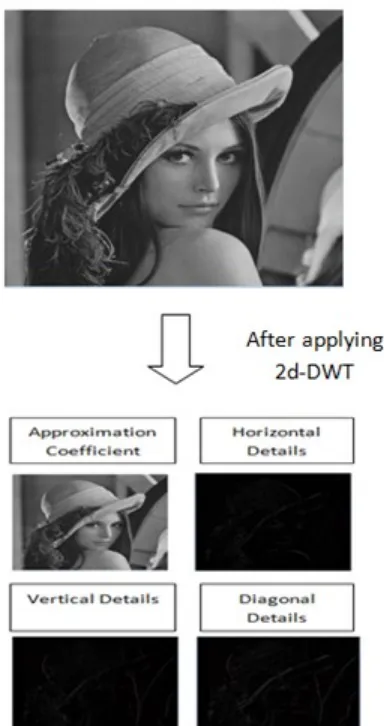
Discrete wavelet transform is widely used for steganographic work in frequency domain. One dimensional discrete wavelet transform (DWT) is nothing but a processed work of high and low-pass filtering on an object, which helps to produced a smoother version of the object by convolution. In 2d-DWT, first 1d-DWT is applied on rows followed by columns, results four level of details as approximation, horizontal, vertical and diagonal details. Normally image contains Integer value but after applying DWT the resulting output is a floating point value, which makes reconstruction difficult. Therefore, for our proposed algorithm we are using Integer-to-Integer wavelet transform (IWT) [6], [7]. Let the original Grayscale image IG is of size M X N and Integer Wavelet transform on IG gives us
IGAi,j= IG2i,2j +IG2i+1,2j/2 IGHi,j = IG2i+1,2j – IG2i,2j IGVi,j = IG2i,2j+1 - IG2i,2j IGDi,j = IG2i+1,2j+1 - IG2i,2j
Figure 1. The embedding process of proposed algorithm.
IV.
PROPOSED METHOD
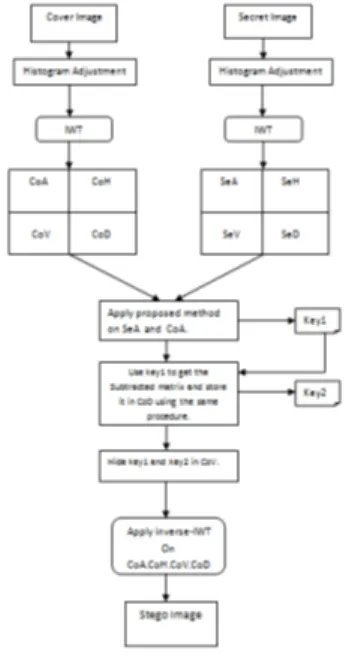
image. Figure 2 and 3 shows the block diagram of the proposed method.
Figure 2. The embedding process of proposed algorithm.
A. Embedding process
1.Let Co is a gray scale cover image and we will apply
Integer Wavelet Transform on it to get CoA, CoH, CoV, CoD sub-images. Same process is applied on secret image to get SeA, SeH, SeV, SeD sub-image.
2.Take 2-by-2 block of SeA and using the RSME find the best matched block from CoA. Make a secret key1 by taking the index value of best-matched block.
3.Using key1 find the difference between the block
of SeA and CoA.This process gives another matrix of same size using the difference value.
DSeA=SeA-CoA
Figure 3. The extraction process of proposed algorithm.
a. Again, apply same procedure as step-2 for DSeA and CoD, which gives another secret key2.
b. Now, take key1 and key2 and hide them in CoV by taking 2 LSB of every coefficient. c. Apply inverse-IWT on CoA, CoH, CoV, CoD
and get the Stego Image.
B. Extraction process
1. Take the stego image St as input and apply IWT on it to get four sub-image StA, StH, StV, StD. 2. Extract the secret key1, key2 from SeV.
3. Using the key key1 and key2 extract all 2-by-2 block of StA and StD. Now subtract them to get the secret image SeA1.
4. After getting the image SeA1 make 3 sub-image SeH1,SeV1,SeD1 as zero and apply inverse-IWT on four sub-image to get the secret image of actual size.
V.
RESULT ANALYSIS
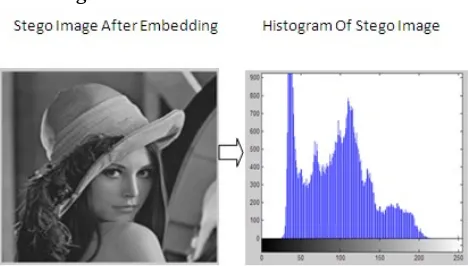
the proposed algorithm, we got good quality stego image. Peak Signal-to-Noise Ratio (PSNR) is used to measure the image quality after embedding the secret message. PSNR value indicates the proposed algorithm produced good quality stego image. Histogram of the cover, stego images are shown in Fig 4 and 5 after hiding 128 x 128
Table 1. PSNR Values After aplying Proposed Method
Figure 4. Histogram of Cover image.
VI.
CONCLUSION
The proposed algorithms hides the key instead of hiding the secret image that helps to improve the stego image quality, which is one of the most important characteristics of steganography. The PSNR shows that the method gives high quality stego image. The algorithm uses block matching technique with the stego image which helps to extract the secret image with help of the key from stego image without hiding any information on it. In future we
will try to implement the algorithm by applying it on color image to hide multiple secret image on a single cover image.
Figure 5. Histogram of Stego image with hidden data.
VII.
REFERENCES
[1]. P. Fabien, J. Ross. Anderson and Markus G. Kuhn,Information Hiding A Survey, Proceedings of the IEEE, pp.1062-1078, 1999. [2]. Arvind Kumar and Km. Pooja,Steganography-
A Data Hiding Technique, International Journal of Computer Applications, Vol. 9, No.7, pp.19-23, November 2010.
[3]. Li B., He, J. Huang and J.She, Y.Q,A Survey on Image Steganography and Steganalysis, Journal of Information hiding and Multimedia Signal Processing, pp.142-172, 2011.
[4]. Gandharba Swain1 and Saroj Kumar Lenka2,LSB Array Based Image Steganography Technique by Exploring the Four Least Significant Bits, Springer-Verlag Berlin Heidelberg , Part II, CCIS 270, pp.479-488, 2012.
[5]. Juan Jos Roque, Jess Mara Minguet, SLSB: Improving the Steganographic Algorithm LSB, WOSIS, INSTICC press, pp.57-66, 2009.
[6]. A.R. Calderbank, Ingrid Daubechies, Wim Sweldens and Boon-lock Yeo,Lossless Image compression Using Integer to Integer Wavelet Transform, International Conference on Image processing, IEEE press, Vol.1, pp.596-599, 1997.
IEEE Transactions on Image Processing, Vol 9 Issue 11, pp.1972- 1977, November 2000. [8]. Chih-Yang Lin and Yu-Tai Ching,A Robust
Image Hiding Method Using Wavelet Technique, Journal Of Information Science and Engineering, pp.163-174, 2006.
[9]. Ali Al-Ataby and Fawzi Al-Naima,A Modified High Capacity Image Steganography Technique Based on Wavelet Transform,The International Arab Journal of Information Technology, Vol.7, No 4, pp.358-364, 2010.
[10]. Amitava Nag , Sushanta Biswas, Debasree Sarkar and Parth Pratim Sarkar,A Novel Technique for Image Steganography Based on DWT and Huffman Encoding, International Journal of Computer Science and Security(IJCSS), Vol 4, Issue 6, pp.561-570, 2011.
[11]. Hemalatha S, U Dinesh ACharya, Renuka A