CSEIT1831214 | Received : 15 Jan 2018 | Accepted : 05 Feb 2018 | January-February-2018 [(3) 1 : 717-722]
International Journal of Scientific Research in Computer Science, Engineering and Information Technology © 2018 IJSRCSEIT | Volume 3 | Issue 1 | ISSN : 2456-3307
717
Green Computing using GPU in Image Processing
Chahat Monga
Assistant Professor, Guru Nanak college, Department of Computer Science, Ferozepur, Punjab, India
ABSTRACT
Green computing is the process of reducing the power consumed by a computer and thereby reducing
carbon emissions. The total power consumed by the computer excluding the monitor at its fully
computative load is equal to the sum of the power consumed by the GPU in its idle state and the CPU
at its full state. Recently, there have been tremendous interests in the acceleration of general
computing applications using a Graphics Processing Unit (GPU). Now the GPU provides the
computing powers not only for fast processing of graphics applications, but also for general
computationally complex data intensive applications. On the other hand, power and energy
consumptions are also becoming important design criteria. Consequently, software designs have to
consider the power/energy consumptions together with performance when they are developing
software.The GPU therefore does the 100% of the CPU work in its idle state .Hence the power
consumed by the GPU will be low. Also when the GPU is doing all the work the CPU will remain at a
load less than its idle load. Hence the power consumed will be equal to the power consumed by the
CPU at a load less than its idle load plus the power consumed by a GPU.
Keywords : GPU (Graphical Processing Unit), CUDA, OpenCV, nVidia, Image Processing.
I.
INTRODUCTION
Green computing refers to those practices adopted in the IT industry so as to reduce carbon emissions [1]. The practices may be both in hardware or software terms. The hardware obtained these days are usually very efficient if used properly . So there is more research in the coding part than in hardware be it with making the webpage of websites black so as to reduce power consumption to making shorter codes ,it all accounts for green computing [2-4]. In our paper we have used Graphical processing units for reducing the carbon emissions. Graphical processing units are the processing units which are used to calculate which pixel is to be lit up at what instant of time. Since these calculations have to be
very interactive environment to the gaming user. Green computing, also called green technology, is the environmentally sustainable to use of computers and related resources like - monitors, printer, storage devices, networking and communication systems - efficiently and effectively with minimal or no impact on the environment. Green computing whose goals are to reduce the use of hazardous materials, maximize energy efficiency during the product's
lifetime, and promote the recyclability or
biodegradability of defunct products and factory waste. Conserving resources means less energy is required to produce, use, and dispose of products ,Saving energy and resources saves money .Green computing even includes changing government policy to encourage recycling and lowering energy use by individuals and businesses.
WHAT IS GPU?
Digital Image processing is part of daily computations. The graphics processing unit (GPU) has become an essential part of today’s conventional computing systems. In few years, there has been a marked raise in the performance and capabilities of GPUs.
Graphics Processing Units is powerful,
programmable, and highly parallel computing, which are increasingly targeting for general-purpose computing applications. The modern GPU is not only a powerful graphics engine but also a highly parallel programmable processor featuring peak arithmetic and memory bandwidth that substantial as CPU. The GPU’s has capability computing broad range of computation, complex problems solve & especially for high range of graphical data. This effort in general purpose computing on the GPU, also known as GPU computing, which proposed GPU as an alternative to traditional microprocessors in high-performance computer systems of the future. The Graphics processing units (GPUs) are being increasingly used to accelerate a wide variety of applications. Recent advances in GPU architectures have not only improved the baseline performance but have also provided programmers with new
options to optimize their applications for better performance. Despite these advances, writing efficient GPU applications remains a challenging task. Chief among these challenges is the problem of memory performance. GPGPU refers to the use of graphics processing units (GPUs) to perform general processing tasks, and it involves explicitly copying large amounts of data over the PCIe bus, between the CPU and GPU. This process can be relatively time consuming. Further complications and slowdowns can occur if the data does not fit on the GPU’s memory, multiplying the problem by necessitating frequent CPU-GPU data transfers. Unlike a CPU, a GPU lacks the benefit of automatic memory paging. As a result, GPU memory management is explicitly handled by the programmer. This makes memory optimization a delicate process. The large number of threads running on a GPU will multiply any mistakes and inefficiencies in the code. This can seriously hamper an application’s performance. Differences in algorithms and GPU architectures serve to complicate this matter even further. Data that arrives on a GPU’s memory must then be accessed by a huge number of threads via the memory hierarchy. The threads need to be able to access this data efficiently, and through limited means. Inefficient GPU memory access is a common occurrence, and serves to hamper performance even further, particularly in workloads that are data intensive. Optimizing GPU memory performance is a complex and challenging problem. There are a wide assortment of memory optimization techniques and configurations. The suitability and efficiency of these optimization techniques may vary between different applications and data sizes.
WHY GPU?
graphics and computing applications. Exposing high-definition graphics scenes is a problem with fabulous inherent parallelism. A graphics programmer writes a single-thread program that draws one pixel. The GPU runs multiple instances of this thread in parallel are known as multi-thread parallel computing. It draws multiple pixels in parallel at a time. As Software scalability rapidly increase GPU parallelism, simultaneously in hardware increasing transistor
density with performance. GPU-accelerated
computing is the use of a graphics processing unit (GPU) together with a CPU to accelerate scientific, analytics, engineering, consumer, and enterprise applications. Pioneered in 2007 by NVIDIA, GPU accelerators now power energy-efficient datacenters in government labs, universities, enterprises, and small-and-medium businesses around the world. GPUs are accelerating applications in platforms ranging from cars, to mobile phones and tablets, to drones and robots.
II.
METHODS AND MATERIAL
ARCHITECTURE OF GPU
In GPU computing, code is typically executed both on a conventional CPU and on a GPU. Sequential code with many random memory accesses, branches and complicated logic is most efficiently executed on the CPU. Parallel, arithmetic code may see a significant speed-up when executed on the GPU [12]. Efficient development of parallel applications for GPUs is dependent upon a sufficiently high-level programming language. Examples of such languages are CUDA (for NVIDIA GPUs) and OpenCL (general-purpose). These languages helps abstract the complicated nature of the GPU hardware, hiding low-level features. By focusing on exploiting the inherent parallelism of the problem, significant speed-ups can be gained with reasonable effort. The parallel part of a CUDA program consists of kernels that are executed on the GPU. Many copies of the kernel are executed in parallel as threads, grouped together in thread blocks. Threads within the same block may communicate through shared memory.
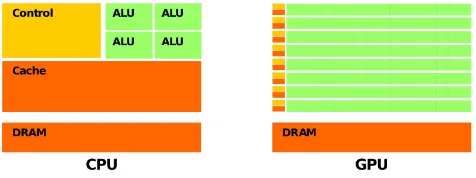
GPUs are optimized for Floating Point Operations, as well as being optimized for parallelism. On typical Multiprocessor consists of 4 cores (as with most of the Intel i-Series multiprocessors), while a GPU is composed of tens of processors. This is because CPUs could be considered memory based processors while GPUs could be called ALU based, which allows the GPU to perform more operations in parallel resulting in the high GFLOPS (FLOPS = Floating Point Operation Per Second) compared to the CPU.
Figure 1. CPU v/s GPU Architecture.
Why do HPC customers care about Perf/watt when upgrading their systems?
computing, FLOPS is a measure of computer performance, useful in fields of scientific calculations that make heavy use of floating-point calculat ions.
CUDA
The massive amount of digital data on the web has brought a number of challenges such as prohibitively high costs in terms of storing and delivering the data. Image compression therefore involves reducing the amount of memory it takes to store an image in order to reduce these large costs. Image processing generally, is a very compute intensive task. Taking into consideration the image representation and quality, systems or application/techniques for image processing must have special capabilities for unquestionable results in their image processing. The rapid growth of digital imaging applications,
including desktop publishing, multimedia,
teleconferencing, computer graphics and
visualization and high definition television (HDTV) has increased the need for effective image compression techniques. Many image processing algorithms require dozens of floating point computations per pixel, which can result in slow runtime even for the fastest of CPUs. Because of the need for high performance computing in today’s computing era, this paper presents a study based on Cordic based Loeffler DCT for image compression using CUDA. Image processing takes the advantage of CUDA processing because of the parallelism that pixels exhibit in an image and that can be offered by the CUDA architecture. In that way the CUDA architecture is found to be relevant for image processing [1], [2], [3] and [4]. This paper presents a performance based evaluation of the DCT image compression technique on both the CPU and GPU using CUDA. The focus of the paper is on the Cordic based Loeffler DCT. We begin by giving a brief review of literature (background), followed by a description of the research methodology employed, including an overview of image compression, GPUs, CUDA architecture, Cordic based Loeffler DCT and related theory. This is then followed by the results of
the experiments and their interpretation and lastly, conclusions and future work. CUDA is the missing link between the developer and the GPU. It was developed by NVIDIA and is implemented in all NVIDIA GPUs starting the G80s. Before having
programming architectures dedicated to
programming the GPU, a programmer had to choose either between dealing with the complex APIs of the GPUs or “tricking” it by passing a texture, that contains the data or the instructions, to the GPU and then receiving a the data in the form of a texture, which typically creates a lot of overhead. CUDA processors are programmed in CUDA C, which is basically C/C++ with some CUDA extensions, which will be mentioned and explained later on. It is important to know that in early versions of CUDA the GPU had to be programmed in C, while the CPU could be programmed in either. This is important when writing code, since the developer must know at all times, whether the code is compiled for the CPU or the GPU. Starting from CUDA 3.0 more C++ features had been enabled for the code compiled for the GPU.
of the thread inside the block. Inside a 2D Block threads are positioned at (0,0), (0,1), … (n-1, n-1), as shown in the previous figure. Since the Thread ID must be of type uint3 – which will be considered a normal integer for now – something like (3,2) for the Thread ID is not applicable.
III. CONCLUSION
As a promising architecture for supercomputers, GPU-based computing is receiving significant attention for its performance and power efficiency. In order to help the HPC community better understand the power characteristics of different application kernels on the GPU, we have conducted this study to characterize the performance and power of various application kernels under varying frequency settings. Based on our findings, the GPU application kernels’ performance and power consumption are largely determined by two characteristics: the rate of issuing instructions and the ratio of global memory transactions to computation instructions. For future work, we intend to conduct our study on other GPUs,
including from AMD and Intel. Given the software abstraction used in this work is OpenCL which is supported by most accelerator platforms, a fair comparison running the same code across platforms is possible. In addition, we believe a complete and comprehensive modeling of GPU performance and power consumption would be very useful.
IV. REFERENCES
[1]. Jain, Anil. K. (2013) Fundamentals of digital
image processing . Prentice Hall: Englewood Cliffs, NJ.
[2]. Jackson, David Jeff & Hannah, Sidney Joel,
(2011) "Comparative Analysis of image Compression Techniques," System Theory
2013, Proceedings SSST ’93, 25th
Southeastern Symposium, pp 513517.
[3]. Zhang, Hong., Zhang, Xiaofei.& Cao, Shun
(2000) "Analysis & Evaluation of Some Image Compression Techniques," High Performance Computing in Asia Pacific Region, 2000 Proceedings, 4th Int. Conference, Vol. 2, pp 799-803.
[4]. Gonzalez, Rafael & Woods, Richard E. (2002)
Digital Image Processing, 2nd ed. n. Edition 2002: Prentice-Hall Inc.
[5]. Sonal, Dinesh Kumar (2007), "A Study of
Various Image Compression Techniques", Guru Jhambheswar University of Science and Technology, Hisar.
[6]. Gleb V. Tcheslavski (2008), "Image
compression fundamentals".Springer 2008, ELEN 4304/5365 DIP
[7]. NVIDIA Corporation (2012), "NVIDIA
CUDA Programming Guide v. 4.2",
http://www.nvidia.com.
[8]. Owens, John D., Houston, Mike, Luebke,
[9]. Halfhil, Tom R., (2008), "Parallel Processing
With CUDA". Microprocessor Report,
Scottsdale, Arizona, 28 / January / 2008.
[10]. Gupta, Maneesha. & Garg, Amit Kumar.
(2012) "Analysis of Image Compression Algorithm Using DCT" International Journal of Engineering Research and Applications (IJERA) ISSN: 2248-9622 www.ijera.com, Vol. 2, Issue 1, pp.515-521.
[11]. Chi-Chia Sun, Benjamin Heyne, Shanq-Jang
Ruan and Juergen Goetze.,(2006), "A Low-Power and High-Quality Cordic Based Loeffler DCT"., Information Processing Lab,
Dortmund University of Technology,