A High-Quality Web Corpus of Czech
Johanka Spoustov´a, Miroslav Spousta
Institute of Formal and Applied Linguistics Faculty of Mathematics and Physics Charles University Prague, Czech Republic
{johanka,spousta}@ufal.mff.cuni.cz
Abstract
In our paper, we present main results of the Czech grant project Internet as a Language Corpus, whose aim was to build a corpus of Czech web texts and to develop and publicly release related software tools. Our corpus may not be the largest web corpus of Czech, but it maintains very good language quality due to high portion of human work involved in the corpus development process. We describe the corpus contents (2.65 billions of words divided into three parts – 450 millions of words from news and magazines articles, 1 billion of words from blogs, diaries and other non-reviewed literary units, 1.1 billion of words from discussions messages), particular steps of the corpus creation (crawling, HTML and boilerplate removal, near duplicates removal, language filtering) and its automatic language annotation (POS tagging, syntactic parsing). We also describe our software tools being released under an open source license, especially a fast linear-time module for removing near-duplicates on a paragraph level.
Keywords:corpus, web, Czech
1.
Introduction
Due to the large expansion of the Internet in the recent years, web space became very rich and valuable mine for language resources of various kind, especially mono- and bilingual text corpora, eg. (Baroni and Kilgarriff, 2006). The aim of our project was to exploit the Czech web space and build a web corpus of Czech, which will be useful both for research in theoretical linguistics and for training NLP applications (machine learning in statistical machine trans-lation, spoken language recognition etc.)
There already exists a large corpus of Czech texts, Czech National Corpus (CNC, 2005), compiled from texts ob-tained directly from publishers (books, newspapers, maga-zines etc.), but the legal restrictions do not allow the corpus creators to freely distribute the data.
Generally, due to the author’s law, one cannot freely dis-tribute whole texts downloaded from the web neither, but our aim was to find a way how to make our web corpus ac-cessible and downloadable for both professionals and gen-eral public, at least in some modified, limited form (see sec-tion 7.).
2.
Texts selection and the cleaning process
After investigating other possibilities, we have chosen to begin with manually selecting, crawling and cleaning par-ticular web sites with large and good-enough-quality tex-tual content (e.g. news servers, blog sites, young mothers discussion fora etc.). In our selection, we were guided by our knowledge of the Czech Internet and by the results of NetMonitor.cz – a service monitoring Czech web sites pop-ularity and traffic.
For web pages selection and their HTML markup and boil-erplate removal, we used manually written scripts for each web site. This approach made us sure, compared to com-pletely automatic cleaning approaches such as (Spousta et al., 2008), that the corpus will contain only the desired content (pure articles, blogs and discussion messages) and
we will avoid fundamental duplicates (perexes and sam-ples from articles and blogs, repetitions of first messages on each discussion page in some fora etc.). Additionally, we have removed the documents resulting into empty or nearly empty raw texts from the corpus, including the basic HTML level and the URLs lists.
After downloading and cleaning a few carefully selected sites, we were pleasantly surprised with the size of the ac-quired data. For example, the poetry server pismak.cz pro-vided us with 40 millions of words1of amateur poems, one
of the most popular news servers idnes.cz contained 94 mil-lions of words in articles contents, 118 milmil-lions of words in articles discussions and 54 millions of words in blogs, and mothers visiting discussion server modrykonik.cz have pro-duced 313 millions of words in their discussions.
For comparison, first version of Czech National Corpus (CNC, 2005), the biggest corpus of Czech, from the year 2000, contained 100 millions of words, and the latest ver-sion contains 300 millions of words in balanced texts (fic-tion, technical literature and news) and 1 billion of words in news texts. All these texts were obtained directly from the publishers and are not available for download from the web.
Encouraged by the size, and also by the quality of the texts acquired from the web, we decided to compile the whole corpus only from particular, carefully selected sites, to pro-ceed the cleaning part in the same, sophisticated manner, and to divide the corpus into three parts – articles (from news, magazines etc.), discussions (mainly standalone dis-cussion fora, but also some comments to the articles in acceptable quality) and blogs (also diaries, stories, poetry, user film reviews). Until now, we have acquired about 3.8 billions of words in raw texts resulting into 2.6 billions of words after near-duplicate detection and language detec-tion, from only about 40 web sites.
1
articles discussions blogs all
HTML 88 GB 192 GB 109 GB 389 GB
raw text 8.4 GB 16 GB 18 GB 42 GB
raw text (tokens) 737 mil. 2,089 mil. 2,038 mil. 4,864 mil. raw text (words) 611 mil. 1,674 mil. 1,575 mil. 3,860 mil. deduplicated (tokens) 634 mil. 1,943 mil. 1,496 mil. 4,073 mil. deduplicated (words) 531 mil. 1,579 mil. 1,176 mil. 3,285 mil. cz-only (tokens) 628 mil. 1,407 mil. 1,250 mil. 3,285 mil. cz-only (words) 526 mil. 1,143 mil. 982 mil. 2,652 mil.
Table 1: Sizes of the particular parts of the corpus during the downloading and cleaning process.
smaller chunks of text, such as paragraphs, leads to the in-creasing number of classification errors.
As a consequence, we have developed a tool that deals with shorter texts more successfully. It is based on word n-grams estimated from the Wikipedia content. Currently, it uses word unigrams (top 100 000 most frequent words for every language) and is able to distinguish 49 languages.
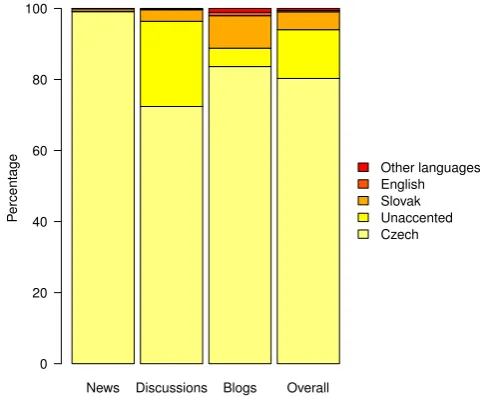
Table 1 shows the final corpus size after performing unaccented-words and language filter (and leaving only correct Czech), Figure 1 shows in more detail the language composition of the data detected by our tools.
News Discussions Blogs Overall
P
ercentage
0 20 40 60 80 100
Other languages English Slovak Unaccented Czech
Figure 1: Results of the language filtering module.
5.
Automatic linguistic processing
Our corpus is automatically linguistically processed us-ing state-of-the-art morphological analysis (Hajiˇc, 2004), version CZ110622a, state-of-the-art averaged perceptron POS tagger (Spoustov´a et al., 2009), implementation Fea-turama3, feature set neopren, and a maximum spanning tree dependency parser (McDonald et al., 2005), version
3
http://sf.net/projects/featurama/
0.4.3c4. The tagger and the parser were trained on the stan-dard data sets from (Hajiˇc et al., 2006).
6.
Comparison with current corpora
Following our previous article (Spoustov´a et al., 2010), we would like to compare our new corpus to other resources available. Ideally, we would like to acquire web data that are as similar to currently available corpora as possible. First, we focus on word and sentence measures that may be easily extracted from the texts, such as mispelled-word ra-tio and average sentence length. If the differences in these measures are too big, we may conclude that texts included in the web corpus differ from those in reference corpus a lot. For the comparison experiments, we chopped a 50 mil-lion token portion of the CNC SYN2005 and the three parts of our web corpus (articles, discussions, blogs). We split all the portions into 1 million-token length parts and estimate mean and standard deviation for experiments where appli-cable.
According to Figure 2, it turns out that in terms of average sentence length the articles part of our web corpus is quite similar to the SYN2005. This is not surprising, taking into account the SYN2005 structure (40 % fiction, 27 % techni-cal literature, 33 % journalism).
Relatively high average sentence length in web discussions (compared to blogs) may be caused by segmentation errors (the task is difficult in some cases due to the lack of punc-tuation and capitalization).
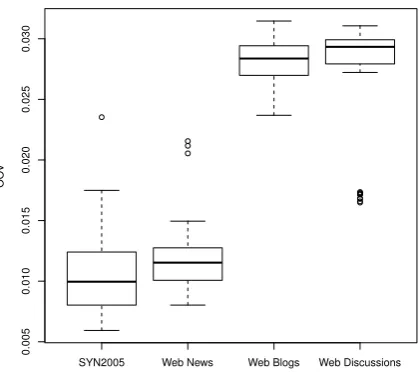
The results of out-of-vocabulary words percentage measur-ing presented in Figure 3 are also not surprismeasur-ing. Texts from the articles section are written in correct Czech and most of them are professionally reviewed and proofreaded. On the contrary, in discussions and blogs ”everything is allowed”. We must also take into account the tolerated error-rate of the language filter and unaccented Czech filter.
In fact, the corpus comparison is quite difficult and chal-lenging task itself. (Kilgarriff, 2001) explores several different measures of corpus similarity (and homogene-ity), such as perplexity and cross-entropy of the language models, χ2 statistics or Spearman rank correlation coef-ficient. Using the ”Known-Similarity Corpora”, he finds, that for the purpose of corpora similarity comparison, χ2 and Spearman rank methods work significantly better than the cross-entropy based ones.
4
articles discussions blogs SYN2005
articles 0.941 (0.046) 0.053 0.240 0.707
discussions 0.973 (0.011) 0.630 0.143
blogs 0.980 (0.014) 0.402
SYN2005 0.937 (0.024)
Table 2: Spearman rank correlation coefficient as a measure of homogeneity and inter-corpus similarity. Homogeneity is measured using 10 random partitions of the corpus divided into two halves and the results are average and standard deviation (in brackets).
SYN2005 Web News Web Blogs Web Discussions
12
14
16
18
20
22
Sentence Length
Figure 2: Average sentence length comparison of SYN2005 and particular parts of the WEB corpus.
For our data sets, we compute Spearman rank correlation coefficient of the distance of ranks of 500 most frequent words. The difference is small for text where common word patterns are similar. As the measure is independent of the corpora size, we can directly compare both homogeneity (intra-corpus) and similarity (inter-corpus) results.
Table 2 shows that all the (sub)corpora are quite homoge-nous. The highest inter-corpus similarity was achieved be-tween web-articles and SYN2005, these corpora also have very similar homogeneity.
We can conclude that the articles sub-corpus seems to be the moct appropriate for substituting the Czech National Corpus, when necessary, while the other web sub-corpora will probably be useful for other, more specific tasks (eg. the discussions sub-corpus for dialogue systems language modelling).
7.
Availability
The full version of the corpus (complete articles, blogs etc. with automatic linguistic annotation and viewable cor-responding URLs) is, due to the author’s law, not avail-able for download, only for viewing and searching through our simple corpus viewer on the project website http: //hector.ms.mff.cuni.cz
For public download, we offer following resources (also on
SYN2005 Web News Web Blogs Web Discussions
0.005
0.010
0.015
0.020
0.025
0.030
OO
V
Figure 3: Box-plots of out-of-vocabulary words percentage for SYN2005 and particular parts of the WEB corpus.
the project’s website):
• URL lists
• Shuffled sentences (annotated): articles (3.2 GB), dis-cussions (6.1 GB), blogs (5.7 GB)
• N-gram collection (unigrams to 5grams, 2 or more oc-currences, without annotation): articles, discussions, blogs, complete
The software tools (near-duplicate detection algorithm, lan-guage detection module, simple corpus viewer) are also available for download on the websitehttp://hector. ms.mff.cuni.cz
As the project is finished, we cannot guarantee the avail-ability of the Hector site in the future (in depends on fi-nancial and personal conditions of the department), but some of the resources will probably be available through the LINDAT-Clarin repository.
8.
Conclusion
process. We have also described our newly developed soft-ware tools (near-duplicate detection algorithm, language detection module), which are being released together with the data.
9.
Acknowledgement
This work has been using language resources developed and/or stored and/or distributed by the LINDAT-Clarin project of the Ministry of Education of the Czech Republic (project LM2010013).
The research described here was supported by the project GA405/09/0278 of the Grant Agency of the Czech Repub-lic.
10.
References
Marco Baroni and Adam Kilgarriff. 2006. Large linguistically-processed web corpora for multiple lan-guages. InProceedings of 11th Conference of the Euro-pean Chapter of the Association for Computational Lin-guistics, Trento, Italy.
Burton H. Bloom. 1970. Space/time trade-offs in hash cod-ing with allowable errors. Commun. ACM, 13:422–426, July.
Andrei Z. Broder, Steven C. Glassman, Mark S. Man-asse, and Geoffrey Zweig. 1997. Syntactic clustering of the web. Computer Networks and ISDN Systems, 29(8-13):1157 – 1166. Sixth International World Wide Web Conference.
Moses S. Charikar. 2002. Similarity estimation techniques from rounding algorithms. In Proceedings of the thiry-fourth annual ACM symposium on Theory of computing, STOC ’02, pages 380–388, New York, NY, USA. ACM. CNC, 2005. Czech National Corpus – SYN2005. Institute of Czech National Corpus, Faculty of Arts, Charles Uni-versity, Prague, Czech Republic.
Jan Hajiˇc. 2004. Disambiguation of Rich Inflection (Computational Morphology of Czech). Nakladatelstv´ı Karolinum, Prague.
Jan Hajiˇc, Eva Hajiˇcov´a, Jarmila Panevov´a, Petr Sgall, Petr Pajas, Jan ˇStˇep´anek, Jiˇr´ı Havelka, and Marie Mikulov´a. 2006. Prague Dependency Treebank v2.0, CDROM, LDC Cat. No. LDC2006T01. Linguistic Data Consor-tium, Philadelphia, PA.
Adam Kilgarriff. 2001. Comparing corpora. International Journal of Corpus Linguistics, 6(1):97–133.
Ryan McDonald, Fernando Pereira, Kiril Ribarov, and Jan Hajic. 2005. Non-projective dependency parsing using spanning tree algorithms. InProceedings of Human Lan-guage Technology Conference and Conference on Em-pirical Methods in Natural Language Processing, pages 523–530, Vancouver, British Columbia, Canada, Octo-ber. Association for Computational Linguistics.
Miroslav Spousta, Michal Marek, and Pavel Pecina. 2008. Victor: the web-page cleaning tool. InProceedings of the Web as Corpus Workshop (WAC-4), Marrakech, Mo-rocco.
Drahom´ıra “johanka” Spoustov´a, Jan Hajiˇc, Jan Raab, and Miroslav Spousta. 2009. Semi-supervised training for the averaged perceptron POS tagger. InProceedings of
the 12th Conference of the European Chapter of the ACL (EACL 2009), pages 763–771, Athens, Greece, March. Association for Computational Linguistics.