Proceedings of the Student Research Workshop associated with RANLP 2017, pages 35–40,
Multi-Document Summarization of Persian Text Using Paragraph Vectors
Morteza Rohanian University of Tehran
Abstract
A multi-document summarizer finds the key topics from multiple textual sources and organizes information around them. In this paper we propose a summariza-tion method for Persian text using para-graph vectors that can represent textual units of arbitrary lengths. We use these vectors to calculate the semantic related-ness between documents, cluster them to a number of predetermined groups, weight them based on their distance to the cen-troids and the intra-cluster homogeneity and take out the key paragraphs. We com-pare the final summaries with the gold-standard summaries of 21 digital topics us-ing the ROUGE evaluation metric. Exper-imental results show the advantages of us-ing paragraph vectors over earlier attempts at developing similar methods for a low re-source language like Persian.
1 Introduction
Multi-document summarization is the task of tak-ing the most important points of multiple input documents and put them forward in a short, co-hesive way that is easy to follow. The main goal of multi-document summarization is to provide an outcome as objective as possible that can repre-sent all documents with emphasis on key topics. Today, automatic summarization is being used as a technology that makes huge amount of online data accessible in a time that is not practicable to produce summaries manually.
Automatic summarization has been an active field of study in recent years and there are vari-ety of approaches that have been proposed so far. Roughly, summarization methods can be split into two classes: abstractive summarization in which
the system analyses the input documents and gen-erates summaries; and extractive summarization which is the method of selecting parts of the in-put documents and employing them without any changes.
Extractive summarization approaches can be based on supervised learning, using document-summary pairs as training data in order to pre-dict textual units worthy of being in the summary. These textual units can be keywords (Hong and Nenkova, 2014), phrases and sentences (Hu and Wan, 2013). Employing cluster centroids was one of the first attempt to use an unsupervised learning method for summarization (Radev et al., 2004). Sentences are represented as weighted vectors and put in clusters by applying cosine similarity. Pre-trained word vectors also have been used for ex-tractive summarization (Kageback et al, 2014). For sentence representation the authors apply 2 different approaches of adding word vectors and unfolding recursive auto-encoder (RAE).
Our method employs paragraph vector models to compute semantic relatedness between fixed-sized textual units with variable lengths (differ-ent paragraphs) and uses K-means clustering algo-rithm for grouping them based on their proximity. We use the centroids of clusters as the main top-ics of documents and choose representative para-graphs according to their weights.
2 Related Work
Based on statistical information derived from word frequency, Luhn (1958) was first to propose an algorithm for automatic extractive summariza-tion. Later works expanded Luhns word based approach by adding other weighted statistical or linguistic features of documents. Kupiec et al. (1995) present a supervised method that consid-ered sentences with the title-keywords in them as
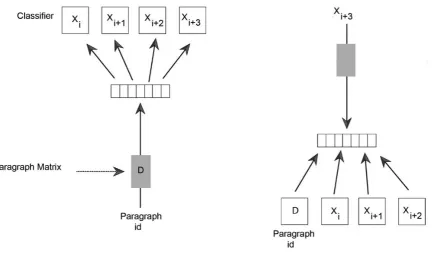
Figure 1: On the right using paragraph vectors to predict the next word of a given document and capturing word order. On the left predicting words of a paragraph using its vector.
main paragraph of that cluster. Here, we cluster close paragraphs by computing semantic similar-ities using specific number of latent topics within them. The most distant paragraph from the cen-ter in each cluscen-ter is the oucen-ter point of the cluscen-ter. More weight around the center of cluster shows that the central paragraph is a good representation of that cluster and we dont need to add outer para-graphs for a more balanced point of view.
To find the main paragraphs, first we initialize the K centroids randomly. Each paragraph vectors is assigned to its nearest centroid, using a specific distant metric. Each cluster center vector acts as the representation of that cluster. Then we com-pute the new centroids by taking the mean of all vectors assigned to each cluster. The algorithm stops until no paragraph vectors change clusters.
We use cosine similarity, which particularly used for non-zero vectors and Euclidean metric for an n-dimensional space. We weight paragraphs based on the density of each cluster. As proposed by Leskovec et al, (2014) if the ratio of the number of paragraphs divided by some power of the diam-eter of a cluster is below some threshold we can consider that cluster as a separated, and extract the outer point in addition to central paragraph. We use the number of dimensions of the space as the power. The number of all paragraphs in our
docu-ments divided by dimensions number power of the diameter of our vector space is our threshold. The diameter is still the maximum distance between any two points in the cluster.
3.3 Evaluation Method
For evaluation we use ROUGE (Lin, 2004), which is a recall-oriented, BLEU-like tool that con-siders n-gram overlaps between the automatic summaries and set of manually-provided, gold-standard summaries. There are three different ROUGE scores that are the common measure-ment tools used in recent publications: ROUGE-1, ROUGE-2, and ROUGE-SU4, which count matches in unigrams, bigrams, and skip-bigrams. ROUGE-1 and ROUGE-2 have the strongest asso-ciation with the gold-standard summaries.
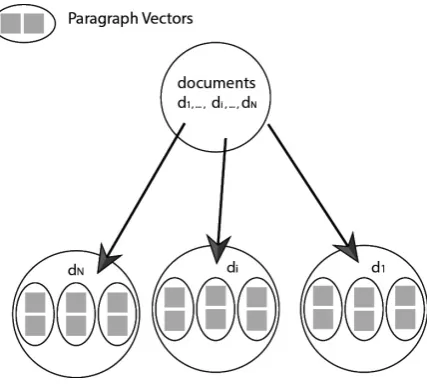
Figure 2: Clustering paragraphs into K clusters.
4 Experiments 4.1 Dataset
In order to evaluate our method we provide a dataset of 21 digital topics with each topic having between 50 and 150 paragraphs made by various users which were gathered from different Persian review sites. Each topic is about a specific prop-erty of a digital product (e.g. Screen of iPhone SE or Battery of Nikon D7200). The dataset includes gold-standard abstractive summaries of 3 for each topic.
4.2 Parameter Settings
The model in our experiment is trained on Persian Wikipedia dataset of 2.5 GB using fastText (Bo-janowski et al., 2016). The dimension of vectors was considered 100 and 200 for words using Skip-gram neural networks model and 50 and 100 for paragraphs. Our models were trained 50 and 100 epochs. We chose 3 and 5 as the number of clus-ters and used two different distance metrics. We conduct our experiments on a 4.0GHz computer.
4.3 Results and Discussion
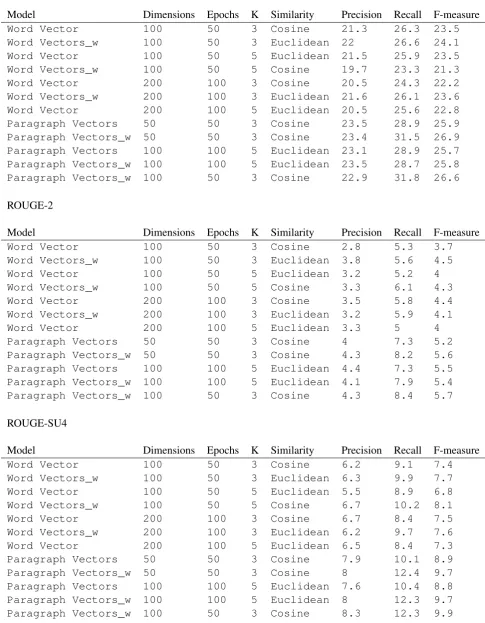
The multi-document summarization methods de-scribed in Section 3 evaluation results with dif-ferent parameters are shown with varying param-eters in Table 1. The results based on word vec-tors from the 1, 2, and ROUGE-SU4 scorings show that our model performs better with higher dimensions and smaller K. The model earns the maximum F-measure of 24.1 on word
vectors and gains from training for a greater num-ber of epochs. The results are stable among vari-ous ROUGE scores which means that the outputs with most correlation with human-provided sum-maries also are more fluent.
As can be seen from the Table, paragraph vec-tors reached the best performances for both three and five clusters compared to word vectors. Using cosine similarity measure improves the recall for different ROUGE scores evaluations while mod-els using Euclidean metric have higher precision and F-measure. High recalls and F-measures are not achievable for our extractive summarization method due to our gold-standard summaries being abstractive.
Indicated by the results Paragraph Vector ap-pears to be a better representation to use for clus-tering semantically related documents, likely be-cause of word order consideration. The ROUGE-SU4 scores also show that in addition to seman-tics, paragraph vectors are more effective in cap-turing syntactic information.
Table 1 shows that capturing the outer topics by weighting paragraphs leads to a more balanced summary and a better ROUGE-SU4 score. It is more convincing for an individual user to read a summary from multiple perspectives. We do not observe significant improvements in ROUGE-1 and ROUGE-2 scores of our weighted models.
5 Conclusion
We described a method clustering main topics of several documents using paragraph vectors as the basis of semantic similarity between paragraphs of different lengths. The centroids of clusters con-sidered as the main topic and paragraphs were weighted based on the distribution of data in each group. The paragraphs with more weight were ex-tracted and compared to human-provided abstrac-tive summaries.
The results suggest that weighting the para-graphs can make summaries more objective. How-ever, the weighting can be combined by several other textual semantic features like the polarity of paragraphs. Considering corefrence resolution also makes the summaries more coherent and de-crease the level of redundancy.
References
ROUGE-1
Model Dimensions Epochs K Similarity Precision Recall F-measure
Word Vector 100 50 3 Cosine 21.3 26.3 23.5 Word Vectors_w 100 50 3 Euclidean 22 26.6 24.1 Word Vector 100 50 5 Euclidean 21.5 25.9 23.5 Word Vectors_w 100 50 5 Cosine 19.7 23.3 21.3 Word Vector 200 100 3 Cosine 20.5 24.3 22.2 Word Vectors_w 200 100 3 Euclidean 21.6 26.1 23.6 Word Vector 200 100 5 Euclidean 20.5 25.6 22.8 Paragraph Vectors 50 50 3 Cosine 23.5 28.9 25.9 Paragraph Vectors_w 50 50 3 Cosine 23.4 31.5 26.9 Paragraph Vectors 100 100 5 Euclidean 23.1 28.9 25.7 Paragraph Vectors_w 100 100 5 Euclidean 23.5 28.7 25.8 Paragraph Vectors_w 100 50 3 Cosine 22.9 31.8 26.6
ROUGE-2
Model Dimensions Epochs K Similarity Precision Recall F-measure
Word Vector 100 50 3 Cosine 2.8 5.3 3.7
Word Vectors_w 100 50 3 Euclidean 3.8 5.6 4.5 Word Vector 100 50 5 Euclidean 3.2 5.2 4 Word Vectors_w 100 50 5 Cosine 3.3 6.1 4.3
Word Vector 200 100 3 Cosine 3.5 5.8 4.4
Word Vectors_w 200 100 3 Euclidean 3.2 5.9 4.1 Word Vector 200 100 5 Euclidean 3.3 5 4 Paragraph Vectors 50 50 3 Cosine 4 7.3 5.2 Paragraph Vectors_w 50 50 3 Cosine 4.3 8.2 5.6 Paragraph Vectors 100 100 5 Euclidean 4.4 7.3 5.5 Paragraph Vectors_w 100 100 5 Euclidean 4.1 7.9 5.4 Paragraph Vectors_w 100 50 3 Cosine 4.3 8.4 5.7
ROUGE-SU4
Model Dimensions Epochs K Similarity Precision Recall F-measure
Word Vector 100 50 3 Cosine 6.2 9.1 7.4
Word Vectors_w 100 50 3 Euclidean 6.3 9.9 7.7 Word Vector 100 50 5 Euclidean 5.5 8.9 6.8 Word Vectors_w 100 50 5 Cosine 6.7 10.2 8.1
Word Vector 200 100 3 Cosine 6.7 8.4 7.5
Word Vectors_w 200 100 3 Euclidean 6.2 9.7 7.6 Word Vector 200 100 5 Euclidean 6.5 8.4 7.3 Paragraph Vectors 50 50 3 Cosine 7.9 10.1 8.9 Paragraph Vectors_w 50 50 3 Cosine 8 12.4 9.7 Paragraph Vectors 100 100 5 Euclidean 7.6 10.4 8.8 Paragraph Vectors_w 100 100 5 Euclidean 8 12.3 9.7 Paragraph Vectors_w 100 50 3 Cosine 8.3 12.3 9.9
3:11371155.
Piotr Bojanowski, Edouard Grave, Armand Joulin, and Tomas Mikolov. 2016. Enriching word vectors with subword information.arXivpreprint arXiv:1607.04606. Marco Bonzanini, Miguel Martinez-Alvarez, and Thomas
Roelleke. 2013. Extractive summarization via sentence removal: Condensing relevant sentences into a short summary. In Proceedings of the 36th International ACM SIGIR Conference on Re- search and Development in Information Retrieval, SIGIR 13, pages 893896. ACM. Mohamad Ali Honarpisheh, Gholamreza Ghassem-Sani, and Seyed Abolghasem Mirroshandel. 2008. A Multi-Document Multi-Lingual Automatic Summarization System. In IJCNLP,pages 733-738.
Kai Hong and Ani Nenkova. 2014. Improving the estimation of word importance for news multi-document summariza-tion.In Proceedings of EACL.
Yue Hu and Xiaojun Wan. 2015. Ppsgen: learning-based presentation slides generation for academic papers. IEEE transactions on knowledge and data engineering 27, no. 4: 1085-1097.
Mikael K Łageb ack, Olof Mogren, Nina Tahmasebi, and Devdatt Dubhashi. 2014. Extractive summarization using continuous vector space models. In CVSC at EACL, pages 3139.
Julian Kupiec, Jan Pedersen, and Francine Chen. 1995. A trainable document summarizer. In Proceedings of the 18th annual international ACM SIGIR conference on Research and development in information retrieval, pages. 68-73. ACM.
Quoc Le, and Tomas Mikolov. 2014. Distributed represen-tations of sentences and documents. In Proceedings of the 31st International Conference on Machine Learning (ICML-14), pages. 1188-1196.
Chin-Yew Lin. 2004. Rouge: A package for automatic evaluation of summaries. In Text summarization branches out: Proceedings of the ACL-04 workshop,vol. 8.
Hans Peter Luhn. 1958. The automatic creation of literature abstracts. IBM Journal of research and development 2,
no. 2 : 159-165.
Tomas Mikolov, Kai Chen, Greg Corrado, and Jeffrey Dean. 2013a. Efficient estimation of word representations in vector space.ArXivpreprint arXiv:1301.3781
Tomas Mikolov, Ilya Sutskever, Kai Chen, Greg S Corrado, and Jeff Dean. 2013b. Distributed representations of words and phrases and their compositionality. In Advances in Neural Information Processing Systems,
pages 31113119.
Dragomir R Radev, Hongyan Jing, Magorzata Sty s, and Daniel Tam. 2004. Centroid-based summarization of multiple documents. Information Processing and Management,40(6):919938
Jure Leskovec, Anand Rajaraman, and Jeffrey David Ullman. 2014. Mining of massive datasets.Cambridge University
Press.
Hassan Shakeri, Saeedeh Gholamrezazadeh, Mohsen Amini Salehi, and Fatemeh Ghadamyari. 2012. A New Graph-Based Algorithm for Persian Text Summarization.
In Computer Science and Convergence,pages. 21-30. Yong Zhang, Meng Joo Er, and Rui Zhao. 2015. Multi