Cryptography in the Multi-string Model
Jens Groth∗ Rafail Ostrovsky†
UCLA Computer Science Department 4732 Boelter Hall
Los Angeles, CA 90095-1596, USA {jg,rafail}@cs.ucla.edu
Abstract
The common random string model permits the construction of cryptographic protocols that are prov-ably impossible to realize in the standard model. In this model, a trusted party generates a random string and gives it to all parties in the protocol. However, the introduction of such a third party should set alarm bells going off: Who is this trusted party? Why should we trust that the string is random? Even if the string is uniformly random, how do we know it does not leak private information to the trusted party? The very point of doing cryptography in the first place is to prevent us from trusting the wrong people with our secrets.
In this paper, we propose the more realistic multi-string model. Instead of having one trusted authority, we have several authorities that generate random strings. We do not trust any single authority, we only assume a majority of them generate the random string honestly. We demonstrate the use of this model for two fundamental cryptographic taks. We define non-interactive zero-knowledge in the multi-string model and construct NIZK proofs in the multi-string model. We also consider multi-party computation and show that any functionality can be securely realized in the multi-string model.
Keywords: Common random string model, string model, non-interactive zero-knowledge,
multi-party computation.
∗
Supported by NSF ITR/Cybertrust grant No. 0456717. †
1
Introduction
THE PROBLEM. In the common random string model, a trusted party generates a uniformly random bit-string and makes it available to all parties. A generalization of this model is the common reference bit-string (CRS) model, where the string may have a non-uniform distribution. Blum, Feldman and Micali [BFM88] introduced the CRS model to construct non-interactive zero-knowledge (NIZK) proofs. A relaxation of the plain model was needed, since only languages inBPPcan have non-interactive or two-round NIZK proofs in the plain model, [GO94]. There are other examples of protocols that cannot be realized in the standard model but are possible in the CRS model, for instance universally composable (UC) commitment [CF01]. The CRS-model has therefore found wide-spread use in the field of cryptology.
Using the CRS-model to solve the tasks mentioned above in some sense just ignores a very real problem. It remains to specify where the CRS comes from. One solution is to have a trusted third party that generates the CRS, but this raises a trust-issue. It is very possible that the parties cannot find a party that they all trust. Would Apple trust a CRS generated by Microsoft? Would US government agencies be willing to use a CRS generated by their Russian counterparts?
Alternatively, the parties can generate the CRS themselves at the beginning of the protocol. If a majority is honest, they could for instance use multi-party computation to generate a CRS. However, this kind of setup makes the whole protocol much more complicated and requires them to have an initial round of interaction. They could also trust a group of parties to jointly generate a CRS, however, this leaves them with the task of finding a volunteer group to run a multi-party computation protocol whenever a CRS is needed. Other relaxations of the CRS-model found in the literature, such as the registered public key model that Barak et al.[BCNP04] use for multi-party computation also suffer from deficiencies. In the registered key model, parties can register correctly generated public keys, and these keys can be used for multi-party computation. However, now we need a trusted party to perform this verification of the keys.
THE MULTI-STRING MODEL. We propose the multi-string model as a solution to the above mentioned problems. In this model we have a number of authorities that assist the protocol execution by providing random strings. If a majority of these authorities are honest the protocol will be secure. There are two reasons that the multi-string model is attractive. First, the authorities play a minimal role in the protocol. They simply publish random strings, they do not need to perform any computation, be aware of each other or any other parties, or have any knowledge about the specifics of the protocol to be executed. This permits easy implementation, the parties wishing to execute a protocol can for instance simply download a set of random strings from agreed upon authorities on the internet. Second, the security of the protocols need to rely only on a majority of the authorities being honest at the time they created the strings. No matter how untrustworthy the other parties in your protocol are, you can trust the protocol if a majority of the authorities are honest. In other words, the honesty of a small group of parties can be magnified and used by any set of parties.
Now we have a new reasonable model for constructing secure protocols. The question remains, whether we can actually securely realize protocols in this model? We answer this question in the affirmative by defining and constructing non-interactive zero-knowledge proofs in the multi-string model and by securely realizing general multi-party computation in the multi-string model.
1.1 Non-interactive Zero-Knowledge
before non-interactive and 2-round zero-knowledge proofs only exist for trivial languages [GO94]. Instead, much research has gone into constructing non-interactive zero-knowledge proofs in the CRS-model.
We define multi-string NIZK proofs for NP-languages in Section 2. In this definition a proof is con-structed usingncommon reference strings, which we imagine to be picked from a set of strings generated by some authorities. We further imagine that out of thenstrings, a majority (or some threshold, see Section 2) of them have been honestly generated and no side-information has been stored about them. In that case we will have completeness, soundness and zero-knowledge defined as respectively the prover being able to convince the verifier if he knows a witness for the statement, the prover’s inability to prove a false statement and the verifier’s inability to learn anything else from the proof than the truth of the statement. We also consider more complex notions of zero-knowledge such as simulation-soundness, proofs of knowledge and simulation-sound extractability in the multi-string model.
We will construct multi-string NIZK proofs for any NP-language based on general cryptographic assump-tions. This is a non-trivial task, since any of the common reference strings may be maliciously generated and leak information, so for instance the trivial solution of concatenatingnNIZK proofs does not work.
We also construct very efficient multi-string NIZK proofs for circuit satisfiability, based on specific num-ber theoretic assumption related to groups with bilinear maps. Using groups with a bilinear map is harder than one might expect at first glance, since all the common reference strings are generated independently and therefore we cannot assume the existence of a commonly agreed upon group. Nonetheless, we manage to construct such NIZK proofs and they are surprisingly efficient, a proof consists ofO(n+|C|) group ele-ments. Since in a typical setting,nwill be much smaller than the size of the circuit this matches the most efficient known constructions for the single common reference string case by Groth, Ostrovsky and Sahai [GOS06b, GOS06a] where an NIZK proof consists ofO(|C|)group elements.
1.2 Multi-party Computation
Canetti’s UC framework [Can01] defines secure execution of a protocol under concurrent execution of arbi-trary protocols. We refer the reader to Section 5.1 for an overview and to Canetti’s paper for details, for now let us just say that the essence of the definition is to compare a protocol executing in the real world with an ideal process where a trusted party takes inputs from the parties and hands them their outputs. A protocol securely realizes the ideal functionality (the trusted party’s program) if whatever the executing environment sees in the real life execution can be simulated on top of the ideal functionality.
It is known that in the plain model, any (well-formed) ideal functionality can be securely realized if a majority of the parties are honest. On the other hand, if a majority may be corrupt, there are certain functionalities that are provably impossible to realize. Relaxing the setting to the CRS-model, Canetti, et al. showed that any (well-formed) ideal functionality can be securely realized in the CRS-model, even against adversaries that can adaptively corrupt arbitrary parties and where parties are not assumed to be able to securely erase any of their data. However, it is an open question where this CRS should come from, since the parties provably cannot compute it themselves and it may be undesirable to trust one single authority to create a CRS, and risk the compromise of all your confidential data if the trust turns out to be unwarranted.
2
Definitions
LetRbe an efficiently computable binary relation. For pairs(x, w) ∈Rwe callxthe statement andwthe witness. LetLbe the NP-language consisting of statements inR.
A multi-string proof system for a relationRconsists of probabilistic polynomial time algorithmsK, P, V, which we will refer to as respectively the key generator, the prover and the verifier.
The key generation algorithm can be used to produce common reference stringsσ. In the present paper, we can implement our protocols with a key generator that outputs a uniformly random string of polynomial length`(k), however, for the sake of generality, we include a key generator in our definitions. Please note, the key generator takes only the security parameter as input, we do not assume that the key generator has any knowledge of the circumstances in which the common reference string is going to be used.
The prover takes as input (tc, ts, tz, ~σ, x, w), where ~σ is a set on n common reference strings and
(x, w) ∈ R, and produces a proof π. The verifier takes as input (tc, ts, tz, ~σ, x, π) and outputs 1 if the proof is acceptable and 0 if rejecting the proof. We call(K, P, V)a (tc, ts, tz, n)-NIZK proof system for
R if it has the completeness, soundness and zero-knowledge properties described below. We remark that (1,1,1,1)-NIZK proof systems correspond closely to the standard notion of NIZK proofs in the CRS-model.
(tc, ts, tz, n)-COMPLETENESS. For all non-uniform polynomial time adversariesAwe have
PrhS:=∅; (~σ, x, w)← AK;π ←P(t
c, ts, tz, ~σ, x, w) :
V(tc, ts, tz, ~σ, x, π) = 0and(x, w)∈Rand|~σ\S| ≥tc i
≈0,
whereKon queryioutputsσi ←K(1k)and setsS:=S∪ {σi}.
Our protocols will have perfect(tc, ts, tz, n)-completeness for all0≤tc ≤n. In other words, even if the adversary chooses all common reference strings itself, we still have probability 1 of outputting an acceptable proof.
(tc, ts, tz, n)-SOUNDNESS. The goal of the adversary in the soundness definition is to forge a proof using
ncommon reference strings, even if tsof them are honestly generated. The adversary gets to see possible choices of correctly generated common reference strings and can adaptively choosenof them, it may also in thesencommon reference strings include up ton−tsfake common reference strings that it chooses itself.
We say(K, P, V)is(tc, ts, tz, n)-sound if for all non-uniform polynomial time adversariesAwe have
Pr h
S :=∅; (~σ, x, π)← AK :V(tc, ts, tz, ~σ, x, π) = 1andx /∈Land|~σ\S| ≥ts i
≈0,
whereKis an oracle that on queryioutputsσi ←K(1k)and setsS=S∪ {σi}.
(tc, ts, tz, n)-ZERO-KNOWLEDGE. We wish to formulate that iftz common reference strings are correctly generated, then the adversary learns nothing from the proof. As is standard in the zero-knowledge literature, we will say this is the case, when we can simulate the proof. Let thereforeS1be an algorithm that outputs
(σ, τ), respectively a simulation reference string and a simulation trapdoor. Let furtermore,S2 be an
algo-rithm that takes input(tc, ts, tz, ~σ, ~τ , x, w)and simulates a proofπif~τ containstz simulation trapdoors for common reference strings in~σ.
considered by Groth in [Gro06] in the common reference string model and was proven to imply adaptive multi-theorem zero-knowledge.
We say (K, P, V)is(tc, ts, tz, n)-composable zero-knowledge if there existsS1, S2 such that we have
both reference string indistinguishability and simulation indistinguishability as described below. Either of these come in computational, statistical and perfect flavors. We describe the computational flavor, since that is the most relevant in this paper.
REFERENCE STRING INDISTINGUISHABILITY. For all non-uniform polynomial time adversariesAwe have
Prhσ ←K(1k) :A(σ) = 1i≈Prh(σ, τ)←S1(1k) :A(σ) = 1
i
.
(tc, ts, tz, n)-SIMULATION INDISTINGUISHABILITY. For all non-uniform interactive polynomial time ad-versariesAwe have
Pr h
S :=∅; (~σ, x, w)← AS1(1k);π←P(t
c, ts, tz, ~σ, x, w) :A(π) = 1and(x, w)∈Rand|~σ\S| ≥tz i
≈ PrhS :=∅; (~σ, x, w)← AS1(1k);π←S
2(tc, ts, tz, ~σ, ~τ , x) :A(π) = 1and(x, w)∈Rand|~σ\S| ≥tz i
,
where~τ contains the simulation trapdoors corresponding toσi’s generated byS1.
LOWER BOUNDS FOR MULTI-STRINGNIZKPROOFS. Soundness and zero-knowledge are complementary. The intuition is that if an adversary controls enough strings to simulate a proof, then he can prove anything and we can no longer have soundness.We capture this formally in the following theorem.
Theorem 1 IfLis a language with a proof system(K, P, V)that has(tc, ts, tz, n)-completeness, soundness
and zero-knowledge thenL∈P/polyorts+tz > n.
Proof. Assume we have an(tc, ts, tz, n)-NIZK proof system for RdefiningLandts+tn ≤ n. Given an elementx, we wish to decide whetherx ∈ Lor not. We simulatetz common reference strings(σi, τi) ←
S1(1k)and generaten−tz common reference stringsσj ← K(1k)settingτj = ⊥. We then simulate the proofπ ←S2(~σ, ~τ , x). OutputV(~σ, x, π).
Let us analyze this algorithm. If x ∈ L, then by (tc, ts, tz, n)-completeness a prover with access to a witness w would output a proof that the verifier accepts if all common reference strings are generated correctly. By reference string indistinguishability, we will therefore also accept the proof when some of the common reference strings are simulated. By(tc, ts, tz, n)-simulation indistinguishability, where we give
(x, w)as non-uniform advice toA, we will output 1 with overwhelming probability onx∈L.
On the other hand, if x /∈ L, then by the (tc, ts, tz, n)-soundness we output 0 with overwhelming probability, sincen−tz ≥ ts common reference strings have been generated correctly. This shows that
L∈BPP/poly. By [Adl78] we haveP/poly = BPP/poly, which concludes the proof.
(tc, ts, tz, n)-KNOWLEDGE. Strenghtening the definition of soundness, we call (K, P, V) a (tc, ts, tz, n) proof of knowledge forRif there exists a knowledge extractorE = (E1, E2)with the properties described
below.
For all non-uniform polynomial time adversariesAwe have
Prhσ←K(1k) :A(σ) = 1i≈Prh(σ, ξ)←E1(1k) :A(σ) = 1
i
.
For all non-uniform polynomial time adversariesAwe have
PrhS :=∅; (~σ, x, π)← AE1(1k);w←E
2(tc, ts, tz, ~σ, ~ξ, x, π) :
V(tc, ts, tz, ~σ, x, π) = 1and|~σ\S| ≥tsand(x, w)∈/ R i
≈0,
whereE1 is an oracle that returns(σ, ξ) ← E1 and setsS := S∪ {σ}, andξ~is thenelement vector that
contains at leasttsξ’s corresponding to theσ’s in~σgenerated byE1.
(tc, ts, tz, n)-SIMULATION-SOUNDNESS. In security proofs, it is often useful to simulate a proof for a false statement. However, seeing a simulated proof for a false statement might enable an adversary to generate more proofs for false statements. We say an NIZK proof is(tc, ts, tz, n)-simulation-sound if an adversary cannot prove any false statement even after seeing simulated proofs of arbitrary statements.
More precisely, a(tc, ts, tz, n)-NIZK proof system(K, P, V, S1, S2)is(tc, ts, tz, n)-simulation-sound if for all non-uniform polynomial time adversaries we have
Pr h
S:=∅;Q:=∅; (~σ, x, π)← AS1,S02(·,·)(1k) :
(x, π)∈/ Qandx /∈LandV(~σ, x, π) = 1and|~σ\S| ≥ts i
≈0,
whereS1returns (σ, τ) ← S1(1k) and setsS := S∪ {σ}, andS20(~σ, x)returnsπ ← S2(tc, ts, tz, ~σ, ~τ , x) with~τ containing simulation trapdoors for theσ’s generated byS1and setsQ:=Q∪ {x, π}.
(tc, ts, tz, n)-SIMULATION-EXTRACTABILITY. Since we are working in the multi-string model, we assume strings can be set up and used by anybody who comes along. Knowledge extraction and zero-knowledge may both be very desirable properties, however, we may also imagine security proofs where we at the same time need to extract witnesses from some proofs and simulate other proofs. This joint simulation/extraction is for instance often seen in security proofs in the UC framework.
Combining simulation soundness and knowledge extraction, we may therefore require that even after seeing many simulated proofs, whenever the adversary makes a new proof we are able to extract a witness. We call this property simulation-extractability. Simulation-extractability implies simulation-soundness, because if we can extract a witness from the adversary’s proof, then obviously the statement must belong to the language in question.
Consider a(tc, ts, tz, n)-NIZK proof of knowledge(K, P, V, S1, S2, E1, E2). LetSE1 be an algorithm
that outputs(σ, τ, ξ)such that it is identical to S1 when restricted to the first two parts(σ, τ). We say the
NIZK proof is (tc, ts, tz, n)-simulation-extractable if for all non-uniform polynomial time adversaries we have
PrhS :=∅;Q:=∅; (~σ, x, π)← ASE01,S2(·,·)(1k);w←E
2(tc, ts, tz, ~σ, ~ξ, x, π) :
(x, π)∈/ Qand(x, w)∈/RandV(tc, ts, tz, ~σ, x, π) = 1and|~σ\S| ≥ts i
where SE10 outputs (σ, ξ) from (σ, τ, ξ) ← SE1(1k) and sets S = S ∪ {σ}, S2 outputs π ←
S2(tc, ts, tz, ~σ, ~τ , x), where~τ containstzτ’s corresponding toσ’s generated bySE1and setsQ=Q∪{x, π},
andξ~is a vector containing at leasttsξ’s generated bySE1 corresponding toσ’s in~σ.
(tc, ts, tz, n)-EXTRACTION ZERO-KNOWLEDGE. Combining simulation soundness and knowledge extrac-tion, we may also require that even after seeing many extractions, it should still be hard to distinguish real proofs and simulated proofs from one another. This definition resembles the definition of chosen ciphertext attack secure public key encryption.
Consider a(tc, ts, tz, n)NIZK proof of knowledge(K, P, V, S1, S2, E1, E2). LetSE1 be an algorithm
that outputs(σ, τ, ξ)such that it is identical to S1 when restricted to the first two parts(σ, τ). We say the
NIZK proof is (tc, ts, tz, n)-extraction zero-knowledge if for all non-uniform interactive polynomial time adversaries we have
Pr h
S:=∅; (~σ, x, w)← ASE01,E2(·,·)(1k);π ←P(tc, ts, tz, ~σ, x, w) :
AE2(·,·)(π) = 1and(x, w)∈Rand|~σ\S| ≥tz i
≈
Pr h
S:=∅; (~σ, x, w)← ASE01,E2(·,·)(1k);π ←S2(tc, ts, tz, ~σ, ~τ , x) :
AE2(·,·)(π) = 1and(x, w)∈Rand|~σ\S| ≥tz i
,
where SE10 outputs (σ, τ) from (σ, τ, ξ) ← SE1(1k) and sets S = S ∪ {σ}, E2 outputs w ←
E2(tc, ts, tz, ~σ, ~ξ, x), when the query containstsσ’s generated bySE1 andπis not the challenge proof.
3
Multi-string NIZK Proofs based on General Assumptions
MULTI-STRINGNIZKPROOFS. We start out with a simple construction of a multi-string NIZK proof that works for tc = 0 and all choices of ts, tz, n so ts +tz > n. We use two tools in this construction, a pseudorandom generator and a zap. Recall, a zap is a two-round public coin witness-indistinguishable proof, where the verifier’s first message is chosen at random and can be fixed once and for all and be reused in subsequent zaps.
A common reference string will consist of a random valuerand an initial messageσfor the zap. Given a statementx∈L, the prover makes zaps for
x∈L or there aretzcommon reference strings whereris a pseudorandom value.
In the simulation, we create simulation reference strings asr= prg(τ)enabling the simulator to make zaps without knowing a witnesswforx∈L.
Common reference string: Generater← {0,1}2k;σ ← {0,1}`zap(k). OutputΣ := (r, σ).
Proof: Given inputtz,(Σ1, . . . ,Σn), a statementxand a witnesswso(x, w)∈R, we wish to provex∈L. Using NP-reductions, we create a polynomial size circuitCthat is satisfiable if and only if
x∈L or |{ri|∃τi : ri = PRG(τi)| ≥tz.
Chosen appropriately, NP-reductions are witness preserving, so we also reducewto a witnessW for
Verification: Givenncommon reference strings(Σ1, . . . ,Σn), a statementxand a proofΠ = (π1, . . . , πn) return1if and only if all of them satisfyVzap(σi, C, πi) = 1, whereCis generated as in the proof.
Simulated reference string: Selectτ ← {0,1}k;r:= PRG(τ)andσ← {0,1}`zap(k). Output((r, σ), τ).
Simulated proof: Given input (Σ1, . . . ,Σn),(τ1, . . . , τn), x so we have for tz reference strings ri =
PRG(τi) we wish to simulate a proof Π. As in a proof, use NP-reductions to get a circuit C that is satisfiable if and only ifx ∈ L or |{ri|∃τi : ri = PRG(τi)| ≥ tz. Pick the first tz common reference string Σi, whereri = PRG(τi), and reduce this to a witness W for the satisfiability of
C. For all ncommon reference strings, generateπi ← Pzap(σi, C, W). Return the simulated proof
Π := (π1, . . . , πn).
Theorem 2 The existence of one-way functions and zaps with perfect completeness imply the existence of (0, ts, tz, n) NIZK proofs for any 1 ≤ ts, tz ≤ nwith ts+tz > nin the common random strings model
with statistical(0, ts, tz, n)-soundness. In particular, enhanced trapdoor permutations imply the existence of
NIZK proofs in the common random string model, which in turn implies the existence of zaps.
Proof. Trapdoor permutations imply one-way functions, which in turn imply the existence of pseudorandom
generators [HILL99]. Dwork and Naor [DN02] construct zaps from NIZK proofs in the random string model, which can be built from trapdoor permutations. There are a few details that are easy to resolve, but worth mentioning. First, they allow completeness error in the zaps, however, it is easy to see that their construction is actually perfectly complete if one uses an NIZK proof with perfect completeness in their construction. Second, their construction uses an inital message that is polynomial in the statement size, whereas we want the authorities to generate common reference strings without knowing the statement size in advance. Plugging in any NIZK with common random string size that is independent of the statement size circumvents this problem.
Direct verification reveals that we have perfect completeness, even for tc = 0. Let us prove that we have(0, ts, tz, n)-soundness. Any honestly generated common reference string has negligible probability of containing a pseudorandom valuer. Withtshonestly generated strings andtz > n−ts, there is negligible probability that(Σ1, . . . ,Σn) have tz or more pseudorandom values. If x /∈ L, the resulting circuitC is unsatisfiable. Also, at least one of the common reference strings has a correctly generated initial message for the zap. By the statistical soundness of this zap it is thus hard to construct a valid proof, even for an unbounded adversary ofCbeing satisfiable.
We now turn to the question of(0, ts, tz, n)-zero-knowledge. Computational reference string indistin-guishability follows from the pseudorandomness ofPRG. With at leasttz simulated reference strings the only difference between proofs using the witness ofx ∈ Land simulated proofs using the simulation trap-doors is the witnesses we are using in the zaps. Computational simulation indistinguishability follows from a standard hybrid argument using the witness indistinguishability of the zaps.
(0, ts, tz, n)-SIMULATION-EXTRACTABLENIZKPROOF. More advanced proofs, such as multi-string NIZK proofs of knowledge that are simultaneously(0, ts, tz, n)-simulation-extractable and(0, ts, tz, n)-extraction zero-knowledge can also be constructed in the multi-string model.
To permit the extraction of witnesses, we include a public key for a CCA2-secure cryptosystem in the common reference strings. In a proof, the prover will make a(ts, n)-threshold secret sharing of the witness and encrypt the shares under thenpublic keys. To extract the witness, we will decrypttsof these ciphertexts and combine the shares to get the witness.
To avoid tampering with the proof, we will use a strong one-time signature scheme. The prover generates a key(vksots, sksots) ← Ksots(1k)that he will use to sign the proof. The implication is that the adversary,
who sees simulated proofs, must still use a differentvksots in his forged proof, because he cannot forge the
The common reference string will contain a value, which in a simulation string will be pseudorandom. The prover will prove that he encrypted a(ts, n)-secret sharing of the witness, or that he knows how to eval-uatetz pseudorandom functions invksots using the seeds of the respective common reference strings. On a
real common reference string, this seed is not known and therefore he cannot make such a proof. On the other hand, in the simulation the simulator does know these seeds and can therefore simulate without knowing the witness. Simulation soundness follows from the adversary’s inability to guess these pseudorandom functions onvksots, even if it knew the evaluations on many other verification keys.
Zero-knowledge under extraction attack follows from the CCA2-security of the cryptosystem. Even after having seen many extractions, the ciphertexts reveal nothing about the witness, or even whether the trapdoor has been used to simulate a proof.
Common reference string/simulation string: Generate (pk1, dk1),(pk2, dk2) ← Kcca2(1k);r ←
{0,1}2k;σ← {0,1}`zap(k). ReturnΣ := (pk
1, pk2, r, σ).
The simulators and extractorsS1, E1, SE1 will generate the simulated reference strings in the same
way, except for choosingτ ← {0,1}kandr := PRF
τ(0). We use the simulation trapdoorτ and the extraction keyξ :=dk1.
Proof: P(0, ts, tz,(Σ1, . . . ,Σn), x, w) where(x, w) ∈ R runs as follows. First, generate a key pair for a strong one-time signature scheme(vksots, sksots)←Ksots(1k). Use(ts, n)-threshold secret sharing to get sharesw1, . . . , wnofw. Encrypt the shares asci1 = Epki1(wi, vksots;ri1). Also encrypt dummy
values ci2 ← Epki2(0). Consider the statement: c11, . . . , cn1 all encrypt vksots, and furthermore
c11, . . . , cn1are encryptions of shares of a(ts, n)-secret sharing of a witnesswso(x, w)∈Ror at least
tzof theri’s on the common reference strings are on the formri = PRFτi(0)and the correspondingci2 is an encryption ofPRFτi(vksots). We can reduce this statement to a polynomial size circuitCand a satisfiability witnessW. For alli’s we create a zapπi ←Pzap(σi, C, W). Finally, we sign everything using the strong one-time signature sig ← Signsksots(vksots,Σ1, c11, c12, π1, . . . ,Σn, c1n, c2n, πn). The proof isΠ = (vksots, c11, c12, , π1, . . . , c1n, c2n, πn, sig).
Verification: To verifyΠon the form described above, verify the strong one-time signature and verify then
zapsπ1, . . . , πn.
Extraction: To extract a witness check that the proof is valid. Next, use the firsttsextraction keys inξ~to decrypt the correspondingts ciphertexts. Use Lagrange interpolation on the plaintexts to recover the witnessw.
Simulated proof: To simulate a proof, pick the first tz simulation trapdoors in ~τ. These are τi so
ri = PRFτi(0). As in the proof generate(vksots, sksots) ← Ksots(1
k). Createt
z pseudorandom valuesvi := PRFτi(vksots). Encrypt the values asci2 ← Epki2(vi). For the other reference strings,
just letci2 ← Epki2(0). Let w1, . . . , wn be a(ts, n)-threshold secret sharing of 0. We encrypt also
these values as ci1 ← Epki1(wi, vksots). Let C be the circuit corresponding to the statement that
c11, . . . , cn1 containvksots, and alsoc11, . . . , cn1 contains a(ts, n)-threshold secret sharing of a wit-nesswso(x, w)∈Ror there are at leasttzof the ciphertextsc12, . . . , cn2that contain pseudorandom
function evaluations onvksots. From the creation of the ciphertextsci1andci2we have a witnessW for
Cbeing satisfiable. Create zapsπi ← Pzap(σi, C, W)forCbeing satisfiable. Finally, make a strong one-time signature on everythingsig ← Signsksots(vksots,Σ1, c11, c12, π1, . . . ,Σn, cn1, cn2, πn). The simulated proof isΠ := (vksots, c11, c12, π1, . . . , cn1, cn2, πn, sig).
Theorem 3 The above protocol is a (0, ts, tz, n)-NIZK proof for all choices of ts +tz > n. It can be
Proof. Let us start with the latter part. Enhanced trapdoor permutations, imply the existence of zaps with
perfect completeness and pseudorandom functions and strong one-time signatures. Enhanced trapdoor per-mutations also imply the existence of CCA2-secure public key encryption with errorless decryption. In case dense public key cryptosystems and enhanced trapdoor permutations exist, CCA2-secure encryption with random strings as public keys exist.
Perfect completeness follows by direct verification. Common reference strings and simulated reference strings are indistinguishable by the pseudorandomness of the pseudorandom functionPRF.
Let us consider extraction-sound zero-knowledge. The adversary knows the simulation trapdoorsτi, and has access to an extraction oracle. He selects a statementxand a witnesswand has to distinguish a proof on a simulated reference string using respectively the witness or the simulator. We consider a series of hybrid experiments.
Hybrid 1: This is the experiment, where we run the adversary on a simulated reference string and make proofs using the real prover and witnessw.
Hybrid 2: We modify hybrid 1 by encryptingtzpseudorandom values inc12, . . . , cn2. We knowtzseedsτi such thatri= PRFτi(0). Instead of settingci2←Epk2(0), we encryptci2 ←Epk2(PRFτi(vksots).
By the semantic security of the cryptosystem, hybrid 1 and hybrid 2 are computationally indistinguish-able.
Hybrid 3: We modify hybrid 2, by reducing the pseudorandom values and the randomness used in forming the ciphertextsc12, . . . , cn2 to form a witnessW forC being satisfiable. We use this witness in the
zaps, instead of the witnessw.
By the witness-indistinguishability of the zaps, hybrid experiments 2 and 3 are indistinguishable.
Hybrid 4: We modify hybrid 3 such that if the adversary ever recycles one of the ciphertextci1 from the
challenge proof in one of the encryption queries and this is a valid proof, then we abort.
There is negligible probability of aborting. To make a valid proof, the adversary has to sign the proof using a verification keyvksots0 . By the existential forgeability of the strong one-time signature scheme, this verification key has to differ from the verification keyvksots used in the challenge. This means,
ci1 contains the wrong verification key. However, in the zaps, of which at least one is made using a
correctly generated initial message, the adversary proves thatci1does containvksots0 . By the soundness
of the zap, there is negligible probability of the adversary succeeding in this.
Hybrid 5: We modify hybrid 4 by making a (ts, n)-threshold secret sharing w1, . . . , wn of 0 instead of secret sharingw. We encrypt these shares inci1 ← Epki1(wi, vksots). This hybrid is identical to the
simulation process.
Hybrid 4 and hybrid 5 are indistinguishable. We have ruled out that the adversary ever makes an extrac-tion query, recycling aci1from the challenge. Using a hybrid argument on the chosen ciphertext attack
security of the cryptosystems, the adversary cannot distinguish encryptions of shares of a threshold secret sharing ofwfrom shares of a threshold secret sharing of0. The remainingn−tz < tsshares do not reveal anything.
Next, let us consider simulation-sound extractability. Here the adversary sees extraction keys, but not the simulation trapdoors of the common reference strings generated bySE1. It has access to a simulation
oracle, and in the end it outputs a statement and a proof. By the unforgeability of the strong one-time signature scheme, it cannot reuse a strong verification keyvksotsused in a simulated proof. Let us look at an
uses a correctly generated initial message, then tells us that c11, . . . , cn1 contain a(ts, n)-threshold secret sharing ofw. Decryptingtsof these ciphertexts, permits us to reconstruct the witnessw.
A similar proof, shows that we have statistical(0, ts, tz, n)-knowledge extraction. The point in this proof is that with overwhelming probability a random string does not contain a pseudorandom valuer, so therefore
c11, . . . , cn1 must encrypt a(ts, n)-threshold secret sharing of a witness forx∈L.
4
Multi-string NIZK Proofs from Groups with a Bilinear Map
SETUP. We use groups G,GT of order p, where p is a k-bit prime. We make use of a bilinear map e :
G×G → GT. I.e., for allu, v ∈ Ganda, b ∈ Zwe have e(ua, vb) = e(u, v)ab. We require thate(g, g)
is a generator ofGT ifgis a generator ofG. We require that group operations, group membership, and the
bilinear map be efficiently computable. Such groups have been widely used in cryptography in recent years. LetG be an algorithm that takes a security parameter as input and outputs (p,G,GT, e, g)such thatp is prime,G,GT are descriptions of groups of orderp, e : G×G → GT is an admissible bilinear map as described above andgis a random generator ofG.
We use the decisional linear assumption introduced by Boneh, Boyen and Shacham [BBS04].
Definition 4 (Decisional Linear Assumption (DLIN)) We say the decisional linear assumption holds for
the bilinear group generatorGif for all non-uniform polynomial time adversariesAwe have
Prh(p,G,GT, e, g)← G(1k);x, y, r, s←Zp :A(p,G,GT, e, g, gx, gy, gxr, gys, gr+s) = 1 i
≈ Prh(p,G,GT, e, g)← G(1k);x, y, r, s, d←Zp :A(p,G,GT, e, g, gx, gy, gxr, gys, gd) = 1 i
.
Throughout the paper, we work over a bilinear groups(p,G,GT, e, g) ← G(1k) generated such that the DLIN assumption holds forG. Honest parties always check group membership ofG,GT when relevant and halt if an element does not belong to a group that it was supposed to according to the protocol.
We will make some further assumptions on the groups that we use. Given a description of a group (p,G,GT, e, g)it should be possible to verify that indeed it is a group. Moreover, we will require that there is a decoding algorithm that given a random string of(n+ 1)kbits interprets it asnrandom group elements. The decoding algorithm should be reversible, such that given n group elements we can create a random (n+ 1)k-bit string that will decode to thengroup elements.
When working in the random strings model, we will also require that the group can be sampled from a random string ofk-bit length.1
Example. We will offer a class of candidates for DLIN groups as described above. Consider the elliptic curvey2 = x3+ 1 modq, whereq = 2 mod 3is a prime. It is straightforward to check that a point(x, y) is on the curve. Furthermore, picking y ∈ Zq at random and computingx = (y2 −1)q+13 modq gives
us a random point on the curve. The curve has a total ofq+ 1points, including the point at infinity. When generating such groups, we will pickpas a randomk-bit prime. We then letqbe the smallest prime sop|q+1 and defineGto be the orderpsubgroup of the curve. The target group isGT =F∗q2and the bilinear map is the
modified Weyl-pairing. Verification of(p,G,GT, e, g)being a group with bilinear maps is straightforward, since it corresponds to checking thatp, qare primes sop|q+ 1andq = 2 mod 3andgis an orderpelement on the curve.
PSEUDORANDOM GENERATORS FROM THEDLINASSUMPTION. Consider a DLIN group(p,G,GT, e, g). Choosex, y ← Z∗
p at random and setf =gx, h=gy. Given random elementsu, v← G, we can compute
1
w=u1/xv1/y. The DLIN assumption says that(f, h, u, v, w)is indistinguishable from(f, h, u, v, r), where
ris a random group elements fromG. In other words, we can create a pseudorandom function(x, y, u, v)7→
(gx, gy, u, v, u1/xv1/y)that strecthes our randomness with an extra group element. We will need to create random looking strings that have hidden structure, this construction gives us exactly that. However, we need to stretch our random group elements into more group elements.
Let us pickmpairs(xi, yi)←Z∗p×Z∗pand create correspondingfi =gxi, hi =gyi. We can now stretch
2ngroup elementsu1, v1, . . . , un, vnwithmnextra group elements by computingwij :=u1j/xiv1j/yi. It turns out that if the n pairs of group elements (uj, vj) are chosen at random, then
(f1, h1, . . . , fm, hm, u1, v1, . . . , un, vn, w11, . . . , wmn)looks like a random2m+ 2n+mn-tuple of group elements. To see this, consider the following hybrid experimentEIJ, where we pickwij at random for pairs
(i, j)wherei < I ∨(i=I ∧j < J)and compute the rest of thewij’s according to the method described above. We need to prove that thewij’s generated in respectivelyE11andEm,n+1are indistinguishable.
Consider first experimentsEI,J, EI,J+1 for1 ≤ I ≤ m,1 ≤ J ≤ n. In case there is a non-uniform
adversaryAthat can distinguish these two experiments, then we can break the DLIN assumption as follows. We have a challenge (f, h, u, v, w) and wish to know whether w = u1/xv1/y or w is random. We let
fI := f, hI := h and generate all the other fi, hi’s according to the protocol. We setuJ := u, vJ := v andwIJ := w. For i < I we pickwij at random. Also, for i = I, j < J we pick wij at random. For
i = I, j > J we pick rj, sj at random and set(uj, vj, wIj) = (frj, hsj, grj+sj). For j < J we select
(uj, vj)at random. Finally, fori > I we compute allwij according to the protocol. If(u, v, w)is a linear tuple, we have the distribution from experiment EI,J, whereas if (u, v, w) is a random tuple we have the distribution from experimentEI,J+1. An adversary distinguishing these two experiments, therefore permits
us to distinguish linear tuples from random tuples. We conclude the proof by observingEI+1,1 =EI,n+1.
Observe, it is straightforward to provide a witness for(u, v, w)being a linear tuple. The witness consists ofπ = uy/x. (u, v, w)is a linear tuple if and only ife(u, h) = e(f, π) ande(g, πv) = e(w, h). In other words, we can providen2 proofsπij for wij being correct. Furthermore, all these proofs consist of group elements and can be verified by checking a set of pairing product equations. It follows from Groth [Gro06] that there exists a (simulation-sound) NIZK proof of sizeO(mn)group elements for thewij’s having been computed correctly.
MULTI-STRINGNIZKPROOFS FROM DLIN GROUPS. We will construct a protocol that is a(0, ts, tz, n) -simulation-sound NIZK proof for circuit satisfiability consisting ofO((n+|C|)k) bits, where |C|is the number of gates in the circuit andkis the security parameter. Typically,nwill be much smaller than|C|, so the complexity matches the best known NIZK proofs for circuit satisfiability in the single common reference string model [GOS06b, GOS06a] that have proofs of sizeO(|C|k).
One could hope that the construction from the previous section could be implemented efficiently using groups with a bilinear map. This strategy does not work because each common reference string is generated at random and independently of the others. This means that even if the common reference strings contain descriptions of groups with bilinear maps, most likely they are different and incompatible groups.
In our construction, we accept that all the common reference strings describe different groups and we also let the prover pick a group with a bilinear map. Our solution to the problem described above, is to translate simulation reference strings into simulation reference strings in the prover’s group. Consider a common reference string with groupGkand the prover’s groupG. We will let the common reference string contain a
random stringrk. From the earlier discussion, we know that we can build pseudorandom generators in each group. Consider now the pair of strings(rk⊕sk, sk). Since strings can be interpreted as group elements, we have corresponding sets of group elements in respectively Gk andG. However, sincerk is chosen at random it is unlikely that bothrk⊕skcorresponds to a pseudorandom value inGkand at the same timesk corresponds to a pseudorandom value inG. Of course, the prover has some degree of freedom in choosing
can use an entropy argument for it being unlikely that both strings are pseudorandom values.
Now we use non-interactive zaps and NIZK proofs to hop accross the bridge between the two groups. The prover will selectsksork⊕skis a pseudorandom value inGkspecified by the common reference string and give an NIZK proof for this using that common reference string. In his own group, he getsnvalues
s1, . . . , sk and proves thattz of those are pseudorandom orCis satisfiable. In the simulation, on the other hand he knows the simulation trapdoors fortz reference strings and he can therefore simulate NIZK proofs ofrk⊕skbeing pseudorandom. This means, he can select the correspondingsk’s as a pseudorandom values and use this to prove that there are at leasttzpseudorandom values in his own group, so he does not need to know the satisfiability witnesswto carry out the proof in his own group.
There are more technical details to consider. We want to contruction to be efficient in n. Therefore, instead of proving directly that there aretzpseudorandom values orCis satisfiable, we use a homomorphicly encrypted counter. In the simulation, we set the counter to be1for each pseudorandom value and to be 0 for the rest of the values in the prover’s group. The homomorphic property enables us to multiply these ciphertexts and get an encrypted count of tz. It is straightforward to prove that the count is tz or C is satisfiable. As a further twist, we can set up the common reference strings such that they enable us to make simulation-sound NIZK proofs. This way, with a few extra tweaks we actually get a(0, ts, tz, n) -simulation-sound NIZK proof for circuit satisfiability whents+tz> n.
Common reference string/simulation reference string: Generate a DLIN group (p,G,GT, e, g) ←
G(1k). Generate a common reference string for a simulation-sound NIZK proof on basis of this group
Σ← Ksim−sound(p,G,GT, e, g)as in [Gro06]. Also, pick a random stringr ← {0,1}`65(k). Output
Σ := (p,G,GT, e, g, σ, r).
Provided one can sample groups and group elements from random strings, this can all be set up in the random string model.
When generating a simulation reference string, use the simulator for the simulation-sound NIZK proof to generate(σ, τ)←Ssim−sound(p,G,GT, e, g). OutputΣas described above and simulation trapdoor
τ.
Proof: Given common reference strings (Σ1, . . . ,Σn), a circuit C and a satisfiability witness w do the following. Pick a group(p,G,GT, e, g) ← G(1k). Pick also keys for a strong one-time signature scheme(vksots, sksots)←Ksots(1k). Encodevksots as a tuple ofO(1)group elements fromG.2
For each common reference stringΣkdo the following. Pick a pseudorandom value with 6 key pairs, 6 input pairs and 36 structured elements. This gives us 60 group elements fromGk. Concatenate the tuple of 60 group elements withvksotsto getO(1)group elements fromGk. Make a simulation-sound NIZK proof, usingσk, for theseO(1)group elements being of a form such that the first 60 of them constitute a pseudorandom value. From [Gro06] we know that the size of this proof isO(1) group elements fromGk. Definesk ∈ {0,1}65k to be a random string such that rk ⊕sk parses to the 60 elements from the pseudorandom value.
From now on we will work in the group(p,G,GT, e, g)chosen by the prover. Pickpk := (f, h)as two random group elements. This gives us a CPA-secure cryptosystem, encrypting a messagem∈G with randomnessr, s ∈ Zp asEpk(m;r, s) := (fr, hs, gr+sm). For each k = 1, . . . , nwe encrypt
1 =g0asck←Epk(1). Also, we takeskand parse it as 60 group elements. Call this tuplezk.
Make a non-interactive zapπusing the group(p,G,GT, e, g)and combining techniques of [GOS06a]
2
and [Gro06] for the following statement:
Csatisfiable ∨ (
n Y
k=1
ckencryptsgt
∧ ∀k:ckencryptsg0 org1 ∧ zkis a pseudorandom structure ∨ci encryptsg0
).
The zap consists ofO(n+|C|)group elements and has perfect soundness.
Sign everythingsig←Signsksots(vksots, C,Σ1, s1, π1, c1, . . . ,Σn, sn, πn, cn, p,G,GT, e, g, f, h, π).
The proof isΠ := (vksots, s1, π1, c1, . . . , sn, πn, cn, p,G,GT, e, g, f, h, π, sig).
Verification: Given common reference stringsΣ1, . . . ,Σn, a circuitCand a proof as described above, do the following. For allkcheck the simulation-sound NIZK proofsπkforrk⊕skencoding a pseudorandom structure inGkusing common reference string σk. Verify(p,G,GT, e, g)is a group with a bilinear map. Verify the zapπ. Verify the strong one-time signature on everything. Output 1 if all checks are ok.
Simulated proof: We are given reference stringsΣ1, . . . ,Σn. tzof them are simulation strings, where we know the simulation trapdoorsτkfor the simulation-sound NIZK proofs. We wish to simulate a proof for a circuitCbeing satisfiable.
We start by choosing a group(p,G,GT, e, g)← G(1k)and public keyf, h←G. We create ciphertexts
ck ← Epk(g1)for thetz simulation reference strings, where we know the trapdoorτk, and setck ←
Epk(g0)for the rest. We also choose a strong one-time signature key pair(vksots, sksots)←Ksots( 1k).
Fortz of the common reference strings, we know the simulation keyτk. This permits us to choose an arbitrary stringskand simulate a proofπkthatrk⊕skencodes a60element pseudorandom structure. This means, we are free to choose sk so it encodes a pseudorandom struture zk in G60. For the
remainingn−tz < tsreference strings, we selectsksork⊕skdoes encode a pseudorandom struture inGk and carry out a real simulation-sound NIZK proof πk for it being a pseudorandom structure concatenated withvksots.
For allkwe haveckencryptinggb, whereb∈ {0,1}. We have Qn
k=1ckencryptinggt. We also have for thetzsimulation strings, where we knowτkthatskencodes a pseudorandom structure, whereas for the other common reference strings we haveckencryptsg0. This means we can create the non-interactive zapπwithout knowingC’s satisfiability witness.
Sign everythingsig←Signsksots(vksots, C,Σ1, s1, π1, c1, . . . ,Σn, sn, πn, cn, p,G,GT, e, g, f, h, π).
The simulated proof isΠ := (vksots, s1, π1, c1, . . . , sn, πn, cn, p,G,GT, e, g, f, h, π, sig).
Theorem 5 Assuming we have a DLIN group as described above, then the construction above gives us a (0, ts, tz, n)-simulation-sound NIZK proof for circuit satisfiability, where the proofs have sizeO((n+|C|)k)
bits. The proof has statistical(0, ts, tz, n)-soundness. The scheme can be set up in the common random
string model if we can sample groups with bilinear maps and group elements from random strings.
Proof. We have already argued in the construction that if we can sample groups and group elements from
random strings and vice versa given groups and group elements sample random strings that yield these group elements, then the common reference strings can be set up in the random strings model. Perfect completeness follows by straightforward verification.
Let us prove that we have statistical (0, ts, tz, n)-soundness. Consider first an arbitrary group
We will now bound the probability of both rk ⊕sk and sk specifying pseudorandom values in their respective groups for a random choice ofrk. Consider first the probability that a random stringskspecifies a pseudorandom value inG60. There are at most224kpseudorandom strings, since the 12 pairs(fi, hi)and the 12 pairs(uj, vj) fully define the pseudorandom value. 60 random group elements have at59kbits of entropy, so we get a probability of at most 224k−59k = 2−35k ofsk specifying a pseudorandom value in
G60. Similarly, for a random choice ofrkwe have at most probability2−35kthatrk⊕skis a pseudorandom value in the group specified by the common reference string. Withrk, sk both chosen at random, we have a total maximal probability of2−70k of bothrk⊕sk andsk specifying pseudorandom values. The prover can choose the group freely, giving him at most22k different choices for the groupGandg. He can also
choosesk freely, giving him 265k possibilities. Sincerk is chosen at random, there is at most probability
22k+65k−70k = 2−3k of it being possible to choose sk and the group G so bothrk⊕sk and sk specify pseudorandom values. With overwhelming probability, we can therefore assume that no honestly generated common reference string exists such that bothrk⊕skandsk specify pseudorandom values in respectively
GkandG.
Any common reference stringΣk that is honestly generated has overwhelming probability of having a common reference stringσkfor the simulation-sound NIZK with perfect soundness. Whenever the prover makes a proof using this string, he must therefore picksk sork⊕sk is pseudorandom. Consequently,sk does not specify a pseudorandom value in the groupG. The zap has perfect soundness, so it shows thatCis
satisfiable orckcontainsg0. Similarly, for any stringΣkthat is not honestly generated, the zap demonstrates thatCis satisfiable orckcontainsg0org1. Since at leastts > n−tzstrings are honestly generated, we see that ifCis unsatisfiable, thenQn
k=1ckcontains one of the valuesg0, . . . , gtz−1. The zap therefore shows us thatCmust be satisfiable.
To argue computational(0, ts, tz, n)-simulation-soundness, observe that simulated proofs are signed with a strong one-time signature. Since the signature scheme has existential unforgeability, the adversary must choose a differentvksotsthat it has not seen in a simulation. Recall, whenever we make a simulation-sound
NIZK using a particular common reference stringΣk, we concatenatevksots tork⊕skto get the statement we wish to prove. By the simulation-soundness of the NIZK proofs on honestly generated strings, we can not forge such a proof even though we have already seen simulated proofs. Therefore,rk⊕sk must be a pseudorandom string. We can now argue(0, ts, tz, n)-simulation-soundness just as we argued(0, ts, tz, n) -soundness.
It remains to prove computational (0, ts, tz, n)-zero-knowledge. Reference string indistinguishability follows from the reference string indistinguishability of the simulation-sound NIZK proofs. We will now consider simulation indistinguishability, so consider a case where the adversary sees simulated reference strings and gets the simulation trapdoors that allow the simulation of proofs for the reference strings. The adversary, chooses a set of common reference strings and receives a proof generated with the satisfiability witness forCor alternatively a simulated proof and wants to distinguish between the two possibilities.
Let us start with a simulated proof and compare it with a hybrid experiment, where we use the satisfiability witness forC in the non-interactive zap. By the computational witness-indistinguishability of the zap, the adversary cannot tell these two experiments apart. Next, let us choose all ck’s as encryptions of g0. By the semantic security of the cryptosystem, the adversary cannot detect this change. We already selectskso
rk⊕skspecifies a pseudorandom value for the reference strings not generated byS1. Let us switch to also
5
Multi-party Computation
5.1 The UC Framework
The universal composability (UC) framework, see [Can01] for a detailed description, is a strong security model capturing security of a protocol under concurrent execution of arbitrary protocols. We model every-thing not directly related to the protocol through an environmentZ. The environment can at its own choosing give inputs to the parties running the protocol, and according to the protocol specification, the parties can give outputs to the environment. In addition, there is an adversaryAthat attacks the protocol.Acan communicate freely with the environment. It can aadaptively corrupt parties, in which case it learns the entire history of that party and gains complete control over the actions of this party. The environment learns whenever a party is corrupted.
To model security we use a simulation paradigm. We specify the functionalityFthat the protocol should realize. The functionalityF can be seen as a trusted party that handles the entire protocol execution and tells the parties what they would output if they executed the protocol correctly. In the ideal process, the parties simply pass on inputs from the environment toFand whenever receiving a message fromFthey output it to the environment. In the ideal process, we have an ideal process adversaryS. Sdoes not learn the content of messages sent fromF to the parties, but is in control of when, if ever, a message fromF is delivered to the designated party.Scan corrupt parties, at the time of corruption it will learn all inputs the party has received and all outputs it has sent to the environment. As the real world adversary,Scan freely communicate with the environment.
We now compare these two models and say that the protocol securely realizesF if no environment can distinguish between the two worlds. This means, the protocol is secure, if for any polynomial timeArunning in the real world, there exists a polynomial timeS running in the ideal process withF, so no non-uniform polynomial time environment can distinguish between the two worlds.
Our goal in this section is to show that any well-formed functionality can be securely realized in the multi-string model. By well-formed functionality, we mean a functionality that is oblivious of corruptions of parties, runs in polynomial time, and in case all parties are corrupted it reveals the internal randomness used by the functionality is revealed to the ideal process adversary. This class contains all functionalities, we can reasonably expect to implement with multi-party computation, because an adversary can always corrupt a party and just have it follow the protocol, in which case the other parties in the protocol would never learn that it was corrupted.
5.2 Tools
This section will present a number of tools we will need in our constructions.
PSEUDORANDOM CRYPTOSYSTEM WITH PSEUDORANDOM KEYS. A cryptosystem(Kpseudo, E, D) has
pseudorandom ciphertexts of length`E(k)if for all non-uniform polynomial time adversariesAwe have
Prh(pk, dk)←Kpseudo(1k) :AEpk(·)(pk) = 1
i
≈ Pr h
(pk, dk)←Kpseudo(1k) :ARpk(·)(pk) = 1
i
, (1)
whereRpk(m)runsc← {0,1}`E(k)and returnsc. We require that the cryptosystem have errorless decryp-tion.
TAG-BASED SIMULATION-SOUND TRAPDOOR COMMITMENT. A tag-based commitment scheme has four algorithms. The key generation algorithmKtag−comproduces a commitment keyckas well as a trapdoor key
tk. There is a commitment algorithm that takes as input the commitment keyck, a messagemand any tag
tagand outputs a commitmentc = Comck(tag;m;r). To open a commitmentcwith tagtagwe revealm and the randomnessr. Anybody can now verifyc= Comck(tag;m;r). As usual, the commitment scheme must be both hiding and binding.
In addition, to these two algorithms there are also a couple of trapdoor algorithms Tcom,Topenthat allow us to create an equivocal commitment and later open this commitment to any value we prefer. We create an equivocal commitment and an equivocation key as(c, ek)← Tcomtk(tag). Later we can open it to any messagemasr←Topenek(tag;m), such thatc= Comck(tag;m;r).
We require that equivocal commitments and openings are indistinguishable from real openings. For all non-uniform polynomial time adversariesAwe have
Pr h
(ck, tk)←Ktag−com(1k) :AR(·,·)(ck) = 1
i
≈ Prh(ck, tk)←Ktag−com(1k) :AO(·,·)(ck) = 1
i
, (2)
where R(m, tag) returns a randomly selected randomizer and O(m, tag) computes (c, ek) ← Tcomtk(tag, m);r ← Topenek(tag, m) and returns r. Both oracles ignore tags that have already been submitted once.
The tag-based simulation-soundness property means that a commitment usingtagremains binding even if we have made equivocations for commitments using different tags. For all non-uniform polynomial time adversariesAwe have
Prh(ck, tk)←Ktag−com(1k); (tag, c, m0, r0, m1, r1)← AO(·)(ck) :tag /∈Qand (3)
c= Comck(tag;m0;r0) = Comck(tag;m1;r1)andm0 6=m1
i ≈0,
where O(Com, tag) computes (c, ek) ← Tcomtk(tag), returns c and stores (c, tag, ek), and
O(Open, c, m, tag) returns r ← Topenck(tag, ek, c, m) if (c, tag, ek) has been stored, and where Q is the list of tags for which equivocal commitments have been made byO.
The term tag-based simulation commitment comes from Garay, MacKenzie and Yang [GMY03], while the definition presented here is from MacKenzie and Yang [MY04]. The latter paper offers a construction based on one-way functions. In addition, since we are working over random strings, we wantKtag−comto
output public keys that are random or pseudorandom, i.e., we can usepk ← {0,1}`tag−com to generate the
public key.
EXTRACTABLE TRAPDOOR COMMITMENT SCHEME. We will need something that is stronger than tag-based simulation-sound commitments, namely a tag-tag-based simulation-extractable commitment. This is a tag-based simulation-sound trapdoor commitment scheme with an additional algorithmExtractthat given the trapdoor is able to extract the message inside the commitment. More precisely, with the trapdoor we can make trapdoor commitments, however, for all other tags, the adversary will end up making unconditionally binding commitments.
A tag-based simulation-extractable commitment scheme consists of five polynomial time algorithms (Kse−com,Com,Tcom,Topen,Extract), such that the first 4 constitute a tag-based trapdoor commitment
scheme, and such that (Kse−com,Com,Extract) is a semantically secure cryptosystem. It will have the
For all non-uniform polynomial time adversariesAwe have
Pr[Q:=∅; (σ, τ, ξ)←Kse−com(1k); (m, r)← AO(·);c:= Comσ(tag;m;r) :
Extractξ(tag, c)6=mandtag /∈Q]≈0,
whereO is an oracle that on input(tag, m)runs(c, ek) ← Tcomτ(tag);r ← Topenek(tag, m), returnsr and setsQ:=Q∪ {tag}.
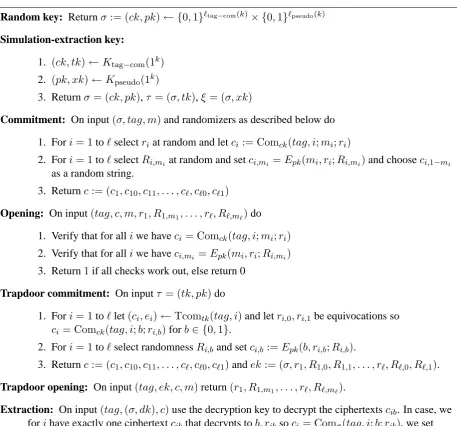
We will construct a tag-based simulation-extractable commitment scheme from the tools in this section. We use a tag-based simulation-sound trapdoor commitment scheme to commit to each bit ofm. Ifm has length`this gives us commitmentsc1, . . . , c`. When making trapdoor commitments, we can use the trapdoor keytkto create equivocal commitmentsc1, . . . , c`that can be opened to any bit we like.
We still have an extraction problem, we may be unable to extract a message from tag-based commitments created by the adversary. To solve this problem we choose to encrypt the openings of the commitments. Now we can extract messages, but we have reintroduced the problem of equivocation. In a trapdoor commitment we may know two different openings of a commitmentcito respectively 0 and 1, however, if we encrypt the opening then we are stuck with one possible opening. This is where the pseudorandomness property of the cryptosystem comes in handy. We can simply make two encryptions, one of an opening to 0 and one of an opening to 1. Since the ciphertexts are pseudorandom, we can open the ciphertext containing the opening we want and claim that the other ciphertext was chosen as a random string. To recap, the idea so far to commit to a bitbis to make a tag-based simulation-sound trapdoor commitmentcito this bit, and create a ciphertext
ci,bcontaining an opening ofcitob, while choosingci,1−bas a random string. These are the main ideas, we now present the protocol in Figure 1.
Theorem 6 Tag-based simulation-extractable commitment schemes exist with pseudorandom keys if
pseu-dorandom cryptosystems with pseupseu-dorandom keys exist.
Proof. Tag-based simulation-sound trapdoor commitments with pseudorandom keys can be built from
one-way functions, so we have the tools needed in the construction. This also shows that we have pseudorandom keys for the tag-based simulation-extractable commitment scheme.
We now need to prove that even after seeing trapdoor commitments and openings, it is hard to come up with a commitment with a different tag, where the opening and extraction are different. Consider first the case, where the adversary for some indexicreatesci, ci0, ci1 so bothci0 andci1 decrypt to valid openings
ofci to respectively 0 and 1. Since tag has not been used before, we have not used tag, i in any com-mitment we have trapdoor opened before, so we have broken the simulation-sound binding property of the tag-based simulation-sound trapdoor commitment. The errorless decryption property of the pseudorandom cryptosystem now tells us that if the adversary opens all triplesci, ci0, ci1 succesfully, then so must we get
these openings when decrypting.
We also need to prove that we have the trapdoor property. We will modify the trapdoor oracle in several steps and show thatAcannot tell the difference. Let us start with the oracle that on input(tag, m)returns a randomly chosen randomizerr1, R1,m1, c1,1−m1, . . . , r`, R`,m`, c1,1−mb. Instead of making commitments
ci:= Comck(tag, i;mi;ri), we may instead run(ci, eki)←Tcomtk(tag, i);ri ←Topeneki(mi)and useri as the randomizer. By the trapdoor property of the tag-based simulation-sound commitment the two oracles are indistinguishable toA.
Next, consider the trapdoor oracle, where we make trapdoor openings to both ri0 and ri1 so ci =
Comck(tag, i;b;ri,b)for bothb = 0andb= 1. We encrypt(b, ri,b)with randomnessRi,b. We then return
ri, Ri,mi, ci,1−mi. By the pseudorandomness of the ciphertexts, this is indistinguishable from the previous
oracle.
STRONG ONE-TIME SIGNATURES. We remind the reader that strong one-time signatures allow a
Random key: Returnσ:= (ck, pk)← {0,1}`tag−com(k)× {0,1}`pseudo(k)
Simulation-extraction key:
1. (ck, tk)←Ktag−com(1k)
2. (pk, xk)←Kpseudo(1k)
3. Returnσ = (ck, pk),τ = (σ, tk),ξ= (σ, xk)
Commitment: On input(σ, tag, m)and randomizers as described below do
1. Fori= 1to`selectriat random and letci := Comck(tag, i;mi;ri)
2. Fori= 1to`selectRi,miat random and setci,mi =Epk(mi, ri;Ri,mi)and chooseci,1−mi as a random string.
3. Returnc:= (c1, c10, c11, . . . , c`, c`0, c`1)
Opening: On input(tag, c, m, r1, R1,m1, . . . , r`, R`,m`)do
1. Verify that for alliwe haveci = Comck(tag, i;mi;ri) 2. Verify that for alliwe haveci,mi =Epk(mi, ri;Ri,mi) 3. Return1if all checks work out, else return 0
Trapdoor commitment: On inputτ = (tk, pk)do
1. Fori= 1to`let(ci, ei)←Tcomtk(tag, i)and letri,0, ri,1 be equivocations so
ci= Comck(tag, i;b;ri,b)forb∈ {0,1}.
2. Fori= 1to`select randomnessRi,band setci,b :=Epk(b, ri,b;Ri,b).
3. Returnc:= (c1, c10, c11, . . . , c`, c`0, c`1)andek:= (σ, r1, R1,0, R1,1, . . . , r`, R`,0, R`,1).
Trapdoor opening: On input(tag, ek, c, m)return(r1, R1,m1, . . . , r`, R`,m`).
Extraction: On input(tag,(σ, dk), c)use the decryption key to decrypt the ciphertextscib. In case, we forihave exactly one ciphertextcibthat decrypts tob, ribsoci= Comσ(tag, i;b;rib), we set
mi :=b. In case all these processes succeed, we return the concatenationm, else we return⊥.
Figure 1: Tag based simulation-extractable commitment.
attack, it must be infeasible to forge a signature on any different message and infeasible to come up with a different signature on the same message. Strong one-time signatures can be constructed from one-way functions.
5.3 Multi-party Computation in the Multi-string Model
We will demonstrate that any well-formed functionalityFcan be securely realized in the multi-string model. In this proof, we build on a result by Canetti et al. [CLOS02], which demonstrates that for any well-formed functionalityF there is a non-trivial protocol that securely realizes it in the common random string model. Our task can therefore be simplified to securely realizingFCRSin the multi-string model.
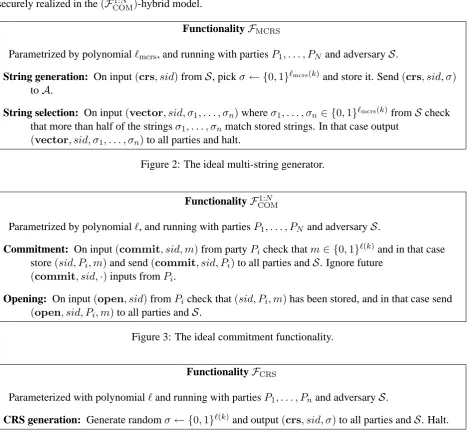
securely realized in the(F1:N
COM)-hybrid model.
FunctionalityFMCRS
Parametrized by polynomial`mcrs, and running with partiesP1, . . . , PN and adversaryS.
String generation: On input(crs, sid)fromS, pickσ ← {0,1}`mcrs(k)and store it. Send(crs, sid, σ)
toA.
String selection: On input(vector, sid, σ1, . . . , σn)whereσ1, . . . , σn∈ {0,1}`mcrs(k)fromS check that more than half of the stringsσ1, . . . , σnmatch stored strings. In that case output
(vector, sid, σ1, . . . , σn)to all parties and halt.
Figure 2: The ideal multi-string generator.
FunctionalityF1:N
COM
Parametrized by polynomial`, and running with partiesP1, . . . , PN and adversaryS.
Commitment: On input(commit, sid, m)from partyPi check thatm∈ {0,1}`(k)and in that case store(sid, Pi, m)and send(commit, sid, Pi)to all parties andS. Ignore future
(commit, sid,·)inputs fromPi.
Opening: On input(open, sid)fromPicheck that(sid, Pi, m)has been stored, and in that case send
(open, sid, Pi, m)to all parties andS.
Figure 3: The ideal commitment functionality.
FunctionalityFCRS
Parameterized with polynomial`and running with partiesP1, . . . , Pnand adversaryS.
CRS generation: Generate randomσ ← {0,1}`(k)and output(crs, sid, σ)to all parties andS. Halt.
Figure 4: The ideal common random string generator.
We will assume the parties can broadcast messages, i.e., have access to an ideal broadcast functionallity FBC, see Figure 5. We note that broadcast can be securely realized in a constant number of rounds if au-thenticated communication is available [GL05]. Furthermore, auau-thenticated communication can be securely realized using digital signatures, so one possible setup is that the parties somehow have managed to exchange verification keys for the digital signature scheme.
FunctionalityFBC
Running with partiesP1, . . . , Pnand adversaryS.
Broadcast: On input(broadcast, sid, ssid, m)fromPi, send(broadcast, sid, ssid, Pi, m)to all parties andS. Ignore future(broadcast, sid, ssid,·)inputs fromPi.
5.4 Universally Composable Commitment in the Multi-string Model
In our security proof, the ideal process adversarySwill interact withF1:N
COMand make a black-box simulation
ofArunning withFMCRS andP1, . . . , PN. There are two general types of issues that can come up in the ideal process simulation. First, whenF1:N
COM tells S a party has committed to some message,S does not
know which message it is. Therefore, we want to be able to make trapdoor commitments and later open them up. Second, when a corrupt party sends a commitment, thenS needs to input some message toF1:N
COM. In
this case, we therefore need to have an extractable commitment to the message. The tag-based simulation-extractable commitments presented in Section 5.2 come close to fitting this description.
Our idea is to use each of thencommon random strings output by FMCRS as a public key for such a commitment scheme. This gives us a set ofncommitment schemes, of which at leastt=dn+12 eare secure. Without loss of generality, we will from now on assume we have exactlytsecure commitments. In the ideal process, the simulator gets to pick these keys and can therefore pick them as simulation-extractable keys.
To commit to a message m, a party makes a(t, n)-threshold secret sharing of it and commits to each secret share using a different commitment scheme. When making a trapdoor commitment, we make honest commitments ton−trandom shares for the adversarial keys, and trapdoor commitments with the simulation-extractable keys. Since the adversary knows at mostn−t < tshares, we can later open the commitment to any message we want by fitting the remainingt shares and trapdoor opening the commitments to these shares. To extract a messagem, we extracttshares from the simulation-extractable commitments. We can now combine the shares to get the adversarial message.
One remaining issue is when the adversary recycles a commitment or parts of it. This way, we may risk that it uses a trapdoor commitment made by an honest party, in which case we are unable to extract a message. To guard against this problem, we will let the tag for the simulation-extractable commitment scheme contain the identity of the senderPi, forcing the adversary to use a different tag, which in turn enables us to extract.
Another problem arises, when the adversary corrups a party, which enables it to send messages on behalf of this party. At this point, however, we learn the message so we just need to force it to reuse the same message if it reuses parts of the trapdoor commitment. We therefore introduce a second trapdoor commitment scheme, use this trapdoor commitment scheme to commit to the shares of the message, and insert it in the tag as well. Therefore, if reusing a tag, the adversary must also reuse the same share given by this tag.
Commitment: On input(vector, sid,(ck1, σ1), . . . ,(ckn, σn))fromFMCRS and(commit, sid, m) from
Z, the party Pi does the following. He makes a (t, n)-threshold secret sharing s1, . . . , sn of m. He picks randomizers rj and makes commitments cj := Comck(sj;rj). He also picks random-izers Rj and makes tag-based commitments Cj := Comck((Pi, cj);sj;Rj). The commitment is
c:= (c1, C1, . . . , cn, Cn). He broadcasts(broadcast, sid, c).
Receiving commitment: A party on input (vector, sid,(ck1, σ1), . . . ,(ckn, σn)) from FMCRS and
(broadcast, sid, Pi, c)fromFBCbroadcasts(broadcast, sid, Pi, c).
Once it receives similar broadcasts from all parties, all containing the same Pi, c, it outputs
(commit, sid, Pi)to the environment.
Opening commitment: Party Pi wishing to open the commitment broadcasts
(open, sid, s1, r1, R1, . . . , sn, rn, Rn).
Receiving opening: A party receiving an opening (open, sid, Pi, s1, , r1, R1, . . . , sn, rn, Rn) from FBC
to a commitment it earlier received, checks that all commitments are correctly formed cj =