
Volume 2006, Article ID 39604, Pages1–12 DOI 10.1155/WCN/2006/39604
CSMA/CCA: A Modified CSMA/CA Protocol Mitigating
the Fairness Problem for IEEE 802.11 DCF
Xin Wang and Georgios B. Giannakis
Department of Electrical and Computer Engineering, University of Minnesota, Minneapolis, MN 55455, USA
Received 15 August 2005; Revised 23 November 2005; Accepted 22 December 2005
Carrier sense multiple access with collision avoidance (CSMA/CA) has been adopted by the IEEE 802.11 standards for wireless local area networks (WLANs). Using a distributed coordination function (DCF), the CSMA/CA protocol reduces collisions and improves the overall throughput. To mitigate fairness issues arising with CSMA/CA, we develop a modified version that we term CSMA with copying collision avoidance (CSMA/CCA). A station in CSMA/CCA contends for the shared wireless medium by em-ploying a binary exponential backoffsimilar to CSMA/CA. Different from CSMA/CA, CSMA/CCA copies the contention window (CW) size piggybacked in the MAC header of an overheard data frame within its basic service set (BSS) and updates its backoff counter according to the new CW size. Simulations carried out in several WLAN configurations illustrate that CSMA/CCA im-proves fairness relative to CSMA/CA and offers considerable advantages for deployment in the 802.11-standard-based WLANs.
Copyright © 2006 X. Wang and G. B. Giannakis. This is an open access article distributed under the Creative Commons Attribution License, which permits unrestricted use, distribution, and reproduction in any medium, provided the original work is properly cited.
1. INTRODUCTION
The medium access control (MAC) protocol is the main
element determining how efficiently the limited
commu-nication bandwidth of the underlying wireless channel is shared in a wireless local area network (WLAN). It is cru-cial that the MAC protocol provides robustness and
fair-ness among users. The IEEE 802.11 standards [5–7] are the
first international standards for WLANs, providing general MAC layer and physical (PHY) layer specifications. At the MAC layer, IEEE 802.11 specifies a basic distributed coor-dination function (DCF) and an optional point coordina-tion funccoordina-tion (PCF). Our work in this paper pertains to
the DCF, which is a contention-based decentralized
proto-col utilizing the so-called carrier sense multiple access with collision avoidance (CSMA/CA). The latter constitutes the basic access mechanism for supporting asynchronous data transfer. At a high-level description, the CSMA/CA for DCF
consists of two parts: the CSMA scheme [2] and the CA
scheme, relying on a binary exponential backoff(BEB)
algo-rithm [2]. In the DCF, collisions of MAC frames are avoided
and/or resolved by jointly utilizing the CSMA scheme and the BEB algorithm. The analytical and simulation results
in [8,9] confirm that CSMA/CA endows the IEEE 802.11
WLANs with fairly good saturation throughput. In the long term, the DCF basically provides the contending stations
equal opportunities to access the shared channel. However, with a nonfully connected wireless network topology, the
IEEE 802.11 CSMA/CA protocol has to deal with thefairness
problemwhereby stations cannot gain access to the wireless
medium equally during heavy traffic conditions [10].
More-over, since contending stations do not always have a frame to
transmit, they experience unfairness [12]. The fairness
prob-lem may seriously affect thequality of service (QoS)support
for WLAN. The desirable QoS of some users may not be sat-isfied due to unfair access opportunities. Modifications to the existing IEEE 802.11 MAC protocols have been proposed
[10–18], most aiming to modify the BEB algorithm.
It is well known that the fairness problem within the IEEE 802.11 WLANs comes behind the fact that each station must rely on its own direct experience in estimating conges-tion, which often leads to asymmetric views. All schemes in
[10–15] are designed to counter the possibly wrong direct
experience of congestion estimates. However, in the designs
of [10–15], the hidden-station problem [2, Section 4.2.6],
which is one of the main sources of erroneous direct expe-rience estimates, was seldom investigated. Based on the
mul-tiple access with collision avoidance (MACA) protocol [3],
Bharghavan et al. introduced the so-termed MACAW
proto-col [4], which accounts for the hidden-station problem. The
idea in MACAW amounts to a simple yet efficient “backoff
about network congestion levels becomes a collective
prac-tice. Further congestion information exchange and backoff
schemes improved the fairness of the original MACA proto-col considerably.
The objective of this paper (in par with the goals of most prior works) is to develop a MAC protocol capable of miti-gating the fairness problem at low cost and without having to make major modifications to existing hardware. By miti-gating the fairness problem, CSMA/CCA facilitates QoS pro-visioning regardless of the underlying network topology.
In-spired by the backoffcopying in [4], our simple plan is to
apply the contention window (CW) size copying among
sta-tions. We call the resulting protocol CSMA withcopying
col-lision avoidance (CSMA/CCA), since it is rooted in the origi-nal CSMA/CA protocol. Stations in CSMA/CCA contend for the channel similarly as in the CSMA/CA protocol. However, after winning the contention, a station piggybacks its CW size in its data frame. Deferring stations in the same basic service set copy the CW size in the overheard data frame. By this CW size copying, we expect that the stations can con-tend for the channel with similar CW sizes, thereby access-ing the channel statistically equally. The main contribution of
this paper is a practical MAC protocol, which is also different
from the prior work in the following: (1) it is specifically tai-lored for IEEE 802.11 DCF; (2) unlike the continuous-value
backoffcopying, CW size copying incurs only 3 bits overhead
which can be easily absorbed by the current standards; (3)
while GDCF [13] implements the gentle CW decrease based
on the individual station’s contention history, our gentle CW size decrease algorithm takes into account the overall
chan-nel traffic; and (4) by the CW size reset function, we mitigate
theshadowed-receiver problemwhich remains unresolved in
MACAW [4].
The paper is organized as follows. InSection 2, the IEEE
802.11 DCF based on the CSMA/CA protocol is briefly out-lined. Design of the proposed CSMA/CCA protocol is
pre-sented in Section 3. Then, inSection 4, computer
simula-tions are carried out to evaluate the performance of CSMA/ CCA.Section 5gives the conclusions of this paper.
2. IEEE 802.11 DCF BASED ON THE CSMA/CA PROTOCOL
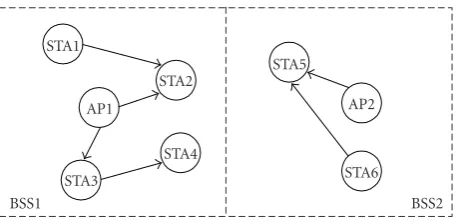
Figure 1depicts an example configuration covered by IEEE
802.11 standards [5,6], where a set of stations controlled by
a single coordination function (such as a DCF) is defined as a basic service set (BSS). There are two kinds of BSSs:
in-dependent BSS (IBSS) and infrastructure BSS, the difference
being that there is an access point (AP) in infrastructure BSS
whereas no AP is available in IBSS. Both BSSs inFigure 1are
infrastructure ones. The members (stations or APs) of a BSS,
for example, STA3 (hereafter, STAndenotes stationn) and
STA4 in BSS1, can directly communicate with each other, but
two stations in different BSSs can only communicate through
their APs and the distribution system (DS); for example, data from STA3 to STA5 has to go through STA3-AP1-AP2-STA5. Clearly, since there is no AP in IBSS, stations in one IBSS cannot communicate with stations in other BSSs. There is a
STA1
Figure1: An example configuration of the IEEE 802.11 WLAN.
unique BSS identification (BSSID) which is the MAC address in use by the AP of the BSS. In the WLAN, a link is referred to as a directional data stream between two stations. The di-rection of the link is determined by the data frame
trans-mission; for example, link STA3-STA4 inFigure 1indicates
that STA3 is the initial station and intends to transmit a data frame to STA4. It is the initial station of a link who contends for the link. In an infrastructure BSS, a normal station has
one transmit buffer and can only initiate one link at a time.
The AP may initiate more than one link. When the AP is the initial station of more than one link, it contends for these links separately. In this case, the AP is viewed as several dif-ferent initial stations at the MAC layer by default; for
exam-ple, AP1 inFigure 1is viewed as two different initial stations
by the MAC protocol when it contends for links AP1-STA2 and AP1-STA3 separately. Since all the members of a WLAN share the same wireless channel, a MAC protocol is needed to coordinate their access.
At the MAC layer, the IEEE 802.11 specifies a basic DCF based on the CSMA/CA protocol. For DCF operations, IEEE 802.11 defines certain interframe space (IFS) intervals be-tween successive transmissions of MAC frames. The two rel-evant intervals are short IFS (SIFS) and DCF-IFS (DIFS). The SIFS is smaller and used for high-priority frames such as ACK (acknowledgment) frames and CTS frames; whereas the DIFS is larger and used for normal data frames in DCF operation.
In the CSMA/CA protocol, an initial station with a MAC frame to transmit has to sense the channel. If the channel is idle for a DIFS period, the station can proceed with its trans-mission. Otherwise, the station defers and continues mon-itoring the channel until an idle DIFS is detected. Then a
random backoffcounter is generated by the station before
sending. The backoffcounter runs down as long as the
chan-nel remains idle; it pauses when the chanchan-nel becomes busy; and it resumes as the channel is idle for a DIFS period again.
The station is permitted to transmit when its backoffcounter
reaches zero. For implementation efficiency purposes, the
backoff counter employed by DCF is discrete-time scaled.
The time immediately following an idle DIFS is slotted and
the random backoffcounter counts down one after a slot.
size w which has minimum value CWmin and maximum
value CWmax. Before each transmission, the initial value of
the backoffcounter is uniformly chosen by the initial station
in the range [0,w−1]. At the first attempt of a data frame,
wis set to CWmin. After each failed transmission, it doubles
wuntil the latter reaches CWmax. After each successful data
frame transmission,wis reset to CWminsince it begins the
first attempt of another data frame.
With the CSMA/CA protocol in use, the DCF provides both a DATA-ACK two-way handshaking basic access mech-anism and an RTS-CTS-DATA-ACK four-way handshak-ing access mechanism (called RTS/CTS access mechanism hereinafter). In the basic access mechanism, the CSMA/CA protocol is applied to the DATA/ACK exchange. A good il-lustration for the implementation of the basic access
mech-anism of DCF can be found in [1, Chapter 11]. The
dif-ference between the RTS/CTS access mechanism and the basic access mechanism is the addition of the RTS/CTS ex-change for reservation purposes before DATA/ACK trans-missions. The CSMA/CA protocol is applied to the short RTS/CTS exchange and DATA/ACK transmissions are
car-ried out contention-free. This mechanism is effective for
sys-tem performance when the average length of data frames is large compared to that of the RTS and CTS frames. Be-sides reservation, the purpose of RTS and CTS frames is to carry the duration of the following DATA/ACK exchange. Based on this information, all other stations in the WLAN are then able to update their network allocation vectors (NAVs), which indicate how long the channel will remain busy. For the RTS/CTS access mechanism, IEEE 802.11 standards de-fine virtual carrier sensing based on the NAV signal. An ini-tial station is able to proceed with its transmission only if the channel is sensed idle both physically and virtually. Vir-tual carrier sensing is designed to combat the hidden-station problem for radio channels.
3. DESIGN OF THE CSMA/CCA PROTOCOL
The proposed CSMA/CCA protocol operates under two as-sumptions: (1) RTS/CTS access mechanism is active (even though the proposed CSMA/CCA can be applied also to the basic access mechanism, RTS/CTS access mechanism is in-corporated for better addressing the fairness issue related to the hidden-station problem); and (2) all the links in the WLAN have identical priorities. Although the newly
pro-posed IEEE 802.11e standard [7] defines a MAC
enhance-ment for QoS traffic and some recent efforts were made to
provide fairness in QoS [19,20], we do not deal with
QoS-enabled MAC architectures, where links could have different
priorities.
Based on the fact that the CW size represents the con-tending priority and the stations could contend fairly with similar CW sizes, our CSMA/CCA protocol aims to
miti-gate the fairness problem. The main difference between the
proposed CSMA/CCA and the existing CSMA/CA protocol is the addition of the CW size copying, which we invoke to handle the inherent fairness problem. In our novel CCA scheme, we define CW size copying routines and propose a
gentle BEB equipped with reset (GBEBwR) algorithm mod-ified from the BEB algorithm to control the CW size of each initial station. The detailed design of the CW size copying routines and the GBEBwR algorithm are presented next.
3.1. CW size copying routines
The CW size copying routines include a piggyback routine, a copy routine, and an update routine. In our CSMA/CCA
pro-tocol, initial stations contend for the channel with a backoff
-before-transmit process, as in the CSMA/CA protocol. How-ever, after winning the contention, that is, after a successful RTS/CTS exchange, a station executes a piggyback routine to piggyback its CW size in its data frame. Then the deferring stations copy the CW size in the overheard data frame with a copy routine. After CW size copying, the deferring stations
also execute a routine to update their current backoff
coun-ters according to the new CW size.
Piggyback routine
In IEEE 802.11 standards [5–7], the CW size w can only
take the values of 2lCW
min,l =0, 1,. . .,L−1, in the range
[CWmin, CWmax], where CWmin, CWmax, and the number of
CW size levelsLare PHY-specific. To carry the CW size
copy-ing, we only need to piggyback the corresponding CW size level in a frame. For various IEEE 802.11 PHY layer speci-fications, it turns out that at most 7 levels of CW size, car-ried by 3 bits, are required. Since the CW size information is used for MAC operation, we piggyback it in the MAC header of certain frames. The general IEEE 802.11 MAC frame format comprises a set of fields in a fixed order in
all frames, as depicted in Figure 2. Each MAC frame
con-sists of a MAC header, a frame body, and a frame check
se-quence (FCS). Note that CW size copying is effective only
when there exists a successful transmission. For the RTS/CTS access mechanism, a data frame is always transmitted un-der the contention-free situation with high probability of success. For this reason, we plug the CW size level in the MAC header of a data frame. For instance in IEEE 802.11a,
b, as shown inFigure 2, the frame control field in the MAC
header consists of a number of subfields, among which the type and subtype fields together identify the function of the frame. The type value of a data frame is defined as 10 and the subtype values 1000–1111 for the data frame are reserved in IEEE 802.11. These reserved subtype values can provide the required 3 bits to carry the CW size level. In a nutshell, our piggyback routine proceeds as follows: after winning the contention, a station piggybacks its CW size level in the data frame MAC header with the subtypes 1000–1111, where the first bit indicates the piggyback in a normal data frame, and the remaining three bits specify the CW size level. Note that some reserved subtype values 1000–1111 are already used in
802.11e for QoS support [7]. However, the new 802.11e MAC
MAC header
Octets: 2 2 6 6 6 2 6 0-2312 4
Frame control
Duration
/ID Address 1 Address 2 Address 3 Sequence
Figure2: MAC frame format.
Table1: Address field contents.
ToDS FromDS Address 1 Address 2 Address 3 Address 4
0 0 DA SA BSSID N/A
0 1 DA BSSID SA N/A
1 0 BSSID SA DA N/A
1 1 RA TA DA SA
Copy routine
In the MACAW protocol [4], it is suggested that the backoff
copying should be allowed only among the pads in the same cell. In the proposed CSMA/CCA protocol with stations and BSS playing the roles of pads and cell, we follow similar steps and copy the CW size without leakage across the BSSs by utilizing the BSSIDs. The frame format for a data frame is
shown inFigure 2. The content of the address fields depends
on the values of the ToDS and FromDS bits (which indicate if the frame goes to or comes from another BSS, with a “1”
in-dicating “true”) in frame control field, as defined inTable 1.
If the content is shown as N/A, the field is omitted. The DA and SA denote the destination and sender addresses, respec-tively. The RA and TA are only used in a data frame transmis-sion between two APs (in the situation that both ToDS and FromDS are equal to 1), and denote the addresses of receiv-ing and transmittreceiv-ing AP, respectively. Note that RA and TA are two BSSIDs for the BSSs to which the two APs belong. To prevent leakage across the BSSs, we design a copy routine as follows: upon hearing a data frame, a deferring station copies the CW size only if the overheard data frame carries a BSSID, RA or TA matches the station’s BSSID, and the piggybacked
CW size level is different from the station’s CW size.
Update routine
Along with CW size copying, the deferring stations also need
to update their backoffcounter values. Through the update,
the backoffcounter of a deferring station pretends to be
gen-erated according to the new CW size. To this end, we design
an update routine as follows: letwn,wodenote the new and
old CW sizes of a deferring station before and after CW size copying, respectively; and define a CW size changing factor
fc=wn/wo. Then a deferring station updates the new backoff
counter valuecnfrom the old valuecousing
cn=
where xrnd denotes a random real number uniformly
dis-tributed in [0, 1), andadenotes the integer part of a
posi-tive real numbera. Note thatfcis an integer when it is greater
than 1. When the CW size increases by a factor fc, we add
fcxrndtocofcso that the future collision probability is
re-duced; and thus stations with the samecomay no longer
col-lide in the future. Accordingly, when the CW size decreases,
we simply usecofcas the new counter value. In this way,
the backoffcounter update (1) saves the contention histories
of the deferring stations, as in the CSMA/CA protocol.
3.2. GBEBwR algorithm
The GBEBwR algorithm is used to control the CW size of an initial station in the proposed CSMA/CCA protocol. In the GBEBwR, a station does not reset its CW size to the min-imum after only one successful transmission as in the BEB algorithm. Instead, we use a gentle CW size decrease algo-rithm, where a station halves its CW size after hearing no
less thancconsecutive successful transmissions in its BSS.
Al-though independently designed, this gentle CW size decrease
is very similar to the GDCF scheme in [13]. In GEBEwR,
when a station’s access attempt fails, the station doubles its CW size until reaching a maximum value as in the BEB
al-gorithm. However, to cope with theshadowed-receiver
prob-lem, we design a CW size reset function where a station resets
its CW size to the minimum value, instead of doubling it as
in GDCF, when it experiencesrconsecutive failed access
at-tempts.
Gentle CW size decrease algorithm
In the CSMA/CA protocol, the CW sizewof the initial
sta-tion is reset to CWminupon a success. If we adopt this rapid
decrease scheme in the proposed CSMA/CCA and let it affect
range have a minimal CW size. Then we repeat a period of contention to increase the CW size until a successful access attempt happens. To avoid this wild oscillation, a multiplica-tive increase and linear decrease (MILD) algorithm is used in
the MACAW protocol [4] to control the adjustment of
back-offintervals. With the MILD algorithm, the backoffinterval
of a station is increased upon a collision by a multiplicative
factor (1.5) and is decreased by 1 upon success. Clearly, the
MILD algorithm cannot be applied to our CW size adjust-ment since the CW size can only take limited values. To fa-cilitate our CW size copying, we design a gentle CW size de-crease algorithm, which is similar to the GDCF scheme in
[13] but is based on the overall channel traffic instead of
indi-vidual station’s contention history. We let each initial station
have an integer success counternswith initial value 0. The
counter nsis updated in several ways. Whenever an initial
station finishes a successful RTS/CTS exchange, it increases
itsnsby 1, that is,ns=ns+ 1; and whenever it has a failed
RTS/CTS exchange, it resets itsnsto 0. Whenever an initial
station hears a data frame with a matched BSSID, if the over-heard frame carries the same CW size as its current one, it
sets itsns=ns+ 1; otherwise it sets itsns=1. Before sending
its data frame after winning the contention, the station
com-pares itsnswith a prescribed decrease thresholdd, which is
a design parameter. Ifns≥d, as resettingns=0, the station
halves its current CW size and piggybacks the new CW size level in the data frame MAC header. Otherwise, the station does not adjust its CW size and piggybacks its current CW size level. This way, the gentle CW size decrease algorithm disallows simultaneous fast decrease of all the initial stations’ CW sizes.
CW size reset function
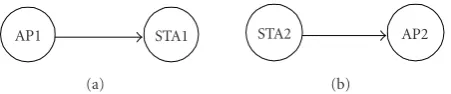
Normally, the double-upon-collision size of the CW used in the BEB algorithm is still adopted by the GBEBwR algorithm. Together with the gentle CW size decrease algorithm, from a single station’s point of view, the CW size adjustment be-comes a fast-increase-slow-decrease process. This may in-duce the shadowed-receiver problem, which is illustrated by Figure 3, copied from [8, Figure 7]. In this two-BSS con-figuration, both STA1 and STA2 are in range of each other but can only hear their respective APs. Consider that links AP1-STA1 and STA2-AP2 are active. In this scenario, the two
initial stations AP1 and STA2 may have very different
con-tention experiences. Whenever AP1 is sending a data frame, STA2 would know the duration of the data transmission from the preceding CTS frame sent by STA1. Therefore, it defers and resumes to contend the channel until the AP1-STA1 transmission ends. However, when STA2 is sending, AP1 still senses an idle channel physically and virtually, thereby may access the channel. As AP1 accesses the channel during the STA2-AP2 transmission, STA1 becomes a shad-owedreceiver. STA1 may not receive the RTS frame from AP1 and is not allowed to respond since it is in the range of STA2.
As a result, the CW size in AP1 could rapidly reach CWmax
during the STA2-AP2 transmission. For a
fast-increase-slow-decrease algorithm, the situation inFigure 3always ends up
STA1 AP1
(a)
STA2 AP2
(b)
Figure3: A two-BSS configuration where both stations are only in range of their respective APs and also in range of each other: (a) AP1 is sending data to STA1, and (b) STA2 is sending data to AP2. Each link is generating data at 32 frames per second.
with AP1 having a maximum CW size and STA2 having a minimum CW size. Note that this shadowed-receiver prob-lem can also occur within one BSS; for example, replacing AP1 and AP2 with STA3 and STA4 and assuming that all the stations are in the same BSS but STA3 and STA4 cannot hear each other, the same problem arises. The MACAW protocol
[4] fails in this shadowed-receiver scenario, since with link
STA2-AP2 fully seizing the channel, link AP1-STA1 is pro-hibited. Without a CW size reset function, our CSMA/CCA
protocol does not fail thanks to the good backoffscheme
inherited from the CSMA/CA protocol. But STA2 probably seizes the channel much more often than AP1, causing the shadowed-receiver problem because the initial station cannot distinguish between access failure due to collision and access failure due to the shadowed-receiver. Based on the observa-tion that the initial staobserva-tion could probably have consecutive failed accesses in a shadowed-receiver scenario, we design a CW size reset function as follows. We let each initial station
have an integer failure counternf with initial value 0.
When-ever an initial station senses a busy channel due to other sta-tions, or, it finishes a successful RTS/CTS exchange by itself,
it resets itsnf to 0. Only after a failed RTS/CTS exchange by
itself, it increases itsnf by 1, that is,nf = nf + 1. Then it
compares itsnf with a prescribed reset thresholdr, which is
another design parameter. Ifnf < r, it doubles its CW size as
normal; otherwise, withnf =0, the station resets its CW size
back to CWmin.
3.3. Operation of CSMA/CCA protocol
Here we summarize the operation of our CSMA/CCA
pro-tocol. In CSMA/CCA, each initial station has a CW sizew,
a backoff counter, a success counter ns along with a
pre-scribed decrease thresholdd, and a failure counternf along
with a prescribed reset threshold r at the MAC layer. The
values of the thresholds dandr will be heuristically
deter-mined through simulations.1For clarity, consider the
finite-state machine ofFigure 4describing the behavior of an initial
station. In the proposed CSMA/CCA protocol, an initial sta-tion can be in one of six states.
(1) Waiting: the station has an empty transmit queue and is waiting for the data arrival.
Waiting Coordinating Contending Deferring
fails Backoendsff
RTS/CTS succeeds
Figure4: A finite-state machine for the behavior of an initial station in the proposed CSMA/CCA protocol.
(2) Coordinating: the station is coordinating its CW size
and backoffcounter according to the proposed CCA
mechanism.
(3) Contending: the station is contending the channel by
running down its backoffcounter.
(4) Deferring: the station is deferring its contention due to the busy channel.
(5) Accessing: the station is performing RTS/CTS ex-change.
(6) Winning: the station is performing DATA/ACK ex-change.
The coordinating state is in the core of the operation. In this state, the proposed CCA scheme, which is our ma-jor contribution, is active to resolve the collision and achieve
fairness. An initial station transits between different states
and behaves at the MAC layer as follows.
(1) Waiting-coordinating: after data frames arrive and the channel is sensed idle (by the CSMA scheme) for a DIFS period, the station transits from the waiting state to the co-ordinating state, in which a random integer is uniformly
se-lected from [0,w−1] as the backoffcounter value.
(2) Coordinating-contending: if the transmit queue is
non-empty, after the backoffcounter value is determined, the
station starts or resumes its backoffcounter and then transits
from the coordinating state to the contending state, in which
the backoffcounter keeps running down as long as the
chan-nel is idle.
(3) Contending-deferring: if the channel is sensed busy
before the backoffcounter reaching zero, the station transits
from contending to deferring, in which it freezes its backoff
counter and resets its failure counternf =0.
(4) Deferring-coordinating: after the channel is sensed idle for a DIFS period, the station transits from deferring to coordinating. If a data frame is heard successfully while deferring, the station executes the copy routine in the coor-dinating state to determine if it needs to copy the CW size in the overheard frame. If the overheard data frame has a matched BSSID and carries the same CW size as the sta-tion’s, the station does not copy and increments its success
counterns = ns+ 1. However, if the overheard data frame
with a matched BSSID carries a different CW size, the station
copies the CW size and executes the update routine to
re-fresh its current backoffcounter value as in (1), while setting
itsns= 1. Corrupted and overheard data frames without a
matched BSSID are ignored.
(5) Contending-accessing: upon its backoff counter
reaching zero, the station transits from contending to access-ing, in which an RTS/CTS exchange is carried out.
(6) Accessing-coordinating: if the RTS/CTS exchange fails, the station transits from accessing to coordinating. In the coordinating state, the station resets its success counter
tons=0 and sets its failure counter tonf =nf+ 1. Then the
station compares itsnf with the reset thresholdr. Ifnf < r,
it doubles its CW sizewuntil reaching CWmax; otherwise, as
resettingnf =0, the station resets its CW sizew=CWmin. A
random integer is generated according to the new CW sizew
as the backoffcounter value.
(7) Accessing-winning: if the RTS/CTS exchange suc-ceeds, the station transits from accessing to winning. In the
winning state, the station resets its failure counter tonf =0
and sets its success counter tons=ns+ 1. Then the station
compares itsnswith the decrease thresholdd. Ifns ≥d, as
resettingns=0, the station halves its CW sizew; otherwise,
it keepswunchanged. Finally, it executes the piggyback
rou-tine to piggybackwin the MAC header of the data frame and
performs DATA/ACK exchange.
(8) Winning-coordinating: after the DATA/ACK ex-change, the station transits from the winning state to the co-ordinating state. If the DATA/ACK succeeds, the transmitted
data frame is removed from the transmit buffer; otherwise, it
is still kept for retransmissions. Then if the transmit queue is nonempty, the station generates a random integer as its
back-offcounter value according to its CW sizew.
(9) Coordinating-waiting: if the transmit queue is empty, the station transits from the coordinating state to the waiting state.
4. PERFORMANCE EVALUATION
We use computer simulations to evaluate the performance of the proposed CSMA/CCA protocol and compare it with that of the CSMA/CA protocol in the IEEE 802.11 DCF. In the simulations, we assume a “near-field” radio technology in use in the investigated IEEE 802.11 WLANs, where both capture and interference are rare due to sharp decays in
Table2: FHSS system parameters and additional parameters used in the simulations.
Frame payload 8184 bits
MAC header 272 bits
PHY header 128 bits
ACK 112 bits + PHY header
RTS 160 bits + PHY header
CTS 112 bits + PHY header
Channel bit rate 1 M bits/s
Propagation delay 1μs
Slot duration 50μs
SIFS 28μs
DIFS 128μs
CWmin 16
CWmax 1024
Retry limit for RTS/CTS access 7 CW size decrease thresholdd 10 (default) CW size reset thresholdr 4 (default)
channel. When a receiver is in the range of more than one transmitting station, a collision occurs and all transmitted frames cannot be recovered. A frame can also be corrupted by the noise even when there is no collision. The simulations
are carried out at the frame level. The effect of the noise is
simulated by a given bit error rate (BER)Pbfor all the links.
The success probabilityPsof a frame in a link is then given
byPs=(1−Pb)t, wheretis the duration of the frame in bits.
Infinite transmit buffering is assumed for each link.
The values of the system parameters for the IEEE 802.11
DCF simulator are summarized inTable 2. As in [8], these
parameter values closely follow those specified for the fre-quency hopping spread spectrum (FHSS) PHY layer in IEEE
802.11b standard [5]. Note that for each data frame, there
is a retry limit. Whenever the number of retransmissions of a data frame reaches this limit, it has to be removed from
the transmit buffer no matter if its last transmission succeeds
or not. The channel bit rate is assumed 1M bits/s. Frame and header sizes are exactly as those defined by IEEE 802.11 MAC and FHSS PHY layer specifications. Unless otherwise specified, the data frame body payload size is constant (8, 184 bits), which is about a fourth of the maximum MAC pro-tocol data unit (MPDU) size (4095 octets) specified for the
FHSS PHY layer [5, Section 14.9]. Unless otherwise
speci-fied, we assume that the BERPb=10−5, thereby resulting in
a 0.9177 data frame success probability. The error detection
of transmitted frames by their FCS is assumed to be perfect at the receiver. Each simulation result (in the sequel) is ob-tained by averaging 10 independent runs, where in each run the simulated system is typically run for a time period be-tween 100 and 500 seconds.
4.1. Performance measures
To evaluate the network performance, we use five perfor-mance measures: throughput, average data frame delay, data frame loss rate, and two fairness indices: STD (standard de-viation) and LFI (link fairness index).
We define the throughput Ras the average number of
successful data frames per second, and the average data frame
delayDas the average delay in seconds for a data frame from
being generated to being successfully received. We define the
data frame loss ratioρas
ρ:= number of discarded data frames
total number of transmitted data frames. (2)
Since infinite transmit buffering is assumed, the data frame
loss is only caused by the prescribed retry limit. When
cal-culating the total number of transmitted data frames in (2),
we do not count retransmissions of the same data frames. The STD is defined as the standard deviation of the
indi-vidual link throughput. IfN denotes the number of links,
R the total throughput, andRnthe throughput for link n,
n=1, 2,. . .,N, then the STD is given by
4.2. Fully loaded IBSS
As in [8,10], we first investigate a fully loaded IBSS
(with-out AP and communication with other BSSs), in which we assume a fixed number of links per IBSS, each always hav-ing a data frame ready to send. The throughput obtained in this fully loaded case is the maximum one which the IBBS
can afford. In this case, we do not consider the delay measure
since the queueing delay for a data frame could become ar-bitrarily large. In the IBSS considered, all stations are within the radio range of each other. There does not exist hidden-station problem, let alone the shadowed-receiver problem.
Hence, the reset thresholdrdoes not affect the performance
of CSMA/CCA. We take a default valuer =4. As described
inSection 3, for the operation of the proposed CSMA/CCA,
we need to assign a decrease thresholdd. The performance
evaluation of CSMA/CCA with differentds and that of the
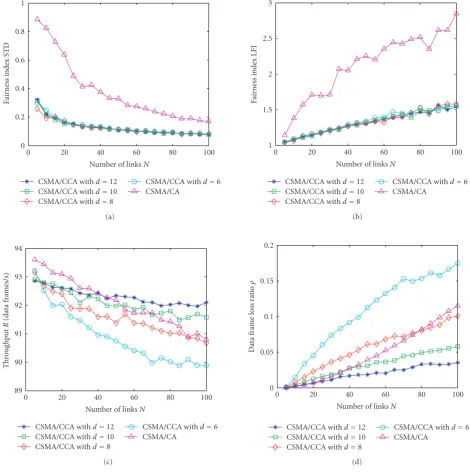
CSMA/CA protocol are compared inFigure 5. As shown in
Figures5(a)and5(b), the CSMA/CCA protocols have much
smaller fairness indices (STDs and LFIs) than the CSMA/CA protocol. This fact meets the design expectation and demon-strates that the CW size copying can mitigate the fairness
problem. InFigure 5(c), the CSMA/CCA protocols withd=
10, 12 have a steady throughput whereas the CSMA/CCA
protocols withd = 6, 8 and the CSMA/CA protocol have
large throughput drops as the network traffic load
(num-ber of links) goes up. Note that when the traffic load is not
100
Number of linksN 0
Number of linksN 1
Number of linksN 89
Number of linksN 0
Figure5: Comparison of (a) fairness index STD, (b) fairness index LFI, (c) throughput, and (d) data frame loss ratio for the CSMA/CCA protocol and CSMA/CA protocol in a fully loaded IBSS.
CSMA/CA relative to CSMA/CCA whenN <40. As shown in
Figure 5(d), the CSMA/CCA protocols withd=10, 12 have smaller data frame loss ratios than the CSMA/CA protocol,
whereas the CSMA/CCA protocol with d = 6, 8 exhibits
larger data frame loss ratio than the CSMA/CA protocol. The worse throughput and data frame loss ratio performance
of the CSMA/CCA protocols with small ds comes from
the oscillation phenomenon stated in [4]. It coincides with
the analysis in [13] and suggests that a moderate decrease
thresholddshould be chosen to avoid possible performance
drops in throughput and data frame loss ratio.
4.3. Infrastructure BSSs with Poisson arrivals
To evaluate CSMA/CCA in more realistic scenarios, we revisit
certain network configurations from [4]. In those
configura-tions, we consider infrastructure BSSs with Poisson arrivals. There exist an AP and several associated stations in each BSS and each link is fed with data frames following a Poisson
dis-tribution with the same intensityλ=32 data frames/s. Unless
otherwise specified, the stations can only hear their associ-ated AP and vice versa. By default, we assign the decrease
STA1
Figure6: A two-BSS configuration where all the stations in BSS1 and STA5 in BSS 2 are in range of each other. The stations are send-ing data to their respective APs. Each link is generatsend-ing data at 32 frames per second.
In the following network configurations, we compare CSMA/CCA against the existing CSMA/CA protocol. In
or-der to investigate the effects of the designed CW size reset
function and the CW size copying leakage, we also test two modified versions of the CSMA/CCA protocols: CSMA/CCA protocol without reset and CSMA/CCA protocol allowing for leakage. In the CSMA/CCA without reset, we simply set the
reset threshold to a large numberr = 100, so that the CW
size reset function seldom works; whereas, unless otherwise
specified, we let the reset threshold r = 4 in CSMA/CCA.
In the CSMA/CCA allowing for leakage, we let a deferring station copy the CW size level in the overheard data frame without checking the BSSID.
A two-BSS configuration
First, we consider a two-BSS configuration copied from [8,
Figure 8], as depicted inFigure 6, where all stations (STA1–
STA4) in BSS1 and STA5 in BSS2 are in range of each other. The stations are sending data to their respective APs. Since all the stations (STA1–STA4) in BSS1 and STA5 in BSS 2 are in range of each other, the leakage of the CW size copying may happen in the tested CSMA/CCA protocol allowing for
leakage. As shown by the simulation results inTable 3, all the
CSMA/CCA protocols have smaller fairness indices (STDs and LFIs) than the CSMA/CA protocol, at the price of a lit-tle worse throughput and average delay performance.
Actu-ally, in all four protocols the links STAn-AP1,n =1,. . ., 4,
in BSS1 have very fair throughput shares; whereas in BSS2, link STA5-AP2 has much smaller throughput than that of link STA6-AP2. This is largely due to the inherently unfair fact that when a station in BSS1 transmits, the link STA5-AP2 has to defer; whereas the link STA6-STA5-AP2 can succeed in parallel. Our CSMA/CCA protocol does not intend to solve this kind of unfairness since it may largely degrade the system throughput. In this example, the CSMA/CCA allowing for leakage yields worse fairness performance than the other two CSMA/CCA protocols. The reason is that in the CSMA/CCA with leakage, after a successful data frame transmission in BSS1, the CW size is leaked to STA5 whereas STA6 is unaf-fected. Since congestion around the area where STA6 stays is much lighter than that in the BSS1-BSS2 border, the leaked
CW size is expected to be larger than that of STA6. There-fore, the leakage usually makes STA5’s CW size larger than that of STA6, which reduces the STA5’s access opportunities
further. As shown inTable 3, both CSMA/CCA as well as the
CSMA/CCA protocol without reset yield very similar fairness performance. The designed CW size reset function has little impact on the protocol performance, since there does not ex-ist shadowed-receiver problem in this configuration.
A three-BSS configuration
Here we consider a three-BSS configuration copied from [8,
Figure 10], as depicted in Figure 7. Besides the APs, BSS1
contains four stations (STA1–STA4) and BSS2 contains only one station (STA5), all STA1–STA5 near the BSS1-BSS2 bor-der. There is one station (STA6) which straddles the BSS2-BSS3 border and is in range of both AP2 and AP3. The sta-tions near the BSS1-BSS2 border are within range of each other; however, they can only hear their own APs. Each of STA1–STA5 has data frames to and from the AP of its BSS.
Recall that AP1 is viewed as a number of different initial
sta-tions when it contends for different links separately. STA6
is sending data frames to AP3. The data frame generation
rate in each link is 32 frames per second. Table 4 shows
the simulation results for the four tested protocols. Since BSS3 only contains one link, the BSS3 fairness indices are
omitted. It can be verified from Table 4that the individual
link throughput in BSS1 is unfair for the CSMA/CA
proto-col, with links STAn-AP1 having much higher throughput
than links AP1-STAn,n = 1,. . ., 4. This unfairness comes
from the shadowed-receiver problem occurring at AP1 when STA5 is transmitting. Compared to the CSMA/CA protocol, the three versions of CSMA/CCA protocol largely mitigate the fairness problem in BSS1. Specifically, in each BSS, the CSMA/CCA protocol without reset exhibits very good fair-ness characteristics with small BSS STDs and LFIs. How-ever, this good fairness is actually achieved by almost pro-hibiting the data transmissions in BSS2. Because either link (AP2-STA5 or STA5-AP2) in BSS2 encounters the shadowed-receiver problem when any link in BSS1 and BSS3 is on, without the CW size reset function, both links would
eas-ily have their CW sizes staying at CWmaxand seldom
trans-mit. Besides maintaining good fairness in each BSS, the other two CSMA/CCA protocols achieve better balance among the BSSs than the CSMA/CCA protocol without reset. With the help of the CW size reset function, the links in BSS2 could
have their CW sizes escape from CWmaxand hence gain more
chances to access the channel. FromTable 4, we can see that
the CW size leakage across the BSSs actually helps to further balance the BSS throughput in this example, by sacrificing some fairness in the single BSS, because the CW size leak-age from BSS1 to BSS2 can mitigate the heavy
shadowed-receiver problem in BSS2. In the MACAW protocol [4], the
Table3: Simulation results for the two-BSS configuration inFigure 6: throughput is in data frames/s, and average delay is in seconds.
CSMA/CCA CSMA/CCA without reset CSMA/CCA allowing for leakage CSMA/CA
STA1-AP1 throughput 18.8198 8.9500 19.9860 20.4957
STA2-AP1 throughput 18.9746 18.8951 20.0013 20.2652
STA3-AP1 throughput 18.8679 18.9073 19.9051 19.9821
STA4-AP1 throughput 18.9251 18.9197 19.9912 20.2681
STA5-AP2 throughput 16.4971 16.3774 12.3084 11.5260
STA6-AP2 throughput 32.3277 32.4309 32.2214 31.7331
Overall throughput 124.4112 124.4803 124.4133 124.2708 Overall average delay 28.7690 30.0479 27.5486 28.9493 Overall data frame loss ratio 0.00016 0.00013 0.00024 0.00022 BSS1 fairness index STD 0.0583 0.0240 0.0384 0.1821 BSS2 fairness index STD 7.9153 8.0267 9.9565 10.1036 Overall fairness index STD 5.2580 5.3071 5.8493 5.8712
BSS1 fairness index LFI 1.0082 1.0029 1.0048 1.0257 BSS2 fairness index LFI 1.9596 1.9802 2.6178 2.7532 Overall fairness index LFI 1.9596 1.9802 2.6178 2.7532
STA1 STA2 STA3
STA4 AP1
BSS1
STA5 AP2
BSS2
STA6
AP3
BSS3
Figure7: A three-BSS configuration with varying levels of conges-tion.
is out of the definitions of the IEEE 802.11 standards, we do not investigate this RRTS scheme. Also note that the RRTS scheme cannot completely solve the shadowed-receiver prob-lem; for example, it fails in the shadowed-receiver
configura-tion inFigure 3.
A worst case
Finally, let us revisit the two-BSS configuration in Figure 3
with two links (AP1-STA1 and STA2-AP2). Since there is only one link in each BSS in this configuration, the de-sired benefit of the CW size copying diminishes. Moreover, there exists high unbalance between the two links, where link STA2-AP2 experiences a severe shadowed-receiver problem
whereas link AP1-STA1 does not. As described inSection 3,
the designed gentle CW size decrease algorithm is nonro-bust to the shadowed-receiver problem. This imbalance may largely degrade fairness performance of the CSMA/CCA
pro-tocol. Therefore, the configuration inFigure 3is one of the
worst cases for the proposed CSMA/CCA protocol. As
veri-fied by simulation results inTable 5, the CW size reset
func-tion does mitigate the shadowed-received problem, for ex-ample, the CSMA/CCA protocol without reset yields the worst performance, and the CW size leakage does not help in this example, for example, the CSMA/CCA allowing leak-age has worse performance than our CSMA/CCA protocol. Compared to the CSMA/CA, the proposed CSMA/CCA pro-tocol has a little worse fairness performance. But the biggest disadvantage of our CSMA/CCA protocol is its severe degra-dation in average delay performance compared to that of CSMA/CA in this worst case.
As demonstrated by our simulations, the proposed CSMA/CCA protocol meets the design objective and miti-gates the fairness problem in most cases. But we hasten to note that there are many remaining design issues, including
the amelioration of the shadowed-receiver problem inFigure
3.
5. CONCLUSIONS
Table4: Simulation results for three-BSS configuration inFigure 7: throughput is in data frames/s, and average delay is in seconds.
CSMA/CCA CSMA/CCA without reset CSMA/CCA allowing for leakage CSMA/CA
STA1-AP1 throughput 10.9465 11.4992 10.2350 15.2702 STA2-AP1 throughput 11.1360 11.5067 10.0668 15.1787 STA3-AP1 throughput 10.8232 11.2967 10.2854 16.1105 STA4-AP1 throughput 10.9170 11.3074 10.1881 15.8502
AP1-STA1 throughput 10.7715 11.3690 8.9339 5.7771
AP1-STA2 throughput 10.6091 11.2821 8.5661 5.9530
AP1-STA3 throughput 10.4814 11.3093 8.9035 6.0410
AP1-STA4 throughput 10.5912 11.2590 8.6512 6.2679
STA5-AP2 throughput 2.0741 0.3808 6.1743 3.5362
AP2-STA5 throughput 1.9264 0.4811 5.3879 1.8705
STA6-AP3 throughput 32.1408 32.0342 32.0012 32.4216 Overall throughput 122.4172 123.7255 119.3935 124.2770 Overall average delay 32.8033 37.1690 23.9973 24.9502 Overall data frame loss ratio 0.0283 0.0081 0.0786 0.0523
BSS1 fairness index STD 0.2028 0.0910 0.7260 4.8059 BSS2 fairness index STD 0.0739 0.0502 0.3932 0.8328 Overall fairness index STD 7.4434 7.7825 6.8645 8.4317
BSS1 fairness index LFI 1.0625 1.0220 1.2007 2.7887 BSS2 fairness index LFI 1.0767 1.2634 1.1460 1.8905 Overall fairness index LFI 16.6844 84.1234 5.9395 17.3331
Table5: Simulation results for shadowed-receiver configuration inFigure 3: throughput is in data frames/s, and average delay is in seconds.
CSMA/CCA CSMA/CCA without reset CSMA/CCA allowing for leakage CSMA/CA AP1-STA1 throughput 26.2337 18.3634 22.1149 28.5990 STA2-AP2 throughput 32.8342 32.9669 30.1760 27.0833
Total throughput 59.0671 51.3303 52.2909 55.6823
Average delay 11.7957 32.9497 30.0828 0.0054
Data frame loss ratio 0.0016 0.00078 0.0077 0.0011
Fairness index STD 3.3003 7.3018 4.0305 0.7578
Fairness index LFI 1.2516 1.7953 1.3645 1.0560
IEEE 802.11 DCF. Therefore, it can be readily deployed in the existing IEEE 802.11 WLANs.
6. DISCLAIMER
The views and conclusions contained in this document are those of the authors and should not be interpreted as
rep-resenting the official policies, either expressed or implied, of
the Army Research Laboratory or the US Government.
ACKNOWLEDGMENTS
This work was prepared through collaborative participa-tion in the Communicaparticipa-tions and Networks Consortium sponsored by the US Army Research Laboratory under the Collaborative Technology Alliance Program, Cooperative
Agreement DAAD19-01-2-0011. The US Government is authorized to reproduce and distribute reprints for Gov-ernment purposes notwithstanding any copyright notation thereon.
REFERENCES
[1] K. Pahlavan and P. Krishnamurthy,Principles of Wireless Net-works: A Unified Approach, Prentice-Hall, Upper Saddle River, NJ, USA, 2002.
[2] L. Kleinrock and F. A. Tobagi, “Packet switching in radio chan-nels: part I—carrier sense multiple-access modes and their throughput-delay characteristics,”IEEE Transactions on Com-munications, vol. 23, pp. 1400–1416, 1975.
Computer Networking Conference, pp. 134–140, Ontario, Canada, September 1990.
[4] V. Bharghavan, A. Demers, S. Shenker, and L. Zhang, “MACAW: a media access protocol for wireless LAN’s,” in Pro-ceedings of the Conference on Communications Architectures, Protocols and Applications (SIGCOMM ’94), pp. 212–225, Lon-don, UK, August-September 1994.
[5] IEEE 802.11 WG,Wireless LAN medium access control (MAC) and physical layer (PHY) specifications: higher speed physi-cal layer (PHY) extension in the 2.4GHz band, IEEE Std. 802.11b/D5.0, April 1999.
[6] IEEE 802.11 WG,Wireless LAN medium access control (MAC) and physical layer (PHY) specifications: higher speed phys-ical layer (PHY) extension in the 5GHz band, IEEE Std. 802.11a/D5.0, April 1999.
[7] IEEE 802.11 WG, Draft supplement to Part 11: wireless medium access control (MAC) and physical layer (PHY) specifi-cations: medium access control (MAC) enhancements for quality of service (QoS), IEEE 802.11e/D3.3.2, November 2002. [8] G. Bianchi, “Performance analysis of the IEEE 802.11
dis-tributed coordination function,”IEEE Journal on Selected Ar-eas in Communications, vol. 18, no. 3, pp. 535–547, 2000. [9] F. Cali, M. Conti, and E. Gregori, “IEEE 802.11 wireless LAN:
capacity analysis and protocol enhancement,” inProceedings of IEEE 17th Annual Joint Conference of the IEEE Computer and Communications Societies (INFOCOM ’98), vol. 1, pp. 142– 149, San Francisco, Calif, USA, March-April 1998.
[10] T. Ozugur, “Optimal MAC-layer fairness in 802.11 networks,” inProceedings of IEEE International Conference on Communi-cations (ICC ’02), vol. 2, pp. 675–681, New York, NY, USA, April-May 2002.
[11] T. Ozugur, M. Naghshineh, P. Kermani, C. M. Olsen, B. Rez-vani, and J. A. Copeland, “Balanced media access methods for wireless networks,” inProceedings of 4th Annual ACM/IEEE In-ternational Conference on Mobile Computing and Networking (MobiCom ’98), pp. 21–32, Dallas, Tex, USA, October 1998. [12] I. Tinnirello and S. Choi, “Temporal fairness provisioning in
multi-rate contention-based 802.11e WLANs,” inProceedings of 6th IEEE International Symposium on a World of Wireless Mobile and Multimedia Networks (WoWMoM ’05), pp. 220– 230, Taormina, Italy, June 2005.
[13] C. Wang, B. Li, and L. Li, “A new collision resolution mecha-nism to enhance the performance of IEEE 802.11 DCF,”IEEE Transactions on Vehicular Technology, vol. 53, no. 4, pp. 1235– 1246, 2004.
[14] E. M. Cheung, G. W. Wong, and R. W. Donaldson, “Proba-bilistic contention window control in 802.11 WLANs,” in Pro-ceedings of IEEE Pacific Rim Conference on Communications, Computers and Signal Processing (PACRIM ’03), vol. 2, pp. 654–658, Victoria, BC, Canada, August 2003.
[15] Y. Kwon, Y. Fang, and H. Latchman, “Design of MAC proto-cols with fast collision resolution for wireless local area net-works,”IEEE Transactions on Wireless Communications, vol. 3, no. 3, pp. 793–807, 2004.
[16] S. J. Golestani, “A self-clocked fair queueing scheme for broad-band applications,” inProceedings of IEEE 13th Networking for Global Communications (INFOCOM ’94), vol. 2, pp. 636–646, Toronto, Ontario, Canada, June 1994.
[17] C. E. Koksal, H. Kassab, and H. Balakrishnan, “An analysis of short-term fairness in wireless media access protocols,” in Proceedings of International Conference on Measurement and
Modeling of Computer Systems (SIGMETRICS ’00), pp. 118– 119, Santa Clara, Calif, USA, June 2000.
[18] Z. Fang, B. Bensaou, and Y. Wang, “Performance evaluation of a fair backoffalgorithm for IEEE 802.11 DFWMAC,” in Pro-ceedings of the 3rd ACM International Symposium on Mobile Ad Hoc Networking and Computing (MobiHoc ’02), pp. 48–57, Lausanne, Switzerland, June 2002.
[19] S. Mangold, S. Choi, P. May, and G. Hiertz, “IEEE 802.11e— fair resource sharing between overlapping basic service sets,” in Proceedings of the 13th IEEE International Sympo-sium on Personal, Indoor and Mobile Radio Communications (PIMRC ’02), vol. 1, pp. 166–171, Lisboa, Portugal, September 2002.
[20] Y. Xiao and H. Li, “Voice and video transmissions with global data parameter control for the IEEE 802.11e enhance dis-tributed channel access,” IEEE Transactions on Parallel and Distributed Systems, vol. 15, no. 11, pp. 1041–1053, 2004.
Xin Wangreceived his B.S. degree in 1997
and M.S. degree in 2000 from Fudan Uni-versity, Shanghai, China, and his Ph.D. degree in 2004, from Auburn University, all in electrical engineering. He is cur-rently a Research Associate at the Univer-sity of Minnesota. His research interests in-clude medium access control, cross-layer design, energy-efficient resource allocation, and signal processing for communication networks.
Georgios B. Giannakis received his B.S.
in 1981 from the National Technical Uni-versity of Athens, Greece and his M.S. and Ph.D. degrees in electrical engineering in 1983 and 1986 from the University of Southern California. Since 1999 he has been a Professor with the Department of Electri-cal and Computer Engineering at the Uni-versity of Minnesota, where he now holds an ADC Chair in Wireless
![Figure 10], as depicted in Figure 7. Besides the APs, BSS1](https://thumb-us.123doks.com/thumbv2/123dok_us/916767.1110963/9.600.57.290.69.180/figure-depicted-figure-aps-bss.webp)
