1
Support vector regression integrated with fruit fly optimization algorithm
1
for river flow forecasting in Lake Urmia basin
2
Saeed Samadianfard1, Salar Jarhan2, Ely Salwana 3 , Amir Mosavi 4,5,6 ,Shahaboddin Shamshirband 7,8*
3
1 Department of Water Engineering, Faculty of Agriculture, University of Tabriz, Tabriz, Iran
4
2 Department of Hydrosciences, Technische Univeristät Dresden, Dresden, Germany
5
4 Centre for Accident Research Road Safety-Queensland, Queensland University of Technology, Brisbane QLD 4059,
6
Australia;
7
5 School of the Built Environment, Oxford Brookes University, Oxford OX3 0BP, UK
8
6 Institute of Automation, Kando Kalman Faculty of Electrical Engineering, Obuda University, Budapest 1034,
9
Hungary
10
11
7Department for Management of Science and Technology Development, Ton Duc Thang University, Ho Chi Minh
12
City, Viet Nam
13
8Faculty of Information Technology, Ton Duc Thang University, Ho Chi Minh City, Viet Nam
14
15
16
Abstract
17
Adequate knowledge about the development and operation of the components of water systems is of high
18
importance in order to optimize them. For this reason, forecasting of future events becomes greatly significant
19
due to making the appropriate decision. Moreover, operational river management severely depends on accurate
20
and reliable flow forecasts. In this regard, current study inspects the accuracy of support vector regression
21
(SVR), and SVR regulated with fruit fly optimization algorithm (FOASVR) and M5 model tree (M5), in river
22
flow forecasting. Monthly data of river flow in two stations of the Lake Urmia Basin (Vaniar and Babarud
23
stations on the Aji Chay and the Barandouz Rivers) were utilized in the current research. Additionally, the
24
influence of periodicity (π) on the forecasting enactment was examined. To assess the performance of
25
mentioned models, different statistical meters were implemented, including root mean squared error (RMSE),
26
mean absolute error (MAE), correlation coefficient (R), and Bayesian information criterion (BIC). Results
27
showed that the FOASVR with RMSE (4.36 and 6.33 m3/s), MAE (2.40 and 3.71 m3/s) and R (0.82 and 0.81)
28
values had the best performances in forecasting river flows in Babarud and Vaniar stations, respectively. Also,
29
regarding BIC parameters, Qt-1 and π were selected as parsimonious inputs for predicting river flow one month
30
ahead. Overall findings indicated that, although both FOASVR and M5 predicted the river flows in suitable
31
accordance with observed river flows, the performance of FOASVR was moderately better than the M5 and
32
periodicity noticeably increased the performances of the models; consequently, FOASVR can be suggested as
33
the accurate method for forecasting river flows.
Keywords: River flow forecasting; Optimization; M5 model tree; Support vector regression; Fruit fly
35
optimization algorithm
36
37
38
1. Introduction
39
Dependable approximation of discharge is imperative in water resources management (Onyari and Ilunga,
40
2010). Nowadays, stream flow predicting is a dynamic and active research zone which has been studied. The
41
stream flow is censorious to numerous actions such as planning and designing flood protections for farming
42
lands and urban areas, and evaluating the amount allowable extracted water from a river for irrigation (Ismail
43
et al., 2010). By happening a dynamic climate change and continues altering of environmental situations,
44
instantaneous approaches based on utilizing real past data rather than the hydrology of the catchments has
45
become more applicable (Fernando et al., 2012).
46
Generally, data mining is an influential novel methodology based on the abstraction of concealed information
47
from huge data. These tools forecast forthcoming movements of a special system using knowledge-driven
48
decisions resulted from enormous input-output data. M5 model tree (M5), as a sub-technique of data mining,
49
constructs tree based linear models for continues data. Lately, the implementation of M5, as decision tree based
50
regression method, have been stated for hydrological and water-related studies (Bhattacharya and Solomatine,
51
2005, 2006; Khan and See, 2006; Siek and Solomatine, 2007; Stravs and Brilly, 2007; Samadianfard et al.,
52
2014(a,b); Esmaeilzadeh et al. 2017). Londhe and Dixit (2011) implemented M5 to estimate river flow at two
53
stations of India. The models were established by the preceding values of gauged river flow and rainfall for
54
predicting river flow one day beforehand. Sattari et al., (2013) inspected the proficiencies of support vector
55
machine (SVM) and M5 model tree in forecasting flows of Sohu River. They revealed that M5 provided precise
56
predictions comparing with SVM.
57
SVM is a technique in which the strong points of traditional statistical methods, which are theory-oriented and
58
analytically simple, are utilized. SVM approach has been frequently implemented in the areas of hydrology
59
and forecasting time series. Liong and Sivapragasam (2002) applied the method for foreseeing floods. Yu et
60
al. (2004) suggested a method for forecasting daily runoff through combining Chaos Theory and the SVM
61
method. Recently, support vector regression (SVR) method has been developed based on SVM and shows
(ANN) and SVR to monthly streamflow recorded in 2 different stations revealed that both models coupled
64
with wavelet transformation produced more accurate outcomes than the regular models. Also, the results
65
specified that SVR models had enhanced performances comparing ANN models. Wu et al. (2008) used a
66
genetic algorithm to optimize the SVR model, and result exhibited that the suggested model could anticipate
67
river flow precisely in comparison with other models. Londhe and Gavraskar (2015) utilized the SVR model
68
to one-day ahead forecast river flow in two studied locations. The model results were favorable according to
69
the low values of the evaluating metrics.
70
On the other hand, Cao and Wu (2016) coupled Fruit Fly Optimization algorithm (FOA) with SVR (named
71
FOASVR) for optimizing the parameters of SVR. The obtained results exhibited that applying FOASVR had
72
a significant role in increasing the prediction accuracy. Lijuan and Guohua (2016) used FOASVR which
73
hybridizes the SVR model with FOA to estimate monthly incoming tourist flow. It was reported that the
74
suggested FOASVR is a viable option for touristic applications.
75
The key objective of this research is exploiting the accuracy of M5, support vector regression, and optimized
76
SVR with FOA for river flow forecasting in the Vaniar and Babarud stations on the Aji Chay and the
77
Barandouz rivers, respectively, located in the Lake Urmia basin of Iran. Some evaluation parameters for error
78
estimation are utilized for assessing the enactment of the considered models. To the best knowledge of the
79
authors, FOA has not been integrated with SVR in river flow forecasting.
80
81
2. Techniques applied in modeling
82
2.1 M5 model tree
83
With a constant value at their leaves, model trees are based on regression trees (Witten and Frank, 2005). In
84
this regard, M5, as one of the versions of model trees, has a high capability to forecast continuous numerical
85
attributes (Quinlan, 1992). Moreover, two different steps are necessary to develop tree models. Firstly, a
86
splitting principle should utilize for creating a decision tree. This criterion is constructed using the standard
87
deviation (SD) of the class values which reach a node as a size of the error. So, the standard deviation reduction
88
(SDR) is given by:
89
ii
T SD T T T SD
Where T is a set of data that reaches the node and Ti is the ith subset of data. After the first step, data in the
90
secondary nodes have lower SD comparing with initial nodes, so, M5 selects the split which expects to
91
maximize error reduction. Producing a large tree is the main drawback of this step which may cause overfitting
92
problem. Pruning techniques should be employed in order to fix this problem and avoid overfitting. Therefore,
93
the second step for developing M5 involves these techniques and substitution of subtrees with LR functions.
94
As a result, by applying these two steps, M5 develops an LR model for each subspace.
95
96
2.2 Support vector regression (SVR)
97
SVM is recognized as a technique for classification and regression (Vapnik, 1995). Generally,
regression-98
based SVM is called SVR. For solving complex problems effectively, SVR is constructed based on minimizing
99
the structural risk. So, insensitive loss function ( ) identified as the model tolerating errors up to in the
100
training data. Thus, the SVR pursues a linear function as follows:
101
b x w x
F( ) T (2)
Where w and b represent the coefficients of the weight vector. This can be clarified as the following problem:
102
1
2|| || + (ξ + ξ
∗)
( ) − ≤ +ξ∗
− ( ) ≤ +ξ
ξ , ξ∗≥ 0, = 1,2, … ,
(3)
Where C>0 is a penalty parameter which has to be selected earlier. The constant C can grade the experimental
103
error. Moreover, ξ ξ∗ which are known as slack variables indicating distathe nce between real values and
104
the corresponding boundary values of tube. Hence, in order to minimize Eq. (2) subject to Eq. (3), non-Lthe
105
R function is given by (Gunn, 1998; Cimen, 2008):
106
N
i
i i
i K x x B
x f
1 *
,
(4)
Where
K
(
x
,
x
i)
is the Kernel function,a
i,
a
*i
0
are the Lagrange multipliers and B is a bias term. Kernel trick107
is an approach which is used to solve this problem by SVR (Smola and Scholkopf, 2004). In this study, the
108
widely implemented kernel named radial basis function (RBF) is utilized for building optimum SVR model.
109
Converging fast, working well in high dimensional spaces and being simple are some advantages of the
110
selected kernel (Wu et al., 2009).
( , ) = exp (− | − | ) (5)
Where is the bandwidth of kernel function. C, andare three predefined parameters. In this research, 1,
112
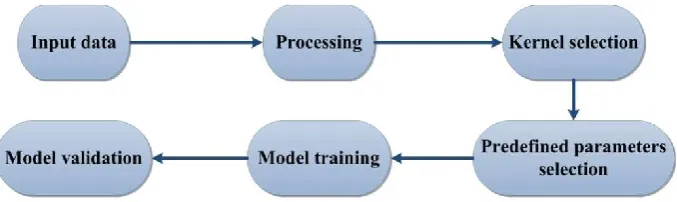
0.01, and 0.001 were selected as default amounts which are used in WEKA software, respectively. Fig. 1
113
indicates scthe hematic configuration of SVthe R model.
114
115
116
Fig. 1 schematic configuration of SVR model.
117
118
2.3. Fruit fly Optimization Algorithm (FOA)
119
FOA which was introduced by Pan (2012) is a swarm intelligent optimization algorithm that imitates the
120
activities of fruit flies for searching the global optimum. Fruit flies can identify the smell from even 40
121
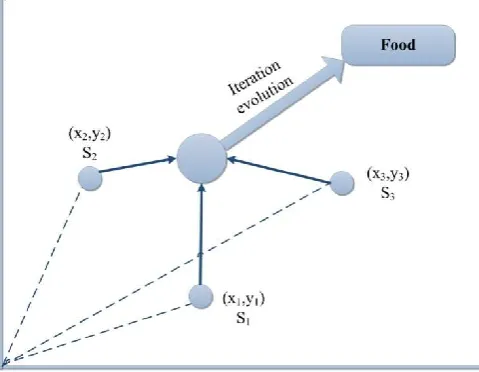
kilometers and fly on the way to it. Fig. 2 displays the food searching progression utilized by fruit fly
122
iteratively. According to Pan (2012), the following equations are exploited to acquire the initial swarm location
123
of a fruit fly:
124
= ( )
= ( )
(6)
Where LR is the location range of the accidental, initial fruit fly swarm. Subsequently, unexpected search
125
direction and distance for foraging of the fruit flies are given by:
126
= + ( )
= + ( )
(7)
where FR is the random flight range, so, smell concentration judgment value (S) can be computed by:
= 1/ + (8)
128
Fig. 2 food searching process utilized by fruit fly iteratively.
129
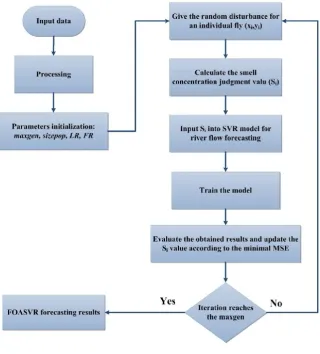
For improving the performance of river flow forecasting, FOA was implemented for choosing optimized values
130
of three SVR parameters including , ε, γ, which are connected to ( , , ) (i.e., = , γ = , and ε =
131
). The flowchart of the mentioned procedure (FOASVR) is displayed in Fig. 3. Moreover, the differences
132
among the predicted and the actual values were evaluated by mean squared error (MSE), as presented in
133
equation belthe ow:
134
=∑ ( − ) (9)
where p and o re the ith predicted and observed values and n is the entire number of data. The fruit fly saves
135
the finest smell concentration value and the corresponding coordinate among the swarms, then flies towards
136
the next place. When the new result is not superior to the previous iteration or the iteration number reaches its
137
maximum, or the error of the prediction reaches the predefined value, this process will stop. Therefore, optimal
138
values are acquired, and the model has the best performance with these values.
140
Fig. 3 The FOASVR flowchart
141
In this research, data were normalized to be between 0 and one because it helps to increase the accuracy of the
142
model and to predict performance (Chang and Lin, 2001). Besides, LR and FR were chosen to be included [0,
143
10] and [-1, 1], respectively; Also, the maximum iteration number (maxgen) was equal to 100, and the
144
population size (size pop) was selected to be 20 in order to have reasonable efficiency. Moreover, Libsvm
145
toolbox was used to run SVR in this article.
146
3. Study area
147
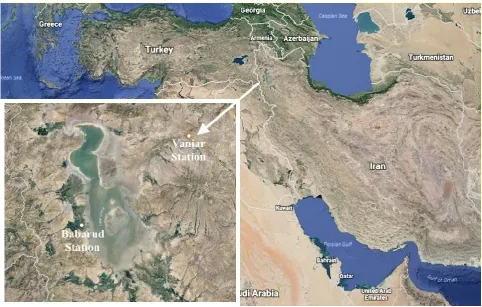
In the current study, the monthly river flow was used for the Vaniar station on the Aji Chay Stream and the
148
Babarud station on the Barandouz River, both located at Lake Urmia basin of Iran (Fig. 4). The observed data
149
include 780 monthly river flows (65 years from 1952 to 2017) for Babarud station and 744 monthly records
150
(62 years from 1952 to 2014) for Vaniar station. Moreover, there is no basic and technical way of separating
151
training and testing data. For example, the study of Kurup and Dudani (2002) used a total of their 63% of data
152
for model development whereas Pal (2006) used 69%, and Samadianfard et al. (2013, 2014) used 67% of total
153
data, and Deo et al. (2018) and Samadianfard et al. (2018) used 70% of total data to develop their models.
Thus, for developing the studied models, the data are divided into training (70%) and testing (30%).
155
Additionally, Table 1 displays the statistics of implemented data for both stations. The observed data confirms
156
high positive values of skewness (Csx = 2.13 and 3.19). Furthermore, the low auto-correlations demonstrated
157
the low persistence for both mentioned stations. According to the crisis of Lake Urmia, the amounts of
158
precipitation and consequently river flow have decreased for the recent years; therefore, this may cause some
159
difficulties in forecasting river flows.
160
161
162
Fig. 4 Babarud and Vaniar stations, located at Lake Urmia basin <URL1>
163
164
Table 1 Statistical parameters of the implemented data (X mean, X max, X min, Sx, Csx, a1, a2, a3 denote the overall mean,
165
maximum, minimum, standard deviation, skewness, lag -1, lag -2, lag -3 auto-correlation coefficients, respectively)
166
Station Data set Xmean
(m3/s)
Xmax
(m3/s)
Xmin
(m3/s)
Sx (m3/s)
Csx
(m3/s) r1 r2 r3
Babarud Training data 8.75 66.50 0.00 9.63 2.05 0.70 0.25 -0.07
Testing data 4.71 43.27 0.00 7.37 2.54 0.59 0.14 -0.12
Entire data 7.74 66.50 0.00 9.28 2.13 0.69 0.25 -0.05
Vaniar Training data 14.28 178.29 0.00 21.35 2.94 0.62 0.15 -0.11
Testing data 5.66 65.30 0.00 10.50 3.02 0.50 0.11 -0.05
Entire data 12.13 178.29 0.00 19.58 3.19 0.63 0.18 -0.07
4. Evaluation parameters
168
In this study, different evaluation parameters were considered for scrutinizing the precision of the mentioned
169
models for river flow forecasting.
170
As one of the widely-used statistical parameters, root mean squared error (RMSE) measures the average
171
amount of error (the difference between predicted and observed flows) appropriately, and it can be determined
172
as follows:173
n i op i Q i
Q n RMSE 1 2 1 (10)
where Qp(i), Qo(i), and n represent the predicted river flow, the observed river flow, and the number of
174
observations, respectively.
175
The bias in the predicted river flow is calculated by the mean absolute error (MAE) which measures the
176
closeness of the predictions to the actual flows. Lower MAE values represent more precise predictions of river
177
flow either equal or close to the observed values. It is calculated as follows:
178
n i op i Q i
Q n MAE
1
1 (11)
The correlation coefficient (R), which describes the amount of linearity among simulated and observed values
179
of river flows, ranges from -1 to 1 and is described as follows:
180
2 1 1 2 2 1 1 2 1 1 1 1 1 1 n i p n i p n i o n i o n i p n i o n i p o i Q n i Q i Q n i Q i Q i Q n i Q i Q R (12)Also, the Bayesian information criterion (BIC) was utilized to specify the best model parsimoniously which
181
means that the model with fewer input parameters could have better performance in comparison to others. BIC
182
measures models relative to each other; in fact, the model with the best performance has the smallest quantity
183
of the BIC (Burnham and Anderson, 2002). It is given as follows:
184
= ∗ ln + ∗ ln( ) (13)
where K indicates the number of input parameters and RSS can be determined as follows:
n
i
o
p i Q i
Q RSS
1
2 (14)
Furthermore, Taylor diagram (TD) which is a graphical illustration of the observed and forecasted data, was
186
applied for inspecting the precision of models (Taylor, 2001). The TD has this capability to encapsulate some
187
characteristics of the predicted and observed flows at the same time. This diagram can illustrate RMSE, R, and
188
SD between the forecasted and actual data, simultaneously. In TD, the azimuth angle, the radial distance from
189
the origin, and radial distance from the observed data point denote the R-value, the ratio of the normalized SD
190
and the RMSE value of the prediction, respectively.
191
192
5. Results and discussion
193
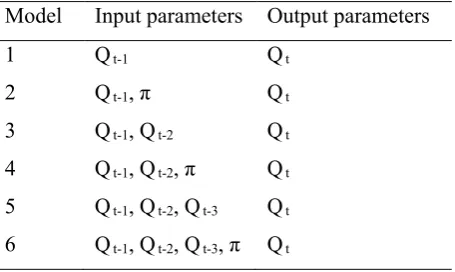
For evaluating the effects of previous monthly flows, three input combinations were established. Moreover,
194
the periodicity effect was inspected by appending a component π (1 to 12 for each month).
195
Table 2 Input parameters of the established models.
196
Model Input parameters Output parameters
1 Qt-1 Qt
2 Qt-1, π Qt
3 Qt-1, Qt-2 Qt
4 Qt-1, Qt-2, π Qt
5 Qt-1, Qt-2, Qt-3 Qt
6 Q t-1, Q t-2, Q t-3, π Q t
197
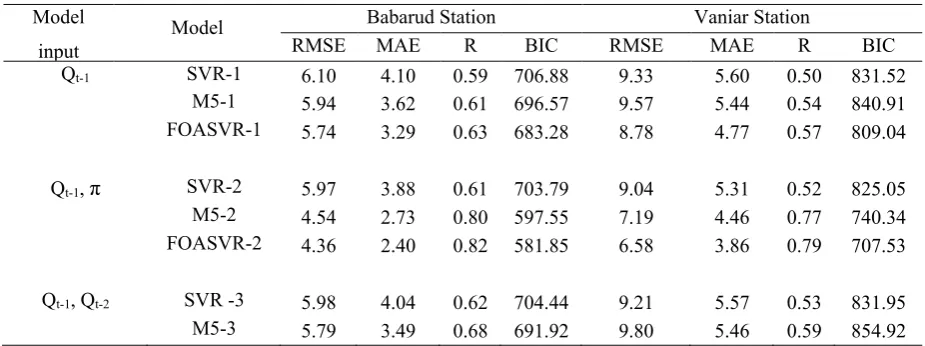
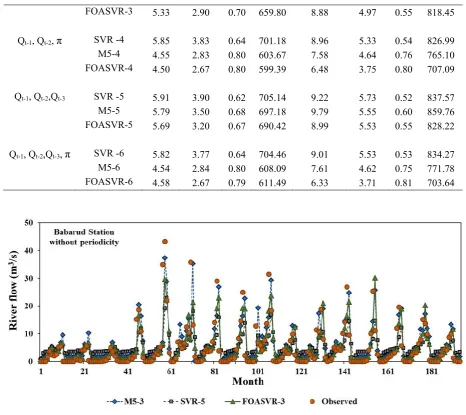
The results of statistical parameters for studied techniques in the test phase for the Babarud station are given
198
in Table 3. As mentioned before, π was appended to the input combinations 1,3, and 5 to examine the effect
199
of periodicity. From the table, it is clear that the periodicity considerably increased each model’s accuracy. For
200
the FOASVR model, R increased from 0.63 (for input combination (1)) to 0.82 (for input combination (2)) and
201
similarly, RMSE and MAE indices decreased from 5.74 to 4.36 and from 3.29 to 2.40, respectively. Regarding
202
two previous cases, by adding periodicity component, R increased from 0.70 to 0.80 and RMSE, and MAE
203
decreased from 5.33 to 4.50 and from 2.90 to 2.67, respectively. Finally, in the case of three previous
204
discharges inputs, R increased from 0.67 to 0.79 and RMSE, and MAE decreased from 5.69 to 4.58 and from
205
3.20 to 2.67, respectively. Comparison of FOASVR, M5, and SVR models indicated that the FOASVR-2
model whose inputs are Qt-1, and π had better accuracy than the M5 and SVR models. M5 also performed better
207
than the SVR model. Overall, FOASVR performed better than SVR and M5s. Also, FOA increased the
208
accuracy of SVR by approximately 27% for RMSE and 38% for MAE in the second scenario which performed
209
roughly (4% RMSE and 14%MAE) better than M5. Without periodicity, FOASVR-3 indicated 6% better
210
performance than M5-3, and they performed better than the SVR-5 model. The relative RMSE and MAE
211
differences between the optimal FOASVR-3 model without periodicity and FOASVR-3 model with periodicity
212
input were 18.2% and 17.2%, respectively. From the BIC point of view FOASVR-2, M5-2, and SVR-4 with
213
the values of 597.55, 581.85, and 701.18 had better performance in comparison with other models which means
214
that these scenarios had parsimonious inputs (accurate result with fewer input parameters), respectively. So,
215
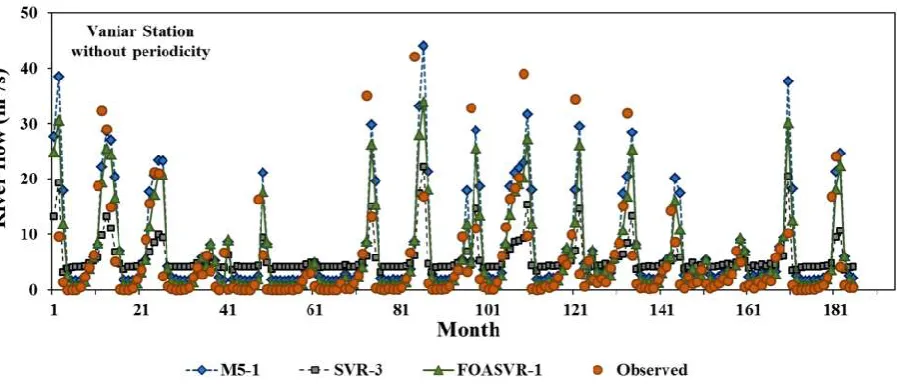
for this station input combination (2) was a reasonable choice. Time variation of observed and predicted river
216
flows by the optimal periodic and non-periodic FOASVR, M5 and SVR models are illustrated in Fig. 5 and 6.
217
It can be comprehended from the figures that all three periodic and non-periodic models considerably
218
underestimate some peak flows. It seems that preciseness of these models decreases with increasing flow rate.
219
However, the superior accuracy of FOASVR and M5 to the SVR model can be comprehended from these
220
figures. Comparison of Fig. 5 and 6 visibly indicate that the periodic models better approximates the observed
221
river flows than the non-periodic models. Fig. 9 displayes the scattered diagrams of the observed and predicted
222
monthly river flows by each method. It is noticeably evident from the graphs that the SVR model performs
223
worse than the other two methods especially in the prediction of peak river flows. Comparison of two figures
224
reveals that the estimates of periodic models are more accurate than non-periodic models. Also, this figure
225
indicates that all models (periodic and non-periodic) overestimate some low flows.
226
The test statistics of the FOASVR, M5 and SVR models for the Vaniar station are also provided in Table 3.
227
Similarly, the encouraging influence of periodicity component on models’ precision is clearly seen for this
228
station. For the FOASVR model, R increased from 0.57 (for input combination (1)) to 0.79 (for input
229
combination (2)) and similarly, RMSE and MAE values decreased from 8.78 to 6.58 and from 4.77 to 3.86,
230
respectively. In the case of two previous discharges inputs, by adding periodicity component, R increased from
231
0.55 to 0.80 and RMSE, and MAE decreased from 8.88 to 6.48 and from 4.97 to 3.75, respectively. Finally, in
232
the three previous discharges inputs case, R increased from 0.55 to 0.81 and RMSE, and MAE values decreased
233
from 8.99 to 6.33 and from 5.53 to 3.71, respectively. Comparison of three models revealed that the optimal
234
and π inputs and both performed better than the optimal SVR-6 model whose inputs are same as FOASVR-6.
236
Generally, FOASVR performed better than SVR and M5 models, moreover, accuracy of SVR was increased
237
by 29.7% and 30.4% related to RMSE and MAE in the optimal scenario (FOASVR-6) by applying FOA,
238
respectively; also, FOASVR showed 16.8% and 19.7% better performances than M5 in terms of RMSE and
239
MAE for this scenario, respectively. Without the periodicity component, the optimal FOASVR-1 model
240
performed better than the optimal M5-1 and SVR-3 model. The relative RMSE and MAE differences between
241
the optimal FOASVR-1 model without periodicity and FOASVR-1 model with periodicity input were 25.1%
242
and 19.1%, respectively. The best values for BIC in this station were related to FOASVR-6 with 703.64,
M5-243
2 with 740.34, and SVR-2 with 825.05. According to the fact that FOASVR-6 was closely followed by
244
FOASVR-4 with the value of 707.09 and FOASVR-2 with the value of 707.53, it is better to choose a
245
combination with fewer input parameters. Thus, the input parameters of Qt-1 and π were selected as a
246
parsimonious scenario for this station similar to the previous station. Fig. 7 and 8 demonstrate the time variation
247
of observed and predicted river flows by the optimal periodic and non-periodic FOASVR, M5 and SVR
248
models. As found for the Vaniar station, here also the three periodic and non-periodic models underestimate
249
some peak flows. Comparison of Fig. 7 and 8 confirm that appending the periodicity component as the input
250
increases the estimation capacity of the models. The scatterplots of the observed and predicted monthly river
251
flows by each method are shown in Fig. 9. Alike to the previous station, the FOASVR and M5 perform better
252
than the SVR model especially in the prediction of peak river flows. This figure indicates that the estimates of
253
periodic models are more accurate. According to Fig. 9, same as Babarud station, the models overestimate low
254
flows in the Vaniar station, so, forecasting shifts from overestimation to underestimation with increasing flow
255
rate.
256
Table 3 The evaluation parameters of studied models in the test period
257
Model
input
Model Babarud Station Vaniar Station
RMSE MAE R BIC RMSE MAE R BIC
Qt-1 SVR-1 6.10 4.10 0.59 706.88 9.33 5.60 0.50 831.52
M5-1 5.94 3.62 0.61 696.57 9.57 5.44 0.54 840.91 FOASVR-1 5.74 3.29 0.63 683.28 8.78 4.77 0.57 809.04
Qt-1, π SVR-2 5.97 3.88 0.61 703.79 9.04 5.31 0.52 825.05
M5-2 4.54 2.73 0.80 597.55 7.19 4.46 0.77 740.34 FOASVR-2 4.36 2.40 0.82 581.85 6.58 3.86 0.79 707.53
FOASVR-3 5.33 2.90 0.70 659.80 8.88 4.97 0.55 818.45
Qt-1, Qt-2, π SVR -4 5.85 3.83 0.64 701.18 8.96 5.33 0.54 826.99
M5-4 4.55 2.83 0.80 603.67 7.58 4.64 0.76 765.10 FOASVR-4 4.50 2.67 0.80 599.39 6.48 3.75 0.80 707.09
Qt-1, Qt-2,Qt-3 SVR -5 5.91 3.90 0.62 705.14 9.22 5.73 0.52 837.57
M5-5 5.79 3.50 0.68 697.18 9.79 5.55 0.60 859.76 FOASVR-5 5.69 3.20 0.67 690.42 8.99 5.53 0.55 828.22
Qt-1, Qt-2,Qt-3, π SVR -6 5.82 3.77 0.64 704.46 9.01 5.53 0.53 834.27
M5-6 4.54 2.84 0.80 608.09 7.61 4.62 0.75 771.78 FOASVR-6 4.58 2.67 0.79 611.49 6.33 3.71 0.81 703.64
258
259
Fig. 5 The observed and forecasted monthly river flows without periodicity for Babarud station
260
261
Fig. 6 The observed and forecasted monthly river flows with periodicity for Babarud station
263
Fig. 7 The observed and forecasted monthly river flows without periodicity for Vaniar station
264
265
266
Fig. 8 The observed and forecasted monthly river flows with periodicity for Vaniar station
269
Fig. 9 The scatterplots of observed and forecasted monthly river flows with and without periodicity for both stations
270
271
Furthermore, TDs were utilized for examining SD and R values for the FOASVR, M5 and SVR models. Fig.
272
10 exhibits TDs for all models, where the space from the reference green point is an amount of the centered
273
RMSE. So, it can be comprehended from Fig. 10 that FOASVR (a point with yellow color) provided relatively
274
precise predictions of river flow in both stations.
275
276
277
Fig. 10. TDs of the monthly predicted river flow
6. Conclusion
281
In the current study, three different data-driven techniques, FOASVR, M5, and SVR were compared in one
282
month ahead river flow forecasting in two stations, located in the Lake Urmia Basin of Iran. Comparison of
283
three periodic models specified that the periodic FOASVR model had better accuracy than the periodic M5
284
and SVR models. M5 was also found to achieve more suitable results than the SVR model. Similar to periodic
285
models, comparison of non-periodic models showed that the optimal FOASVR also had a better performance
286
than M5 and SVR models. It was proved that appending periodicity component significantly increases models’
287
accuracy in forecasting monthly river flows for both stations. For the Babarud station, the relative RMSE and
288
MAE differences between the optimal periodic and non-periodic FOASVR models were found to be 18.2%
289
and 17.2%, respectively. For the Vaniar station, the periodicity component decreased the RMSE and MAE
290
values of the optimal FOASVR models by 27.9 and 22.2%, respectively. According to BIC, the second input
291
combination (Qt-1 and π) opted as parsimonious inputs for FOASVR with values of 581.85 and 707.53 for
292
Babarud and Vaniar stations, respectively. Generally, the performance of FOASVR models was better than
293
the other two methods in forecasting monthly river flows. However, all methods indicated some difficulties in
294
forecasting river flow peaks while the FOASVR models provided a better forecast in high river flows.
295
References
296
Bhattacharya, B., Solomatine, D.P., 2005. Neural networks and M5 model trees in modeling water level–discharge
297
relationship. Neurocomputing. 63, 381–396.
298
Bhattacharya, B., Solomatine, D.P., 2006. Machine learning in sedimentation modeling. Neural Networks. 19, 208–214.
299
Burnham, K.P., Anderson, D.R., 2002. Model Selection and Inference: a Practical Information-theoretic approach, second
300
edition. Springer-Verlag, New York.
301
Cao, G., Wu, L., 2016. Support vector regression with fruit fly optimization algorithm for seasonal electricity consumption
302
forecasting. Energy 115, 734–745. doi:10.1016/j.energy.2016.09.065
303
Chang, C.-C., Lin, C.-J., 2001. Training v-support vector classifiers: theory and algorithms.Neural Comput. 13(9), 2119–
304
47.
305
Cimen, M., 2008. Estimation of daily suspended sediments using support vector machines. Hydrol. Sci. J. 53 (3), 656–
306
666.
307
Esmaeilzadeh, B., Sattari, M.T., Samadianfard, S., 2017. Performance evaluation of ANNs and an M5 model tree in
308
Sattarkhan Reservoir inflow prediction. ISH Journal of Hydraulic Engineering. 1-10.
Fernando, A.K., Shamseldin, A.Y., Abrahart, B.J., 2012. River Flow Forecasting Using Gene Expression Programming
310
Models. 10th International Conference on Hydroinformatics HIC 2012. Hamburg, Germany.
311
Gunn, S.R., 1998. Support Vector Machines for Classification and Regression, Technical Report. University of
312
Southampton, England.
313
Ismail S., Samsudin, R., Shabri, A., 2010. River Flow Forecasting: a Hybrid Model of Self Organizing Maps and Least
314
Square Support Vector Machine. Hydrol. Earth Syst. Sci. Discuss. 7, 8179–8212.
315
Kalteh, A.M., 2013. Monthly river flow forecasting using artificial neural network and support vector regression models
316
coupled with wavelet transform. Comput. Geosci. 54, 1–8. doi:10.1016/j.cageo.2012.11.015
317
Khan, A.S., See, L., 2006. Rainfall-Runoff modeling using data-driven and statistical methods. Institute of Electrical and
318
Electronics Engineers (IEEE).
319
Lijuan, W., Guohua, C., 2016. Seasonal SVR with FOA algorithm for single-step and multi-step ahead forecasting in
320
monthly inbound tourist flow. Knowledge-Based Syst. 110, 157–166. doi:10.1016/j.knosys.2016.07.023
321
Liong, S.Y., Sivapragasam, C., 2002. Flood stage forecasting with support vector machines. J. AWRA. 38 (1), 173–186.
322
Londhe, S.N., Dixit, P.R., 2011. Forecasting Stream Flow Using Model Trees. International Journal of Earth Sciences
323
and Engineering. 4(6), 282-285.
324
Londhe, S., Gavraskar, S.S., 2015. Forecasting One Day Ahead Stream Flow Using Support Vector Regression. Aquat.
325
Procedia 4, 900–907. doi:10.1016/j.aqpro.2015.02.113
326
Pan, W.-T., 2012. a new Fruit Fly Optimization Algorithm: Taking the financial distress model as an example.
327
Knowledge-Based Syst. 26, 69–74. doi:10.1016/j.knosys.2011.07.001
328
Onyari, E., Ilunga, F., 2010. Application of MLP neural network and M5P model tree in predicting streamflow: A case
329
study of Luvuvhu catchment, South Africa. International Conference on Information and Multimedia Technology
330
(ICMT). Hong Kong, China. V3, 156-160.
331
Quinlan, J.R., 1992. Learning with continuous classes. Proceedings Fifth Australian Joint Conf. on Artificial Intelligence
332
(ed. by A. Adams & L. Sterling). World Scientific, Singapore. 343–348.
333
Samadianfard, S., Nazemi, A.H., Sadraddini, A.A., 2014a. M5 model tree and gene expression programming based
334
modeling of sandy soil water movement under surface drip irrigation. Agriculture Science Developments. 3,
178-335
190.
336
Samadianfard, S., Sattari, M.T., Kisi, O., Kazemi, H., 2014b. Determining flow friction factor in irrigation pipes using
337
data mining and artificial intelligence approaches. Applied Artificial Intelligence. 28, 793-813.
338
Sattari, M.T., Pal, M., Apaydin, H., Ozturk, F., 2013. M5 Model Tree Application in Daily River Flow Forecasting in
339
Sohu Stream, Turkey. Water Resources. 40(3), 233-242.
Siek, M., Solomatine, D.P., 2007. Tree-like machine learning models in hydrologic forecasting: optimality and expert
341
knowledge. Geophysical Research Abstracts. Vol. 9.
342
Smola, A.J., Scholkopf, B., 2004. A tutorial on support vector regression. Statistics and Computing. 14(3), 199-222.
343
Stravs, L., Brilly, M., 2007. Development of a low flow forecasting model using the M5 machine learning method.
344
Hydrological Sciences. 52(3), 466–477.
345
Taylor, K.E., 2001. Summarizing multiple aspects of model performance in a single diagram. J. Geophys. Res. Atmos.
346
106, 7183–7192.
347
<URL1>https://earth.google.com/web/@32.205151,53.07029487,2852.42968574a,2667368.97567809d,35y,0.1175398
348
4h,16.72644158t,-0r
349
Vapnik, V., 1995. The Nature of Statistical Learning Theory. Springer Verlag, New York, USA.
350
Witten, I.H., Frank, E., 2005. Data Mining: Practical Machine Learning Tools and Techniques with Java Implementations.
351
Morgan Kaufmann: San Francisco.
352
Wu, C.L., Chau, K.W., Li, Y.S., 2008. River stage prediction based on a distributed support vector regression. J.
353
Hydrol. 358, 96–111. doi:10.1016/j.jhydrol.2008.05.028
354
Wu, C.-H., Tzeng, G.-H., Lin, R.-H., 2009. A Novel hybrid genetic algorithm for kernel function and parameter
355
optimization in support vector regression. Expert Syst. Appl. 36, 4725–4735. doi:10.1016/j.eswa.2008.06.046
356
Yu, X.Y., Liong, S.Y., Babovic, V., 2004. EC-SVM approach for realtime hydrologic forecasting. J. Hydroinf. 6 (3),
357
209–233.
358
Kurup, P.U., Dudani, N.K. Neural networks for profiling stress history of clays from PCPT data. Journal of
359
Geotechnical and Geoenvironmental Engineering 2014; 128(7): 569-579.
360
Samadianfard, S, Delirhasannia, R, Kisi, O, Agirre-Basurko, E. Comparative analysis of ozone level prediction models
361
using gene expression programming and multiple linear regression. GEOFIZIKA 2013; 30:43-74.
362
Samadianfard, S, Sattari, MT, Kisi, O, Kazemi, H. Determining flow friction factor in irrigation pipes using data mining
363
and artificial intelligence approaches. Applied Artificial Intelligence 2014; 28: 793-813.
364
Samadianfard, S., Asadi, E., Jarhan, S., Kazemi, H., Kheshtgar, S., Kisi, O., Sajjadi, S., Abdul Manaf, A., 2018.
365
Wavelet neural networks and gene expression programming models to predict short-term soil temperature at
366
different depths, Soil and Tillage Research, 175: 37-50.
367
Deo, R.C., Ghorbani, M.A., Samadianfard, S., Maraseni, T., Bilgili, M., & Biazar, M., 2018. Multi-layer perceptron
368
hybrid model integrated with the firefly optimizer algorithm for windspeed prediction of target site using a limited
369
set of neighboring reference station data, Renewable Energy, 116: 309-323.