Edinburgh Research Explorer
MCMix: Anonymous Messaging via Secure Multiparty
Computation
Citation for published version:
Alexopoulos, N, Kiayias, A, Zacharias, T & Talviste, R 2017, MCMix: Anonymous Messaging via Secure Multiparty Computation. in Proceedings of the 26th USENIX Security Symposium 2017. USENIX Association, pp. 1217-1234, USENIX Security Symposium, Vancouver, Canada, 16/08/17.
Link:
Link to publication record in Edinburgh Research Explorer Document Version:
Peer reviewed version
Published In:
Proceedings of the 26th USENIX Security Symposium 2017
General rights
Copyright for the publications made accessible via the Edinburgh Research Explorer is retained by the author(s) and / or other copyright owners and it is a condition of accessing these publications that users recognise and abide by the legal requirements associated with these rights.
Take down policy
The University of Edinburgh has made every reasonable effort to ensure that Edinburgh Research Explorer content complies with UK legislation. If you believe that the public display of this file breaches copyright please contact [email protected] providing details, and we will remove access to the work immediately and investigate your claim.
MCMix: Anonymous Messaging via Secure Multiparty Computation
Nikolaos Alexopoulos
Technische Universit¨at Darmstadt, Germany
[email protected]
Aggelos Kiayias
University of Edinburgh, UK
[email protected]
Riivo Talviste
Cybernetica AS, Estonia
[email protected]
Thomas Zacharias
University of Edinburgh, UK
[email protected]
Abstract
We present MCMix, an anonymous messaging system that completely hides communication metadata and can scale in the order of hundreds of thousands of users. Our approach is to isolate two suitable functionalities, called dialing and conversation, that when used in succession, realize anonymous messaging. With this as a starting point, we apply secure multiparty computation (“MC” or MPC) and proceed to realize them. We then present an implementation using Sharemind, a prevalent MPC system. Our implementation is competitive in terms of latency with previous messaging systems that only offer weaker privacy guarantees. Our solution can be instan-tiated in a variety of different ways with different MPC implementations, overall illustrating how MPC is a vi-able and competitive alternative to mix-nets and DC-nets for anonymous communication.
1
Introduction
In an era in which privacy in communications is becom-ing increasbecom-ingly important, it is often the case that two parties want to communicate anonymously, that is to ex-change messages while hiding the very fact that they are in conversation. A major problem in this setting is hid-ing the communication metadata: while existhid-ing crypto-graphic techniques (e.g., secure point-to-point channels implemented with TLS) are sufficiently well developed to hide the communication content, they are not intended for hiding the metadata of the communication such as its length, its directionality, and the identities of the commu-nicating end points. Metadata are particularly important, arguably some times as important to protect as the com-munication content. The importance of metadata is re-flected in General Michael Hayden’s quote “We kill peo-ple based on metadata”1and in the persistence of
secu-1Complete quote: “We kill people based on metadata. But that’s
not what we do with this metadata.” General M. Hayden. The Johns
rity agencies with programs like PRISM (by the NSA) and TEMPORA (by the GCHQ) in collecting metadata for storage and mining.
Anonymous communication has been pioneered in the work of Chaum, with mix-nets [16] and DC-nets [14] providing the first solutions to the problem of sender-anonymous communication. In particular, a mix-net en-ables the delivery of a set of messages fromn senders to a recipient so that the recipient is incapable of map-ping outgoing messages to their respective senders. A DC-net on the other hand, allows n parties to imple-ment an anonymous broadcast channel so that any one of them can use it to broadcast a message to the set of par-ties without any participant being able to distinguish the source. While initially posed as theoretical constructs, these works have evolved to actual systems that have been implemented and tested, for instance in the case of Mixminion [25], that applies the mix-net concept to e-mail, in the case of Vuvuzela [49] that applies the mix-nets concept to messaging and in the case of Dissent [51] that implements DC-nets in a client-server model.
It is important to emphasize that the adversarial set-ting we wish to protect against is a model where the adversary has aglobal viewof the network, akin say to what a global eavesdropper would have if they were pas-sively observing the Internet backbone, rather than a lo-calized view that a specific server or sub-network may have. Furthermore, the adversary may manipulate mes-sages as they are transmitted and received from users as well as block users adaptively. Note that in a more “lo-calized” adversary setting one may apply concepts like Onion routing [48], e.g., as implemented in the Tor sys-tem [27], or Freenet [20] to obtain a reasonable level of anonymity with very low latency. Unfortunately such systems are susceptible to traffic analysis, see e.g., [34], and, in principal, they cannot withstand a global adver-sary.
Given the complexity of the anonymous communica-tion problem in general, we focus our applicacommunica-tion objec-tive to the important special case ofanonymous messag-ing, i.e., bidirectional communication with bothsender and receiver anonymity that requires moderately low la-tency and has relatively small payloads (akin to SMS text messaging). The question we ask is whether it is possi-ble to achieve it with simulation-based security2while scaling tohundreds of thousandsof users. In particular, we consider two types of entities in our problem spec-ification, clients and servers, and we ask how is it pos-sible that the servers assist the clients that are online to communicate privately without leakinganytype of meta-data to a global adversary, apart from the fact that they are using the system. Furthermore, we seek a decentral-ized solution, specifically one where no single entity in the system can break the privacy of the clients even if it is compromised. We allow the adversary to completely control the network as well as a subset of the servers and adaptively drop clients’ messages or manipulate them as it wishes.
Our Contributions.We present MCMix, the first anony-mous messaging service that offers simulation-based se-curity, under a well specified set of assumptions, and can scale to hundreds of thousands of users. In our solution, we adopt a different strategy compared to previous ap-proaches to anonymous communication. Specifically, we provide a way to cast the problem of anonymous mes-saging natively in the setting of secure multiparty com-putation (MPC). MPC, since its initial inception [31], is known to be able to distribute and compute securely any function, nevertheless, it is typically considered to be not particularly efficient for a large number of parties and thus inconsistent with problems like anonymous messag-ing. However, the commodity-based approach for MPC [7] (client-server model), and more recent implementa-tion efforts such as Fairplay [10], VIFF [23], Sharemind [11], PICCO [53], ObliVM [40], Araki et al. [5] and [30] increasingly suggest otherwise.
We first propose two ideal functionalities that corre-spond to the dialing operation and the conversation op-eration. The MCMix system proceeds in rounds, where in each round an invocation of either the dialing or the conversation ideal functionality is performed. The dial-ing functionality enables clients to either choose to dial another client or check whether anyone is trying to dial them (in practice in most dialing rounds the overwhelm-ing majority of clients will be in dial-checkoverwhelm-ing mode). If a matching pair is determined by the ideal functionality,
2We use this term to refer to a level of metadata hiding that
en-sures, in a simulation based sense, thatno informationis leaked to an adversary. This is distinguished from weaker levels of privacy, such as e.g., a differential privacy setting where some controlled but non-trivial amount of information is leaked to the adversary.
then the caller will be notified that the other client has accepted their call and the callee will be notified about the caller. Moreover, the ideal functionality will deliver to both clients a random tag that can be thought of the equivalent of a “dead drop” or “rendezvous” point. Sub-sequently, the clients can access the conversation func-tionality using the established random tag. When two clients use the same random tag in the conversation func-tionality, their messages are swapped and thus they can send messages to each other (even concurrently).
The two ideal functionalities provide a useful abstrac-tion of the anonymous messaging problem. We proceed now to describe how they can be implemented by an MPC system. It is easy to see that a straightforward implementation of the functionality programs results in a circuit of sizeΘ(n2), where n is the number of
on-line users accessing the functionalities. Such a solution would be clearly not scalable. We provide more effi-cient implementations that achieveO(nlogn) complex-ity in both cases with very efficient constants using state of the art oblivious sorting algorithms [33, 13].
Given our high level functionality realizations, we pro-ceed to an explicit implementation in the Sharemind sys-tem [11] using its SecreC programming language [12]. We provide benchmarks for the Dialing and Conversa-tion soluConversa-tions. The Sharemind platform provides a 3-server implementation of information theoretically se-cure MPC. Our results showcase that our system can handle hundreds of thousands of users in a reasonable latency (little over a minute), that is consistent with mes-saging.
In order to provide theoretical evidence of fur-ther improving performance and scaling to even larger anonymity sets, we provide a parallelized version of the conversation functionality. Parallelization is a non-trivial problem in our setting since we would like to maintain anonymity across the whole user set; thus, a simplis-tic approach that breaks users into chunks solving dial-ing and conversation independently will isolate them to smaller “communication islands”; if two users have to be on the same island in order to communicate, this will lead to privacy loss that is non-simulatable and we would like to avoid. Our parallelized solution manages to make the interaction between islands, in a way that maintains strong privacy guarantees, at the cost of a correctness er-ror that can become arbitrarily small. In this way, by utilizing a large number of servers, we provide evidence that the system can scale up to anonymity sets of up to half a million of users. To sum up, our contributions can be expressed by the following points:
- A model for simulation-based anonymous messaging. - A realization of this model with a set of programs that are provably secure and expressed in a way so that they can be implemented in any MPC platform.
- An implementation of our programs in Sharemind that can accomodate anonymity sets of hundreds of thou-sands of users.
- A novel parallelization technique that allows our system to scale, in theory, even beyond the order of hundreds of thousands of users.
Organization. After shortly presenting some prelim-inary topics in section 2, we formalize the concept of anonymous messaging via an ideal MPC functionality and introduce the Dialing and Conversation programs in an abstract form that together solve the sender and re-ceiver anonymous messaging problem (cf. Section 3). In Section 4, we present the general architecture of MCMix and in Sections 5 and 6, we propose a way to realize the Dialing and Conversation programs, using MPC. Then, in Section 7, we give more details regarding how the MCMix system implements anonymous messaging in a provably secure and privacy-preserving way. In Sec-tion 8, we present the results of benchmarking our proto-type and in Section 9, we account for the client-side load of our system. In Section 10, we provide an overview of noticeable anonymous communication systems and when applicable, we compare their performance and se-curity level to MCMix. Finally, in Section 11, we intro-duce a novel way to parallelize our conversation protocol in order to achieve even better scalability.
2
Background
Secure Multiparty Computation. Secure Multiparty Computation (MPC), is an area of cryptography con-cerned with methods and protocols that enable a set of usersU=u1, . . . ,un with private datad1, . . . ,dn from a domain setD, to compute the result of a public function f(d1, . . . ,dn)in a range setY, without revealing their pri-vate inputs. For clarity, we also assume that f accepts⊥ as input, which denotes abstain behavior.
Sharemind. Sharemind [11] is an MPC framework that offers a higher level representation of the circuit being computed in the form of a program written in a C-like language, namely the SecreC language [12]. It uses three-server protocols that offer security in the presence of an honest server majority. That is, we assume that no two servers will collude in order to break the sys-tems privacy. Our implementation is designed over the Sharemind system, but the general approach that we in-troduce for anonymous messaging can also be deployed over other MPC protocols. The security of Sharemind has been analyzed several settings including semi-honest and active attacks (e.g., [11, 43]).
Oblivious Sorting. Sorting is used as a vital part of many algorithms. In the context of MPC, sorting an array of values without revealing their final position,
is called oblivious sorting. The first approach to sort-ing obliviously is ussort-ing a data-independent algorithm and performing each compare and exchange execution obliviously. This approach uses sorting networks to per-form oblivious sorting. Sorting networks are circuits that solve the sorting problem on any set with an order re-lation. What sets sorting networks apart from general comparison sorts is that their sequence of comparisons is set in advance, regardless of the outcome of previous comparisons. Various algorithms exist to construct sim-ple and efficient networks of depth O(log2n)and size O(nlog2n). The three more used ones are Batcher’s odd-even mergesort and bitonic sort [6] and Shellsort [46]. All three of these networks are simple in principle and efficient. Sorting networks that achieve the theoretically optimalO(logn)andO(nlogn)complexity in depth and total number of comparisons, such as the AKS-network [1] exist, but the constants involved are so large that make them impractical for use. Note that even for 1 billion val-ues, i.e.,n=109, it holds that logn<30 so, in practice, the extra log factor is preferable to the large constants. A major drawback of all sorting network approaches is that sorting a matrix by one of its columns would require oblivious exchange operations of complete matrix rows, which would be very expensive.
In recent years, techniques have been proposed from Hamada et. al [33] to use well known data-dependent algorithms, such as quicksort, in an oblivious manner to achieve very efficient implementations, especially when considering a small number of MPC servers, which is very often the case. This approach uses the “shuffling before sorting” idea, which means that if a vector has already been randomly permuted, information leaked about the outcome of comparisons does not leak infor-mation about the initial and final position of any element of the vector. More specifically, the variant of quick-sort proposed in [33], needs on averageO(logn)rounds and a total of O(nlogn)oblivious comparisons. Com-plete privacy is guaranteed when the input vector con-tains no equal sorting keys, and in the case of equal keys, their number leaks. Furthermore, performance of the al-gorithm is data-dependent and generally depends on the number of equal elements, with the optimal case being that no equal pairs exist. Practical results have shown [13] that this quicksort variant is the most efficient obliv-ious sorting algorithm available, when the input keys are constructed in a way that makes them unique.
In our algorithms, we utilize the Quicksort algorithm together with a secret-shared index vector as described in [13]. This way, each sortable element becomes a unique value-index pair, providing us the optimal Quick-sort performance and complete privacy. In addition, it has the added benefit of making the sorting algorithm stable.
Identity-Based Key Agreement Protocols. Like in [39], we make use of identity-based cryptography [45] to cir-cumvent the need for a Public Key Infrastructure (PKI), here, for the computation of the dead drops3. In identity-based cryptography, a Key Generation Center (KGC) us-ing a master secret key, generates the users’ secret keys, while the users’ public keys are a deterministic function of their identity. In anidentity-based key agreement (ID-KA) protocol(e.g. [32, 44, 47, 18, 52, 29, 50]), any pair of users can execute aGenerateKeyalgorithm to agree on a shared key value, on input their obtained secret keys and the other user’s identity.
In our setting, we will apply ID-KA for the compu-tation of the dead drops, where now the users compute their secret keys by combining partial secret keys issued by the MPC servers. Therefore, we adjust ID-KA to a multiple KGC setting where each MPC server plays the role of a KGC. In general, we can manage distributed key generation in a fault tolerant manner, using thresh-old secret-sharing techniques. However, since our threat model considers a passive (semi-honest adversary), we consider an m-out-of-m instantiation, keeping protocol description simple. In particular, we can naturally extend a single KGC ID-KA protocol to a setting withmKGCs denoted byKGC1, . . . ,KGCm. In the full version of our paper, we present at length two multiple KGC ID-KA constructions based on ID-KA protocols that use crypto-graphic pairings.
In the first construction, we build upon the SOK ID-KA protocol introduced in [44] and proven secure in [42]. The key agreement in SOK is non-interactive and the shared key between two fixed users is fixed and can be computed only by knowing the other user’s iden-tity.
In the second construction, we build upon the ID-KA protocol introduced in [47] as modified in [18] that achieves securityandforward secrecy as proven in [17]. In this construction, the users must additionally exchange some additional random values in every new session that is necessary for forward secure key agreement.
Both constructions match the original single ID-KA protocols, whenm=1. Therefore, it is straightforward that the first construction (resp. the second construction) preserves security (resp. security and forward secrecy) against any polynomially bounded semi-honest adver-sary that corrupts all-but-one of themKGCs.
In the current version of MCMix, we do not focus on forward security. Hence, our system’s description (cf. Dialing protocol in Section 5) is based on the sim-pler first ID-KA construction, where knowledge of the users’ usernames is enough for shared key computation.
3If users’ public keys have been distributed in a PKI setting, then we
can turn to the easier solution of classic Diffie-Hellman key exchange for dead drop computation.
Nonetheless, in Section 7 (cf. Remark 5), we briefly dis-cuss on how the second construction could be adopted to a forward-secure version of our system, leaving detailed description for future work.
3
Ideal Anonymous Messaging
We formalize the concept of anonymous messaging in line with standard MPC security modeling. In particu-lar, we capture the notion of anideal MPC functionality Fthat in presence of an ideal adversarySreceives inputs from a number ofnusers and computes the desired result w.r.t. some program f. An MPC protocol is said to be secure w.r.t. a class of programs, if its execution running in the presence of a real-world adversary results in in-put/output transcripts that are indistinguishable from the ideal setting thatFspecifies for program f.
Subsequently, inspired by Tor, Vuvuzela and other re-lated systems, we make use of the “rendezvous points” idea. Specifically, we instantiateF w.r.t. two distinct “abstract” programs DLNabs andCNVabs that reflect the
Dialing and Conversation functionalities respectively; the two programs are abstract in the sense that, in this section, they will be described at a high level algorith-mic way that we will make concrete in the coming sec-tions. The use of a random rendezvous point in the es-tablishment of a communication channel between two users averts any denial of service attacks targeting spe-cific users by other users at the conversation phase. Notation. We write x←$ X to denote that x is sam-pled uniformly at random from setX. For a positive integer n, the set {1, . . . ,n} is denoted by [n]. The j-th component of n-length tuple a is denoted by a[j], i.e. a:= (a[1], . . . ,a[n]). We use ≈c to express indis-tinguishability between transcripts, seen as random vari-ables. Bynegl(·)we denote that a function is negligible, i.e. asymptotically smaller than the inverse of any poly-nomial. We useλ as the security parameter.
Letx=hx1, . . . ,xnibe a vector of users’ inputs. We denote by EXECFS,,xf(λ)the transcript of input/outputs in
an ideal MPC execution ofFinteracting with the ideal adversaryS, and by EXECPA,,fx(λ) the transcript of in-puts/outputs in a real-world execution of MPC protocol Pw.r.t. f under the presence of adversaryA. By PPT, we mean thatAruns in probabilistic polynomial time. Entities and threat model. We consider a client-server MPC setting. Namely, the entities involved in an MPC protocol P are (i) a number of n users u1, . . . ,un that provide their inputshx1, . . . ,xniand (ii) a number ofm serversSer1, . . . ,Sermthat collectively compute an eval-uation on the users’ inputs w.r.t. a program f. The users engaged in a specific MPC execution round form an
ac-tive setUact. We consider anad-hocsetting [8] of secure
computation, where the program f is known in advance, butnotthe active user setUact.
An adversary against P is allowed to have a global view of the protocol network. In addition, it may cor-rupt up to a fixed subset of θ servers and has limited
computational resources preventing it from breaking the security of the underlying cryptographic primitives.
In standard MPC cryptographic modeling, the security ofPis argued w.r.t. the functionalityFthat specifies an “ideal” evaluation of f, where the privacy leakage is the minimum possible for the honest users. Thus, indistin-guishability between the ideal and the real world setting implies that an adversary against P obtains essentially no more information than this minimum leakage. In our description,Fmerely leaks whether an honest user is on-line or not. This information is impossible to hide against a network adversary and hence it is a minimum level of leakage. On the other hand, information that can be typ-ically inferred by traffic analysis, is totally protected by F. This level of anonymity, sometimes referred to as un-observability, requires the participation of all online par-ties and the generation of “dummy traffic” independently of whether or not they wish to send a message in a par-ticular round. As a result, any protocolPthat securely realizesFwhere f represents a dialing or conversation program, should incorporate such a methodology. As we demonstrate, using MPC to realize P is a natural way to determine the appropriate level and form of “dummy traffic” needed to realize this level of anonymity. An ideal MPC functionality for a family of programs.
In a messaging system, dialing and conversation among users are operations where conflicts are likely to appear, e.g. two users may dial the same person, or conversation may be accidentally established on colluding communi-cation channels (three equal rendezvous points are com-puted). One can think several other examples of opera-tions where conflicts are possible, such as election tally where exactly one out of multiple ballots per voter must be counted, or deciding on the valid sequence of transac-tions on a blockchain ledger when forking occurs. Any program implementing this type of an operation must be able to resolve these conflicts. The way that conflict res-olution is achieved, may depend on parameters like com-putation efficiency, communication complexity or user priority, yet in any case, a set of programs that imple-ment the same operation are in some sense equivalent and may be clustered under the same family. A plausible requirement is that the choice of the family member that will be utilized should not affect the security standards of the operation implementation.
Consequently, in an MPC setting that supports the re-alization of any program in the family, it is desirable that security is preserved w.r.t. to the entire family, so that
one can choose the family member that suits their cus-tom requirements. To express this formally, we introduce a relaxation of the usual MPC functionality. Namely, the relaxed ideal MPC functionalityFis for a family of programs{fz}z in the presence of an ideal adversaryS that chooses the indexz(this is the relaxation), wherez can be parsed as the “code” that determines the family member fz. The program fz accepts as input a vector
x=hx1, . . . ,xniof (i) valid messages from some domain Dor (ii)⊥, if the user is inactive, i.e. not inUact. In our
description, computation takes place even when a subset of users abstain from the specific execution by not pro-viding inputs. To formalize the abstain behavior of user ui, for everyi∈[n]we define an ‘abstaini(·)’ predicate overD∪ {⊥}as follows: abstaini(xi):= 1, ifxi=⊥ 0, ifxi∈D (1) The ideal MPC functionality F is presented in Fig. 1. Note that the relaxation suggests that the users will re-ceive output from a program fzforzthat will be the ideal adversary’s choosing.
Ideal MPC functionalityFfor programs{fz}z
– Upon receiving ‘start’ from S, it sets the status to ‘input’ and initializes two listsLinputandLcorras empty. – Upon receiving(corrupt,ui)fromS, it addsuitoLcorr. – Upon receiving(send input,xi)fromui, ifui∈Lcorr, then it sends(send input,ui,xi)toS. Ifui∈/Lcorr, then it sends (i) send input,ui,abstaini(xi)
to S, where
abstaini(·)is defined in Eq. (1).
– Upon receiving(receive input,ui,xi˜)fromS, if (i) the status is ‘input’ and (ii)(ui,·)∈/Linput, then ifui∈/Lcorr, it adds(ui,xi)toLinput, else it adds(ui,xi˜)toLinput. – Upon receiving(compute,z)fromS, ifLinputcontains records for all users inUact, it executes the following steps: first, then it computes the value vector
y=hy1, . . . ,yni ←fz(x1, . . . ,xn).
Then, it sends yi to ui fori, . . . ,n, (hence, S obtains
{yi}ui∈Lcorr).
Figure 1: The ideal MPC functionalityFfor family of programs{fz: D∪ {⊥}
n
−→Y}z, interacting with the ideal adversaryS.
The security of a real-world MPC protocolPis defined w.r.t. a class of programsFas well as a family selected fromFas follows:
Definition 1. LetPbe an MPC protocol with n users and
Pis a(θ,m)-secure MPC protocolw.r.t.{fz}z⊆F, if for every active user setUact∈U, every program fz, every input vectorx=hx,. . . ,xniand every PPT adversaryA corrupting up to θ out of m servers, there is an ideal adversarySs.t.
EXECSF,x(λ)≈c EXECAP,,fxz(λ).
The family of programsDLNabsandCNVabs. An
anony-mous messaging scheme comprises the following two functionalities: (i) theDialing functionality, which con-sists of the computation of a rendezvous point for a given pair of users who want to communicate, and (ii) the Con-versation functionality, which represents the actual ex-change of messages. For the familiesDLNabsandCNVabs,
the parameterz, enables the adversary to choose (i)how to handle collisions between multiple dialersin the case of DLNabs, and (ii) how to handle the presence of three
or more equal dead dropsin the caseCNVabs(which
hap-pens only in the case of malicious users). We note that this minimum level of adversarial manipulation does not affect the security features of the anonymity system, yet it allows for substantial performance gains in terms of the implementation.
We formally express the above functionalities by in-stantiating the generic MPC functionalityFw.r.t. the Di-aling program familyDLNabs and theConversation
pro-gram familyCNVabs(i.e. we set f asDLNabsandCNVabs).
We note that for both the dialing and conversation pro-gram families, the verification that the parameterz has the proper structure can be suitably restricted so that it is tested efficiently by the program. For brevity, we omit further details.
The Dialing program familyDLNabs. In the Dialing
func-tionality, a rendezvous point for users ui and uj is set when two requests of the form (DIAL,ui,uj) and (DIALCHECK,uj)have been produced. Thus, the Di-aling program familyDLNabsreceives inputs that are
vec-tors of(DIAL,·,·)or(DIALCHECK,·)requests, as well as ⊥to denote user inactivity. That is, Uact is the set
of users that do not provide a ⊥ input. The program DLNabs is parameterized byz, that specifies a
determin-istic programRzDLN(·,·)over pairs of inputs to resolve the case where more than one dial requests address the same user/dial checker. The Dialing program familyDLNabs is
presented formally in Figure 2.
By the definition of DLNabs, two active users ui,uj that have submitted matching dialing and dial check re-quests are going to be provided the same random integer ti=tj∈ {ti,j,tj,i}, which establishes a rendezvous point. We will refer to these non-⊥values int1, . . . ,tnasdead drops. In addition, DLNabs returns to each dialchecker
ui a bitciwhich is 1 iffui has succesfully established a rendezvous with some dialer. Such information is rea-sonable to be provided to a dialchecker, asti might be
a random value that is not an actual dead-drop. Hence, the bitcicommunicates to the dialchecker that she has an incoming call (if nobody calls the dialchecker, then a ran-dom dead drop value is returned that nobody else shares with her). On the other hand, a dialer should not be able to infer information about the dial traffic and availability concerning some dialchecker, thereforeDLNabs does not
provide this success check to the dialers.
The Conversation program familyCNVabs. Given the
es-tablishment of the dead drops, as set byDLNabs, the
Con-versation program family CNVabs realizes the operation
of message exchange, where messages lie in some space M. The program familyCNVabsis presented in Figure 3.
Program familyDLNabsparameterized byz
–Domain:(DDLNabs∪ {⊥}) n, where DDLNabs:= n (DIAL,ui,uj) ,(DIALCHECK,ui) o ui6=uj∈U
Namely, letUact:={ui∈U|xi6=⊥}; a valid inputxi
for userui∈Uactconsists of either (i) a(DIAL,ui,uj) request for some userujthatuiwants to dial, or (ii) a
(DIALCHECK,ui)request.
For a vector of inputs x = hx1, . . . ,xni, if
xi = (DIALCHECK,ui) then Mi(x) = {j | xj = (DIAL,uj,ui)}, else is /0. Parse z as a deterministic
programRzDLN, such that for any xif Mi(x)6= /0, then
RzDLN(i,x)∈Mi(x), else it is equal to⊥.
– Range: YDLNabs :=h{yi|yi∈[a,b]}iui∈Uact, where [a,b]is a predetermined integer interval.
–Function: On input a vectorx=hx1, . . . ,xniwhere
each non-⊥valuexiis either a(DIAL,ui,uj)request, or a(DIALCHECK,ui)request,DLNabscomputes a vector
y=hyiiui∈Uact, as follows:
•LetIact:={i|ui∈Uact}be the set of indices that refer to active users. Fori,j∈Iact,DLNabs samples distinct random integersti,jfrom range[a,b].
•For everyi∈Iact:
◦Ifxi= (DIAL,ui,uj), then if there is a j∈Iactsuch thatxj= (DIALCHECK,uj)andi=RzDLN(j,x), then it setsti=ti,j. Otherwise (i.e., there is no such j), it sets ti=ti,i. In both cases, it setsyi=ti.
◦Ifxi= (DIALCHECK,uj), then if there is a j∈Iact such thatj=RzDLN(i,x)6=⊥, then it setsti=ti,jand a bit ci=1. Otherwise (i.e., there is no suchj), it setsti=ti,i
and a bitci=0. In both cases, it setsyi= (ti,ci).
•It returns the value vectory:=hyiiui∈Uact.
Figure 2: The Dialing program familyDLNabs:(DDLNabs∪
{⊥})n−→Y
DLNabs with parameterz, where non-⊥range values are integers sampled from range[a,b].
By the definition ofCNVabs, if every dead drop is not
shared among three or more users, then two usersui,uj are going to exchange their messagesmi,mjonly if they provide the same dead drop ti=tj. Recall that if the dead drops are computed as outputs of the Dialing pro-gram familyDLNabs w.r.t. the same active setUact, then
no more than two users share the same dead drop, which implies the correctness ofCNVabs. In the other cases,
ei-ther (i) ei-there is no matching dead drop or (ii) more than 2 matching dead drops exist. In case (ii), the parame-terz specifies a deterministic programRzCNV among in-puts which in turn determines the pair of matching dead drops. In any case, when a message exchange fails for some user, thenCNVabsreturns back this message to the
user for resubmission in an upcoming round.
Program familyCNVabsparameterized byz
–Domain:(DCNVabs∪ {⊥}) n, where DCNVabs:= (CONV,ti,mi) ti∈[a,b],mi∈M ui∈U
Namely, let Uact :={ui∈U|xi6=⊥}; a valid input for useruiconsists of a(CONV,ti,mi)request for ren-dezvous point tagged bytifor sending messagemi. For a vector of inputs x, define Ni(x) ={j |xj =
(CONV,ti,mj)}. Parse z as a deterministic program
RzCNV, such that for anyxifNi(x)6= /0 thenRzCNV(i,x)∈ Ni(x), else it is equal to⊥.
–Range:h{mi|mi∈Uact}iui∈Uact.
–Function: On input a vectorhx1, . . . ,xniwhere each
non-⊥valuexi is a(CONV,ti,mi)request,CNVabs re-turns a valuey=hyiiui∈Uact, as follows:
•LetIact:={i|ui∈Uact}be the set of indices that refer to active users. For everyi∈Iact: ifj=RzCNV(i,x)6=⊥,
then it setsyi=mj. Otherwise, it setsyi=mi. •It returns the value vectory:=hy1, . . . ,yni.
Figure 3: The Conversation program family CNVabs :
(DCNVabs∪ {⊥})
n−→Y
CNVabs with parameter z, where non-⊥dead drop values are integers sampled from a pre-determined interval[a,b] and messages are taken from spaceM.
Anonymous Messaging Systems. An anonymous mes-saging system is a pair of protocols that realize any two members of the familiesDLNabsandCNVabsunder the
se-curity guarantee provided in Definition 1. Given such realization, anonymous communication can be achieved as a continuous sequence of interleaved invocations of dialing and conversation. In principle, dialing can be more infrequent compared to conversation, e.g., perform only a single dialing every certain number of
conversa-tion “rounds.” We note that the value of our relaxaconversa-tion of MPC security is on the fact that we can realize any member of the respective families.
Sharemind as a secure MPC platform. As already dis-cussed, Sharemind will be the building platform for the implementation of our anonymous messaging scheme. As shown in [11], Sharemind is information theoreti-cally secure against a passive (honest-but-curious) adver-sary that corrupts 1-out-of-3 MPC servers. Subsequent work [43] provides interesting directions regarding the active security of Sharemind, even specifically for novel oblivious sorting algorithms [38]. However, in our im-plementation, we consider the case of passive security.
In more detail, let S be the class of programs that can be written in Sharemind’s supporting language Se-creC. In our analysis, we claim that Sharemind operates as a(1,3)-secure MPC platform for any program family member of the classSagainst passive adversaries, as in Definition 1. Using the above claim, we provide two Se-creC programs and prove that they realize two members of the familiesDLNabsandCNVabs, (cf. Sections 5 and 6)
hence obtaining an anonymous messaging system. Alternative MPC platforms. For the purpose of the pro-posed anonymous messaging, Sharemind can be viewed as a black box providing MPC functionality. Hence, it is also possible to swap Sharemind for another MPC implementation providing different deployment or secu-rity properties. For example, recently, Furukawa et al. proposed a highly-optimised protocol for computation with an honest majority and security for malicious ad-versaries [30], that was further improved by Araki et al. [4]. Similarly, it is possible to support more than three computation parties. SPDZ [24] is a practical MPC im-plementation that provides statistical security against an active adversary that corrupts up to m−1 parties. Its online computation and communication complexities are bothO(m|C|+m3), where|C|stands for the computable arithmetic circuit size. In our setting, the lower bound for this circuit size is the number of users,n. Both actively secure MPC implementations mentioned here work in a preprocessing (i.e. offline/online) model.
4
System Architecture
Our work is presented in a manner that makes it easy to implement using any of the aforementioned MPC proto-cols in Section 2 and with any number of servers. How-ever, for the sake of presentation, we assume three MPC servers, denoted by Ser1,Ser2,Ser3. As a general idea, the protocol works in rounds, where in each round users break their input into shares and forward the shares to the servers, with each server receiving one share. Then, the servers interactively compute the desired output shares,
which are in turn returned to the respective users. In our description, for simplicity we choose additive secret sharing, but other sharing schemes would not affect the functionality of our architecture.
Besides the MPC servers, the complete architecture of our system comprises anentryand anoutputserver used to handle user requests. The entry and output servers may be located on the same or on different physical ma-chines and are only trusted to relay messages.
Registration phase. At the beginning, the MPC servers Ser1,Ser2,Ser3 run the Setup phase of the secure mul-tiple KGC ID-KA protocol (cf. Section 2) playing the role of three KGCs:KGC1,KGC1,KGC3generating their partial master secret keysmsk1,msk2,msk3.
Before starting to use the system, each useruiregisters with a unique username UNiof 64 bits. Then, each MPC serverSer`,`∈ {1,2,3}generatesui’s partial secret key
ski,`and sends itui. Upon receivingski,1,ski,2,ski,3,ui combines the partial keys to obtain her ID-KA secret key ski as output of the secret key derivation algorithm. In addition, by performing standard key exchange opera-tion,ui obtains a symmetric keyki,`for communication
with each ofSer`, `∈ {1,2,3}. From this point on, any
authentication and communication between ui and the servers is performed using symmetric key cryptography. In the client-side,uican computeuj’s ID-KA public key pkjas a function of her usernameUNjand agree on the ID-KA keyKi,`. In the rest of this paper, we set the length
of the usernamesUN1, . . . ,UNn∈UN, to be 64 bits. Main phase. The main phase of the protocol for each roundr, consists of the following steps:
1. Encoding: Each user ui generates a requestai, as
input to the MPC that is to be executed.
2. Secret sharing: Each user ui creates three shares
of the request using additive secret sharing, so that ai =ai,Ser1+ai,Ser2+ai,Ser3 holds. Note that the sub-scripts denote the MPC server that will process the share. Then each of the three shares intended for one of the MPC servers is encrypted with the respective symmet-ric key ki,` using authenticated encryption. The result
is a triple of the forma0i= (a0i,Ser1,a0i,Ser2,a0i,Ser3), where a0i,Ser`:=Enkki,`(ai,Serj), `={1,2,3}. Then each user sends the encrypted shares along with her usernameUNi, as a package to the entry server.
3. MPC input preparation: Before the start of round
r, the entry server groups the packages received already and sends each share along with its associated username to the respective MPC servers. It is important to note that the use of an entry server is only to synchronize the MPC servers and to provide the shares in the same or-der to each of them. For notation simplicity and without loss of generality, we assume that the entry server ar-rangesuias the user that submitted thei-th input. Then,
each MPC serverSer`receives a sequence of the form
a0Ser ` =ha
0
1,Ser`,· · ·,a 0
n,Ser`i. We denote as n the num-ber of users that provided an input in roundr. In addi-tion toa0Ser
`, the MPC servers also receive a sequence of the users’ usernames in corresponding order, that is a se-quence of the formUN=hUN1,· · ·,UNni, whereUNiis the registered username of the user that provided inputi.
4. Order check: Each MPC server computes a hash
of the usernames in the order they appear in its input sequence, asH(UN1|| · · · ||UNn), and exchanges it with the other MPC servers. In case the three hashes do not match, it is implied that the order of the usernames pro-vided to the three servers was different. Thus, a denial of service attack has taken place by either the entry server or one of the MPC servers (considering they reported a false hash). This step is optional when considering only privacy implications of a malicious entry server.
5. Decryption and authentication: At this point,
au-thentication is performed implicitly by each server via decrypting the received share with the symmetric key corresponding to the username that came with the share. Thus shares aSer` =haSer`,1,· · ·,aSer`,ni, with aSer`,i:= Decki,`(a
0
Ser`,i)are ready for the MPC.
6. MPC algorithm: The MPC servers execute the
MPC protocol.
7. Encryption and return:Each MPC server encrypts
each output share with the respective symmetric key and forwards shares of the form b0Ser
`=hb 0
1,Ser`,· · ·,b 0 n,Ser`i to the output server. The output server collects the shares corresponding to the same user and returns a package of the form(b0i,Ser
1,b
0
i,Ser2,b0i,Ser3)to each userui.
8. Decryption and reconstruction:Each user decrypts
the received shares with the respective symmetric key and adds them, resulting inbi=bi,Ser1+bi,Ser2+bi,Ser3,
wherebi,Ser`=Decki,`(b 0
i,Ser`). The valuebiis the final
output of the MPC protocol for each useruifor roundr. Remark 1. The entry and output servers are used for practical reasons. The main function they perform is grouping the received packages of shares and forwarding them to/from the servers. As they have no information about the symmetric keys exchanged between users and servers at the registration phase, they schedule the traffic consisting of encrypted shared data. Hence, if entry and output servers are malicious, they can do no more than an adversary controlling the network.
5
The Dialing Protocol
The dialing protocol enables a useruito notify another userujthat she wants to start a conversation, much like how the telephone protocol works. The protocol runs in
rounds to deter possible timing attacks, where in each round, every online active user will either send a DIAL request or a DIALCHECK request. All requests are mu-tually indiscriminate. For clarity, we first provide a de-scription of the Dialing protocol steps. Then, we proceed with the efficient programDLNsortimplementing it.
Protocol description. The protocol runs in seven steps, where steps 2-6 are executed by the MPC servers. Steps 1 and 7 are executed locally by each user.
1. Encoding: The inputsx1, . . . ,xnare of the form of
(DIAL,ui,uj)requests,(DIALCHECK,ui)requests, or ⊥, representing the action each user takes for this dialing round. For simplicity, assume that the users are enumer-ated as u1, . . . ,un consistently with the input sequence x1, . . . ,xn, i.e. ui is the user that submitted the i-th in-put. As a result, the active users that submitted non-⊥ values, are enumerated asu1, . . . ,uact, whereactis the
size of the active setUact. The inputs of the active users
are encoded as triples of the formai:= (ai[1],ai[2],ai[3]) where the third component is aninput wire IDwidi. The wire IDs are initially set to zero, but in the following Step 2, eachwidiwill be set unique for eachui.
In particular, if ui wants to dial uj, then the (DIAL,ui,uj)request is encoded as(UNi,UNj,0)where UNi andUNj are the usernames of the dialer and the dialee respectively. If ui is a dial checker, then the (DIALCHECK,ui) request is encoded as (C,UNj,0), where (i)Cis a special value designated to denote a dial check and is different from any possible username value, and (ii)UNjis the checker’s own username.
2. Assigning wire ID values: As a first step, the MPC
protocol assigns unique wire IDs for each user. This is done by setting the third componentai[3] of the en-coded tripleaitoi. Therefore, for eachui, we have that widi:=i. These wire IDs are needed internally for the MPC calculation and express the order in which the in-puts were received so that the respective outin-puts will be delivered in the same order.
3. Checking input validity: The protocol then checks
if any of the first two members of each triple, denoted by ai[1]andai[2], is equal to the submitter’s username. This check ensures that inputs are encoded in a way that does not compromise the security of the system. The threat here is that a useruimight try to impersonate a userujby encoding a DIALCHECK input as ai= (C,UNj,widi). That attack would allow useruito receive a dial request that was intended for useruj. A similar problem arises when considering a user ui encoding a DIAL input as ai= (UNl,UNj,widi). In this case, userujwill think the dial originated from userul. To avert such impersonation attacks, it is enough for the MPC protocol to check that either the first or the second member of an input tuple is equal to the username of the user that submitted that
in-put. This, along with the fact that the input is sent from the user to each MPC server using authenticated encryp-tion (cf. step 2 of the architecture in secencryp-tion 4) guarantees that no impersonation attack can take place.
In more detail, if the input is a DIALCHECK request, then this check ensures that the second member of the tuple is the user’s own username. In the case of a DIAL request, the check ensures that a user can only imperson-ate another user when she dials herself, that is a request of the formai= (UNj,UNi,widi)is created by userui. In this case, this request does not affect the protocol. If the check fails for the encoded inputai, then the input is set toai= (0,0,widi)and does not affect the protocol.
4. Sorting by usernames: The encoded input triples
are first sorted according to their second components using the oblivious Quicksort algorithm of [33], im-plemented according to [13]. Observe that every non-zero second component is either (i) the usernameUNj of dialee uj in a dial request from some user ui, or (ii) the username UNj from dial checker uj. Thus, when a triple (C,UNj,widj) is adjacent to some triple (UNi,UNj,widi)with a non-zero second component, this determines a dial pair betweenui,uj. We note that two special conflict cases may appear:
I. (C,UNj,widj)is adjacent to two dial triples as
. . . ,(UNi,UNj,widi),(C,UNj,widj),(UNi0,UNj,widi0), . . . II. Two or more adjacent dial triples correspond to (C,UNj,widj). The sorting would then appear as . . . ,(UNi0,UNj,widi0),(UNi,UNj,widi),(C,UNj,widj), . . .
5. Connecting neighbors: Next, requests are
pro-cessed individually by looking at both their neighbors’ triples to determine if there is a dial for any given dial check request. Of course, requests at the first and last place of the sorted vector need only look at one neigh-bor. Thus, we can claim that any dial check request will have a suitable dial request as its neighbor or not at all.
In more detail, for every userui, the protocol produces a pairb:= (bi[1],bi[2]), wherebi[2]iswidi andbi[1]is either (i) the usernameUNj of some userujthat dialed ui, or (ii) 0, if no dial request has been made forui, orui has made a dial request.
6. Sorting by wire IDs: As a final sorting step, the
protocol needs to sort the processed requests according to their wire IDs in order for the correct requests to be forwarded to each user. The latter sort, performed on hb1, . . . ,bactiaccording to the wire IDs can again be
im-plemented by the Quicksort algorithm of [33].
The result of the last sorting is a vectorhbˆ1, . . . ,bˆacti where ˆbiis a pair(bˆi[1],bˆi[2])that corresponds touiand ˆ
b1is essentially either (i) a usernameUNj or (ii) a zero value, in both cases indexed by ˆb2:=widi.
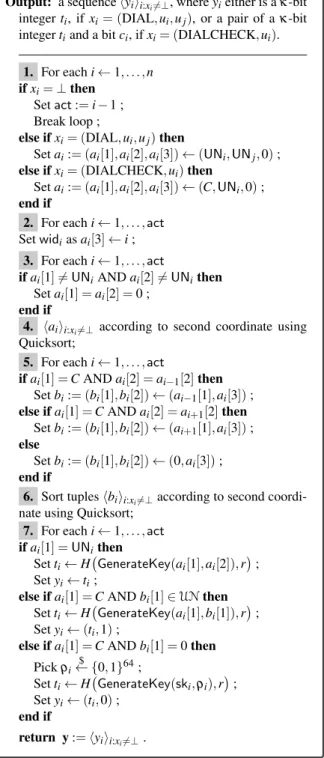
The Dialing ProgramDLNsort
Input: a sequence hx1, . . . ,xni where xi is either a
(DIAL,ui,uj)request, a(DIALCHECK,ui)request, or⊥. All⊥inputs are stacked last.
Output: a sequencehyiii:xi6=⊥, whereyieither is aκ-bit
integerti, ifxi= (DIAL,ui,uj), or a pair of aκ-bit integertiand a bitci, ifxi= (DIALCHECK,ui).
1. For eachi←1, . . . ,n
ifxi=⊥then
Setact:=i−1 ; Break loop ;
else ifxi= (DIAL,ui,uj)then
Setai:= (ai[1],ai[2],ai[3])←(UNi,UNj,0);
else ifxi= (DIALCHECK,ui)then
Setai:= (ai[1],ai[2],ai[3])←(C,UNi,0);
end if
2. For eachi←1, . . . ,act
Setwidiasai[3]←i;
3. For eachi←1, . . . ,act
ifai[1]6=UNiANDai[2]6=UNithen
Setai[1] =ai[2] =0 ;
end if
4. haiii:xi6=⊥ according to second coordinate using
Quicksort;
5. For eachi←1, . . . ,act
ifai[1] =CANDai[2] =ai−1[2]then
Setbi:= (bi[1],bi[2])←(ai−1[1],ai[3]); else ifai[1] =CANDai[2] =ai+1[2]then
Setbi:= (bi[1],bi[2])←(ai+1[1],ai[3]); else
Setbi:= (bi[1],bi[2])←(0,ai[3]);
end if
6. Sort tupleshbiii:xi6=⊥according to second
coordi-nate using Quicksort;
7. For eachi←1, . . . ,act ifai[1] =UNithen
Setti←H GenerateKey(ai[1],ai[2]),r
; Setyi←ti;
else ifai[1] =CANDbi[1]∈UNthen
Setti←H GenerateKey(ai[1],bi[1]),r
; Setyi←(ti,1);
else ifai[1] =CANDbi[1] =0then
Pickρi $ ← {0,1}64; Setti←H GenerateKey(ski,ρi),r; Setyi←(ti,0); end if return y:=hyiii:xi6=⊥.
Figure 4: The Dialing program DLNsort realizing the
Dialing program DLNabs for dialing round r, and users
u1, . . . ,unwith usernamesUN1, . . . ,UNn∈ {0,1}64. The valueCdenotes a dial check request.
7. Computing the dead drops:After the Quicksort
al-gorithm is completed, the active usersu1, . . . ,uactare
de-livered the values ˆb1[1], . . . ,bˆ1[act]respectively. Having received ˆbi[1], dialeruithat knowsUNj, and dial checker ujthat obtainedUNi, can calculate their shared dead drop value for dialing roundras follows:
ti:=H Ki,j,r
, if ˆbi[1] =0 tj:=H Kj,i,r, if ˆbi[1] =UNj
Above, H is a standard cryptographic hash function, ris the round number. The valuesKi,j,Kj,i are the ID-KA keys that ui and uj compute by running the key agreement algorithmGenerateKey on input (ski,UNj) and(skj,UNi)respectively (cf. Section 2), whereski,skj are the secret keys ofui anduj. Recall that the opera-tions for ID-KA key generation are over a finite multi-plicative group of prime orderq. We stress that the dead drop value is at least 64 bits long to make accidental col-lisions unlikely, although our system can tolerate them. By the correctness of the ID-KA protocol, it holds that Ki,j=Kj,i, hence we have thatti=tj.
On the other hand, if useruidial checked but ˆbi[1] = 0 (no one dialed ui), then for uniformity reasons, she computes a random dead drop as above by inserting a random value ρi in place of UNj, i.e. she sets ti:= H GenerateKey(ski,ρi),r.
Note that ifuihas dialchecked, then either (i) she es-tablished a rendezvous point with uj, if ˆb1=UNj, or (ii) no one dialed her, if ˆb1=0. Thus, she can set a “success” bitcito 1 or 0 respectively, indicating her suc-cessful engagement in the dialing roundr. Besides, if ui is a dialer that dialeduj, then she always computes the valueti:=H GenerateKey(ski,UNj),r
, regardless of the success of her dialing request. Hence, she can not infer a success bit.
The Dialing programDLNsort. The program DLNsort
implementing the Dialing protocol is presented in Fig. 4. Following Section 3, we show that DLNsort realizes
the member of the Dialing program familyDLNabs that
corresponds to our sorting process. Namely, in Step 4 ofDLNsort (Sorting by usernames), the inputs are
ar-ranged according to an ordering of their second coordi-nate. Thus, we set the indexzthat parameterizes the fam-ilyDLNabs to be the stringzqs2as follows: zqs2is parsed
as the deterministic programRzDLNqs2 that takes as takes as input an indexiand array of triplesxin encoded form, and outputs the index jso that when the array is sorted according to Quicksort ordering on the second coordi-nate,xiis the left neighbor of the encodedxj. Formally, we state the following theorem and provide the proof in the full version of the paper.
Theorem 1. Let n be the number of users, κ ≥64be the dead drop string length and q be the prime order of the underlying ID-KA group. Let H be the cryptographic hash function modeled as a random oracle. Then, the Dialing programDLNsortdescribed in Fig. 4 implements
the member of the Dialing program family DLNabs
de-scribed in Fig. 2 for parameter zqs2with correctness
er-ror nq4 +2nκ.
Remark 2. The correctness error nq4 +2nκ is typically a negligible value in our setting. To provide intuition, con-sider the case with a number ofn=100000<217users, dead drop sizeκ=64 bits and group sizeq≥2128. The
error for this case is less than 217·4 2128 +
217
264 ≈2
−47.
6
The Conversation Protocol
The Conversation protocol facilitates the actual exchange of messages associated with the sametdead drop value, which represents a rendezvous point computed in the fi-nal step of a Dialing protocol execution. It is expected that no more than two messages will have the samet value due to its large bit-size, although our system can handle collisions as we will see later. As in the previ-ous section, we first provide a description of the Con-versation protocol and then the corresponding program labeledCNVsortthat implements it. At this point, we have
to highlight our assumption that a valid messagemiat the input has its least significant bit (LSB) equal to 0. This flag which could also be a discrete fourth member of our tuple, is useful at (i) conflict resolution when more than two dead drops are identical and (ii) the parallelization of our protocol discussed in section 11 and in the full version of the paper.
Protocol description. The protocol is executed via the following steps, where steps 2-6 are executed by the MPC servers. Step 1 is executed locally by each user.
1. Encoding: The inputs are of the form of
(CONV,ti,mi)requests, or ⊥. Again, we assume that the users are enumerated asu1, . . . ,unconsistently with the order they submitted their input sequencex1, . . . ,xn, hence all⊥values are stacked last. Active users’ inputs are encoded as triples of the formai:= (ai[1],ai[2],ai[3]) where the third component is an input wire IDwidithat will be uniquely assigned in the following step. In par-ticular, ifui wants to engage in conversation, then the (CONV,ti,mi)request is encoded as(ti,mi,0). In case ui is not engaging in conversation the request will use a random dead drop value and a random message.
2. Assigning wire ID values: As a first step, the MPC
protocol assigns unique wire IDs for each user. This is done by setting the third componentai[3]of the encoded tripleaitoi. Thus, for eachui, we have thatwidi:=i.
3. Sorting by dead drops: The encoded input triples
are first sorted according to their first components using the oblivious Quicksort algorithm of [33]. As a result, the inputs of any two users that share the same dead drop value will become adjacent.
4. Exchanging adjacent messages: By construction,
two inputs with the same dead drop value indicate a pair of usersui anduj that wish to communicate. Thus, the protocol generates a vectorhb1, . . . ,bni, where each bi is a pair(bi[1],bi[2]), of which the second component is widiand the first component is either (i) the message of some adjacent encoded input, or (ii) the original message mi, if message exchange did not take place foruibecause there was no matching dead drop or due to conflict (three or more equal dead drops). As already mentioned, the LSB of two exchanged messages is set to 1. In the special conflict case where three or more values share the same dead dropt, an arrangement would be as follows:
. . . ,(t0,mk,k),(t,mj,j),(t,mi,i),(t,mi0,i0), . . . In this case, the messages ofuiandujwill be exchanged and ui0 will obtain back his message at the end of the
protocol, notifying him to resubmit.
5. Sorting by wire IDs: As in the Dialing protocol
(Step 5), the Conversation protocol performs a Quicksort on the processed requests according to their mutually dis-tinct wire IDs in order for the correct requests to be for-warded to each user. The result is a vectorhbˆ1, . . . ,bnˆ i where ˆbiis a pair(biˆ[1],biˆ[2])that corresponds touiand is either (i) a messagemj from some useruj or (ii) the original messagemi, in both cases indexed bywidi.
6. Forwarding messages:At the end, the protocol
dis-cards the wire IDs and creates the output vector y= hy1, . . . ,yni:=hbˆ1[1], . . . ,bnˆ [1]i. Thus, each yi is either (i) a message mj from some user uj or (ii) the self-generated message mi. Finally, the users u1, . . . ,un are delivered the valuesy1, . . . ,yn.
Remark3. In reality, the dead drop valuetiof some user ui is not exactly the value she received from a dialing protocol execution. For conversation roundrit is com-puted asti:=H(t(dialing)i,r), wheret(dialing)i is the dead drop forui, generated by the dialing protocol and acts as the seed for the creation of an ephemeral dead drop for each conversation round.
Remark 4. Due to the size of dead drops values, the probability that a collision on randomly generated dead drop values will occur can be made very small. Even in the case of a collision, the client of the user that was af-fected would just resend that message in the next round, as it would know that a collision occurred because it re-ceived a message it could not decrypt.
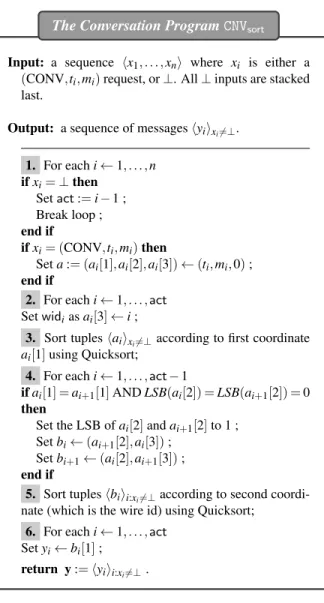
CNVsort implementing the Conversation protocol is
pre-sented in Fig. 5.
The Conversation ProgramCNVsort
Input: a sequence hx1, . . . ,xni where xi is either a
(CONV,ti,mi)request, or⊥. All⊥inputs are stacked last.
Output: a sequence of messageshyiixi6=⊥.
1. For eachi←1, . . . ,n ifxi=⊥then Setact:=i−1 ; Break loop ; end if ifxi= (CONV,ti,mi)then Seta:= (ai[1],ai[2],ai[3])←(ti,mi,0); end if
2. For eachi←1, . . . ,act
Setwidiasai[3]←i;
3. Sort tupleshaiixi6=⊥according to first coordinate ai[1]using Quicksort;
4. For eachi←1, . . . ,act−1
ifai[1] =ai+1[1]ANDLSB(ai[2]) =LSB(ai+1[2]) =0 then
Set the LSB ofai[2]andai+1[2]to 1 ;
Setbi←(ai+1[2],ai[3]);
Setbi+1←(ai[2],ai+1[3]); end if
5. Sort tupleshbiii:xi6=⊥according to second
coordi-nate (which is the wire id) using Quicksort;
6. For eachi←1, . . . ,act
Setyi←bi[1];
return y:=hyiii:xi6=⊥.
Figure 5: The Conversation programCNVsortrealizing the
Conversation programCNVabs for conversation round r,
dead drop sizeκ≥64 and usersu1, . . . ,unwith messages taken from spaceM.
Following Section 3, we show thatCNVsortrealizes the
member of the Conversation program familyCNVabsthat
corresponds to our sorting process. Namely, in Step 3 of CNVsort(Sorting by dead drops), the inputs are arranged
according to an ordering of their first coordinate. Thus, we set the indexzthat parameterizes the familyCNVabsto
be the stringzqs1as follows:zqs1is parsed as the
deter-ministic programRzCNVqs1that takes as input an indexiand array of triplesxin encoded form, and outputs the index jso that when the array is sorted according to Quicksort ordering on the first coordinate, the encoded triple ofui (or resp. uj) has no neighbors on the left of the sorted
array and the encoded triple ofuj(or resp.ui) is the right neighbor of the encoded triple ofui (or resp. uj). For-mally, we state the following theorem and provide the proof in the full version of the paper.
Theorem 2. Let n be the number of users andκ≥64be
the dead drop string length. The Conversation program CNVsortdescribed in Fig. 5 implements the member of the
Conversation program familyCNVabsdescribed in Fig. 3
for parameter zqs1.
7
The MCMix Anonymous Messaging
Sys-tem
Having presented the general architecture of our system in Section 4 and the Dialing and Conversation protocols and programs in Sections 5 and 6 respectively, we now show how these programs are implemented in our archi-tecture. Our system consists of two MPC instances of the general architecture in Section 4, executing one after the other or independently in parallel. One implements the Dialing protocol and the other the Conversation protocol. Below, we specify the operations of general architecture for each of our two protocols. We note with the prime symbol, e.g. 1’., the specification of the respective step, e.g. 1., of the general architecture.
Dialing. The execution of the Dialing protocol for round rfollows the steps of section 4 with the following partic-ularities:
1’. Encoding: The input of useruiis encoded asai=
(UNi,UNj,0), in the case of a dial to useruj, or asai= (C,UNi,0)in the case of a dial request, as specified by Step 1 of the Dialing programDLNsortin Fig. 4.
6’. MPC algorithm:The MPC server secure
computa-tion consists of Steps 2-6 ofDLNsort.
8’. Decryption and reconstruction: The
recon-structed valuebi received by userui is the outputbi of Step 6 ofDLNsort.
9’. Dead drop calculation:As an extra step, the dead
drop valueti is calculated by each user by performing Step 7 ofDLNsort.
Conversation. The execution of the conversation pro-tocol for roundrfollows the steps of Section 4 with the following particularities:
1’. Encoding: Input is encoded asai= (ti,mi,0), with
tibeing a dead drop calculated by the final step of a pvious dialing round in the case of a real conversation re-quest (also taking into account Remark 3), or a random value in the case the user does not want to send a mes-sage (but still wants to protect her privacy), according to the Conversation programCNVsortin Fig. 5.
6’. MPC algorithm:The MPC server secure computa-tion consists of Steps 2-6 ofCNVsort.
8’. Decryption and reconstruction: The
recon-structed valuebireceived by the user that provided input iis the outputyiof Step 6 ofCNVsortand is the message
intended for this user.
Security of MCMix. We prove our security theorem for the generalθ-out-of-mcase, as in Definition 1, using the parameterszqs2andzqs1defined in Sections 5 and 6
respectively. We provide the proof in the full version.
Theorem 3. Letκ be the dead drop size, n be the
num-ber of users, m be the numnum-ber of servers and q the size of the underlying Diffie-Hellman group, where n,m are polynomial inλ,κ=Θ(λ)and q=Ω(2λ). LetPbe a
(θ,m)-secure MPC protocol with n users w.r.t. (i) the
Server Computation Steps 2-6 of the Dialing program DLNsort described in Fig. 2 and (ii) the Server
Compu-tation Steps 2-6 of the Conversation programCNVsort
de-scribed in Fig. 3. Then,MCMix implemented overPis an anonymous messaging system by securely realizing the program familiesDLNabs andCNVabs for parameters
zqs2and zqs1respectively.
Remark5 (On forward security of MCMix). MCMix in its current form does not offer forward security. Nev-ertheless it is possible to provide forward security as fol-lows. First, clients could refresh their exchanged keys with the servers in regular time intervals, e.g., once a day. Alternatively to avoid interaction, forward secure encryption can be used, e.g., see [9]. With respect to the dead drop calculation we can obtain forward security by applying our second ID-KA construction with forward secrecy (cf. Section 2 and the full version). The addi-tional communication cost to the Dialing protocol would be one extra random group element per user as now the active inputsx1, . . . ,xn for dialing need to be used for the first round of the exchange; they are of the form of (DIAL,ui,uj,ri)and(DIALCHECK,ui,rj), whereri,rj are random elements from the ID-KA cyclic group. Sort-ing would still be executed on the users’ usernames and the wire IDs as before thus incurring no additional over-head. We omit further details.
8
Implementation and Benchmarking
We implemented a prototype of our system using the Sharemind platform and performed extensive evaluation. Experiment setting. Benchmarks were run on a cluster of three machines with point-to-point 1 Gbps network connections using various profiles for network latency aiming to simulate WAN behavior. Each machine has a 12-core 3 GHz Hyper-Threading CPU and 48 GB of
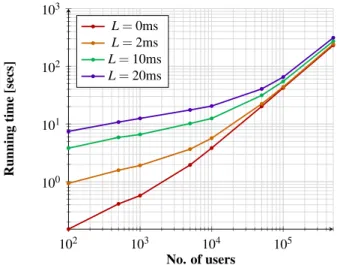
RAM. However, even though the hardware supports it, Sharemind MPC protocols are not optimized to use mul-tiple CPU cores or network layer in a parallel manner. The servers running Sharemind employ only 2 cores, one for executing the computations and another for pseudo-random number generation. To simulate real-world envi-ronment, we use thetctool to manipulate operating sys-tem’s network traffic control settings. This tool is used to both cap the available network bandwidth, as well as introduce communication latency by adding round-trip delay (ping). 102 103 104 105 100 101 102 103 No. of users Running time [secs] L=0ms L=2ms L=10ms L=20ms
Figure 6: Running time in secs of the Dialing protocol implementation for a number ofn=100, 500, 1K, 5K, 10K, 50K, 100K, 500K users and latencyL=0, 2, 10, 20 ms. The benchmarks were run with message size 8 Bytes and 1 Gbps network bandwidth.
Dialing protocol. We benchmarked our dialing protocol for various numbers of users and various latency values. The results are presented in Fig. 6. As we can see, the dialing protocol has a runtime for each round of around one minute for 100,000 users and around 300 seconds for 500,000 users, considering the worst case of 20 ms of latency. The latter value might still be considered accept-able for some settings, as dialing rounds need not be exe-cuted very often. Another interesting observation is that the effect of latency diminishes as the number of users increases, due to the fact that the number of communica-tion rounds of our algorithm scales logarithmically to the number of inputs. This in turn happens because Quick-sort needsO(log(n))steps to sortninputs when executed in parallel. The vectorized nature of our implementation succeeds in taking advantage of the parallelizable nature of the algorithm. The time a user needs to encode her request and send it, as well as the time required by each MPC server to decrypt the requests it received have no effect on the per round runtime of our system. This is
be-cause these operations are performed in a pipelined fash-ion. This means that the encoding, encryption and de-cryption of the requests for roundr+1 takes place while the MPC servers perform the computations for roundr. In the dialing protocol this is acceptable as a user’s in-tent on whether to dial or perform a dial check might not depend on the output of the previous dialing round. Conversation protocol.For the conversation protocol we made extensive benchmarks considering the number of users, the latency of the network, as well as the message size. In Fig. 7, we can see that the running time of the conversation protocol with a very small message size of 8 Bytes (B) is similar to the running time of the dialing protocol. That is, the system can serve 100,000 users with in around one minute for maximum latency of 20 ms. Again, we see that latency is a minor performance factor for a large number of users. This fact enables us to claim that our system will have similar running times even with greater latency values.
102 103 104 105 100 101 102 103 No. of users Running time [secs] L=0ms L=2ms L=10ms L=20ms
Figure 7: Running time in secs of the Conversation pro-tocol implementation for a number ofn=100, 500, 1K, 5K, 10K, 50K, 100K, 500K users and latencyL=0, 2, 10, 20 ms. The benchmarks were run with message size 8 Bytes and 1 Gbps network bandwidth.
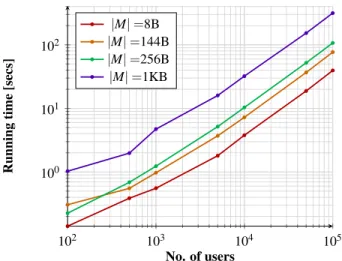
In Fig. 8, we consider how the message size affects performance. We have benchmarked various message sizes ranging from 8 B to 1 KB messages. No artifi-cial latency has been injected for these experiments. We see that message size affects performance in a significant way as opposed to latency, but the system can still sup-port anonymity sets of tens of thousands of users even with 1KB messages and certainly SMS long messages for hundreds of thousands.
Finally, in Fig. 9, we provide the peak network band-width consumption during the Dialing and Conversation protocols. We note that the total bandwidth is shown,
i.e. bytes sent and received and to both other computing nodes. We observe that in both protocols the bandwidth consumption remains at a low level of less than 100Mbps for the Dialing protocol for (usernames of 64bits) as well as the Conversation protocol for messages of up to SMS size. For bigger message sizes and 100,000 users, we get that the total consumption is roughly 150Mbps and 300Mbps for messages of 256B and 1KB respectively, which can be realistic for a large scale setting.
102 103 104 105 100 101 102 No. of users Running time [secs] |M|=8B |M|=144B |M|=256B |M|=1KB
Figure 8: Running time in secs of the Conversation pro-tocol implementation for a number ofn=100, 500, 1K, 5K, 10K, 50K, 100K users and message size|M|=8, 144, 256, 1K Bytes. The benchmarks were run with no latency and 1 Gbps network bandwidth.
102 103 104 105 101 102 No. of users P eak netw ork band width [Mbps] |M|=8B |M|=144B |M|=256B |M|=1KB |UN|=64bit
Figure 9: The peak network bandwidth consumption in Mbps during the Dialing protocol for usernames (UNs) of 64bits and the Conversation protocol for message size |M|=8B, 144B, 256B, 1KB, given a number ofn=100, 500, 1K, 5K, 10K, 50K, 100K users. The benchmarks were run with no latency and 1 Gbps network bandwidth.