The University of San Francisco
USF Scholarship: a digital repository @ Gleeson Library |
Geschke Center
Mathematics College of Arts and Sciences
2017
Topic Supervised Non-Negative Matrix
Factorization
K. MacMillan
James D. Wilson
University of San Francisco, [email protected]
Follow this and additional works at:http://repository.usfca.edu/math Part of theMathematics Commons
This Article is brought to you for free and open access by the College of Arts and Sciences at USF Scholarship: a digital repository @ Gleeson Library | Geschke Center. It has been accepted for inclusion in Mathematics by an authorized administrator of USF Scholarship: a digital repository @ Gleeson Library | Geschke Center. For more information, please [email protected].
Recommended Citation
Topic Supervised Non-negative Matrix Factorization
Kelsey MacMillan
∗and James D. Wilson
†July 4, 2017
Abstract
Topic models have been extensively used to organize and interpret the contents of large, unstructured corpora of text documents. Although topic models often perform well on tradi-tional training vs. test set evaluations, it is often the case that the results of a topic model do not align with human interpretation. This interpretability fallacy is largely due to the unsu-pervised nature of topic models, which prohibits any user guidance on the results of a model. In this paper, we introduce a semi-supervised method called topic supervised non-negative matrix factorization (TS-NMF) that enables the user to provide labeled example documents to promote the discovery of more meaningful semantic structure of a corpus. In this way, the results of TS-NMF better match the intuition and desired labeling of the user. The core of TS-NMF relies on solving a non-convex optimization problem for which we derive an iterative algorithm that is shown to be monotonic and convergent to a local optimum. We demonstrate the practical utility of TS-NMF on the Reuters and PubMed corpora, and find that TS-NMF is especially useful for conceptual or broad topics, where topic key terms are not well under-stood. Although finding an optimal latent structure for the data is not a primary objective of the proposed approach, we find that TS-NMF achieves higher weighted Jaccard similarity scores than the contemporary methods, (unsupervised) NMF and latent Dirichlet allocation, at supervision rates as low as 10% to 20%.
Keywords: topic modeling, matrix decomposition, natural language processing, semi-supervised learning
∗Master of Analytics Program, University of San Francisco. San Francisco, CA 94117. kjmacmillan@
usfca.edu
†Department of Mathematics and Statistics, University of San Francisco. San Francisco, CA 94117
1
Introduction
Large, unstructured corpora of text data are generated from an expanding array of sources: online journal publications, news articles, blog posts, Twitter feeds, and Face-book mentions, to name a few. As a result, the need for computational methods to organize and interpret the structure of such corpora has become increasingly apparent. Topic models are a popular family of methods used to discover underlying semantic structure of a cor-pus of documents by identifying and quantifying the importance of representative topics, or themes, throughout the documents. Topic modeling techniques like non-negative matrix factorization (NMF) [22] and latent Dirichlet allocation (LDA) [5; 6; 7], for example, have been widely adopted over the past two decades and have witnessed great success.
Despite the accomplishments of topic models over the years, these techniques still face a major challenge: human interpretation. To put this into context, consider the most common practice in which a user assesses a topic model. First, a test collection of documents with manually labeled topics is held out. A topic model is then trained on the remaining docu-ments, and evaluated on how closely the topics discovered on the training data match those in the test set. As pointed out by [5;9], evaluation of topic models in this traditional training-test set manner often lead to results that are weakly correlated with human judgment. This is not surprising since the assessment strategy itself generally does not incentivize human interpretation. To provide a concrete example consider the well-studied Reuters corpus from [4] that contains 10,788 labeled documents. The following is a document in the corpus that has been labeled with the topic sugar:
The outcome of today’s European Community (EC) white sugar tender is extremely difficult to predict after last week’s substantial award of 102,350 tonnes at the highest ever rebate of 46.864 European currency units (Ecus) per 100 kilos, traders said.
We ran NMF and LDA on the full corpus. The two closest matching topics to the true label sugar were: NMF - tonne, export, shipment and sugar, trader, european; LDA
-european, french, tonne, andsugar, trader, said. Each of these methods do indeed output a topic containing the true label sugar; however, without further analysis it is a challenging
task to identify that sugar was the desired label of the document. We further analyze the Reuters corpus in Sections 4 and 5.
In this paper we introduce a novel topic model, known as Topic Supervised NMF (NMF), that dramatically improves the interpretability of contemporary topic models. TS-NMF is a semi-supervised topic model that enables the user to (i) provide examples of documents labeled with known topics and (ii) constrain the topic representation of the cor-pus to align with the labeled examples. Supervision is formulated as requiring that certain documents either contain a subset of known topics with non-zero strength or explicitly do not contain the identified known topics. By providing known topics to the model rather than allowing the model to generate an arbitrary latent structure, the interpretation of doc-uments containing those known topics will be readily understood. TS-NMF relies on the minimization of a non-convex optimization function. We describe a fast iterative algorithm to approximate this minimization, and prove that the algorithm converges to a local min-imum. We apply TS-NMF to two data sets, the Reuters news article corpus [4] and the MEDLINE/PubMed abstracts corpus [1], and assess the utility of our method through a comparison with contemporary topic models, including unsupervised NMF and LDA.
2
Related Work
A corpus of n documents and t terms can be represented by a n× t term-document matrix V containing non-negative entriesvi,j >0 that quantify the importance of termj in
documenti. The choice of weightsvi,j is dependent upon the application, but is typically
cal-culated using some function of term frequency (TF) and inverse document frequency (IDF) (see [18] for a review). Mathematically, topic models are mappings of V to a lower dimen-sional representation of V involving the d < n, t topics describing the documents. Existing topic modeling approaches generally fall into two classes of methods: matrix decomposition methods, which seek a low dimensional representation ofV through a factorization into two or more low-rank matrices, and probabilistic topic modeling methods, which seek a genera-tive statistical model for V. Here, we describe each class of methods in more detail, paying special attention to the works that are most closely related to TS-NMF.
TS-NMF can be viewed as a semi-supervised generalization of NMF. In the case that no supervision is provided, TS-NMF indeed reduces to NMF. NMF is a powerful matrix decom-position technique that has been applied to a variety of areas, including speech denoising, microarray analysis, collaborative filtering, and computer vision [8;16;19;20]. More broadly, NMF is useful in settings where the domain of the data is inherently non-negative and where parts-based decompositions are desired. In general, NMF seeks an×d non-negative matrix
W and a d ×t non-negative matrix H so that V ≈ W H. The matrices W and H are estimated by minimizing the following objective function:
DN M F(W, H) = ||V −W H||2F, W >0 H >0, (1)
where||·||F is the Frobenius norm. In topic modeling,W andHhave a special interpretation:
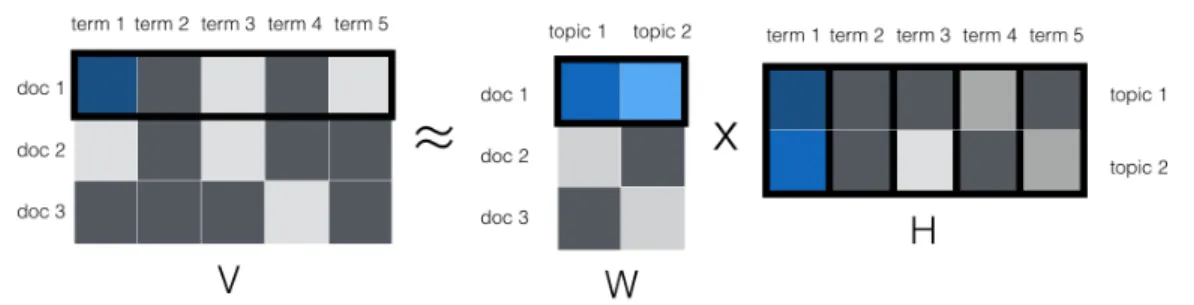
Wij quantifies the relevance of topicj in documenti, andHij quantifies the relevance of term
j in topic i(see Figure 1).
Figure 1: Illustration of NMF model for topic modeling
Other related extensions of NMF include constrained NMF [21], and semi-supervised NMF [10]. Constrained NMF assumes that some subset of columns of V have class labels that dictate their location in latent space. In this formulation, one constrains the matrix H
so as to enforce the relation that if theith and jth columns of V have the same class labels, then the ith and jth rows of H are equal. Semi-supervised NMF was developed with the objective of identifying the clusters of each column of V. With this method, the user can provide pairwise constraints on the columns of V, specifying whether they must or cannot be clustered together. The minimization problem in (1) is reformulated as a non-negative tri-factorization of the similarity matrix that provides the clustering information. As we will see in the next section, each of these methods permits much stronger supervision than
TS-NMF in that our proposed method constrains only which of a subset of topics are not allowed to be in some subset of documents.
Latent Semantic Indexing (LSI) [11; 13] is a popular matrix decomposition method uti-lized in topic modeling. LSI seeks a latent representation of V via a singular value de-composition (SVD). Though not directly applied to topic modeling, [3] and [17] introduced supervised versions of the decomposition methods Principal Components Analysis (PCA) and SVD, respectively. In these works, supervision consisted of incorporating auxiliary in-formation for matrix decomposition in the form of a linear model.
Though not our focus in this paper, probabilistic topic models have been widely applied (see [5] for a review). Probabilistic topic models seek a generative statistical model for the matrixV. The most prominent of these approaches is latent Dirichlet allocation (LDA) [6;7], which models the generation of V as a posterior distribution arising from the probability distributions describing the occurrence of documents over topics as well as the occurrence of topics over terms. LDA takes a Bayesian approach to topic modeling and assumes a Dirichlet prior for the sets of weights describing topics over terms and documents over topics. In this way, the resulting model forms a probability distribution, rather than unconstrained weights onW andH. Recent extensions of LDA have considered alternative prior specifications and have begun to explore supervision through apriori topic knowledge [2].
3
Topic Supervised Non-negative Matrix Factorization
Suppose that one supervises k << n documents and identifies ` << t topics that were contained in a subset of the documents. One can supervise the NMF method using this information. This supervision can be represented by the n×d topic supervision matrix L. The elements of L are of the following form:Lij =
1 if topic j is permitted in document i
0 if topic j is not permitted in document i
We use the supervision matrix L to constrain the importance weights Wij. For all pairs
as requiring the labeled documents to lie within a prescribed subspace of the latent topic space. Let◦represent the Hadamard product operator. For a term-document matrixV and supervision matrix L, TS-NMF seeks matricesW and H that minimize
DT S(W, H) =||V −(W ◦L)H||2F, W >0, H>0. (2)
3.1
The TS-NMF Algorithm
In general the optimization function DT S is not convex in its arguments. Thus we seek
an iterative monotonic algorithm that improves in each iteration. We first devise an itera-tive multiplicaitera-tive update rule for minimizing (2), then we prove that our update rules are monotonically non-increasing in DT S and will converge to a local minimum fixed point.
We begin with an equivalent representation of the Frobenius norm of a matrix: ||A||2
F =
Tr(ATA), where Tr(·) represents the trace of a matrix, or the sum of its entries on the diagonal. Using this representation and properties of the trace we are able to simplify the expression in (2) as follows.
DT S(W, H) = Tr(V VT)−2Tr(VT(W ◦L)H) + Tr(HT(W ◦L)T(W ◦L)H). (3)
We apply the method of Lagrange multipliers on (3) with the constraints Wij > 0 and
Hij >0. Letα= (αij) and β= (βij) denote the matrices of Lagrange multipliers for W and
H, respectively. Then, minimizing DT S(W, H) is equivalent to minimizing the Lagrangian
L(W, H):
L(W, H) = DT S(W, H) + Tr(αWT) + Tr(βHT) (4)
Taking partial derivatives in (4) yields
∂L(W, H)/∂H =−2VT(W ◦L) + 2H(W ◦L)T(W ◦L) +β. (6)
Note that minimizing DT S(W, H) can be achieved in an element-wise fashion. With this
in mind, we apply the Karush Kuhn Tucker conditions αijWij = 0 and βijHij = 0 and set
the expressions in (5) and (6) to 0 for each element (i,j) to obtain the following system of equations
[H(W ◦L)T(W ◦L)]rjHrj −[VT(W ◦L)]rjHrj = 0 (7)
[((W ◦L)HHT)◦L]irWir−[V HT ◦L]irWir = 0 (8)
Solving equations (7) and (8) leads to the following iterative algorithm that sequentially updates the entries ofH and W.
Algorithm: TS-NMF Multiplicative Update Rules Initialize H0, W0,t = 0 Loop Set H =Ht,W =Wt For r= 1, . . . , d, j = 1, . . . , t, and i= 1, . . . , n: Hrjt+1 =Hrjt [(W ◦L) TV] rj [(W ◦L)T(W ◦L)H] rj (9) Wirt+1 =Wirt [(V H T)◦L] ir [((W ◦L)HHT)◦L] ir (10) IfHt+1 =Ht and Wt+1 =Wt, break Elseset t=t+ 1 and repeat Loop
Initialization of H0 and W0 is arbitrary; however, we follow the suggestion of [15] and
initializeH0 using the Random Acol method. The entries ofW0 are sampled as independent
realizations from a uniform random variable on the unit interval.
3.2
Monotonicity of the Algorithm
We now analyze the convergence and monotonicity of the TS-NMF algorithm by ana-lyzing the update rules (9) and (10). Our main result shows that the optimization function
DT S(W, H) is non-increasing in these updates, and that a fixed point (W∗, H∗) will be a
stationary point of the functionDT S(W, H). This suggests that the output of the algorithm,
(W∗, H∗) will be a local minimum of DT S(W, H). Our main result is made precise in the
following theorem.
Theorem 1. The optimization functionDT S(W, H)is non-increasing under the update rules
(9) and (10). Furthermore, DT S(W, H) is invariant under these updates if and only if
(Wt, Ht) is a stationary point for D
T S(W, H). It follows that (W∗, H∗) is a local minimum
for DT S(W, H).
The proof of Theorem 1 relies on identifying an appropriate auxiliary function for
DT S(W, H) and proving that the update rules (9) and (10) minimize the chosen auxiliary
function at each iteration. This proof technique was, for example, utilized in [12] for analyz-ing convergence properties of the Expectation-Maximization algorithm. We fill in the details below.
Let FH(Hrj) denote the part of DT S(W, H) that depends on the element Hrj, and
FW(Wir) the part that depends on Wir. Since the update rules in (9) and (10) are
element-wise, it is sufficient to show thatFH(Hrj) andFW(Wir) are non-increasing in the updates to
prove Theorem 1. To show this, we construct an appropriate auxiliary function for FH(Hrj)
and FW(Wir). An auxiliary function for F(x) is defined as follows:
Definition 2. G(x, x0) is an auxiliary function for F(x) if G(x, x0)> F(x) and G(x, x) =
F(x).
The following well-known lemma reveals the importance of auxiliary functions in studying the convergence of iterative algorithms.
Lemma 3. If G(x, x0) is an auxiliary function for the function F(x), then F is non-increasing under the update
xt+1 =argminxG(x, x0) (11) An important consequence of Lemma 3is thatF(xt+1) =F(xt) if and only ifxt is a local
minimum of G(x, xt). It follows that iterating the update in (11) will converge to a local minimum of F. We proceed by identifying auxiliary functions for FH(Hrj) and FW(Wir).
The next proposition explicitly identifies the auxiliary functions that we need.
Proposition 4. Let FW(Wir) denote the part of (3) that depends on Wir, and let FH(Hrj)
be the part of (3) that depends on Hrj. Define the following two functions:
GH(h, Hrjt ) =FH(Hrjt ) + ∂FH(Hrjt ) ∂H (h−H t rj) + [(W ◦L)T(W ◦L)H] rj Ht rj (h−Hrjt )2 GW(w, Wirt) =FW(Wirt) + ∂FH(Wirt) ∂W (w−W t ir) + [((W ◦L)HHT)◦L] ir Wt ir (w−Wirt)2.
Then GH(h, Hrjt ) is auxiliary for FH(h) and GW(w, Wirt) is auxiliary for FW(w).
Proof. It is obvious that GH(h, h) = FH(h) and GW(w, w) = FW(w). To show that
GH(Hrjt , h) > FH(Hrjt ) one can instead compare GH(Hrjt , h) with the second order
Tay-lor expansion of FH(Hrjt ). Through a little algebra, the result follows. The same argument
holds true to show GW(Wirt, w)>FW(Wirt).
Our final proposition relates the desired update rule in (11) to our proposed update rules in (9) and (10).
Proposition 5. Let GH(h, Hrjt ) and GW(w, Wirt) be defined as in Proposition (4). Then,
argminhGH(h, Hrjt ) = H t rj [(W ◦L)TV] rj [(W ◦L)T(W ◦L)H] rj (12) argminwGW(w, Wirt) = Wirt [(V HT)◦L]ir [((W ◦L)HHT)◦L] ir (13)
Proof. The function GH(h, Hrjt ) is quadratic in h and has a non-negative second
deriva-tive. Furthermore, GW(w, Wirt) is quadratic in w and has a non-negative second derivative.
Proof of Theorem 1: Recall that minimizing DT S(W, H) can be done in an
element-wise fashion, namely by minimizing FH(Hrj) and FW(Wir) for all pairs (r, j) and (i, r). It
thus suffices to show that FH(Hrj) and FW(Wir) are non-increasing in the update rules (9)
and (10), respectively. Proposition 4reveals that GH(h, Hrjt ) and GW(w, Wirt) are auxiliary
functions for FH(h) and FW(w), respectively. Thus according to Lemma 3,DT S(W, H) will
be non-increasing under the following updates:
Hrjt+1 = argminhGH(h, Hrjt ); W t+1
ir = argminwGW(w, Wirt)
Applying (12) and (13) to the above updates, we obtain our desired result.
3.3
Error Weighting
In some applications, it may be of interest to incorporate a weighting scheme that captures “importances” of the documents in V. To do so, one can introduce a n × t weighting matrix E whose entries represent the importance weight of the respective entries in V. The aim of TS-NMF then becomes to identify matrices W > 0 and H > 0 that minimize
DT SW(W, H) = ||((V −(W ◦L)×H))◦E||2F. Although error weighting isn’t required in
TS-NMF, we find empirically that it can improve results by penalizing poor representations of labeled documents more heavily than unlabeled documents. For the results that follow we run TS-NMF onDT SW(W, H) withEhaving rowiset to 1 if documentiwas not supervised,
and to the inverse supervision rate if document i was supervised. We further discuss the weighting procedure and how to adapt the update rules in (9) and (10) to DT SW in the
supplemental material.
4
Experiments
To assess the efficacy of TS-NMF, we study two datasets: the Reuters data set provided as part of the NLTK Python module [4], and abstracts from NIH’s MEDLINE/PubMed citation record [1]. The Reuters data set contains 10,788 labeled news documents, and each document often had multiple labels. We removed any Reuters news documents that had
fewer than 250 characters, which left 8294 documents. From the MEDLINE/PubMed data set, we use a subset of 15,320 abstracts as the corpus and apply PubMed controlled MeSH keywords as labels. Abstracts and keywords are filtered such that each keyword label is attributed to at least 100 abstracts and each abstract has at least one keyword label. In each corpus, tokens were created by splitting the text into 1-grams with NLTK’s Treebank Word tokenizer and then lemmatized using NLTK’s Wordnet lemmatizer. Documents were encoded into a document-term matrix using TFIDF with a vocabulary of 2000 and L2-normalization of the term frequencies within each document. We also removed stopwords and any tokens with fewer than 3 characters long. In the Reuters data set, the true number of labels is 90, and in the PubMed dataset it is 265, so we set k= 90 andk = 265, respectively. We ran TS-NMF on both the Reuters and PubMed data sets, and compared discovered topics with LDA and unsupervised NMF. For TS-NMF we applied a range of supervision according to the supervision rate, which is defined as the proportion of documents included in the labeled set. We provide more detailed summaries of the data in the supplement.
4.1
Evaluation Metrics
Topic models are evaluated by comparing the similarity between the topics found by a model and the ground-truth labels provided in the Reuters dataset and by the PubMed MeSH keywords. Let W and Wf be the identified and true topic - document matrices, respectively. To calculate the similarity between W and Wf, one first calculates a similarity matrix that expresses the Jaccard distrance between the rows of each topic - document matrix, separately. Let Wj be the jth row ofW. Then, the Jaccard match between theith
and jth row is defined as:
J(Wi,Wj) = Pd k=1min(Wik, Wjk) Pd k=1max(Wik, Wjk) . (14)
The Kuhn-Munkres matching algorithm [14] is subsequently applied to the similarity ma-trices for W and fW to identify the optimal one-to-one mapping from discovered topics to known labels in such a way that the sum of all similarities between the mapped topics and true labels are maximized. A topic is considered ”resolved” when it has a similarity score
greater than 0.1.
5
Results
To gain practical insight into the interpretability of the models, we first provide some examples of labeled Reuters articles in Table1. Document 1 of Table1shows a case where all topic models provide reasonable interpretations. They all correctly identify ‘yen’ and ‘dollar’ as key topic defining terms and the meaning of those terms is clear. In the case of Document 2 all models correctly identify ‘sugar’ as a key term, but the unsupervised methods (LDA and NMF) contain some spurious terms, such as ‘export’, ‘european’, and ‘said’ that muddle interpretation. The benefit of topic supervision becomes particularly evident in Document 3. Notably, the topics found via NMF and LDA don’t have a clear human interpretation. TS-NMF captures the terms ‘production’ and ‘industrial’ even with only a 0.2 supervision rate. The same holds true for higher supervision rates.
Figure 2 shows the impact of supervision rate on weighted Jaccard similarity score and topic resolution with greater granularity. Initially, at supervision rates below 20%, we see rapid improvements in terms of similarity. Then, across a midrange of supervision rates (about 20% to 70%) we see a leveling off. Finally, at high supervision rates (greater than 70%), nearly all remaining topics are resolved. This suggests that there exists an optimal supervision rate regime that balances labeling costs with marginal model improvements.
Table 1: Example Reuters results from NMF, LDA, and TS-NMF at 0.2, 0.5, and 0.8 supervision rate. Results reveal that TS-NMF identify interpretable topics that closely match the true topic labels.
Document 1: The Bank of Japan bought a small amount of dollars shortly after the opening at around 145.30 yen, dealers said. The central bank intervened as a medium - sized trading house sold dollars, putting pressure on the U.S. Currency, they said. Labels: dollar; money-foreign exchange; yen
TS-NMF (0.2) TS-NMF (0.5) TS-NMF (0.8) NMF LDA
dollar, yen, dealer (0.34)
dollar, yen, dealer (0.41)
dollar, yen, dealer (0.33)
yen, tokyo (0.34); dollar, dealer, cur-rency (0.41)
dollar, yen, said (0.86)
Document 2: The outcome of today’s European Community (EC) white sugar tender is extremely difficult to predict after last week’s substantial award of 102,350 tonnes at the highest ever rebate of 46.864 European currency units (Ecus) per 100 kilos, traders said. Labels: sugar
TS-NMF (0.2) TS-NMF (0.5) TS-NMF (0.8) NMF LDA
sugar, tonne, white (0.29) barley, tonne, ecus (0.19); sugar, tonne, white (0.27) barley, tonne, ecus (0.15); sugar, tonne, white (0.19) tonne, export, shipment (0.20); sugar, trader, european (0.37) european, french, tonne (0.30); said, market, analyst (0.30); sugar,trader,said (0.37)
Document 3: China’s industrial output rose 14.1 pct in the first quarter of 1987 against the same 1986 period, the People’s Daily said. Its overseas edition said the growth rate, which compares with a target of seven pct for the whole of 1987 was ”rather high” but the base in the first quarter of 1986 was on the low side. Industrial output grew 4.4 pct in the first quarter of 1986. It said China’s industrial production this year has been normal but product quality and efficiency need further improvement. It gave no further details. Labels: industrial production index
TS-NMF (0.2) TS-NMF (0.5) TS-NMF (0.8) NMF LDA
china, agency, news (0.18); january, industrial, pro-duction (0.22); quarter, first, fourth (0.17) pct, industrial, production (0.35); china, chinese (0.22)
quarter, first, third (0.17); pct, in-dustrial, january (0.30); china, chi-nese, daily (0.28) china, produc-tion, output (0.35); quarter, first, result (0.27) pct, growth, year (0.25); pct, jan-uary, february (0.30); said, mar-ket, analyst (0.18)
Figure 3: Comparison of LDA, NMF, and TS-NMF (at 0.05, 0.2, 0.5, 0.8) on Reuters and PubMed.
Figure 3 compares similarity scores across topic modeling methods for the two chosen corpora. In the case of the Reuters data set, LDA outperforms NMF and 5% TS-NMF. However, we see significant gains at supervision levels of 20%. In the case of the PubMed data set, however, LDA performs much worse than NMF. Even more interestingly, NMF outperforms TS-NMF up to a supervision level of about 50%. Moreover, NMF’s results are less variable than the TS-NMF results, implying that the subset of documents included in the labeled set are very important for this corpus. In fact, there appears to be bi-modality in the 50% TS-NMF results. We note that although the weighted Jaccard similarity score is useful for quantifying how well the model represents the prescribed latent structure of the data set, it does not say anything about interpretability of the results. Human labeling doesn’t necessarily correspond to the best latent structure for the data, which is what the factorization and probabilistic models optimize for. This disagreement between human and machine is manifested by low Jaccard scores and is the crux of the interpretation challenges that our proposed supervision strategy seeks to address.
6
Discussion
In this paper we introduced a novel topic modeling method, TS-NMF, that improves hu-man interpretability of topics discovered from large, poorly understood corpora of documents. In such applications, TS-NMF enables the user to incorporate supervision by providing ex-amples of documents with desired topic structure. Although we focused on the formulation of TS-NMF for topic modeling, this method can, with appropriate choice of supervision, be readily generalized to any non-negative matrix decomposition application. We developed an iterative algorithm for TS-NMF based on multiplicative updates and proved the monotonic-ity of the algorithm and its convergence to a local optimum. Finally, we ran TS-NMF on the Reuters and PubMed corpora and compared the method to state of the art topic modeling methods. We found in both applications that there was a regime of low-to-moderate super-vision rates that balanced cost (labeling is expensive) and utility (significant improvement in the model). We have shown that TS-NMF is an effective topic modeling strategy that should be considered in applications when human interpretability is important.
Appendix
A
Error Weighting of TS-NMF
We note that in practice very low supervision rates (few labeled documents compared to the entire corpus) may result in a representation that ”ignores” the labeled data in favor of a factorization with lower loss. This is counter to the interpretability benefit of TS-NMF. To provide a factorization that seeks minimum error around the labeled data, we can weight the “important” (minority case) examples more heavily in the loss function.
In this setting, error weighting can be done by introducing a new error weight matrix
E, which has the same shape as V. E has values at row indices of unlabeled documents equal to 1 (no weighting) and value at labeled document indices greater to 1. Typically, in-verse frequency weighting is used, (number of documents)/(number of labeled documents). However labeled document weights could also be assigned according to a confidence metric.
For instance, one may have both user labeled documents and expert labeled documents, and want to penalize the expert labeled documents more heavily. With error weighting, the loss function for our problem becomes:
DT SW =||((V −(W ◦L)×H))◦E||2F, W >0, H >0 (15)
The corresponding update rules for error-weighted TS-NMF (to replace equations (9) and (10) in the main document) are as follows
Hrjt+1 =Hrjt [(W ◦L) T(V ◦E)] rj [(W ◦L)T((W ◦L)H◦E)] rj (16) Wirt+1 =Wirt [((V ◦E)H T)◦L] ir [((((W ◦L)H)◦E)HT)◦L] ir (17)
B
Additional Empirical Analyses
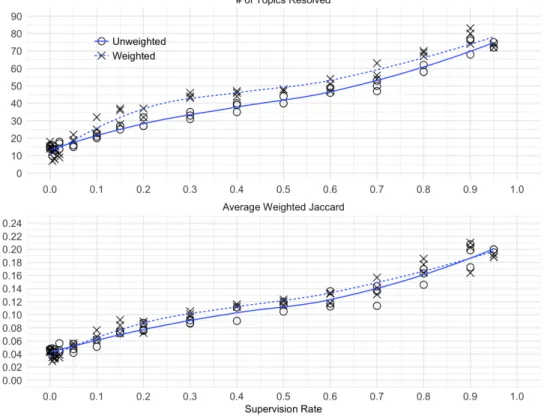
We compare the weighted versus non-weighted versions of TS-NMF on the Reuters data set across a grid of supervision rates as well. Figure 4 illustrates the number of topics resolved and the Jaccard match under each of these methods. Generally, the results show that weighted TS-NMF outperforms unweighted TS-NMF across rates of supervision between 0.2 and 0.7, but that the two methods are comparable for other supervision rates.
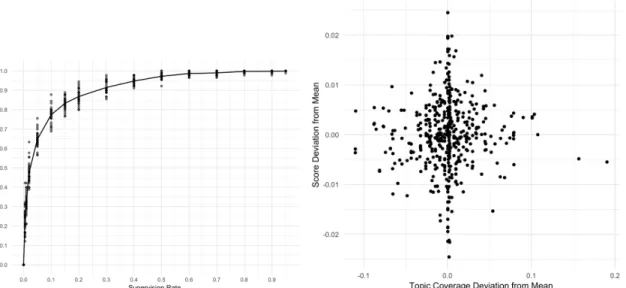
It may be of interest to investigate whether the supervision rate that we specify is con-flated with topic coverage on either the Reuters or PubMed data set. To test this, we take 1000 random samples of documents at a specified supervision rate from the Reuters data set and calculate the topic coverage, or proportion of topics that are incorporated in the sample of documents. We plot the relationship between topic coverage and supervision rate in the left plot of Figure 5. This plot suggests that it is not immediately apparent whether the model is more responsive to the amount of topic coverage or the supervision rate. Moreover, because documents to topics is a one to many mapping, it is not clear how one would ma-nipulate topic coverage while holding supervision rate steady. To investigate this dynamic, we took advantage of the fact that each of our runs at a given supervision rate produced
Figure 4: Comparison of weighted and non-weighted TS-NMF methods on the Reuters data set.
a variety of topic coverage rates due the random selection of the labeled document sub-set. Therefore, we could examine whether a relatively large topic coverage rate at a given supervision rate was predictive of a higher score. The right plot of Figure 5 is a plot of topic coverage rate deviation from group mean against score deviation from group mean, where groups are defined by the supervision rate. Based on Figure5, there is no relationship between topic coverage and model quality at a given supervision rate.
Figure 5: (Left) Topic coverage by supervision rate. (Right) Topic coverage deviation by similarity score deviation within supervision rate groups.
References
[1] MEDLINE/PubMed Citation Records; U.S. National Library of Medicine. https://www.nlm. nih.gov/databases/download/pubmed_medline.html. Accessed: 2017-03-15.
[2] David Andrzejewski and Xiaojin Zhu. Latent dirichlet allocation with topic-in-set knowledge. In Proceedings of the NAACL HLT 2009 Workshop on Semi-Supervised Learning for Natural Language Processing, pages 43–48. Association for Computational Linguistics, 2009.
[3] Eric Bair, Trevor Hastie, Debashis Paul, and Robert Tibshirani. Prediction by supervised principal components. Journal of the American Statistical Association, 101(473):119–137, 2006.
[4] Steven Bird, Ewan Klein, and Edward Loper. Natural Language Processing with Python. O’Reilly Media, Inc., 1st edition, 2009.
[5] David M Blei. Probabilistic topic models. Communications of the ACM, 55(4):77–84, 2012. [6] David M Blei, Andrew Y Ng, and Michael I Jordan. Latent dirichlet allocation. Advances in
neural information processing systems, 1:601–608, 2002.
[7] David M Blei, Andrew Y Ng, and Michael I Jordan. Latent dirichlet allocation. Journal of machine Learning research, 3(Jan):993–1022, 2003.
[8] Jean-Philippe Brunet, Pablo Tamayo, Todd R Golub, and Jill P Mesirov. Metagenes and molecular pattern discovery using matrix factorization. Proceedings of the national academy of sciences, 101(12):4164–4169, 2004.
[9] Jonathan Chang, Jordan Boyd-Graber, Chong Wang, Sean Gerrish, and David M. Blei. Read-ing tea leaves: How humans interpret topic models. InNeural Information Processing Systems, 2009.
[10] Yanhua Chen, Manjeet Rege, Ming Dong, and Jing Hua. Non-negative matrix factorization for semi-supervised data clustering. Knowledge and Information Systems, 17(3):355–379, 2008. [11] Scott Deerwester, Susan T Dumais, George W Furnas, Thomas K Landauer, and Richard
Harshman. Indexing by latent semantic analysis. Journal of the American Society for Infor-mation Science, 41(6):391, 1990.
[12] Arthur P Dempster, Nan M Laird, and Donald B Rubin. Maximum likelihood from incomplete data via the em algorithm. Journal of the Royal Statistical Society. Series B (methodological), pages 1–38, 1977.
[13] Thomas Hofmann. Probabilistic latent semantic indexing. InProceedings of the 22nd annual international ACM SIGIR conference on research and development in information retrieval, pages 50–57. ACM, 1999.
[14] Harold W. Kuhn. The hungarian method for the assignment problem.Naval Research Logistics Quarterly, 2:83–97, 1955.
[15] Amy N Langville, Carl D Meyer, Russell Albright, James Cox, and David Duling. Initializa-tions for the nonnegative matrix factorization. In Proceedings of the twelfth ACM SIGKDD international conference on knowledge discovery and data mining, pages 23–26. Citeseer, 2006. [16] Daniel D Lee and H Sebastian Seung. Learning the parts of objects by non-negative matrix
factorization. Nature, 401(6755):788–791, 1999.
[17] Gen Li, Dan Yang, Andrew B Nobel, and Haipeng Shen. Supervised singular value decompo-sition and its asymptotic properties. Journal of Multivariate Analysis, 146:7–17, 2016. [18] Gerard Salton and Christopher Buckley. Term-weighting approaches in automatic text
[19] Amnon Shashua and Tamir Hazan. Non-negative tensor factorization with applications to statistics and computer vision. InProceedings of the 22nd international conference on Machine learning, pages 792–799. ACM, 2005.
[20] Paris Smaragdis and Judith C Brown. Non-negative matrix factorization for polyphonic mu-sic transcription. In Applications of Signal Processing to Audio and Acoustics, 2003 IEEE Workshop on., pages 177–180. IEEE, 2003.
[21] H Wu and Z Liu. Non-negative matrix factorization with constraints. In Proceedings of the 24th AAAI Conference on Artificial Intelligence, pages 506–511, 2010.
[22] Wei Xu, Xin Liu, and Yihong Gong. Document clustering based on non-negative matrix factorization. In Proceedings of the 26th annual international ACM SIGIR conference on research and development in informaion retrieval, pages 267–273. ACM, 2003.