Copyright Statement
This copy of the thesis has been supplied on condition that anyone who consults it is understood to recognise that its copyright rests with its author and that no quotation from the thesis and no information derived from it may be published without the author’s prior consent.
Simplifying Authoring of
Adaptive Hypermedia Structures
in an eLearning Context
by
Oliver Schneider
A thesis submitted to the University of Plymouth in partial fulfilment for the degree of
Doctor of Philosophy
School of Computing and Mathematics Faculty of Science and Technology
In collaboration with University of Applied Sciences Darmstadt
Abstract
In an eLearning context, Adaptive Hypermedia Systems have been developed to improve learning success by increasing learner satisfaction, learning speed, and edu-cational effectiveness. However, creating adaptive eLearning content and structures is still a time consuming and complicated task, in particular if individual lecturers are the intended authors. The way of thinking that is needed to create adaptive structures as well as the workflows is one that lecturers are unaccustomed to.
The aim of this research project is to develop a concept that helps authors create adaptive eLearning content and structures, which focuses on its applicability for lecturers as intended authors. The research is targeted at the sequencing of content, which is one of the main aspects of adaptive eLearning.
To achieve this aim the problem has been viewed from the author’s side. First, in terms of complexity of thoughts and threads, explanations about content structures have been found in storytelling theory. It also provides insights into how authors work, how story worlds are created, story lines intertwined, and how they are all merged together into one content. This helps us understand how non technical authors create content that is understandable and interesting for recipients. Second, the linear structure of learning content has been investigated to extract all the information that can be used for sequencing purposes. This investigation led to an approach that combines existing models to ease the authoring process for adaptive learning content by relating linear content from different authors and therefore defining interdependencies that delinearise the content structure.
The technical feasibility of the authoring methods for adaptive learning content has been proven by the implementation of the essential parts in a research prototype and by authoring content from real life lectures with the prototype’s editor. The content and its adaptive structure obtained by using the concept of this research have been tested with the prototype’s player and monitor. Additionally, authoring aspects of the concept have been shown along with practical examples and workflows. Lastly, the interviewees who took part in expert interviews have agreed that the concept significantly reduces authoring complexity and potentially increases the amount of lecturers that are able to create adaptive content. The concept represents the common and traditional authoring process for linear content to a large extent. Compared to existing approaches the additional work needed is limited, and authors do not need to delve into adaptive structures or other authors’ content structures and didactic approaches.
Contents
List of Figures 11
List of Tables 13
1 Introduction 23
1.1 Research Context: Atlantis University . . . 24
1.1.1 Learner Preferences . . . 26
1.1.2 Technological Platform to Support the Learning Process . . . 27
1.2 Motivation: Proposal for a Supporting Concept . . . 29
1.3 Aims and Objectives . . . 30
1.4 Methodology . . . 31
1.5 Thesis Structure . . . 32
2 Authoring for Adaptive eLearning 35 2.1 Basic Concepts . . . 35
2.1.1 Adaptive vs. Adaptable . . . 36
2.1.2 Sequencing . . . 36
2.2 Relevant eLearning Specifications . . . 40
2.2.1 IMS Simple Sequencing . . . 41
2.2.2 IMS Learning Design . . . 43
2.3 Sequencing in eLearning . . . 48
2.4 Adaptive Educational Hypermedia . . . 49
2.5 Current State of Authoring Adaptive Educational Hypermedia . . . . 53
2.6 Appraisal . . . 55
2.7 What’s next . . . 56
3 Adaptive eLearning Based on Authoring 57 3.1 Storytelling for Adaptive eLearning . . . 58
3.1.1 Modern Storytelling Models . . . 58
3.1.2 Storytelling Aspects of Interest for Adapting Linear Content Structures . . . 62
3.1.3 Interactive Storytelling . . . 64
3.2 The Concept: “Coherence” . . . 66
3.2.1 Delinearise Content . . . 67
3.2.2 Miscellaneous Concept Features . . . 72
3.2.3 Sequencing Strategies . . . 72
3.3.2 Components and Design . . . 77
3.3.3 Learning Path Construction . . . 92
3.4 Summary . . . 96
3.5 What’s next . . . 97
4 Authoring Aspects 99 4.1 Consequences of Interactivity on Authorship . . . 99
4.2 Structure Transfer . . . 102
4.2.1 Adopting Basic Linear Structure . . . 102
4.2.2 Structure Organisation . . . 105
4.2.3 Fitting into an Environment . . . 107
4.2.4 Weighting the Structure . . . 111
4.3 Authoring Workflows . . . 112
4.3.1 Adapting Existing Content . . . 112
4.3.2 Adding Content . . . 114
4.3.3 Adopting Learner Structures . . . 115
4.3.4 eLearning 2.0 Aspects . . . 115
4.4 Proposed Authoring Environment . . . 117
4.4.1 Import . . . 117
4.4.2 Relation Manager and Editor . . . 118
4.4.3 Context Manager and Editor . . . 120
4.4.4 Debugger . . . 121
4.5 Summary . . . 123
4.6 What’s next . . . 123
5 Prototypical Implementation of the Adaptive eLearning Concept 125 5.1 Application Specification . . . 126
5.1.1 Actual State Analysis . . . 126
5.1.2 Environment Analysis . . . 127
5.1.3 Definition of Objectives . . . 127
5.2 Scope of Services . . . 129
5.3 Implementation . . . 130
5.3.1 Programming Language and Framework . . . 131
5.3.2 Code Organisation . . . 131
5.3.3 Client Server Communication . . . 137
5.3.4 Database . . . 138
5.3.5 Data Models . . . 139
5.3.6 Pathfinding . . . 142
5.3.7 Adaptation . . . 149
5.4 Graphical User Interface . . . 150
5.4.1 Player . . . 153
5.4.2 Editor . . . 153
5.4.3 Monitor . . . 158
5.5.2 Client . . . 160
5.6 Summary . . . 160
5.7 What’s next . . . 161
6 Evaluation of the Concept by Research Interviews 163 6.1 Aim of Inquiry . . . 163
6.2 Method: Expert Interviews . . . 166
6.3 Methodological Aspects . . . 171
6.4 Interview Guide . . . 172
6.4.1 Interviewees’ Background and Opinion . . . 174
6.4.2 Introduction to the Concept and Hands On . . . 178
6.4.3 Discussion about the Concept . . . 178
6.5 Preparing the Prototype . . . 180
6.5.1 Choosing the Content . . . 182
6.5.2 Preparing the Content . . . 183
6.5.3 Arranging the Coherence Prototype . . . 185
6.6 Interviewees . . . 193 6.7 Interview Situation . . . 198 6.8 Analysis Process . . . 200 6.8.1 Transcription . . . 201 6.8.2 Typification . . . 202 6.8.3 Code Matrix . . . 206
6.9 Outcomes of the Interviews . . . 208
6.9.1 Common Workflow for Creation of Learning Content . . . 209
6.9.2 Lecture Preparation . . . 212
6.9.3 Comprehension Problems Behaviour . . . 212
6.9.4 Cooperative Content Creation . . . 215
6.9.5 Experience in Adaptation . . . 216
6.9.6 Estimation of Current Authoring Concepts . . . 220
6.9.7 Introduction and Hands on . . . 224
6.9.8 Authoring Content-Structures . . . 226
6.9.9 Adaptivity . . . 227
6.9.10 Support of Different Content-Structures . . . 228
6.9.11 Applicability for Lecturing Purposes . . . 228
6.9.12 Highlights . . . 229
6.9.13 Proposed Improvements . . . 238
6.9.14 Limitations . . . 248
6.9.15 Scenario . . . 256
6.10 Summary . . . 258
6.10.1 Current Authoring Situation . . . 260
6.10.2 Interviewees’ Estimation of the Concept . . . 261
6.10.3 Remarks on Using the Prototype for the Evaluation . . . 262
6.10.4 Wrap Up and Further Notes . . . 263
7.2 Limitations of Research . . . 267 7.3 Future Work . . . 269 7.3.1 Concept . . . 270 7.3.2 User Interface . . . 272 7.3.3 Authoring . . . 272 7.3.4 Integration . . . 273 7.3.5 Miscellaneous . . . 274 A Publications 279 A.1 Conference Proceedings . . . 279
A.2 Journals . . . 279
A.3 Conferences . . . 279
A.4 Conferences (Presentations) . . . 281
B Expert Interviews 283 B.1 Expert Interview Abstracts . . . 283
B.1.1 Prof. Manfred Gaida . . . 283
B.1.2 Dr. Stefan Göbel . . . 285
B.1.3 Prof. Dr. Matthias L. Hemmje . . . 287
B.1.4 Prof. Dr. Ido Aharon Iurgel . . . 288
B.1.5 Prof. Dr. Detlef Krömker . . . 290
B.1.6 Prof. Dr. Wolfgang Müller . . . 292
B.1.7 Dr. Heiko Rölke . . . 293
B.1.8 Prof. Dr. Ulrike Spierling . . . 294
B.1.9 Dr. Ingo Stengel . . . 297
B.2 Selected Transcripts . . . 298
B.2.1 Transcript has been removed due to Personal Right restrictions298 B.2.2 Dr. Heiko Rölke . . . 298
C Test Environment 317 C.1 Server . . . 317
C.1.1 Ubuntu Linux . . . 317
C.1.2 Web Server Apache 2 . . . 318
C.1.3 Database CouchDB . . . 318
C.2 Client . . . 318
C.3 Content . . . 318
C.3.1 Example User . . . 319
C.3.2 Coherence Lecture Test Content . . . 323
C.4 Miscellaneous Preparations . . . 357
E Technical Details of the Coherence Model Components 367 E.1 Coherence . . . 367 E.2 Condition . . . 369 E.3 ContentSection . . . 370 E.4 ContentType . . . 371 E.5 ContextGroup . . . 372 E.6 EmergencyExitType . . . 373 E.7 NeedContext . . . 375 E.8 ReleaseContext . . . 376 E.9 Repeat . . . 377 E.10 SetContext . . . 378 F Bibliography 381 G Copies of Own Publications 401 G.1 Non-Linear Extended Blended Learning . . . 402
G.2 Mobile Gaming Experience – Working on an Empirical Prototype . . 412
G.3 Learn Your Own Way: Decision Way through Narrative Approaches, Methods, and Paradigms for Learning Purposes . . . 420
G.4 Inside Coherence: Concept for a Non-Linear eLearning Solution . . . 436
G.5 Find Your Own Path: Path Construction Strategy for Atlantis Uni-versity’s Coherence Service . . . 448
G.6 Atlantis University: Learn Your Own Way . . . 460
G.7 Simplified Creation and Presentation of Non-Linear Adaptive Content 478 G.8 Exploration of Learner Preferences and their Impact Within a Media Module . . . 492
List of Figures
1 Example of the six learner-preferences . . . 26
2 Collaborative Content Manipulation – CoCoMa . . . 28
3 Spectrum of adaptation in computer systems . . . 36
4 String of pearls . . . 37
5 String of pearls variation . . . 37
6 Branching . . . 38
7 Complex branching . . . 39
8 Simple Sequencing Standard Behaviour . . . 42
9 Simple Sequencing Loop . . . 44
10 Reload Learning Design Editor . . . 46
11 LAMS Author Mode . . . 47
12 Adaptive Techniques . . . 50
13 Dexter Model . . . 51
14 Adaptive Hypermedia Application Model . . . 51
15 The five level AHS authoring model . . . 52
16 Internal structure of linear content . . . 63
17 StoryWorld Authoring Tool . . . 65
18 Structure of sectioned linear content . . . 68
19 Insertion of content sections that must be presented . . . 70
20 Insertion of alternative content sections . . . 71
21 Overview of the concept’s components . . . 78
22 Coherence Concept Model . . . 79
23 Content Sections . . . 80
24 Content Types . . . 82
25 Content type examples . . . 83
26 Contexts . . . 84
27 Context comparison modes . . . 86
28 Best fitting content . . . 87
29 Repeats . . . 88
30 Content section information taken from source . . . 104
31 Structure organisation . . . 106
32 Content section 1 as a precondition for content section 7 . . . 108
33 Content sections that are preferred for users with a special context . . 111
37 Coherence structure sorted by each author . . . 119
38 Coherence structure sorted by author A . . . 119
39 Coherence structure sorted by author C . . . 120
40 Services needed for creation and presentation of adaptive content . . 129
41 Organisation of the Coherence code . . . 132
42 Schematic player MVC class information flow diagram . . . 134
43 Statechart diagram of player’s init state . . . 135
44 Statechart diagram of player’s main state . . . 136
45 Coherence Model . . . 140
46 Coherence Runtime Model . . . 141
47 Coherence Login . . . 151
48 Register new user . . . 152
49 Select Coherence . . . 154
50 Coherence Player presents a content-section . . . 155
51 Pathfinder pane to select the next step . . . 156
52 Coherence Editor . . . 157
53 Coherence Monitor . . . 159
54 User-centred evaluation for personalised systems . . . 170
55 Coherence Paper Prototype . . . 184
56 Example Context . . . 186 57 Example NeedContext . . . 187 58 Example ContentSection . . . 189 59 Example ContentType . . . 190 60 Example Structure . . . 191 61 Example Condition . . . 192
List of Tables
1 The Functions of the Dramatis Personæ . . . 60
2 Examples for context sources . . . 85
3 Description for selected typical weight values . . . 91
4 Some reasons to alter the original path . . . 93
5 Code Matrix . . . 208
6 Mapping Coherence to LAOS layers . . . 274
7 Mandatory Coherence attributes . . . 367
8 Mandatory Coherence children . . . 368
9 Optional Coherence children . . . 368
10 Mandatory Condition attributes . . . 369
11 Mandatory Condition children . . . 369
12 Optional Condition children . . . 369
13 Mandatory ContentSection attributes . . . 370
14 Optional ContentSection children . . . 370
15 Mandatory ContentType attributes . . . 371
16 Optional ContentType children . . . 371
17 Mandatory ContextGroup attributes . . . 372
18 Mandatory ContextGroup children . . . 373
19 Mandatory EmergencyExitType attributes . . . 373
20 Mandatory EmergencyExitType children . . . 374
21 Optional EmergencyExitType children . . . 374
22 Mandatory NeedContext attributes . . . 376
23 Mandatory ReleaseContext attributes . . . 377
24 Mandatory Repeat attributes . . . 377
25 Mandatory Repeat children . . . 378
26 Optional Repeat children . . . 378
Acronyms
AEH Adaptive Educational Hypermedia 31, 35, 49, 54, 56
AEHS Adaptive Educational Hypermedia System 30–32, 35, 49, 51, 53, 54, 64, 274
AH Adaptive Hypermedia 54
AHAM Adaptive Hypermedia Application Model 51
AI Artificial Intelligence 38, 287
API Application Programming Interface 83 BSD Berkeley Software Distribution 138
CC Common Cartridge 41
CSS Cascading Style Sheets 160
ECTS European Credit Transfer and Accumulation System 24, 53
EML Educational Modelling Language 43
FQDN Fully Qualified Domain Name 385
GUI Graphical User Interface 54, 133, 134, 149, 150, 153, 194, 195, 203, 234, 237, 245, 262, 295, 297
HTML Hypertext Markup Language 80, 102, 129–131, 160
HTTP Hypertext Transfer Protocol 137, 138 ITS Intelligent Tutoring System 49
JSON JavaScript Object Notation 131, 132, 137–139, 386
LAOS Layered WWW AHS Authoring Model and their corresponding Algebraic
Operators 270, 274
LDAP Lightweight Directory Access Protocol 41 LIS Learning Information Services 41, 273
LMS Learning Management System 28, 30, 48, 126, 127, 139, 160, 251, 252, 273 LODE Learning Object Discovery and Exchange 273
LOM Learning Object Metadata 41
LTI Learning Tools Interoperability 40, 127, 273
MD Learning Resource Meta-data 41
MVC Model View Controller 131, 133
ODP Open Document Presentation 117
ODT Open Document Text 117
OER Open Educational Resources 228, 252 PDF Portable Document Format 183, 248, 351 QTI Question and Test Interoperability 41
REST Representational State Transfer 131, 137, 139 RIA Rich Internet Application 130
ROA Resource Oriented Architecture 137
SCORM Sharable Content Object Reference Model 41, 43, 48 SOAP Simple Object Access Protocol 137
SVG Scalable Vector Graphics 102, 130, 160, 183 UoL Unit of Learning 45
URI Uniform Resource Identifier 137, 138, 150, 160
W3C World Wide Web Consortium 102, 130, 160, 183, 386
Acknowledgements
First of all, I would like to thank Anja Feix for her help, advice, understanding, support, and much more. Without her I would not have started this PhD research project, and without her I would not have finished it.
I also have to thank my family. Without them I could not have started this project, and without them I could not have finished it.
Also without the help of my first supervisor Prof. Dr. Udo Bleimann this work would have not been possible. He was always there in case of any problems or just for advice. He was also very motivational as he found the right solutions each time.
I would like thank my third supervisor Dr. Andy Phippen for his support. He always helped me wherever possible.
I would also like to acknowledge my former colleagues at Zentrum für Graphis-che Datenverarbeitung (ZGDV – Computer Graphics Centre), research department “Digital Storytelling”, as well as everybody at the Institut für Angewandte Infor-matik Darmstadt (aiDa – Applied Informatics Darmstadt), Zentrum für Advanced Learning, Medien und Simulation (igdv – Centre for Advanced Learning, Media, and Simulation), and, of course, all the students, supervisors, and researchers of the Atlantis University Project. Furthermore I thank my former colleagues of the research group on mobile gaming experiences and human-computer interaction “Gangs of Bremen” at Hochschule Bremen (Bremen University of Applied Sciences), namely Prof. Dr. Barbara Maria Grüter, for giving me advice and asking me the right questions, especially at the beginning of this project.
Of course, I would also like to thank all my friends who helped me proofread and brainstorm, hosted my office for several months, harboured me one year while I worked in the very north of Germany, helped me when coming up against hard times, or just had patience until the work was finished.
Further, I would like to thank Prof. Dr. Bettina Harriehausen-Mühlbauer for being my second supervisor.
Author’s Declaration
At no time during the registration for the degree of Doctor of Philosophy has the author been registered for any other university award without prior agreement of the Graduate Committee.
This study was financed by myself, without any grant or support by any company or institution.
The postgraduate research project has been conducted and supervised under the agreement between the University of Plymouth and the Hochschule Darmstadt (h_da, University of Applied Sciences Darmstadt) concerning the establishment of
the Darmstadt Node of CSCAN at Hochschule Darmstadt.
Relevant scientific seminars and conferences were regularly attended at which work was frequently presented, and several papers were prepared for publication. Publications:
• Stengel, I., Schneider, O., Bleimann, U.: Exploration of Learner Preferences and their Impact Within a Media Module, in Bleimann, U., Dowland, P. S., Furnell, S.M., Schneider O. (Eds.): “Proceedings of the Eighth International Network Conference (INC 2010)”, pp. 279–288, ISBN: 978-1-84102-259-8 (2010) • Schneider, O., Bleimann, U., Phippen, A.D., and Harriehausen-Mühlbauer, B.: Simplified Creation and Presentation of Non-linear Adaptive Content, in M. Chang et al. (Eds.): “Learning by Playing. Game-based Education System Design and Development, Edutainment 2009, Banff, Canada, August 9–11, 2009. Proceedings”, Lecture Notes in Computer Science, Volume 5670, pp. 239 – 250, Springer Verlag, Berlin Heidelberg, ISBN 978-3-642-03363-6, DOI 10.1007/978-3-642-03364-3_30 (2009)
• Schneider, O., Bleimann, U., and Stengel, I.: Atlantis University: Learn Your Own Way, Int. J. Mobile Learning and Organisation, Vol. 3, No. 2, pp. 184 –
201 (2009)
• Schneider, O., Bleimann, U., Phippen, A.D., Harriehausen, B.: Find Your Own Path: Path Construction Strategy for Atlantis University’s Coherence Service, in Bleimann, U. et. al: Proceedings of the Fourth Collaborative Research Symposium on Security, E-learning, Internet and Networking (SEIN 2008), Glyndˆwr, UK, 6–7 November, p. 46–55, ISBN: 978-1-84102-196-6 (2008)
Seventh International Network Conference (INC2008), Plymouth, UK, 8–10 July, pp 223–233, ISBN: 978-1-84102-188-1 (2008)
• Schneider, O., Bleimann, U., Phippen, A.D., and Harriehausen, B.: Learn Your Own Way: Decision Way through Narrative Approaches, Methods and Paradigms for Learning Purposes, in Bleimann, U. et.al: Proceedings of the Third Collaborative Research Symposium on Security, E-learning, Internet and Networking (SEIN 2007), Plymouth, UK, 14–15 June, pp 99–114, ISBN: 978-1-84102-173-7 (2007)
• Grüter, B., Gröning, S., Milszus, W., Oks, M., and Schneider, O.: Mobile Gam-ing Experience – WorkGam-ing on an Empirical Prototype, NordiCHI’06 Workshop: User Experience – Towards a unified view. Oslo, Norway (2006)
• Schneider, O., Bleimann, U., Harriehausen, B., and Phippen, A.D.: Non-Linear Extended Blended Learning, Proceedings of the Sixth International Network Conference (INC2006), Plymouth, UK, 11–14 July, pp 377–384 (2006)
Presentations:
• Schneider, O., Bleimann, U.: Adaptive Learning Using Storytelling Approaches, Collaborative European Research Conference (CERC2012), Darmstadt, Ger-many (2012)
• Schneider, O.: Einbindung externer Aktivitäten mit IMS-LTI (Learning Tools Interoperability), MoodleMoot 2012, Münster, Germany (2012)
• Schneider, O., Phippen, A.D., Bleimann, U., and Harriehausen-Mühlbauer, B.: Coherence: The personal-individual way of learning, in S. Wheeler (Ed.): “Digital Futures: Learning in a Connected World”, pp. 23, 6th Plymouth
e-Learning Conference 2011, Plymouth, UK (2011)
• Schneider, O.: Atlantis University Project: “Learn Your Own Way”, Moodle 2010, Universität Duisburg-Essen, Germany (2010)
• Schneider, O., Bleimann, U., Phippen, A.D., and Harriehausen-Mühlbauer, B.: Cooperative Creation of Non-Linear eLearning Content, in S. Wheeler (Ed.): “Learning without Limits: Facing the Challenges”, pp. 59, 5th Plymouth
e-Learning Conference 2010, Plymouth, UK (2010)
• Martens, T., Hatteh, A., Schulmeyer, M., and Schneider, O.: Integrating Motivation in e-Learning, 4th Plymouth e-Learning Conference 2009, Plymouth, UK (2009)
• Bleimann, U., Stengel, I., and Schneider, O.: Atlantis University: The Future of Learning and Teaching, 4th Plymouth e-Learning Conference 2009, Plymouth,
UK (2009)
• Schneider, O.: ODF for Blender in an eLearning Context, Blender Conference, Amsterdam, Netherlands 24–26 October (2008)
Presentations and Conferences Attended:
• Collaborative European Research Conference (CERC2012), Darmstadt, Ger-many (2012)
• MoodleMoot 2012, Münster, Germany (2012)
• 6th Plymouth e-Learning Conference 2011, Plymouth, UK (2011)
• Eighth International Network Conference (INC 2010), Heidelberg, Germany (2010)
• Moodle 2010, Universität Duisburg-Essen, Germany (2010) • 5th Plymouth e-Learning Conference 2010, Plymouth, UK (2010)
• MoodleMoot 2010, Berlin, Germany (2010) • Edutainment 2009, Banff, Canada (2009)
• 4th Plymouth e-Learning Conference 2009, Plymouth, UK (2009)
• Fourth Collaborative Research Symposium on Security, E-learning, Internet and Networking (SEIN 2008), Glyndˆwr, UK (2008)
• Blender Conference, Amsterdam, Netherlands (2008)
• Seventh International Network Conference (INC2008), Plymouth, UK (2008) • Third Collaborative Research Symposium on Security, E-learning, Internet and
Networking (SEIN 2007), Plymouth, UK (2007)
• Sixth International Network Conference (INC2006), Plymouth, UK (2006)
Word count of main body of thesis: 60 424
Signed ... Date Monday 28th July, 2014
Chapter 1
Introduction
People are different and therefore learn differently [22]. To support these differences, adaptive learning systems have been developed that adapt the presentation of learning content [86]. The objective is to improve learning success by increasing learner satisfaction, learning speed, and educational effectiveness. However, authoring adaptive content and structures is still an unsolved problem [20] that is addressed by the research project described in this thesis.
To set out the basis for the motivation for this research project, this chapter starts with the context of this research, the Atlantis University project. First, a brief overview is given about the project itself, followed by a deeper insight into the topics that are related to this research project: Learner preferences and the tool Collaborative Content Manipulation.
Based on the demand for creating, preparing, reusing, and presenting the content of a university network as described in the first section, the next section sets forth the motivation behind starting the research project presented in this thesis.
Section 1.3 Aims and Objectives highlights the research goals, followed by a section about the methodology for research and for system development. Lastly, section 1.5 Thesis Structureguides the reader through the thesis by outlining the information to be found in each chapter.
1.1
Research Context: Atlantis University
The research of this PhD project was part of the interdisciplinary project Atlantis University [107]. Atlantis University started in 2002 and was active until 2011. Ten universities and companies from the United Kingdom, Ireland, Poland, Hungary, Germany, and the United States of America collaborated in researching and develop-ing new pedagogical concepts. The project focused on an innovative combination of different knowledge transfer forms called Extended Blended Learning [17], which in essence is a mix of project-based learning, eLearning, and face-to-face learning.
The internationalisation of Atlantis did not end with its international project-partners; it was international by all means possible and all the project partners worked together on the Atlantis approach. Of course, students were able to take courses at the partner universities and additionally there were international modules such as International Project Based Learning [16]. Some modules and lessons from the partner universities were combined which enabled partners (and lecturers) to focus on their strengths. Students gained internationally accredited and recognised qualifications through international cooperative, collaborative, and interdisciplinary learning.
To simplify the process of exchanging and merging learning content, the content and the organisation of the issues were standardised. The Bologna-process was a very important step for the project, but Atlantis University went beyond European Credit Transfer and Accumulation System (ECTS). The intention was to build a virtual university that provided all its partners with access to the content of Atlantis University. The modules were developed with the cooperation of the partners. The strongest partner, in each topic respectively, took the lead. Hence, the modules were developed once but could then be used many times at different locations.
Because Atlantis University brought together the content of many universities, large amounts of learning content were available. In particular, students of small universities or faculties were able to profit from this because they were able to
1.1. Research Context: Atlantis University select from a large pool of content. Although this is an advantage, the factor of the agony of choice also had to be taken into consideration: In today’s universities the students might know their lecturers from earlier modules and as such have the chance to estimate who can provide the best content for them. However, in Atlantis University many more modules and lecturers as well as languages and individual student preferences had to be taken into consideration. Therefore, Atlantis university needed a software which could filter the offered content to meet a suitable preselection.
Additionally, it was also desirable to combine not only complete modules, but also their structure and single learning units. In the vision of Atlantis University, when a lecturer wanted to assemble a new module he could consider the structure and application and then select already existing, suitable content from the Atlantis University’s learning content database and adapt it to his needs. Another option would be using existing content, including its structure, as the basis for the lecturer’s own learning content development. A large selection of content would allow for more possibilities of adaptation and personalisation and hence be beneficial to students.
A further aim of the Atlantis University project was to be involved in international cooperation and interdisciplinary learning and teaching within the scope of an internationally accredited study path [15]. Briefly outlined, in future the virtual university should offer online content, modules, and access to people affiliated with partner universities worldwide through a software portal. Using internationally equivalent content, examination rules, and degrees, a student should be able to take part in modules at one university but also to attend projects all over the world online. Atlantis University should serve as a mediator, offering communication interfaces and filters, enabling sorting and combining international content.
The above stated aims of the Atlantis University Project led to the research project that is reported in this thesis. A concept was to be designed that would allow the reuse of existent learning content according to offers tailored to the individual requirements of the students.
Before discussing the aim of this research project in more detail, the following sections present further details of the Atlantis University project that are relevant for the motivation of this PhD research project. These include a learner preferences model and parts of the technical environment of Atlantis University, and in particular the collaboration tool CoCoMa.
1.1.1
Learner Preferences
For further improvement of the learning process within Atlantis University, individual learning characteristics of learners and teachers were taken into consideration. The model developed by Röll merges seven preference determination models out of 70 existing models [23] and defines six different learner types [101]. A person does not just correspond to one learner-type, but his strong and weak developed learning preferences are distributed through all six preferences, see figure 1. Typically two preferences are high levelled, two are medium, and two are weak levelled [102].
The illustration shows exemplary strengths in the domains of perceiver and organiser. A person of this learner type learns especially well and with pleasure if he is led step-by-step through clearly structured learning content [23]. In addition, the
An a lyst C re a to r C o mmu n ica to r C o n st ru ct o r O rg a n ise r Pe rce ive r
Figure 1: Example of the six learner-preferences: This shows how Röll’s model consists of six types. In this example, the types, organiser and perceiver are strong, while analyst and communicator are medium, and constructor and creator are less well developed.
1.1. Research Context: Atlantis University amplitude in the perceiver’s field shows that the learner should have this content audio-visually presented to achieve optimum learning success [103]. Hence, the learning material prepared for this learner type is intended to stimulate his senses. These might be charts, animation, or videos, but also kinetic stimulation like touch or auditive talks and discussions. Constructors prefer experiments and are generally very pragmatically assessed. Engineers often represent this type. Communicators need group work, while analysts use a rather analytical approach and achieve the best learning results by using books [103]. Creators learn best if they deal with something completely new. They often lose interest if standard operations are involved in this process. Analysts are logical people who prefer facts and figures for learning.
The Atlantis University Project partners were interested in how these learner preferences could improve learning and teaching, for example seeing if different ways of teaching or different content about the same subject would be helpful to different learners. Also explored was how different content could be created effectively and if authors could create content that factors in the different needs of different learners [115]. Research was conducted to see if the wealth of information available in such a network of universities could be utilised to address different needs.
Atlantis University and this research project are not tied to the usage of this particular learner preference theory. Since the discussion about the right learner characterisation is not part of the scope of this thesis, the learner preferences model can be substituted by another model. However, the model has been used within this research project for application purposes in order to have a model to start with that can be used for adaptation.
1.1.2
Technological Platform to Support the Learning
Pro-cess
The Atlantis University’s portal integrated the project partners’ international and interdisciplinary modules. On the one hand this was realised with well known online
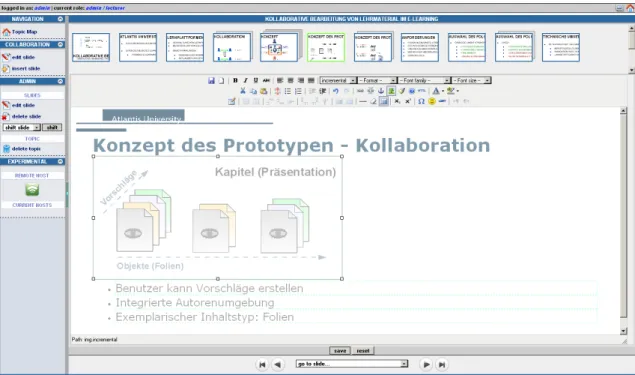
Figure 2: Collaborative Content Manipulation – CoCoMa: Here seen in editing mode. The left side contains overall controls like inserting or deleting slides and starting editing. The top lists all slides in a row, indicating alternatives as stacked on top of the primary slide. For example, the fifth slide has the most alternatives. The sixth slide is currently being edited in the biggest area of the CoCoMa window.
services, while on the other hand it was part of the project to research new services that support the learning process.
The portal was based on the Learning Management System (LMS) Moodle which focuses on cooperative working scenarios [128]. For Atlantis, the week-based course structure was used. The header of the Moodle course was used for the overall tasks, the week fields were filled with special time dependent tasks.
The international and collaborative interdisciplinary character of the project de-manded applicable services. For collaboration on content between lecturers and their students of the different Atlantis partner universities, the Atlantis team developed the prototype Collaborative Content Manipulation (CoCoMa) [93]. CoCoMa is a mixture of an online presentation service and a Wiki with simple rights management. It imports slide sets that can be presented, but also edited by other lecturers or students (see figure 2). Should any changes occur the original author is informed and
1.2. Motivation: Proposal for a Supporting Concept can either replace the original slide or reject the new slide. This process not only simplified editing and the process of keeping the content updated, but also enabled collaborative learning by contribution. This was Atlantis University’s approach towards eLearning 2.0 [14].
Soon the idea arose to not just dismiss or replace slides, but to keep appropriate edits as alternative versions to meet the needs of different learners. This raised some questions about handling the alternatives, for example: How could lecturers provide them easily? How could students find them easily? What about the structure of a slide set that contains edited versions? Could any kind of all over structure be used? These questions and the desire to answer them were the motivational factors behind starting this research project.
1.2
Motivation: Proposal for a Supporting Concept
Because of the networked universities within the Atlantis University Project, the collaborative contributions, ideas, and the research into learner preferences, this PhD research project was initiated to combine these subjects to create added value: Students should be able to use the content provided by the network, which is far greater than the learning content of individual universities, without getting lost in the content space. Röll’s learner preferences could be incorporated as an added option to help students find the most suitable content. As proposed by eLearning 2.0, the students should be able to contribute content, their preferred structure, annotation-like comments, and ratings. The students should also be able to take individual learning paths, thus leaving the linear learning paths that are normally provided.
Therefore a concept was to be developed that could help both lecturers and students achieve this. The concept and the derived system should be usable in com-mon environments. Hence it should be integrated in or at least work in conjunction
with LMSs. Therefore it needed to be web based and prepared to support common eLearning specifications. It should not only support the creation of new content structures but also reuse existing linear learning content, which is the wealth and advantage of such a university network. At first, the focus was not to be on students but rather on lecturers to enable them to create adaptive content, since this is the central issue. In order not to put lecturers off from authoring, the effort involved in learning how to create adaptive content and the corresponding structures as well as the work itself, which is needed to create an adaptive structure, should be doable.
As described with CoCoMa in the previous section, individuals – whether lecturers or students – edit the slides or any other kind of content. The outcomes are alternative versions of the same content that should be incorporated into the content structure. Thus although many parameters could be adapted, for example sorting, navigation, layout, and colour [70], the focus of this research is sequencing, because individual content sections should be included or the structures of different existing content should be merged.
1.3
Aims and Objectives
Based on the motivation described in the previous section, a concept should be developed in the context of the Atlantis University project that supports creation of adapted learning content, usable for web based LMSs. Therefore, the following question needs to be answered:
What concept of structuring content has the capability of simplifying the authoring of adapted eLearning content for non-technical users?
In respect to the state of the art in adaptive eLearning, besides the approaches of the eLearning area, Adaptive Educational Hypermedia Systems (AEHSs) are also of interest. They are seen as the research area for adaptive learning content and are
1.4. Methodology that an appropriate concept could be developed to fit the needs as described above. Hence, the following objectives need to be fulfilled by the research project:
1. Investigation of existing approaches in eLearning and AEHS with regard to authoring, focused on applicability for lecturers as the intended authors. 2. Design of an appropriate concept that is based on the results of the investigation.
That includes directions of proposed workflows for targeted users.
3. Testing the technical feasibility of the concept by implementing a research prototype and realising the concept’s essential parts.
4. Evaluation of the concept with an appropriate method.
1.4
Methodology
To get an overview about existing approaches, the related research literature was examined to highlight common features already existing in eLearning specifications and Adaptive Educational Hypermedia (AEH) focused on authoring. After seeing that authoring is still an obstacle for the wider usage of AEH, especially in terms of sequencing, a new concept was proposed that needed to be tested and evaluated.
As proof of the concept a prototype was realised that was used to test the main functionality. Due to the complexity of the common authoring approaches, the prototype was developed from scratch in order to tailor it to the proposed concept. Development started by implementing basic versions of all three software components player, editor, and monitor that provided a fully functional graphical user interface. Thus each step of the subsequent development could be tested, especially by monitoring each step of the concept’s runtime behaviour with the monitor.
Lastly, the concept was evaluated quantitatively by conducting expert interviews. During the interviews the prototype helped the interviewees gain a better insight
into the concept’s mode of operation and its implications for the authoring process, but also the anticipated effect on learning.
1.5
Thesis Structure
The second chapter that follows, discusses aspects and difficulties in authoring adaptive eLearning content. Therefore, appropriate eLearning specifications and AEHS approaches are investigated in respect to authoring. The chapter ends with a proposal for the research of a concept, which is usable for lecturers and enables the reuse of existing learning content.
Chapter 3 discusses how linear content is structured from the point of view of storytelling theory in respect to parameters that concern the creation of adaptive learning content structures. Based on the results, a concept is proposed that is expected to significantly reduce the complexity and effort needed for authoring these kinds of structures. It also discusses the consequences of the authorship: Generally, letting users manipulate content structures raises the question of whether they also become authors of the presented content which therefore may have an impact on the role of authors of adaptive learning content.
Intended authoring workflows are presented in chapter 4. It is based on the concept of the previous chapter and describes the transfer and enhancement of structures based on existing content. Additionally, the most important aspects of an authoring environment for the concept are proposed.
The prototype Coherence that was realised as proof of the concept is presented in chapter 5. After discussing the objectives of the prototype, the implementation is explained, including the client server concept, the code organisation, and the implemented pathfinding algorithms. It also gives the reader a better idea of the look and feel of the prototypical implementation of Coherence by presenting its graphical user interface.
1.5. Thesis Structure In chapter 6, the qualitative evaluation of the research by means of research interviews is described. It presents the preparations, including the test content, and discusses the analysis and the outcomes of the expert interviews.
Finally, chapter 7 summarises and concludes the results achieved. Additionally, it discusses the limitations of the research as well as possible directions for further work based on the results of this project.
Chapter 2
Authoring for Adaptive eLearning
Having set out the motivation for this PhD research project in the preceding chapter 1 Introduction, this chapter discusses authoring aspects of adaptive eLearning and AEH. Therefore it starts with an introduction to basic concepts of adaptive and interactive content. Thereafter, specifications of the eLearning area that include adaptive presentation by sequencing of eLearning content are presented because the motivation of this research is sourced by eLearning and its scopes of application. This is followed by an introduction to AEH that gives details about common concepts of this research area. Section 2.5 Current State of Authoring Adaptive Educational Hypermediaon page 53 presents the work currently undertaken that covers authoring adaptive content. Finally, section 2.6 Appraisal discusses aspects of the current authoring approaches and points out the research gap.
2.1
Basic Concepts
Before introducing to eLearning and AEHSs, basic concepts are presented, with a look, first, at the range of adaptation, before basic sequencing concepts are then introduced.
Adaptive
System initiated adaptivity (no user control)
System initiated adaptivity with pre-information to the user about changes
User selection of adaptation from system suggested features User desired adaptability supported by tools (and performed by the system) User initiated adaptability (No system initiation) Adaptable
Figure 3: Spectrum of adaptation in computer systems [91] Permission to reproduce this figure has been granted by Kinshuk
2.1.1
Adaptive vs. Adaptable
There are two main types of adaptation: adaptive and adaptable [91]. Also any mixtures between adaptive and adaptable are possible, see figure 3.
Adaptable systems allow the user to change certain system parameters to adapt its behaviour. These could simply be user interface features like font size, changing the position of blocks, for example moving the calendar, or adjusting the audio volume. It also includes explicit demands for additional learning content, for example by clicking on a “more information”, “examples”, or “exercises” button.
Adaptive systems adapt automatically based on the user’s interaction, for example browsers that change the colours of already visited links. In a learning context, already viewed learning content could be marked as the same. Adaptation may also be used to influence which content is presented and its order, which is called sequencing and is discussed in the following sections.
2.1.2
Sequencing
Sequencing is used to adapt the content structure, hence the order of presenting content parts and the decision, what is presented. The following sections present the underlying sequencing concepts and how they are used in this thesis. Therefore it starts with the concept that is closest to linear structures.
2.1. Basic Concepts
Figure 4: String of pearls: To proceed to the next step (white bricks), depending on the conditions one, some, or all substeps (grey bricks), need to be fulfilled.
String of Pearls
This structure is basically linear. It defines the order of predefined steps – pearls – with some freedom for the user. Before the user can proceed to the next step, he needs to fulfil one or more of the substeps of one pearl [79, p 62]. This structure does not need to be highly interactive, as the substep to be fulfilled can be, for example, having seen one content of the pearl.
The pearls can be sets which contain subsets of domain model concepts as used in an earlier version of InterBook [24], see figure 4. Or it may provide branches that immediately come back to the (linear) main branch. This is used to support the presentation of additional information, questions, etc., which is how it is used for example in LernBar [124], compare figure 5.
Because string of pearls is nearly linear, it is easy for authors. The structure is similar to a linear structure with additional information as used for example in textbooks that provide boxes with tips, exercises, etc. Hence existing content can be
!
!
!
+
+
?
?
Figure 5: String of pearls variation: This more linear variation adds, for example, extra information (+) or questions (?) to the main path of content (!).
Figure 6: Branching: The path branches at decision points. While this figure only shows one or two paths going from a decision point, of course the number of alternative paths is not restricted and can be more than two.
adopted easily and the same is true for creating new content. However, extensive adaptive or interactive behaviour cannot be created with string of pearls, as it is limited to simpler structures.
Branching
This structure is characterised by dedicated decision points within the content where the path branches to two or more paths, see also figure 6. It is not required that the user notices branching like explicit branches in hypertext stories. Branches can be hidden, happen some time after a user action, or happen because of a number of actions.
The concept of branching is easy understandable. However, in case of creating non-trivial content, branching structures tend to become complex and are therefore difficult to handle, in particular for non-technical people (see figure 7). It is not only the huge number of content parts that is a reason for its complexity, but also that each branch of each position point needs to be formulated explicitly in the right context of the overall content.
Rule-Based Concepts
“Rule-based concepts” is used as a collective term that includes all the more complex concepts like preconditions and Artificial Intelligence (AI). The term itself is a bit misleading because string of pearls and branching may also be realised with rules.
2.1. Basic Concepts
Figure 7: Complex branching: For non-trivial content, branching structures tend to become complex and therefore difficult to author.
However, because these two concepts can be also realised without rules, usually the term “rule-based concepts” does not include these concepts, as long as they only include simple logic.
This concept uses conditions that need to be fulfilled, rules that describe how the conditions should be fulfilled, and statements that describe what to do if the rules are fulfilled. The following pseudo code is a simple example:
if ( passedXY and grade > 2.3 and ! solvedExample ) {
// Do something ...
}
The code in curly brackets is only executed if the conditions within the round brackets are fulfilled. Thus the code is executed if the user has passed something beforehand, got a grade greater than 2.3, and did not solve an example. Because all
these conditions have to be fulfilled before they are asked for, often they are also called preconditions.
This simple code already shows some typical aspects of rule-based concepts, in particular in contrast to branching. While branching structures can be thought stepwise from the beginning to the end, rule based concepts are mainly backwards, because conditions have to be fulfilled before something can happen. Additionally, the branching concept requires the authors to specify and create (program) each single decision and each single step, rule based concepts only need the necessary rules that are required to distinguish between the possible different actions of a specific state.
2.2
Relevant eLearning Specifications
This section focuses on eLearning specifications that deal with adaptivity and inter-activity. Most eLearning specifications focus on other typical eLearning applications like content, activity, user exchange, metadata for modules, etc. Some of them could be used in addition to the ones presented, for example for metadata or user modelling, but only the most important of these will be mentioned briefly within this section. A more detailed description of nearly all eLearning specifications from the point of view of adaptive hypermedia can be found in Hendrix’ PhD Thesis [61].
Currently, the IMS Global Learning Consortium [66] is the main contributor for learning specifications. It has developed specifications for nearly every learning oriented purpose, but the consortium now focuses on the most important specifications needed for learning technology integration and content exchange. These are:
• Learning Tools Interoperability (LTI) [81]
Enables seamless integration of learning activities from other vendors into any supported Learning Management System. These activities could also be installed on other servers by any provider outside the campus.
2.2. Relevant eLearning Specifications • Learning Information Services (LIS) [109]
Defines the information needed to exchange learning related data, such as people, groups, memberships, courses, and outcomes. It also includes a service that could be seen as a learning directory service (like a Lightweight Directory Access Protocol (LDAP) server for learning purposes).
• Common Cartridge (CC) [68]
A specification for exchanging learning content. • Question and Test Interoperability (QTI) [77]
A specification for describing questions and tests. Widely used in assessments. Two more non IMS specifications are also widely used: Sharable Content Object Reference Model (SCORM) that is, like IMS-CC, a specification to exchange learning content and Learning Object Metadata (LOM) [62] that is still commonly used to describe learning object related metadata. Although these and other specifications may be used to describe parts of an adaptive or non-linear structure like LOM or IMS-Learning Resource Meta-data (MD) [10] for further description of the learning objects or IMS-QTI for integrated assessments, only those specifications that are about sequencing itself are of interest for this research project and therefore described in detail in the following sections.
2.2.1
IMS Simple Sequencing
IMS Simple Sequencing [89] is a specification to describe paths through a collection of learning activities. Thus it can be used to define the order in which the learning activities are presented, using conditions for selecting, delivering, and skipping resources. It is intended for:
• Multiple paths through one set of learning activities. • Patterns of formative assessment.
A
AA AB AC
Figure 8: Simple Sequencing Standard Behaviour [89, p 11]: Child nodes of a parent node are presented one after the other.
Reprinted with Permission from IMS Global Learning Consortium (www.imsglobal. org) from IMS Simple Sequencing Best Practice and Implementation Guide
Version 1.0 Final Specification, Copyright 2003, by IMS Global Learning Consortium Inc. All rights reserved.
• Summative assessments. • Decision Trees.
• Adding Context Sensitive Network Services to Content. • Step Through Tutorials.
It is called “Simple”, because it addresses not all, but an important segment of the entire problem space for learning content sequencing. Adaptation is only addressed in a limited way, and collaboration not at all.
The whole concept is based on learning activities that are arranged as an activity tree. Any leaf node may be associated with a content resource. An activity cluster is defined as a single node and all its immediate children. A cluster is the scope of rules and navigation control nodes that are associated to the parent node of a cluster and define the behaviour of sequencing its children.
The default mode allows the learner any sub-activity in a cluster, but a guided flow can also be defined. Unless otherwise specified with rules, a guided flow delivers all the children activities of a node, one after the other, see figure 8. This standard behaviour is called “forward flow”.
2.2. Relevant eLearning Specifications Sequencing itself happens in the sequencing loop (figure 9) that is started each time a learner moves to the next activity. It consists of six behaviours, each of them acting on its corresponding request. For example, the Sequencing Behaviour acts on any pending Sequencing Request and may result in a Delivery Request that in turn triggers the Delivery Request Behaviour.
Simple Sequencing is not at all “simple” to implement, which is perhaps why SCORM 2004 is the only known implementation of the specification [90].
2.2.2
IMS Learning Design
Learning Design (LD) [72] is intended to be a pedagogical meta language. As such it is the successor of Educational Modelling Language (EML) [71] that has been developed at the Open Universiteit Nederland.
LD has been “developed to describe an unlimited number of pedagogical ap-proaches” [73, p v]. It is not only possible to describe the particular elements of a didactic situation, but the whole didactic situation itself. Therefore both the struc-tural elements and the sequence of the learning activities are described. Sequencing does not need to be linear, but can be adapted to any context or can be parallel. It should also be usable in any scenario and therefore fit for eLearning, face-to-face learning, and blended learning. But it should also be suitable for adaptive learning, mobile learning, game based learning, and more. The aims can be described as follows:
• Description of actions for both learners and lecturers.
• Description of resources and services that are used during learning. • Support for different pedagogical approaches.
• Support for single learners as well as learning groups. • Support for eLearning and Blended Learning.
Overall Sequencing Process
Navigation Behaviour
Exit Behaviour
Selection and Randomisation Behaviour
Sequencing Behaviour
Delivery Request Behaviour Rollup Behaviour WAIT for Navigation Request
Deliver Content
Runtime
State Model
Interact with State Model Data Communication
Deliver Content Resource Navigation Event
Figure 9: Simple Sequencing Loop [89, p 64]: It waits until the user requests new content (top brick). The six behaviours of the grey brick “overall sequencing process” influence the content that is chosen and presented (brick Deliver Content).
Reprinted with Permission from IMS Global Learning Consortium (www.imsglobal. org) from IMS Simple Sequencing Best Practice and Implementation Guide
Version 1.0 Final Specification, Copyright 2003, by IMS Global Learning Consortium Inc. All rights reserved.
2.2. Relevant eLearning Specifications IMS LD distinguishes between three implementation levels:
• Level A is the main level that supports basic functionality that consists only of the LD core objects: roles, activities, any resources, and structure elements such as method, play, act, and role-part. Activities are performed by learners and teachers in a linear order or without any restrictions, using resources and services.
• Level B adds properties and conditions. Properties store information about learners, roles, and the state of LD itself. Conditions influence the learning flow according to specific circumstances or properties.
• Level C adds notifications that may trigger actions in response to events in a learning process.
A LD Unit of Learning (UoL) can be compared to a written lesson plan that includes any resources and actions that might be needed during teaching. The conceptual structure of LD is constructed like a theatre play: Activity is the central and main part and describes the tasks the role has to perform and the available environments. The play consists of actors (roles) and parts (role-parts). A sequence consists of parts that are ordered one after another. As default, the following act begins as soon as the previous one is finished. This can be changed by the designer. The specification describes two types of roles: Staff and Learner. Commonly the learners do the learning activities and staff provides feedback and monitors the progress with support activities. More specialised roles can be created using sub-roles.
Non-linearity can be provided in two ways: Either simple sequencing is utilised, or the LD possibilities of level B are used as follows: Any play’s method may contain conditions that define the run of the play – and therefore influence the sequence. For example, after finishing an activity a role may choose the next one on its own and
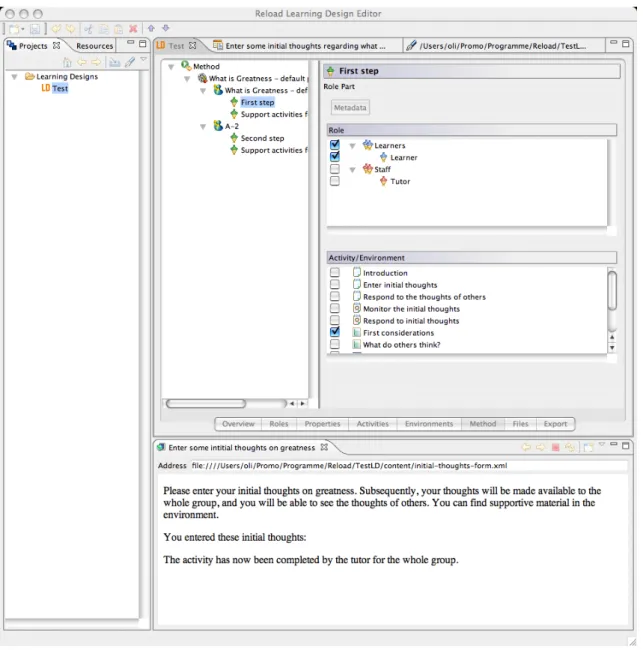
Figure 10: Reload Learning Design Editor
Various tools have been developed to author or edit LD, but only two of them have been successful: Reload Learning Design Editor and LAMS.
The Reload Learning Design Editor [98] (see figure 10) is the reference editor for the LD specification and one of the few LD editors that supports all three levels A, B, and C. On the other hand, it is not intended for endusers, as it basically just presents the internal structure of LD. Additionally, it does not support any kind of content creation – hence the learning content itself has to be created with other tools and then imported into this editor. Development stopped in 2006.
2.2. Relevant eLearning Specifications
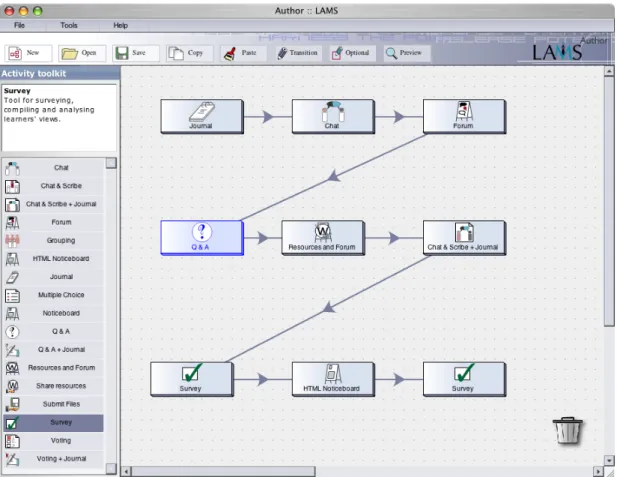
The Learning Activity Management System LAMS [76] is still maintained and provides a user interface that is manageable by non-technical endusers (see figure 11). The downside regarding LD is that it is not a real LD tool but only is inspired by this specification, and the version 1.x series stuck to linear sequences. Beginning with version 2.x, LAMS provided LD Level A export, and internally non-linear sequences. LAMS is still being developed and supported [75].
2.3
Sequencing in eLearning
Although some eLearning projects tried different sequencing approaches, for example Chameleon [43], ACE [110], and LernBar [124], however, by 2007 still none of the approaches had been adopted by eLearning systems, and therefore none of them is used widely [60]. Even eLearning specifications do not integrate adaptive learning anymore because lecturers could do sequencing better. For example, while SCORM 2004 integrated IMS Simple Sequencing, the comparable specification IMS Content Cartridge – its version 1.0 Final Specification was published four years later on 1st
October 2008 – did not use any adaptation.
Currently, the established LMSs are to some extent taking on adaptation and adaptivity. Looking at, for example, Moodle, of course it could be stated that already earlier versions provided adaptation: The personal page “MyMoodle” lists all the learner’s modules (Moodle calls them “courses”). Additionally, module participants can be assigned to teams, so that each team may be assigned its separate activities. This does not mean that different teams are presented different activities as they are all the same. But the teams have separated access and they may not see or edit the other teams’ activities, depending on the module settings. However, this is not adaptive in terms of personalised learning systems because it is static and does not change due to any kind of rules or be influenced by the learner’s behaviour and activities.
2.4. Adaptive Educational Hypermedia Moodle 2.0 took one step in the direction of adaptive learning by introducing “conditional activities” [84]. It restricts access to activities in respect to grades, completion of other activities, date, time, and more. It can be used to disallow working through special activities until some preconditions are met, but it can be also used to provide adaptive learning paths. Usage is very low level, especially in the case of the latter it is very complicated, because preconditions have to be defined for every single step of each path. As this is a very new feature of Moodle, it remains to be seen if educators will accept it.
2.4
Adaptive Educational Hypermedia
The presentation of learning content can be personalised by adapting it to a learner’s needs. This is the domain of the research field AEHs [86], which is based on hypermedia, adaptive systems, and Intelligent Tutoring System (ITS) [24]. Because it is normally used in a web context, models and algorithms are often simpler compared to ITS [37].
Many parameters can be adapted, for example colour, layout, language, sorting, and more, see figure 12 [70]. This research focuses on sequencing of content, which in figure 12 is called “Adaptive Navigation Techniques”.
Regarding the underlying models, first single purpose systems had been developed for AEHS that used hard coded models and content. Using another content or pushing it into a different domain was difficult or impossible, because the concepts and the models had been too specialised.
The second generation is based on reference models. The best known is the Dexter model [57] that consists of three layers: The run-time layer, the storage layer, and the within-component layer, see figure 13. Basically the storage layer describes the hypermedia itself, hence a network of nodes and links. It is worth noting that nodes are calledcomponents within the Dexter model because the specification group
Content Adaptation Techniques (Canned Text, Multimedia) Adaptive Presentation Techniques Adaptive Navigation Techniques Inserting/removing fragments Altering Fragments Dimming Fragments Sorting Fragments Zoom/Scale Stretchtext Layout Link Sorting/ Ordering Link Annotation Combinatorial techniques Link Generation Guidance Link Hiding
Local and Global Maps
Direct (Local) Guidance Non-contextual links Contents, Index links Fitting in a template Contextual links Partitioning/zooming Rearrangement Disabling Removal Global Guidance Hiding
Figure 12: Adaptive Techniques [70]
2.4. Adaptive Educational Hypermedia Figure has been removed
due to Copyright restrictions.
Figure 13: Dexter Model [57]
had too many divergent interpretations about a node. The run-time layer presents the hypermedia and handles user interactions and dynamics. It is connected through the presentation specifications to the storage layer. The within-component layer is not specified because this would be pointless as there are too many possible nodes like text, pictures, films, and more.
In 1999, the Dexter model had been extended to the Adaptive Hypermedia Application Model (AHAM) [19] that supersedes the storage layer with three models: The teaching model, the domain model, and the user model, see figure 14. AHAM consists of five models – separating the entire model into five layers or sub-models is the current status: “A typical architecture of the state of the art of AEHS is fully decoupled and consists of five complementary models: i) The domain model which
Figure has been removed due to Copyright restrictions.
DM domain model
goal (and constraints) model goal (and constraints) model GM goal and constraints model UM user model
AM adaptation model PM presentation model
Figure 15: The five level AHS authoring model [37]
specifies what is to be adapted ii) The user and context models which indicate what parameters the content can be adapted and iii) the instructional and adaptation models which express the pedagogical approach the learning process should be based on, as well as the forms of adaptation to be performed.” [86]
Looking from the authoring side gives a similar picture: It started with three layers: The conceptual layer, the lesson layer, and the student adaptation and presentation layer [36]. This was soon revised to five layers: domain model, goal (and constraints) model, user model, adaptation model, and presentation model [37],
see figure 15.
This layering is done to separate the content itself from various abstraction layers. Thus the presentation can be adapted following a mixture of different strategies, each of them defined in its own layer. This increases reusability because in order to adapt the content presentation to another context potentially not the content itself but only the strategies of the according layers need to be defined.
However, from an authoring point of view this seems problematic for two reasons: First, thinking in layers seems to be challenging for authors who are unfamiliar with creating adaptive content structures: “when creating a course authors do not mentally distinguish between topic relations and pedagogical relations” [20]. Second, creating generic content units that may be moved to different positions within a path seems unfamiliar for non technical authors: “authors often start out by thinking in
2.5. Current State of Authoring Adaptive Educational Hypermedia terms of a sequence or learning path instead of leaving as much navigational freedom as possible in their course and only using prerequisites where really needed” [20]. These aspects do not seem to have been addressed so far.
2.5
Current State of Authoring Adaptive
Education-al Hypermedia
In addition to the problem that authoring adaptive content is an unfamiliar and difficult process, it is also labour-intensive and therefore too expensive [97]. According to De Bra et al., transferring existing content for 1 ECTS module (representing 25 to 30 hours of study time) into an adaptive online module needs at least one person working 6 months full time [20]. One reason is the poor usability because of the prototypical implementation so far [26], but also the architectural design fails to meet the overall needs of Web-enhanced learning [82], so it is regarded with scepticism whether educators are “willing to invest the significant time and effort required to initially integrate an AEHS into their teaching plans and to ensure that the learning offerings provided meet the curriculum.” [86]
Currently efforts are being made to combine the best of AEHSs and courseware re-use systems. Projects like APeLS, KnowledgeTree [26], and the EU project GRAPPLE (Generic Responsive Adaptive Personalized Learning Environment) [53] extend the idea of reusing content that can be searched by authors – as seen for example in ARIADNE [47] and MTS [51] – with adaptivity of AEHSs. These could solve the problem of creating content that could be also used for adaptive learning systems. However, none of these kinds of systems have been accepted by educators so far, hence there is no reusable content in courseware re-use systems. But even if they already had been used widely, adaptivity itself is the problem. For example, Paul de Bra et al. summarise for GRAPPLE: “The real bottleneck in large scale adoption of adaptive learning is still the authoring of the adaptation.” [20] Thus, a

![Figure 9: Simple Sequencing Loop [89, p 64]: It waits until the user requests new content (top brick)](https://thumb-us.123doks.com/thumbv2/123dok_us/10929911.2981841/46.892.135.679.269.821/figure-simple-sequencing-loop-waits-until-requests-content.webp)
![Figure 12: Adaptive Techniques [70]](https://thumb-us.123doks.com/thumbv2/123dok_us/10929911.2981841/52.892.130.676.181.1011/figure-adaptive-techniques.webp)