Citation: Tjahja, Cyril, Yee, Joyce and Aftab, Mersha (2017) Objects of Design: Activity
Theory as an analytical framework for Design and Social Innovation. In: DMA 2017 - The
Design Management Academy Conference, 7th - 9th June 2017, Hong Kong, China.
URL:
https://designinnovationmanagement.com/dma2017/
<https://designinnovationmanagement.com/dma2017/>
This version was downloaded from Northumbria Research Link:
http://nrl.northumbria.ac.uk/37763/
Northumbria University has developed Northumbria Research Link (NRL) to enable users to
access the University’s research output. Copyright
©and moral rights for items on NRL are
retained by the individual author(s) and/or other copyright owners. Single copies of full items
can be reproduced, displayed or performed, and given to third parties in any format or
medium for personal research or study, educational, or not-for-profit purposes without prior
permission or charge, provided the authors, title and full bibliographic details are given, as
well as a hyperlink and/or URL to the original metadata page. The content must not be
changed in any way. Full items must not be sold commercially in any format or medium
without formal permission of the copyright holder. The full policy is available online:
http://nrl.northumbria.ac.uk/policies.html
This document may differ from the final, published version of the research and has been
made available online in accordance with publisher policies. To read and/or cite from the
published version of the research, please visit the publisher’s website (a subscription may be
required.)
This work is licensed under a Creative Commons Attribution-NonCommercial-Share Alike 4.0 International License.
https://creativecommons.org/licenses/by-nc-sa/4.0/
Objects of Design: Activity Theory as an
analytical framework for Design and Social
Innovation
TJAHJA Cyril*; YEE Joyce and AFTAB Mersha Northumbria University, United Kingdom [email protected]
doi: 10.21606/dma.2017.120
Design and social innovation is a developing field of study. The current lack of critical analysis of initiatives and the dominance of insights and methods from European cases in academic literature are not sufficient to construct an image that could be considered as comprehensive. This paper aims to address both issues by introducing Activity Theory as an analytical framework, as its ability to examine phenomena in their native context through multiple perspectives is considered to be well-suited to study design and social innovation initiatives. The analysis of data obtained during a field study investigating three social initiatives in Bangkok contributed to
understanding how they work and why they exist, in addition to highlighting the influence of the Thai social and cultural context on the role of design in the social innovation process.
keywords: design and social innovation; activity theory; Thailand; methodology
Introduction
With an increasing amount of initiatives sprouting up across the globe, the field of design and social innovation appears to be gaining momentum. However, its popularity in practice is overshadowed by the gaps in knowledge that currently exist in its study. Academic publications tend to focus on certain aspects of design and social innovation, such as its definition (Jégou & Manzini, 2008; DiSalvo et al., 2011; Manzini, 2015), issues regarding implementation and continuation (Camacho Duarte, Lulham & Kaldor, 2011; Hillgren, Seravelli & Emilson, 2011; Cipolla & Moura, 2012) and the role that design(ers) play in the process (Brown & Wyatt, 2010; Thorpe & Gamman, 2011). However, their
mode of operation, the stakeholders’ motivations and underlying power structures are usually not reported and analysis of what actually works is rare (Mulgan, 2014; Komatsu et al., 2016). In other words, how and why these projects work is often unknown.
The dominance of European best practice examples in literature problematises this further. As design and social innovation projects are connected to their respective social and cultural environment, the transfer of methods and ideas that have proven to be successful in the west might or might not be appropriate or desirable in a different context (Brown & Wyatt, 2010). Local knowledge and practices are in danger of being substituted by imported solutions and paradigms (Bala-Miller, 2008; Akama & Yee, 2016), that are not necessarily better suited to address local issues and could also serve as good examples for the west. Without a framework that can analyse how design and innovation initiatives operate, their effectiveness and sustainability in the long-term, in any context, cannot be ascertained.
The aim of the paper is to highlight the suitability of Activity Theory (AT) to study design and social innovation initiatives by presenting findings that have been obtained during a preliminary field study in Bangkok where AT was used as a framework for data analysis. Activity Theory is a framework that can 1) study an initiative along with its ‘native’ ecosystem instead of a viewing it as an idea, process or method developed in isolation, 2) reveal how an initiative functions through examining its internal dynamics as well as its stakeholders and 3) provide a means of evaluating and analysing an initiative in order to establish what works and why. It connects individuals to their culture and society by studying the tools and signs that mediate between them in relation to the wider community, along with the multiple perspectives of its stakeholders (Engeström, 1999). Motivations, (power) relations, restrictions and issues can be identified and analysed by constructing the stakeholders’ respective activity systems, the primary units of analysis. The current discourse on design and social innovation presents a view that leaves room for expansion. Analysis is often limited to the description or prescription of how the implementation of design methods have been beneficial to solve a perceived social problem (Jégou & Manzini, 2008; Camacho Duarte, Lulham & Kaldor, 2011; Meroni, Fassi & Simeone, 2013). However, this approach, although useful in demonstrating the
potential merits of design, reflects a singular perspective on the process and does not take into account the perspectives of other stakeholders involved. Without knowledge
regarding their motivations it remains unclear whether any value has been created for anyone other than the researcher(s).
Background
The Bangkok field study is part of a PhD research project investigating what constitutes design and social innovation initiatives in the Asia-Pacific region. In particular, the research aims to determine why design and social innovation projects are initiated, for whom they create value and what role design plays in creating this value, by constructing a select number of case studies varying in type of project and locality. The paper presents findings from Thailand, the first of three countries that will be examined in the course of the PhD research project that is currently on-going.
Design and social innovation
In the last decade, there has been increasing interest in design and social innovation, which is often attributed to the rise in popularity that social innovation itself has experienced in the same time period (Hillgren, Seravelli & Emilson, 2011; Mulgan, 2014). Design methods such as visualisation, prototyping, participatory design and strategic design are perceived to contribute in a positive manner to the social innovation process (Brown & Wyatt, 2010; Murray, Caulier-Grice & Mulgan, 2010). Along with its popularity in practice, the number of academic publications on design and social innovation has been increasing steadily in the past years as well. However, the study of design and social innovation is still considered to be developing (Irwin, 2015); Significant improvements can be made in terms of what is studied and how it is studied. The current lack of critical analysis, and the exploration and discussion of methods, values and practices of cases that are less represented in literature need to be addressed for design and social innovation to continue its development towards a field or discipline that could be considered as mature.
Activity Theory
Activity Theory, also known as Cultural Historical Activity Theory, is a framework that can be used for analysis of qualitative data. Originating in Classical German philosophy, the works of Marx and Engels and the Soviet cultural psychology of Vygotsky, Leont'ev and Luria, AT provides an alternative to the traditional view in which individuals are perceived as separate from their surrounding social structures. As this dualistic perspective falls short of explaining contemporary complex social transformations, AT aims to connect the individuals and their surrounding social structures by pursuing a monist approach in which both are studied at the same time by focusing on the generated activity (Engeström, 1999). AT is very well suited to analyse design processes as it can constructively describe its activity structure and development in its own context (Lauche 2005; Tarbox, 2006; Tan & Melles, 2010). It therefore has the ability to look further than design and social
innovation as an isolated method, process or idea by also providing insight into the ecosystem in which an initiative takes place and to which it is inextricably linked. AT has been applied in various fields of study, such as learning (Wells, 1993; Jonassen & Rohrer-Murphy, 1999), human-computer interaction (Nardi, 1996; Kuutti, 1996) and organisation studies (Blackler, 1993; Chatzakis, 2014). Although AT has not been frequently used to study design, there are studies that have used AT as a method to examine graphic design (Tan & Melles, 2010), service design (Sangiorgi & Clark, 2004) and interaction design (Kaptelinin & Nardi, 2006).
The Activity System
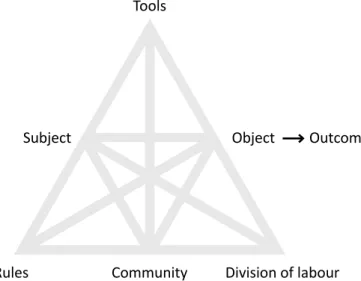
Activity Theory is rooted in the idea that an individual or group (subject) should be studied together with its surroundings or social context (Nicolini et al., 2003, cited in Chatzakis, 2014). Subjects make use of concepts and/or artefacts (tools) to achieve their goals, intentions or desires (objects) (Kaptelinin & Nardi, 2006). The relationship between subject, tools and object can be considered as an activity conducted by a subject to achieve a certain outcome (Tan & Melles, 2010). Collective activities are driven by communal motives, which are formed when collective needs might potentially be fulfilled by certain objects. The motive for the activity is embedded in the object of the activity
(Engeström, 2000). Linking the subject-tools-object relationship to the wider social context are rules, which can be implicit or explicit,the broader community, consisting of other activity systems and, if applicable, shared and coordinated by a division of labour
(Chatzakis, 2014). The relationship between these different elements make up the activity system, the basic unit of analysis in AT (see figure 1).
Figure 1 The activity system – adapted from Engeström (1999)
The Advantages of Activity Theory
Activity Theory has several advantages which make it suitable for studying design and social innovation:
1. The activity system allows for a rich description of what people do, how they do it and with whom, including the relevant context in which this takes place while taking into account both the relevant internal and external elements (Chatzakis, 2014). It therefore can provide insight into the (power) relations between the stakeholders in a design and social innovation project. Furthermore, AT allows the (cultural) context to be preserved as this is embedded in the activity system framework.
2. Innovation networks can be analysed as networks of developing activity systems with each having their own objects, knowledge and resources (Miettinen & Hasu, 2002). Using the AT framework on a design and social innovation initiative would enable analysis of specific activities, issues and motivations from multiple stakeholders’ perspectives (see figure 2). 3. AT takes both the researcher’s and the subject’s view into account, thereby
avoiding objectification of the subject (Engeström, 1999; Tan & Melles, 2010). As the construction of an activity system requires the input and interpretation of both the subject and the researcher, it is less susceptible to bias from the researcher’s side.
Subject
Object
Division of labour
Rules
Community
Tools
Outcome
4. By studying their own history, activity systems can focus on certain issues and track them over time (Engeström, 2001). Historicity can serve to extrapolate the past situation, via the current situation, to the future. It is therefore particularly relevant to design and social innovation as this might facilitate
infrastructuring, an organic approach that focuses on long-term commitment to the project by building relationships with stakeholders using a flexible allotment of time and resources, resulting in an open-ended design structure without predefined goals or fixed timelines (Björgvinsson, Ehn & Hillgren, 2010; Hillgren, Seravelli & Emilson, 2011)
Figure 2 Innovation networks as networks of activity systems
Alternative approaches
Actor-Network-Theory (ANT) was initially considered as a method of analysis due to its ability to map out actors in networks of agency. Originating from the sociology of science and technology, ANT does not distinguish between humans and objects, considering all entities, individuals and non-individuals, as actants (Latour, 1996). Furthermore, ANT argues that all interactions are mediated by actant networks which not only participate, but are also responsible for actively creating all social life (Law, 1992). However, its assumption that society, and therefore culture, is created through the interaction between actants implies the absence of any pre-existing society or culture, including the one that which gave rise to the networks themselves (Bloor, 1999). Moreover, as the notion of success in the ANT paradigm is not based on the value created, but instead on the length on the network, any normative questions cannot be properly addressed (Radder, 1992). ANT is therefore not able to analyse issues surrounding culture, norms and values in design and social innovation, making it unsuitable for this study.
Participatory action research has also been considered as a possible strategy for both collecting and analysing data. Central to this approach is the desire to promote change by
actively being involved in a certain practice, which is achieved by researchers collaborating with the those who are the focus of the research. Oftentimes, action research will be conducted in a cyclical manner, where planning, acting, observing and reflecting on a change it will repeat itself throughout the process (Robson, 2013). Passive participant observation, which demands a lesser degree of involvement, was also considered. Here, the researcher collects and analyses data obtained through observation to find out what is going on in the field, becoming an accepted member of the group, but without directly participating in the process (Robson, 2013). Both participatory action research and passive participant observation were eventually dismissed as viable approaches to collect and analyse data as they were too demanding on the time and resources available for the research project. In addition, their dependence on the availability of, and access to, design and social innovation initiatives that were still on-going or in the process of starting up, made it impractical to pursue these approaches.
Methodology
Pilot study
To test whether data collection using AT would yield the desired type of data, a pilot study was conducted several months prior to actual field study. Students of the MA/MSc Multidisciplinary Innovation, a project-focused course taught at a UK-based university in which multidisciplinary teams of students and academics collaborate with external organisations on commercial and social innovation projects, were invited to participate in an AT workshop.
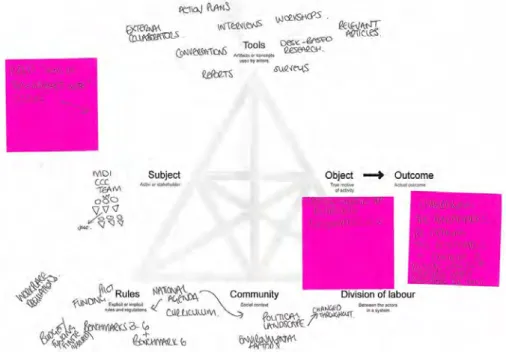
At the beginning of the workshop, a brief explanation was given on how to use the AT framework, followed by a session in which the students were given the opportunity to analyse multi-stakeholder group projects that they worked on in the previous term. The students were asked to team up with their original project members and use the AT framework to analyse their respective projects from the perspectives of at least two of the stakeholders involved. For this purpose, handouts with a diagram of the activity system (similar to figure 1) were distributed on which the students could write. The groups discussed among themselves for 30 minutes after which each group presented the result of their analysis to the other groups, which were then discussed with the entire class. After the session, the handouts were collected, the findings summarised by the researcher and distributed to the students.
The results of the groups’ analyses using the AT framework revealed whothe stakeholders were, how they related to one another, how they influenced each other’s decisions and how they attempted to achieve their goals (see figure 3 for an example). Interesting findings include the notion that a subject could be utilised a tool by another subject, as one group of students felt that they themselves were being used as an instrument by their direct client to achieve a politically motivated goal within the client’s organisation. Another group reported that (negative) comments on social media regarding the project led to their client reconsidering the object, which in turn affected the design process. For the student project teams, AT proved to be useful as a reflective tool, enabling them to identify possible reasons why certain stakeholders behaved in a certain manner, what motivations underpinned this behaviour and how this influenced the outcome. For
example, after conducting the analysis using AT, one group of students realised that the friction experienced in their project might have occurred due to the difference in underlying motivations of the different stakeholders, leading to expectations that were ultimately not met, thereby causing conflict.
The pilot study, although limited in scope, confirmed that analysis using the AT framework can successfully answer questions regarding how and why projects operate the way they do, viewed from the perspective of different stakeholders.
Figure 3 Example of an analysis conducted using the AT framework by student project team for one of the stakeholders involved in their project
Field study
After the pilot study, a one month field study was conducted in Bangkok with the intention to gain insight into the types of design and social innovation initiatives present, identify who the initiators and stakeholders are within these initiatives, map the relations between the stakeholders and examine their mode of operation, as part of the larger on-going PhD research project. The Design and Social Innovation in Asia-Pacific (DESIAP) platform, a network and community of practitioners and professionals from various disciplines, regularly organises events where those who are either active or interested in the field of design and social innovation can connect and exchange ideas. Its symposium and workshop held at the Thailand Creative and Design Center (TCDC) in Bangkok marked the beginning of the field study and provided an opportunity to connect with local academics and practitioners. Those that were willing to provide more in-depth
information regarding their projects were contacted after the symposium for a follow-up meeting or interview.
Three initiatives were eventually selected to be further developed into case studies, based on the availability and willingness of the stakeholders to be interviewed. Other selection criteria include the type of project (top-down or bottom-up) and scale (small, medium or large). The majority of the meetings were arranged in an informal manner and conducted in a casual setting, such as a coffee shop. Three formal interviews were conducted, one face-to-face and two via Skype.
The format used in the pilot study, during which the students analysed their own projects using the AT framework explicitly in a workshop setting, was not used in the field study as gathering all the stakeholders involved in the respective initiatives was not feasible. Instead, the AT framework was used implicitly during individual semi-structured
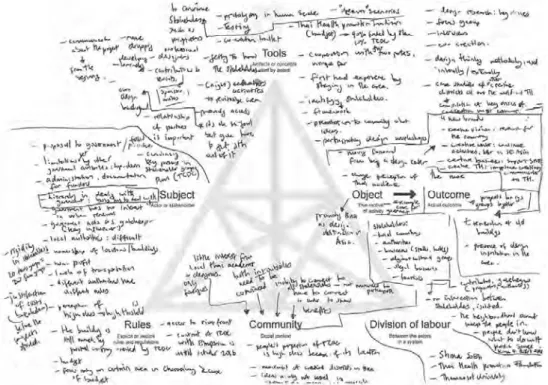
interviews with practitioners and stakeholders by loosely directing the questions along the prescribed categories (subject, object, tools, rules, community and division of labour). The interviews were then transcribed and the answers grouped according to the six categories, thereby constructing an activity system for each stakeholder interviewed (see figure 4 for an example). The activity systems were then analysed by identifying patterns and interactions between categories and compiled into broader themes.
Figure 4 Example of an analysis conducted using the AT framework for one of the stakeholders of the Co-Create Charoenkrung project
Findings
Co-Create Charoenkrung
–
A pioneering urban renewal project
Context
Co-Create Charoenkrung is a large-scale high-profile design and social innovation project initiated by the Thailand Creative and Design Center (TCDC), a knowledge and education centre focused on promoting design and creative practice in Thailand. Currently located in the centre of Bangkok, it is planning to move to the historical Grand PostalBuilding
located in the Charoenkrung neighbourhood. This relocation was taken as an opportunity to ‘introduce itself’ while simultaneously starting a process of urban renewal, co-created and co-designed with residents and other local stakeholders; an initiative that is
unprecedented in Thailand. Two stakeholders in the project were interviewed: the initiator and overall project manager at TCDC and the project manager from the design agency Shma SoEn.
Mode of operation
The management and execution of the project is distributed among three equal partners. TCDC is responsible for the overall management of the project. Shma SoEn, a local design firm, oversees the execution of design-related activities and Thammasat University provides support in terms of design research and consultation. Adding to the complexity of the project are the many stakeholders, such as various local authorities, commercial businesses situated in the neighbourhood (international hotels and corporations, galleries, shops and stalls) and diverse groups of community residents (elderly, students, ethnic and religious minorities). TCDC utilises its own proprietary design thinking approach,
formalised into the Co-Create model, in which a series of steps guide those who would like to start an urban renewal project in their own neighbourhood.
Selected findings
Object: the motivation of TCDC for initiating the Co-Create Charoenkrung project was driven by a desire to move forward as an organisation. By combining their relocation with a process of urban renewal, it wishes to remove the threshold that was perceived to exist by ‘ordinary’ Thai citizens and instead place itself in the middle of society. Shma SoEn’s design team perceived Co-Create Charoenkrung as a ‘dream project’, combining their professional expertise in design with the need to do good and give something back to the local community.
Tools: Co-creation and co-design workshops were conducted at different stages throughout the process and with different participants: the partners, stakeholders and wider community of residents. In some instances, co-creation tools were custom-made to ensure the participation of all stakeholders, regardless of age or seniority, which can be a sensitive issue in Thai culture. Visualisation by design and prototyping on actual scale (1:1 prototyping) were mentioned as being particularly useful in convincing key government officials, private parties and the local community itself of the value of the project as both interviewees expressed that Thai people in general need to be shown concrete results in order to support an initiative. For example, it took significant effort for the project team to convince the Grand Postal Building’s property management to allow the construction of the Green Pocket Space, one of the planned 1:1 prototypes, in front of premises, despite
the fact that TCDC is the building’s tenant. However, after seeing the result, the property management staff requested to extend the three days that were initially planned for the prototype to seven days, and installed benches around the Green Pocket Space area for customers and passers-by to relax, which have become a permanent fixture.
Communication about the project was perceived to have played an important role. Internal communication managed the expectations of the stakeholders as the lack of knowledge regarding the project sometimes restricted the process and caused it to slow down. External communication, on the other hand, helped to prevent inaccurate representation of the project in the media.
Rules: As Co-Create Charoenkrung’s aim of urban renewal inherently entails the modification of public and private spaces, the stakeholders involved here are (local) government departments and private corporations or land owners, who control access to these spaces. The interaction between TCDC and the various other government
stakeholders encountered at different levels was characterised as being difficult. The general attitude towards the project was perceived to be polite but uncooperative and even those who were willing to help were only able to do so within their own jurisdiction. Hierarchy played in important role as key senior officials needed to be convinced to obtain access and cooperation. A top-down approach was therefore considered to be the only way to make the project succeed.
Community: Both interviewees found the most significant limitation of the project to be that some stakeholders could not be contacted or could not be persuaded to participate in the project. This was attributed to the fact that there was no real incentive for them to participate. Involving stakeholders and partners in the co-creation process who are normally not consulted, such as the Thai Health Promotion Foundation, which funded 90% of the project, was experienced to have a positive effect as this increased the sense of ownership. In addition, its success has prompted an exchange of ideas between the Co-Create Charoenkrung project group and other initiatives taking place in Bangkok as the concrete results it produces show that their approach actually works.
Afterword
–
A crowdfunding platform for books
Context
Founded by two former university classmates, Afterword is a small company that publishes books about niche topics. Founded in 2013, the company helps individuals who wish to publish with concept development, editing, design and crowdfunds the funds required to produce the book. Although initially Afterword was only involved in the activity of crowdfunding activity, along the way they realised that they also had to take on role of incubator for the book projects. The founders believe that topics that might not be commercially viable for major publishers are nonetheless important as they fulfil an educational demand that would otherwise not be met through traditional channels. One of the founding partners agreed to an informal meeting where she elaborated on the company itself, the books they publish and how their publishing process works.
Mode of operation
Although stakeholders may vary per project, those typically involved are Afterword itself, the client or author(s) who wishes to publish a book, a design agency who is responsible
for the book’s layout and the people who crowdfund the book. Co-creation processes often take place, involving the company and the authors. Although the two founding partners are a stable factor in this smaller-scale bottom-up initiative their collaborators shift constantly as the books they publish can have different authors, (crowd)funders and audiences.
Selected findings
Object: Although the founderindicated that she aspired to ultimately become a global brand, the motivation for starting Afterword was rooted in the desire to use a design thinking / human-centred design approach to tackle social problems, and in particular, issues surrounding reading and writing in Thailand. After an initial exploration of the problem, Afterword was founded as a crowdfunding platform for non-mainstream books. The partner who was interviewed stated that she is motivated by the Buddhist belief of doing good for most aspects in life, although not specifically for this company.
Tools: Afterword uses many design methods at various stages of the process. Design thinking is used to understand authors and readers who lack resources, both when exploring the issue as well as during the project. Rapid prototyping and tests are conducted to establish whether the ideas work and brainstorm sessions are organised together with stakeholders. Communication design is frequently used as crowdfunding requires a significant amount of online and offline strategic communication, which involves the design of messages and channels to reach the target audience. These messages are considered to be important to help build both Afterword’s as well as the book projects’ respective brands and communicate these brands a visually and verbally attractive manner.
Rules: Every publication has its own contributors and stakeholders; The clients dictate the amount of involvement of the company in the process, which can differ depending on the publication.
Community: The limitations encountered by the company is the commitment level of its stakeholders, which in some cases is perceived to be low. According to the founder, this might be due to the fact that although Thai people often will help those in need, they are less inclined to help those who are deemed to be of similar or higher standing. The government is perceived to be mostly focused on urgent issues, such as poverty, health and safety, instead of supporting the publishing of books. Afterword therefore did not request funding from the government nor attempt to contact them. Funding for Afterword in its early stages came from incubators (a public organisation and an international non-profit organisation). The individual book projects are funded through crowdfunding. As Afterword believes in crowdfunding and people’s participation, there was no government involvement to begin with.
Deschooling Games
–
A collective that teaches skills through games
Context
Instead of solving problems themselves, Deschooling Games’ aim is to teach their clients the skills needed to solve problems on their own, believing that games are a suitable medium for accomplishing this. Communicating mainly through Facebook, the multi-disciplinary team consists of three core members: a training facilitator, a teacher/activist
and a designer, and occasionally enlists the help of volunteers. One of the team members of Deschooling Games provided information about his collective during an informal meeting after one of their workshops and a Skype interview.
Mode of operation
Deschooling Games organises training workshops for educators to improve (gamify) their teaching skills through the designing and playing of board games. For this purpose, the collective designs games that aim to achieve three goals: 1) Getting information (knowledge), 2) Developing specific skills and 3) Opening perspectives (attitude). For example, in a workshop given at a nursing school one of the teams of participants made a game where the objective was to guess nursing vocabulary.
Selected findings
Object: Deschooling Games believes that it is a challenge for design to improve education in Thailand in the broadest sense. Not limited to formal institutions such as schools or universities, but including educating certain target groups regarding important issues that are often complex in nature, such as policy, healthcare or the economy. The collective believes that design for learning tools are necessary to achieve this goal; Games are but one of the many possible directions that can be taken. The interviewed member’s personal motivation was that commercial design is not meaningful enough, it needs a social side that is driven by the notion of tackling issues together instead of financial gain.
Tools: By emphasising on the transfer of the skills involved to develop these games, Deschooling Games hopes to achieve a more permanent effect. The gamification of the learning experience is considered by the collective to be an alternative way of learning that is fun and in which everyone can participate. The professional networks of the collective’s members, social media and word of mouth were reported to be the reasons clients became interested in the Deschooling Games workshops.
Rules: As the individual members are involved in the Deschooling Games on a part-time basis, alongside their respective careers, time management is considered to be important. Furthermore, most projects need to be planned two to three months in advance and need to cater to clients who have different needs. The individual members of Deschooling Games have different views how to move their collective forward. The member that was interviewed expressed a vision that was not shared by the others, which is the need to expand to a different type of audience, emphasising diversification instead of replication. Since the team members are not involved in the initiative full-time, financial gain is not considered a priority. They therefore currently do not see a reason to rush into business.
Community: The learning through games workshops are perceived to highlight the value of their approach to the community by creating tangible results: the transfer of skills. Situations are simplified into a game format to enable participants to view the situation from different perspectives and promote discussion. In addition, Deschooling Games hosts a Facebook group where they can share events and information with active teachers who are interested in using games in the classroom and wish to design their own, helping them in the design process.
Discussion of findings
Although the findings discussed in the previous section are all perceived to be relevant to the study of design and social innovation, there are some patterns that are either recurring or interacting, leading to the identification of several broader themes.
The importance of education
All three initiatives, however different, perceive the current level of education as a problem and have their own way of addressing the issue. TCDC’s mission is to educate Thai people on design and it views its relocation as an opportunity to position itself closer to the community it serves. Afterword aims to educate by publishing books which might not be considered commercially viable by mainstream publishers, but address topics which it feels strongly about. Deschooling Games hopes to improve education by offering a broader perspective on teaching through alternative learning tools, such as using games as a source of inspiration. The importance of education underscores the notion that initiatives are created in response to local needs and motivations, and can differ between cultural contexts (Bala-Miller et al., 2008).
The influence of the Thai cultural context
Although the following factors might not be unique to Thai culture, they were emphasised by the interviewees to influence Thai people’s perception and attitude towards the initiatives. Akama and Yee (2016) note that motivations can lie beyond design, shaped by religious, spiritual and philosophical evolutions. Buddhism, practiced by most Thai, and/or the general desire to do good were reported by several interviewees to be their
underlying motives for initiating or being involved in their respective initiatives. Hierarchy played in important part in all initiatives, albeit in a different manner. The Co-Create Charoenkrung project team encountered issues surrounding professional hierarchy when approaching government officials, which made a top-down approach necessary. Hierarchy in the form of seniority, as described by Yasuoka and Sakurai (2012) in their Japanese case study, was encountered in Co-Create Charoenkrung’s co-creation process. To combat its potentially negative effects, custom tools had to be developed that removed perceived thresholds and encouraged all to contribute, regardless of their age or status. Deschooling Games, however, challenges educational hierarchy by empowering the bottom and giving ideas to the middle in order to create movement in the Thai educational system.
Hierarchy played a different role altogether in the case of Afterword, as the perception that only those that are worse off are entitled to being helped, was thought to be the cause of low levels of participation. A recurring factor present in both Co-Create
Charoenkrung and Deschooling Games was the need for tangible results, especially when proposing design solutions. Several interviewees stated that plans and proposals are usually not enough to convince Thai people, as they will only believe that something works by being able to see it with their own eyes.
The many faces of the government
Co-Create Charoenkrung, led by the government organisation TCDC, demonstrated that other manifestations of the same government can be encountered at different levels (local, municipal, departmental) and can assume different roles (authority, gatekeeper, influencer, funder, participant, initiator) within one project. It can also have different attitudes towards the initiative (facilitating, antagonising, indifferent). Other government
agencies are therefore able to set limitations or boundaries for the project, for example, if they have jurisdiction or ownership over public space or buildings. The notion put forward by Mulgan (2014), that the application of design thinking within the public sector has become quite common around the world, is unfortunately not yet a given in Thailand. Local practitioners still need to work hard to gain the trust and cooperation of government bodies that does not seem to have much affinity with design nor social innovation.
The role of design
Co-Create Charoenkrung showed that design can be used to negotiate access, both literally and figuratively. Literally, by providing access to spaces which were inaccessible before through the redesign of public space. Figuratively, as a tool to convince
stakeholders such as governmental departments, private parties and the community to lend their support through visualisation by design and prototyping proposed solutions on actual scale (1:1 prototyping). Here, design assumes the roles of framework maker, where design is used to create meaningful conversations that drive initiatives forward, and
community builder, where design provides a conducive atmosphere and the tools for the stakeholders involved to co-create with one another (Yee, Jefferies & Michlewski, 2017).
Current limitations and plans for further study
Several key stakeholders of the respective initiatives provided the data that was used for the analysis. However, it was not possible to contact or set up interviews with all of the stakeholders originally envisioned due to the restrictions in time and resources available for the field study. A second, more extensive field study is planned where the stakeholders will be interviewed again to elaborate on the themes that were identified in this paper. This will allow a more extensive analysis by reconstructing the AT framework at a different point in time, thereby enabling the examination of the historical development of certain issues. In addition, other stakeholders that were involved will be contacted and their views incorporated in the analysis to furnish a deeper understanding of the three initiatives.
Conclusion
In the previous decade, we have established what design and social innovation is and how it can be implemented. In the next, we need to turn our attention towards how it works, why it works and for whom it works. The current gap, combined with the dominance of European examples, paints an incomplete and generalised picture of design and social innovation practice. This paper has shown how Activity Theory can potentially be an effective analytical framework for design and social innovation initiatives through its ability to study initiatives as they occur in their own context, revealing what motivates the stakeholders, how they achieve their goals, what their limitations are and how they are influenced by their social environment.
The themes that were identified through this analysis show that local context can exert considerable influence on how design and social innovation is practiced. The desire to improve education appeared to be a recurring motive in all three initiatives. In addition, religion, hierarchy, the need for concrete results and the role(s) of the government were of significance. These factors, in turn, affected the role of design in the process.
This paper aims to contribute to the building of an increasingly rich and multi-faceted understanding of design and social innovation as it is practiced in regions outside of the western, developed countries by presenting findings obtained from three Thai social initiatives. As design for social innovation practice emphasises reciprocity in its approach and methods, this principle should equally be reflected in its study.
Acknowledgements
The presentation of the paper at the DMA Conference 2017 in Hong Kong was supported by the Design Research Society. I would like to thank the interviewees from Afterword, Deschooling Games and TCDC for sharing their insights and providing comments which greatly improved the paper.
References
Akama, Y., & Yee, J. (2016). Seeking stronger plurality: Intimacy and integrity in designing for social innovation. Paper presented at Cumulus 2016, Hong Kong.
Bala-Miller, P., Marras, I., & Zacarias, A. (2008). Creative Communities: Their role and impact on welfare and development. In F. Jégou & E. Manzini (Eds.), Collaborative Services: Social Innovation and Design for Sustainability (pp. 133-136). Milan: Edizioni POLI.design. Björgvinsson, E., Ehn, P., & Hillgren, P.-A. (2010). Participatory design and “democratizing
innovation”. Paper presented at the PDC'10, Sydney.
Blackler, F. (1993). Knowledge and the Theory of Organisations: Organisations as Activity Systems and the Reframing of Management. Journal of Management Studies, 30(6), 863–884. Bloor, D. (1999). Anti-Latour. Studies in History and Philosophy of Science, 30(1), 81-112. Brown, T., & Wyatt, J. (2010). Design Thinking for Social Innovation. Stanford Social Innovation
Review(Winter), 30-35.
Camacho Duarte, O., Lulham, R., & Kaldor, L. (2011). Co-designing out crime. CoDesign, 7(3-4), 155–
168.
Chatzakis, E. (2014). Maintaining Agility: A study of obscure New Product Development practices in small and medium sized manufacturing enterprises to understand how they maintain relevance to their markets. (PhD), Northumbria University, Newcastle upon Tyne.
Cipolla, C., & Moura, H. (2012). Social Innovation in Brazil Through Design Strategy. Design Management Journal, 6(1), 40-51.
DiSalvo, C., Lodato , T., Fries, L., Schechter, B., & Barnwell, T. (2011). The collective articulation of issues as design practice. CoDesign, 7(3-4), 185-197.
Engeström, Y. (1999). Expansive Visibilization of Work: An Activity-Theoretical Perspective. Computer Supported Cooperative Work, 8(1), 63–93.
Engeström, Y. (2000). Activity theory as a framework for analyzing and redesigning work. Ergonomics, 43(7).
Engeström, Y. (2001). Expansive Learning at Work: Toward an activity theoretical reconceptualization. Journal of Education and Work, 14(1), 133-156.
Hillgren, P.-A., Seravelli, A. & Emilson, A. (2011). Prototyping and infrastructuring in design for social innovation. CoDesign, 7(3-4), 169-183.
Irwin, T. (2015). Transition Design: A Proposal for a New Area of Design Practice, Study, and Research. Design and Culture, 7(2), 229–246.
Jonassen, D. H., & Rohrer-Murphy, L. (1999). Activity theory as a framework for designing
constructivist learning environments. Educational Technology Research and Development, 47(1), 61–79.
Kaptelinin, V., & Nardi, B. A. (2006). Acting with Technology: Activity Theory and Interaction Design. Cambridge, MA: MIT Press.
Komatsu, T., Celi, M., Rizzo, F., & Deserti, A. (2016). A case based discussion on the role of Design Competences in Social Innovation. Paper presented at the Design Research Society 50th Anniversary Conference, Brighton.
Kuutti, K. (1996). Activity theory as a potential framework for human-computer interaction research. In B. A. Nardi (Ed.), Context and consciousness: Activity theory and human-computer interaction (pp. 17-44). Cambridge, MA: MIT Press.
Lauche, K. (2005). Collaboration Among Designers: Analysing an Activity for System Development. Computer Supported Cooperative Work, 14(3), 253–282.
Latour, B. (1996). On actor network theory: A few clarifications plus more than a few complications. Soziale Welt, 47, 369-381.
Law, J. (1992). Notes on the Theory of the Actor-Network: Ordering, Strategy and Heterogeneity. Systems Practice, 5(4), 379–393.
Manzini, E. (2015). Design, When Everybody Designs: An Introduction to Design for Social Innovation Cambridge, MA: MIT Press.
Meroni, A., Fassi, D., & Simeone, G. (2013). Design for social innovation as a form of designing activism: An action format. Paper presented at the Social Frontiers, London.
Miettinen, R., & Hasu, M. (2002). Articulating User Needs in Collaborative Design: Towards an Activity-Theoretical Approach. Computer Supported Cooperative Work, 11(1), 129–151. Mulgan, G. (2014). Design in public and social innovation: What works and what could work better.
Retrieved from https://www.nesta.org.uk/sites/default/files/design_in_public_and_ social_innovation.pdf
Murray, R., Caulier-Grice, J., & Mulgan, G. (2010). The Open Book of Social Innovation. Retrieved from http://youngfoundation.org/wp-content/uploads/2012/10/The-Open-Book-of-Social-Innovationg.pdf
Nardi, B. A. (1996). Context and Consciousness: Activity Theory and Human-computer Interaction. Cambridge, MA: MIT Press.
Nicolini, D., Gherardi, S., & Yanow, D. (2003). Knowing in organizations: a practice based approach. Armonk, NY: M.E. Sharpe.
Radder, H. (1992). Normative Reflexions on Constructivist Approaches to Science and Technology. Social Studies of Science, 22(1), 141-173.
Robson, C. (2013). Real World Research (3rd ed.). Chichester: Wiley.
Sangiorgi, D., & Clark, B. (2004). Toward a Participatory Design Approach to Service Design. Paper presented at the PDC-04 Participatory Design Conference, Toronto, Canada.
Tan, S., & Melles, G. (2010). An activity theory focused case study of graphic designers’ tool -mediated activities during the conceptual design phase. Design Studies, 31(5), 461-478. Tarbox, J. D. A. (2006). Activity Theory: A Model for Design Research. In A. Bennett (Ed.), Design
Studies: Theory and Research in Graphic Design (pp. 73-81). New York: Princeton Architectural Press.
Thorpe, A., & Gamman, L. (2011). Design with society: why socially responsive design is good enough. CoDesign, 7(3-4), 217–230.
Wells, G. (1993). Reevaluating the IRF Sequence: A Proposal for the Articulation of Theories of Activity and Discourse for the Analysis of Teaching and Learning in the Classroom. Linguistics and Education, 5, 1-37.
Yasuoka, M., & Sakurai, R. (2012). Out of Scandinavia to Asia: adaptability of participatory design in culturally distant society. Paper presented at the PDC12 Participatory Design Conference. Yee, J., Jefferies, E., & Michlewski, K. (2017). Transformations: 7 Roles to Drive Change by Design.
Amsterdam: BIS.
About the Authors
Cyril Tjahja is a PhD student at Northumbria University (UK) and a design practitioner. His research interests include design and social innovation, visual and government identities, Dutch design and material culture.
Joyce Yeeis Associate Professor in Northumbria University’s School of Design. Joyce’s research focuses on the impact and
value of design in social innovation. She is the co-founder of the Design for Social Innovation in Asia-Pacific network (DESIAP) with Yoko Akama. Her recent book
‘Transformations’ introduces 7 change roles that drives
change in organisations through design.
Mersha Aftab Currently a senior lecturer in Innovation at the Department of Design, Dr. Mersha Aftab started working with
Northumbria University, in June 2012. Mersha’s interest lies
in exploring the role of design as a leader in multinational organisations. Her PhD was a collaboration with Philips Design investigating the role of design as a leading functional discipline. Since, she has build design case studies of Nokia, Daimler, Airbus and Unilever.