MODELING AND VERIFICATION OF A STREAM
AUTHENTICATION PROTOCOL USING
COMMUNICATING SEQUENTIAL PROCESSES
A Thesis Submitted to
the Graduate School of Engineering and Sciences of
İzmir Institute of Technology
in Partial Fulfillment of the Requirements for the Degree of
MASTER OF SCIENCE
in Computer Engineering
by
Süleyman Murat ÖZKAN
August 2010
İZMİR
We approve the thesis of Süleyman Murat ÖZKAN
_______________________________ Prof. Dr. Sıtkı AYTAÇ
Supervisor
_______________________________ Assoc. Prof. Dr. Ahmet KOLTUKSUZ Co-Supervisor
_______________________________ Assist. Prof. Dr. Ufuk ÇELİKKAN Committee Member
_______________________________
Assist. Prof. Dr. Gökhan DALKILIÇ Committee Member
_______________________________ Assist. Prof. Dr. Serap ATAY
Committee Member
26 August 2010
_____________________________ _____________________________ Prof. Dr. Sıtkı AYTAÇ Assoc. Prof. Dr. Talat YALÇIN Head of the Department of Dean of the Graduate School of Computer Engineering Engineering and Sciences
ACKNOWLEDGEMENTS
First, I owe my gratitude to my co-advisor Assoc. Prof. Dr. Ahmet Koltuksuz for his guidance and patience.
I also would like to thank Prof. Dr. Sıtkı Aytaç for his support and encouragement. Additionally, I would like to thank Asst. Prof. Dr. Serap Atay for her invaluable support.
Furthermore, I would like to express my gratitude to (almost Dr.) Selma Tekir and Mutlu Beyazit. This study would not have been possible without the wisdom, guidance, friendship and humor. My roommate Gürcan Gerçek deserves my thanks too. I also would like to thank to Dr. Wayne Trotman, for his help in correcting typos and errors in this study.
Finally, I would like to thank my family most, for their never-ending support. Especially, my fiancé and colleague Burcu Külahçıoğlu deserves my sincere thanks. This study could never be finished without her support, encouragement and love.
iv
ABSTRACT
MODELING AND VERIFICATION OF A STREAM
AUTHENTICATION PROTOCOL USING COMMUNICATING
SEQUENTIAL PROCESSES
Although most systems used for computation are concurrent systems, classical theories of computation are generally involved in sequential formalisms. Thus, mathematical methods are developed for modeling and analyzing the behavior of concurrent and reactive systems. One of these formal methods is Communicating Sequential Processes (CSP), which is a process algebra proposed by Hoare in the 1970s. Broad theory of CSP captures different properties of processes by using different approaches within a unifying formalization.
Many security protocols are modeled with CSP and successfully verified using model-checking or theorem proving techniques. Unlike other authentication protocols modeled using CSP, each of the Efficient Multi-chained Stream Signature (EMSS) protocol messages are linked to the previous messages, forming hash chains, which introduce difficulties into the modeling and verification. In this thesis the EMSS stream authentication protocol is modeled using CSP and its authentication properties are verified using model checking, which in turn calls for building an infinite state model of the protocol that is also successfully reduced into a finite state model.
v
ÖZET
HABERLEġEN SIRALI SÜREÇLER KULLANARAK BĠR AKIġ
KĠMLĠK DENETĠMĠ PROTOKOLÜNÜN MODELLENMESĠ VE
DOĞRULANMASI
Hesaplamada kullanılan sistemlerin çoğu eĢzamanlı sistemler olmasına rağmen, klasik hesaplama kuramı genel olarak sıralı sistemler üzerinde durmaktadır. Bu nedenle, eĢzamanlı ve birbiriyle iletiĢim içinde olan sistemlerin modellenmesi ve doğrulanması için matematiksel yöntemler geliĢtirilmiĢtir. Bu yöntemlerden birisi olan HaberleĢen Sıralı Süreçler (CSP), Hoare tarafından yetmiĢli yıllarda geliĢtirilen bir süreç cebiridir. CSP’nin kapsamlı kuramı, süreçlerin değiĢik özelliklerini, değiĢik yaklaĢımları kullanarak yakalamaya izin verir.
Birçok güvenlik protokolü CSP ile modellenmiĢ ve model denetimi veya kuram ispatı teknikleri kullanılarak bu protokollerin doğruluğu gösterilmiĢtir. CSP ile modellenmiĢ olan diğer kimlik denetimi protokollerinden farklı olarak, her bir Verimli Çoklu-Zincirli AkıĢ Ġmzası (EMSS) protokol mesajı, modelleme ve doğrulamada zorluk yaratacak Ģekilde, önceki mesajlara özet zincirleri ile bağlıdır. Bu tezde, EMSS akıĢ kimlik denetimi protokolü CSP ile modellenmiĢ ve kimlik denetimi özellikleri, model denetimi yöntemlerini kullanarak doğrulanmıĢtır.
vi
TABLE OF CONTENTS
LIST OF FIGURES ... ix
LIST OF TABLES ... x
CHAPTER 1. INTRODUCTION ... 1
CHAPTER 2. CONCURRENT SYSTEMS AND COMMUNICATING SEQUENTIAL PROCESSES ... 3
2.1. Concurrent Systems ... 3
2.1.1. Models of Concurrency ... 4
2.1.2. Formal Verification Techniques ... 4
2.2. Communicating Sequential Processes (CSP) ... 5
2.3. Events, Processes and Operations ... 5
2.4. Operational Semantics ... 7
2.5. Behaviors and Denotational Semantics ... 8
2.5.1. Traces (𝒯) Model ... 8
2.5.2. Stable Failures (ℱ) Model ... 9
2.5.3. Failures / Divergences (𝒩) Model ... 10
2.6. Refinement Relations ... 11
2.7. A Verification Tool for CSP: FDR ... 12
2.7.1. Refinement Checking ... 13
2.7.2. Compression Techniques ... 14
CHAPTER 3. MODELING AND VERIFICATION OF SECURITY PROTOCOLS USING CSP ... 15
3.1. Stream Authentication ... 15
3.2. The Generic CSP Protocol Model ... 16
3.2.1. Honest Agents ... 17
3.2.2. Intruder Model ... 17
vii
3.3. Data Independence ... 19
3.4. Specification of Security Protocols ... 21
3.4.1. Using 𝑠𝑖𝑔𝑛𝑎𝑙 Events... 21
3.4.2. Authentication ... 21
CHAPTER 4. PROPOSED MODEL FOR THE PROTOCOL ... 23
4.1. The Efficient Multi-chained Stream Signature (EMSS) Protocol ... 23
4.2. Modeling Assumptions ... 25
4.3. Symbolic Data Types and Operations ... 25
4.3.1. Symbolic Data Types ... 26
4.3.2. Cryptographic Operations ... 27
4.4. Modeling the Hash Chain Mechanism using Fixed Hash Sizes ... 27
4.4.1. Using Fixed Hash Sizes ... 28
4.4.2. The Construction of 𝐷𝑎𝑡𝑎𝐻𝑎𝑠 Set ... 29
4.4.3. The 𝑎𝑠 function ... 31
4.4.4. Implementation Considerations ... 32
4.5. Infinite State CSP Model of the EMSS Protocol... 35
4.5.1. Sender Agent ... 35
4.5.2. Receiver Agent ... 36
4.5.3. Check Process ... 37
4.5.4. Intruder and the Network ... 39
4.5.5. Example Correct Run ... 42
4.6. Reduction of Infinite State Model to Finite Model ... 44
4.6.1. Analyzing the Infinite State CSP Model... 44
4.6.2. Revisions on the Data Model ... 45
4.6.3. Bounding the Size of Hash Sets ... 46
4.6.4. Revisions on Agent Processes ... 47
4.6.5. Example Run using the Revised Model ... 49
4.7. Labeling the Sequence of Messages ... 50
CHAPTER 5. SPECIFICATION AND VERIFICATION OF THE PROPOSED PROTOCOL MODEL ... 51
viii
5.2. Specifications of the Proposed Model ... 52
5.2.1. Validation Specifications ... 53
5.2.2. Verification Specifications ... 54
5.3. Refinement Checking of the Proposed Model... 55
CHAPTER 6. CONCLUSIONS ... 58
REFERENCES ... 60
ix
LIST OF FIGURES
Figure Page
Figure 3.1. Generic CSP Model Used for Verification of Security Protocols ... 16
Figure 4.1. The Hash Chains Between the Protocol Messages in EMSS ... 24
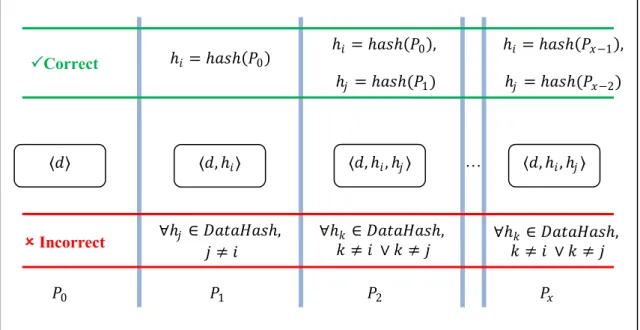
Figure 4.2. Each Message Must Use the Hashes of Preceding Messages ... 30
Figure 4.3. Actual Data Types Used in the Protocol Model ... 33
Figure 4.4. The PM Set Including the Signature Message ... 33
Figure 4.5. The Function that Computes the Cardinality of 𝐷𝑎𝑡𝑎𝐻𝑎𝑠 ... 34
Figure 4.6. The 𝐷𝑎𝑡𝑎𝐻𝑎𝑠 Set of Size 3 ... 34
Figure 4.7. The Algorithm of 𝐶𝑒𝑐𝑘 Process ... 38
Figure 4.8. The Network Model Used for the Protocol ... 41
Figure 4.9. Correct and Incorrect Hash Values ... 46
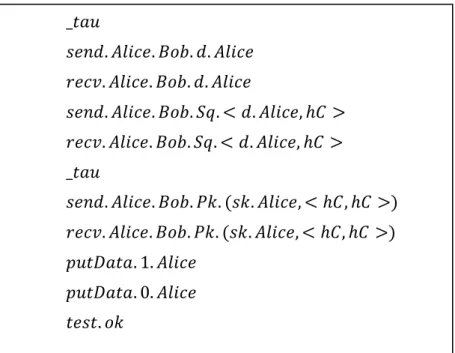
Figure 5.1. The Debug Trace of the First Validation Property ... 56
x
LIST OF TABLES
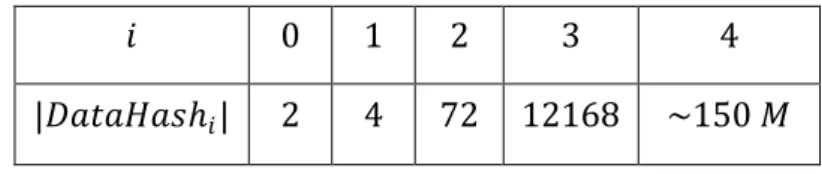
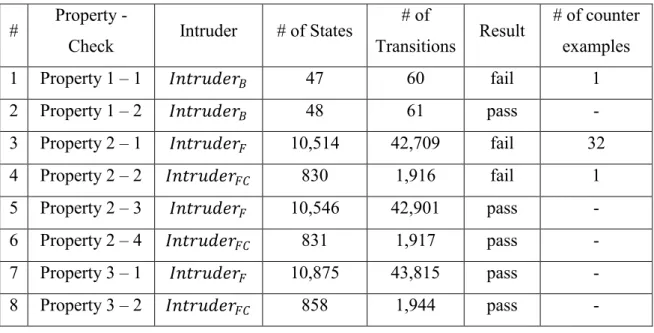
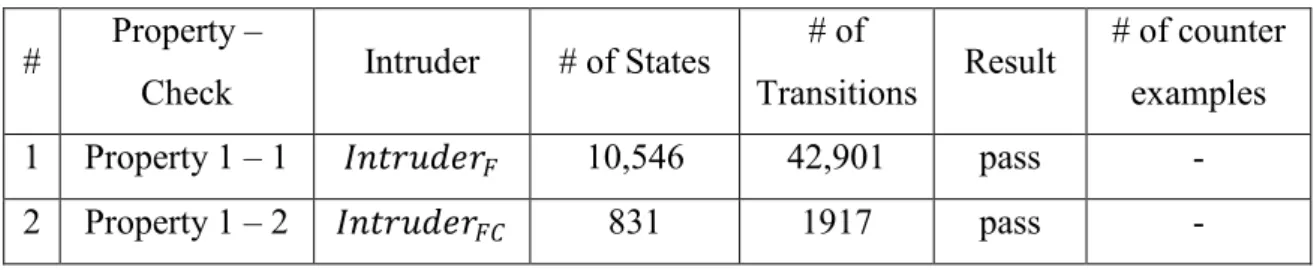
Table Page Table 4.1. The Size of 𝐷𝑎𝑡𝑎𝐻𝑎𝑠 Set for Two Data Values. ... 44 Table 5.1. Results of Refinement Checks of Validation Properties ... 55 Table 5.2. Results of Refinement Checks for Verification Properties ... 57
1
CHAPTER 1
INTRODUCTION
Systems in the real world are composed of many interacting components, which can, in turn, interact with other systems, constituting a system exhibiting more complex behavior than their sub-components. Also, these systems run concurrently; that is, events may occur simultaneously instead of sequentially.
Computational systems are good examples of these systems. For example, an operating system can run multiple processes simultaneously which interact with each other. Even though this is only an illusion, the interaction of the processes with each other and the environment makes it a concurrent system, interacting and evolving in parallel with each other.
On the other hand, most classical theories of computation are involved in sequential formalisms of computation, such as automata theory and Turing machines. These formalisms consider computation as a transformation of input into output, while interaction with environment (or other systems) is left unconsidered.
The deficiencies of sequential computing models led to the formation of concurrent formalisms of computation, starting with the introduction of Petri nets (Petri 1962). Currently, there are different approaches for modeling concurrent systems based on graph (e.g. Labeled Transition Systems), net (e.g. Petri Nets) and term (e.g. Process algebras) structures, which have different levels of expressiveness. The specifications of a model can be stated in the same formalism as the model itself or in a different formalism, which are used to verify the correctness of the system (Glabbeek 2000).
Another aspect of concurrent systems is the dependence on the concept of time. Concurrency theory models time in its formalisms in two different approaches. The first aspect is the qualitative notion of time, which does not keep track of the actual units of time elapsed between events, but the relative ordering of the events. The other models use quantitative notion of time, in which the passage of time between two events can be explicitly modeled.
2 Communicating Sequential Processes (CSP) is essentially a term based model. The model of the system and the specifications are represented as CSP processes. Then, the correctness of the system is determined by means of refinement relations.
The contribution of this study is to model the Efficient Multi-chained Stream Signature (EMSS) protocol using CSP and verify its authentication properties using model checking. The infinite state model of the EMSS protocol is built using fixed sized hashes. This model is not suitable for verification by model checking; therefore it has been reduced into a finite state model and verified using Failures - Divergences Refinement (FDR) (Goldsmith 2005a) tool. This study uses model checking to verify the security properties of EMSS protocol, which have previously been verified only using theorem proving methods (ter Beek, et al. 2003, 2006, Perrig, et al. 2000).
In the second chapter, the theory of Communicating Sequential Processes and its place in the concurrent computing models are introduced. The fundamental operators and concepts of CSP and their role in the operational semantics of the language are presented. Additionally, behavior of the processes is discussed within the denotational semantics section. Finally, the concept of refinement is introduced and tool support for CSP is evaluated.
The purpose of the third chapter is to introduce general concepts and techniques used for modeling and verification of security protocols, as the protocol model of EMSS constructed in this thesis modifies and uses these concepts.
In the fourth chapter, the EMSS protocol is introduced and CSP model of the EMSS protocol is built. In order to do that, infinite state CSP model of the protocol is first built and then reduced to a finite state model while retaining the properties of the protocol.
The fifth chapter involves building the specification processes and performing validation and verification of the model using refinement checking on the reduced model. Additionally, the reduced model is evaluated using results of the check.
3
CHAPTER 2
CONCURRENT SYSTEMS AND COMMUNICATING
SEQUENTIAL PROCESSES
In this chapter, the theory of Communicating Sequential Processes (CSP) and its place in the concurrent computing models are introduced. The fundamental operators and concepts of CSP and their role in the operational semantics of the language are presented. Additionally, behavior of the processes is discussed within the denotational semantics section. Finally, the concept of refinement is introduced and tool support for CSP is evaluated.
2.1.
Concurrent Systems
Computational systems are mostly composed of subcomponents which interact with each other and form a more complex structure. Concurrency theory forms the mathematical foundations for representing and analyzing these systems in a systematic manner.
Concurrent systems share some common traits. First, concurrent systems have interaction. Interaction might be implemented differently in different models, but in general, it allows a system to communicate with another system.
The second trait is non-transformality. Transformal models are defined within the classical theories of computation, in which the system is only an input – output transformer, such as an automaton. However, concurrent systems interact with each other, they tend to evolve with their environments and their outputs may not entirely depend on the inputs. The final trait is unbounded execution. In sequential models, the model need to stop, but concurrent systems do not have this restriction. (Bowman and Gomez 2006).
4
2.1.1.
Models of Concurrency
There are numerous models, which represent concurrent systems. These models can be classified with respect to the kind of mathematical objects that are used to represent processes (Winskel and Nielsen 1995).
In Graph oriented models (Keller 1976), a system is represented by a process graph, or state-transition diagram. A variant is labelled transition systems, in which a concurrent system is not denoted by a whole graph, but by a vertex in a graph. Another class is net oriented models, in which a concurrent system is represented by a Petri net. Event oriented models represents a concurrent system by a set of events (action occurrences) together with some structure on this set, determining the relations between the events (Mazurkiewicz 1988).
In term models, a system is represented as a term in a system description language, such as Calculus of Communicating Systems (CCS) (Milner 1982) or CSP. Using term models, a system can be denoted either by means of an expression (i.e. term) in that language or semantically.
CSP is a term based model. In CSP, processes can be viewed in three different aspects, each of which gives different meanings to processes (Roscoe 1998):
(i) Operational Semantics interprets CSP processes as transition diagrams and helps generating the state space of processes from process definitions.
(ii) Denotational Semantics interprets CSP processes in terms of the behaviors that the processes engage in. Different behaviors are represented as different models.
(iii) Algebraic Semantics involves in the algebraic relations between operators and defines process equivalences in terms of relations.
2.1.2.
Formal Verification Techniques
After expressing the system using a model, verification results need to be established on this model. To establish verification results on a model, the requirements of the model should be formalized first.
5 Then, the model is verified using theorem-proving; which uses logical inference rules in order to prove or disprove the specifications. Alternatively, the model can be verified using model checking; which involves in building the state space of the system and exhaustively checking all states against the specifications.
2.2.
Communicating Sequential Processes (CSP)
CSP (Hoare 1978, Roscoe 1998, Schneider 1999, Davies 2006) is a process algebra, designed specifically for the description of communication patterns of concurrent system components that interact through message passing. The original version of CSP is introduced in the seventies and further developed and refined to modern form as process algebra (Brookes et al 1984, Hoare 1985) which is widely influenced by Calculus of Communicating Systems (Milner 1982).
Machine readable CSP or 𝐶𝑆𝑃𝑀 (Scattergood 1998) is a functional language
with CSP constructs represented in ASCII form.
2.3.
Events, Processes and Operations
In CSP, systems are modeled in terms of the events that they can perform. Events are atomic and have no measurable duration. Also, the intervals of time between events are not considered, only the relative ordering of events is important. Timed CSP (Reed and Roscoe, 1998) is an extension to CSP, which introduces timing information in processes, in order to model the passage of time.
A single event may contain various pieces of information, so events can have structure. If 𝑀 and 𝑁 are two sets of messages, then 𝑀. 𝑁 will be the set of messages
{𝑚. 𝑛 | 𝑚 ∈ 𝑀 ∧ 𝑛 ∈ 𝑁}.
Events can be associated with channels, which model the point to point communications between processes. A channel 𝑐 is said to be of type 𝑀 if any event
𝑐. 𝑚 ∈ Σ has that 𝑚 ∈ 𝑀.
Definition (Alphabet): The set of all possible events (Σ) forms the alphabet of the process and denoted as Σ. An alphabet can be finite (𝛴∗) or infinite (Σω).
6 The 𝜏 event specifies an internal transition that cannot be observed from environment.
Definition (Process): Processes are the components of systems, which are the entities, described using CSP in terms of the possible events they may engage in.
The BNF form of a CSP process can be defined as:
𝑃, 𝑄 ∷= 𝑆𝑇𝑂𝑃 𝑆𝐾𝐼𝑃 𝑎 → 𝑃 𝑃; 𝑄 𝑃 □ 𝑄 𝑃 ⊓ 𝑄 𝑎: 𝐴 → 𝑃 𝑎 |
𝑃 △ 𝑄 | 𝑓 𝑃 𝑃 \ 𝐴 𝑃 ||𝐴 𝐵𝑄 | 𝑃 ||𝐴 𝑄 | ||𝐴𝑃𝑃 | 𝑃 ||| 𝑄 | 𝜇 𝑋 ∙ 𝐹(𝑋)
The process 𝑆𝑇𝑂𝑃 is the process that can engage in no events at all; it is equivalent to deadlock. 𝑆𝐾𝐼𝑃 denotes a process that does nothing but immediately terminate.
𝑎 → 𝑃 defines a process prefixed with an event using the prefix operator →. The process will communicate the event 𝑎 and then behave as process 𝑃.
𝑃; 𝑄 is the sequential composition operator, which handles the control over 𝑄
after 𝑃 has been successfully terminated.
The process 𝑃 □ 𝑄 (deterministic choice) and 𝑃 ⊓ 𝑄 (non-deterministic choice) both can behave like 𝑃 or like 𝑄. The main difference is, in deterministic choice, the environment decides on which process to run.
𝑎: 𝐴 → 𝑃 𝑎 denotes a deterministic choice between the events of the set 𝐴
which may be finite or infinite. This notation allows representing the inputs from and outputs to the channels. The input 𝑐? 𝑥 ∶ 𝐴 → 𝑃(𝑥) can accept any input 𝑥 of type 𝐴
along channel 𝑐, following which it behaves as 𝑃(𝑥). Its first event will be any event of the form 𝑐. 𝑎 where 𝑎 ∈ 𝐴. The output 𝑐! 𝑣 → 𝑃 is initially able to perform only the output of 𝑣 on channel 𝑐, then it behaves as 𝑃.
The interrupt process, 𝑃 △ 𝑄 defines a process which behaves as 𝑃 unless it receives an interrupt event, which is the first event of process 𝑄. If this event is received, the control is transferred to 𝑄 and process 𝑃 is discarded.
A relabeled process 𝑓 𝑃 has a similar control structure to 𝑃, however the events are renamed depending on the function 𝑓. The hiding operator 𝑃 \ 𝐴 defines a process similar to process 𝑃 but the environment will not see the events defined in the set 𝐴. The hidden events will occur immediately, as the environment is not able to see these events and synchronize with them.
7 Processes may also be composed in parallel. If 𝐴 is a set of events, then the process 𝑃 ||𝐴 𝑄 behaves as 𝑃 and 𝑄 acting concurrently, with synchronizing on any event in the synchronization set 𝐴. Events not in 𝐴 may be performed by either of the processes independent of the other. If the alphabets of 𝑃 and 𝑄 are 𝐴 and 𝐵
respectively, then (provided 𝑃 and 𝑄 cannot communicate using an event outside their alphabets) 𝑃 |𝐴 |𝐵 𝑄 = 𝑃 𝐴 ∩ 𝐵|| 𝑄. The indexed parallel operator ||𝐴𝑃𝑃 defines a process
which is composed of 𝑃 processes with a set of respective interfaces 𝐴𝑃. Interleaving
(i.e. the two components do not interact on any events) is achieved by synchronizing on nothing so 𝑃 ||| 𝑄 = 𝑃 ||∅ 𝑄 .
The recursion 𝜇 𝑋 ∙ 𝐹(𝑋) represents a process which behaves like 𝐹(𝑋) but with every free occurrence of 𝑋 in 𝑃 (recursively) replaced by 𝜇 𝑋 ∙ 𝐹 𝑋 ; where the variable
𝑋 here usually appears freely within 𝐹(𝑋).
2.4.
Operational Semantics
The operational semantics views CSP processes as transition systems and provides a formal way of generating the transition systems of processes.
Definition (Labeled Transition System): A labeled transition system (LTS) is a tuple (ℙ, →) where ℙ is set of nodes (states) , Σ,𝜏 = Σ ∪ { , 𝜏} is set of actions
(events) and → is a ternary relation such that →⊆ ℙ × Σ,𝜏 × ℙ.
A process 𝑃, with set of initial states 𝑃0, performs an event from Σ,𝜏 and changes its node accordingly. Each node of the LTS represents the state of the process. The LTS can be finite or infinite, depending on the set of states required to define the process. It is generally assumed that each node is reachable from 𝑃0 (Roscoe 1998).
Firing rules are defined for each CSP operator to systematically generate the state space of processes from process definitions. These firing rules form a logical inference system as a whole. Model checkers use these firing rules to generate the state space of a system (Goldsmith 2005b).
As the CSP processes can be viewed as LTSs, the similarity between LTS and automata raises the question of the relation of CSP with automata. The expressiveness of processes in CSP corresponds to partial automata; in which the transition function is
8 a partial function (Wolter 2002). Similarly, the expressiveness of Timed CSP is equivalent to a subclass of Timed Automata (Alur and Dill 1994, Ouaknine and Worrel, 2002).
2.5.
Behaviors and Denotational Semantics
Denotational semantics of CSP introduces behavioral models for capturing and comparing the behavior of processes. Each model defines the observations to be made on the processes and provides algebraic relations between these observations.
Different behaviors of the system are captured with different models, so they can represent the same system in different levels of detail. What they have in common is that each of them provides an abstract way of representing a process as a set of behaviors it can have in one or more categories.
There are three widely used models in CSP, that represent the most commonly used behaviors, namely Traces (𝒯), Stable Failures (ℱ) and Failures / Divergences (𝒩) models. All three models are based on recording finite observations on processes.
It is also possible to define new behavioral models in CSP which make different observations on processes (Bolton and Lowe 2004, Roscoe, et al. 2007, Roscoe 2008, 2009).
2.5.1.
Traces (
𝓣
) Model
The sequence of all events that a process has communicated by some point in its execution forms the trace of the process. A trace of a process may be finite or infinite, but in this model, only finite traces are considered.
𝑡𝑟𝑎𝑐𝑒𝑠(𝑃) is the function that defines a process as the set of finite sequences of visible events that it could perform, thus 𝑡𝑟𝑎𝑐𝑒𝑠(𝑃) ⊆Σ∗.
This function must satisfy the following pair of healthiness conditions to be in 𝒯
(traces model):
(T1) 〈〉 ∈ 𝑡𝑟𝑎𝑐𝑒𝑠(𝑃)
9 The condition (T1) states that empty trace is a trace of process 𝑃. (T2) states that the set 𝑡𝑟𝑎𝑐𝑒𝑠(𝑃) is prefix closed; meaning that any prefix of a trace is also a trace of 𝑃. Note that ^ denotes the concatenation of two traces (Roscoe 1998).
The deadlocked process 𝑆𝑇𝑂𝑃 cannot perform any actions, so its trace only contains the empty trace, that is 𝑡𝑟𝑎𝑐𝑒𝑠(𝑆𝑇𝑂𝑃) = { 〈〉 }. On the other hand, the process
𝑅𝑈𝑁Σ is the process that can perform every action in its alphabet Σ, that is 𝑅𝑈𝑁Σ = 𝑥: Σ → 𝑅𝑈𝑁Σ. Its traces contain all possible traces in the system: 𝑡𝑟𝑎𝑐𝑒𝑠 𝑅𝑈𝑁Σ = Σ∗.
Traces model is used for general safety specifications of processes.
2.5.2.
Stable Failures (
𝓕
) Model
Stable failures model (ℱ) considers the set of events that a process cannot accept as well as the trace information of a process. ℱ makes more identifications between processes than 𝒯; thus ℱ is a finer model than 𝒯.
Definition (Refusal): A refusal is set of events that a process fails to accept even if events are available to the process. 𝑟𝑒𝑓𝑢𝑠𝑎𝑙𝑠(𝑃) is the set of 𝑃’s initial refusals.
𝑟𝑒𝑓𝑢𝑠𝑎𝑙𝑠(𝑃/𝑡𝑟) is the set of 𝑃’s refusals after a trace of 𝑡𝑟, where 𝑟𝑒𝑓𝑢𝑠𝑎𝑙𝑠(𝑃) ⊆ ℙΣ. (Note that ℙ represents the power set.)
Definition (Stable State): A process is said to be in a stable state, if the process has no immediate internal actions (𝜏). If there are one or more 𝜏’s available, these internal actions will be taken and the process gets into some other state; so only stable states have refusal sets.
Definition (Failure): Each possible (𝑡𝑟, 𝑋) pair is a failure of the process where 𝑡𝑟, 𝑋 ⊆ Σ∗× ℙΣ. The function 𝑓𝑎𝑖𝑙𝑢𝑟𝑒𝑠 𝑃 = 𝑡𝑟, 𝑋 𝑡𝑟 ∈ 𝑡𝑟𝑎𝑐𝑒𝑠 𝑃 ∧
𝑋 ∈ 𝑟𝑒𝑓𝑢𝑠𝑎𝑙𝑠(𝑃/𝑡𝑟) } forms the failure set of a process 𝑃. This function must satisfy both (T1), (T2) (healthiness conditions for 𝒯) and these conditions:
(F1) 𝑡𝑟, 𝑋 ∈ 𝑓𝑎𝑖𝑙𝑢𝑟𝑒𝑠 𝑃 ⇒ 𝑡𝑟 ∈ 𝑡𝑟𝑎𝑐𝑒𝑠 𝑃
(F2) 𝑡𝑟, 𝑋 ∪ 𝑌 ∈ 𝑓𝑎𝑖𝑙𝑢𝑟𝑒𝑠 𝑃 ⇒ 𝑡𝑟, 𝑋 ∈ 𝑓𝑎𝑖𝑙𝑢𝑟𝑒𝑠 𝑃
(F3) 𝑡𝑟, 𝑌 ∈ 𝑓𝑎𝑖𝑙𝑢𝑟𝑒𝑠 𝑃 ∧ ∀𝑥 ∈ 𝑋 ∙ 𝑡𝑟 ^ 〈𝑥〉 ∉ 𝑡𝑟𝑎𝑐𝑒𝑠 𝑃 ⇒ 𝑡𝑟 , 𝑋 ∪ 𝑌 ∈ 𝑓𝑎𝑖𝑙𝑢𝑟𝑒𝑠 𝑃
The first condition (F1) provides consistency with the traces of the process, if 𝑡𝑟
10 that every refusal set of possible trace should be subset - closed. The final condition (F3) states that events performed in a particular state can be added to the failures set of the process.
2.5.3.
Failures / Divergences (
𝓝
) Model
While ℱ can be useful for classifying deterministic and nondeterministic processes, it has some shortcomings when there are processes which include infinite number of internal actions.
Definition (Divergence): A process is said to be divergent if infinite, consecutive sequence of internal actions (𝜏) occur. The set 𝑑𝑖𝑣𝑒𝑟𝑔𝑒𝑛𝑐𝑒𝑠(𝑃) is the set of traces of 𝑃 (thus, 𝑑𝑖𝑣𝑒𝑟𝑔𝑒𝑛𝑐𝑒𝑠(𝑃) ⊆ Σ∗) after which the process diverges.
Definition (Deterministic Process): A process 𝑃 is a deterministic process if
𝑑𝑖𝑣𝑒𝑟𝑔𝑒𝑛𝑐𝑒𝑠 𝑃 = and 𝑡𝑟^〈𝑎〉 ∈ 𝑡𝑟𝑎𝑐𝑒𝑠(𝑃) ⟹ (𝑡𝑟, 𝑎 ) ∉ 𝑓𝑎𝑖𝑙𝑢𝑟𝑒𝑠(𝑃), that is; if it does not diverge, it does not accept and refuse the same event.
The sets 𝑡𝑟𝑎𝑐𝑒𝑠(𝑃) and 𝑓𝑎𝑖𝑙𝑢𝑟𝑒𝑠(𝑃) must be extended to provide divergence information:
(1) 𝑡𝑟𝑎𝑐𝑒𝑠⊥(𝑃) = 𝑡𝑟𝑎𝑐𝑒𝑠(𝑃) ∪ 𝑑𝑖𝑣𝑒𝑟𝑔𝑒𝑛𝑐𝑒𝑠(𝑃)
(2) 𝑓𝑎𝑖𝑙𝑢𝑟𝑒𝑠⊥(𝑃) = 𝑓𝑎𝑖𝑙𝑢𝑟𝑒𝑠(𝑃) ∪ {(𝑡𝑟, 𝑋) | 𝑡𝑟 ∈ 𝑑𝑖𝑣𝑒𝑟𝑔𝑒𝑛𝑐𝑒𝑠(𝑃)} In (1), 𝑡𝑟𝑎𝑐𝑒𝑠(𝑃) is extended to contain the traces in which the process diverges. (2) states that if a process diverges, then it refuses every event.
In 𝒩, a process 𝑃 can be described with pair (𝑓𝑎𝑖𝑙𝑢𝑟𝑒𝑠⊥(𝑃), 𝑑𝑖𝑣𝑒𝑟𝑔𝑒𝑛𝑐𝑒𝑠(𝑃))
where 𝑓𝑎𝑖𝑙𝑢𝑟𝑒𝑠⊥ ⊆ (Σ∗× ℙΣ∗) and 𝐷 ⊆ Σ∗. Also, several healthiness conditions
are defined for pairs to describe processes:
(F1) 𝑡𝑟𝑎𝑐𝑒𝑠⊥ 𝑃 = 𝑡𝑟 𝑡𝑟, 𝑋 ∈ 𝑓𝑎𝑖𝑙𝑢𝑟𝑒𝑠(𝑃)} is non-empty and prefix closed. (F2) 𝑡𝑟, 𝑋 ∈ 𝑓𝑎𝑖𝑙𝑢𝑟𝑒𝑠 𝑃 ∧ 𝑌 ⊆ 𝑋 ⟹ (𝑡𝑟, 𝑌) ∈ 𝑓𝑎𝑖𝑙𝑢𝑟𝑒𝑠 𝑃 (F3) 𝑡𝑟, 𝑋 ∈ 𝑓𝑎𝑖𝑙𝑢𝑟𝑒𝑠 𝑃 ∧ ∀𝑎 ∈ 𝑌 ∙ 𝑡𝑟^〈𝑎〉 ∉ 𝑡𝑟𝑎𝑐𝑒𝑠⊥ 𝑃 ⟹ (𝑡𝑟, 𝑋 ∪ 𝑌) ∈ 𝑓𝑎𝑖𝑙𝑢𝑟𝑒𝑠 𝑃 (F4) 𝑡𝑟^〈 〉 ∈ 𝑡𝑟𝑎𝑐𝑒𝑠⊥ 𝑃 ⟹ (𝑡𝑟, Σ) ∈ 𝑓𝑎𝑖𝑙𝑢𝑟𝑒𝑠 𝑃 (D1) 𝑡𝑟 ∈ 𝑑𝑖𝑣𝑒𝑟𝑔𝑒𝑛𝑐𝑒𝑠 𝑃 ∩ Σ∗∧ 𝑎 ∈ Σ∗ ⟹ 𝑡𝑟^𝑎 ∈ 𝑑𝑖𝑣𝑒𝑟𝑔𝑒𝑛𝑐𝑒𝑠(𝑃) (D2) 𝑡𝑟 ∈ 𝑑𝑖𝑣𝑒𝑟𝑔𝑒𝑛𝑐𝑒𝑠 𝑃 ⟹ (𝑡𝑟, 𝑋) ∈ 𝑓𝑎𝑖𝑙𝑢𝑟𝑒𝑠 𝑃
11 (D3) 𝑡𝑟^〈 〉 ∈ 𝑑𝑖𝑣𝑒𝑟𝑔𝑒𝑛𝑐𝑒𝑠 𝑃 ⟹ 𝑡𝑟 ∈ 𝑑𝑖𝑣𝑒𝑟𝑔𝑒𝑛𝑐𝑒𝑠 𝑃
The condition (F2) states that if a process can refuse 𝑋, then it can refuse any subset of it. (F3) condition points out that if a process refuses 𝑋 after 𝑡𝑟, then the same state must refuse any events in set 𝑌, the set of events it cannot perform after 𝑡𝑟. (F4) states that if a process terminates, then it refuses anything. The divergence condition, (D1) is an extension closure property, stating that if 𝑡𝑟 is a divergence of 𝑃 then so is 𝑡𝑟^𝑎. Condition (D2) states the process refuses any 𝑋 ⊆ ℙΣ∗, because it only performs the internal actions. The last condition, (D3) states the special case of termination event.
Stable processes can be described with same observations in both models. In other words, 𝒩 does not provide more observations than ℱ for stable processes (Roscoe 1998).
2.6.
Refinement Relations
Assume that 𝑃 ⊓ 𝑅 can be used anywhere instead of 𝑅, where 𝑃 and 𝑅 are processes. To satisfy this property, 𝑃 must exhibit all behavior that 𝑅 exhibits (i.e. every behavior of 𝑃 should be a behavior of 𝑅), therefore it can be said that 𝑃 refines 𝑅. That is, if 𝑃 ⊓ 𝑅 = 𝑅 then 𝑃 refines 𝑅, which is symbolized as 𝑅 ⊑ 𝑃.
Refinement relation is;
(i) reflexive; for any process 𝑃, 𝑃 ⊓ 𝑃 = 𝑃, therefore every process is a refinement of itself
(ii) antisymmetric; for any processes 𝑃 and 𝑅, if 𝑃 ⊓ 𝑅 = 𝑅 and 𝑃 ⊓ 𝑅 = 𝑃 then
𝑃 = 𝑄. This forms the notion of equivalence between processes.
(iii) transitive; for any processes 𝑃,𝑅 and 𝑄, if 𝑅 ⊑ 𝑃 and 𝑃 ⊑ 𝑄, then 𝑅 ⊑ 𝑄. As the behaviors of processes are defined by models; refinement relations can be expressed in terms of the models. Let ℳ 𝑃 represent the set of all possible behaviors of process 𝑃 in model ℳ. If process 𝑃 refines process 𝑅 in model ℳ, then the set of all behaviors of R should include at least all behaviors of P. That is, if 𝑅 ⊑ℳ 𝑃, then
12 The refinement relation forms a partial ordering between processes. This also means that, there are least refined processes and most refined processes. For example, in
𝒯 (traces model), 𝑆𝑇𝑂𝑃 is the most refined process, because for any 𝑃, 𝑡𝑟𝑎𝑐𝑒𝑠 𝑃 ⊇ 𝑡𝑟𝑎𝑐𝑒𝑠 𝑆𝑇𝑂𝑃 . The least refined process is 𝑅𝑈𝑁Σ, therefore, for any process 𝑃,
𝑡𝑟𝑎𝑐𝑒𝑠(𝑅𝑈𝑁Σ) ⊇ 𝑡𝑟𝑎𝑐𝑒𝑠(𝑃).
It is straightforward to define the refinement relation for 𝒯, ℱ and 𝒩 models:
Definition (Traces Refinement): Let 𝑃, 𝑅 be two processes. 𝑅 ⊑𝒯 𝑃 (𝑃 is a
trace refinement of 𝑅) if and only if 𝑡𝑟𝑎𝑐𝑒𝑠 𝑅 ⊇ 𝑡𝑟𝑎𝑐𝑒𝑠 𝑃 .
Definition (Failures Refinement): Let 𝑃, 𝑅 be two processes. 𝑅 ⊑ℱ 𝑃 (𝑃 is a failures refinement of 𝑅) if and only if 𝑡𝑟𝑎𝑐𝑒𝑠(𝑅) ⊇ 𝑡𝑟𝑎𝑐𝑒𝑠(𝑃) and 𝑓𝑎𝑖𝑙𝑢𝑟𝑒𝑠(𝑅) ⊇ 𝑓𝑎𝑖𝑙𝑢𝑟𝑒𝑠(𝑃). If 𝑅 ⊑ℱ 𝑃 for processes 𝑃 and 𝑅; then 𝑅 ⊑𝒯 𝑃 also holds.
Definition (Failures-Divergences Refinement): Let 𝑃, 𝑅 be two processes.
𝑅 ⊑𝒩 𝑃 (𝑃 is a failures - divergences refinement of 𝑅) if and only if 𝑓𝑎𝑖𝑙𝑢𝑟𝑒𝑠⊥(𝑅) ⊇
𝑓𝑎𝑖𝑙𝑢𝑟𝑒𝑠⊥(𝑃) and 𝑑𝑖𝑣𝑒𝑟𝑔𝑒𝑛𝑐𝑒𝑠(𝑅) ⊇ 𝑑𝑖𝑣𝑒𝑟𝑔𝑒𝑛𝑐𝑒𝑠(𝑃).
Refinement checking involves using another CSP process as the specification process, which identifies the correct behavior of a process. This approach is somewhat similar to the concept of language inclusion, which is defined for finite state automata.
It is also possible to use other formalisms for expressing specifications, such as Computational Tree Logic (CTL) (Emerson and Clarke 1982) and Linear Tree Logic (LTL) (Pnueli 1977). However, it is proved that refinement checking is more expressive than CTL (Leuschel et al. 2001).
In addition to refinement checking, it is possible to use individual properties 𝑅
and check if a process 𝑃 satisfies 𝑅; which is 𝑃 𝒔𝒂𝒕 𝑅 (Hoare 1985). The expressive power of sat based specification and refinement relations is also comparable (Roscoe 2005).
2.7.
A Verification Tool for CSP: FDR
Failures - Divergences Refinement (FDR) (Goldsmith 2005a) is a commercial tool, designed to establish verification results for the concurrent and reactive systems
13 described in CSP. It calculates the state space of the given system and performs an exhaustive search on this space, like the other model checking tools.
Generally, FDR obtains its results by comparing two descriptions: a specification and an implementation; in order to determine if the latter is a refinement of the former. If a check is successful, it means that the implementation is a reasonable candidate for substitution into the role of the specification.
FDR generates LTS of processes according to operational semantics through a process called compilation. However, a compilation process that treats all the processes same is inefficient when checking big state spaces. Therefore, FDR uses a two-level approach to calculating operational semantics: The low level is fully general but relatively inefficient, whereas the high level is restricted (specifically, it cannot handle recursion) but much more efficient in terms of space and time.
The most recent version of FDR used in this study is FDR 2.83 which is released on July 23, 2007. FDR can check for refinement in Traces, Stable Failures and Failures – Divergences models and in several non-standard models (Bolton and Lowe 2003, Goldsmith 2005a).
2.7.1.
Refinement Checking
The refinement checking mechanism in FDR depends on the theory of fixed point induction (Tarski 1955, Roscoe 1998).
Suppose a check in which whether an implementation process 𝐼𝑚𝑝𝑙 refines the specification process 𝑆𝑝𝑒𝑐 with respect to model 𝒩, that is 𝐼𝑚𝑝𝑙 ⊒𝒩 𝑆𝑝𝑒𝑐. Let all the
states for 𝑆𝑝𝑒𝑐 and 𝐼𝑚𝑝𝑙 be 𝑆 and 𝐼, respectively. Before the refinement check, FDR normalizes specification process 𝑆𝑝𝑒𝑐.
After normalization, a process pair must satisfy these conditions if failures-divergences refinement holds:
(1) ∀𝑎 ∙ (𝐼→ ) ⟹ (𝑆𝑎 → )𝑎
(2) ∀𝑋 ∙ 𝐼 𝑟𝑒𝑓𝑢𝑠𝑒𝑠 𝑋 ⟹ 𝑆 𝑟𝑒𝑓𝑢𝑠𝑒𝑠 𝑋
(3) 𝐼 ↑⟹ 𝑆 ↑
The condition (1) states that if an event is possible from implementation state 𝐼, then it must be available for specification state 𝑆. Condition (2) states that any refusal of
14
𝐼 should be available for 𝑆. Since the subset of a refusal is also a refusal, only maximal refusals are checked. Finally (3) states that 𝐼 should diverge only if 𝑆 do. (Goldsmith 2005a).
If a pair is correct, then all pairs should be checked, that are reachable from current state. The refinement holds if it holds for every pair in the state space. Hence, refinement checking is only applicable to finite state processes.
2.7.2.
Compression Techniques
Similar to other model checkers, FDR also suffers from the state space explosion problem. Some compression techniques are used to decrease the number of states that should be checked. Compression involves converting a state machine into an equivalent but a more efficient state machine, by application of several techniques (Roscoe, et al. 1995, Clarke et al. 1999, Goldsmith 2005a).
These compression techniques are available to all processes because they are applied to the generated LTS by the operational semantics. However the gain provided by these techniques is generally dependent on the structure of the process. Unsuitable compression techniques are known to increase the state space of some processes (Roscoe 1998).
15
CHAPTER 3
MODELING AND VERIFICATION OF SECURITY
PROTOCOLS USING CSP
The purpose of this chapter is to introduce the general concepts and techniques used for modeling and verification of security protocols. In this study, these concepts are heavily used in the modeling of the protocol and verification of the protocol model.
Security protocols (cryptographic protocol) define a sequence of messages between two or more participants. They aim to reach a goal (e.g. authentication between principals, secrecy of a message, etc…) using cryptographic mechanisms such as encryption, decryption and hashing; even if the underlying medium is insecure.
3.1.
Stream Authentication
Some applications require a stream of data be transported between agents on a network, often with smaller packets, where the data in each packet is related with the previous and the next packets. This is often the case in real-time stock exchange, audio / video transmission protocols or sensor networks where the data is generated in real time and needs to be transported in a timely manner (Gennaro and Rohatgi 1997, Anderson, et al. 1998, Canetti, et al. 1999). Thus, these applications have different requirements, such as reliability, group management and locus of control (Obraczka 1998).
In addition to these issues, authenticating and signing the stream is fairly different from standard authentication schemes such as Needham – Schroeder Protocol (Needham and Schroeder, 1978) or Yahalom Protocol (Burrows, et al. 1990). These schemes provide authentication between one sender and one responder; which agree on a shared secret key. However, streaming protocols may use many responders while sender is single. So, these schemes are not suitable for streaming applications where the sender must authenticate it to multiple receivers.
Stream authentication protocols are generally verified using theorem proving techniques, due to their infinite state space. However, Timed Efficient Stream
Loss-16 tolerant Authentication Protocol (TESLA) (Perrig, et al. 2000) has been modeled using CSP and verified using model checking (Broadfoot and Lowe 2002), which used data independence techniques (Lazic 1998, Roscoe and Broadfoot 1999, Roscoe, et al 2000).
3.2.
The Generic CSP Protocol Model
Each participant is modeled as CSP processes and a network between these processes is constructed. Security properties of the model are then analyzed with respect to the specifications of the protocol using refinement relations (Ryan et al. 2001).
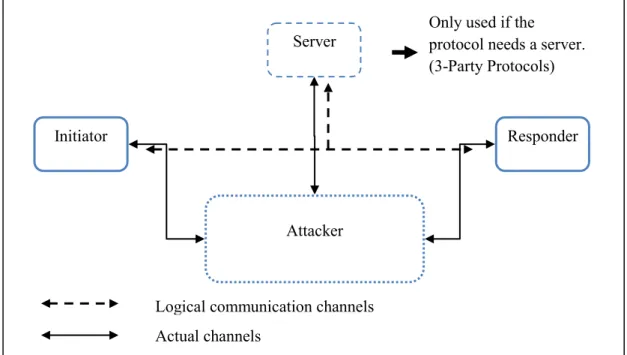
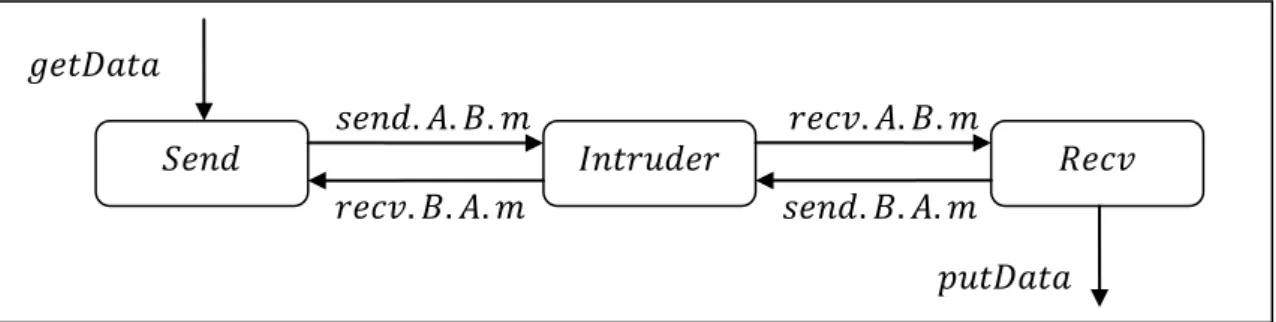
CSP model of a protocol represents a finite subset of the real protocol, which supposedly includes infinite number of states, to be analyzed by model checking. The network is modeled as a CSP process which is the parallel composition of honest agents, other protocol participants and attacker. The network process provides an abstraction of the real network. Communication between the processes is provided by CSP channels which are labeled with sender and receiver fields. Honest agents use these channels to receive and send the protocol messages. The structure of a generic CSP network model is given in Figure 3.1.
Initiator Responder
Server
Attacker
Only used if the
protocol needs a server. (3-Party Protocols)
Logical communication channels Actual channels
17 This model can also be modified to satisfy different requirements. For example, more processes can be added to represent agents with different roles or agent processes can contain two or more internal processes (Dilloway and Lowe 2007).
3.2.1.
Honest Agents
Honest agents are trustworthy processes that aim to reach the protocol goal, despite the interventions of the un-trusted network. An agent can either act as an
initiator or responder of the protocol and might be parameterized by its identity.
When acting as an initiator, initiating agent chooses an agent to communicate with and then communicates messages of the protocol in turn. The responding process communicates the protocol messages as defined in the protocol description. When the run is complete, agents enter a state in which they are in a session with each other.
In addition to the protocol messages, agents may also engage in signal events. These events represent the state of protocol run and they are sent using different channels such that attacker is not able to interfere with them. Hence, a general view of protocol run can be obtained and this information might be used to build specification processes (Shaikh et al. 2009).
3.2.2.
Intruder Model
The network is responsible for the transmission of messages and cannot be trusted, since the messages can be lost, reordered or changed during transmission. Also; the network may contain some malicious parties that may acquire sensitive information and even forge their own messages.
In this model, the intruder is modeled as the network. Capabilities of the intruder are:
Deliver Messages:
This is basically transmitting the message to intended recipient without any alteration.
18 Intruder may access the contents of transmitted messages. On overhearing, it may add overheard message to its knowledge base. The message will still be delivered to intended recipient, without alteration.
Block (Intercept) Messages:
The message will not be delivered to recipient in this case. Forge (Fake) Messages:
Intruder may create messages by applying some operations (deductions) to messages in its knowledge base. Also; it may send previous messages, which is known as replay or redirection.
This view of network is known as Dolev - Yao Model (Dolev and Yao 1981) in which a strong intruder that forms the untrusted medium. In this model, the intruder can even perform cryptographic attacks on encrypted messages.
However the protocol must be checked for correctness, not underlying cryptographic operations. Hence the capabilities of intruder are limited by perfect –
cryptology assumptions.
First, the contents of encrypted messages cannot be viewed, if the process cannot supply the proper decryption key. Additionally, keys cannot be deduced from encrypted messages by guessing or applying cryptanalysis.
This view of network is known as Dolev - Yao Model with perfect-cryptology. If the protocol is checked to be correct despite the presence of a strong intruder; it should also be correct for networks with weaker intruders (Roscoe 1995a).
On the other hand; using weaker channels than Dolev - Yao is also possible. In the case of empirical channels (i.e. Channels on which the data is transferred using sight, hearing, etc…), when sight is used as a channel; the channel cannot be spoofed and is authentic, but confidentiality cannot be assured (Nguyen and Roscoe 2008).
3.2.3.
Simplifications on Protocol Model
The complexity of protocols makes analysis much more difficult. When analyzing a complex protocol using model checking, state space explosion problem occurs.
The idea is to apply as many safe simplifying transformations as possible, trying to avoid introducing new attacks, and then to analyze the simplified protocol. If the
19 simplified protocol is secure, then so is the original; if the attack discloses an attack up on the simplified protocol, then it must be considered that whether there is a corresponding attack on the original protocol. If there is such an attack, then clearly the original protocol is flawed; otherwise, it means that the whole scheme has been oversimplified. (Hui and Lowe 1999, 2001).
Examples of such transformations include removing encryptions, hash functions and some atomic or hashed fields, renaming atomic fields and removing fields from the bodies of encryptions (Hui and Lowe 1999, 2001).
3.3.
Data Independence
A process can be parameterized if its behavior is dependent on parameters
𝑝1, 𝑝2, … , 𝑝𝑛 with respective types 𝑇1, 𝑇2, … , 𝑇𝑁. Each different value bound to
parameters will build a different instance of the process. Parameterized processes need to be instantiated using values of appropriate type, in order to be verified using a model checker. Hence, the result of verification is actually meaningful for one instance of system, not for all values of parameterized type.
Definition (Parameterized Verification Problem): The problem of verifying whether a parameterized system satisfies correctness conditions for all parameter values is known as Parameterized Verification Problem (Lazic 1998).
Although the Parameterized Verification Problem is undecidable (Krzysztof and Kozen, 1986) there are some subclasses of problems, on which this problem becomes decidable. The data independence techniques focus on identifying such processes.
Definition (Data Independence): A parameterized system 𝑃 is data-independent with respect to a data type 𝑇 if and only if the operations performed in the system are restricted to:
(i) Input,
(ii) Store and copy within its variables (i.e. polymorphic operations such as tupling),
(iii) Performing equality tests between them (but not ordering), (iv) Output.
20 The system must not perform operations on 𝑇 which can constrain its type, such as computing the size of 𝑇, apply ordering operations between members of 𝑇, using constants of type 𝑇, etc…. Also, the control flow of program must not depend on the parameterized values of type 𝑇 (Lazic 1998).
Definition (Weak Data Independence): A parameterized system 𝑃 is weakly data-independent if either;
(i) Values from 𝑇 can affect the control flow of 𝑃 by equality tests, or, (ii) It has formal operations from any type to 𝑇.
The idea is to verify a data-independent program with respect to type 𝑇 using the minimum sized set of 𝑇; and the result of verification would hold for all finite or infinite sized type 𝑇. This minimum size is actually a threshold value; after which the program behavior won’t change.
Let 𝑆𝑝𝑒𝑐(𝑇) and 𝐼𝑚𝑝𝑙(𝑇) be data independent processes with respect to type 𝑇; representing respectively specification and implementation processes. It is needed to determine the threshold values to check for refinement between 𝑆𝑝𝑒𝑐(𝑇) and 𝐼𝑚𝑝𝑙(𝑇)
and determinism check of process 𝐼𝑚𝑝𝑙(𝑇).
Definition (𝑵𝒐𝑬𝒒𝑻𝑻 Condition): A data independent process 𝑃 satisfies 𝑁𝑜𝐸𝑞𝑇𝑇
condition if it contains no explicit or implicit equality tests between the members of type 𝑇.
If 𝑆𝑝𝑒𝑐 process only knows that an arbitrary member of 𝑇 is communicated but not interested in which member is; a set of size 1 can be used. Otherwise, if the 𝑆𝑝𝑒𝑐
process is interested in each value is output in right place, a set of size 2 can be used. For the general case; it is assumed that the data independent processes may have equality tests between members of type 𝑇 and control flow of process may be affected with these tests. Hence, the 𝑁𝑜𝐸𝑞𝑇𝑇 condition might not be satisfied by these processes. If 𝑆𝑝𝑒𝑐(𝑇) and 𝐼𝑚𝑝𝑙(𝑇) are data independent processes with respect to type 𝑇
and they do not satisfy 𝑁𝑜𝐸𝑞𝑇𝑇 condition; thresholds can be computed by determining some constants. These constants need to have a finite value to calculate a usable threshold value; else the process does not have a finite threshold. (Lazic 1998).
21
3.4.
Specification of Security Protocols
This section is devoted to the construction of specification processes for security protocols. There are different methods for specifying secrecy, authentication and non repudiation properties of protocols, however only authentication properties are introduced (Roscoe 1996, 1998, Schneider 1996, 1997, Lowe 1997a).
3.4.1.
Using
𝒔𝒊𝒈𝒏𝒂𝒍
Events
It is necessary to capture the state of honest agents during the protocol run in order to build the specifications of the system. Signal events are used to determine this information. Signal events use channels that are not accessible by the intruder. When an agent reaches a certain stage of execution in a run, these events are performed. Then the system’s behavior can be captured by hiding other events other than these signal events (Shaikh, et al. 2009).
The channel 𝑠𝑖𝑔𝑛𝑎𝑙 is used to capture the states of execution of agents. An event in the form of 𝑠𝑖𝑔𝑛𝑎𝑙. 𝑅𝑢𝑛𝑛𝑖𝑛𝑔. 𝑟𝑜𝑙𝑒. 𝐴. 𝐵. 𝑑1. 𝑑2 represents that agent 𝐴, thinks
it is running the protocol as 𝑟𝑜𝑙𝑒 with 𝐵, agreeing on data items 𝑑1 and 𝑑2. This event is performed before the last message that 𝐴 sends.
An event in the form of s𝑖𝑔𝑛𝑎𝑙. 𝐶𝑜𝑚𝑚𝑖𝑡. 𝑟𝑜𝑙𝑒. 𝐴. 𝐵. 𝑑1. 𝑑2 represents that agent
𝐴 thinks that it has succeeded in protocol run where it performed as 𝑟𝑜𝑙𝑒 with 𝐵, agreeing on data items 𝑑1 and 𝑑2. This event is performed after 𝐴’s last event in the run.
3.4.2.
Authentication
Authentication is concerned with the verification of an entity's claimed identity. An authentication protocol provides an agent 𝐴 with a mechanism to ensure that the other party 𝐵 has also been involved in the protocol run. However, there is no consensus on the exact meaning of authentication. Therefore, four possible specific meanings of the term are introduced and evaluated (Lowe 1997a).
22 The first definition is the strongest definition; agreement, where the protocol agents are required to agree on a mutual set of data items. Also a protocol run of initiator must be matched by a unique run on the responding side of the protocol.
A weaker definition is non-injective agreement, where the agents are required to agree on a mutual set of data items, as in agreement, but a run of the protocol might not be matched by a unique run on responding side. A protocol which satisfies agreement specifications also satisfies non-injective agreement specifications.
Weak agreement specifications provide weaker specifications than non-injective agreement. This definition of authentication allows agent 𝐵 to assume any protocol role in its run. Therefore, agent A does not have a guarantee about the role of responding agents or values of data items. Additionally, two agents do not need to agree on a mutual set of data items.
The weakest definition is aliveness. In this definition, a run of agent 𝐵 may not be recent. In other words, this specification allows checking that agent 𝐵 has completed the protocol run before agent 𝐴. Also agent 𝐵 may not believe that it was running the protocol with agent 𝐴.
23
CHAPTER 4
PROPOSED MODEL FOR THE PROTOCOL
In this chapter, the EMSS protocol is introduced and evaluated under CSP for verification. First, infinite state CSP model of the protocol is built, which is then reduced into a finite state model using some observations and assumptions while retaining the properties of the protocol. This model is represented as a CSP process that describes the behavior of the protocol.
4.1.
The Efficient Multi-chained Stream Signature (EMSS) Protocol
The Efficient Multi-chained Stream Signature (EMSS) protocol (Perrig, et al. 2000) aims to provide the authentication of sender to receivers, which is based on signing a small number of special messages in a data stream. Each packet is linked to a signed message via multiple hash chains.
Hash chains are formed by appending the hash of each message to a number of subsequent messages.
The main features of this scheme are; the amortization of the cost of signature operation over multiple packets, resistance to packet loss, low message overhead and non repudiation of the sender to the transmitted data (Perrig, et al. 2000).
The hash chains are formed by appending the hashes of a number of previous messages to current message 𝑃𝑖. Periodically, a signature message 𝑃𝑠𝑖𝑔𝑛 is sent, which contains the hashes of previous messages in a signature. Receiver then decrypts the signature message and obtains the signed hashes of previous messages. The chained hashing relation between the messages is illustrated in Figure 4.1.
There should be a path from a message to the signed message to authenticate the message. To authenticate message 𝑃𝑖, then the existence of messages 𝑃𝑖+1 or 𝑃𝑖+2 is sufficient. If both of these messages are lost, then there’s no path to 𝑃𝑖 from the
24 Figure 4.1. The Hash Chains Between the Protocol Messages in EMSS
The digital signature message can be sent periodically for every 𝑛 messages, which would be different for each application of protocol. Clearly, for authenticity verification, the receiver must buffer messages until a signature message arrives. Several use cases are defined for setting these parameters to use the protocol for different purposes (Perrig, et al. 2000).
EMSS can be represented in Security Protocol Notation as: 1. 𝐴 → 𝐵 ∶ 𝑃0, 𝑃0 = d0
2. 𝐴 → 𝐵 ∶ 𝑃1, 𝑃1 = 𝑑1, (𝑃0)
i. 𝐴 → 𝐵 ∶ 𝑃𝑖, 𝑃𝑖 = 𝑑𝑖, 𝑃𝑖−1 , (𝑃𝑖−2)where2 ≤ 𝑖 < 𝑛
… …
n. 𝐴 → 𝐵 ∶ 𝑃𝑛, 𝑃𝑛 = { 𝑃𝑛−1 , 𝑃𝑛−2 }𝑠𝑘(𝐴)
where, 𝑑 is the data and is the hash function. Since the protocol is not defined in security protocol notation (Perrig, et al. 2000), the protocol definition that is used in this study is the same as the one in (ter Beek, et al. 2006).
Only 𝑑0 is sent to the receiver as the first protocol message 𝑃0. In the second message, 𝑑1is sent to the receiver along with the hash of 𝑑0. Next message consists of
𝑑2 and hashes of 𝑃1 and 𝑃0. Thus, 𝑃0 may be still authenticated even if 𝑃1 is lost or unauthenticated. The last message consists of 𝑃𝑛 −1 and 𝑃𝑛−2, encrypted with 𝑠𝑘(𝑠) - the private key of the sender.
𝑃0 𝑃1 𝑃2 𝑃𝑖−1 𝑃𝑖 𝑃𝑠𝑖𝑔𝑛 𝑃𝑖−3 𝑃𝑖−2 𝑖 − 6 packets
25 As opposed to non-stream protocols, which have a predefined number of protocol messages in a run, the maximum message number in a run of EMSS protocol depends on the application (Perrig, et al. 2000).
EMSS protocol does not make any secrecy claims, as the data items are sent to the receiver in the clear. However, the receiver is able to check for the authenticity of incoming messages when a signature message arrives. Thus, EMSS claims to provide
one-way authentication, only authenticating the sender to receivers. The sender agent is not able to authenticate the receiver agents. In this study, one-way authentication properties of EMSS protocol are considered.
4.2.
Modeling Assumptions
It is assumed that the agents perform only the operations defined in the protocol description. Also, the agents are assumed to know their own secret keys, the public keys and the identities of other agents. One further assumption is that the intruder has the capabilities of a Dolev - Yao Intruder (Dolev and Yao 1981).
Additionally, a perfect cryptosystem is assumed in order to focus the analysis on the protocol. For hashing, it is assumed that agents cannot extract the message contents from hashed messages. Also, hashes of different messages are always different. Hence, a perfect hashing scheme is assumed where the hashed message gives no clue about the clear message and furthermore, no hash collisions occur.
The protocol definition does not include any communication from the receiver to the sender. So it is assumed that the sender knows the identities of receivers with which it will communicate with. In reality, this is likely to be a subset of all agent identities.
EMSS protocol can be configured to have more than two hash values in a protocol message (Perrig, et al. 2000). In this study, it is assumed that one message has the hashes of two other messages.
4.3.
Symbolic Data Types and Operations
Symbolic data types model the actual data structures and variables within the protocol. This abstraction provides a degree of freedom from the constraints on actual data structures but allows including them in the model.
26 Cryptographic operations are also represented symbolically for symbolic data types, thus, the operation is not performed in reality; but relevant symbolic data are modified appropriately. This allows the model to ignore the implementation specific details of cryptosystem, as stated in the modeling assumptions.
4.3.1.
Symbolic Data Types
Protocol messages and their contents need to be represented in a structured way. Messages and their subcomponents are constructed from atomic data items by concatenation. This means that a communication of a compound message is equivalent to the communication of all of its atomic subcomponents.
Hence, a data type 𝑓𝑎𝑐𝑡 is defined in 𝐶𝑆𝑃𝑀, in order to represent atomic data
items such as agent identities, keys, encrypted and hashed messages and compound data items that are built using atomic data items:
𝑑𝑎𝑡𝑎𝑡𝑦𝑝𝑒 𝑓𝑎𝑐𝑡 = 𝐴𝑔𝑒𝑛𝑡. 𝐴𝐺𝐸𝑁𝑇 | 𝑆𝑞. 𝑆𝑒𝑞(𝑓𝑎𝑐𝑡) | 𝑝𝑘. 𝐴𝐺𝐸𝑁𝑇 𝑠𝑘. 𝐴𝐺𝐸𝑁𝑇 𝑘𝑒𝑦. 𝐴𝐺𝐸𝑁𝑇, 𝐴𝐺𝐸𝑁𝑇 | 𝑃𝑘. 𝑓𝑎𝑐𝑡, 𝑓𝑎𝑐𝑡 𝐸𝑛𝑐𝑟𝑦𝑝𝑡. 𝑓𝑎𝑐𝑡, 𝑓𝑎𝑐𝑡 𝐻𝑎𝑠. (𝑓𝑎𝑐𝑡)
The 𝐴𝐺𝐸𝑁𝑇 set contains the agent labels. An agent 𝐴 is identified by 𝐴𝑔𝑒𝑛𝑡. 𝐴
in protocol messages, where 𝐴 ∈ 𝐴𝐺𝐸𝑁𝑇.
Sequenced messages can be represented by 𝑆𝑞. 〈𝑓𝑎𝑐𝑡0, 𝑓𝑎𝑐𝑡1, … , 𝑓𝑎𝑐𝑡𝑛〉, which represents a sequence of facts; 𝑓𝑎𝑐𝑡0 to 𝑓𝑎𝑐𝑡𝑛. The public and secret keys of
agents are represented respectively by 𝑝𝑘. 𝐴𝐺𝐸𝑁𝑇 and 𝑠𝑘. 𝐴𝐺𝐸𝑁𝑇. Hence, a key pair for an agent 𝐴 becomes 𝑝𝑘. 𝐴 and 𝑠𝑘. 𝐴; which are the dual of each other. Similarly, 𝑘𝑒𝑦. (𝐴𝐺𝐸𝑁𝑇, 𝐴𝐺𝐸𝑁𝑇) symbolizes a symmetric key between two agents.
The data type 𝑓𝑎𝑐𝑡 is defined recursively to allow the use of nested encryption, nested hashing and sequencing inside an encryption.
The set of items that can be constructed from 𝑓𝑎𝑐𝑡 has unnecessary and invalid combinations of facts, most of which don’t represent meaningful protocol messages. For example, 𝐸𝑛𝑐𝑟𝑦𝑝𝑡. (𝑘𝑒𝑦. 𝐴, 𝐵 , … ) and 𝐸𝑛𝑐𝑟𝑦𝑝𝑡. (𝑘𝑒𝑦. 𝐵, 𝐴 , … ) represent the same message, because 𝑘𝑒𝑦. (𝐴, 𝐵) and 𝑘𝑒𝑦. (𝐵, 𝐴) represent the same key. In a similar sense, illegal protocol messages can be constructed using this set.
27 These definitions are restricted in order to reduce the state space; by defining a finite set of protocol messages. This approach helps reducing the need of recording every message separately, providing a reduction in the number of facts to be tracked.
4.3.2.
Cryptographic Operations
In the analysis, the main focus of interest is finding attacks which are mounted on the behavior of protocol participants, not on the cryptosystems used in the protocol. Furthermore, CSP is not a suitable formalism to represent and verify cryptosystems.
Therefore encryption, decryption and hashing operations are represented as symbolic operations. The operation is not performed in the real sense, only the data items are tagged (or untagged) to symbolize that the operation is performed.
In symbolic encryption, 𝑃𝑘. (𝑓𝑎𝑐𝑡, 𝑓𝑎𝑐𝑡) represents a public key encrypted message and 𝐸𝑛𝑐𝑟𝑦𝑝𝑡. 𝑓𝑎𝑐𝑡, 𝑓𝑎𝑐𝑡 represents a symmetrically encrypted message. Using the values within an encrypted data block means the decryption of the message. If the receiving agent knows 𝑘𝑒𝑦. (𝐴, 𝐵), it can receive (synchronize on) the message and use its contents. However, the intruder should have to decode the message if and only if it has the right key. Decryption is provided in a deduction in this case; the intruder does not have access to the contents unless it has the corresponding key.
Hashing mechanism is similar to this approach. However, intruder does not have any deductions to retrieve the contents of the hashed messages.
4.4.
Modeling the Hash Chain Mechanism using Fixed Hash Sizes
This section discusses problems encountered during the modeling of EMSS protocol and proposes a method to overcome these problems. First, the straightforward approach and its problems are explained. Then, a fixed size hashed message approach is defined for hash chain modeling.
The straightforward approach expresses the hash values by tagging the data values with 𝐻𝑎𝑠. ( ). This does not pose a problem for non-stream protocols, which do not use nested hashing. However, as in the EMSS protocol, the length of the representation of the hash value becomes very large when nested hashing is used. Using this straightforward method, 𝑖𝑡 EMSS protocol message is represented as:
28 𝑠𝑒𝑛𝑑. 𝐴𝑙𝑖𝑐𝑒. 𝐵𝑜𝑏. 𝑆𝑞. 〈𝑑𝑖, 𝐻𝑎𝑠. 𝑆𝑞. 〈𝑑𝑖−1, 𝐻𝑎𝑠. 𝑆𝑞. 〈𝑑𝑖−2〉 … 〉 , 𝐻𝑎𝑠. 𝑆𝑞. 〈𝑑𝑖−2, 𝐻𝑎𝑠. 𝑆𝑞. 〈𝑑𝑖−3〉 … 〉 〉 where 𝐴𝑙𝑖𝑐𝑒, 𝐵𝑜𝑏 ∈ 𝐴𝐺𝐸𝑁𝑇.
Another issue is the types of 𝑠𝑒𝑛𝑑 and 𝑟𝑒𝑐𝑒𝑖𝑣𝑒 channels. In CSP; it is possible to define channels with arbitrary type; however for model-checking purposes; the types of channels should be defined explicitly. Channels which accept messages with arbitrary number of nested hashes are a problem while expressing the protocol for model-checking tools.
Because of these reasons, hash chaining in the EMSS protocol using a tagged representation cannot be modeled for model checking purposes.
4.4.1.
Using Fixed Hash Sizes
In this approach, the size of a hashed message should be fixed, whatever the message length is. So, 𝑖𝑡 protocol message, sent from 𝐴𝑙𝑖𝑐𝑒 to 𝐵𝑜𝑏 is represented by:
𝑠𝑒𝑛𝑑. 𝐴𝑙𝑖𝑐𝑒. 𝐵𝑜𝑏. 𝑆𝑞. 〈𝑑𝑖, 𝑖−1, 𝑖−2〉
where 𝑖−1and 𝑖−2 represent the hash values of previous two messages.
Representing the protocol messages in such a manner requires a relationship, a mapping between the hash values and the protocol messages to be hashed. The receiver process needs to check the correctness of the hash values by comparing received hashes with computed hashes, thus such a mapping becomes necessary.
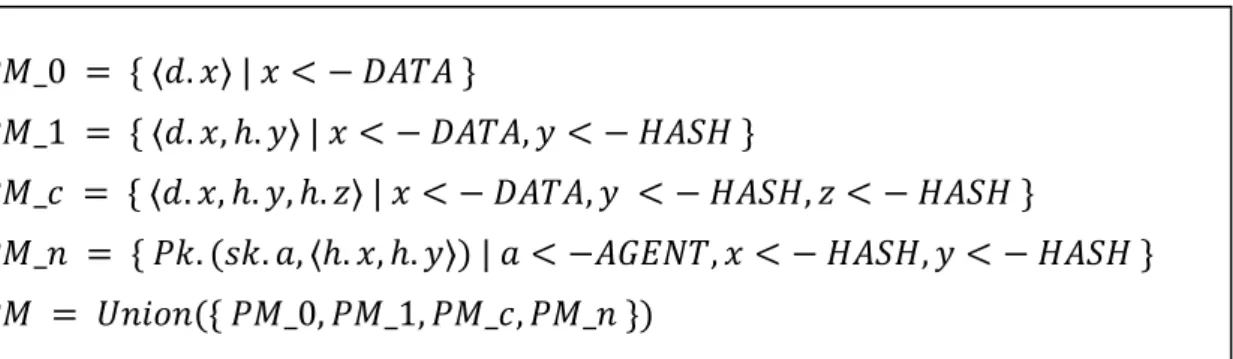
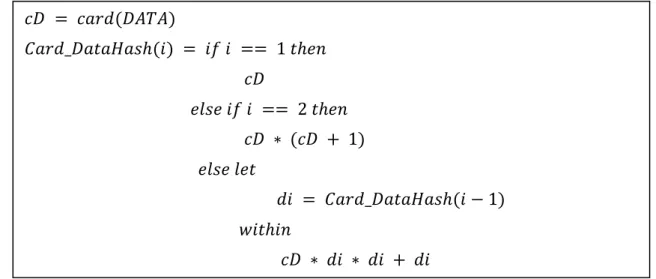
Before the definition of mapping data, protocol messages and hashes should be represented using sets, whose elements are symbolic representations of actual data structures. Elements of the 𝐴𝑙𝑙𝐷𝑎𝑡𝑎 set represent all possible symbolic data values in the protocol:
𝐴𝑙𝑙𝐷𝑎𝑡𝑎 = 𝑑𝑖 𝑖 ∈ 0. . 𝑚 }
where 𝑚 represents the upper bound on the number of data values. The 𝐴𝑙𝑙𝐻𝑎𝑠𝑒𝑠 set represents all symbolic hash values usable on the system, with 𝑛 being the maximum number of symbolic hashes: