QUT Digital Repository:
http://eprints.qut.edu.au/
27216
Dong, Andy., Maher, Mary Lou and Daruwala, Yohann.
Where the actions
are : bring reality into virtual reality.
The Participants of the CRC for Construction Innovation have delegated authority
to the CEO of the CRC to give Participants permission to publish material created
by the CRC for Construction Innovation. This delegation is contained in Clause 30
of the Agreement for the Establishment and Operation of the Cooperative Research
Centre for Construction Innovation. The CEO of the CRC for Construction
Innovation gives permission to the Queensland University of Technology to publish
the papers/publications provided in the collection in QUT ePrints provided that the
publications are published in full. Icon.Net Pty Ltd retains copyright to the
publications. Any other usage is prohibited without the express permission of the
CEO of the CRC. The CRC warrants that Icon.Net Pty Ltd holds copyright to all
papers/reports/publications produced by the CRC for Construction Innovation.
Where the actions are: bring reality into virtual reality
Andy Dong
Key Centre of Design Computing &
Cognition
Wilkinson Building (G04)
Sydney NSW 2006 AUSTRALIA
+61 2 9351 3031
[email protected]
Mary Lou Maher
Key Centre of Design Computing &
Cognition
Wilkinson Building (G04)
Sydney NSW 2006 AUSTRALIA
+61 2 9351 4108
[email protected]
Wai Kong Wan
Key Centre of Design Computing &
Cognition
Wilkinson Building (G04)
Sydney NSW 2006 AUSTRALIA
+61 2 9351 2053
[email protected]
Yohann Daruwala
Key Centre of Design Computing &
Cognition
Wilkinson Building (G04)
Sydney NSW 2006 AUSTRALIA
+61 2 9351 2053
[email protected]
ABSTRACT
This paper describes a work-in-progress on developing design environments that combine wireless and mobile technologies with augmented reality to facilitate bringing context from the physical environment to the virtual models for design work. One of the challenges for designers in a variety of end-user-oriented design disciplines such as architecture and industrial design has been capturing and replaying the contextual information of the intended domain of the artifact being designed. Either the technology is decidedly low-tech, such as charcoal drawings in a sketchbook, out-of-reach, such as immersive virtual reality CAVEs, or a “make-do” with existing technologies, such as a collage of digital photos. This paper describes a novel combination of “off-the-shelf” technologies that may allow designers more capability to create models using standard computer-aided design applications and augmented reality to combine the current, physical context with the projected, digital context. We demonstrate this approach in the building design domain to address a common problem in building construction, construction defect resolution.
Categories and Subject Descriptors
J6.6 [Computer-Aided Engineering]: Computer aided design.
General Terms
Design, Human Factors.
Keywords
Augmented reality; mobile computing.
1.
INTRODUCTION
Designers are peripatetic workers. Training and education in various design-related disciplines such as architectural design, industrial design, and interaction design encourages this peripatetic tendency as contextual inquiry is an integral aspect of the design process in these disciplines. Bellotti and Bly distinguish between local mobility and long distance collaboration in their description of peripatetic designers at a consulting firm [2].
Today’s emerging nomadic computing tools and public and private wireless data infrastructure pushes the potential for leveraging this mobility rather than seeing it as a technical difficulty. This enhanced mobility encourages designers out of their office, enabling them to conduct contextual inquiry of users, study environments, and explore places and spaces in situ. This
paper describes research that aims to build mobile design studios that allow designers to design wherever the designing happens, and more importantly, appropriate to the context of the designed artifact. Taking cues from the field of model based optimization, our philosophy is not to reproduce the context in the highest fidelity simulator, such as with a virtual reality CAVE, nor to miniaturize desktop computer-aided design applications onto handheld computers. In fact, we believe the first would produce cognitive overload and the second mask the advantages of nomadic computing. Rather, our approach is to supplement computer-aided design applications to allow designers to build models that stimulate their recollection of the context for which they are designing.
Our objective is to develop a model for design environments that allow designers to create models that combine the current, physical context with the projected, digital context, that is, the existing context plus the designed artifacts. In this environment designers may experience the emerging concept rather than merely represent the structural embodiment of a concept. Additionally, the system should facilitate the capability for designers to work with others, inside and outside of the studio. This approach sits within two ends in a spectrum of approaches for embedding physical contexts into virtual models and vice versa. On the one hand, the intended aim of augmented reality is Permission to make digital or hard copies of all or part of this work for
personal or classroom use is granted without fee provided that copies are not made or distributed for profit or commercial advantage and that copies bear this notice and the full citation on the first page. To copy otherwise, or republish, to post on servers or to redistribute to lists, requires prior specific permission and/or a fee.
VRST 2005, November 7-9, 2005, Monterey, CA, USA.
to allow users to visualize virtual reality models in the physical context, bringing the virtual to the physical. Systems which allow designers to model 3D objects while situated in the physical context such as the Tinmith-Metro system [7] exemplify this approach. On the other hand, “pure” augmented reality computer-aided design applications such as the ARTHUR system lets designers view digital models of to-be-built buildings within the pre-existing urban landscape for urban planning and design, but both the to-be-built buildings and the existing urban environment are presented as 3D augmented reality digital models [3]. The urban streetscape is not presented to the viewers as it actually exists. The intent of the system described in this paper is to bring the physical into the virtual to facilitate the perception and interaction with both the physical and the digital components in the designer’s studio.
The idea of connecting the physical context with the digital model for designers to experience the emerging concept of the design closes the loop on what has been called experience design. The new discipline of experience design deals with the creation of a dialog between the consumers of a product and the product through all touch points with the product. Grefé describes the field of experience design through words and an equation. In words, experience design deals with the “form, content and context of communication occurring over time”; described mathematically, experience design = (form + content + context ) ÷ time [5]. Grefé, in describing what experience design is and how designers may “design” experiences, also usefully offers a way to think about how experiences are created. We would modify Grefé’s equation to consider that those experiences emerge through the accumulation of reciprocal interactions
between a person and content over time where the content is more
than the form of an object and the subject matter of the object. Expressed mathematically, our model of experience is: experience = ∫ (content + context) dt where content includes the (linguistic) senses of content as subject matter, cognitive object, and person, object or scene.
Thus, the computer-aided design application affords the designer’s recollection of the context for which they are designing through the repetition of the experience through computation. The model of that experience, and the enactment of new experiences, comes about through the retroactive re-construction of the context with the new designed artifacts, model = experience + computation. This paper describes our ongoing research in the type of computational systems based on virtual reality and nomadic computing that include experience in the physical context. The intent is that those models will assist the designers to create artifacts and associated experiences for wherever “the actions are” [4], that is, wherever the user may engage in a touch point with the artifact.
2.
DESIGNING WITH PHYSICAL
CONTEXTS
The system consists of two main parts: context capture and context re-play. The hardware supporting the context capture part
consists of a wireless integrated mobile phone (i.e., mobile phone, personal digital assistant, still and moving image digital camera) with a GPS card. The hardware supporting the context re-play part consists of a horizontal, interactive tabletop as an
input/output device that combines a projector-based and an
augmented reality display system. The following sections describe each of the parts in further detail.
2.1
Capturing Context
The mobile computer, in the form of a handheld computer such as a Tablet PC, palm-sized personal digital assistant (PDA) such as a Palm, or a “smart phone” which combines the features of a PDA and mobile phone, along with wireless networking such as Wi-Fi, WiMAX, and GPRS, provide the basic infrastructure for nomadic computing applications. There are an increasing number of research projects and commercial products that aim to take advantage of the computing power of these nomadic computing devices such as information management on construction sites [6], and digital moving image capture [8]. Our point of departure is that nomadic computing allows just one aspect of “scaling interaction with respect to time” [1] where the interaction in this application deals interacting with the contexts within which a designed artifact will exist.
In the experience capture stage, the user creates a short digital media (e.g., digital audio, still image or moving image) clip and textual record of the context. The digital media is additionally annotated with meta data about the location of the media using GPS coordinates. This information is then sent to a remote database to store the data. The available network communication protocols include HTTP over Wi-FI or WiMAX, SMS or MMS over GPRS and Bluetooth. With SMS, the user is limited to sending textual information only with the GPS coordinates. For Bluetooth, the system sends two data files using Bluetooth file sharing: one file containing the textual data and a reference to the digital clip and one containing the digital media clip.
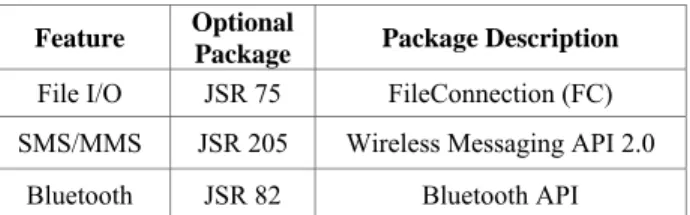
Implemented in J2ME for cross-platform portability, the following optional packages required are described in Table 1. The data capture and transmission requires the following Java Specification Request (JSR) optional packages:
Table 1. J2ME Optional Packages for Capture Phase
Feature Optional
Package Package Description File I/O JSR 75 FileConnection (FC) SMS/MMS JSR 205 Wireless Messaging API 2.0
Bluetooth JSR 82 Bluetooth API
At the moment, there is no J2ME enabled device which supports all of the required optional packages. The IBM J9 J2ME runtime environment, which runs on portable devices with the Microsoft Windows PocketPC operating system, supports JSR 75 but not JSR 205 or JSR 82. Mobile phones running the Symbian 9.1 operating system, such as the Nokia N91, support JSR 75 and JSR 82 but only JSR 120 (Wireless Messaging API 1.1) which does not include support for MMS. WiMAX is not yet available in Australia. As such, the current implementation of the capture phase only supports wireless data transfer via HTTP over Wi-Fi and GPRS.
Figure 1 shows the data capture software running in the Sun J2ME mobile phone emulator. The user browses the mobile device’s file system for the digital media clip to send, inputs the GPS coordinates, and selects the communication protocol as shown in Figure 1(a). Figure 1(b) depicts the type of note that a user may attach to the digital media clip. When the user pushes
the “Send” button, the digital media clip is sent using the requested communication protocol.
(a) (b)
Figure 1 Capture data on mobile phone
2.2
Replaying Context
The data sent by the mobile device is received by a computer which listens for the data from the mobile device. The service listeners include an HTTP daemon, an SMS/MMS service gateway, and a Bluetooth server. The received data is uploaded to a relational database. This information can then be retrieved and “re-played” on a horizontal interactive tabletop system.
The horizontal interactive tabletop system consists of a projector-based display and an augmented reality display. The combination of the three displays enables a virtual 3D display. The projector displays a 2D view (e.g., a plan view) whereas the augmented reality system displays a 3D perspective view from a section cut in the plan. To display the digital still image in augmented reality, the still image is placed as a texture on a 2D face.
The interactive tabletop system includes various tangible interaction devices including a hand movable vertical screen that changes the camera location for the perspective view, augmented reality patterns printed on blocks that the user may move, augmented reality patterns inside CAD applications that are positioned automatically based on the GPS coordinates of the captured digital media clips that that designer wishes to re-play, and a pen-based interface for moving the augmented reality patterns within the CAD model.
3.
DEMONSTRATION
During the construction phase of a building, changes or defects provoke a design issue that needs to be resolved by consulting the design models or drawings in light of the information available only on the construction site. Current practice tends to resolve these issues through multiple phone calls and conversations in the design office that try to reconstruct the physical context with words and relate that context to the CAD-based design models.
The resolution of the design issues is complicated by two confounding variables. First, the context, that is the built environment, is partially built but also partially digital in the form of 2D and 3D CAD models. Thus, the designed solution must satisfy the realities of what has been built, the current context, and what will be built, the projected context. Second, the fix is mired by contractual obligations and stakeholders. Therefore, the designed solution is more likely to arise from intensive sessions of
synchronous collaborative design. The design environment
provided by our approach, combining the nomadic experience capture with the replaying of the context while designing a solution collaboratively on the horizontal interactive tabletop system, brings the two kinds of information together to facilitate further design development.
The digital images of construction defects are sent via HTTP over GPRS (with the mobile device’s inbuilt GPRS modem) to the office. The architects then select the defects to view within a 2D plan view of the site as shown in Figure 2.
Figure 2 Floor plan shown in Microstation
The floor plan (plan view) is projected on the horizontal surface of the interactive tabletop. First, the user must calibrate the system by identifying a known point on the drawing and a known GPS coordinate as the reference point. All subsequent locations in the drawing are calculated based on the reference point. The digital clip is retrieved along with the GPS coordinates of the digital clip showing the defect. For each digital image, an augmented reality pattern is automatically displayed in the 3D model. Each pattern is actually a pre-drawn “cell” and is inserted into the model (We are using the Microstation BASIC API.). Once the augmented reality pattern is drawn, the augmented reality system superimposes the digital image of the construction defect on the vertical screen.
Figure 3 Plan view with augmented reality patterns and images
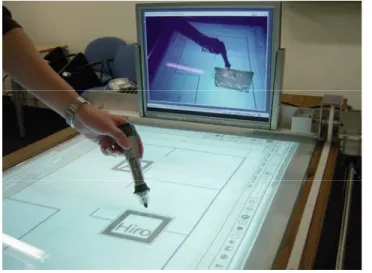
Using a pen-based interface, the user may also move and rotate the images to the proper orientation if the designer knows the proper orientation. At this point, bearing and angle of inclination/declination of the viewer is not captured due to the unreliable bearing data from the GPS receiver and lack of a sensor to measure the inclination/declination viewing angle of the digital camera.
Figure 4 User rotates augmented reality pattern with Mimio pen-based interface
4.
CONCLUSIONS
This paper describes a design environment that brings and locates relevant physical context into a 3D digital model of a design. The ability to locate and connect remote physical context with a 3D digital model is possible with mobile computing devices and wireless networks. The demonstration application facilitates collaboration among architects, engineers, and building contractors to resolve a design issue due to a construction defect. The challenge in construction defect resolution is that the working context is partially built, partially digital. The combination of the technologies affords the combination of the physical “as-built”
model and the digital model. We are currently outfitting the mobile device with additional sensors and other location-sensing technologies to more precisely locate the digital images in the virtual model as well as extending the capability for the designer to manipulate the 3D model elements including the accumulation of physical context information.
Eventually, unified computer-aided modeling systems employing nomadic computing and mobile technologies combining the approach described in this paper with systems such as Tinmith-Metro would allow designers to work where the actions are.
5.
ACKNOWLEDGMENTS
This research was supported in part by the Australian Cooperative Research Centre for Construction Innovation under grant 2002-057-C.
6.
REFERENCES
[1]. Abowd, G.D. and Mynatt, E.D. Charting past, present, and future research in ubiquitous computing. ACM Transactions on Computer-Human Interaction (TOCHI), 7 (1). 29-58.
[2]. Bellotti, V. and Bly, S., Walking away from the desktop computer: distributed collaboration and mobility in a product design team. in CSCW '96: Proceedings of the 1996 ACM conference on Computer supported cooperative work, (Boston, MA, United States, 1996),
ACM Press, 209-218.
[3]. Broll, W., Lindt, I., Ohlenburg, J., Wittkämper, M., Yuan, C., Novotny, T., gen. Schieck, A.F., Mottram, C. and Strothmann, A. ARTHUR: A collaborative augmented environment for architectural design and urban planning. Journal of Virtual Reality and Broadcasting, 1 (1).
[4]. Dourish, P. Where the Action Is: The Foundations of Embodied Interaction. MIT Press, Cambridge, MA,
USA, 2001.
[5]. Grefé, R. (Form + Content + Context) ÷ Time = Experience Design. Gain: AIGA Journal of Design for the Network Economy, 1 (1). 1-4.
[6]. Kimoto, K., Endo, K., Iwashita, S. and Fujiwara, M. The application of PDA as mobile computing system on construction management. Automation in Construction, 14 (4). 500-511.
[7]. Piekarski, W. and Thomas, B.H., Interactive augmented reality techniques for construction at a distance of 3D geometry. in EGVE '03: Proceedings of the workshop on Virtual environments 2003, (Zurich, Switzerland,
2003), 19-28.
[8]. Teng, C.-M., Wu, C.-I., Chen, Y.-C., Chu, H.-h. and Hsu, Y.-j., Design and evaluation of mProducer: a mobile authoring tool for personal experience computing. in Proceedings of the 3rd international conference on Mobile and ubiquitous multimedia,
(College Park, MD, United States, 2004), ACM Press, 141-148.