CRITICALITY-AWARE MEMORY SYSTEMS
A Dissertation
Presented to the Faculty of the Graduate School of Cornell University
in Partial Fulfillment of the Requirements for the Degree of Doctor of Philosophy
by Saugata Ghose
c
2014 Saugata Ghose ALL RIGHTS RESERVED
CRITICALITY-AWARE MEMORY SYSTEMS Saugata Ghose, Ph.D.
Cornell University 2014
Research on computer memory systems has been of increasing importance over the last decade, as they have become a significant bottleneck for application per-formance. While newer memory systems offer increased memory level paral-lelism, they cannot be used blindly due to contention for shared resources, mak-ing a beneficial and valid sequencmak-ing of memory requests requisite in order to exploit these improvements. Traditional approaches to improving this sequenc-ing rely on highly sophisticated memory systems, where significant amounts of inference are often required to make these sophisticated decisions.
Unfortunately, this design philosophy may no longer be sustainable. For example, as memory clock frequencies continue to scale while processor fre-quencies remain stagnant, sophisticated memory controllers are already being squeezed out, forcing computer architects to revert to simpler designs. We use this as an opportunity to symbiotically involve the processor cores in the decision-making process, simultaneously offloading the complexity from these memory decision makers while extracting richer information on each memory operation.
This work studies the concept of load criticality, where the processors them-selves identify the loads which they believe to be most important. Using loads that block at the end of the processor pipeline as an indicator of criticality, we annotate these load block predictions onto memory requests, for use by var-ious components in memory. Our research finds that even using small,
sim-ple predictors for load criticality can offer comparable performance to comsim-plex state-of-the-art schedulers for both parallel applications and multiprogrammed workloads on a contemporary multicore system. This same predictor can be used to obtain significant performance improvements and energy savings when using hardware prefetchers.
Ultimately, our criticality-aware design approach achieves the performance of traditionally-complex memory systems, and does so with trivial overheads that are attractive for future commercial adoption.
BIOGRAPHICAL SKETCH
Saugata Ghose made his grand entrance into the world one Father’s Day in the corn fields of Ames, IA. One could say that his destiny as a computer architect was sealed from birth: not only is he the son of one, but he also shares a birthday with IBM. There was no fighting fate, and in two years’ time, the Ghose family would move to the birthplace of IBM, thus beginning Saugata’s somewhat odd love of the Upstate New York tundra.
After working hard and playing harder during high school, Saugata traveled afar to the State University of New York at Binghamton, where he earned dual B.S. degrees in Computer Science and Computer Engineering. During his time there, Saugata won several awards for academic achievement and service. His time as an undergraduate researcher with Dr. Aneesh Aggarwal all but set in stone a graduate career in architecture.
Unwilling to leave his beloved upstate behind, Saugata moved an hour north to Ithaca, to begin what would be a seven-year residency (much to the delight of the landlords at Plaza East Apartments). At the Cornell University School of Electrical and Computer Engineering, under the tutelage of Dr. Jos´e Mart´ınez, he happily whittled away his time performing research in the areas of adaptable multicore architectures and memory systems. Between delicious gastronomic endeavors with friends and educating many an undergraduate, Saugata honed his desires for a career in academia. Through all of these (mis)adventures, he earned the ASEE National Defense Science and Engineering Graduate Fellow-ship, as well as the 2013 ECE Director’s PhD Teaching Assistant Award.
His successful dissertation defense in July 2014 brought a 25-year-long career as a student to a glorious end. Saugata now faces the daunting prospects of leaving New York behind and pursuing a career in the real world.
To Dadu, Baba, Mommom, Rimi, and everyone else who believed in (and put up with) me along the way.
ACKNOWLEDGMENTS
This work would not have been possible had it not been for my advisor, Dr. Jos´e Mart´ınez. Throughout my graduate career, he has offered invaluable advice and countless forms of support. He has encouraged me when I was dejected about a project, and given tough love when I needed a push. If I had to do it all again, I’d gladly choose to work with you, Jos´e. For you, I promise that I’ll stop unnecessarily apologizing as much as I do (sorry that I had to bring it up here). I owe an enormous debt of gratitude to my educators, past and present, all of whom have been a genuine source of inspiration. I have learned quite a lot from each of the Computer Systems Laboratory (CSL) faculty, both technically and professionally. In particular, I would like to thank my committee members, Dr. David Albonesi and Dr. Rajit Manohar, for their help and mentoring.
Hyodong Lee, Monica Lin, and Rebant Srivastava deserve much praise for their assistance in this work. Hyo is a tireless worker and all around a wonder-ful person. Monica mixes a drive for perfection with a knack for knowing just when to let the sarcasm and levity peek through. Rebant, with his unmatched enthusiasm, has been a loyal collaborator and friend. I know the three of you will go very far, and I’m honored to have played a small role in your lives.
My fellow CSL compatriots have been fantastic for support in the trenches throughout this arduous process. I am thankful to have had Meyrem and Nevin Kırman, Maia Kelner, and Xiaodong Wang in my research group. From round after round of Kelnerball, to my supposed love of one J. Bieber, the fun I had with Janani Mukundan was perfectly counterbalanced with many a fruitful dis-cussion, and it’s been a tough final year without her in the office. Special thanks belong to Raymond Huang, Shreesha Srinath, and Jonathan Tse, with whom I’ve constantly bounced off ideas and enjoyed countless evenings.
I have been fortunate to have friends such as Conway Niu, Frank Zurla, Houtan Fanisalek, Vanessa Crans, and Danielle Crans share in my escapades throughout my graduate years, as well as many more.
Matthew Manela, my most trusted partner in so many endeavors, has eter-nally championed me. He has offered many pearls of wisdom over the years, most notably that the mark of a good Italian restaurant is their Fettuccine Al-fredo. Whenever Matt and I get lost in some crazy vision, Mallory Emerson has always been the voice of reason, until of course she starts joining us in crazy machinations (only to bring everyone back to reality again). Having the two of them and Harrison in my life brings me unbounded joy, and I can’t wait for the next Saugata Goose caper (I, of course, want to retain animation rights).
Robert Karmazin is the first person I go to for my ridiculous endeavors. Late night soda runs, trips to Mt. Pleasant to stargaze, gunning that U-Haul down Game Farm Rd.—Ithaca just wouldn’t be the same for me if we weren’t such close friends. While I admire his efforts to perform the doctoral exams in alpha-betical order, I look forward to the day he can escape to the real world.
My experiences at Cornell would not have been the same without Lillian Hsu. Not only was she crazy enough to remain friends, but she watched over me with her (grand)motherly tendencies. If my stomach could sing, it would dedicate a song to her daily home-cooked feasts, and for the best desserts it will ever have. Her vernacular is one-of-a-kind, and I don’t think I could ever truly “flummox about” with anyone else. Lillian, if you ever finally procure that three year Muranda cheddar, I’ll elevate you from second class friend status, deal?
I could simply say that Jessica Thompson and I share pretty much every musical interest, the same sense of humor, and a love of Buffalo chicken and the Yankees, and that would be enough for us to be great friends. Of course, it’s
been much more than that. She’s always there at my beckon and call, and has been the most faithful of friends from our days of off-color math and following police chases, all the while laughing at my dumb jokes. Oh, now’s as good time as any to remind you that you don’t really need hubcaps to drive, Jess.
This, of course, brings me to Jillian Thompson, the best friend one could ask for. If I could go back in time, the first thing I’d do is smack my sixth grade self for hating her (though she had stabbed me in a nightmare). From a friend-ship that started as little more than absurd silliness and a desire to reclaim a screen name that was rightfully mine, I’ve gained my most introspective con-versations, and a friend who fights constantly for me. I’ve never met anyone as passionate or sensitive (I’ve seen her softer side, so we’re even), or one who I can be so at ease with. Much as you try, Jill, you’ll never be rid of my harassment.
As they say, you can never choose your family, but boy did I luck out in that lottery. Without the encouragement of my father, Kanad, I doubt I would have such an interest in computers. As much a friend as a dad, I owe much of my sensibilities (and snobbery) to him. Indrani, my mother, showed me how to be compassionate, and dedicated her life to caring for my sister and me. Unfortu-nately, I’ve been a lifelong victim of her sense of humor. I remember when my sister Ipsita was born, and how much I had wanted a dog instead. Was I ever wrong—having a little sister is one of the great joys of my life, even when she’s not so fond of me (big brother duties require me to be a pain in your posterior). I had loving, caring grandparents, and my grandfather Ananda Mohan instilled in me a vivid curiosity for the sciences—I hope I would’ve made you all proud. My family taught me the virtues of education and hard work, and above all how to be a good person. Their endless belief in me is the reason I have achieved so many of my goals, and for that, nothing can say thank you enough.
TABLE OF CONTENTS
Biographical Sketch . . . iii
Dedication . . . iv
Acknowledgments . . . v
Table of Contents . . . viii
List of Figures . . . x
List of Tables . . . xii
List of Abbreviations . . . xiii
1 Introduction 1 1.1 The Limitations of Autonomous Memory Controllers . . . 1
1.2 A Symbiotic Solution to Both Problems . . . 4
1.3 Key Contributions . . . 6
2 Background 7 2.1 Contemporary Memory Systems . . . 7
2.1.1 Double Data Rate DRAM . . . 9
2.1.2 The Memory Controller . . . 12
2.1.3 Prefetching . . . 15
2.1.4 Challenges . . . 21
2.2 Criticality: Targeted System Optimizations . . . 24
2.2.1 Instruction Criticality . . . 25
2.2.2 Load Criticality . . . 28
3 The Commit Block Predictor 33 3.1 Design . . . 33
3.2 Ranking Degrees of Criticality . . . 36
4 Criticality-Based Memory Scheduling 39 4.1 Using Criticality Information in the Memory Scheduler . . . 40
4.2 Experimental Methodology . . . 42
4.2.1 Architectural Model . . . 42
4.2.2 Applications . . . 43
4.3 Evaluation . . . 43
4.3.1 Naive Predictor-Less Implementation . . . 47
4.3.2 First Take: Binary Criticality . . . 48
4.3.3 Scheduling with Ranked Criticality . . . 49
4.3.4 Effect on Load Latency . . . 55
4.3.5 Sensitivity to Architectural Model . . . 56
4.3.6 Storage Overhead . . . 58
4.3.7 Comparison to Other Schedulers . . . 60
5 The Relevance of Commit Stalls to Load Criticality 68
5.1 A Lack of Consensus . . . 69
5.2 Performing a Systematic Search for Criticality . . . 72
5.3 A Trace-Based Analysis of the Commit Block Predictor . . . 74
5.4 Evaluation . . . 75
5.4.1 Systematic Metric Search . . . 76
5.4.2 The Effectiveness of Targeting Commit Blocks . . . 77
6 Selective Hardware Prefetching Using Criticality 81 6.1 Establishing a Baseline . . . 83
6.2 Prior Work in Focused Prefetcing . . . 85
6.3 It’s All About Location: Prefetcher Attachment . . . 87
6.4 Exploiting Parallel Application Behavior for Prefetching . . . 89
6.4.1 Memory Layout for Parallel Applications . . . 90
6.4.2 Simpler Is Better: Sequential Prefetching . . . 92
6.5 You Are What You Eat: Throttling vs. Filtering . . . 93
6.5.1 Accuracy-Based Prefetch Throttling . . . 93
6.5.2 Criticality-Based Prefetch Filtering . . . 95
6.6 Experimental Methodology . . . 97 6.7 Evaluation . . . 99 6.7.1 Stream Prefetcher . . . 99 6.7.2 Sequential Prefetcher . . . 103 6.7.3 DRAM Bandwidth . . . 105 6.7.4 Multiprogrammed Workloads . . . 109 6.7.5 Accuracy-Based Throttling . . . 111
6.7.6 Filtering Using the LIMCOS Classifiers . . . 113
6.7.7 Synergy with Criticality-Based Memory Scheduling . . . . 114
6.7.8 Hardware Overhead . . . 116 6.8 Summary . . . 116 7 Related Work 118 7.1 Instruction Criticality . . . 118 7.2 Load Criticality . . . 120 7.3 Memory Scheduling . . . 122 7.4 Prefetching . . . 123 8 Conclusion 126 9 Future Work 128 9.1 Revisiting the Instruction Criticality Graph Model . . . 128
9.2 History-Based Criticality Prediction . . . 130
A List of Criteria Tested During the Systematic Search 132
LIST OF FIGURES
2.1 Logical organization of DDR DRAM . . . 9 2.2 Traditional approaches for attaching prefetchers to the cache . . 16 2.3 Stream prefetcher table entry . . . 20 2.4 Normalized peak frequency of DDR memories and processors
released in the last ten years . . . 24 2.5 Example directed acyclic graph for Fields instruction criticality . 25 2.6 Breakdown of dynamic long-latency loads that block at the ROB
head . . . 31 3.1 Overview of Commit Block Predictor operation . . . 34 4.1 Combined criticality and request age for use by theCASRAS-Crit
memory scheduler . . . 42 4.2 Speedups from Binary criticality prediction within the memory
scheduler . . . 48 4.3 Speedups from ranking criticality within the memory scheduler 50 4.4 Speedups observed while sweeping table size for MaxStallTime
criticality prediction . . . 52 4.5 Average L2 miss latency for critical and non-critical loads within
the memory scheduler . . . 56 4.6 Sweep over number of ranks per channel, for DDR3-1600 and
DDR3-2133 memory . . . 57 4.7 Sweep over load queue sizes . . . 58 4.8 Performance of two state-of-the-art schedulers compared to our
proposal . . . 61 4.9 Performance of MORSE-P when restricting the number of ready
commands that can be considered by the scheduler in a single DRAM cycle . . . 63 4.10 Weighted speedups for multiprogrammed workloads from
us-ing ranked criticality . . . 65 5.1 Mean speedup for a sweep of different criticality metrics . . . 76 6.1 Parameter sweep over distance and degree for 64-entry stream
prefetchers . . . 83 6.2 Speedup from applying criticality-based filtering to existing
pre-fetchers . . . 85 6.3 Proposed cache attachment approaches for more aggressive
pre-fetching . . . 87 6.4 Example of prefetching for a contiguous data segment statically
partitioned amongst four threads of a parallel program . . . 90 6.5 Parameter sweep over distance and degree for 64-entry stream
6.6 Performance ofAccessstream prefetcher with criticality filtering 101 6.7 Performance of best stream prefetcher configurations . . . 102 6.8 Sweep overNfor sequential prefetchers . . . 104 6.9 Performance of sequential prefetchers with criticality filtering . . 105 6.10 Breakdown of bandwidth utilization for stream prefetchers . . . 106 6.11 Breakdown of bandwidth utilization for sequential prefetchers . 107 6.12 Prefetcher performance with various criticality filters . . . 108 6.13 Performance of best parallel application prefetchers on
multipro-grammed workloads . . . 109 6.14 Performance of various modified FDP mechanisms for parallel
applications . . . 111 6.15 Performance of various FDP mechanisms for multiprogrammed
workloads . . . 112 6.16 Speedup for LIMCOS filtering and CBP-based filtering of
aggres-sive prefetchers . . . 113 6.17 Speedup due to combining criticality-aware scheduling with
CBP-filtered stream prefetchers . . . 114 6.18 Speedup due to combining criticality-aware scheduling with
CBP-filtered sequential prefetchers . . . 115 9.1 Modified directed acyclic graph for instruction criticality to
LIST OF TABLES
4.1 Parameters of the simulated architecture for criticality-based
scheduling . . . 44
4.2 Micron DDR3-2133 DRAM model . . . 45
4.3 List of simulated parallel applications and their input sets . . . . 46
4.4 List of multiprogrammed workloads . . . 46
4.5 Criticality counter widths . . . 59
4.6 Comparison of various state-of-the-art memory schedulers with our proposed CBP-based schedulers . . . 60
4.7 State attributes found using feature selection for Crit-RL self-optimizing memory scheduler . . . 62
5.1 Changes in LLC load miss behavior due to Binary CBP-based scheduling . . . 78
6.1 FDP configurations tested . . . 93
6.2 Best threshold parameters found for FDP . . . 94
6.3 Parameters of the simulated architecture for prefetching . . . 98
6.4 Micron DDR3-2133 DRAM energy model . . . 99
6.5 Best prefetcher settings for parallel applications . . . 102
LIST OF ABBREVIATIONS AHB Adaptive History-Based Scheduler
ALU Arithmetic Logic Unit
CAS Column Access Strobe
CBP Commit Block Predictor
CLEAR Checkpointed Early Load Retirement
CLPT Critical Load Prediction Table
CMAC Cerebellar Model Articulation Controller
CMP Chip Multiprocessor
CPU Central Processing Unit (Processor)
DAG Directed Acyclic Graph
DDR Double Data Rate
DIMM Dual In-Line Memory Module
DRAM Dynamic Random Access Memory
FCFS First-Come-First-Serve
FDP Feedback Directed Prefetching
FR-FCFS First-Ready First-Come-First-Serve
GPU Graphics Processing Unit
ILP Instruction Level Parallelism
ISA Instruction Set Architecture
L1 Level 1 Cache
L2 Level 2 Cache
LDQ Load Queue
LIMCOS Loads Incurring Majority of Commit Stalls
LLC Last Level Cache
LSQ Load-Store Queue
MLP Memory-Level Parallelism
MORSE Multi-Objective Reconfigurable Self-Optimizing Scheduler
MSHR Miss Status Holding Register
MT/s Megatransfers per Second
PAR-BS Parallelism-Aware Batch Scheduler
PC Program Counter
RAS Row Access Strobe
RL Reinforcement Learning
ROB Reorder Buffer
SIMD Single Instruction, Multiple Data
SRAM Static Random Access Memory
SSD Solid State Drive
SSE Streaming SIMD Extensions
CHAPTER 1
INTRODUCTION
1.1
The Limitations of Autonomous Memory Controllers
Modern computer processors have today found their performance constrained by the performance of the memory system, a roadblock commonly known as thememory wall [80]. Memory operation latencies have not scaled as quickly as processor performance, and despite improvements to the memory architecture to deliver greater memory-level parallelism (MLP), a miss to the dynamic ran-dom access memory (DRAM) devices that make up main memory can be very costly, taking hundreds of processor clock cycles. Even misses to a last level cache (LLC) can incur a penalty of dozens of cycles. To this end, much con-temporary research in computer architecture has focused on improving various aspects of the memory subsystem.
In the memory hierarchy, decisions about how to handle memory requests have traditionally been made independent of the processor cores that issue these requests. While this eases system design complexity by increasing modularity, it forces designers to rely on potentially large amounts of inference inside the memory when making these decisions. These decision-making mechanisms, typically unaware of the state of the applications and processors, are often un-able to make choices that best address the direct needs of the programs. In-stead, we have relied on memory-centric objectives that can be directly mea-sured within memory, such as improving the throughput of individual threads or assessing the accuracy of in-memory predictors.
An excellent example of this can be found in the memory controller. The con-troller receives requests for main memory from the processor, and mustschedule (decide the most optimal order of) these requests for servicing by DRAM. Cur-rent research in memory scheduling attempts to perform “smarter” request in-terleavings to better take advantage of the MLP offered by DRAM [11, 23, 28, 36, 37, 38, 52, 53, 55, 65]. In a push to better identify these smarter interleavings, a number of sophisticated memory schedulers have arisen [28, 38, 52]. Due to the design abstraction of the interface between the processor and its memory sys-tem, only the address of the requested memory location is typically sent down through the memory system. This requires these more sophisticated memory schedulers to perform a significant amount of inference on the properties of a request within the memory scheduler itself, as the scheduler does not have ac-cess to these properties directly.
Typically, complex schedulers must factor in device timing constraints, the hierarchical design of DRAM, and contention for shared structures (such as the row buffer and memory channel buses) [29], reordering the requests to achieve the best expected memory throughput (or other such memory-centric metrics). This reordering can be problematic, though, as it ignores the needs of a particu-lar application. Within the processor, we find that certain loads are morecritical (important) to improving program performance than others. Unfortunately, as current schedulers are unable to identify this importance, they are unable to take advantage of this information. Moreover, while memory-centric metrics were previously thought to serve as an adequate proxy for program performance, we have found this to often not be the case, compounding the lost potential in cur-rent schedulers resulting from the inability to prioritize critical loads. We find this principle to be true in several locations within the memory.
Concurrently, a second issue with current memory designs has arisen. For a long time, DRAM design exploited process improvements to increase den-sity, but raw performance did not scale as aggressively as it did for processors (the main premise behind the memory wall). Partly as a result, the ratio of the CPU clock cycle (which also regulates the on-chip memory controllers) to the DRAM clock cycle was typically large. This allowed researchers to propose increasingly more sophisticated memory scheduling mechanisms that still met the DRAM cycle time. Designs such as the reinforcement-learning-based mem-ory scheduler [28, 52] require multiple CPU cycles to make a single scheduling decision.
Based on recent DRAM trends, however, we conjecture that this approach to memory scheduler design is not sustainable. Memory bus frequencies for double data rate (DDR) DRAM have grown steadily over the last decade, dou-bling every 3-4 years. This growth will continue with DDR4, where devices are already expected to reach a data transfer rate of 3200 MT (megatransfers) per second [31]. With CPU frequencies remaining more or less stagnant, their on-chip memory controllers will have fewer available cycles to make a schedul-ing decision. This means that we will no longer be able to conduct such high degrees of inference within the memory controller. As the available time contin-ues to decrease, memory controllers will be forced to revert to simpler scheduler designs.
1.2
A Symbiotic Solution to Both Problems
Conventional wisdom leads us to assume that these simpler designs will re-sult in poorer scheduling algorithms. We believe this is a flawed conclusion, based in part on an archaic scheduler design approach—scheduling decisions are taken wholly by the memory controller, yet virtually the only information supplied with each memory request is its effective address. In this scenario, the only way to attain high-performance scheduling from such limited observation of a program’s execution is to resort to heavyweight controller designs that are highly reliant on inference, such as those discussed in Section 1.1.
In our work, we turn to assistance from the processor tosymbiotically make decisions within the memory system, solving both of these problems simulta-neously. The processor has significantly greater time available for processing and predicting information about a dynamic load instance, beginning from the decode stage. The processor can make a more sophisticated prediction about thecriticality(importance) of a load, while also having access to a much greater source of data about the load instance, the application, and the current state of the processor. By the time a load is issued, the CPU sends this predigested in-formation along with the request address to the memory hierarchy, where the different hierarchy components can use this information in the best possible way (which can differ by component).
This idea of sending an annotation about urgency is akin to the way a freight shipping company (such as FedEx or UPS) works. Without any such informa-tion, the company will try to maximize its efficiency by shipping as many pack-ages as possible, such as by filling cargo planes in the order that packpack-ages are
received and dispatching the planes once they fill up. This maximized through-put target is similar to how current memory schedulers try to maximize band-width utilization. In reality, the shipping company is actually notified of the urgency of each package by the sender, who dictates that certain packages must arrive in one day, while others have no urgency and can be shipped using a slower method. As a result, the shipping company will sacrifice its maximum potential throughput in order to guarantee that these priority packages arrive at their destinations on time, even if it comes at the cost of delaying those packages which were already declared to not be urgent. Likewise, our processor, playing the role of the sender, achieves the same thing by informing the memory hierar-chy of the loads that are most urgent (and even rankinghowimportant they are, just as parcel senders mark how soon a package should arrive).
Our research explores two complementary aspects of load criticality. We must first identifywhatmakes a load critical. This involves not only understand-ing the characteristics of loads and programs within the CPU, but also designunderstand-ing hardware that can take this information and properly mark these memory re-quests. Second, once we have this information, we must decidehowto best use this information throughout the memory hierarchy. As we see, there are several locations where we can use this information in a variety of ways. At the end of the day, our goal is to prioritize those loads which matter most to the currently-executing application, thereby increasing overall system performance through a targeted optimization approach.
1.3
Key Contributions
This work makes the following contributions to the field of memory systems:1
• We are the first to recognize this issue of memory scheduling logic being “squeezed out” by continued increases in DDR DRAM bus frequencies; • We break down the barrier between the processor and the memory
con-troller, allowing the system to perform symbiotic decision making through the use of limited communication between these devices;
• We identify and analyze the usefulness of predicting loads that stall at the head of the processor reorder buffer for our criticality metric;
• We propose a simple mechanism that can use load criticality predictions from within the processor to improve memory scheduling decisions; • We perform a quantitative comparison against several ad-hoc criteria
pre-viously proposed in literature for indicating load criticality;
• We identify memory access behavior within parallel applications that can be better exploited by hardware prefetchers; and
• We use a simple criticality-based filter to target the utilization of ag-gressive prefetchers, delivering both improved performance with lower DRAM energy consumption.
1Portions of this work (including but not limited to Chapters 3 and 4) were previously
Architec-CHAPTER 2
BACKGROUND
2.1
Contemporary Memory Systems
Computer processors rely on a memory system in order to provide it with both volatile and non-volatile storage of information (which can consist both of in-structions for programs that need to be executed, and data that is used and ma-nipulated by these programs). A vast number of modern processors implement amodified Harvard architecture, which possesses the following properties [25, 26]:
• At the processor interface, independent buses for data and instruction re-quests;
• Independent highest-level caches (closest to the processor) for data and instruction memory;
• A shared memory address space amongst instructions and data; and • Lower level caches, DRAM, and non-volatile storage that do not partition
data and instructions into discrete locations.
Most modern processors contain several processor cores on a single silicon die, and enable parallel programming by implementing a shared memory sys-tem, where all of these cores have access to the same address space in order to communicate with each other through memory. The most common implemen-tations use a shared last level cache (LLC). Higher levels of cache are private to each processor core, allowing the system to reduce the effects of inter-thread
multiprogrammed workloads). To facilitate the shared memory space, these higher private caches usecache coherenceprotocols to coordinate the consistency of this data across all of the cores (e.g., managing duplicate copies of the same data, handling updates written by one of the cores). These caches are imple-mented using bistable static RAM (SRAM) transistor cells in order to provide faster access to stored memory [29]. Lower-level caches have a much greater capacity than higher levels, but this comes at the cost of a longer cache access latency. Multi-level caches in contemporary processors are hierarchically or-ganized to provide low average-case latencies while minimizing the penalty incurred by a highest-level cache miss, through exploiting bothspatialand tem-porallocality in the memory access patterns of programs.
Beyond the LLC, a series of off-chip DRAM devices (traditionally referred to asmain memory) maintain large numbers of active virtual pages in a volatile space [29]. A DRAM device contains a capacitive element for every bit of mem-ory stored. While the use of a capacitive element greatly increases the storage density in comparison to SRAM, the memory access latency grows significantly, and the capacitive elements cannot be directly modified. The most common modern instance of DRAM, double data rate (DDR) DRAM, is discussed fur-ther in Section 2.1.1.
Logically under the DRAM sits a much larger non-volatile storage element known as thehard drive. The hard drive stores all of the memory pages, both those actively mapped within DRAM and those that are not currently in use. Previously, hard drives were exclusively made of magnetic disks, but today, solid state drives (SSDs) have become common as well. Currently, both forms of hard drives are significantly slower than DRAM (trading off density and
non-DRAM Channels Memory Controllers Transaction Queue Scheduler row 0A row 0B row 0C row 0D row 1A row 1B row 1C row 1D row 2A row 2B row 2C row 2D row 3A row 3B row 3C row 3D row 4A row 4B row 4C row 4D row 5A row 5B row 5C row 5D row 6A row 6B row 6C row 6D row 7A row 7B row 7C row 7D Banks
open row: 0C no row open open row: 2A no row open open row: 4A no row open open row: 6D open row: 7C
Row Buffer
Ranks
Figure 2.1: Logical organization of DDR DRAM.
volatility for performance), though this may change with the introduction of newer non-volatile technologies within the next decade [8, 41].
2.1.1
Double Data Rate DRAM
Modern DRAM devices, such as used in double data rate (DDR) DRAM, con-tain a large number of capacitive elements. These devices are organized into a hierarchy of smaller structures that allow the system to exploit greater memory level parallelism (MLP), in order to mitigate the shortcomings of long-latency DRAM operations. Figure 2.1 illustrates how this hierarchy is logically orga-nized for DDR DRAM memory systems [29].
At the highest level, the DRAM devices are divided into memory channels. These channels behave independent of one another, and each has a dedicated
bus that connects them to the processor die. Each of these channels and its corresponding bus are managed by its own memory controller, whose job is to sequence pending memory requests and maintain the correct state of active DRAM pages. These operations are known as memory scheduling, and are one of the major memory system activities targeted by our work; as such, we will discuss scheduling in more depth in Section 2.1.2. Over the last decade, the memory controller has largely been integrated on die with the processor cores, and operates at the same clock frequency as the processor cores themselves. Physically, a DRAM channel can consist of one or more dual in-line memory modules (DIMMs), each of which contains several DRAM chips [29, 47, 49].
Within each channel exists a number of physical and logical subdivisions of these capacitive elements, as shown in Figure 2.1. At the finest granularity, each memory channel can return a 64-byte line of data. Multiple such lines of data combine to form a row, which is typically sized to match the size of a memory page within the system. While individual lines can be modified and retrieved, the majority of operations within DRAM take place at the row level. As aforementioned, these capacitive elements cannot be modified directly, in order to reduce the amount of charge required for storage. As a result, when the controller issues a command to a particular memory row, that row must be activated. Activation copies the values stored within the capacitive element into a series of SRAM cells known as a row buffer, from which all read and write operations can be performed. When the controller is finished with the row, the contents of the row buffer are written back to the corresponding row in mem-ory, in an operation known asprecharging. Physically, each line within a row is actually partitioned across multiple DRAM chips in order to reduce row access latencies [47, 49].
As only one row can be activated within a row buffer at a time, these rows are clustered intobanks. Each bank contains a series of rows, and has its own row buffer. Within a channel, the banks can mostly operate independently, allowing for the concurrent processing of memory operations (known as bank level par-allelism). The memory controller must, however, coordinate activities to some degree across multiple banks in order to manage shared resources, such as a single command bus and a single data bus.
In order to increase DIMM densities, the concept of arankwas introduced. Ranks are collections of DRAM chips that operate in lockstep. For example, when a row is requested in Bank 2, that row is opened in Bank 2 for each of the ranks. Address interleavingis used to ensure that no more than a single copy of a memory location exists within the entirety of DRAM (and to exploit spatial locality in the memory request stream). This interleaving is often chosen to maximize the probability that the rows open for that same bank in other ranks will also contain lines to be requested soon [29].
The values stored within DRAM must be periodically refreshed, as the ca-pacitive elements leak charge and, if unchecked, will eventually lose the value stored within them. A refresh operation is typically as simple as activating and then precharging a row [29]. However, since activation and precharge require the use of the row buffer, a currently-refreshing bank is unable to service any DRAM requests. The memory controller typically handles refresh operations, and maintains countdown timers to ensure that these operations take place be-fore any data loss is expected to occur. In order to minimize the impact of re-freshing, such operations are staggered across banks, though further mitigation of refresh overheads is an active area of research [6, 7, 45, 51].
2.1.2
The Memory Controller
On die, the main job of the memory controller is to collect pending requests for its managed memory channel and determine how and when to service these requests [29]. The controller maintains atransaction queue, as seen in Figure 2.1. This queue maintains all of the requests received by the controller for that par-ticular channel which are yet to be serviced.1 Amemory schedulerexamines the
state of the DRAM (which is tracked and saved within the memory controller) and the pending requests in the transaction queue, and determines which of these requests should be issued next to the DRAM device. Based on the state of the DRAM bank being accessed, a series of commands will be sent off-chip to activate the row if need be, perform reads and writes, and to precharge the row at some point back into the capacitive storage elements.
As mentioned in Section 2.1.1, all of the various components within a mem-ory channel share a single bus, and must therefore coordinate their timings such that requests do not overlap. Unlike other buses, where queues are used to hold requests which lose arbitration, the data bus from DRAM to the die does not have any outbound queuing, hence the need to ensure the lack of request over-lap. The controller must also typically keep track of which rows in each bank are activated in the row buffer, in order to determine if precharge and activate commands are necessary for the next requests to those banks. While manag-ing this hardware contention, the controller needs to track how long each of the operations take, as a bank currently performing an operation will be unable to execute another operation concurrently.
1In many controller implementations, requests that are in progress within DRAM are
ex-panded and stored within a command queue. For the purposes of our work, this design distinc-tion is irrelevant.
In addition, due to the design of the DRAM devices, a number of timing constraints arise, all of which must be obeyed by the memory controller [29]. For example, when switching between one rank and another, the memory con-troller must allot a certain delay to ensure that the DRAM circuitry properly completes the switch. Another example of a timing constraint is the four activa-tion window, which states that in a given sliding window of time, no more than four activate commands can be issued to a bank, in order to keep the DRAM power network stable. The controller must also keep track of which rows need to be refreshed, maintaining a countdown timer to the next refresh period. All of these timing constraints are statically defined as part of the device specifica-tion [47, 49].
As it is, managing these timings alone can lead to significant complexity in the controller design. The transaction queue is necessary since a number of requests will find themselves delayed due to these timings and to contention. In its simplest form, a memory scheduler will go through the queue in the order that the requests were received in (known asfirst-come-first-serve, or FCFS) [65]. The oldest request to an idle bank (for our purposes, a bank that is not in the process of servicing a prior request, and is not performing a refresh operation) will be scheduled.
Rixner et al. performed some of the first studies into modifying the order of operations within the memory controller [65]. Their work found that if the prioritization of these requests was altered (while of course still maintaining correct behavior with regards to the DRAM specification), significant perfor-mance benefits were attainable. In particular, two scheduling approaches were found to be beneficial. The first was an open row policy for controllers, where
upon completion of servicing a request, a row would not be precharged im-mediately, and would instead be left open in case other requests would hit in that open row (in effect exploiting spatial locality). The second change takes advantage of this open row behavior, and opportunistically prioritizes requests that are to the row currently open in the row buffer, ahead of older requests that are to closed rows. This form of scheduling, known asfirst-ready first-come-first-serve(FR-FCFS), improves on average memory access times by reducing the total number of activate and precharge commands that need to be issued.
Much research since then has studied improving further upon the FR-FCFS scheduler prioritization, resulting in more sophisticated scheduling mecha-nisms [11, 23, 28, 36, 37, 38, 52, 53, 55, 65]. Unfortunately, in present memory controllers, there is very little information gathered about each pending request. In fact, the only data that the controller receives from the processor cores is the address of the requested data location. This can often lead memory schedulers to perform significant inference on each of these requests in order to extract un-observable information, which can greatly increase the complexity of scheduler design. In addition, schedulers that adapt at runtime often require some metric to gauge their performance and detect if further adaptation is required. Again due to the lack of visibility to the controller, performance metrics from the pro-cessor perspective cannot be measured, and thus schedulers turn to measuring memory-centric metrics (such as bandwidth utilization or average memory ac-cess time), with the expectation that these serve as adequate proxies for overall system performance [23, 28, 36, 37, 38, 53, 55].
Chapter 4 will discuss our approach to memory scheduling, and how the use of criticality information directly annotated by the processor cores will avoid
some of the pitfalls of present memory scheduler designs. Prior research in memory scheduling is discussed in Section 7.3.
2.1.3
Prefetching
Due largely to the loop-recurrent nature of computer programs, memory access requests often exhibit some form of regularity (a strided access pattern) in their sequence of addresses. The order of instructions fetched from memory also ex-hibits regularity, as instructions are often executed in order until control flow divergence occurs. These patterns can be exploited by predicting ahead of time which data and instructions will be requested by the processor in the future, assuming that this regularity holds during subsequent execution. These mech-anismsprefetch certain cache lines from lower levels of memory at some point before the instruction needing the data or the processor fetch mechanism issues the request. If this prefetch prediction is correct and performed early enough, the performance penalty that would normally occur due to a cache miss can of-ten be avoided completely. However, if the prediction is incorrect, poof-tentially useless lines will have been retrieved into the cache, causing harmfulpollution by unnecessarily evicting other lines from the cache [70].
There is a large body of work in prefetching, and mechanisms have been proposed both in hardware and in software. Software prefetch support pro-vides additional instructions in the instruction set architecture (ISA) that can be used to retrieve data from lower levels of memory into higher level caches. Often, software developers must explicitly insert these instructions manually into their programs, requiring them to anticipate the expected memory latency,
Last-Level Cache (LLC) cache accesses from upper levels
cache misses to DRAM controller Prefetcher prefetch request (a) Last-Level Cache (LLC) cache accesses from upper levels
cache misses to DRAM controller Stream Prefetcher prefetch request allocate monitor (b)
Figure 2.2: Traditional approaches for attaching prefetchers to the cache: (a) Prefetcher reads sequence of cache misses; (b) Stream pre-fetcher uses sequence of cache misses to allocate entries, and sequence of all accesses to monitor and prefetch (split attach-ment).
trol flow. However, as the program will explicitly be sending this informa-tion, the accuracy of these requests is often much higher than their hardware counterparts. Depending on the ISA, instructions are sometimes provided to let developers explicitly dictate how far up the cache hierarchy a prefetch re-quest can be placed into [25]. While this does give greater control to the devel-oper, it does undo some of the benefits of abstraction, forcing programmers to have some knowledge of their underlying hardware. Another drawback is that these ISA extensions can often be processor-specific, reducing program cross-compatibility. Some compilers also provide compile-time support to automat-ically insert prefetch instructions, though this can reduce the accuracy of the prefetch requests due to limitations in program analysis [50].
In hardware, circuits are built to intercept the stream of memory requests, and to extract potential patterns. These patterns are then extrapolated into
ex-pected future sequences. Naturally, different types of hardware prefetchers are differentiated by their precise mechanisms used to extract and extrapolate these patterns. Typically, these prefetchers, as designed, attach to a cache as shown in Figure 2.2(a). The prefetchers observe all misses being dispatched from a cache to lower memory levels, under the hypothesis that learning the stream of misses will allow the prefetcher to predict subsequent misses. When the prefetcher an-ticipates these misses, it will issue prefetch requests to these lower levels, using the same mechanisms that a non-predicted (ordemand) request would use. In or-der to avoid redundant requests, a hardware prefetcher will first look up these predicted misses in the cache that it is attached to. If the predicted miss hits in the cache, the data is already present, and there is no need for the prefetch request to unnecessarily consume bandwidth. Such a mechanism also allows the prefetcher to take advantage of the miss status holding registers (MSHRs) within the cache, to coalesce multiple requests for the same cache line (to further reduce unnecessary bandwidth utilization).
Today, most modern processors implement some form of software and hard-ware prefetching. For example, the IBM POWER7 processor contains a pre-fetcher that is controlled via register, and can perform both next line prefetch-ing and strided prefetchprefetch-ing of varyprefetch-ing aggressiveness [33]. Prior versions of the IBM POWER processor family have also contained stream prefetchers [74]. The POWER ISA also provides support for prefetch instructions [27]. In its latest IA-64 architectures, Intel provides both next line prefetchers and stream prefetcher along multiple points within the cache hierarchy [25]. The Intel SSE instruction set for x86 architectures contains instructions that can explicitly request cache lines and select into which cache levels these lines are placed [25].
While there are several proposed hardware prefetch mechanisms, we focus our attention now on a small subset of them, as they form the basis for most of the more sophisticated mechanisms: The sequential prefetcher, the stride pre-fetcher, and the stream prefetcher (which is considered to be state-of-the-art). Other prefetcher schemes, including derivative hardware mechanisms, are dis-cussed in Section 7.4.
Sequential Prefetcher
The sequential prefetcher is the simplest of these three prefetch designs. In its most basic form, thenext line prefetcher, for every missed line, requests the sub-sequent line in address order. In a more aggressive setup, the sub-sequential pre-fetcher can fetch the next N lines. The simplicity of these prefetchers makes them quite attractive, as they provide significant speedups with very minimal logic: Unlike more sophisticated prefetchers, there is no training period, and their design easily exploits spatial locality. However, this can result in unnec-essary cache pollution without much net benefit, especially for programs with non-unit access strides. While increasing N can improve the chances of find-ing a useful line, this aggressive behavior comes with a high performance cost. Przybylski showed that, for single-threaded workloads, whenNis greater than one, the negative impact of pollution outweighed the performance benefits of useful prefetching [61]. Another pitfall, the result of having no training, is that sequential prefetchers generally do not contain logic to distinguish the prefetch direction, which limits their potential applicability.
Stride Prefetcher
Stride prefetchers try to overcome these problems by attempting to learn the distance between miss addresses [19]. When a request misses in the cache, an entry in the stride prefetcher is allocated. A subsequent miss generated by the same static instruction will be sent to that entry, which will try to determine the direction and difference in addresses. Further misses that confirm the success of the prediction will lead to more prefetches based on the determined stride, while an incorrect prediction forces the prefetcher to stop issuing requests until it can again learn the access pattern.
Stride prefetchers are quite successful for highly regular memory access pat-terns, especially if the data is accessed by the same instruction being executed in a high-iteration loop. Unfortunately, stride prefetchers often prove to be too dependent on this regularity, and are too rigid to identify complex memory be-havior. Furthermore, each request needs to send the program counter of the instruction to the prefetcher, resulting in extra communication overhead from the processor and additional work/storage in the core. For a stride prefetcher, the number of available entries is a tunable parameter.
Stream Prefetcher
Stream prefetchers attempt to improve on stride prefetchers by relaxing some of the requirements [35, 58, 70, 74]. Instead of observing requests by PC, the stream prefetcher maintainsmonitoring windows. If a miss is observed that does not fall into any existing monitoring windows, a new entry (see Figure 2.3) is allocated, with a start pointer initialized to the request’s effective address. For this new
monitoring window
current data segment
SP EP DIR TRAIN . . . EP + N stream prefetcher entries next addresses to prefetch
Figure 2.3: Stream prefetcher table entry. SP is thestart pointer, referring to the beginning of the monitoring window. EP is theend pointer, and points to the next address to prefetch. Theprefetch degree, shown as N, controls the number of blocks to prefetch each time. DIR is the direction of the stream, and TRAIN stores whether the entry is ready to prefetch.
entry, the prefetcher waits for the next two cache misses that fall within 16 blocks of the start pointer, and then uses them to train the direction of prefetching. After training, theend pointerkeeps track of the last address that was requested. When a subsequent memory request’s address falls between the current start and end pointers (the monitoring window), then the prefetcher will retrieve the nextNblocks, whereNis theprefetch degree, and advance the end pointer.2 The
size of the monitoring window can never grow beyond theprefetch distance, and so eventually the start pointer is advanced along with the end pointer.
As with the stride prefetcher, we can also tune the number of entries. The stream prefetcher, while still monitoring request patterns, is less reliant on reg-ularity, as any request falling within the monitoring window allows the pre-fetcher to advance, thus allowing for flexibility not only in the size of the stride,
2As proposed for the POWER4, only useful prefetches that fell within the monitoring
win-dow were tracked [74]. However, we did not find any appreciable speedups from this approach. Without a very large prefetch degree, their mechanism greatly reduces the opportunities
avail-but also in the order of accesses. As the entries are no longer tracked by PC, this extra information no longer needs to be transmitted to the caches, and requests to the same memory region by different static instructions can now be combined into a single request stream. However, the stream prefetcher requires a mech-anism to detect that a prefetch has been used, and must send this information to the prefetcher separate from the addresses missed in the cache. The stream prefetcher also has a long training period, and therefore will not be useful for short streams of data.
Unlike other prefetchers, which are attached to the cache as shown in Fig-ure 2.2(a), stream prefetchers perform significantly better when attached as shown in Figure 2.2(b) [70, 74]. By performing monitoring on all of the requests coming into a cache, and not just misses, the stream prefetcher is able to more quickly confirm that it has identified a correct stream of requests, since the cache would otherwise filter out the complete pattern if these requests were cache hits. However, the cache is still used to filter out which requests stream entries are allocated for, greatly reducing the pressure due to having a limited number of entries available. Throughout this work, all unmodified stream prefetchers are set up to train on all of the requests coming into a cache.
2.1.4
Challenges
In the memory hierarchy, decisions about memory requests have traditionally been decoupled from the processor cores that issue the requests. While this eases system design complexity by increasing modularity, it forces designers to rely on potentially large amounts of inference inside the memory when
mak-the state of mak-the applications and processors, are often unable to make choices that best address the direct needs of the programs. Instead, we have relied on memory-centric objectives that improve the throughput of the subsystem or of threads. While this was previously thought of as an adequate proxy for program performance, we have found that this is in fact not the case, and such memory-centric decisions fail to properly address the urgency of individual loads within the processor.
An excellent example of this can be found in the memory controller. The controller receives requests for memory from the processor, and must decide what the optimal order of scheduling these requests is. As discussed in Sec-tion 2.1.2, complex schedulers typically factor in device timing constraints, the hierarchical design of DRAM, and contention for shared structures (such as the row buffer and the memory channel buses) when reordering the requests to achieve the best expected memory throughput. This reordering can be prob-lematic, though, as it ignores the needs of the processor itself. Within each application, we find that certain loads are morecritical (important) to improv-ing program performance than others. Unfortunately, as current schedulers are unable to identify this importance, they are unable to take advantage of this information. We find this to be true in a number of locations within memory.
Concurrently, a second issue with current memory design has arisen. For a long time, DRAM design exploited process improvements to increase den-sity, but performance did not scale as aggressively. Partly as a result, the ratio of CPU (including on-chip memory controllers) to DRAM clock cycle was typi-cally large. This allowed researchers to propose increasingly more sophisticated memory scheduling mechanisms that still met the DRAM cycle time. Designs
such as the reinforcement-learning-based scheduler [28, 52] require multiple CPU cycles to make a single scheduling decision.
Based on recent DRAM trends, however, we conjecture that this approach to memory scheduler design is not sustainable. Figure 2.4 shows that DDR mem-ory bus frequencies have grown steadily over the last decade, doubling every three to four years, whereas CPU frequencies have remained more or less stag-nant [9, 14, 24, 26]. This growth will continue with DDR4, where devices are already expected to reach a data transfer rate of 3200 MT/s [31]. The result is that integrated memory controllers running at the CPU clock will have fewer available cycles to make a scheduling decision. Ultimately, we will no longer be able to conduct such high degrees of inference within the memory controller, as the complex circuitry (and associated critical timing path) will be “squeezed out.” As the available time continues to decrease, memory controllers will be forced to revert to simpler scheduler designs.
Conventional wisdom leads us to assume that these simpler designs will re-sult in poorer scheduling algorithms. We believe this is a flawed conclusion, based in part on an archaic scheduler design approach—scheduling decisions are taken wholly by the memory controller, yet virtually the only information supplied with each memory request is its effective address. In this scenario, the only way to attain high-performance scheduling from such limited observation of a program’s execution is indeed to resort to heavyweight controller designs. Ideally, memory controllers need to retain the sophistication of complex con-trollers without somehow requiring the associated circuitry along the critical path.
1.0 2.0 3.0 4.0 5.0 o rm alize d Fr eque nc y DDRx Intel IBM 0.0 2002 2004 2006 2008 2010 2012 2014 N o Year
Figure 2.4: Peak frequency of DDR memories and processors released in each of the last ten years, normalized to the highest released frequency in 2003 [9, 14, 24, 26].
2.2
Criticality: Targeted System Optimizations
Numerous hardware optimizations in computer architecture target individual instructions. Oftentimes, these optimizations can be too costly to apply to every instruction [15]. The concept of criticality allows architects to identify a sub-set of these instructions where such optimizations will be most effective. The goal of such targeted optimization is to reap the majority of the benefits that one would achieve applying the optimization globally, while saving on expen-sive resources such as power or hardware complexity. Naturally, this does not come for free—criticality identification mechanisms are often placed in hard-ware and can involve sophisticated analysis, which in turn results in significant overheads.
There are two general subfields of criticality relevant to our work.Instruction criticality identifies a subset of all instructions within a program that should be targeted to improve overall program objectives (often performance). Load criticality, on the other hand, is a more ill-defined concept that typically uses
D
E
C
LWD
E
C
ADDD
E
C
LWD
E
C
SUBD
E
C
BEQD
E
C
SWD
E
C
LWD
E
C
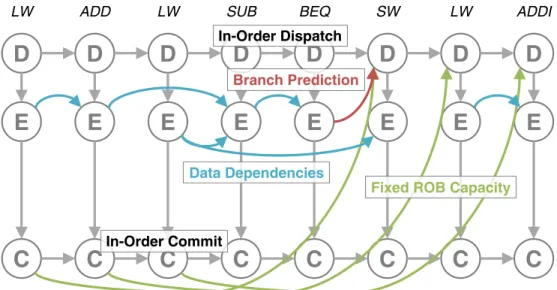
ADDI In-Order Dispatch In-Order Commit Data DependenciesFixed ROB Capacity Branch Prediction
Figure 2.5: Example directed acyclic graph for Fields instruction critical-ity. In addition to in-order dispatch and commit,E → E edges capture data dependencies,C → Dedges capture the fixed ca-pacity of the reorder buffer, andE → Dedges capture branch misprediction penalties.
one of a number of ad-hoc metrics to identify which load instructions should be prioritized by the memory subsystem.
2.2.1
Instruction Criticality
Instruction criticality research has mainly focused on identifying which instruc-tions within the processor fall along thecritical pathof program execution. Due to the ability of superscalar out-of-order processors to exploit instruction level parallelism (ILP) and memory level parallelism (MLP), the latencies of several instructions will overlap, and many instructions with full latency overlap will have their delays masked completely by longer, more critical instructions whose longer delays contribute to further delaying the completion of the program. The premise of instruction criticality is that these critical instructions are chosen for
optimizations that are applied within the processor pipeline, which would oth-erwise have be applied to all flight instructions. A number of different in-struction criticality prediction mechanisms have been proposed and used for a variety of purposes; these are discussed in more detail in Section 7.1. Here, we shall focus on a more formal approach to critical instruction identification.
Fields et al. proposed the use of a directed acyclic graph (DAG) to capture the critical path of program execution for a single thread within an out-of-order processor [15, 16]. Figure 2.5 shows an example criticality DAG. Each dynamic instance of an instruction is modeled as three timing nodes: dispatch time (D), execution time (E), and commit time (C). These nodes can be saved as time-stamps when a particular event finishes taking place, and in the case of the E
node represents when the instruction exits the ALU [16]. Ordering and depen-dencies, both within an instruction and across instructions, are captured in the DAG as directed edges. While most of these edges are statically annotated based on correct program behavior and true data dependencies, some edges attempt to capture structural hazards within the processor. The modeled edges include:
• D→ D, to represent in-order dispatch;
• D→ E, as instructions can only execute after being dispatched;
• E → D, to account for branch misprediction penalties; • E → E, to capture data dependencies amongst instructions; • E →C, as instructions can only commit after being executed;
• C → D, to account for a finite reorder buffer (ROB) capacity; and • C →C, to represent in-order commit.
The fully-constructed DAG can then identify the critical path through a sim-ple back-propagation algorithm [15]. The commit time of the final instruction is equivalent to the time at which the program completed. From this node, the DAG can be traversed in reverse, by identifying which of the edges were last-arriving(i.e., which source nodes for the edges have the most recent timestamp). The intuition is that the event responsible for the last-arriving edge is the rea-son that the destination node could not complete earlier, and that the arrival times for other, earlier sources did not have any material effect on that time (i.e., they haveslack[17]). By recursively applying this algorithm to the source nodes that resulted in the last-arriving edges, a path through the DAG can be found of nodes whoselatenessdirectly prevented other instruction events from taking place, and thereby increased the program execution time. Note that it is perfectly acceptable for a node to have two last-arriving edges, and that in such cases, the critical path is considered to have diverged. All traversed criti-cal paths will reach the dispatch node of the first instruction in the program, due to the way in which the graph has been constructed, thus ensuring that critical path identification through back propagation will identify the path through the entire program [16].
This approach represents the generally accepted method of performing static critical path identification. Unfortunately, it has a number of shortcomings for direct application to memory-level optimizations. The Fields model does not explicitly capture any interactions that take place within memory, such as mem-ory access time and request coalescing. While this worked for the original study, which simulated a fixed-latency memory [15], a more realistic memory model exhibits much greater latency variability, and can have a large effect on the over-all critical path. Another issue is that a static approach to criticality approach
can identify the most critical instructions, but will not account for other instruc-tions that, while previously not critical due to their masked latency, now find themselves on the critical path. This can often happen when a long-latency in-struction is optimized, and a second inin-struction with limited slack no longer has its complete latency masked by the now-optimized instruction. Such dynamic effects are important to capture at runtime in order to find further opportunities for improvement.
Despite these potential issues, a formal approach to critical path analysis can be beneficial for analyzing the performance of other predictors. As a potential direction for future work, we propose one way of incorporating these memory-level interactions into the Fields model in Section 9.1.
2.2.2
Load Criticality
A general instruction criticality analysis can be selectively applied to load in-structions in order to perform memory-side optimizations.3 However, as these
more general mechanisms are not specifically targeted towards memory oper-ations, they may not reveal enough information about these instructions. The intent of criticality is to differentiate between instructions and find those ones expected to provide the most improvement when selected. A successful crit-icality detection algorithm for memory should provide significant differentia-tion between different load instrucdifferentia-tion instances. In the general criticality case, the latency of an operation can often be used to distinguish the criticality of an
3Store operations are generally not considered, as stores do not hold up forward progress
within the processor. Instead, their associated writes are queued within a buffer, and oppor-tunistically drained by the system when appropriate. As such, store operations are rarely ex-pected to fall along the critical path of execution.
instruction. Unfortunately, from the example viewpoint of DRAM, where all requests reaching DRAM incur long latencies, all of these instruction instances could potentially be marked as critical, in effect providing no differentiation amongst these loads.
Since memory-based optimizations only need to analyze memory instruc-tions, a number of more targeted criticality detection mechanisms have been proposed. Due to the often complex nature of interactions throughout the mem-ory system, no formal method of memmem-ory instruction classification has been proposed to date. Instead, a selection criterion is chosen, often based on expert intuition, with the expectation that it will correlate well with the identification of memory instructions that are most important to target. The community has pro-posed several such criteria for critical load identification, but have not achieved any consensus on whether any one metric is better suited than the others.
The wide range of load criticality criteria will be discussed further in Chap-ter 5. For now, we will focus on two fine-grained metrics for load criticality identification, which have wide applicability for our target optimizations.
Direct Consumer Count
Subramaniam et al. proposed a load criticality predictor based on the observa-tion that loads with a larger number of consumer instrucobserva-tions are more likely to be critical to the program’s execution, and thus the number of consumers can be used as an indicator of criticality [73]. They add counters to the ROB to track direct dependencies only, which can be determined when consumers enter the rename stage. The number of consumers is then stored in a PC-indexed
Criti-cal Load Prediction Table (CLPT), and if this count exceeds a certain threshold (which, as they show, is application-dependent), they mark the instruction as critical the next time it is issued.
From the perspective of the memory scheduler, we hypothesize that this measure of criticality may be informative, even if only a fraction of loads marked critical may ever be seen by the memory scheduler (the L2 misses). Thus, we include this criterion for criticality in our scheduler study (Section 4). We explore two configurations: One which simply marks L2 misses as criti-cal or not according to the predictor (CLPT-Binary), and another one where the dependency count used by the predictor is actually supplied to the memory scheduler (CLPT-Consumers), so that the scheduler can prioritize among the L2 misses marked critical.
Long-Latency Loads Blocking at Commit Time
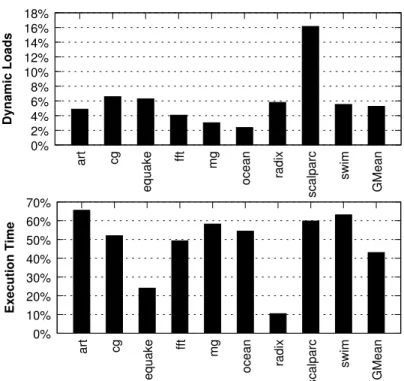
Recall that in out-of-order processors, once load instructions are issued to mem-ory and their entries are saved in the load queue, these instructions exit the ex-ecution stage but remain in the ROB until the requested operation is complete and the appropriate value is supplied. This means that while other resources of the back end have been freed up, long-latency load instructions may reach the ROB head before they complete, where they will block the commit stage, possibly for many cycles. A long-latency block at the ROB head can lead to the ROB filling up, and eventually prevent the processor from continuing to fetch/dispatch new instructions. In the worst case, this may lead to a complete stall of the processor.
0% 2% 4% 6% 8% 10% 12% 14% 16% 18% GMean swim scalparc radix ocean mg fft equake cg art Dynamic Loads 0% 10% 20% 30% 40% 50% 60% 70% GMean swim scalparc radix ocean mg fft equake cg art Execution Time
Figure 2.6: Percentage of dynamic long-latency loads that block at the ROB head (top), and percentage of processor cycles that these loads block the ROB head (bottom) when scheduled using FR-FCFS, averaged across all threads of each parallel application.
Runahead and CLEAR try to attack this problem by extending the archi-tecture with special execution modes. In Runahead, when a long-latency load blocks the ROB head, the architectural state is checkpointed, allowing execu-tion to continue, albeit “skipping” instrucexecu-tions that are in the load’s dependency chain (easily detectable by “poisoning” the destination register) [10, 54]. After the load completes, the processor systematically rolls back to that point in the program order. The goal is to use Runahead mode to warm up processor and caches in the shadow of the long-latency load. In CLEAR, a value prediction is provided to the destination register instead of poisoning it, which allows the hardware to leverage the (correct) execution in the shadow of that load when the prediction is correct, or to still warm up processor and cache structures oth-erwise [39]. Checkpoint support is still needed.


![Figure 2.4: Peak frequency of DDR memories and processors released in each of the last ten years, normalized to the highest released frequency in 2003 [9, 14, 24, 26].](https://thumb-us.123doks.com/thumbv2/123dok_us/10226338.2926479/39.918.247.713.120.330/figure-frequency-memories-processors-released-normalized-released-frequency.webp)