© 2019 by the Serbian Biological Society How to cite this article: González-Félix ML , Perez-Velazquez M, Cañedo-Orihuela 755 H. Seasonal changes in gonad maturity, proximate and fatty acid composition
of Limbaugh’s damselfish, Chromis limbaughi Greenfield & Woods, 1980 (Pisces: Pomacentridae). Arch Biol Sci. 2019;71(4):755-65.
Seasonal changes in gonad maturity, proximate and fatty acid composition of Limbaugh’s
damselfish,
Chromis limbaughi
Greenfield & Woods, 1980 (Pisces: Pomacentridae)
Mayra Lizett González-Félix, Martin Perez-Velazquez* and Hugo Cañedo-Orihuela
Department of Scientific and Technological Research, University of Sonora, Edificio 7-G, Blvd. Luis Donaldo Colosio s/n, e/Sahuaripa y Reforma, Col. Centro, C.P. 83000, Hermosillo, Sonora, Mexico
*Corresponding author: [email protected]
Received: June 13, 2019; Revised: August 5, 2019; Accepted: September 3, 2019; Published online: September 12, 2019
Abstract: Limbaugh’s damselfish, Chromis limbaughi Greenfield & Woods, 1980, is endemic to the Gulf of California, and
one of the five most exploited species for the aquarium trade in this region. C. limbaughi is a gonochoristic, gregarious
and territorial species without sexual dimorphism that inhabits rocky, sheltered areas. Development of captive breeding techniques for this species would not only ensure a continued supply of fish for the commercial trade, but perhaps more
importantly, it would also alleviate fishing pressure and support stock enhancement. Thus, as a first step towards achieving
these goals, in this work, we investigated some aspects of the reproductive biology of C. limbaughi. Seasonal fish samplings,
with a total of eighty-nine fish caught in one year, were carried out at San Esteban Island, Gulf of California, Mexico. The
reproductive season of C. limbaughi extends, at least, from May to September. A new maximum standard length of 10.5 cm
is reported for this species. The estimated size at first sexual maturity was 7.90 cm for males and 7.59 cm for females. For both male and female gonads, the major constituent fatty acids were palmitic acid, stearic acid, oleic acid, docosahexaenoic
acid, eicosapentaenoic acid and arachidonic acid. The water-quality conditions under which maturation of C. limbaughi
took place were measured, and should prove useful for the management of broodstock in captivity.
Keywords: Chromis limbaughi; gonad maturity, fatty acid profile; developmental stages; proximate composition
INTRODUCTION
For many years the trade of marine ornamentals has been a profitable activity worldwide [1,2]. However, this market is not without controversy, as most of the trad-ed marine organisms are capturtrad-ed from the wild [3]. This is also the case of Limbaugh’s damselfish, Chromis limbaughi, one of the five most heavily exploited fish species in the Gulf of California, Mexico, for the aquar-ium trade [4]. C. limbaughi, a member of the family Pomacentridae, is a beloved species for fish hobbyists for several reasons. It is an eye-catching damselfish, beautifully colored in blue and yellow, especially in the juvenile stages. It is a relatively rare species, endemic to the Gulf of California. And last but not least, unlike many other damselfishes, which typically are highly territorial and aggressive, C. limbaughi is reasonably mild-tempered, compatible with many other fishes in the community aquarium. Although C. limbaughi is in the list of ornamental fishes with special protection
status in the Mexican legislation for wildlife conserva-tion NOM-059-SEMARNAT-2001 [5], the Mexican government has issued fishing permits for C. limbaughi
and other species for small-scale fishing cooperatives in the Gulf of California. Regrettably, the actual data on fish catches are unknown because fisheries record-keeping and reporting are either nonexistent or not en-forced [4]. Thus, there has long been strong suspicion of overexploitation and/or illegal fishing [6,7].
of vitellogenin [10], which is incorporated into devel-oping oocytes [11,12]. Among lipids, fatty acids play key roles in broodstock nutrition. While saturated and monounsaturated fatty acids are usually catabolized for energy, long-chain polyunsaturated fatty acids (LC-PUFA) accumulate in sufficient amounts in oocytes to guarantee adequate hatching and early larval growth and survival [13]. Specifically, docosahexaenoic acid (22:6n-3, DHA) is an important constituent of the cen-tral nervous system tissues [14]. Eicosapentaenoic acid (20:5n-3, EPA) and arachidonic acid (20:4n-6, ARA) act as prostaglandin precursors, which stimulate steroi-dogenesis in the ovaries and testicles [15]. In addition, ARA is believed to play a role in the development of the embryonic immune system, hatching and growth during early larval stages in fish [16].
To advance our knowledge of aspects of its re-productive biology and gonad biochemical composi-tion, this study evaluated seasonal changes in gonad maturity, proximate and fatty acid composition of Limbaugh’s damselfish C. limbaughi.
MATERIALS AND METHODS Fish collection
A fish collection permit for scientific purposes (Per-mit No. SGPA/DGVS/06436/17) was obtained from the Mexican Agency for the Environment and Natu-ral Resources (SEMARNAT) on August 2, 2017. Four fishing samplings were conducted during the months of May (spring), September (summer), November (au-tumn) and February (winter), in temperatures repre-senting each season. Fish were captured by SCUBA diving, using dip fishing nets, at San Esteban Island, Gulf of California, Mexico (latitude 28°42'2.66'' N and longitude 112°34'37.42'' W). Records of water temperature, salinity, pH and depth were obtained at the sampling site. Caught fish were temporarily placed in a submerged cage, then transported live in circular polyethylene tanks (250 l capacity) to the University of Sonora, Hermosillo, Sonora. Upon arrival, they were euthanized with an overdose of tricaine methanesul-fonate (MS-222 at 300 mg l-1), which complies with the Official Mexican Norm (NOM-062-ZOO-1999) on the Technical Specifications for the Production, Care and Use of Laboratory Animals [17]. Fish were
individu-ally weighed and measured, and their gonads and liver were removed to calculate the gonadosomatic index
GSI (%)=(gonad weight, g/body weight, g)×100; the hepatosomatic index:
HSI (%)=(liver weight, g/body weight, g)×100; and condition factor:
K=(body weight, g×100)/total length3, cm. Gonads were divided into two similar portions. One of them was placed in Davidson’s fixative solution (ace-tic acid:95% ethanol:formaldehyde:H2O at a 1:3:2:3 ratio) for 24 h for the histological determination of the gonad developmental stage. The second portion was stored at -84.0ºC and used for the determination of the proximate and fatty acid composition.
Histological evaluation of gonads
Upon storage in Davidson’s solution, the gonads were transferred into a 70% ethanol solution, then into eth-anol solutions of increasing concentrations (80, 95, 100%) for dehydration, and then into xylene for clear-ing. At least three segments per gonad were sliced and embedded in paraffin. Transverse sections, approxi-mately 4 μm thick, were cut, placed onto microscope slides and stained with hematoxylin and eosin (H&E). These preparations were examined under an invert-ed trinocular microscope (VWR International LLC, Model 89404-462, Radnor, PA, USA) equipped with a digital camera (VWR International LLC, Model V-10, Radnor, PA, USA) using the Motic Images Multi-focus software (Motic Instruments, Carlsbad, CA, USA) for image acquisition. A standardized nomenclature for staging gonad development [18], which includes the stages immature, developing, spawning capable, re-gressing and regenerating, was followed.
Proximate and fatty acid composition
respectively [19]. Crude fat (CF) was extracted following a gravimetric method [20], obtaining a CF extract of 30 mL. CF was then quantified gravimetrically after drying a 5 mL aliquot of extract under nitrogen. The remaining 25-mL lipid extract was employed for fatty acid analysis. Fatty acids were transesterified using boron trifluoride. Fatty acid methyl esters (FAME) were then analyzed with a Varian 3800 gas chromatograph equipped with a 30 m×0.25 mm fused silica capillary column and a flame ionization detector, following a method previously described [21]. Fatty acids were identified by compar-ing retention times to those of known standards and expressed as percent of FAME identified.
Size at first sexual maturity
Using the Spearman-Karber equation [22], size at first sexual maturity was calculated by:
M (size at first sexual maturity)=anti log m, where: m=xk+(X/2)–(X Σ pi).
The 95% confidence limits were determined by: anti log10 m ± 1.96 × √ (X2 × Σ (pi – qi)/(ni-1)), where: xk is the log10 of the size class middle value at which 100% of fish are mature, X is the mean difference between log10 of the size class middle values, pi=ri/ni, where ri is the number of fish with mature gonads to class i, and ni is the total number of fish to class i.
Finally, qi is 1-pi.
Statistical analysis
Possible differences between sexes in length (to-tal length, standard length, fork length) and body weight were assessed by one-way analysis of vari-ance (ANOVA), using a significvari-ance level of P≤0.05.
ANOVA was also applied to GSI, HSI, K and gonad proximate and fatty acid composition data for males and females at different gonad developmental stages. When significant differences were detected, Tukey’s HSD test was used as the mean separation procedure. Statistical analyses were performed using the Statistical Analysis System software package (SAS Institute Inc., 2013, Software Release 9.4, Cary, NC, USA).
RESULTS
Collected fish, length and weight
Thirty-five (15 male, 20 female) fish individuals, six-teen (8 male, 8 female) individuals, ninesix-teen (9 male, 10 female) individuals and nineteen (11 male, 8 fe-male) fish were caught during the spring, summer, autumn and winter surveys, respectively. The male to female ratios were 0.8:1, 1:1, 0.8:1 and 1.4:1, re-spectively. Recorded values of water temperature were 21.0, 27.0, 20.0 and 14.0°C, respectively; water salinity values were 36.0, 36.0, 37.0 and 36.5‰, respectively; pH 8.1, 7.3, 7.8 and 7.7, respectively. Fish were caught at a depth of 15 m throughout the four seasons, except for the winter survey, in which depth of capture was 12 m. Male and female length and body weight data from all four seasons were combined in order to evaluate size differences between sexes. Statistical differences for these parameters were not detected (Table 1).
Histological evaluation of gonads
Nineteen out of twenty females caught in spring had gonads at the developing stage, while one was at the spawning capable stage. In the summer, 37.5% were at the spawning capable stage, 37.5% at the regressing stage and 25% were immature. In autumn and winter, the vast majority of females were at the regenerating
Table 1. Comparison of length and body weight between sexes of Chromis limbaughi caught at San Esteban Island, Gulf of California, Mexico. Values are overall minimum, maximum and mean (± SEM), obtained by combining data from the four seasons.
TL (cm) SL (cm) FL (cm) BW (g)
Min Max Mean Min Max Mean Min Max Mean Min Max Mean
Males 4.2 13.8 9.3±0.4 3.0 10.5 7.0 ± 0.3 3.6 11.9 8.7±0.3 1.0 48.8 19.0±1.8 Females 3.8 12.7 9.6±0.3 2.8 9.8 7.3 ± 0.2 3.3 11.7 8.4±0.3 0.9 45.8 20.3±1.6 ANOVA (P < F) 0.5071 ANOVA (P < F) 0.4204 ANOVA (P < F) 0.4872 ANOVA (P < F) 0.5876
or immature stages (Table 2). Female gonads at the developing stage were characterized by oocytes in pri-mary and secondary vitellogenesis (Vtg1 and Vtg2, re-spectively), some oocytes in primary growth (PG), but no oocytes in tertiary vitellogenesis (Vtg3) (Fig. 1). In spawning-capable females, large proportions of Vtg3, greater than 240 µm in diameter, could be seen, as well
as some oocytes in atresia (A) (Fig. 1). In the regressing stage, there were postovulatory folli-cles, oocytes in atresia and some Vtg1 and Vtg2 (Fig. 1). Similarly, the majority (87%) of males caught in spring had gonads at the developing stage, while one was immature and one in the regenerating stage. Of the males caught in the summer, 62.5% were spawning capable, 25% were at the regressing stage and 12.5% were im-mature. Most of the males collected in autumn had gonads at either the regressing (33.3%) or regenerating (44.5%) stages, while 22.2% were immature. All but one of the males caught in winter were in the regenerating stage (Table 2). The developing stage in male gonads was characterized by large proportions of primary spermatocytes (Sc1) and small amounts of spermato-zoa (Sz) (Fig. 2), while spawning capable gonads had large proportions of spermatozoa, and small amounts of primary or secondary spermatocytes (Sc2) (Fig. 2). Secondary spermatocytes predominated in gonads at the regressing stage, with residual spermatozoa and large empty spaces in the lumen of lobules (Fig. 2).
Table 2. Numbers of female and male Chromis limbaughi at different go-nad developmental stages caught during each season at San Esteban Island, Gulf of California, Mexico.
Season
Imma-ture Devel-oping Spawning capable gressingRe- Regen-erating No. fishTotal Females
Spring 0 19 1 0 0 20
Summer 2 0 3 3 0 8
Autumn 2 0 0 0 8 10
Winter 3 0 0 0 5 8
Males
Spring 1 13 0 0 1 15
Summer 1 0 5 2 0 8
Autumn 2 0 0 3 4 9
Winter 1 0 0 0 10 11
Fig. 1. Histological sections of female Chromis limbaughi gonads at the stages of (A) developing (20X), (B) spawning capable (20X) and (C) regressing (20X), following the nomenclature previously described [18].PG – oocytes in primary growth; Vtg1 – oocytes in primary vitellogenesis; Vtg2 – oocytes in secondary vitellogenesis; A – atresia; Vtg3 – oocytes in tertiary vitellogenesis; POF – postovulatory follicles.
Macroscopically, spawning capable gonads in fe-males were large, with prominent blood vessels, and orange in color. Gonads in the regressing stage were also orange, but somewhat translucent, smaller and flaccid. Regenerating gonads were whitish, small, and with reduced blood vessels. For males, spawn-ing capable gonads were whitish and large. Gonads at all other stages, although relatively smaller, were also whitish and did not display distinctive features to tell them apart.
Body indices
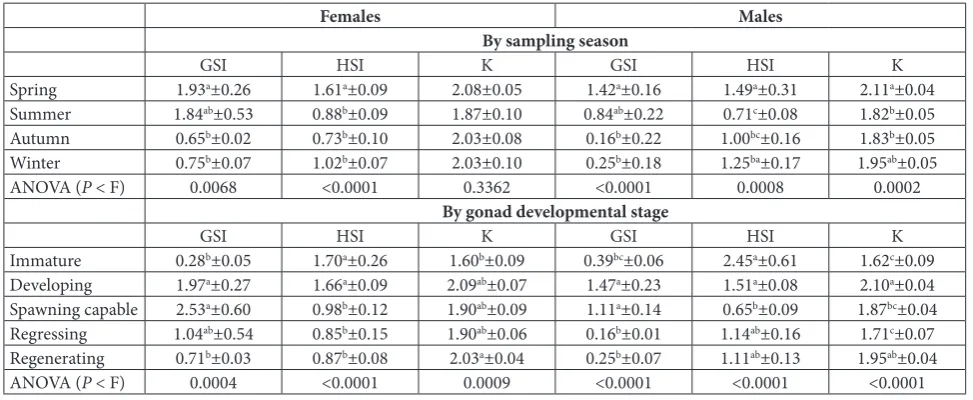
The body indices GSI, HSI and K of males and fe-males, as arranged by sampling season, are shown in Table 3. GSI was highest in spring and summer for both males and females, declining significantly in au-tumn and winter. HSI also varied significantly with sampling season. For females, HSI in spring was sta-tistically higher than in the other seasons. For males, it was highest in spring and lowest in summer. With respect to K of males, it was significantly higher in spring than in other seasons. For females, no statistical differences were detected for this parameter (Table 3). When data were arranged by gonad developmental stage, greater values of GSI were observed in males and females with developing and spawning capable gonads, which decreased at later stages of gonad
de-velopment. HSI was significantly higher in females with immature and developing gonads, as compared to females at other stages of gonad development. In males, the highest HSI values corresponded to males with immature gonads and developing gonads, statis-tically higher than fish with spawning capable gonads, but not different from fish with regressing or regen-erating gonads (Table 3).
Size at first sexual maturity
Size at first sexual maturity for females was 7.59 cm, with 95% lower and upper confidence limits of 6.82 and 8.44 cm, respectively. For males, it was 7.90, with intervals of 7.05 and 8.85 cm, respectively.
Proximate and fatty acid composition of gonads
The proximate composition of gonads varied signifi-cantly with sampling season in terms of the contents of moisture, ash and CP in males, and in terms of the ash content in females. However, the data did not depict clear patterns of variation (Table 4). For males, gonad tissues collected during the winter were insuf-ficient to perform proximate composition analysis.
In females, as arranged by stage of gonad matu-rity, the major constituent fatty acids were, among
Table 3. Body indices (means±SEM) by sampling season and by gonad developmental stage of Chromis limbaughi caught at San Esteban Island, Gulf of California, Mexico.
Females Males
By sampling season
GSI HSI K GSI HSI K
Spring 1.93a±0.26 1.61a±0.09 2.08±0.05 1.42a±0.16 1.49a±0.31 2.11a±0.04
Summer 1.84ab±0.53 0.88b±0.09 1.87±0.10 0.84ab±0.22 0.71c±0.08 1.82b±0.05
Autumn 0.65b±0.02 0.73b±0.10 2.03±0.08 0.16b±0.22 1.00bc±0.16 1.83b±0.05
Winter 0.75b±0.07 1.02b±0.07 2.03±0.10 0.25b±0.18 1.25ba±0.17 1.95ab±0.05
ANOVA (P < F) 0.0068 <0.0001 0.3362 <0.0001 0.0008 0.0002
By gonad developmental stage
GSI HSI K GSI HSI K
Immature 0.28b±0.05 1.70a±0.26 1.60b±0.09 0.39bc±0.06 2.45a±0.61 1.62c±0.09
Developing 1.97a±0.27 1.66a±0.09 2.09ab±0.07 1.47a±0.23 1.51a±0.08 2.10a±0.04
Spawning capable 2.53a±0.60 0.98b±0.12 1.90ab±0.09 1.11a±0.14 0.65b±0.09 1.87bc±0.04
Regressing 1.04ab±0.54 0.85b±0.15 1.90ab±0.06 0.16b±0.01 1.14ab±0.16 1.71c±0.07
Regenerating 0.71b±0.03 0.87b±0.08 2.03a±0.04 0.25b±0.07 1.11ab±0.13 1.95ab±0.04
ANOVA (P < F) 0.0004 <0.0001 0.0009 <0.0001 <0.0001 <0.0001
saturated fatty acids, palmitic acid (16:0) and stearic acid (18:0); among monounsaturated fatty acids, oleic acid (18:1n-9); among fatty acids from the n-3 family, DHA and EPA; and among fatty acids from the n-6 family, ARA. Of these major constituents, EPA, ARA and stearic acid varied significantly with stage of ma-turity, but without showing clear patterns. Significant
differences also were detected for linoleic acid (18:2n-6) and linolenic acid (18:3n-3), but these were minor components. No significant differences were detected for fatty acid groups or the n-3/n-6 ratio (Table 5).
For males, because of insufficient gonad tissue, fatty acid analysis is presented only for the developing,
Table 4. Proximate composition of male and female gonads of Chromis limbaughi caught at San Esteban Island, Gulf of California, Mexico, during each season.
Season Moisture (%) Ash (%) Crude protein (%) Crude fat (%)
Females
Spring 69.67±1.27 1.74b±0.07 21.84±0.82 7.49±0.66
Summer 66.37±4.65 3.78a±0.90 22.87±1.54 8.54±1.19
Autumn 69.34±0.63 1.48b±0.21 21.50±0.93 8.50±1.87
Winter 69.35±0.67 2.94ab±0.57 21.87±0.46 6.02±1.48
ANOVA (P < F) 0.7914 0.0112 0.8645 0.5360
Males
Spring 80.38a±0.29 1.94b±0.08 15.71b±0.34 4.37±0.90
Summer 70.17b±0.44 3.84a±0.13 19.76a±0.48 6.20±0.90
Autumn 70.05b±0.53 1.49b±0.16 21.63a±0.67 7.40±0.90
ANOVA (P < F) <0.0001 <0.0001 <0.0001 0.1287
Values are means (±standard error). Means with different superscripts within the same column are significantly different (P<0.05).
Table 5. Determined composition of selected fatty acids (% of FAME identified) in female gonads of Chromis limbaughi at different developmental stages, caught at San Esteban Island, Gulf of California, Mexico.
Fatty acid Developing Spawning capable Regressing Regenerating ANOVA (P < F)
14:0 5.14±0.20 5.04±0.65 3.90±0.78 4.21±0.48 0.1363
14:1 2.05±0.17 1.63±0.46 1.62±0.30 1.46±0.18 0.2086
16:0 21.00±1.84 31.00±9.63 24.83±2.75 24.63±1.76 0.2552
18:0 6.04b±0.16 6.37ab±0.79 10.66ab±1.59 11.72a±2.36 0.0050
18:1n-9 10.98±0.57 9.03±1.70 12.21±2.69 7.42±1.73 0.0860
18:2n-6 0.81b±0.09 1.23b±0.20 2.51a±1.00 1.58ab±0.38 0.0077
18:3n-3 1.75a±0.25 1.10ab±0.37 0.95ab±0.39 0.59b±0.19 0.0266
20:4n-6 6.59a±0.98 1.90ab±1.90 0.00b±0.00 3.70ab±0.51 0.0344
20:5n-3 6.89a±0.50 3.62ab±1.94 2.18b±0.51 4.41ab±1.01 0.0154
22:5n-3 4.06±0.45 3.63±0.49 5.76±3.20 2.57±0.34 0.1044
22:6n-3 15.11±0.95 13.63±2.27 10.09±1.24 17.60±2.66 0.2965
Saturates 34.01±1.72 43.58±8.90 40.32±2.20 39.17±2.44 0.1890
Monounsaturates 15.40±0.58 12.17±1.86 15.37±2.04 15.32±2.21 0.5603
LC-PUFA 50.59±1.42 44.25±7.09 44.31±4.24 45.51±4.39 0.4153
Total n-3 33.46±1.29 30.30±4.74 29.87±4.28 30.64±3.55 0.7304
Total n-6 10.56±1.16 7.63±1.78 8.58±0.03 10.07±1.19 0.6558
n-3/n-6 3.43±0.34 4.27±0.53 3.48±0.51 3.06±0.15 0.3649
Values represent means (±standard error). Means with different superscripts within the same column are significantly different (P<0.05). FAME – fatty acid methyl esters; LC-PUFA – long-chain polyunsaturated fatty acids.
Saturates: 14:0, 16:0, 18:0, 20:0.
Monounsaturates: 14:1, 16:1, 18:1n-9, 20:1, 22:1, 24:1.
LC-PUFA: 16:2, 18:2n-6, 18:3n-6, 18:3n-3, 18:4n-3, 20:3n-6, 20:4n-6, 20:3n-3, 20:4n-3, 20:5n-3, 22:4n-6, 22:5n-6, 22:5n-3, 22:6n-3, 24:4n-6, 24:5n-6, 24:5n-3, 24:6n-3.
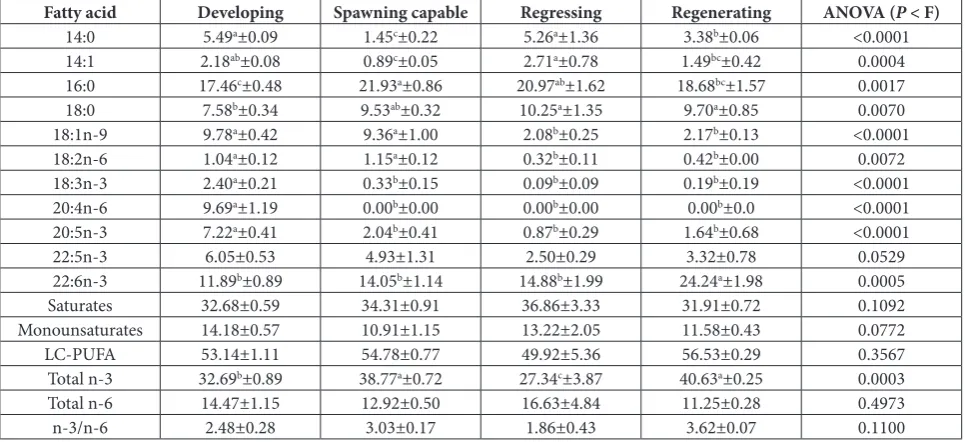
spawning capable, and regressing stages. Similarly to what was previously observed in females, the major constituent fatty acids were 16:0, 18:0, 18:1n-9, DHA, EPA, and ARA (Table 6). Statistical differences were detected for all but docosapentaenoic acid (22:5n-3). However, the relative abundance of individual fatty acids varied from one developmental stage to the next without following definite patterns. Among fatty acid groups, significant differences were observed only for fatty acids of the n-3 family (Table 6).
DISCUSSION
One prominent aspect of the reproductive biology of
C. limbaughi that can be inferred from the results of the present study is its sexual system. Either male or female gametes, but never both types, were present in the same individual. The population structure con-sisted of males and females equally represented in all sizes, as shown by the lack of differences in size and weight between sexes, and with a male to female ratio
close to 1:1. This growing body of evidence clearly indicates that C. limbaughi is a gonochoristic species, which is consistent with gonochorism found in other species of the genus Chromis [23], as well as with findings of male to female ratios close to 1:1, with-out differences in size between sexes, reported for the also gonochoristic species Chromis notata, Chromis chromis, and Chromis hypsilepis [24-26]. As opposed to gonochoristic species, in damselfishes known to be protandrous hermaphrodites, such as Dascyllus, males are notably larger than females [23,27], while the opposite is true for protogynous hermaphrodites, which, among Pomacentrids, is only known to occur for the genera Amphiprion and Premnas [23].
Mating systems in Pomacentridae include monog-amy and polygmonog-amy. In turn, polygmonog-amy can be subdivid-ed into polygyny and promiscuity. Polygynic fishes are known for aggregating into harems where one or two males monopolize mating with several females [23]. In promiscuity, well known in the genus Chromis (e.g., in
C. caerulea, C. chromis and C. pembae), females spawn
Table 6. Determined composition of selected fatty acids (% of FAME identified) in male gonads of Chromis limbaughi at different devel-opmental stages, caught at San Esteban Island, Gulf of California, Mexico.
Fatty acid Developing Spawning capable Regressing Regenerating ANOVA (P < F)
14:0 5.49a±0.09 1.45c±0.22 5.26a±1.36 3.38b±0.06 <0.0001
14:1 2.18ab±0.08 0.89c±0.05 2.71a±0.78 1.49bc±0.42 0.0004
16:0 17.46c±0.48 21.93a±0.86 20.97ab±1.62 18.68bc±1.57 0.0017
18:0 7.58b±0.34 9.53ab±0.32 10.25a±1.35 9.70a±0.85 0.0070
18:1n-9 9.78a±0.42 9.36a±1.00 2.08b±0.25 2.17b±0.13 <0.0001
18:2n-6 1.04a±0.12 1.15a±0.12 0.32b±0.11 0.42b±0.00 0.0072
18:3n-3 2.40a±0.21 0.33b±0.15 0.09b±0.09 0.19b±0.19 <0.0001
20:4n-6 9.69a±1.19 0.00b±0.00 0.00b±0.00 0.00b±0.0 <0.0001
20:5n-3 7.22a±0.41 2.04b±0.41 0.87b±0.29 1.64b±0.68 <0.0001
22:5n-3 6.05±0.53 4.93±1.31 2.50±0.29 3.32±0.78 0.0529
22:6n-3 11.89b±0.89 14.05b±1.14 14.88b±1.99 24.24a±1.98 0.0005
Saturates 32.68±0.59 34.31±0.91 36.86±3.33 31.91±0.72 0.1092
Monounsaturates 14.18±0.57 10.91±1.15 13.22±2.05 11.58±0.43 0.0772
LC-PUFA 53.14±1.11 54.78±0.77 49.92±5.36 56.53±0.29 0.3567
Total n-3 32.69b±0.89 38.77a±0.72 27.34c±3.87 40.63a±0.25 0.0003
Total n-6 14.47±1.15 12.92±0.50 16.63±4.84 11.25±0.28 0.4973
n-3/n-6 2.48±0.28 3.03±0.17 1.86±0.43 3.62±0.07 0.1100
Values represent means (±standard error). Means with different superscripts within the same column are significantly different (P<0.05). FAME – fatty acid methyl esters; LC-PUFA – long-chain polyunsaturated fatty acids.
Saturates: 14:0, 16:0, 18:0, 20:0.
Monounsaturates: 14:1, 16:1, 18:1n-9, 20:1, 22:1, 24:1.
LC-PUFA: 16:2, 18:2n-6, 18:3n-6, 18:3n-3, 18:4n-3, 20:3n-6, 20:4n-6, 20:3n-3, 20:4n-3, 20:5n-3, 22:4n-6, 22:5n-6, 22:5n-3, 22:6n-3, 24:4n-6, 24:5n-6, 24:5n-3, 24:6n-3.
with several males [28]. Although the actual spawning act was not observed in the present study, it is likely that C. limbaughi also conforms to the promiscuity mating system, taking into consideration that during scuba diving it was observed that C. limbaughi does not form harems, and that, unlike haremic systems, with notably less males than females, the male to female ratio was close to 1:1 for this species.
The influence of season on gonad maturity of C. limbaughi was clear. Both male and female fish with gonads in forthright preparation for reproduction pre-dominated in spring. Although scarce, the incidence of females with spawning capable gonads in spring is indicative of the onset of reproduction for this species; however, summer is undoubtedly the most reproduc-tively active season. No evidence of mature gonads was found in autumn or winter, from which it is inferred, based on sampling dates, that the spawning season for
C. limbaughi extends, at least, from May to September. Undoubtedly, increasing water temperature and day-light hours, among other factors, play key roles on this pattern, which corresponds well with those of other pomacentrids of the same geographical area, such as
Stegastes rectifraenum, with a spawning season from March to October, and Microspathodon dorsalis and
Abudefduf troschelii, both with spawning seasons lasting from April to October [29]. In addition, C. limbaughi
seems to be a partial spawner because spawning capable females had mature oocytes, as well as oocytes at other stages of development, i.e., asynchronous development, a feature described also for the partial spawners S. rec-tifraenum, M. dorsalis and A. troschelii [29].
With regard to water temperature, during the summer season it was evident that C. limbaughi
avoids excessively warm waters by occupying niches at relatively greater depths (15 m), where the mean temperature was 27°C, while that at the surface was 31°C. Actual water quality conditions under which the maturation of C. limbaughi takes place were measured in this study. The changes in these conditions can be mimicked for the management of C. limbaughi brood-stock in captivity.
A new maximum standard length of 10.5 cm was recorded in the present study for C. limbaughi, which exceeds the maximum standard length of 10.0 cm re-ported previously for this species [30]. On the other
hand, the range of length measurements recorded here position C. limbaughi, among other species of the same genus, as a medium-sized damselfish. For example, Chromis fieldi is smaller, with SL ranging from 1.5 to 5.7 cm [31], while Chromis crusma and
Chromis punctipinnis are large species, reaching up to 24.5 and 33.0 cm, respectively [32,33].
As stated earlier, because of their more vivid col-oration, juvenile, and thus, immature C. limbaughi, are targeted for capture and marketing. Since the es-timated size at first sexual maturity was 7.90 cm for males and 7.59 cm for females, this implies that the rate of recruitment of fish to reproductive age is being directly impacted. The extent to which this harmful extraction practice may be affecting natural popula-tions is difficult to assess, since there is no certainty about actual numbers of fish catches [4]. However, it brings to light the need for promoting the devel-opment of captive breeding programs to supply the ornamental fish trade, as is the case for other poma-centrids, such as some clownfish, which are currently successfully reared in captivity [34], and at the same time, for halting fishing or enforcing regulations for the extraction of wild organisms.
The seasonal changes in GSI corresponded well with the stages of gonad maturity, reaching the great-est GSI values, by sampling season (Table 3), in spring and summer. When arranged by gonad developmental stage, GSI values were greatest in fish with gonads at the developing and spawning capable stages, reflect-ing active vitellogenesis and spermatogenesis mainly in spring, and spawning in summer. Then, GSI de-creased notably in autumn and winter, when fish were reproductively inactive. A similar seasonal pattern in GSI was observed in the damselfish A. troschelii [35]. The GSI values found in this study (0.25-2.53) are comparable to those reported previously for Chromis pelloura, ranging from approximately 0.2 to 1.4, but for C. notata, very high GSI values of up to 8.5 have been reported [36].
nu-tritional reserves. Furthermore, for males, the drastic change observed is probably also a reflection of egg guarding, a task normally reserved for this gender in species of the family Pomacentridae [23], in which feeding activity may be reduced by up to 85%, for example, for Chromis hypsilepis [37,38]. The relative increase of HSI observed in autumn and winter is not just a consequence of suppression of reproduction, but is likely the result of abundant food supply caused by upwelling during the cold months in this region, which favors primary productivity [39] and allows C. limbaughi to recover hepatic reserves.
The condition factor for some fish species, such as Scorpaena mystes, increases significantly during the spawning season and, thus, can be used as an index of gonad maturity [40]. However, in this study, even if K was significantly influenced by sampling season and gonad developmental stage in males and females, the data did not depict clear trends. Thus, K does not appear to be a good estimator of gonad maturity for this species. The K values observed in this study (1.62 to 2.11) were higher than those reported for Chromis pelloura, which ranged from ca. 0.3 to 0.8 [41].
The proximate composition of gonads showed that the ash content for both males and females was significantly higher in summer, which can be ex-plained by high mobilization of nutrients, including minerals, to this tissue for maturation, as previously reported for Epinephelus diacanthus [42]. The mois-ture content of female gonads did not vary significant-ly with season, agreeing with the lack of differences in moisture content of immature, developing and spawning capable ovaries of E. diacanthus over two years of sampling [42]. Because they are important components of egg yolk, CP and CF have been shown to increase in maturing ovaries [42]. However, in the present study, statistical differences in CP and CF were not observed in females. For males, significant differ-ences were observed only in CP, but the highest value corresponded not to that of summer, but of autumn.
The recurrent presence among LC-PUFA, of DHA, EPA and ARA as main constituent fatty acids in go-nads of C. limbaughi, agrees with the fatty acid profile observed in broodstock gonads of Holacanthus passer, another marine fish species present in the same geo-graphical area [43]. The elevated levels observed are
most likely a reflection of the availability of these fatty acids through the food chains in the area, and they could possibly also be the result of selective retention in specific tissues, as suggested for some species [44]. The fatty acid profile found also endorses the relevance of these LC-PUFA for key reproductive processes such as gametogenesis, embryogenesis, hatching, as well as successful early larval growth and survival [13-15].
CONCLUSIONS
It was observed that C. limbaughi is a gonochoristic species without sexual dimorphism, with a polyga-mous, promiscuous mating system. The reproductive season of C. limbaughi extends, at least, from May to September. A new maximum standard length of 10.5 cm was recorded for this species. The estimated size at first sexual maturity was 7.90 cm for males and 7.59 cm for females. The gonadosomatic index reached the greatest values in spring and summer in fish with gonads at the developing and spawning capable stages, decreasing notably in autumn and winter. The changes observed in the hepatosomatic index illustrate the ac-tive role of the liver in the process of gametogenesis, reaching high values in spring during active vitello-genesis and spermatovitello-genesis for gonad growth, then decreasing significantly in the summer, showing not only a reduction in these processes, but also a decline in nutritional reserves. Even if the condition factor was significantly influenced by sampling season and gonad developmental stage in males, and in females by gonad developmental stage, it was not a good es-timator of gonad maturity for this species. For both male and female gonads, the major constituent fatty acids were palmitic acid, stearic acid, oleic acid, DHA, EPA and ARA. All in all, the present findings bring to light the urgency for promoting the development of captive breeding programs to supply the ornamental fish trade, and at the same time, for halting fishing or, at the very least, properly enforcing regulations for the extraction of wild organisms.
Funding: This study was supported by the University of Sonora, Hermosillo, Sonora, Mexico, Project No. USO313004777.
Acknowledgments: The authors would like to thank the staff
fieldwork. The mention of trademarks or proprietary products does not constitute an endorsement of the product by the authors or University of Sonora and does not imply its approval to the exclusion of other products that may also be suitable.
Author contributions: Martin Perez-Velazquez and Mayra L.
González-Félix conceived and planned the study. Hugo Cañedo-Orihuela and Martin Perez-Velazquez participated in fish collect-ing. Hugo Cañedo-Orihuela and Mayra L. González-Félix carried out the laboratory analyses. Martin Perez-Velazquez took the lead in writing the manuscript. All authors discussed the results and provided critical feedback to the manuscript.
Conflict of interest disclosure: The authors have no conflict of interest related to this work.
REFERENCES
1. Bruckner AW. The importance of marine ornamen-tal reef fish trade in the wider Caribbean. Rev Biol Trop. 2005;53:127-38.
2. Livengood EJ, Chapman FA. The ornamental fish trade: an introduction with perspectives for responsible aquarium fish ownership [Internet]. Gainesville, FL, USA: University of Florida, IFAS, Florida Cooperative Extension Service; 2007 [cited 2016 Nov 01]. 7 p. Available from: http://edis.ifas.ufl. edu/pdffiles/FA/FA12400.pdf
3. Wabnitz C, Taylor M, Green E, Razak T. From ocean to aquarium: the global trade in marine ornamental species. Cambridge, UK: UNEP World Conservation Monitoring Centre; 2003. 64 p.
4. Gijón-Díaz D, Reyes-Bonilla H, Guerrero-cha TP, Fernán-dez-Rivera Melo FJ. Economic potential of ornamental fish catching under federal protection in Mexico. Rev Biol Trop. 2017;65:195-210. Spanish.
5. NORMA Oficial Mexicana NOM-059-SEMARNAT-2001, Proteccion ambiental-Especies nativas de México de flora y fauna silvestres-categorías de riesgo y especificaciones para su inclusion, exclusion o cambio-lista de especies en riesgo. Offic Fed, Mexico. 2010 Dec 30: 1-84. Spanish.
6. Almenara-Roldán S, Ketchum JT. Forgotten islands of the Mexican Pacific. OFI J. 1994;9:12-4.
7. Lango-Reynoso F, Chávez MC, Zamora-Castro JE, Hernán-dez-Zárate G, Ramírez-Barragán MA, Solís-Morán E. Orna-mental marine fishkeeping: a trade of challenges and oppor-tunities. Lat Am J Aquat Res. 2012;40:12-21.
8. Arantes FP, Borć,ato FL, Sato Y, Rizzo E, Bazzoli N. Repro-duction and embryogenesis of the mandi-amarelo catfish,
Pimelodus maculatus (Pisces, Pimelodidae), in captivity. Anat Histol Embryol. 2012;42:30-9.
9. Muchlisin ZA. A general overview on some aspects of fish reproduction. Aceh Int J Sci Technol. 2014;3:43-52. 10. Reading BJ, Sullivan CV. Vitellogenesis in fishes. In: Ferrell
AP, editor. Encyclopedia of fish physiology: from genome to environment. Maryland Heights, MO, USA: Elsevier; 2011. p. 635-46.
11. Collier JT, Kaneko T, Hirano T, Grau EG. Seasonal changes in reproductive activity in the Potter’s angelfish (
Centro-pyge potteri) in Kaneohe Bay, Hawaii. Environ Biol Fishes 2003;68:49-57.
12. Guerriero G. Seasonal steroids variations and maturity stages in the female chub, Leuciscus cephalus L. (Pisces, Cyprinidae). Ital J Zool. 2007;74:317-24.
13. Izquierdo MS, Fernández-Palacios H, Tacon AGJ. Effect of broodstock nutrition on reproductive performance of fish. Aquaculture 2001;197:25-42.
14. Sargent JR, Tocher DR, Bell JG. The lipids. In: Halver JE, Hardy RW, editors. Fish Nutrition. 3rd ed. San Diego, CA, USA: Academic Press; 2002. p. 181-257.
15. Tocher DR, Bell JG, Dick JR, Crampton VO. Effects of dietary vegetable oil in Atlantic salmon hepatocyte fatty acid desaturation and liver fatty acid composition. Lipids 2003;38:723-32.
16. Sorbera LA, Zanuy S, Carrielo M. A role for polyunsatu-rated fatty acids and prostaglandins in oocyte maturation in the sea bass (Dicentrarchus labrax). In: Vandry H, editor. Trends in comparative endocrinology and neurology: from molecular to integrative biology. New York, NY, USA: New York Academy of Sciences; 1998. p. 535-537.
17. NORMA Oficial Mexicana NOM-062-ZOO-1999, Espe-cificaciones técnicas para la producción, cuidado y uso de los animales de laboratorio. Offic J Fed, Mexico. 2001 Aug 22:107-65. Spanish.
18. Brown-Peterson NJ, Wyanski DM, Saborido-Rey F, Mace-wicz BJ, Lowerre-Barbieri SK. A standardized terminology for describing reproductive development in fishes. Mar Coast Fish. 2011;3:52-70.
19. Association of Official Analytical Chemists (AOAC). Offi-cial Methods of Analysis. Arlington, VA, USA Association of Analytical Chemists; 2005.
20. Folch J, Lees M, Sloane GH. A simple method for the isola-tion and purificaisola-tion of total lipides from animal tissues. J Biol Chem. 1957;1:497-509.
21. Lochmann RT, Gatlin III DM. Essential fatty acid require-ment of juvenile red drum (Sciaenops ocellatus). Fish Physiol Biochem. 1993;12:221-35.
22. Udupa KS. Statistical method of estimating the size at first maturity in fishes. Fishbyte 1986;4(2):8-10.
23. Hattori A, Casadeval M. Sex change strategies and group structure of damselfishes. In: Frédérich B, Parmentier E, edi-tors. Biology of damselfishes. Boca Raton, FL, USA: CRC Press; 2016. p. 92-130.
24. Dulčić J, Kraljević M. Age, growth and mortality of dam-selfish (Chromis chromis L.) in the eastern middle Adriatic. Fish Res. 1995;22:255-264.
25. Pandian TJ. Sexuality if fishes. 1st ed. Boca Raton, Florida,
USA: CRC Press; 2010. 218 p.
26. Kim HJ, Na JH, Oh C-W. Age and growth of damselfish
Chromis notata (Temminck & Schlegel, 1843), Jeju Island, Korea. J Appl Ichthyol. 2016;32:1179-85.
27. Asoh K, Yoshikawa T, Kasuya M. Gonadal development and non-functional protogyny in coral-reef damselfish, Dascyllus albisella Gill. J Fish Biol. 2001;58:1601-16.
28. Fishelson L. Behaviour, socio-ecology and sexuality in dam-selfishes (Pomacentridae). Ital J Zool. 1998;65:387-98. 29. Hernández-Olalde L. Ecología reproductiva de peces de
[disser-tation]. La Paz, Baja California, Mexico: Instituto Politécnico Nacional; 2008. 173 p. Spanish.
30. Fischer W, Krupp F, Schneider W, Sommer C, Carpenter KE, Niem VH. Guía FAO para la identificación de especies para los fines de la pesca. Pacífico-centro oriental. Vol. 3, Vertebrados (Part 2). Rome, Italy: Food and Agriculture Organization of the United Nations; 1995. 1813 p. Spanish. 31. Randall JE, DiBattista JD. A new species of damselfish
(Pomacentridae) from the Indian Ocean. Aqua Int J Ich-thyol. 2013;19:1-21.
32. Allen GR. Damselfishes of the world. Melle, Germany: Mer-gus Publishers; 1991. 271 p.
33. Pequeño G, Vargas L, Riedemann A. The “damselfish” Chromis crusma (Valenciennes, 1833) in the coast of Valdivia (ca. 39ºS) with comments on the genus Chromis Cuvier, 1814, in Chilean waters (Osteichthyes: Pomacentri-dae). Invest Mar Valparaiso 2005;33(1):101-107. Spanish. 34. Gopakumar G. Culture of marine ornamental fishes with
reference to production systems, feeding and nutrition. In: International Seminar on Ornamental Fish Breeding, Farm-ing and Trade; 2006 Feb 5-6; Cochin, India; 2006. p. 61-70. 35. Bessa E, Ferraz-Dias J, De Souza AM. Rare data on a rocky
fish reproductive biology: Sex ratio, length of first matura-tion and spawning period of Abudefduf saxatilis (Linnaeus, 1758) with notes on Stegastes variabilis spawning period (Perciformes: Pomacentridae) in São Paulo, Brazil. Braz J Oceanogr. 2007;55(3):199-206.
36. Lee YD, Lee TY. Studies on the reproductive cycle of damsel-fish, Chromis notatus (Temminck et Schlegel). Bull Korean Fish Soc. 1987;20(6):509-19.
37. Robertson DR, Petersen CW, Brawn JD. Lunar reproductive cycles of benthic-brooding reef fishes: reflections of larval biology or adult biology? Ecol Monogr. 1990;60:311-29. 38. Gladstone W. Temporal patterns of spawning and hatching
in a spawning aggregation of the temperate reef fish Chromis hypsilepis (Pomacentridae). Mar Biol. 2007;151:1143-52. 39. Valdéz-Holguín JE, Lara-Lara JR. Primary productivity in
the Gulf of California. Effects of el niño 1982-1983 event. Ciencias Marinas 1987;13:34-50.
40. Jakes-Cota U, Tripp-Valdez A, López-Fuerte FO. Length-weight relationship and relative condition factor of the Stone Scorpionfish Scorpaena mystes in the central area of the Gulf of California, México. Hidrobiológica 2017;27(1):127-29. 41. Al-Zibdah M, Kan’an N. Aspects of growth, reproduction,
and feeding habit of three pomacentrid fish from Gulf of Aqaba, Jordan. Jordan J Biol Sci. 2009;3:119-28.
42. Chandrasekhara-Rao A, Krishnan L. Biochemical com-position and changes in biological indices associated with maturation of the ovary in the spiny cheek grouper Epi-nephelus diacanthus (Valenciennes, 1828). Indian J Fish. 2011;58(2):45-52.
43. Urquidez-Bejarano P, Perez-Velazquez M, González-Félix ML, Castro-Longoria R. Fatty acid and proximate composi-tion of wild male and female king angelfish (Holacanthus passer) gonads during the ripe and spent developmental stages. Anim Reprod. 2016;13(4):820-29.

![Fig. 2. Histological sections of male Chromis limbaughi gonads at the stages of (A) developing (40X), (B) spawning capable (40X) and (C) regressing (20X), following a nomenclature previously described [18]](https://thumb-us.123doks.com/thumbv2/123dok_us/7807099.2085304/4.595.57.540.249.372/histological-limbaughi-developing-regressing-following-nomenclature-previously-described.webp)