Available online through
ISSN 2229 – 5046International Journal of Mathematical Archive- 7(8), August – 2016 95
HARMONIOUS COLORING OF CENTRAL GRAPH OF SOME TYPES OF GRAPHS
U. MUTHUMARI
1*, M. UMAMAHESWARI
21Asst. Professor, Department of Mathematics,
The Standard Fireworks Rajarathnam College for Women, Sivakasi, (T.N.), India.
(Received On: 11-07-16; Revised & Accepted On: 24-08-16)
ABSTRACT
H
armonious colouring is a proper vertex colouring such that no two edges share the same colour pair. The harmonious Chromatic number of a graph is the least number of colours in such a colouring. The purpose of this paper is to study the harmonious coloring of central graph of flower graph, belt graph, rose graph and steering graph and harmonious chromatic number for these graphs. Also we give some structural properties of these graphs.Keywords: Harmonious coloring, Harmonious chromatic number, central graph of a graph, flower graph, belt graph,
rose graph, steering graph.
INTRODUCTION
Harmonious coloring:
In graph theory, a harmonious coloring is a (proper) vertex coloring in which every pair of colors appears on at most
one pair of adjacent vertices. The harmonious chromatic numberχH(G) of a graph G is the minimum number of
colors needed for any harmonious coloring of G.
Central graph of a graph:
The central graph of any graph G is obtained by subdividing each edge of G exactly once and joining all the non-adjacent vertices of G.
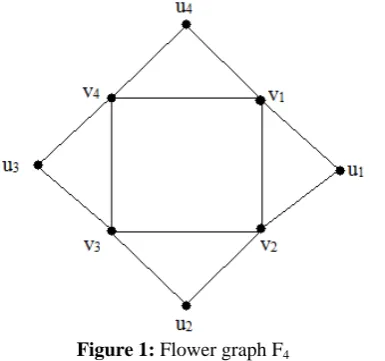
Definition: A Flower graph is obtained from a cycle C = v1, v2……vn, v1 by joining the two consecutive vertices by a
new vertices u1, u2,….un. A flower graph has 2n vertices and 3n edges, where n is the length of the cycle. We denote
this graph Fn.
Example:
Figure 1: Flower graph F4
Corresponding Author: U. Muthumari* Asst. Professor, Department of Mathematics,
Structural Properties of central graph of Flower graph:
Maximum degree ∆ = 4
Minimum degree 𝛿𝛿 = 2
Number of vertices in C(Fn) = 5n
Number of edges in C(Fn) = (2𝑛𝑛)(22𝑛𝑛−1) + 3n
Maximum degree ∆[C(Fn)] = 2n-1
Minimum degree 𝛿𝛿[C(Fn)] = 2
Theorem: The Harmonious chromatic number of central graph of Flower graph C[Fn] is ∆[C(Fn)] + 3.
(i.e) χ𝐻𝐻C(Fn) = ∆[C(Fn)] + 3.
Proof: Let Fn be the Flower graph with 2n vertices and 3n edges.
Let {v1, v2……vn, u1, u2……un} be the vertices of the Flower graph Fn.
By the definition of Central graph, each edge is subdivided by a new vertex.
Therefore, Assume that each edge (vi, vi+1) and the line joining vi and vi+1 to a new vertex ui, i= 1 to n are subdivided by
the vertices ejj, xi, yi, i & j = 1 to n respectively.
Assignthe coloring to vertices as follows: c(vi) = i for 1≤ i ≤ n
c(ui) = n+i for 1≤ i ≤ n
c(ejj) = 2n+1for 1≤ j ≤ n
c(xi) = 2n+2 for 1≤ i ≤ n
c(yi) = n+i for 1≤ i ≤ n
First we claim that, c is a proper coloring.
Since c(vi),c(ui) and its neighbours receive distinct colors.
Further c(vi) ≠ c(ui).
Hence c is a proper coloring.
Next we claim that, c is a Harmonious coloring.
It is clear that each vertex receive a distinct color at a distance atmost 2 from all other vertices.
Thus the coloring is harmonious.
Finally we claim that c is the minimum number of colors in a harmonious coloring.
Suppose not we have the following cases.
Case (i): The color set c(vi) & c(ui) containing 2n colors.
If we assign 2n-1 colors, then the color pair will not distinct. which is contradict the definition of harmonious colors.
Case (ii): The neighbours of ui and vi are given the same color. Then the color pair repeats which is contradiction to the
© 2016, IJMA. All Rights Reserved 97 Illustration for the above theorem:
Figure 2: Central graph of Flower graph [C(F4)]
Figure 3:χ𝐻𝐻 C[F4] = 10
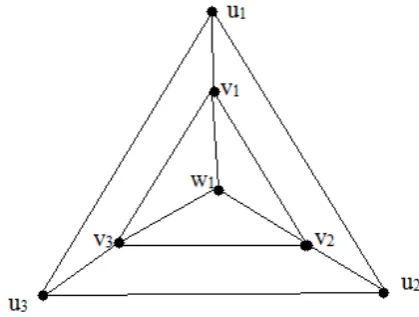
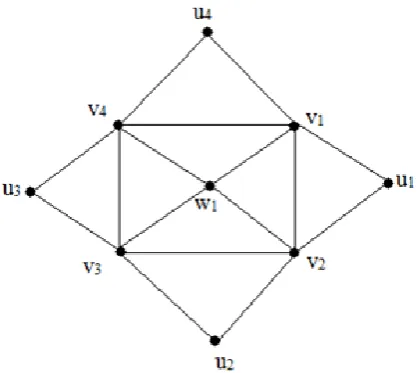
Definition: A Belt graph is obtained from Helm graph by joining its outer vertices. It has 2n+1 vertices 4n edges. It is
denoted by Bn.
Example:
Structural Properties of central graph of graph:
Number of vertices in C(G) = 6n+1
Number of edges in C(G) = 8n
Maximum degree ∆[C(G)] = 2n
Minimum degree 𝛿𝛿[C(G)] = 2
Theorem: The Harmonious chromatic number of central graph of Belt graph C[Bn] is 4n+1. (𝑖𝑖.𝑒𝑒)χ𝐻𝐻[C(Bn)] = 4n+1.
Proof: Let {v1, v2……vn, u1, u2……un, w1} be the vertices of the Belt graph .
By the definition of Central graph, each edge is subdivided by a new vertex.
The edges (ui, ui+1) & (un, u1) is obtained from the outer vertices helm graph are joined. Therefore, Assume that each
edges(ui ,ui+1) &(un,u1) are subdivided by the new vertex xi, ejj, xi, yi, zi,, i & j = 1 to n respectively.
Assignthe coloring to vertices as follows: c(vi) = i for 1≤ i ≤ n
c(ui) = n+i for 1≤ i ≤ n
c(w1) = 2n+1
c(ejj) = (2n+2)+j
c(xi) = (2n+1)+i for 1≤ i ≤ n
c(yi)= (3n+1)+i
c(zi) = (2n+1)+i
Clearly 4n+1 coloring.
First we claim that, c is a proper coloring.
Since c(vi), c(ui), c(wi) and its neighbours receive distinct colors.
Further c(vi) ≠ c(ui) ≠ c(wi)
Hence c is a proper coloring.
Next we claim that, c is a Harmonious coloring.
Its clear that each vertex receive a distinct color at a distance atmost 2 from all other vertices.
Thus the coloring is harmonious.
Finally we claim that c is the minimum number of colors in a harmonious coloring.
Suppose not we have the following cases.
Case (i): The color set c(vi), c(ui) & c(w1) containing 2n+1.
If we assign 2n colors, then the color pair will not distinct. which is contradict the definition of harmonious colors.
Case (ii): The neighbours of ui, vi, w1 are given the same color. then the color pair repeats which is contradiction to the
© 2016, IJMA. All Rights Reserved 99 Illustration for the above theorem:
Central graph of Belt graph C[B3]
χ𝐻𝐻[C(Bn)] = 4(3)+1=13
Definition: A Rose graph is obtained from a wheel graph wn with n vertices (n ≥ 4) by joining the two consecutive
vertices v1, v2,………vn by a new vertices u1,u2,….un. A Rose graph has 2n+1 vertices and 4n edges. Where n is length
of the cycle .We denote this graph by Rn.
Example:
Structural Properties of central graph of Rose graph:
Minimum degree 𝛿𝛿 = 2
Number of vertices in C(Rn) = 6n+1
Number of edges in C(Rn) = (2 𝑛𝑛)(2𝑛𝑛+1)
2 + 4n
Maximum degree ∆[C(Rn)] = p-1 where p is the point on the orignal graph
(or) 2n.
Minimum degree 𝛿𝛿[C(Rn)] = 2
Theorem: The Harmonious chromatic number of central graph of Rose graph C[Rn] is 4n-1.
(i.e) χ𝐻𝐻C(Rn) = 4n-1 .
Proof: Let Fn be the Rose graph with 2n+1 vertices and 4n edges.
Let {v1, v2……vn, u1, u2……un, w1} be the vertices of the Rose graph Rn.
By the definition of Central graph, each edge is subdivided by a new vertex.
Therefore, Assume that each edge (vi,vi+1) and the line joining vi and vi+1 to a new vertex ui, i= 1 to n are subdivided by
the vertices ejj, zi, xi, yi, i & j = 1 to n respectively.
Assignthe coloring to vertices as follows: c(vi) = i for 1≤ i ≤ n
c(ui) = n+i for 1≤ i ≤ n
c(w1) = 2n+1
c(ejj) = 2n+2 for 1≤ j ≤ n
c(zi) = 2n+3 for 1≤ j ≤ n
c(xi) = (2n+3)+i for 1≤ i ≤ n
c(yi) = n+ i for 1≤ i ≤ n
Clearly 4n-1 coloring.
First we claim that, c is a proper coloring.
Since c(vi), c(ui) and c(w1) and its neighbors receive distinct colors. Further c(vi) ≠ c(ui) ≠ c(w1).
Hence c is a proper coloring.
Next we claim that, c is a Harmonious coloring.
Its clear that each vertex receive a distinct color at a distance atmost 2 from all other vertices.
Thus the coloring is harmonious.
Finally we claim that c is the minimum number of colors in a harmonious coloring.
Suppose not we have the following cases.
Case (i): The color set c(vi), c(ui) & c(w1) containing 2n+1 colors.
© 2016, IJMA. All Rights Reserved 101 Case (ii): The neighbors of ui, vi and w1 are given the same color. then the color pair repeats which is contradiction to
the definition of harmonious coloring.
Illustration for the above theorem:
Central graph of Rose graph C[R4]
χ𝐻𝐻[ C(Rn)] = 4(4)-1 = 15
Example:
Stearing graph S4
Structural properties of central graph of stearing graph:
Maximum degree ∆[Sn] = 3
Minimum degree 𝛿𝛿[Sn] = 2
Number of vertices in C[Sn] = 2n+3
Number of edges in C[Sn] =
(𝑛𝑛+1)𝑛𝑛
2 + (n+2)
Maximumdegree∆[C(Sn)] = n(length of the cycle in original graph)
Minimum degree 𝛿𝛿[C(Sn)] = 2
Theorem: The harmonious chromatic number of central graph of stearing graph C[Sn] is 2n,where n is the length of the
cycle.
(i.e) χ𝐻𝐻[C(Sn)] = 2n.
Proof: Let Sn be the stearing graph with n+1 vertices and n+2 edges.
Let {v1, v2,…..vn+1} be the vertices of Sn.let the vertices joining v1 and v2 we obtained a new vertex u1.
By the definition of Central graph, each edge is subdivided by a new vertex. Assume that each edge (vi,vi+1) and the
line joining vi and vi+1, vn and v1 are subdivided by the vertices fi, i=1, 2…..n respectively.And the line joining
v1 and u1, v2 and u1 are subdivided the vertices x1,y1.
Assign coloring to the vertices as follows: c(vi) = i for 1≤ i ≤ n+1
c(ui) = n+1
c(fi,) = n+i for 1≤ i ≤ n
c(x1) = 2n-1
c(y1) = 2n
Clearly c is 2n coloring.
First we claim that c is proper coloring.
Since each c(vi), c(ui) and its neighbours receive distinct colors.
Further c(vi) ≠ c(ui).
Hence c is a proper coloring.
Next we claim that c is harmonious coloring.
© 2016, IJMA. All Rights Reserved 103
Thus the coloring is harmonious.
Finally we claim that c is minimum number of colors in a harmonious coloring.
Suppose not we have following cases.
Case (i): The color set c(vi) and c(ui) contains n+1 colors. If we assign n colors ,then the will not be distinct which
contradict the definition of harmonious coloring.
Case (ii): The neighbour of vi and ui are given the same color,then the color pair repeats which is contradiction to the
definition of harmonious coloring. Hence the minimum number of colors in a harmonious coloring for central graph of stearing graph is 2n.
Illustration of the above theorem:
Central graph of stearing graph C[S4]
χ𝐻𝐻[C(Sn)] = 2(4) = 8
REFERENCES
1. Akhlak Mansuri, R.S.Chandel, Vijay Gupta, On Harmonious Coloring of M(Yn) and C(Yn), World Applied
Programming, Vol. 2, no.3, March 2012,150-152.
2. M.S.Franklin Thamil Selvi, Harmonious coloring of Central graphs of certain snake graphs, Applied Mathematical Sciences, vol. 9, 2015, no.12, 569-578.
3. U Mary, G. Jothilakshmi, On Harmonious coloring of M(Sn) and M(D3m), International journal of Computer application, Issue 4, vol.4, (July-Aug. 2014).
Source of support: Nil, Conflict of interest: None Declared