Automatic Streaming Processing of XSLT Transformations Based on Tree
Transducers
Jana Dvoˇráková
Department of Computer Science
Faculty of Mathematics, Physics and Informatics Comenius University, Bratislava, Slovakia E-mail: [email protected]
Keywords:XML transformation, XSLT, streaming processing, tree transducer
Received:March 15, 2008
Streaming processing of XML transformations is practically needed especially when large XML docu-ments or XML data streams are to be transformed. In this paper, the design of an automatic streaming processor for XSLT transformations is presented. Unlike other similar systems, our processor guarantees bounds on the resource usage for the processing of a particular type of transformation. This feature is achieved by employing tree transducers as the underlying formal base. The processor includes a set of streaming algorithms, each of them is associated with a tree transducer with specific resource usage (mem-ory, number of passes), and thus captures different transformation subclass. The input XSLT stylesheet is analyzed in order to identify the transformation subclass to which it belongs. Then the lowest resource-consuming streaming algorithm capturing this subclass is applied.
Povzetek: Obravnavano je avtomatiˇcno pretakanje XSLT transformacij.
1 Introduction
XML (28) is a meta-language defined by W3 Consortium in order to store structured data. The initial W3C recom-mendation for XML was published in 1998 and since then XML has become a popular format. It is commonly used for data exchange among applications since it enables them to add semantics to data explicitly. Furthermore, XML is a suitable tool in every field where it is necessary to cre-ate document standards. XML usage is still growing fast and new technologies for processing XML documents are emerging.
Transformations of XML documents are needed in many situations. For instance, let us consider two applications exchanging data in XML format, each of them requiring different structure for the same content. Then a transforma-tion must be performed while the data are being transferred between these applications. A typical XML transformation processor reads the whole input document into memory and then performs particular transformation steps according to the specification. References to any part of the input docu-ment are processed in a straightforward way by traversing the in-memory representation, and the extracted parts are combined to form the required output fragment. This ap-proach is called tree-based processing of XML transforma-tions. In early days of XML, this kind of processing was sufficient since the existing XML documents were small and stored in files. However, nowadays it is quite common to encounter extensive XML data (e.g., database exports) or XML data streams in practice. In both cases, the tree-based processing is not suitable - in the former case it is not
acceptable or even possible to store the whole input docu-ment in the memory, while in the later one the XML data become available stepwise and need to be processed “on the fly”.
In our case, the research on efficient process-ing of XML transformations was in part motivated by processing large XML data in the semantic repository Trisolda (9). The repository contains
semantic annotation for various web resources.
A standard format for specify such semantics is Re-source Description Framework (RDF) which is an instance of XML. Since the amount of web resources annotated tends to grow very fast, the transformation of RDF data into other representations/views and vice versa cannot be performed in the tree-based manner. At the same time, it is not suitable to write the transformations by hand using a SAX parser. The transformations needed are not trivial, especially due to the complexity of RDF format, and along with adding new functions into Trisolda repository new transformations may become necessary. Therefore, a more flexible approach is employed and a processor is proposed such that the most efficient strategy for performing a given transformation is automatically chosen.
doc-ument and connect the extracted parts to the proper position within the output document.
Currently, the most frequently used XML transformation languages are XSLT (27) and XQuery (29), both general (Turing-complete) languages intended for tree-based pro-cessing. There is a great interest to identify XSLT and XQuery transformations which allow efficient streaming processing. When designing an XSLT/XQuery streaming processor, the key task is to find the way of handling the non-streaming constructs of the languages. The stream-ing algorithms for XSLT and XQuery transformations are however still under development and the complexity issues such as memory requirements and the number of passes needed for specific, clearly defined transformation classes have not yet been analyzed.
The main contribution of this work is the design of a system for automatic streaming processing of XSLT trans-formations yielding the following properties:
– The transformation classes captured are clearly char-acterized. Each such class contains transformations with common properties - it represents an XSLT sub-set obtained by restricting constructs used in the XSLT stylesheet.
– A streaming algorithm is designed for each transfor-mation class. The main design goal is to minimize the upper bound of memory usage, i.e., to use optimal (or close to optimal) amount of memory. Such upper bound is explicitly stated for each algorithm.
These features are achieved by employing tree transduc-ers as the underlying formal base. Specifically, the de-sign of the processor is based on the formal framework for XML transformations introduced in (10). In this paper, the framework is simplified and customized in order to facili-tate the implementation. It contains a general model – an abstract model of general, tree-based transformation lan-guages, and a set of streaming models that differ in the kind of memory used and the number of passes over the input al-lowed. Each streaming model can simulate some restricted general model. The framework contains a simulation al-gorithm for each such pairstreaming model→restricted general model. The framework is abstract, and thus can be used to develop automatic streaming processors for other general transformation languages as well (e.g., XQuery).
The implementation level of the framework for XSLT language includes the implementation of streaming mod-els and two modules: (1) an analyzer that associates the input XSLT stylesheet with the lowest resource-consuming streaming model that is able to process it, and (2) the trans-lator that automatically converts the XSLT stylesheet into the streaming model chosen according to the associated simulation algorithm. The processor based on the frame-work is easily extensible since new transducers and algo-rithms may be specified and implemented, as well as op-timizable since the current algorithms may be replaced by the more efficient ones. Although there are some XML
transformations such that their streaming processing is al-ways high resource-consuming (e.g., complete reordering of element children), most of the practical transformations can be processed with reasonable bounds on the resource usage and thus, more effectively than when processed in the tree-based manner.
The rest of this paper is organized as follows: Section 2 contains description of both approaches to processing XML transformations and the complexity measures related to streaming processing. In Section 3, the customized for-mal framework for XML transformations is introduced and the underlying tree transducers are described. An example algorithm designed within the framework is presented in Section 4. In Section 5, the design of our automatic stream-ing processor for XSLT transformations is introduced. In Section 6, the relation to other work is discussed. Sec-tion 7 briefly introduces the implementaSec-tion of the exam-ple streaming algorithm and Section 8 concludes with sum-mary and comments on future work.
2 Complexity of streaming
processing
In this section, the relevant complexity measures for the streaming algorithms for XML transformations are speci-fied.
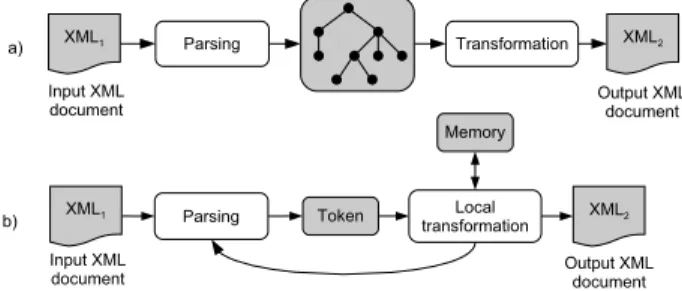
An XML document contains the following basic con-structs: elements, element attributes, and text values. The document may be represented as a tree that is obtained by a natural one-to-one mapping between elements and inter-nal nodes of the tree. The text values appear in the leaves of such tree. Reading a document in document order then exactly corresponds to the preorder traversal of the con-structed tree.
Figure 1: Two types of XML transformation processing: (a) tree-based processing, (b) streaming processing.
to perform only simple transformations, such as renaming elements and attributes, changing attribute values, filtering. It must be extended to perform more complex restructur-ing. The common extensions are (1) allowing more passes over the input document, (2) adding an additional memory for storing temporary data. The extensions can be com-bined1. We obtain the corresponding complexity measures
for streaming processing of XML transformations:
1. the number of the passes over the input tree,
2. the memory size.
It is reasonable to consider the complexity of the stream-ing processstream-ing in relation to the tree-based processstream-ing. As mentioned in Section 1, all XML transformations can be expressed in both XSLT and XQuery, and processed by their tree-based processors. Various transformation sub-classes can be then characterized by putting restrictions on these general transformation languages, typically by ex-cluding certain constructs.
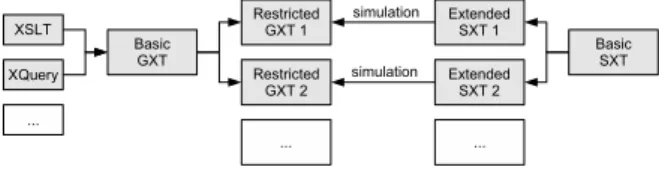
When designing streaming algorithms, we have a choice regarding three settings – the type of the memory used (none, stack, buffers for storing XML fragments), and the values of the two complexity measures mentioned. Stream-ing algorithms with different settStream-ings may capture different transformation subclasses. Since the transformation sub-classes are characterized as some subsets of the general transformation language considered, the key issue in the algorithms is to realize a streaming simulation of the non-streaming constructs included in the restricted language (see Fig. 2).
Figure 2: The streaming simulation of subsets of a general transformation language.
We use tree transducers to design the streaming algo-rithms formally and to model transformation subclasses. They are included in the formal framework for streaming XML transformations that are described in the next section.
3 Formal framework
The framework is intended as a formal base for automatic streaming processors of the general transformation lan-guages. It does not cover all XML transformations. In order to keep the models employed simple and comprehen-sible, it is restricted to model primarily the transformations that capture the relevant problems of streaming processing. In Section 5, a way how some of the restrictions on the transformation set can be overcome in the implementation is described.
The framework consists of the following formal models:
1More passes over the input tree are not possible for XML data streams
that must be processed “on the fly".
Figure 3: A schema of the formal framework.
1. a basic general model for tree-based processing of XML transformations and its restrictions,
2. a basic streaming model for streaming processing of XML transformations and its extensions.
The design of both models results from an analysis of vari-ous tree transformation models, XML transformation mod-els as well as real-world XML transformation languages and systems. They are based on tree transducers, mod-els for tree transformations (25) originated in the formal language theory. We introduce two novel models – a gen-eral XML transducer (GXT)used as the general model, and astreaming XML transducer (SXT)used as the streaming model. They are defined in common terms in order to fa-cilitate development of the simulation algorithms.
The overall schema of the framework is shown in Fig. 3. The basic SXT represents a simple one-pass streaming model without an additional memory. Following the ideas from Section 2, it can be extended by memory for storing temporary data and by allowing more passes over the input document. The basic GXT represents the most powerful general model. As already mentioned, it does not capture all XML transformations, but only a subset significant in the case of streaming processing.
For each extended SXT, the transformation subclass cap-tured is identified by imposing various restrictions on the basic GXT. The inclusion is proved by providing an algo-rithm for simulating this restricted GXT by the given ex-tended SXT.
3.1 Notions and Notations
XML Document Abstraction. In what follows, element attributes and data values are not considered2. LetΣbe an
alphabet of element names. The set ofXML treesoverΣis denoted byTΣ, the empty XML tree is denoted by ε. An
indexed XML treemay in addition have some leaves labeled by symbols from a given setX. A set of XML trees over
Σindexed by X is denoted byTΣ(X). In the rightmost
indexed XML tree, the element of the indexing set occurs only as the rightmost leaf. The set of rightmost indexed XML trees is denoted byTΣ(X)r.
A particular XML treet ∈ TΣ(X)is uniquely specified as a triple(Vt, Et, λt)whereVt is a set of nodes, Et ⊆ Vt×Vtis a set of edges, andλt:Vt→Σ∪Xis a labeling function.
2We refer the reader to (10) for the definition of the extended
Figure 4: An example of the XML tree.
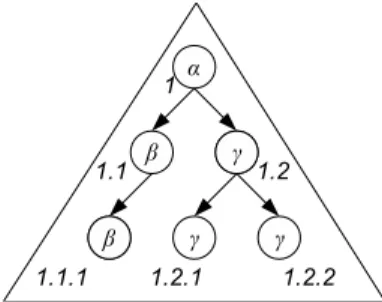
Example 3.1. An XML treet = (Vt, Et, λt)over the al-phabetΣ ={α, β, γ}and the empty indexing setX=∅is shown in Fig. 4. The nodes oftare uniquely identified by dynamic level numbering. The setsVt,Etand the labeling functionλtare defined as follows:
Vt = {1,1.1,1.2,1.1.1,1.2.1,1.2.2}, λt(1) = α, λt(1.1.1) = β, λt(1.1) = β, λt(1.2.1) = γ, λt(1.2) = γ, λt(1.2.2) = γ.
Selecting Expressions. Simple selecting expressions, derived from XPath expressions (26), are used to locate the nodes within the XML tree. The selecting expression is apathconsisting of a sequence ofsteps. It can be either absolute (starting with /), or relative. Thestepconsists of two components – an axis specifieraxisand a predicate pred. They are specified as outlined below. Comparing to the XPath language, the set of expressions is restricted and the syntax of some constructs is simplified – the meaning is explained in parentheses. The semantics of the selecting expressions follows the semantics of the equivalent XPath expressions.
step: axis[pred]
axis: ×(self),
↓(child), ↓* (descendant), ↑(parent), ↑* (ancestor),
←(left sibling), ←∗ (preceding),
→(right sibling), →∗ (following)
pred: ∗ (select all elements)
name (select the elements named name)
i (select the element oni-th position within siblings) step (select the elements having
context specified bystep)
The names of the elements are taken from an alphabetΣ. The set of selecting expressions overΣis denoted bySΣ. The evaluation of a selecting expression in the context of some XML treetand one of its nodesu ∈Vtreturns the same set of nodes oftas the evaluation of the correspond-ing XPath expression. Note that the context set contains a single node only.
3.2 XML Transducers
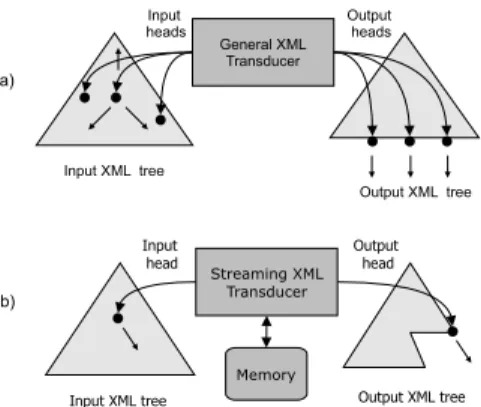
General XML Transducer(Fig. 5a). The input heads of GXT traverse the input tree in any direction and the output is generated from the root to the leaves. At the beginning of a transformation, the transducer has only one input head, which aims at the root of the input tree, and one output head, which aims at the root position of the empty output tree. During a single transformation step, the whole input tree is available as a context. One or more new computa-tion branches can be spawned and the corresponding input control is moved to the input nodes specified by selecting expressions. At the same time, the output heads may gen-erate a new part of the output.
Formally, the GXT is a 5-tuple T = (Q,Σ,∆, q0, R), where
– Qis a finite set of states,
– Σis an input alphabet,
– ∆is an output alphabet,
– q0∈Qis an initial state, and
– Ris a set of rules of the form
Q×Σ→ T∆(Q× SΣ).
For eachq ∈Qandσ ∈Σ, there is exactly onerhs such that(q, σ)→rhs∈Q.
The right-hand side of a rule contains an XML tree over the output alphabet indexed by rule calls– pairs of the form
(q, exp), whereqis a state andexpis a selecting expres-sion that returns a sequence of input nodes to be processed recursively. A simple example of a GXT transformation follows.
Example 3.2. LetT = (Q,Σ,Σ, q0, R)be a GXT where Q={q0},Σ ={α, β, γ}. andRconsists of the rules
(q0, α) → ε , (3.1)
(q0, β) → α((q0,↓[∗])), (3.2)
(q0, γ) → γ((q0,↓[2]),(q0,↓[1])). (3.3)
The transducer processes the input trees over alphabet Σ. The subtrees at nodes named α are completely removed (rule 3.1), the nodes namedβ are renamed and get a new name α(rule 3.2), and at last, when encountering a node namedγ, the first two children are processed in reversed order (rule 3.3).
general transformation languages (XSLT, XQuery). The GXT is tree-walking, i.e., the input tree is traversed in any direction. It allows more computation branches, but it is still sequential model in the sense that during a transforma-tion step only a single rule call is processed.
Figure 5: The processing model of the transducers: (a) the GXT; (b) the SXT.
Streaming XML Transducer(Fig. 5b). The SXT has a single input head that traverses the input tree in preorder, and a single output head that generates the output tree in preorder. Each node is visited twice during a single pass – once when moving top–down, and once when moving bottom–up. Thus, two types of SXT states are recognized (1) the states indicating the first visit of nodes and (2) the states indicating the second visit of nodes. During a single transformation step, the input head either moves one step in preorder or stays at the current position. At the same time, an output action is performed, depending on the type of rule applied. When applying agenerating rule, a new part of the output is connected to the current position of the output head, and then the output head moves to the position under the rightmost leaf of the new part. When applying a closing rule, no output is generated, only the output head is moved one step upwards in preorder within the output tree. Formally, the streaming XML transducer (SXT) is a 5-tupleT = (Q,Σ,∆, q0, R), where
– Q=Q1∪Q2,Q1∩Q2=∅is a finite set of states,
– Σ,∆are the same as in the case of GXT,
– q0∈Q1is the initial state, and
– R=Rg∪Rc,Rg∩Rc =∅is a finite set of rules of the form:
Rg:Q×Σ×P os → T∆(Q× SΣ)r Rc:Q×Σ×P os → Q× SΣ
whereP os = {leaf, no-leaf} × {last, no-last}3.
For each q ∈ Q and σ ∈ Σ there is at most one rhs such that for each pos ∈ P os there is a rule
3Ifpos∈ P osis a node position, its first component is referred by pos[1]and to its second component is referred bypos[2].
(q, σ, pos) → rhs ∈ R4. Furthermore, for each (q, σ, pos) → rhs ∈ R,rec(rhs) = (q0, exp)5, one
of the following preorder conditions holds:
1. moving downwards:q∈Q1, and –pos[1] =no-leaf,q0 ∈Q1,exp=↓[1], or –pos[1] =leaf,q0∈Q2,exp=×[∗],
2. moving upwards:q∈Q2, and
–pos[2] =no-last,q0∈Q1,exp=→[1], or –pos[2] =last,q0∈Q2,exp=↑[∗],
3. no input move:q, q0are of the same kind,exp=
×.
The left-hand side of a rule consists of a state, an element name and a node position. The position is used to deter-mine the preorder move within the input tree and it consists of two predicates – the first one indicating a leaf node, and the second one indicating a last node among the siblings. The right-hand side is an XML tree rightmost indexed by a rule call.
4 An example algorithm
In this section, a particular streaming simulation designed within our framework is presented. In particular, a top-down GXT is simulated by an SXT extended with stack of the size proportional to the height of the input tree.
The stack-based simulation is efficient - in order to eval-uate simple top-down selecting expressions in the branches of the input XML tree the memory size proportional to the length of the branches, which equals height of the input tree, is needed. However, it is shown that a restriction to stack is sufficient. First, the models considered are de-scribed formally.
Restricted GXT.The restricted GXT, called the top-down GXT (TGXT) differs from GXT in the rule definition -R is a set of rules of the form
Q×Σ→ T∆(Q×top-SΣ)
wheretop-SΣis a set of simple top-down selecting expres-sions. It is a subset of selecting expressions such that only top-down axis (child anddescendant) and name predi-cates ([name]) are allowed. The simulated TGXT must in addition satisfy two input-dependent conditions:
1. The TGXT isorder-preservingif and only if, for each of its rules, the input nodes returned by the selecting expressions in the rhs are in preorder for arbitrary in-put treetandu∈Vt.
2. The TGXT isbranch-disjointif and only if, for each of its rules, the input nodes returned by the selecting expressions in the rhs are disjoint for arbitrary input treetandu∈Vt.
Intuitively, if any of the conditions is not satisfied, it may happen that a part of the input tree disproportional to the height of the input tree must be stored in the memory and thus the stack-based simulation is not applicable.
Extended SXT.The extended SXT, called the stack-based SXT (SSXT) is a 7-tuple T = (Q,Σ,∆,Γ, q0, z0, R)
where
– Q,Σ,∆, q0are the same as in the case of SXT,
– Γis a finite set of stack symbols,
– z0∈Γis the initial stack symbol, and
– Ris a finite set of rules of the form: Rg:Q×Σ×P os×Γ →
T∆(Q× SΣ×Γ∗)r
Rc:Q×Σ×P os×Γ → Q× SΣ×Γ∗
The lhs now contains, in addition, the current top stack symbol, and the rhs contains a sequence of stack symbols to be put on the top of the stack. All other symbols have the same meaning as in the SXT.
4.1 Construction of Simulating SSXT
The formal proposition follows. It says that, for each order-preserving and branch-disjoint TGXT, it is possible to con-struct an SSXT inducing equivalent translations.
Proposition 4.1. LetT = (Q,Σ,∆, q0, R)be an order-preserving and branch-disjoint TGXT. Then an SSXT T0
exists such that, for eachtin ∈ TΣ andtout ∈ T∆, ifT
translatestintotoutthenT0translatestintotout.
The simulation proceeds in cycles. During a cycle, a sin-gle transformation step ofTis simulated, called thecurrent transformation step. Such simulation consists of several transformation steps ofT0. A cycle is driven by thecycle
configurationthat consists of three items:
1. current context node- the current input node ofT dur-ing the current transformation step,
2. current rule- the rule ofTapplied during the current transformation step,
3. matched rule call- a rule call of the current rule.
During the whole simulation, the matched rule call repre-sents the leftmost6 rule call, for which a match has been
already found.
At the beginning of the simulation, the current context node is the root node of the input tree, the current rule is the rule ofT of the form(q0, σ)→rhswhereq0is the initial state ofT andσis the name of the root of the input tree. The matched rule call is the left sentinel rule call which is
6The positions of rule calls are always considered with respect to the
preorder of the rhs of the rule.
a virtual rule call positioned to the left from all other rule calls. This special rule call is used to initialize a new cycle. In case no error is encountered, a cycle includes two phases - anevaluation phaseand ageneration phase.
Phase Alternation. During the evaluation phase the input head ofT0traverses the subtree at the current context node in preorder, and at the same time it evaluates all selecting expressions in the rule calls of the current rule. The evalu-ation is accomplished in a standard way by means of finite automata7. Three cases are distinguished depending on the
result of the evaluation phase:
1. A matching node is found for exactly one rule call, and this rule call (newly-matched rule call) is either positioned to the right of the matched rule call or it equals the matched rule call.
This type of cycle is called anentering cyclesince it takes place when the input head ofT0is moving downwards, and a new rule call of the current rule is matched and “recur-sively” processed. The generation phase follows: The out-put head generates a specific part of the outout-put fragment of the current rule. The part is a set of nodes that appear between the matched rule call and the newly-matched rule call. After the generation, the current cycle configuration is stored in the stack. The matched node becomes the new current context node. The rule of the form(q0, σ0)→rhs whereq0 is the state in the newly-matched rule call andσ0 is the name of the matched node becomes the new current rule, and the left sentinel rule call becomes the new cur-rent rule call. A new cycle starts driven by the new cycle configuration.
2. A matching node is found for two or more rule calls, or a matching node is found for a rule call that is po-sitioned to the left of the matched rule call.
This situation occurs in caseTis non-order-preserving and an error is reported.
3. No matching node is found and the whole subtree at the current context node has been traversed.
This type of cycle is called areturning cyclesince it takes place when the input head ofT0 is moving upwards, the processing of some rule call is finished, and the control moves back to the processing of the rule containing this rule call. The current rule is denoted byr. The generation phase follows directly: The last part of the output fragment ofris generated. The top stack configuration becomes the new cycle configuration, and the new cycle starts.
5 Design of XSLT streaming
processor
An automatic streaming processor for XSLT transforma-tions is described which is based on the framework
intro-7This method was, for example, presented in the Y-Filter algorithm
duced. The models within the framework are abstract, and thus the framework provides means to develop efficient streaming algorithms for XML transformation subclasses at abstract level, and to adapt them to an arbitrary general transformation language. First, the general issues regard-ing the framework implementation are described, and then an adaptation for the XSLT transformation language is dis-cussed in more detail.
5.1 Framework Restrictions
As mentioned in the previous section, the formal frame-work is restricted in several ways. Some of the restrictions can be easily overcome in the implementation, while others require more complex handling.
1. Restrictions on the XML document. Attributes and data values are associated with elements. They can be easily added to the implementation – if such con-struct needs to be processed, it is accessed using the same path like the parent element. On the other hand, if the construct needs to be generated in the output, the action is performed together with the generation of the parent element.
2. Restrictions on the selecting expressions. The simple selecting expressions used capture the typical prob-lems that arise during the streaming location of the nodes in XML document (context references in pred-icates, backward axis). Other constructs must be han-dled separately – however, the techniques used for constructs included in our restricted set may be often exploited. Moreover, there has been already carried on a research on the streaming processing of large subsets of XPath language (see Section 6 for overview).
3. Restrictions on the general transformation language. A part of the restrictions in GXT results from the restrictions on selecting expressions, and others are caused by excluding certain general transformation constructs, such as loops, variables, functions. How-ever, the GXT models transformations that reorder the nodes within an XML tree with respect to the docu-ment order, which is probably the most important is-sue in streaming processing of XML transformations if the specific issues concerning selecting expression evaluation are not considered.
5.2 Adaptation for XSLT
Let us now describe the design of the prototype XSLT streaming processor. The GXT represents an abstract model for general transformation languages. Since our in-tention is to adapt the framework for the XSLT language, it does not need to be implemented directly. Instead, we are looking for a correspondence between restricted GXTs and XSLT subsets. The GXT models the XSLT transformations driven by the structure of the input document. Thus, each
XSLT stylesheet consisting of a list of simple templates ac-tivated by structure and mode can be directly converted to GXT. The matching element of such simple template is ref-erenced by a name only and the body of the template may contain several output elements (possibly nested) and calls for applying another templates. The template is called by a selecting expression and a mode.
Specifically, an XSLT stylesheetxslconvertible to GXT consists of (1) an initializing template and (2) several rule templates. Theinitializing templatesets the current mode to the initial state of the GXT.
<xsl:template match="/"> <xsl:apply-templates
select="child::*" mode="q0"/> </xsl:template>
Eachrule templatecan be directly translated to a single rule of GXT. It is of the following form.
<xsl:template match="name" mode="q">
... template body ...
</xsl:template>
The resulting GXT ruleris of the form(q, name)→rhsThus, the left-hand side consists of the element name in thematch at-tribute and the state in themodeattribute. Therhsis created by translation of the template body as described below.
The template body contains a sequence of (possibly nested) output elements andapply-templatesconstructs. An out-put element namednameis specified directly as a pair of tags (alternatively, theelementconstruct might be used):
<name>
...element content ... </name>
Theapply-templatesconstruct has aselectattribute that contains a selecting expression, and amode attribute that represents a state of the resulting GXT.
<xsl:apply-templates
select="selexp" mode="q’"/>
Eachapply-templatesconstruct can be translated to a single rule call. For the case above, a rule call of the form
(q0, selexp)is obtained.
The rhs of the ruleris created from the template body so that each output element corresponds to a single node of rhsand eachapply-templatesconstruct corresponds to a single rule call ofrhs. The structure ofrhsis determined by nesting of the output elements andapply-templates constructs in the template body. The resulting GXT is of the formT = (Q,Σ,∆, q0, R)where
– Qcontains the modes appearing inxsl,
– Rcontains the rules created by translation from par-ticular rule templates as described above. Moreover, Rcontains rule of the form
Figure 6: An implementation of the framework for XSLT language.
for each modeqand nameσ∈Σsuch thatxsldoes not contain a template matchingσin the modeq. Such additional rules correspond to the XSLT implicit built-in rule templates8.
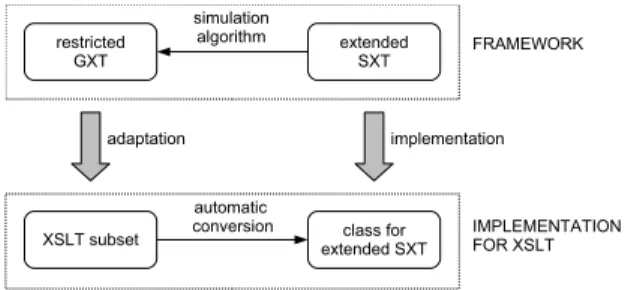
In a similar way, XSLT subsets corresponding to restricted GXTs can be identified. According to the principle of the formal framework, a restricted GXT (GXTr) can be sim-ulated by some extended SXT (SXTe) such that the sim-ulation algorithm is known. Then XSLT stylesheets from the XSLT subset associated withGXTr can be converted toSXTeusing the simulation algorithm. The conversion can be performed automatically since the simulation algo-rithm exactly determines how to convert constructs of the given XSLT subset into the rules ofSXTe. The resulting SXTeis constructed explicitly as an object and its method transf orm()performs streaming processing of the trans-formation specified by the stylesheet. The relation between the formal framework and the implementation for XSLT is shown in Fig. 6.
5.3 Modules of Streaming Processor
To sum up, the streaming processor works in three steps (see also Fig. 7):
1. Analysis. The analyzer examines the constructs in the input XSLT stylesheet (both XPath constructs and XSLT constructs themselves). It checks whether there is specified an XSLT subset that allows all the con-structs encountered. If there are more such subsets, the smallest one is chosen.
2. Translation. The translator creates an object for the extended SXT associated with the XSLT subset cho-sen. The creation is automatic, following the simula-tion algorithm provided for the XSLT subset.
3. Processing. The method transf orm() of the new SXT object is run on the input XML document. The streaming transformation performed is equivalent to the one specified by the input XSLT stylesheet.
8The built-in XSLT rules actually ensure that the resulting GXT is
complete. Note that it is also deterministic sincexslcannot contain two templates matching the same name in the same mode by definition of the valid XSLT stylesheet.
Figure 7: Modules os the automatic streaming processor.
6 Related work
Most of the earlier work was devoted to analyzing the streaming processing of the querying language XPath (1; 2; 6; 7; 14; 16; 22; 24). Recently, several streaming proces-sors for the transformation languages XQuery and XSLT have appeared.
XML Streaming Machine (XSM)(19) processes a subset of XQuery on XML streams without attributes and recur-sive structures. It is based on a model called XML stream-ing transducer. The processor have been tested on XML documents of various sizes against a simple query. Using XSM the processing time grows linearly with the document size, while in the case of standard XQuery processors the time grows superlinearly. However, more complex queries have not been tested.
BEA/XQRL (12) is a streaming processor that imple-ments full XQuery. The processor was compared with Xalan-J XSLT processor on the set of 25 transformations and another test was carried on XMark Benchmarks. BEA processor was fast on small input documents, however, the processing of large documents was slower since the opti-mizations specially designed for XML streams are limited in this engine.
FluXQuery(17) is a streaming XQuery processor based on a new internal query language FluX which extends XQuery with constructs for streaming processing. XQuery query is converted into FluX and the memory size is opti-mized by examining the query as well as the input DTD. FluXQuery supports a subset of XQuery. The engine was benchmarked against XQuery processors Galax and AnonX on selected queries of the XMark benchmark. The results show that FluXQuery consumes less memory and runtime.
SPM (Streaming Processing Model) (15) is a simple one-pass streaming XSLT processor without an additional memory. Authors present a procedure that tries to converts a given XSLT stylesheet into SPM. However, no algorithm for testing the streamability of XSLT is introduced, and thus the class of XSLT transformations captured by SPM is not clearly characterized.
(typically one or two) XML transformations chosen for ex-periments.
In other approaches (3; 13; 21), a new specification lan-guage is developed which supports streaming processing, and the streaming processor for this new language is de-signed. In all cases the connection to the commonly used transformation languages is not clearly stated and the com-putational complexity of the streaming processing is not addressed.
7 Implementation
The formal framework introduced has been implemented on .Net platform. The pilot implementation includes the stack-based algorithm described in Section 4. The evalua-tion of the algorithm implementaevalua-tion shows that it is highly efficient in practice - it requires memory proportional to the depth of the input XML document. Since this depth is gen-erally not depending on the document size and common XML documents are relatively shallow (99% of XML doc-uments have fewer than 8 levels whereas the average depth is 4 according to (20)), the memory requirements for most of the XML documents are constant, independent to the document size. On the contrary, standard XSLT processors are tree-based and thus require memory proportional to the document size. We refer the reader to (11) for a more de-tailed description of the stack-based algorithm implemen-tation and evaluation.
8 Conclusion
A design of an automatic streaming processor for XSLT transformations have been presented. Comparing to other similar processors, the contribution of our approach is that the resource usage for streaming processing of particular types of XSLT transformations is known. Our processor includes several streaming algorithms, and it automatically chooses the most efficient one for a given XSLT stylesheet. The process of choice has a solid formal base – a frame-work consisting of tree transducers that serve as models both for the streaming algorithms and for the transforma-tion types.
In the future work, we plan to include algorithms for the local and non-order-preserving transformations to ob-tain a processor for a a large subset of practically needed XML transformations. We intend to demonstrate the usage of such processor by integration into the Trisolda semantic repository and carry out performance tests and comparison to other implementations subsequently.
Acknowledgement
This work was supported in part by the grant VEGA 1/3106/06.
References
[1] Z. Bar-Yossef, M. Fontoura, and V. Josifovski. On the Memory Requirements of XPath Evaluation over XML Streams. In PODS ’04: Proceedings of the twenty-third ACM SIGMOD-SIGACT-SIGART sym-posium on Principles of database systems, pages 177–188, New York, NY, USA, 2004. ACM.
[2] C. Barton, P. Charles, D. Goyal, M. Raghavchari, M. Fontoura, and V. Josifovski. An Algorithm for Streaming XPath Processing With Forward and Back-ward Axis. InProceedings of ICDE 2003, 2003.
[3] O. Becker. Transforming XML on the Fly. In Pro-ceedings of XML Europe 2003, 2003.
[4] G. J. Bex, S. Maneth, and F. Neven. A Formal Model for an Expressive Fragment of XSLT. Inf. Syst., 27(1):21–39, 2002.
[5] N. Bruno, L. Gravano, N. Koudas, and D. Srivastava. XML & Data Streams. InStream Data Management, pages 59–82. Springer Verlag, 2005.
[6] F. Bry, F. Coskun, S. Durmaz, T. Furche, D. Olteanu, and M. Spannagel. The XML Stream Query Pro-cessor SPEX. InProceedings of ICDE 2005, pages 1120–1121, 2005.
[7] Y. Chen, S. B. Davidson, and Y. Zheng. An Efficient XPath Query Processor for XML Streams. In Pro-ceedings of ICDE 2006, pages 79–79, 2006.
[8] Y. Diao, M. Altinel, M. J. Franklin, H. Zhang, and P. Fischer. Path Sharing and Predicate Evaluation for High-performance XML Filtering. ACM Trans. Database Syst., 28(4):467–516, 2003.
[9] J. Dokulil, J. Tykal, J. Yaghob, and F. Zavoral. Se-mantic Web Repository And Interfaces. In Interna-tional Conference on Advances in Semantic Process-ing SEMAPRO 2007. IEEE Computer Society, 2007.
[10] J. Dvoˇráková and B. Rovan. A Transducer-Based Framework for Streaming XML Transformations. In Proceedings of SOFSEM (2) 2007, pages 50–60, 2007.
[11] J. Dvoˇráková and F. Zavoral. An Implementation Framework for Efficient XSLT Processing. In Pro-ceedings of IDC 2008, Studies in Computational In-telligence, Springer-Verlag, 2008.
[13] A. Frisch and K. Nakano. Streaming XML Trans-formations Using Term Rewriting. InProceedings of PLAN-X 2007, 2007.
[14] P. Genevès and K. Rose. Compiling XPath for Streaming Access Policy. In Proceedings of ACM DOCENG 2005, pages 52–54, 2005.
[15] Z. Guo, M. Li, X. Wang, and A. Zhou. Scalable XSLT Evaluation. InAdvanced Web Technologies and Ap-plications, LNCS 3007/2004. Springer Berlin / Hei-delberg, 2004.
[16] K. Jittrawong and R. K. Wong. Optimizing XPath Queries on Streaming XML Data. InADC ’07: Pro-ceedings of the eighteenth conference on Australasian database, pages 73–82, Darlinghurst, Australia, Aus-tralia, 2007. Australian Computer Society, Inc.
[17] C. Koch, S. Scherzinger, N. Schweikardt, and B. Stegmaier. FluXQuery: An Optimizing XQuery Processor for Streaming XML Data. InVLDB’2004: Proceedings of the Thirtieth International Conference on Very Large Databases, pages 1309–1312, 2004.
[18] X. Li and G. Agrawal. Efficient Evaluation of XQuery over Streaming Data. InVLDB ’05: Proceedings of the 31st international conference on Very large data bases, pages 265–276. VLDB Endowment, 2005.
[19] B. Ludäscher, P. Mukhopadhyay, and Y. Papakon-stantinou. A Transducer-Based XML Query Proces-sor. InProceedings of VLDB 2002, pages 227–238, 2002.
[20] I. Mlýnková, K. Toman and J. Pokorný. Statistical Analysis of Real XML Data Collections. In CO-MAD’06: Proc. of the 13th Int. Conf. on Management of Data, pages 20–31, 2006.
[21] K. Nakano. An Implementation Scheme for XML Transformation Languages through Derivation of Stream Processors. In Proceedings of the Second ASIAN Symposium on Programming Languages and Systems (APLAS’04), 2004.
[22] D. Oltenau, H. Meuss, T. Furche, and F. Bry. XPath: Looking Forward. InProceedings of XMLDM Work-shop, pages 109–127, 2002.
[23] T. Pankowski. Transformation of XML Data Using an Unranked Tree Transducer. InEC-Web, pages 259– 269, 2003.
[24] F. Peng and S. S. Chawathe. XPath Queries on Streaming Data. InProceedings of ACM SIGMOD 2003, 2003.
[25] J. Thatcher. Tree automata: An informal survey. In A. V. Aho, editor,Currents in the Theory of Computing, chapter 4, pages 143–172. Prentice-Hall, 1973.
[26] W3C. XML Path Language (XPath),
ver-sion 1.0, W3C Recommendation, 1999. http://www.w3.org/TR/xpath.
[27] W3C. XSL Transformations (XSLT)
Ver-sion 1.0, W3C Recommendation, 1999. http://www.w3.org/TR/xslt.
[28] W3C. Extensible Markup Language (XML) 1.0
(Fourth Edition), W3C Recommendation, 2006. http://www.w3.org/TR/REC-xml.
[29] W3C. XQuery 1.0: An XML Query