A PROCESS FOR REQUIREMENTS CONCEPTUALIZATION
Alejandro Hossian, Computer Science PhD Program. Computer Science School. National University of La Plata. Argentina, [email protected]
Oscar Dieste, Empirical Software Engineering Research Group. Polytechnic University of Madrid, España, [email protected]
Ramón Garcia-Martinez, Information Systems Research Group. National University of Lanus. Argentina, [email protected]
PRESENTATION
The requirements elicitation process, whose main objective is to give birth to the requirements, not only is a technical process to build a particular system but also an important process of social connotations involving different people (stakeholders), a circumstance which causes certain problems arise when carrying out this process of requirement conceptualization. We propose a process of Requirements Conceptualization that are structured in two phases: (a) Problem-Oriented Analysis: aimed at understanding the problem given by the user in the domain in which this takes place, and (b) Product-Oriented Analysis: its aim is to obtain the functionalities that the user intends to obtain from the software product to be developed, taking into account the relationship of these features with the reality expressed by the user in his speech. Two proofs of concepts are given for the Problem-Oriented Analysis Phase and the Product-Oriented Analysis Phase.
1. INTRODUCTION
The requirements elicitation process, whose main objective is to give birth to the requirements, not only is a technical process to build a particular system but also an important process of social connotations [Sommerville, 2005] that involves different people (stakeholders). It is usual that the process of requirements elicitation causes problems when it is been carrying out [Chatzoglou, 1999]. Similarly, with regard to the stakeholders it is clear that the term is used in reference to any person or group that is affected by the system directly or indirectly, between them can be cited to end users who interact with the system and as well as others who may be affected by the implementation of it (maintenance professionals providing other related systems, experts in the domain of the system, business managers, others).
Now, in light of all the constraints that make mention by Sommerville, proper of requirements elicitation process is that there is a need to explore and analyze those features that are inherent to this process and, as such, contribute to characterize the process. Characterized the task of requirement elicitation, it follows that the axis of it focuses on establishing communication between the User and the Requirements Engineer. When developing their work in elicitation, this must capture and model a reality that frames a problem, whose solution must be approached through a software product. Since this is really an intangible element, usually too complex, it is also difficult to capture.
These problems, taken from the elicitation process, make it difficult for the requirements engineer to develop the stakeholder universe of discourse, as well as the construction of adequate conceptual models [Van der Vos, 1995; Loucopoulos et al, 1995], i.e. these
elicitation and communication between the user and the engineer, probably will be propagated in the activity of construction of conceptual models. These drawbacks inexorably converge towards obtaining low-quality software.
In this context, the problem is focused (Section 2), we propose a process of requirements conceptualization (Section 3), a concept proof of phases problem-oriented analysis and phase product-oriented analysis is given (section 4) and conclusions and future research work is outlined (section 5).
2. PROBLEM DESCRIPTION
The open problem identified in this section, is the need to structure and categorize the information body coming from the elicitation process. The purpose is facilitating the understanding of the problem expressed by the user [Davis, 1993; Faulk 1997], in other words, to conceptualize the requirements. Inadequate treatment of the complexity contained in the user's discourse has been highlighted by several authors [Stucliffe,
1992; Wieringa, 1995], [Faulk, 1997; Jalote, 1997; Chatzoglou, 1999; Juristo et al, 2000;
Davis et al, 2003]. These authors mention the difficulties in building conceptual models
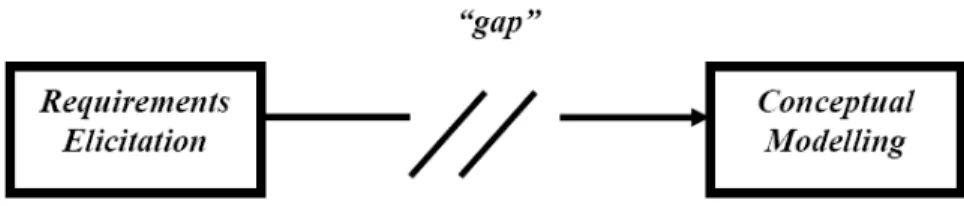
based on the information contained in the elicitation process and reflected in the user's speech. Also worth noting that these difficulties give the analysis process to a degree of immaturity which makes it difficult to perform effectively in this activity, while difficult to adopt this approach in organizations [Moreno, 1999] . Accordingly and pursuant to the foregoing, the open problem addressed in this paper, is a "perception gap" [Stucliffe, 1992, Davis, 1993] in the transition of a process (requirements elicitation) to another process (Conceptual Modeling). This concept is illustrated in Figure 1:
Figure 1. “Gap” between the Requirements Elicitation process and the Conceptual Modeling
Because of this, is clearly a need to conceptualize the requirements stated by the user in his speech before going to the construction of conceptual models in order to reduce complexity and promote understanding referred to the problem described by the user, contributing to the achievement of better quality of Conceptual Models.
3. PROPOSAL OF PROCESS OF REQUIREMENTS CONCEPTUALIZATION
The solution proposed in this work involves the insertion of an activity of Requirements Conceptualization, which aims to act as a bridge or "link" between the activities of requirements elicitation and the activities conceptual modeling, thereby facilitating the understanding of the problem expressed by the user and therefore obtain higher quality Conceptual models [Chen, 1994, Van der Vos, 1995; Chatzoglou, 1999; Juristo et al, 2000; Davis, 2003]. This idea can be displayed on the figure 2 and which shows the absence of the "gap" that is replaced by the activity of Requirements Conceptualization.
Figure 2. Inserting the activity of "Requirements Conceptualization" between the
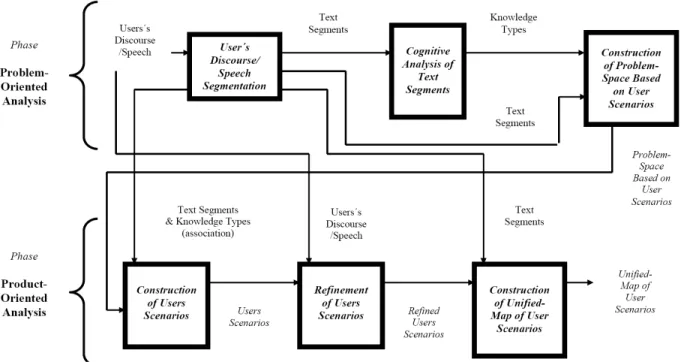
The process of conceptualizing the proposed requirements is done through the so-called Requirements Conceptualization Process which is developed in two phases: (a) Problem-Oriented Analysis, whose goal is to understand the problem posed by the user in the domain in which this takes place, and (b) Product-Oriented Analysis, whose goal is to obtain the functionality that the user intends to obtain from the software product to be developed, taking into account the relationship of these features with the reality expressed by the user in his speech. Figure 3 represents the process of Requirements Conceptualization with focus on interdependence between the phases, tasks and products.
Problem-Oriented Analysis phase is divided into three tasks: (a) "User Discourse/Speech Segmentation", (b) "Cognitive Analysis of Text Segments", and (c) "Construction of Problem Space based on User Scenarios". The "Discourse of Natural Language User" (which from now on in this paper we will call user speech) is the input for the task "User Discourse/Speech Segmentation" that results in the "Text Segments". These segments are the input to task, "Cognitive Analysis of the Text Segments" generating the respective "Knowledge Types". The "Text Segments" and "Knowledge Types" are the inputs for the task "Construction of Problem Space based on User Scenarios" that will result in "Problem Space based on User Scenarios".
Figure 3. Process of requirements conceptualization; detailing: stages, tasks and products
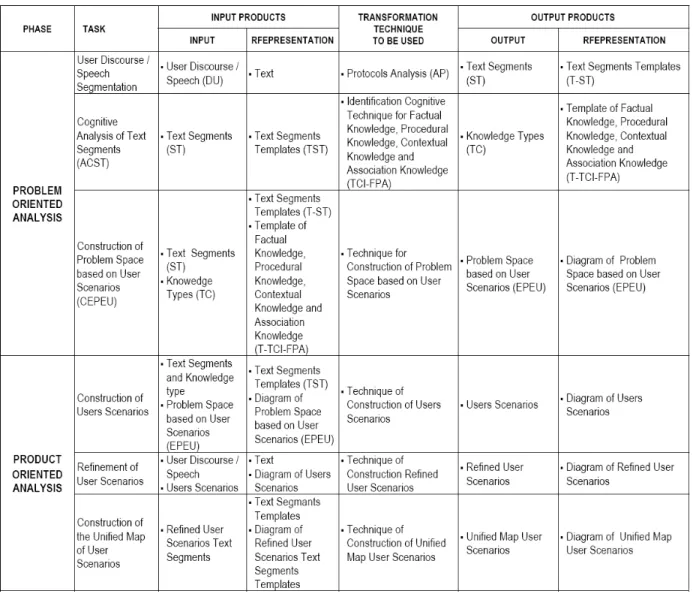
Product-Oriented Analysis phase is divided into three tasks: (a) "Construction of Users Scenarios", "(b) "Refinement of User Scenarios", and (c) "Construction of the Unified Map of User Scenarios". The "Text Segments & Knowledge Types Association" and the "Problem Space based on User Scenarios" constitute the inputs for the task "Construction of User Scenario". These scenarios along with the "User Speech" respectively are the input to task "Refinement of Scenarios User" that generates the respective "Refined User Scenarios". These, and "Text Segments" are the inputs of the task "Construction of the Unified Map User Scenarios", that result in the "Unified Map User Scenarios". The techniques and representations of the tasks in the problem-oriented analysis phase are summarized in Figure 4.
Figure 4. Phase, task and products
4. A Concept Proof of the Proposed Process
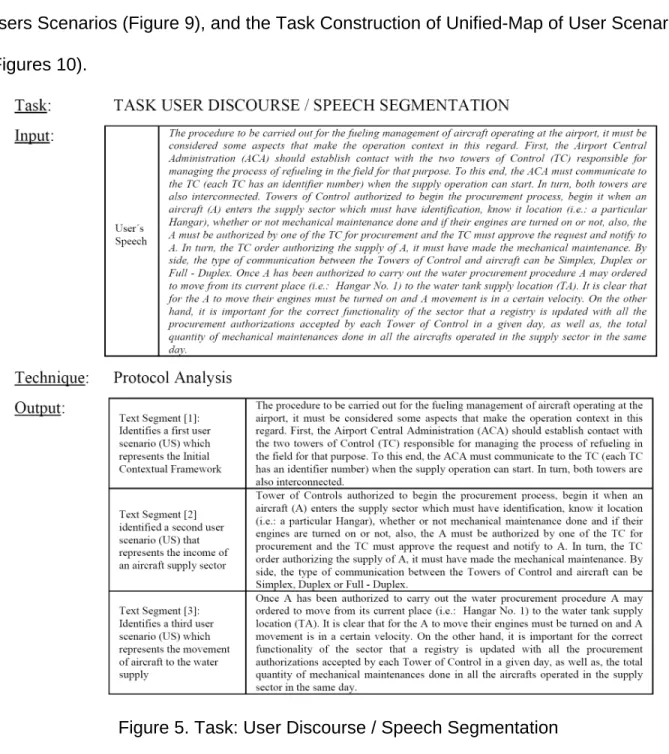
This section presents the example of an Aircraft’s Fuel Supply System as concept proof of the phase "Problem-Oriented Analysis". For each task is described inputs and outputs and the used techniques. There are described: the Task User Discourse / Speech Segmentation (Figure 5), the Task Cognitive Analysis of Text Segments (Figures 6. a, b, c) and the Task Construction of Problem Space based on User Scenarios (Figures 7. a,
b, c), the Task Construction of Users Scenarios (Figure 8), the Task Refinement of Users Scenarios (Figure 9), and the Task Construction of Unified-Map of User Scenarios (Figures 10).
Figure 5. Task: User Discourse / Speech Segmentation
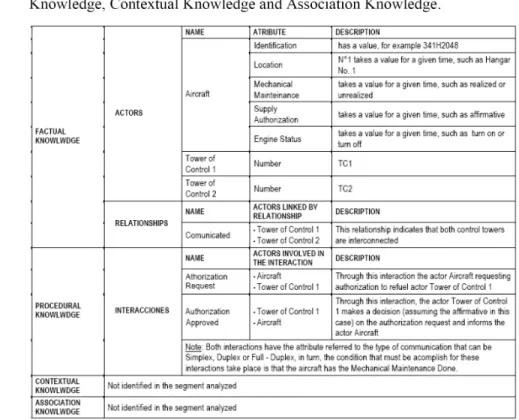
The results of cognitive techniques that have been applied to identify factual knowledge, procedural knowledge, and contextual knowledge and association knowledge with the Text Segments are shown in Figures 6.a, 6.b and 6.c.
Figure 6.a. Task: Cognitive Analysis of Text Segment 1.
Figure 6.c. Task: Cognitive Analysis of Text Segment 3.
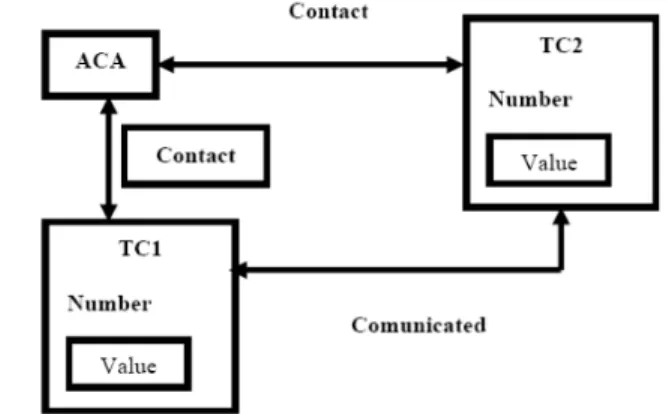
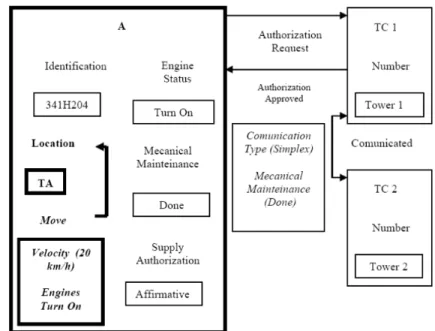
The results of having applied the technique of construction of diagram of problem-space based on user scenarios from templates of factual knowledge, procedural knowledge, contextual knowledge and association knowledge obtained are shown in Figures 7.a, 7.b and 7.c.
Figure 7.a. Task: Construction of Diagram of Problem-Space Based on User Scenarios (Text Segment 1)
Figure 7.b. Task: Construction of Diagram of Problem-Space Based on User Scenarios (Text Segment 2)
Figure 7.c. Task: Construction of Diagram of Problem-Space Based on User Scenarios (Text Segment 3)
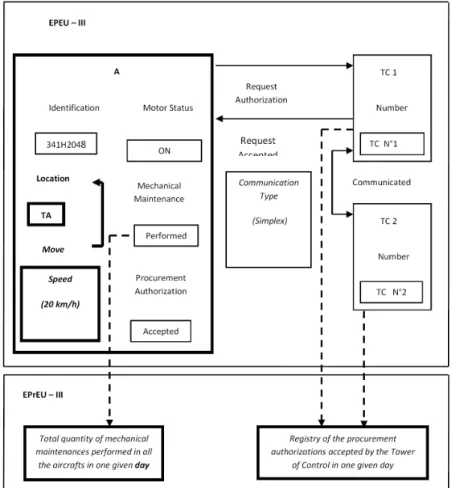
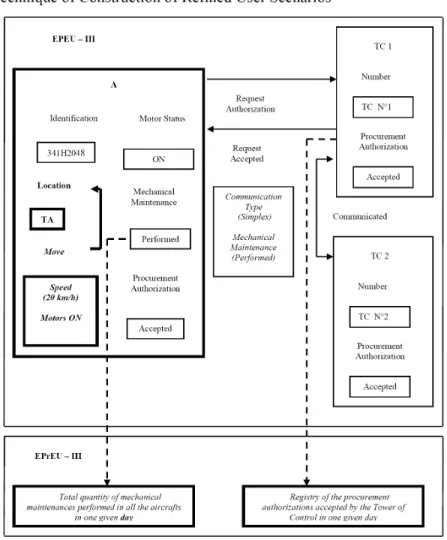
In the Task Construction of Users Scenarios, shown in Figure 8, the requirement engineer proceeds to the building the User Scenario (US) with the building of the blocks corresponding to the Product Space (PrS) for those scenarios in which the functionalities associated to the space problem are identified. In order to perform this task, the requirement engineer has as input products two elements: the Problem Space of the Users Scenarios (EPEU) and the Text Segments with Knowledge Types of Association (STTCA). The result output are the Users Scenarios (US) which are represented by the diagrams that have two blocks corresponding to the Problem Space (PbS) y al Product Space (PrS); which are linked by the arrows between the element (located in the PbS)
of the problem space that are necessary to process the functionality. In this case, the Text Segment [3] is the only one identified as knowledge of association. This knowledge of association allows defining two functionalities which include all the product space
(Registry of the procurement authorizations accepted by the Tower of Control in one
given day and Total quantity of mechanical maintenances performed in all the aircrafts in
one given day).
In the task Refinement of Users Scenarios, shown in Figure 9, the user and the requirement engineer interact together in order to acquire scenarios free of errors and inconsistent. These “debugged” scenarios are called Refined Users Scenarios (RUS).
Figure 9. Task: Refinement of Users Scenarios.
In order to perform this task, the requirement engineer has as input products two elements: the Users Scenarios (US) and the original User’s Discourse / Speech (UD), getting as output the RUS complying the user’s requirements. For this study case, it is
Text Segment [3]: “that a registry is updated with all the procurement authorizations
accepted by each Tower of Control in a given day”. that defines the functionality
“Registry of the procurement authorizations accepted by the Tower of Control in one
given day”. A problem is detected in the User Scenario (US – III) and it is necessary to
add in each Tower of Control actor (TC1 and TC2) the attribute Procurement Authorization with the value Accepted, because these type of authorizations are the only one interested to be registered by this functionality. As a result, the User Scenario that is refined is the third one (US – III).
In the task Construction of Unified-Map of User Scenarios, shown in Figure 10, the requirement engineer works on the construction of the Unified-Map of User Scenarios
(UMUS), which allows documenting the “temporal order” in which the scenarios are
performed. For this task, the requirement engineer has as input products the Text Segments (ST) and the Refined Users Scenarios (RUS), getting as a result the UMUS. The used technique is “Analysis of Transitions of Users Scenarios”, which allows identifying in the Text Segments the elements called “scenario dispatchers” from which the transition is performed. The dispatcher can have three types: 1) context changes in the user discourse, 2) state change in the actors of the scenario (modifying the attribute values) and 3) adding actors to the scenario. In this case, the analysis of Text Segment [1] indicates that the US – 1 is performed by a dispatcher type 1), because it is related to a contextual base frame; the analysis of Text Segment [2] indicates that the US – 2 is performed by a dispatcher type 3), because the aircraft actor is added; and finally the analysis of Text Segment [3] indicates that the US – 3 is performed by a dispatcher type 2), because a change in the state actor aircraft is done when the location attribute is set
from Hangar N°1) to tank supply location (TA). As a result, the UMUS is formed by the US – 1, then by US – 2 and finally by US – 3.
Figure 10. Task: Construction of Unified-Map of User Scenarios.
5. CONCLUSIONS
The main contribution of this paper is to present a methodical process called Requirements Conceptualization, which is divided into two phases, called the Problem Oriented Analysis and Product-Oriented Analysis, and whose main objective is to structure and characterize the mass of information from elicitation activity within the discourse (speech) of the user.
This paper presents two proofs of concept for a specific case about two phases of this process. The first phase has as input the text associated to the User´s Speech (UD) and as an output the Diagram of Problem-Space Based on User Scenarios. To carry out the
Protocol Analysis, Cognitive Techniques for Identification of Factual Knowledge, Procedural Knowledge, Contextual Knowledge and Association Knowledge, and Technique of Construction of Diagram of Problem-Space Based on User Scenarios. The structuration of the Phase of Problem Oriented Analysis into the tasks: User Discourse / Speech Segmentation, Cognitive Analysis of Text Segments and Construction of Problem Space based on User Scenarios; allows the requirements engineer to carry out a systematic analysis of user's speech to reach gradually an integrated representation of the fundamental elements of it.
The next research steps are: [a] develop and execute an experiment to validate empirically the process of requirements conceptualization introduced and [b] to focus on implementing of high quality conceptual models.
6. REFERENCES
Anderson, J. 2006. Cognitive Psychology and its implications – Watson Guptill
Publications.
Carroll, J. 1995. Introduction: The Scenario Perspective on System Development, en "Scenario-Based Design: Envisioning Work and Technology in System Development", editor J. Carroll John Wiley & Sons.
Chatzoglou P., Soteriou A. 1999. A DEA framework to assess the efficiency of the software requirements capture and analysis process. Decision-Sciences. 30(2): 503-31.
Davis, A. 1993. Software Requirements: Objects, Functions and States; Prentice-Hall International.
Faulk, S. 1997. Software Requirements: A Tutorial; In Software Engineering, IEEE
García Martínez, R., Britos, P., 2004. Ingeniería de Sistmas Expertos, Ed Nueva Librería,
Hossian, A., 2003. Tesis de Master en Ingeniería de Software - Universidad Politécnica de Madrid, Madrid.
Jalote, P. 1997. An Integrated Approach to Software Engineering; Springer-Verlag. Juristo, N., Moreno, A. 2000. Introductory paper: Reflections on Conceptual Modeling;
Data and Knowledge Engineering, vol 33.
Loucopoulos, P., Karakostas, V. 1995. System Requirements Engineering; McGraw-Hill,
Moreno, A., 1999. Tesis Doctoral Universidad Politécnica de Madrid, Madrid, 1999. Robertson S. 2002. Project Sociology: Identifying and involving the stakeholders, ICFAI
University Press.
Sommerville, I. 2005. Ingeniería de Software, Addison-Wesley.
Sutcliffe, A., Maiden, N. 1992. Analysing the Novice Analyst: Cognitive Models in Software Engineering; International Journal of Man-Machine Studies, 36(5).
Van der Vos, B., Gulla, J., Van de Riet, R., 1995. Verification of Conceptual Models based n Linguistic Knowledge. NLDB 1995
Wieringa, R. 1995.Requirements Engineering: Frameworks for Understanding; John Wiley.