0
Guidance document on programme development and implementation for the
Ten Year Framework of Programmes on Sustainable Consumption and
Production (10YFP):
Criteria, structure and steps to develop and operationalize them
UNEP, as the 10YFP Secretariat, has developed this paper to provide guidance for the development and implementation of the 10YFP programmes, responding to the 10YFP objectives and the set of criteria for the 10YFP Programmes as stated in the 10YFP adopted document (A/CONF216/5). This is a living document, informed by experience with development of the programmes, and it may evolve during the implementation of the programmes.
The first draft of this paper was sent for comments to National Focal Points, UN Agencies and stakeholders in July 2013. It was reviewed by the 10YFP Board at its first meeting on 1-‐2 October 2013.
During the ongoing public consultations for development of the first five programmes, the need for some clarifications has emerged. Various stakeholders interested in participating in the programmes have requested the Secretariat for more information on the roles and responsibilities of lead actors, the multi-‐stakeholder advisory committees, how to participate and decision making processes in the programmes. This new version addresses those requests, and will be reviewed by the Board at its second meeting (30 March 2014).
DRAFT 6 March 2014
1
Table of Contents
1.
The 10 Year Framework of Programmes on Sustainable Consumption and
Production (10YFP).
... 2
2.
Programmes of the 10YFP
... 3
2.1 What is a 10YFP Programme?
... 3
2.2 Thematic Areas of the 10YFP Programmes
... 3
2.3 Criteria for the 10YFP Programmes:
... 4
3.
Steps to develop the Programmes
... 4
4.
Guidelines for the Structure and Governance of the Programmes
... 6
4.1 Structure and Governance of the 10YFP Programmes
... 6
4.2
Participation and coordination of the Programmes
... 6
4.3 Roles and responsibilities of programmes’ lead actors, Multi-stakeholder
Advisory Committee and partners:
... 8
4.3.1 Role of the Programme lead and co-lead(s):
... 8
4.3.2 Roles and Responsibilities of the Multi-stakeholder Advisory Committee
... 9
4.3.3. Role of Coordinators of the Programme Work Areas
... 11
4.3.4 Role of partners
... 11
5.
Role of the 10YFP Secretariat supporting the 10YFP Programmes
... 11
6.
The programmes and the 10YFP Trust Fund
... 12
7.
Interaction between 10YFP Programmes
... 13
8.
Interaction of the Programme with other mechanisms and activities of the 10YFP
and the 10YFP added value
... 13
Annex I. Template or common format to submit to the Secretariat a proposal for a
10YFP Programme
... 15
2
1.
The 10 Year Framework of Programmes on Sustainable Consumption and
Production (10YFP).
Context, rationale and objectives
At the United Nations Conference on Sustainable Development (Rio+20), Heads of State reaffirmed that promoting sustainable consumption and production (SCP) patterns is one of the three overarching objectives of, and essential requirements for sustainable development. They also reiterated that fundamental changes in the way societies consume and produce are indispensable for achieving global sustainable development.
Furthermore at Rio+20, Heads of State strengthened their commitment to accelerate the shift towards SCP patterns with the adoption of the 10-‐Year Framework of Programmes on Sustainable Consumption and Production Patterns (10YFP), set out in paragraph 226 of the Rio+20 Outcome Document.1
The 10YFP responds to the 2002 Johannesburg Plan of Implementation (JPOI). The framework builds on eight years work of the Marrakech Process2, on regional SCP strategies and initiatives, as well as on
the national cleaner production centres and other SCP policies and practices applied by and engaging with a wide range of governments and other stakeholders.
The 10YFP is a global framework of action to enhance international cooperation to accelerate the shift towards SCP patterns in both developed and developing countries. The framework will support capacity building and provide technical and financial assistance to developing countries for this shift. The 10YFP will develop, replicate and scale up SCP and resource efficiency initiatives, at national and regional levels, decoupling environmental degradation and resource use from economic growth, and thus enhance the net contribution of economic activities to poverty eradication and social development. The framework will encourage innovation and cooperation among all stakeholders. The A/CONF.216/5 document adopted at Rio + 20 provides the vision, goals and common values of the 10YFP as well as its functions, organisational structure, means of implementation, criteria for programme design and an initial, non-‐exhaustive list of five programmes.3 UNEP has been requested
to serve as the 10YFP Secretariat and to establish and administer a Trust Fund to support SCP implementation in developing countries.
All stakeholders from all countries can be involved in the activities of the 10YFP: governments, business and industry (i.e. the private sector), researchers in the scientific and technological community, academia, other major groups including NGOs, as well as UN agencies, financial institutions, and other stakeholders with interest and expertise in SCP.
1 “The Future we Want” Outcome document of the United Nations Conference on Sustainable Development (Rio+20), Rio de Janeiro, Brazil, 20-22 June 2012. (Paragraph 226).
2 The Marrakech Process – a bottom-up multi-stakeholder process - was launched in 2003 by UNDESA and UNEP in order to respond to this call. It identified regional SCP needs and priorities, and supported the development of regional SCP strategies in most regions as well as the implementation of 33 capacity building and demonstration projects worldwide. These included national SCP action plans and seven task forces focused on specific themes. The Marrakech Process supported implementation, capacity building and development of SCP tool kits in the areas of sustainable procurement, tourism, buildings and construction, products, eco-labelling, education and lifestyles, as well as various communications tools and awareness raising activities. For more information see: www.unep.fr/scp/Marrakech
3 Document A/CONF.216/5 is available at www.unep.fr/scp. The text of the 10YFP contained in this document and adopted at the Rio Conference in June 2012 was negotiated at the 19th session of the Commission on Sustainable Development in 2011.
3
2.
Programmes of the 10YFP
2.1 What is a 10YFP Programme?
Programmes are at the core of the 10YFP. They will contribute to meeting the objectives, goals and functions of the 10YFP, responding to national and regional needs, priorities and circumstances. The programmes will build capacity to implement policies, voluntary instruments, management practices, information and awareness raising activities to promote the shift to SCP patterns. The 10YFP will bring together existing initiatives and partnerships working in similar areas, highlighting good practices and success stories, building synergies and cooperation among stakeholders to leverage resources towards mutual objectives and minimize duplication of ongoing efforts. The programmes will support the use of a mix of policy, regulatory and voluntary instruments and set clear objectives, activities and indicators of performance and success.
The programmes of the 10YFP should be broad and flexible allowing for coherence, cooperation, knowledge sharing and strategic channelling of resources in their different areas (e.g. focusing on a sector, or on a cross-‐cutting/thematic SCP issue). The framework will help to prioritize policies, and support development and/or dissemination of tools and methodologies for governments, private sector action, consumer choice and investments which make significant contributions to poverty eradication and sustainable development by promoting SCP.
Likewise, it was recommended that “The 10 Year Framework should draw on valuable aspects of such experiences as the Marrakech Process, the Strategic Approach to International Chemicals Management and national cleaner production centres. The ongoing activities of the Marrakech Process, such as the task forces, should be considered for integration into the structure of the 10-‐year framework of programmes;” (A/CONF.216/5).
2.2 Thematic Areas of the 10YFP Programmes
The 10YFP text adopted includes an indicative and open list of programmes, which “builds on the experience gained through the Marrakech Process, including those areas identified in the regional sustainable consumption and production round tables, strategies and action plans, inter alia.” (A/CONF.216/5). The five initial programmes are:
i) consumer information;
ii) sustainable lifestyles and education; iii) sustainable public procurement (SPP); iv) sustainable buildings and construction; and v) sustainable tourism, including ecotourism.
There is the possibility to develop and launch additional programmes, based on consultations and requests from governments and other stakeholders, taking into account scientific information on SCP priorities at the global, regional and national levels. Proposals for additional programs will be discussed and agreed upon with the 10YFP Board, as per the approved “Criteria and Process for New 10YFP
Programmes Areas”4. If criteria are met, and the Board agrees with the request for new programme
areas, the actors/stakeholders that have made the proposal, will then initiative the proposed five-‐step model (figure 1) for programme development.
4
2.3 Criteria for the 10YFP Programmes:
The 10YFP document provides the following 11 criteria for developing and implementing the sustainable consumption and production programmes included in the 10YFP (A/CONF.216/5, paragraph 7):
a)
Contribute to meeting the goals and principles of the 10-‐year framework of programmes, as well as to the three pillars of sustainable development;b)
Respond to national and regional needs, priorities and circumstances;c)
Be based on life cycle approaches, including resource efficiency and sustainable use of resources, and related methodologies, including science-‐based and traditional knowledge-‐ based approaches, cradle to cradle and the 3R concept, as appropriate;d)
Be based on a solid scientific and policy knowledge base;e)
Be transparent;f)
Be consistent with international obligations, including, where applicable, the rules of the World Trade Organization;g)
Encourage the involvement of all relevant stakeholders;h)
Consider the use of a mix of efficient instruments such as education, training and data collection, as well as research activities in each programme, as appropriate;i)
Have established clear objectives and measures of success;j)
Promote synergies with work in similar areas, in order, inter alia, to promote co-‐benefits and opportunities to leverage resources towards mutual objectives and minimize duplication of ongoing efforts, including in other international forums;k)
Be described in a simple common format, covering the programme criteria mentioned above and identifying lead actors.
For the common format mentioned above see annex I.
3.
Steps to develop the Programmes
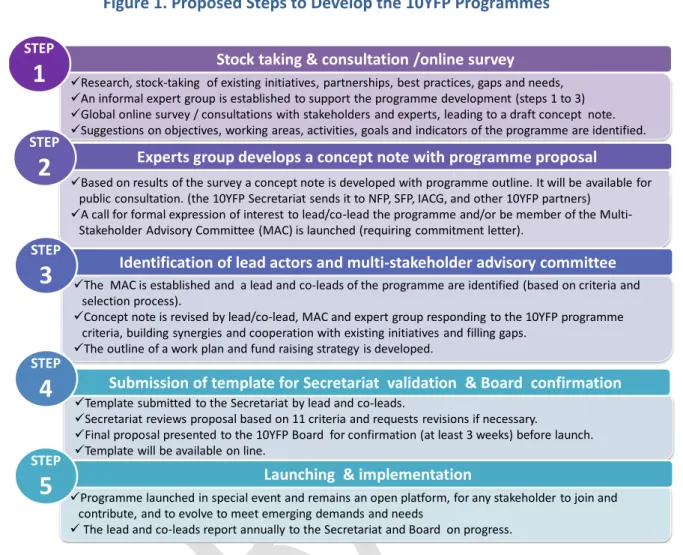
The Secretariat of the 10YFP has initiated and is supporting the consultations for the development and launch of the agreed initial list of five 10YFP Programmes. The first requests from stakeholders to the Secretariat were to provide clear guidance on the programmes objectives, governance and roles of all actors expected to be engaged, as well as the “common format” to register the programmes. This paper aims to fulfil this request. The common format has been developed in consultation with close partners, including relevant UN Agencies. Figure 1 below, describes the proposed and guiding steps to develop the 10YFP Programmes.
The very first step for any interested organization or individual is to contact the 10YFP Secretariat to express interest and enquire on the current status of the development of the related programme. This will help to avoid duplication and enable closer coordination and cooperation.
5
Figure 1. Proposed Steps to Develop the 10YFP Programmes
* In the consultation process (steps 1, 2 and 3) the 10YFP National Focal Points (NFP), Stakeholder Focal Points (SFP) and the Inter-‐Agency Coordination Group (IACG) will be invited to participate and provide inputs. The 10YFP Board will be informed periodically on the development of the programmes.
As stated in the 10YFP document (A/CONF.216/5): “Programmes can be launched under the 10YFP immediately following registration with the Secretariat.” And furthermore: “The secretariat of the 10YFP will maintain a list of all programmes, projects and initiatives under the 10YFP as a living document, to be updated regularly as new programmes, projects and initiatives join. This list will provide an information tool to help in identifying partners and resources to support particular programmes and initiatives.
üResearch, stock-‐taking of existing initiatives, partnerships, best practices, gaps and needs, üAn informal expert group is established to support the programme development (steps 1 to 3) üGlobal online survey / consultations with stakeholders and experts, leading to a draft concept note. üSuggestions on objectives, working areas, activities, goals and indicators of the programme are identified.
Stock taking & consultation /online survey
üBased on results of the survey a concept note is developed with programme outline. It will be available for public consultation. (the 10YFP Secretariat sends it to NFP, SFP, IACG, and other 10YFP partners)
üA call for formal expression of interest to lead/co-‐lead the programme and/or be member of the Multi-‐ Stakeholder Advisory Committee (MAC) is launched (requiring commitment letter).
Experts group develops a concept note with programme proposal STEP
2
üThe MAC is established and a lead and co-‐leads of the programme are identified (based on criteria and selection process).
üConcept note is revised by lead/co-‐lead, MAC and expert group responding to the 10YFP programme criteria, building synergies and cooperation with existing initiatives and filling gaps.
üThe outline of a work plan and fund raising strategy is developed.
Identification of lead actors and multi-‐stakeholder advisory committee STEP
3
üTemplate submitted to the Secretariat by lead and co-‐leads.
üSecretariat reviews proposal based on 11 criteria and requests revisions if necessary.
üFinal proposal presented to the 10YFP Board for confirmation (at least 3 weeks) before launch. üTemplate will be available on line.
Submission of template for Secretariat validation & Board confirmation STEP
4
üProgramme launched in special event and remains an open platform, for any stakeholder to join and contribute, and to evolve to meet emerging demands and needs
üThe lead and co-‐leads report annually to the Secretariat and Board on progress. Launching & implementation STEP
5
STEP
6
4.
Guidelines for the Structure and Governance of the Programmes
Any programme structure and operation will have to enable the participation of different stakeholders, and address the diverse regional and national priorities. The programmes should be flexible to allow creativity, innovation and their evolution over time, for effective delivery of support at national and regional levels for the shift to SCP patterns. Operational guidelines taking account of these requirements are needed, based on the vision, objectives, functions and goals of the 10YFP.
4.1 Structure and Governance of the 10YFP Programmes
A programme will serve as an umbrella bringing together existing initiatives and partnerships, and facilitating new joint projects and activities responding to regional and national (sub-‐national) priorities and needs.
The programmes provide a voluntary and collaborative platform in which various parties (governmental, non-‐governmental, public and private) agree to work together in a systematic way to achieve the overarching goals and objectives of the 10YFP and the specific objectives of the programme.
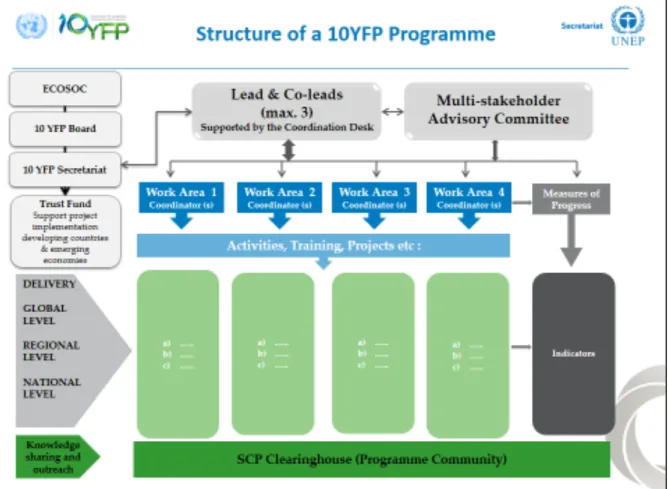
A 10YFP programme could: a) focus on sectors that are resource intensive and of high economic importance (e.g. food, mobility, buildings, tourism), or b) be cross sectoral, focusing on a policy area or instrument (e.g. sustainable public procurement, education and lifestyles, consumer information). Likewise, a programme could include different work areas, and will ideally deliver support at all levels (global, regional and national). For example, a programme on Sustainable Lifestyles and Education could be comprised of different work areas such as: 1) research and innovation, 2) enabling policy and infrastructure, 3) formal and informal education for SCP, and 4) collaboration with business/private sector. The programme could be implemented through existing and/or new partnerships and initiatives.
Each programme will have a lead and co-‐lead(s), a Multi-‐stakeholder Advisory Committee (MAC), coordinators and partners, as well as a Coordination Desk (see figure 2).
4.2
Participation and coordination of the Programmes
Participation in a 10YFP programme is open to any government (national, regional and local, from any UN member state), relevant regional or national organizations, international organizations (including IFIs), industry or business organizations, non-‐governmental/civil society organizations or academic institutions, or any other entity that supports the goals of the 10YFP and agrees to work towards them, based on their respective competencies, comparative advantage and resources.
The governance and coordination of each programme will be based on the following principles: • One lead with at least one and up to two co-‐lead actors will support the overall coordination,
implementation, fundraising activities and monitoring of the programme, and will provide the resources needed to create and sustain its “Coordination Desk”. The term of the lead and co-‐ leads will be 4 years, renewable if agreed in consultation with the MAC.
• A Multi-‐stakeholder Advisory Committee (MAC) is established based on various criteria, including expertise, regional and stakeholder balance. The MAC members will support in a cooperative way the overall coordination, implementation and monitoring of the programme, as well as further resource mobilization. The term of the members of the MAC is 2 years,
7
renewable for up to two terms. The composition of the MAC will be reviewed at the end of each term (with reference to implementation achieved and ensuring regional and stakeholder balance). The MAC in its first term will establish its own Terms of Reference and working modalities, including, if necessary, adjusted rotation and renewal rules to be applied after the initial term. It is recommended to have at least 1/4 of the MAC members change at the end of each term.
• Coordinators of a programme work area: without having to be a lead / co-‐lead or a member of the MAC, any entity with significant expertise in the specific programme area can also become a coordinator of a programme work area if it contributes to the programme objectives by providing resources (including in-‐kind contributions or expertise) for implementation of activities. This coordination role will be discussed and agreed with the lead actors and the MAC.
• Partner: in addition, any stakeholder supporting implementation and/or benefiting from the activities of the programme could be a partner of a programme. Those activities include workshops, trainings, making use and supporting dissemination of the materials, including policy and capacity-‐building tools and reports produced by the programme. Partners do not necessary need to provide technical and/or financial support.
• A Coordination Desk will be established for each programme with resources, including staff, provided by the lead and co-‐leads of the programme.
Figure 2: Structure of a 10YFP Programme: working areas and deliverables
8
4.3 Roles and responsibilities of programmes’ lead actors, Multi-‐stakeholder Advisory
Committee and partners:
Roles and responsibilities across all programmes will be consistent with the vision, objectives, functions and goals of the 10YFP on SCP, including the aforementioned eleven criteria.
4.3.1 Role of the Programme lead and co-‐lead(s):
The lead and co-‐lead(s) for each programme could be a government, UN agency, NGO, private sector body, or specialized technical institution that has recognized competencies in the area. The 10YFP Programmes could have a maximum of three leading the programme: 1 lead and 1 or 2 co-‐lead(s), with, whenever possible, regional and stakeholder balance. Together the lead and the co-‐lead(s) will have the following responsibilities, inter alia:
• support the overall coordination of the programme implementation and pro-‐actively fundraise for the programme;
• provide financial and/or in-‐kind contribution, including dedicated staff, in support of a “Coordination Desk” in charge of operational work (each programme will need a minimum of 1 or 2 full time staff to start operating).
• jointly supervise the work of the Coordination Desk (whose tasks could be executed from different geographical locations);
• chair and co-‐chair the MAC meetings, facilitate the decision-‐making within the Committee and support its activities, including those related to securing support from the 10YFP Trust Fund; • encourage inputs and sharing of information/knowledge and strategies among all partners in
the programme as well as with external partners/initiatives that could join the programme, finding synergies and building cooperation;
• help construct concrete linkages and provide coordination between initiatives within the programme and across the other programmes of the 10YFP, as relevant;
• promote the programme at meetings and conferences, where relevant, and build networks and partnerships regionally and globally.
• communication and outreach activities, including the co-‐management, with the 10YFP Secretariat, of the programme-‐specific community of the Global SCP Clearinghouse (www.scpclearinghouse.org), as the main interface with and between partners, for knowledge management, sharing and dissemination of tools and lessons learned, public relations, etc.; • act as liaison and focal point for contacts with the Secretariat;
• at its discretion, create adhoc task teams to address any specific, technical and/or emerging issues.
• report on progress and outcomes as required, including through the preparation of an annual report for the 10YFP Secretariat to convey to the Board and to be included in the 10YFP report to ECOSOC -‐ as the add interim review Body of the 10YFP.
In addition, it is recommended that the lead entity of the programme takes responsibility for secretariat functions, including organization of meetings and conference calls, programme and financial management, as well as reporting activities. Other respective responsibilities and tasks -‐ e.g.
9
supervision of specific work areas (each of which will have a coordinator), convening major events -‐ will be defined and agreed by the lead and co-‐leads of the programme.
To this end, a Coordination Desk for each of the programmes will be established with the resources, including staff, provided by the lead and co-‐leads, to implement on a daily basis these secretariat functions and responsibilities, serving the objectives and needs of the programme.
a) Criteria for lead and co-‐leads:
Any government (national, regional and local, from any UN member state), relevant regional or national organizations, international organizations (including UN agencies), industry or business organizations, non-‐governmental/civil society organizations or academic institutions, or any other entity that supports the goals of the 10YFP and agrees to work towards them can apply to become a lead or a co-‐lead of a specific 10YFP programme. The lead and co-‐lead(s) should:
• demonstrate an active or leading role in supporting the shift towards sustainable consumption and production patterns at national and/or regional levels;
• provide resources (including in-‐kind contributions or expertise) for coordination and implementation of activities under this programme; and
• ensure minimum commitment to remain engaged for at least four years;
Moreover, the representative of the lead and co-‐lead(s) should preferably demonstrate: • expertise and knowledge on policy-‐making, including on sustainable consumption and
production or related policies, as well as good understanding of the international agenda on sustainable development, including at the regional and global levels;
• experience in performing work related to promoting sustainable consumption and production (SCP) patterns; and
• competencies and skills to coordinate international partnerships, and information networks with governments and other stakeholders
b) How to express interest
• Any entity willing to express interest in becoming a lead or co-‐lead of a specific programme is requested to send a formal commitment letter to UNEP, using the template provided online by the 10YFP Secretariat. Click here (commitment letter).
• If more than three entities are applying to act as lead or co-‐lead of a specific programme, a discussion will be facilitated within the Multi-‐stakeholder Advisory Committee (MAC -‐ see below) and by the 10YFP Secretariat to reach a consensus based on, whenever possible, regional and stakeholder balance. If no consensus is reached, the members of the MAC will vote to select the lead and co-‐leads of the programme, up to the maximum number of three.
4.3.2 Roles and Responsibilities of the Multi-‐stakeholder Advisory Committee
A programme will be an open and inclusive platform, and it will include a Multi-‐stakeholder Advisory Committee (MAC), with a maximum of 20 members to ensure effective coordination and cooperation. The MACs will be established based on SCP expertise, regional and stakeholder balance.
10
• review goals, objectives and measures of success, based on the initial programme’s work plan, with the aim of providing guidance on progress towards more sustainable consumption and production patterns;
• review on the performance and evolution of the programme’s work plan, advise on and proactively engage new partners, initiatives and activities in the line with the objectives of the programme, as well as in response to emerging demand and priorities;
• enhance synergies and cooperation among stakeholders within the programme as well as with other programmes of the 10YFP;
• propose projects and/or activities for implementation in accordance with the work plan of the programme;
• provide guidance to the 10YFP Secretariat for the elaboration of calls for proposals for the 10YFP Trust Fund, in the area of the programme, and to screen and short list proposals received based on established criteria;
• be active in outreach and fundraising to support the expansion and continuity of the programme. • provide relevant advice and feedback on the implementation of the programme activities.
• participate in quarterly teleconferences organised by the lead/co-‐leads and hold in-‐person meetings, at least once per year.
• Initial term members will, furthermore, be responsible for drafting and adopting the specific Terms of Reference and the working modalities of the MAC.
a) Criteria for the members of the Multi-‐stakeholder Advisory Committee
• Any government (national, regional and local, from any UN member state), relevant regional or international organizations, industry or business organizations, non-‐governmental/civil society organizations or academic institutions, or any other entity that supports the goals of the 10YFP and agrees to work towards them can apply to become a member of the MAC of a specific programme.
• The composition of the MAC ideally could reflect a diversity of partner categories and geographic regions, ensuring:
• regional balance, with at least one government representative from each of the five regional groups of the UN, namely: Africa, Asia and the Pacific, Western Europe and Others Group, Latin America and the Caribbean and Eastern Europe;
• representation of at least one UN agencies or intergovernmental organization, two non-‐ governmental organizations, and one business organization when applicable to the related programme;
• gender balance, with the objective of ensuring gender equality whenever possible among the representatives of the MAC members; and
• diverse areas of expertise and stakeholder focus.
In this context, members of the MAC should:
• demonstrate strong interest and/or recognized expertise and experience, if possible reflected in policies and actions, in the area of the programme;
• have played an active or leading role in supporting the sustainable consumption and production and/or sustainable development agenda at the national and/or regional levels;
11
• agree to ensure a legal, transparent and representative governance structure to the programme with appropriate accountability to members on decisions and actions taken by consensus or through voting or other democratic processes;
• ensure a minimum commitment to remain engaged for at least two years; and
• possess the organizational means and time to perform the required tasks and responsibilities, without monetary compensation.
b) Selection process of MAC
• The Multi-‐stakeholder Advisory Committee (MAC) should be composed of a maximum of 20 members, unless decided otherwise in the Terms of Reference and modalities of work adopted during the first term.
• Interested parties will submit a commitment letter to be member of the MAC.
• For the first term of the MAC, and in the circumstance of more than 20 entities applying to become members, the 10YFP Secretariat will:
- facilitate a collegial discussion among applicants to enable them to reach a consensus on the composition of the MAC. The proposal will be submitted to the 10YFP Secretariat and to the Board for their validation, based on the criteria listed above;
- if no consensus can be reached among applicants, the 10YFP Secretariat and the Board will decide on the composition of the MAC based on the criteria listed above.
4.3.3. Role of Coordinators of the Programme Work Areas
Coordinators of a programme work area are not necessarily members of the Multi-‐Stakeholder Advisory Committee, but can take an active role in coordinating one or more of the programme work areas. When coordinating a work area of the programme, they are responsible for ensuring that the related activities are delivered in an inclusive and effective manner. They bring their expertise, expand their networks and partnerships, build synergies and help scale-‐up and replicate best practices on SCP at all levels.
Stakeholders interested to coordinate one of the working areas may submit a formal letter expressing interest to the lead actor that will consult and agree with the MAC.
4.3.4 Role of partners
Any stakeholder supporting implementation and/or benefiting from the activities of the programme could be a partner of a programme. Those activities include workshops, trainings, making use and supporting dissemination of the materials, including policy and capacity-‐building tools and reports produced by the programme. Partners do not necessarily need to provide technical and/or financial support.
Stakeholders interested to become a partner may submit a formal letter expressing interest to the lead actor that will consult and agree with the MAC.
5.
Role of the 10YFP Secretariat supporting the 10YFP Programmes
The 10YFP Secretariat will be supporting the programmes by:12
• facilitating consultation for the development and launching of the programmes, providing platform for online questionnaires, and supporting identification of relevant and interested donors, lead/co-‐ leads, members of the MAC, and coordinators, ensuring regional and stakeholder balance;
• provide platforms and opportunities for the programmes in convening working groups and trainings at relevant 10YFP and SCP meetings at the international, regional and national levels, based on the countries and stakeholders demand and needs;
• identify synergies between the 10YFP Programmes and the existing Regional SCP Strategies, in order to promote cooperation and advance the implementation of regional, sub-‐regional and national SCP priorities;
• coordinating calls for proposals under the Trust Fund of the 10YFP and providing support to each of the 10YFP Programmes for fund raising activities;
• providing the Global SCP Clearinghouse, as a dynamic and decentralized portal that will allow the programme leader/co-‐leads, MACs, and partners to share information, have an online database and collect/showcase best practices;
• inviting stakeholders to contribute to relevant reports and publications, where they can showcase their best practices and work;
• convening meetings and webinars with programme lead/co-‐leads, MAC and partners to share experience, best practices and explore areas of cooperation -‐ ideally all programme leaders will meet at the international meetings of the 10YFP;providing templates and guidance for annual reporting, and
• reporting the progress of programmes to ECOSOC
6.
The programmes and the 10YFP Trust Fund
As stated in the 10YFP adopted document, UNEP has been invited, as the 10YFP Secretariat, to establish and administer the 10YFP Trust Fund. The Trust fund aims at mobilizing voluntary contributions in a stable, sustained and predictable manner from multiple sources, including public/donor contributions, the private sector and other sources, including foundations.
The 10 YFP is a global framework on SCP to be implemented all counties: developed and developing, and economies in transition. However, the 10YFP Trust Fund will only support sustainable consumption and production projects in developing countries and countries with economies in transition, as appropriate, and promote the transparent allocation of resources. Donors, the private sector and others will be encouraged to contribute to the Trust Fund, providing general support to the 10YFP, as well as support to specific programmes and initiatives responding to the national and regional priorities of developing countries.
The Programmes actors (lead, co-‐leads, MAC, coordinators and partners) will be able to prepare project proposals to receive support from the 10YFP Trust Fund.
The leads/co-‐leads and Multi-‐Stakeholder Advisory Committees (MACs) of the 10YFP Programmes, will be asked to support the screening for the submission of project proposals to the Trust Fund. They will advise on a short list of eligible project proposals to received financial support from the Trust Fund, which will undergo further screening and selection by the 10YFP Board and Secretariat. They will:
• screen project proposals related to the work area of their 10YFP programme, ensuring relevance and good technical structure of the projects, and that project proposals respond to the 10YFP objectives, as well as to the 11 criteria;
13
• provide feedback on proposals and technical advice, providing a short list of eligible project proposals; and
• follow up and support when requested by the selected project partners the development and implementation of the funded projects.
7.
Interaction between 10YFP Programmes
The programmes of the 10YFP will be encouraged to build cooperation transversally, identifying areas for cooperation and synergies. For example, the programme on Sustainable Tourism could have important contributions to the programme on Sustainable Lifestyles and Education (information to tourist on sustainable choices and behaviour), as well as to t the Programme on Sustainable Building and Constructions and provide guidelines for design and planning of new hotels, at the same time that collaborates with the Sustainable Public Procurement. Likewise, all programmes could support each other on areas such as indicators and research necessary for a holistic approach to achieving SCP, based on lifecycle analysis.
The international and regional meetings as well as the webinars that the 10YFP Secretariat will convene will serve as important platforms that will allow all the programme leads, MAC, Coordiantors and partners to share experience, best practices and explore areas of cooperation -‐ ideally all programme leaders will meet at the international meetings of the 10YFP.
Al programmes need to identify areas of cooperation and synergies with other programmes of the 10YFP, in order to ensure a bigger collective impact and a lifecycle thinking.
The 10YFP Secretariat has developed the “Global SCP Clearinghouse”. This Clearinghouse has been designed to support the 10YFP programmes and their leader(s), MACs, and partners to share information, coordinate action and enhance cooperation, through a specific “community of practice”. The Clearinghouse provides various tools such as an online database to register SCP initiatives from all stakeholders and countries, open and private working groups, calendar of events, E-‐library and thematic newsletters, among other tools. (see: www.scpclearinghouse.org).
8.
Interaction of the Programme with other mechanisms and activities of the 10YFP
and the 10YFP added value
The 10YFP Programmes are at the core of the framework. They are to contribute to promoting and implementing SCP, bringing together existing initiatives and partnerships working in similar areas, building synergies and cooperation between stakeholders to leverage resources towards mutual objectives and minimizing duplication of effort. The programmes are important mechanisms to meet the goals and principles of the 10YFP, responding to national and regional needs, priorities and circumstances. They will encourage the involvement of all relevant stakeholders, use a mix of policy instruments and set clear objectives, activities and indicators of success.
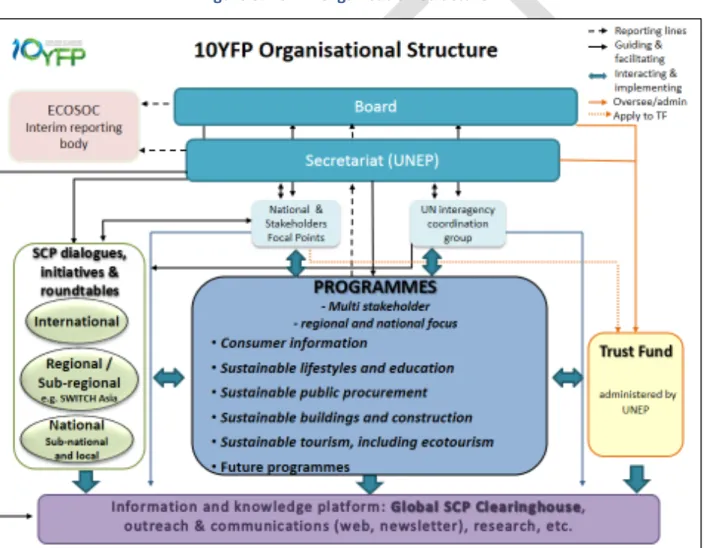
The programmes will be contributing to the overall development and implementation of the 10YFP (see figure 3). They will support activities at the global, regional and national levels, as well as interacting with the Secretariat, the Board, the UN Agencies and the national and stakeholder focal points. More specifically, the programme lead/co-‐leads, MAC members, coordinators or work areas, and partners will undertake the following activities and gain support and enhance collective impact through them. These activities and benefits are applicable to all 10YFP partners in both developed and developing countries, and economies in transition. 10YFP partners will:
1. contribute to the delivery of technical support and demonstration projects, capacity building, and awareness raising activities on SCP responding to needs and demands from regions and countries;
14
2. have direct access to the 10YFP activities and meetings at all levels (international, regional, national) and will contribute to an increased recognition of this area/theme as being critical in the shift towards SCP patterns, which will increase visibility and potentially financial support;
3. optimize the use of their resources (in addition to finding new sources of funding) through strengthening existing and/or building new partnerships/cooperation within and beyond the 10YFP;
4. showcase their work at global and regional levels through the 10YFP platform, its partners, activities and the Global SCP Clearinghouse, which shares knowledge and best practices on SCP; 5. actively contribute to the organization of working groups and capacity building activities related to
the Programme area, advancing the implementation of the existing SCP Regional strategies, national SCP Action plans, and other SCP policies, initiatives or trainings; and
6. be able to apply for and benefit from funding of the 10YFP Trust Fund, supporting the implementation of SCP activities in developing countries and economies in transition.
Figure 3: 10YFP Organisation Structure
15
Annex I. Template or common format to submit to the Secretariat a proposal for a
10YFP Programme
The template below needs to be read together with the 10YFP adopted document. A/CONF.216/5 available at: www.unep.org/10yfp
.
T
ITLE OF THEP
ROGRAMME:
TITLE1. Please list the overall objectives of the programme and how success will be measured (adjust table as relevant)
(See sub-‐paragraph 7.i of document A/CONF.216/5)
Objective 1 measure(s) of success
Objective 2 measure(s) of success
Objective 3 measure(s) of success
2. Please describe how the programme will contribute to meeting the goals / common values of the 10YFP as well as to the three dimensions of sustainable development?
(See paragraphs 1 and 2 including all related sub-‐paragraphs describing the agreed goals and common values of the 10YFP, and sub-‐paragraph 7.a of document A/CONF.216/5)
3. What are the main work/focus areas and related activities of the programme?
(Does it provide technical and/or financial support, capacity building, and/or provide new SCP methodologies and tools? See sub-‐paragraph 7.h of document A/CONF.216/5, which refers to a mix of efficient instruments such as education, training, data collection and research. Other work areas including dialogue activities, knowledge management, national implementation, may be considered)
Work/focus areas
(e.g. research, communication, education, policy advice, capacity
building)
Activities*
(e.g. training, demo project, guidelines, contributing to the Global Clearinghouse, etc)
Budget Secured
(yes, no) If yes, source
16
* Please indicative with an” N” if the activity is new; and with a ”E” if it is an existing one.
4. Please explain how the programme responds to regional and national (sub-‐national and local) needs, priorities and circumstances in developed and/or developing countries.
(See sub-‐paragraphs 2.a referring to the necessity for the 10YFP to be flexible, 2.g referring to specific circumstances of countries and productive systems and criterion 7.b of document A/CONF.216/5)
5. How does this programme build cooperation and synergies with other existing programmes of the 10YFP? (the initial list of 10YFP programmes include: i) consumer information; ii) sustainable lifestyles and education; iii) sustainable public procurement (SPP); iv) sustainable buildings and construction; and v) sustainable tourism, including ecotourism ).
6. How will this programme contribute to sustainable, inclusive and equitable global growth, poverty eradication, employment opportunities and shared prosperity? (e.g. contributes to meeting basic needs, to new economic opportunities and a better quality of life) (See sub-‐ paragraphs 7.a and 1.c of document A/CONF.216/5.)
7. Please describe how the programme activities are based (or will be based) on a solid scientific and policy knowledge base?
(See sub-‐paragraph 7.d of document A/CONF.216/5. For instance, cooperation and dialogue activities, knowledge sources, references and data used to develop and implement the programme can be described here.)
8. Please describe how the programme uses or relies on a life cycle and/or other relevant approaches (traditional knowledge based, resource efficiency, cradle to cradle, 3R, etc.)
17
(See sub-‐paragraphs 1.c.vii and 7.c of document A/CONF.216/5. These approaches can be reflected in the objectives and activities of the programme as well as in the instruments, capacity building activities, and methodologies the programme will be mobilizing.)
9. Who are the lead and co-‐lead actors of the programme?
(See sub-‐paragraph 7.k of document A/CONF.216/5. Lead and co-‐lead actors could be any stakeholder able to support and coordinate the development and implementation of the programme, including fund raising.)
Name of organization and
name of responsible
person
Type1
Scale2
Role and
responsibilities
Focal point3
1 Government, international or regional organization, civil society, academia, business sector, other stakeholder. 2 please specify if global, regional, national or sub-‐national, local communities cities;
3 Name, title and contact details
10. Please list the main actors (MAC members and coordinators of work areas, and any relevant partner) in the development and implementation of the programme
(See sub-‐paragraphs 2.h referring to the need to reduce fragmentation and support synergies in activities related to SCP, while avoiding duplication, 7.g and 7.j of document A/CONF.216/5, referring to the involvement of all relevant stakeholders, as well as to the promotion of synergies with work in similar areas to promote co-‐benefits and opportunities to leverage resources towards mutual objectives and minimize duplication of ongoing efforts, including in other international
forums.)
Name
Type1
Scale2
Role and
responsibilities