Overview: Orchestrating Life’s Processes
The development of a fertilized egg into an adult requires a precisely regulated program of gene expression
Understanding this program has progressed mainly by studying model organisms
Stem cells are key to the developmental process
Orchestrating proper gene expression by all cells is
© 2014 Pearson Education, Inc.
Concept 16.1: A program of differential gene
expression leads to the different cell types in a
multicellular organism
A fertilized egg gives rise to many different cell
types
Cell types are organized successively into tissues, organs, organ systems, and the whole organism
Gene expression orchestrates the developmental
A Genetic Program for Embryonic Development
© 2014 Pearson Education, Inc.
Cell differentiation is the process by which cells
become specialized in structure and function
The physical processes that give an organism its shape constitute morphogenesis
Differential gene expression results from genes being regulated differently in each cell type
Cytoplasmic Determinants and Inductive Signals
An egg’s cytoplasm contains RNA, proteins, and
other substances that are distributed unevenly in the unfertilized egg
Cytoplasmic determinants are maternal substances
in the egg that influence early development
As the zygote divides by mitosis, the resulting cells contain different cytoplasmic determinants, which lead to different gene expression
© 2014 Pearson Education, Inc. Figure 16.3
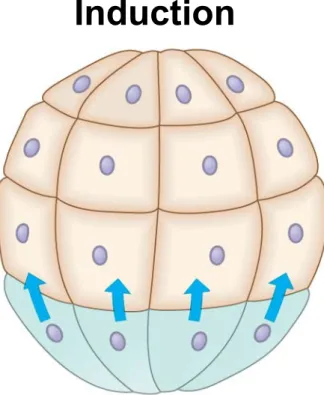
(a) Cytoplasmic determinants in the egg (b) Induction by nearby cells Unfertilized egg Early embryo
The other major source of developmental information is the environment around the cell, especially signals from nearby embryonic cells
In the process called induction, signal molecules from embryonic cells cause transcriptional changes in nearby target cells
© 2014 Pearson Education, Inc.
Sequential Regulation of Gene Expression During
Cellular Differentiation
Determination commits a cell irreversibly to its
final fate
Differentiation of Cell Types
Today, determination is understood in terms of molecular changes, the expression of genes for tissue-specific proteins
The first evidence of differentiation is the production
of mRNAs for these proteins
© 2014 Pearson Education, Inc.
To study muscle cell determination, researchers grew embryonic precursor cells in culture and analyzed them
They identified several “master regulatory genes,” the products of which commit the cells to becoming skeletal muscle
Figure 16.4-3
Other muscle-specific genes Nucleus Master regulatory
gene myoD
DNA
OFF OFF
OFF
mRNA mRNA mRNA mRNA
MyoD Embryonic precursor cell MyoD protein (transcription factor) Another transcription factor Myosin, other muscle proteins, and cell cycle– blocking proteins Myoblast
(determined)
Part of a muscle fiber (fully differentiated cell)
© 2014 Pearson Education, Inc.
Apoptosis: A Type of Programmed Cell Death
While most cells are differentiating in a developing organism, some are genetically programmed to die
Apoptosis is the best-understood type of
“programmed cell death”
Apoptosis also occurs in the mature organism in cells that are infected, damaged, or at the end of their
During apoptosis, DNA is broken up and organelles and other cytoplasmic components are fragmented
The cell becomes multilobed and its contents are packaged up in vesicles
These vesicles are then engulfed by scavenger cells
© 2014 Pearson Education, Inc.
Apoptosis is essential to development and maintenance in all animals
It is known to occur also in fungi and yeasts
In vertebrates, apoptosis is essential for normal
Figure 16.6
1 mm Interdigital tissue Cells undergoing apoptosis
© 2014 Pearson Education, Inc.
Pattern Formation: Setting Up the Body Plan
Pattern formation is the development of a spatial
organization of tissues and organs
In animals, pattern formation begins with the establishment of the major axes
Positional information, the molecular cues that
Pattern formation has been extensively studied in the fruit fly Drosophila melanogaster
Combining anatomical, genetic, and biochemical approaches, researchers have discovered
© 2014 Pearson Education, Inc.
The Life Cycle of Drosophila
Fruit flies and other arthropods have a modular structure, composed of an ordered series of
segments
In Drosophila, cytoplasmic determinants in the
Figure 16.7
0.5 mm Head Thorax Abdomen
Dorsal Ventral Posterior Anterior Right Left (a) Adult BODY AXES Larval stage
(b) Development from egg to larva Segmented embryo Body segments Fertilized egg Unfertilized egg Egg developing within ovarian follicle Hatching 0.1 mm Embryonic development Egg shell Depleted nurse cells Fertilization Laying of egg
© 2014 Pearson Education, Inc.
The Drosophila eggs develop in the female’s ovary, surrounded by ovarian cells called nurse cells and follicle cells
After fertilization, embryonic development results in a segmented larva, which goes through three stages
Figure 16.7b-5
Larval stage
(b) Development from egg to larva Segmented embryo Body segments Fertilized egg Unfertilized egg Egg developing within ovarian follicle Hatching 0.1 mm Embryonic development Egg shell Depleted
nurse cells Fertilization Laying of egg
© 2014 Pearson Education, Inc.
Genetic Analysis of Early Development:
Scientific Inquiry
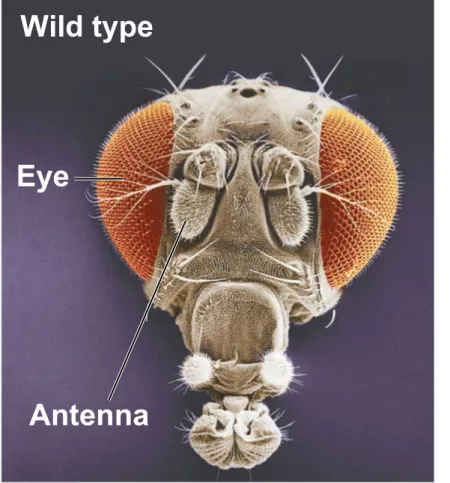
Edward B. Lewis, Christiane Nüsslein-Volhard, and
Eric Wieschaus won a Nobel Prize in 1995 for decoding pattern formation in Drosophila
Lewis discovered the homeotic genes, which
Figure 16.8
Wild type
Eye
Antenna
Mutant
© 2014 Pearson Education, Inc.
Nüsslein-Volhard and Wieschaus studied segment formation
They created mutants, conducted breeding
experiments, and looked for the corresponding genes
Many of the identified mutations were embryonic
lethals, causing death during embryogenesis
Axis Establishment
Maternal effect genes encode cytoplasmic
determinants that initially establish the axes of the body of Drosophila
These maternal effect genes are also called
egg-polarity genes because they control orientation of
© 2014 Pearson Education, Inc.
One maternal effect gene, the bicoid gene, affects the front half of the body
An embryo whose mother has no functional bicoid
gene lacks the front half of its body and has duplicate posterior structures at both ends
Figure 16.9
Head Tail
Tail Tail
Wild-type larva
Mutant larva (bicoid) T1 T2 T3
A2 A3
A1 A4
A8
A5 A6A7
A8 A6
A7
A8 A7
© 2014 Pearson Education, Inc.
This phenotype suggested that the product of the mother’s bicoid gene is concentrated at the future anterior end and is required for setting up the
anterior end of the fly
This hypothesis is an example of the morphogen gradient hypothesis; gradients of substances called
morphogens establish an embryo’s axes and other
The bicoid mRNA is highly concentrated at the anterior end of the embryo
After the egg is fertilized, the mRNA is translated into Bicoid protein, which diffuses from the anterior end
The result is a gradient of Bicoid protein
Injection of bicoid mRNA into various regions of an embryo results in the formation of anterior structures at the site of injection
© 2014 Pearson Education, Inc. Figure 16.10
Anterior end 100 m
Bicoid protein in early embryo
Results
Bicoid protein in early embryo
Bicoid mRNA in mature unfertilized egg
Bicoid mRNA in mature unfertilized egg
Fertilization, translation of
The bicoid research is important for three reasons
It identified a specific protein required for some early
steps in pattern formation
It increased understanding of the mother’s role in
embryo development
It demonstrated a key developmental principle that a
© 2014 Pearson Education, Inc. Figure 16.UN02