CWTS Working Paper Series
Paper number CWTS-WP-2010-002
Publication date March 2, 2010
Number of pages 25
Email address corresponding author [email protected]
Address CWTS Centre for Science and Technology Studies (CWTS) Leiden University
P.O. Box 905 2300 AX Leiden The Netherlands www.cwts.leidenuniv.nl
Discarding the ‘basic science/applied science’
dichotomy:
A Knowledge Utilization Triangle classification
system of research journals
Discarding the ‘basic science/applied science’ dichotomy:
A Knowledge Utilization Triangle classification system of
research journals
Robert J.W. Tijssen
Center for Science and Technology Studies (CWTS), Leiden University, The
Netherlands. E-mail: [email protected]
This paper introduces a new system for classifying scholarly journals in terms of
their degree of ‘application orientation’. The method extends earlier models and
journals classification systems that were designed to tackle the crude duality
between ‘basic research’ and ‘applied research’. The metrics-based classification
system rests on a ‘Knowledge Utilization Triangle’ typology, which distinguishes
three types of co-existing knowledge application domains: ‘clinical’, ‘industrial’
and ‘civic’. The empirical data for each journal metrics relate to the institutional
origin of authors who publish their research papers in scientific journal literature.
The case study applies ‘clinical relevance’ and ‘industrial relevance’ to 11 000
journals indexed by the Web of Science database. The resulting multidimensional classification system of journals comprises of six Journal Application Domain categories. Macro-level trend analysis of the WoS-indexed research publication
output by JAD category reveals redistributions within global science during the
years 1999-2008, with a slight increase of output published in ‘industrially
Introduction
Science is a complex adaptive system. Statistical studies of the system’s
structural properties are stifled by fundamental conceptual and methodological
problems. One of them is the commonly adopted definition of ‘basic research’ and
‘applied research’. The traditional understanding of ‘basic science’ relates to the
relevance for problems internal to science, while ‘applied science’ corresponds to
relevance external to science itself.1
Developing quantitative measures that truly capture the differences between
basic research and applied research are impossible for a lack of comprehensive
and systematic data. As a result, progress on empirical modeling of science
systems, and how science evolves, is hampered by this crude and outdated
dichotomy between ‘basic research’ and ‘applied research’.
Rather than using the ‘basic-applied’ perspective of knowledge production, and
(possible) economic usage, this paper opts for an analytical perspective focusing
on knowledge producers (authors of research publications) and usage within the
scientific communities (absorbing and using the contents of publications). And
rather than trying to classify research activities intrinsically according to the
associated type of research, this approach offers the required empirical
information on research characteristics that is amenable to systematic
measurement. It offers the possibility to develop a metrics and measurement
criteria ranging across the spectrum from ‘basic’ to ‘applied’. The next section
provides a brief overview of these concepts and earlier work on classification
systems. The following section introduces the methodological approach for the
new journal-based classification system. The Findings section applies the
classification system to a large set of journals indexed by the Web of Science database. In the final section the paper concludes by reviewing the method’s
current methodological constraints as well as its potential for further applications
and improvements.
Previous work
The concept of ‘basic research’ has been a topic on science policy and research
funding agenda’s for many decades. Attempts to arrive at a standardized
definition, mostly for the purpose of statistical surveys, were often a subject of
1 From a purely epistemological perspective all sciences could be seen as ‘applied’, in
academic studies and heated debate among statisticians, especially within the
USA and the Organisation for Economic Cooperation and Development (Godin, 2003). Many taxonomies and classification systems dealing with the various types
of research have been proposed and rejected; almost 40 years ago, Rothschild
(1972) identified as many as 45 in the literature.
The leading ‘official’ definition nowadays, endorsed by many statistical offices
worldwide and institutionalized in their statistical surveys, was developed by the
OECD and features in its Frascati Manual (OECD, 2002): ‘Basic research is experimental or theoretical work undertaken primarily to acquire new knowledge of the underlying foundation of phenomena and observable facts, without any particular application or use in view.’ The manual elaborates by stating: ‘The reference to no ‘particular application in view’ in the definition of basic research is crucial, as the performer may not know about actual applications when doing the research or responding to survey questionnaires. The results of basic research are not generally sold but are usually published in scientific journals or circulated to interested colleagues.’ The OECD, fully aware of the definition’s shortcomings,
Despite all the OECD’s good intentions and efforts, these definitions still lack
sufficient clarity in terms of to measurable aspects of research inputs, outputs or
impacts. As a consequence, statisticians, scientometricians and other analysts
have been forced to contend themselves with these rather fuzzy notions and
descriptions, which in turn continues to hamper thorough comparative statistical
analyses of science (Godin, 2003). Fortunately, some conceptual and
methodological progress has been made outside the realm of the statistical offices
to devise categories of research activities that transcend the ‘basic/applied’
duality. OECD’s ‘oriented basic research’ concept resonates with views of Stokes
(1997) who introduced the concept of ‘Pasteur’s Quadrant’ to question the
legitimacy of this duality for describing and analyzing the general patterns and
trends within contemporary science. The quadrant is framed by two key questions
regarding the ultimate goal of research activities: is it driven by quest for
fundamental understanding (yes/no), and are there considerations for use
(yes/no)? The quadrant comprises of three meaningful categories:
• Pure applied research; • Use-inspired research; • Pure basic research.
This extension from two to three categories introduces the ‘context of
application’ perspective and creates a middle ground of ‘use-inspired’ categories
within a classification system. However, similarly to the OCEC definitions, Stokes’
conceptual framework lacks an analytical model to translate these categories into
systematic large-scale collection of empirical data and comparative quantitative
measurement.
The only method available thus far, is one of developed by CHI Research (Philadelphia, USA) in the 1980s.2 This classification system of science is based
on expert assessments of individual research journals, which are assigned to one
of four categories (‘levels’ in CHI terminology) according to a journal’s degree of
‘appliedness’ as reflected in its contents (Noma, 1986; Hamilton, 2003). CHI Research designed two related classification systems. The field-specific classification system dealt exclusively with the biomedical fields, where a journal
is labeled by one of the following levels:
1. Clinical observation;
2 CHI Research was a research-based consultancy company founded in 1968 to
provide information services to both government and private clients in the USA. Its staff
members, including the Director Francis Narin, were active contributors to the
scientometrics community from the early 1970s, to the late 1990s. Francis Narin has now
2. Clinical observation and investigation;
3. Clinical investigation;
4. Basic biomedical research.
CHI’s ‘generic’ classification system covers all other fields of science:
1. Applied technology;
2. Engineering science - technological science;
3. Applied research - targeted basic research;
4. Basic scientific research.
Both classification systems have been used extensively within a range of
empirical studies, both by staff members at CHI Research (e.g. Narin and Rozek, 1988; Hicks and Hamilton, 1999) as well as others (e.g. Brusoni and Geuna,
2003; Lewison and Paraje, 2004; Lim, 2004), mainly to describe and analyze
macro-level features of science as represented in bibliometric studies of the
research literature. Systematic measurements and metrics require objective
statistical data that are generally seen as valid empirical evidence. Various
unresolved issues however remain with regard to the validity of those four
categories and their discriminatory power, and therefore, by extension, the
empirical base and conceptual relevance of the classification system as such.
Unfortunately, the documentation available in the open literature provides no
clarification as to the underlying rationale or theory employed by CHI Research to design these classification systems, nor to the methodological rigor of the way in
which journals were attributed to categories. Not surprisingly, this method has
not been embraced by government statistical offices.
Nonetheless, for lack of feasible alternatives, using research journals as an
entry point to collect comprehensive empirical data remains an attractive
approach for developing more elaborate classification systems of science.
Methodology
Some of methodological problems can be partially circumvented by introducing
a general typology of journals based on the concept of the ‘institutional research
environment’, i.e. the organizational environment in which research activities are
conducted. The notion of classifying research activities according to the
institutional environment of researchers dates back to the 1960s (Reagan, 1967),
an idea further explored by a series of studies during the 1970s (e.g. Falk, 1973;
Brooks, 1980; Langenberg, 1980).
Two of those environments are particularly relevant: the business sector and
managerial structures, incentive systems, organizational routines and economic
forces that affect the choice of research objectives and the extent to which
knowledge creation processes are aimed at meeting the need for practical
applications by (end) users outside academia. The common underlying
assumption is that an applications-oriented research environment is a sufficiently
robust proxy measure for applications-oriented research, especially within
aggregate-level large-scale systematic studies that comprise a large quantity of
research articles produced within these environments. In the case of the business
sector (industry mainly), the research agenda’s and activities are devoted to
topics and outputs with possible medium-term or longer-term commercial
applications in the market place. In the medical sector the applications should
related to public health care, such as improvements of medical technologies,
novel drugs, or therapeutic treatments.
Journals that contain publications (co-)authored by the corporate sector
authors, are therefore more likely to represent ‘applications-oriented science’3
relevant for (science-based) industry and other business sector organizations.
Peer-reviewed learned journals with a large share of corporate authors likely to
perceive industrial R&D staff as one of their major ‘target groups’. Likewise,
journals publishing many research articles originating from staff employed by
general hospitals and medical centers represent ‘applications-oriented science’
relevant for clinical practice. A third (minor) domain of science-based knowledge
utilization is the ‘civic sector’: government agencies, ministries, and other public
sector organizations. Journals with authors from this sector would represent
‘applications-oriented science’ for a wide variety of topics ranging from public
management and policy, economic forecasting, legal issues, to accounting and
taxation. Some journals may have no publications listing corporate sector
addresses or medical sector addresses, or at best negligible fractions. These
journals, with a predominantly academic authorship (including university medical
centers), are hence considered to be ‘basic’ – i.e. more oriented towards
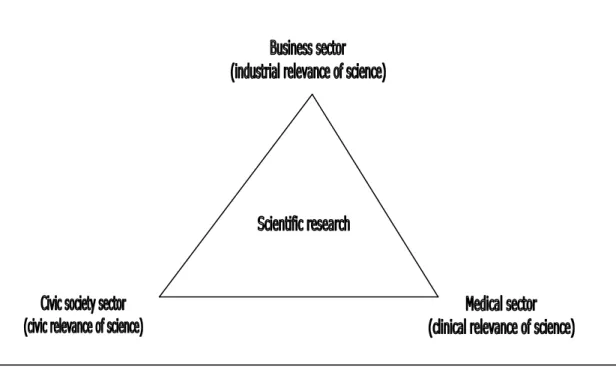
curiosity-driven, exploratory ‘discovery-oriented research’. Figure 1 presents a
stylized graphical model based on a ‘Knowledge Utilization Triangle’ typology of
science-based application domains, where ‘scientific research’ is located at its
core as the source of information and knowledge while the different types of
application domains define its edges. The triangle comprises a spectrum of
research activities and application domains without clear-cut boundaries.
3 ‘Applications-oriented science’ is meant to encompass to a range of synonyms used
within the academic and statistics literature, such as ‘directed research’, ‘strategic
FIG. 1. Knowledge utilization triangle: application domains of scientific research.
Based on the scores along each hypothetical axis, radiating of the core, one
can profile each journal according to its degree of relevance within major
domains. Journals with a high score in either domain, and hence located closest
to an edge of the triangle, are classified as ‘application oriented’; those with a low
score are seen as ‘discovery oriented’ and reside in the centre of this triangle.
Those core journals are predominantly journals with ‘academic’ contributors
employed by universities or other public sector research-performing
organizations. The corresponding journal classification system distinguishes three
major domains of research applications: the medical and health sector, the
business sector, and the civic society sector. Accordingly, the classification
system assigns each journal three percentages, each ranging from 0 to 100:
• Clinical relevance - % of author affiliate addresses referring to a general hospital, medical center or clinic;
• Industrial relevance - % of author affiliate addresses referring to a business enterprise on another type of private sector organization;
• Civic relevance - % of author affiliate addresses referring to local, national or supranational government agencies, ministries, or other civic society
organizations (e.g. societies, trade unions).
This classification methodology is platform-independent. It can be applied to
(open access) journals or other sets of documents that describe research findings.
It is therefore suitable and applicable to any comprehensive bibliographical
database containing published research outputs, notably the large
multidisciplinary databases such as Thomson Reuters Web of Science or Elsevier’s SCOPUS, but also disciplinary databases such as PubMed/Medline. The next section describes a first application of the journal classification system: the Web of Science database.
Application
Web of Science database
The current edition of the classification system was applied to scholarly journals
indexed by Thomson Reuters’ Web of Science database (WoS).4 All bibliographic records of a WoS-indexed publications, across the 10 years time-period
1999-2008, were scanned for author affiliate addresses. The data collection was
restricted to journals of sufficient size for statistical analysis, i.e. those with a
total of publications containing more than 50 different author affiliate addresses
in 1999-2008. Journals that operated under one or more consecutive names, or
name variants, during this period were merged into a single ‘standardized’ journal
title. The smallest journals, those that were discontinued by publishers or very
intermittently indexed by the WoS, were discarded. A total of 11 558 journals
were entered into the analysis.
Note that the coverage of ‘civic sector’ research publications is limited within
the WoS given the type of journals represented in this database. There are
relatively few serials in the database with a strong focus on (local) societal issues
and practical problems that would attract a large ‘civic sector’ authorship. It
would require a significant extension of the database (trade journals, professional
journals and report series) to provide the same level of coverage as the medical
research literature and the industrial research literature. The remainder of this
case study is therefore restricted to clinical relevance and industrial relevance.
As for the operationalization of industrial relevance, each author affiliate
address was assigned to the corporate sector if the publication was registered
within CWTS’ Corporate Research Publications database (see Tijssen et al., 2009). The top 3 journals with the largest share of corporate addresses are: Japan
4 Pertains to the Web of Science (WoS) operated by CWTS under a license agreement with
the database producer Thomson Reuters. The WoS used in this study includes the
Telecommunications Review; Review of the Electrical Communications Laboratories; Fujitsu Scientific & Technical Journal.
In the case of clinical relevance, each address was assigned to the medical
sector if the bibliographic information within the CWTS/WoS information system
complies with two selection criteria:
1. Author address information includes one or more of the following character
strings: ‘Hosp’, ‘Klinikum’, ‘Kliniken ‘, ‘Med Ctr’, ‘Ctr Med’, ‘Coll Med’, ‘Med
Coll’, ‘Clin Ctr’, ‘Hlth Ctr’, ‘Infirm’, ‘Infirmary’, ‘Policlin’, ‘Ziekenhuis’, ‘Hop ‘,
‘Spital’, ‘Osped ‘, ‘Psychiat Klin’ and ‘Oncol Ctr’;
2. CWTS has not assigned the publication to the higher education sector.
The top 3 journals with the largest degree of ‘clinical relevance’ are: King Faisal Specialist Hospital Medical Journal; Journal of the American Podiatry Association; Journal of the Maine Medical Association.
Introducing the second criterion excludes university hospitals and academic
medical centers. These organizations are assumed to be primarily engaged basic
‘discovery oriented’ research. The distinction between university hospitals and
other university organizations is often also blurred in author affiliate addresses
because academics often simply list their university as affiliate address, with no
mentioning of the hospital, clinic or other medical centre. General hospitals that
are assumed to be primarily engaged in ‘application oriented’ clinical research and
applications of medical science as compared to their academic counterparts.
However, the exclusion of the university hospitals and medical centers from the
medical sector remains problematic given the lack of a clear-cut division between
the university-affiliated medical institutes and those outside the university
system. In practice, similar application domains occur in both types of
organizations, notably the intermediate ‘transfer’ orientation often referred to as
‘translational research’. Also, it is not uncommon for research staff having
affiliations in both kinds of institutes, nor is uncommon that general hospitals
participate in academic research projects (e.g. in clinical trials).
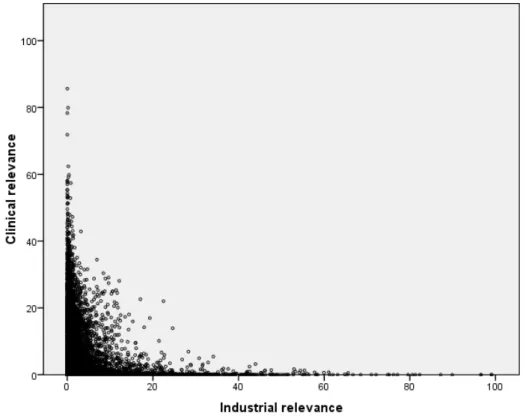
Figure 2 depicts the scatter of the journals on the ‘clinical relevance’ axis and
the ‘industrial relevance’ axis. Both distributions are extremely skewed towards
the bottom end, reflecting the predominantly academic authorship of the
WoS-indexed journals. Both distributions have a mode equal to 0, a median value
(50% percentile) of 1.2. The mean score on ‘clinical relevance’ equals 4.4;
whereas ‘industrial relevance’ mean equals 3.7. The distributions clearly indicate
that each metric represents a distinct knowledge utilization dimension (the
Pearson correlation coefficient between both metrics equals r=-0.14). Many of the
industry and medicine, including research fields relevant to clinical trials of new
drugs, and likely to include research articles (co-)produced by research staff at
biopharmaceutical companies as well as by hospital staff (further elaborated in
Table 3).
FIG. 2. Journal distribution across knowledge utilization domains (% of addresses
referring to the corporate sector or medical sector).
Comparison with the CHI Research classification system
How do these metrics relate to CHI Research’s 4-level classification system?
Only a subset of 5517 WoS-indexed journals can be labeled by CHI Level, where
more recently indexed journals will be under-presented. The CHI-indexed journals
were distributed across the four levels as follows: 1. n=978 (18%); 2. n=1 375
(25%); 3. n=1 369 (25%); 4. n=1 795 (32%). Cross-distributions of the
FIG 3a. Distribution of scores on clinical relevance per CHI level (% of addresses
referring to the medical sector)
FIG 3b. Distribution of scores on industrial relevance per CHI level (% of
Figure 3a, relating to clinical relevance, shows the expected outcome: as the
CHI level become more ‘basic’ (Level 4), the share of addresses referring to the
medical sector declines. There is a considerable spread within each level, with the
weakest correspondence between CHI levels and clinical relevance categories is at
its weakest in the ‘applied’ segment of the journal distribution (Levels 1 and 2).
Significant correlation coefficients are found between CHI levels and clinical
relevance scores: Pearson correlation coefficient P=-0.38 and Spearman’s rho
coefficient ρ=-0.19 (both coefficients are significant at the 0.01 level).
In Figure 3b, dealing with industrial relevance, the same general pattern
occurs but the intra-level spread is even larger than in the case of clinical
relevance, where the CHI level fails to make any meaningful distinction within the
applied Levels 1 and 2. Somewhat lower, but still significant, correlation
coefficients are found between CHI levels and the industrial relevance scores:
Pearson correlation coefficient P=-0.19 and Spearman’s rho coefficient ρ=-0.12
(both are significant at the 0.01 level).
In view of the fact that the CHI Research classification system dates back to the 1980s and 1990s, or at very least back to 2002-2003 (Hamilton, 2003), many
journals might have shifted their cognitive emphasis in recent years – some
becoming more ‘applied’, others more ‘basic’. Part of the observed discrepancy
between the classification systems might therefore allude to changes in journal
editorial policies, and associated shifts in content and institutional origins of
authors that may have occurred in recent years. However, the major part of the
striking differences between the relevance scores and the CHI classification
system are left unexplained, which suggests that the discriminatory power of the
relevance scores seems superior, especially in identifying and categorizing the
applications-oriented journals.
Validation studies
To gauge the validity of the ‘industrial relevance’ and ‘clinical relevance’
metrics one needs an independent information source to describe a journal’s
‘application orientation’ profile. The two most obvious options for conducting such
cross-validity studies are problematic, if not impossible: one could try to get hold
off data from journal publishers to identify the share of subscribers from the
medical sector and business sector (which tend to be closely-protected
confidential files), or distribute surveys amongst the authorship of journals
high non-response rates). In both cases the outcome is likely to be subjective and
unreliable. Alternatively, one could search other sources of bibliographical
information with a bearing on a journal’s ‘applied/basic’ profile.
One option is to compare a journal’s ‘industrial relevance’ score with data
extracted from the reference lists of patents. More specifically, patent references
that are included in a patent examiner report, and ‘cites’ a publication in the
scientific journal literature, where the journal is indexed by the Web of Science. One may safely assume that those journals that are highly cited within patents
will relate to, or contributed to, the R&D underlying patented technologies.
Hence, these so-called ‘non patent references’ (NPR) in patents can be used to
empirically validate the ‘industrial relevance’ dimension, thus introducing the
hypothesis: a significant and positive correlation should exist between the share of corporate authors contributing research papers to a journal and the likelihood that research papers within that same journal are cited in the reference lists of patents.
The NPRs were extracted from the reference lists in all EPO and UPSTO
patents granted during the years 1999-2005.5 ‘NRP intensity’ is defined the
quantity of NPRs to publications in a specific journal divided by the total quantity
of publications in that journal within that same time-interval (i.e. 1999-2005).
The Pearson correlation across all 11 558 journals between ‘industrial relevance’
and NPR intensity equaled r=0.22. However the vast majority of the WoS-indexed
journals will never be cited within patents, especially the ‘basic’ journals within
fields of science that are disconnected from technological development, notably
those within the social sciences and humanities. Hence, the scope of comparison
was restricted to those fields of science (i.e. Thomson Reuters Journal Categories6) that attracted a minimum number of NPRs. The minimum threshold was set at an average of 0.25%, i.e. the NPR count to all journals within a Journal
Category relative to the total publication output of all journals in that same
category. The distribution of NPRs across journals is highly skewed, both within
5 The PATSTAT database (produced by the European Patent Office) was used as
information source. The matching of NPRs to research papers in WoS-indexed was done by
CWTS, with CWTS proprietary software, as a spin-off of an EC/IPTS-ERAWATCH project
(EWN-EX24) conducted in 2009 (Tijssen and Van Looy, 2009).
6 These subject categories are imperfect representations of scientific fields, initially
designed for, and primarily meant for, information retrieval. They are often very fuzzy
defined, and the selected set of journals is neither a complete nor coherent set of all
journals that are relevant to the field (e.g. Boyack et al., 2005; Leydesdorff and Rafols,
and between Journal Categories. The top three journals are Journal of Biological Chemistry (assigned to the Journal Category ‘Biochemistry & Molecular Biology’), Applied Physics Letters (‘Applied Physics’), and Electronics Letters (‘Electrical & Electronic Engineering’).
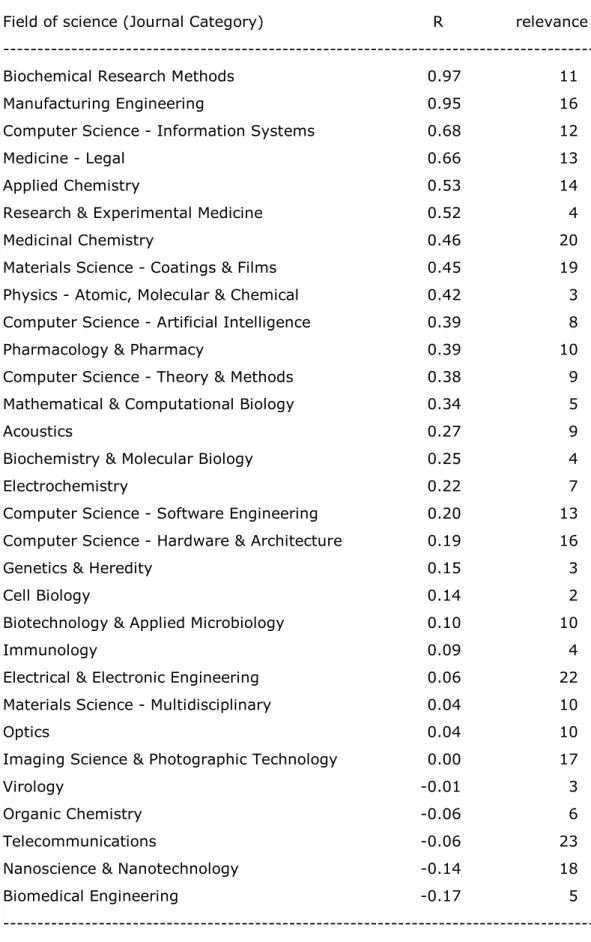
The aggregate result at the level of 31 ‘technology-related’ Journal Categories
is displayed in Table 1. These results clearly indicate a statistically significant
positive correlation in most of these fields. However, the correlations coefficients
vary amongst the fields, where a few fields show no significant correlation at all,
while two fields actually exhibit a significant negative correlation.7 On the whole,
these findings confirm the hypothesis that the ‘Industrial relevance’ indicator
reflects the degree of technologically relevant contents of journals.
Unfortunately, no large scale external sources exist, comparable to the
patents database, to cross-validate the clinical relevance of journals or the
corresponding fields as a whole. The prime candidate for such source would be a
worldwide bibliographic database which contains the cited research literature that
was extracted from the footnotes or reference lists within professional journals for
medical practitioners and within clinical guidelines (e.g. Lewison and Wilcox-Jay,
2003).
The fields with the largest shares of corporate researchers publishing in
journals are typically those in which scientific research and new technologies are
closely related. These are the fields in which those corporate researchers are
likely to be engaged in knowledge transfer from their global research environment
to their intramural domains of industrial/technological applications. The number 1
industrial relevant Journal Category is Petroleum Engineering, a tiny field within the WoS (nine journals only), with a 33% share of author addresses referring to
business enterprises and private sector organizations.
As noted with regard to Figure 1, the industrial application and clinical
application domains are intricately linked within the pharmaceutical sector. This is
where clinical research conducted within hospitals meets industrial R&D devoted
to the development of new therapeutic drugs and innovative treatments.
7 Most notably, the internationally ‘hot’ field of Nanoscience & Nanotechnology; each of the
five journals attributed to this Journal Category have relatively large shares of corporate
sector authors and NPRs, but not in any linear relationship. We may assume a positive
TABLE 1. Validating the industrial relevance of science fields: Pearson correlation
coefficients (R) between “industrial relevance” and “NPR intensity”.
---
Industrial
Field of science (Journal Category) R relevance (%)
---
Biochemical Research Methods 0.97 11
Manufacturing Engineering 0.95 16
Computer Science - Information Systems 0.68 12
Medicine - Legal 0.66 13
Applied Chemistry 0.53 14
Research & Experimental Medicine 0.52 4
Medicinal Chemistry 0.46 20
Materials Science - Coatings & Films 0.45 19
Physics - Atomic, Molecular & Chemical 0.42 3
Computer Science - Artificial Intelligence 0.39 8
Pharmacology & Pharmacy 0.39 10
Computer Science - Theory & Methods 0.38 9
Mathematical & Computational Biology 0.34 5
Acoustics 0.27 9
Biochemistry & Molecular Biology 0.25 4
Electrochemistry 0.22 7
Computer Science - Software Engineering 0.20 13
Computer Science - Hardware & Architecture 0.19 16
Genetics & Heredity 0.15 3
Cell Biology 0.14 2
Biotechnology & Applied Microbiology 0.10 10
Immunology 0.09 4
Electrical & Electronic Engineering 0.06 22
Materials Science - Multidisciplinary 0.04 10
Optics 0.04 10
Imaging Science & Photographic Technology 0.00 17
Virology -0.01 3
Organic Chemistry -0.06 6
Telecommunications -0.06 23
Nanoscience & Nanotechnology -0.14 18
Biomedical Engineering -0.17 5
TABLE 2. Application-oriented fields of science.
---
Industrial Clinical
Fields (Journal Category) relevance (%) relevance (%)
---
Top 10 Industrial-oriented
Petroleum Engineering 33 0
Telecommunications 23 0
Electrical & Electronic Engineering 22 0
Medicinal Chemistry 20 2
Materials Science - Coatings & Films 19 0
Nanoscience & Nanotechnology 18 0
Imaging Science & Photographic Technology 17 1
Computer Science - Hardware & Architecture 17 0
Manufacturing Engineering 16 0
Energy & Fuels 15 0
Top 10 Clinical practice-oriented
Emergency Medicine 0 35
Orthopedics 1 27
Critical Care Medicine 0 24
Surgery 1 23
Pediatrics 0 23
Rheumatology 1 22
General & Internal Medicine 1 22
Medical Laboratory Technology 3 21
Urology & Nephrology 1 21
Gastroenterology & Hepatology 1 21
Top 5 Industrial/clinically-oriented
Pharmacology & Pharmacy 10 9
Materials Science - Biomaterials 7 5
Toxicology 9 5
Biochemical Research Methods 11 4
Medicine - Legal 13 4
Table 2 displays the list of top 10 most ‘clinically relevant’ fields with the
highest fraction of addresses to the medical sector; the top 10 ‘industrially
relevant’ fields collectively constitute the core of ‘transfer sciences’ linking science
to technological innovation; and the top 5 fields with high scores on both ‘clinical
relevance’ and ‘industrial relevance’, where we find the fields that play a major
role in transferring scientific knowledge, tools and related skills to
industrial-medical domain. The ‘clinical practice’ oriented journals have as much as 20% of
their authors from hospitals and clinics. On the whole, the contribution from the
medical sector to WoS-indexed journals in the clinically relevant fields is slightly
higher than the contribution of corporate researchers in the industrially relevant
fields. Note than the 20% share is a conservative estimate since all authors who
are faculty members at academic medical centers and university teaching
hospitals are not included in the medical sector (these institutions are treated as
an integral part of a university system and their publications are classified as
‘academic’).
Journal Application Domains
We have now moved from the crude two-category ‘basic/applied’ classification
system, via Stoke’s three-category system, to CHI Research’s elaborate
four-category system. Clearly, more differentiation is needed to accommodate the
observed diversity within the scholarly journal literature. The statistics and
general patterns presented in the previous analyses constitute an evidence-based
objective framework for systematically classifying journals according to
knowledge application domains. The shape of the distributions depicted in Figure
1 suggests the following six mutually exclusive sets of journals – Journal Application Domain (JAD) categories:
A Academic journals: very few or no contributions from industry and private
sector organizations, nor from general hospitals and medical centers;
I Industry relevant journals: some contributions from industry;
I+ Industry practice journals: many contributions from industry;
C Clinical relevant journals: some contributions from general hospitals;
C+ Clinical practice journals: many contributions from general hospitals;
I-C Industry-clinical relevant journals; some contributions from both industry
and general hospitals.
Any data reduction process of numerical scores into such a small number of
JAD categories is deemed to introduce a certain measure of arbitrariness and
conservatively, i.e. reserving the extreme categories for those journals that differ
significantly from the mean or median, while the intermediate categories are
sufficiently broad to accommodate the wide variety at the center of the
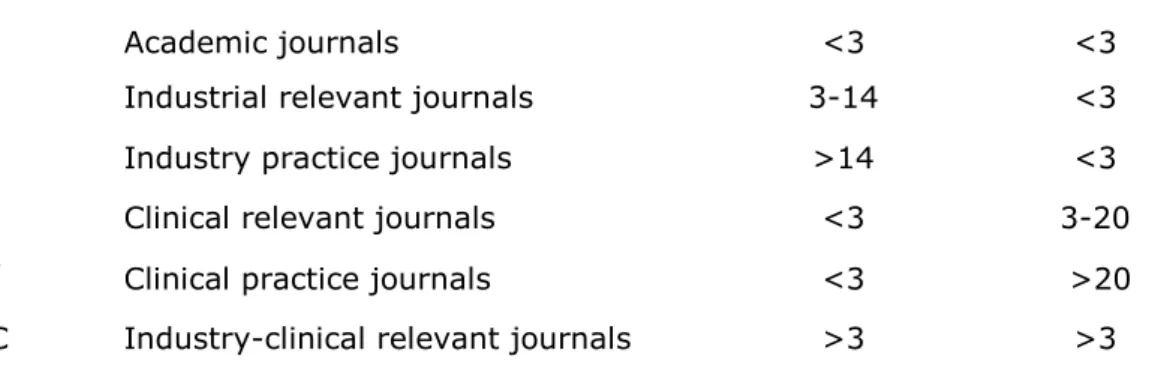
distribution. The distributional statistics in Figure 2 and Table 2 suggest the six
categories as listed in Table 3, with corresponding integer value cut-off points.
These thresholds (3%, 14% and 20%) were validated in an ad hoc fashion by inspecting the journal titles, where titles referring to application-oriented research
topics and areas were used as a marker. The summary statistics of each category
are displayed in Table 4, along with the number of journals they contain.
TABLE 3. Journal Application Domain (JAD) Categories: descriptors and value
range specification.
---
Industrial Clinical
JAD Descriptor relevance (%) relevance (%)
---
A Academic journals <3 <3
I Industrial relevant journals 3-14 <3
I+ Industry practice journals >14 <3
C Clinical relevant journals <3 3-20
C+ Clinical practice journals <3 >20
I-C Industry-clinical relevant journals >3 >3
---
TABLE 4. Summary statistics of JAD Categories.
---
Industrial relevance (%) Clinical relevance (%)
JAD WoS journals mean median stan. dev. mean median stan. dev.
---
A 6 621 1.1 0.6 1.3 0.5 0.0 1.1
I 1 864 11.0 9.4 5.1 0.5 0.0 1.1
I+ 291 39.4 34.7 14.5 0.3 0.0 0.7
C 2 083 1.3 0.9 1.2 13.7 13.5 5.7
C+ 434 0.9 0.4 1.5 32.7 29.8 8.7
I-C 265 8.9 7.6 4.3 11.3 9.9 5.4
Case study
This particular application of the JAD classification system addresses one of the
major issues in science policy and in science studies: is contemporary global
science becoming more application-oriented? In their study of UK science, Hicks
and Katz (1996) argued that the locus of knowledge production might be shifting
in the direction of application domains. Based on their analysis of the Science Citation Index database (now included in the Web of Science), they observed growth rates in publication output above the UK average rate, both by corporate
sector authors and by those within medical sector, yet no conclusive indications
were found of increased application-orientation within UK science as a whole
(Hicks and Katz, 1996).
Appling the JAD system to the WoS enables a check of their hypothesis at the
global level. If their claim holds, an increasing share of the global publication
output in recent years would be distributed through ‘application-oriented’ journals
and an increasing fraction would finds its way to ‘academic journals’. To exclude
the effects of database changes, the trend analysis in constrained to a fixed
subset of 6 387 journals that published papers in each year during time period
1999-2008.
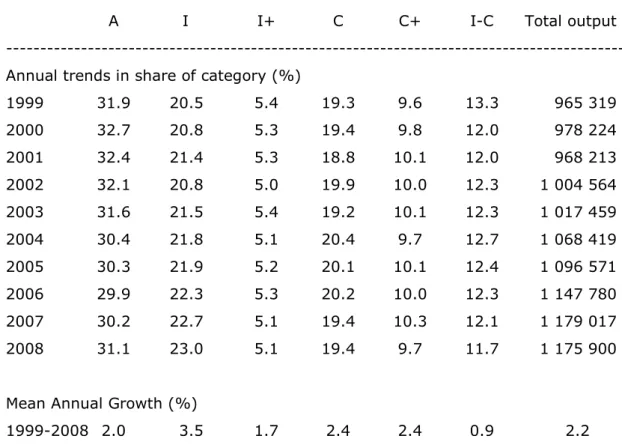
Table 5 lists the trends in the share of each JAD category within the WoS total
annual output. As to be expected, the largest share of knowledge production
represented in WoS-journals relates to research findings that were published in
‘academic journals’. However, this fraction has slipped noticeably over the last 10
years - the 2% annual growth rate of this category is below the growth rate of
the WoS overall. Global science, as represented in by the authorship of
WoS-indexed journals, seems to be becoming slightly less ‘academic’ and more
‘application oriented’. A very visible upward trend is found within ‘industry
relevant science’ (I), which has gradually increased its share in worldwide
publication output from 20.8% to 23%. Interestingly, a downward trend is found
in application-oriented science represented in ‘industry practice journals’ (I+),
while the fraction of output in ‘industry-clinical relevant journals’ (I-C) also shows
a gradual decline in recent years. Note that these declines are relative; as the
WoS continues to expand, the absolute publication output of I+ journals has how
leveled off, after growth until 2006. The absolute numbers of publications in I-C
TABLE 5. Trends within the total WoS-indexed publication output per JAD.
---
A I I+ C C+ I-C Total output
---
Annual trends in share of category (%)
1999 31.9 20.5 5.4 19.3 9.6 13.3 965 319
2000 32.7 20.8 5.3 19.4 9.8 12.0 978 224
2001 32.4 21.4 5.3 18.8 10.1 12.0 968 213
2002 32.1 20.8 5.0 19.9 10.0 12.3 1 004 564
2003 31.6 21.5 5.4 19.2 10.1 12.3 1 017 459
2004 30.4 21.8 5.1 20.4 9.7 12.7 1 068 419
2005 30.3 21.9 5.2 20.1 10.1 12.4 1 096 571
2006 29.9 22.3 5.3 20.2 10.0 12.3 1 147 780
2007 30.2 22.7 5.1 19.4 10.3 12.1 1 179 017
2008 31.1 23.0 5.1 19.4 9.7 11.7 1 175 900
Mean Annual Growth (%)
1999-2008 2.0 3.5 1.7 2.4 2.4 0.9 2.2
---
These subtle shifts suggest a redistribution of publication output within the
industrially relevant research domains, where research publication output in
journals closest to science-based technological development (Stoke’s Pure applied research) are very slowly loosing ground to journals that are less oriented to industrial research (Stoke’s Use-inspired basic research). This ‘hidden evolution’ within the global research literature mirrors trends in corporate R&D expenditures
and research publication output volumes indicating that science-based industries
have been gradually scaling down the level of resources devoted to in-house
scientific research (Godin, 1996; Varma, 2000; Tijssen, 2004). The observed
trends in publication output may also arise (in part) from changes in publication
habits and strategies, where corporate research staff is publishing less about their
research findings within WoS-indexed journals (all else remaining equal).
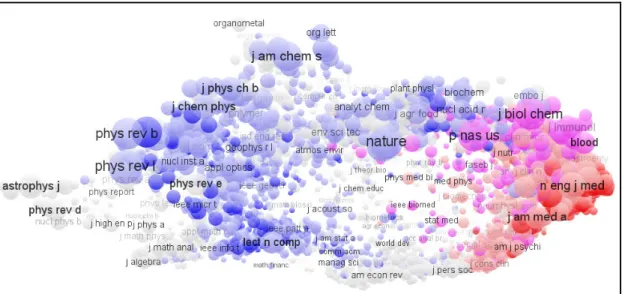
The distribution of JAD categories across all fields of science worldwide is
shown in Figure 4. This graphical presentation, produced by VOSviewer, dispicts the relational network of WoS-indexed journals, where inter-journal distances are
calculated according to their co-citation similarities. The graph comprises of the
subset of 5 000 WoS-indexed journals that are most highly cited (Van Eck &
Academic (A) - grey; Industrial relevant (I) – light blue; Industry practice (I+) –
dark blue; Clinical relevant (C) – light red; Clinical practice (C+) – red;
Industry-clinical relevant (I-C) – pink. World science, as labeled by JAD categories, clearly
shows a divide between clinical relevance to the right (within medical and life
sciences), and industrial relevance to the left (natural sciences and engineering
sciences). The interface between both application domains, industrial-clinical
relevance (biopharmaceutical relevant fields), is also found at the right hand side
of the graph where it is closely tied to the medical and life sciences. The
corresponding interactive VOSviewer map, which can be accessed at http://www.vosviewer.com/maps/journal_application_domains/, provides more
graphical detail, while allowing users to check the clinical relevance score (%
general hospital addresses) and industrial relevant score (% corporate addresses)
of each journal.
FIG 4. Graphical representation of WoS-indexed journals by Journal Application
Category
Clearly, these macro-level findings should be treated with due caution. It
remains unclear to what extent journal- or field-specific factors are also at play,
such as changes within the editorial policies of journals. And it goes without
saying that these findings are platform-dependent and method-dependent. The
choice of the Web of Science as a frame of reference, and the choice of parameter values for defining the six JAD categories, will determine the outcomes. A
different version of the WoS, or another comparable source such as SCOPUS may
classification system, using other or additional information sources, will shed
more light on its statistical robustness and its validity for macro-level analyses of
science.
Discussion and conclusions
Scientific research constitutes a complex, multifaceted activity - its
dimensions are many, several of which are time-dependent and
context-dependent. However, complexity need not breed mystery, because relevant
dimensions are clearly observable and some are, albeit crudely, measurable in
terms of comparative statistics. The model and method presented in this paper
taps into one of those measurable dimensions: it introduces a systematic
evidence-based classification system of research publication outputs that helps
unravel the diversity within science in terms of major application domains.
However, the usage of research publications, and institutional sectors of their
authors, for capturing and codifying diversity is merely a crude approximation of
real life and therefore subject to justified criticism.
The taxonomic principle of the JAD classification system rests critically on two
basic assumptions: (i) an entire journal can be assigned to a single JAD category
reflecting its major application domain(s); (ii) these domains are reflected in the
institutional sector(s) and associated working environments of the authors
publishing in the journal. At macro levels of analysis both are likely to hold, i.e.
across large sets of journals representing science as a whole, or within fields of
science. At meso and micro levels, i.e. within journals and among authors, these
assumptions may break down as the degree of variance within the data increases.
Research publications within a journal tend to reflect different stages within
knowledge creation and utilization process, and may include research papers from
authors covering a variety of working environments and application domains.
Obviously the authors may also differ quite a lot in terms of their motives and
rationale for doing science and disseminating results in their publications, as do
(end)users vary in their the goals and intentions with regards to applications of
those findings and outcomes. The institutional profile of a journal according to the
affiliate background of its authorship is therefore at best a journal-dependent
partial indicator of the associated working environments, application domains and
user communities.
The definition of an institutional sector itself depends heavily on the
conceptual framework and delineation principle. For example, adopting a broader
significantly increase the numbers of ‘clinically relevant’ journals. And redefining
the corporate sector, by for example excluding privately-funded industrial
research organizations, will diminish the quantity of ‘industrially relevant’
journals.
Applying the JAD classification system only to peer-reviewed journals discards
relevant segments of the research publication literature. Peer-reviewed scholarly
journals, especially those that are indexed for the Web of Science, are biased toward English-language ‘main stream’ research, is comprised of (open access)
journals whose business models and editorial policies are focused on wide,
international dissemination. In contrast, the published outputs with a view toward
practical, short-term applications may also find their way to the open literature
through the specialized serials with limited circulation (report series, professional
and trade journals), take the form of proprietary documents (patents), or remain
restricted access documents (confidential reports).
In spite of these methodological constraints, the JAD classification system
represents a significant improvement, at least from an analytical point of view,
compared to other measurement models or earlier classification systems that
lacked a sufficiently transparent methodology or a sound foundation of empirical
data. The omission of a journal classification parameter related to the ‘civic
relevance’ application domains constitutes a noticeable shortcoming in the current
classification system, especially so because the societal relevance of science is
now high on many research policy agenda’s, and an increasingly important
component of research evaluation frameworks linked to evidence-driven funding
of science. Incorporating ‘civic relevance’ domains will require considerable
investments in data mining of existing bibliographic databases (local or
disciplinary), or developing dedicated new databases, that capture the publication
output of these researchers and their user communities worldwide.
The ‘Knowledge Utilization Triangle’ model, its classification system and the
precise definition of the JAD categories, is of course open to further research,
debate, experimentation and improvement. More methodological work lies ahead
of us to develop it into fine-grained and generally-accepted approach. The longer
term and more ambitious R&D agenda is to apply such a system at the source of
the ‘basic science/applied science’ dichotomy: the statistical surveys by
government authorities and international agencies, and their reports on the state
Acknowledgments
Thanks are due to Arnold Verbeek (IdeaConsult, Brussels), Erik van Wijk,
Renald Buter, Nees Jan van Eck, and Ludo Waltman (CWTS, Leiden University) for
their valuable data inputs and research assistance. I would also like to thank the
reviewers for their insightful comments and suggestions.
References
Bailey, K. (1994). Typologies and taxonomies: an introduction to classification
techniques. Thousand Oaks: Sage Publishers.
Boyack, K., Klavans, R., & Börner, K. (2005). Mapping the Backbone of Science.
Scientometrics, 64, 351-374
Brooks, H. (1980). Basic and applied research. In: Categories of Scientific
Research (pp. 14-18). Washington DC: National Science Foundation.
Brusoni, S., & Geuna, A. (2003). An international comparison of sectoral
knowledge bases: persistence and integration in the pharmaceutical industry,
Research Policy, 32, 1897-1912.
Falk, C. (1973), An operational, policy-oriented research categorization scheme,
Research Policy, 2, 186-202.
Hamilton, K. (2003). Subfield and Level Classification of Journals, CHI Report No.
2012-R. Cherry Hill, NJ: CHI Research Inc.
Godin, B. (1996). Research and the practice of publication in industries, Research
Policy, 25, 587–606.
Godin, B. (2003). Measuring science: is there ‘basic research’ without statistics?
Social Science Information, 42, 57-90.
Hicks, D., & Katz, J.S. (1996). Where is science going? Science, Technology &
Human Values. 21, 379-406.
Hicks, D., & Hamilton, K. (1999). Real numbers, Issues in Science and
Technology. 15, 74-75.
Langenberg, D. (1980). Distinctions between basic and applied research. In:
Categories of Scientific Research (pp. 32-36). Washington DC: National
Science Foundation.
Lewison, G., & Paraje, G. (2004), The classification of biomedical journals by
research level. Scientometrics, 60, 145 –157.
Lewison, G., & Wilcox-Jay, K. (2003), Getting biomedical research into practice:
the citations from UK clinical guidelines. In Gohua, J., Rousseau, R., & W.
Scientometrics and Informetrics (pp. 152–160). Beijing, China: Dalian
University of Technology Press.
Leydesdorff, L., & Rafols, I. (2009). A Global Map of Science Based on the ISI
Subject Categories. Journal of the American Society for Information Science
and Technology, 60, 348-362.
Lim, K. (2004). The relationship between research and innovation in the
semiconductor and pharmaceutical industries (1981–1997). Research Policy,
33, 287-321.
Narin, F., & Rozek, R. (1988). Bibliometric analysis of bibliometric analysis of
United States pharmaceutical industry research performance. Research Policy,
17, 139-154.
Noma, E. (1986). Subject Classification and influence weights for 3,000 journals.
Cherry Hill, NJ: CHI Research/ Computer Horizons Inc.
OECD (2002). Frascati Manual, Paris: Organisation for Economic Cooperation and
Development.
Reagan, M. (1967). Basic and applied research: a meaningful distinction?
Science, 155, 1383-1386.
Rothschild, L. (1972). Forty-five varieties of research (and development), Nature,
239, 373-378.
Stokes, D. (1997). Pasteur’s Quadrant: Basic science and technological
innovation. Washington DC: Brookings Institutional Press.
Tijssen, R.J.W. (2004). Is the commercialisation of scientific research affecting
the production of public knowledge? Global trends in the output of corporate
research articles, Research Policy, 33, 709-733.
Tijssen, R.J.W., Van Leeuwen, T.N., & Van Wijk, E. (2009). Benchmarking
university-industry research cooperation worldwide: performance
measurements and indicators based on co-authorship data for the world’s
largest universities. Research Evaluation, 18, 13-24.
Tijssen, R.J.W., & Van Looy, B. (2009). Production of data to analyze university
references found in patent documents by geographic origin. Third report for
IPTS/ERAWATCH NETWORK ASBL (EC Framework Service Contract Nr
-150176-2005-F1SC-BE). Leiden University/Catholic University of Leuven.
Van Eck, N.J., & Waltman, L. (in press). Software survey: VOSviewer, a computer
program for bibliometric mapping, Scientometrics.