Volume 2013, Article ID 401983,5pages http://dx.doi.org/10.1155/2013/401983
Research Article
Topology Identification of Complex Network via Chaotic Ant
Swarm Algorithm
Haipeng Peng,
1Lixiang Li,
1Jürgen Kurths,
2Shudong Li,
3and Yixian Yang
1,41Information Security Center, State Key Laboratory of Networking and Switching Technology,
Beijing University of Posts and Telecommunications, Beijing 100876, China
2Potsdam Institute for Climate Impact Research, D14473 Potsdam, Germany
3College of Mathematics, Shandong Institute of Business and Technology, Yantai, Shandong 264005, China
4National Engineering Laboratory for Disaster Backup and Recovery, Beijing University of Posts and Telecommunications,
Beijing 100876, China
Correspondence should be addressed to Lixiang Li; li [email protected] Received 18 July 2013; Accepted 22 August 2013
Academic Editor: Ming Li
Copyright © 2013 Haipeng Peng et al. This is an open access article distributed under the Creative Commons Attribution License, which permits unrestricted use, distribution, and reproduction in any medium, provided the original work is properly cited. Nowadays, the topology of complex networks is essential in various fields as engineering, biology, physics, and other scientific fields. We know in some general cases that there may be some unknown structure parameters in a complex network. In order to identify those unknown structure parameters, a topology identification method is proposed based on a chaotic ant swarm algorithm in this paper. The problem of topology identification is converted into that of parameter optimization which can be solved by a chaotic ant algorithm. The proposed method enables us to identify the topology of the synchronization network effectively. Numerical simulations are also provided to show the effectiveness and feasibility of the proposed method.
1. Introduction
So far, most researches on complex networks are based on their exact structure dynamics. However, there is often vari-ous unknown or uncertain information in complex networks of the real world. This information including the topology connection of networks, and dynamical parameters of nodes, is always partially known and also changes continuously in many real complex networks such as gene networks, protein-DNA structure network, power grid networks, and biological neural networks [1–4]. Knowledge about the identification of the topology of complex networks is the prerequisite to analyze, control, and predict their dynamical behaviors. Therefore, this topic has drawn great attention of many researchers, since it is of great theoretical and practical significance to use the dynamics of observed nodes for the identification of the network structure [5–7].
The problem of topology identification can be formulated as a gray box model. From this viewpoint, a basic mathe-matical model of the topology for the complex network can be constructed, although its exact structure peculiarities are
not entirely known. In the model of a complex network, there are often some unknown structure parameters which can be completed via topology identification. Therefore, if the basic mathematical model of its topological structure is built, then we only need to identify the unknown structure parameters of this network. Recently, some research on topology identification of complex networks has emerged to identify some complex networks and some time-delay networks [8]. These researchers mainly used an adaptive feed-back control algorithm to solve the problem of topological identification. But this algorithm may fail if the network is in a synchronous regime. In [9], an improved adaptive feedback control method was proposed to make it identifiable in synchronous complex networks. However, this improved method should change the coupling mode of its topology. In addition, to adapt this improved adaptive feedback control method, the dynamical parameter of each node must be observable, which is especially difficult to realize in most real networks such as metabolic networks and power grid networks.
In this paper, a method of topology identification for complex networks is proposed which is based on a chaotic ant swarm (CAS) algorithm. The problem of topology identifica-tion is converted into that of parameter optimizaidentifica-tion which could be solved by the CAS optimization algorithm [10]. The CAS algorithm was inspired by biological experiments of single ant’s chaotic behavior. This CAS method is different from those of ant colony optimization (ACO), since the CAS algorithm combines chaotic and self-organizing behaviors of ants with the advantages of swarm-based algorithms. The CAS algorithm is a global optimization algorithm, and it can deal with topology identification of complex networks effectively when they are in a nonsynchronous and even when they are in a synchronous regime.
The remainder of this paper is organized as follows. In Section2, the problem formulation of topology identification for complex networks is presented. In Section3, the chaotic ant swarm algorithm is introduced. In Section4, results of numerical simulations are given. Finally, some conclusions about the proposed method are drawn in Section5.
2. Problem Formulation
To demonstrate the topology identification of complex networks, in this paper, we consider a general complex dynamical network as in [1] with each node being an 𝑛 -dimensional dynamical system, and it is described by a differential equation of the following form
̇𝑋𝑖= 𝐹𝑖(𝑋𝑖) + 𝑁
∑
𝑗=1𝑐𝑖𝑗𝐻𝑋𝑗, 𝑖 = 1, 2, . . . , 𝑁, (1)
where 𝑁 denotes the number of nodes in the dynamical network and 𝑋𝑖 = (𝑥𝑖1, 𝑥𝑖2, . . . , 𝑥𝑖𝑛) ∈ 𝑅𝑛 is the state vector associated with the 𝑖th node. The function𝐹𝑖 is the corresponding nonlinear vector field.𝐻is the inner-coupling matrix.𝐶 = (𝑐𝑖𝑗)𝑁×𝑁is the coupling topology of the network. If there exists a coupling connection between node𝑖and node 𝑗 (𝑖 ̸= 𝑗),𝑐𝑖𝑗 ̸= 0; otherwise,𝑐𝑖𝑗 = 0. In this paper,𝐶does not need to be symmetric or irreducible.
The coupling matrix 𝐶fully represents the topological information of the complex network. Consequently, the problem of topology identification for a complex network can be converted into that of identification of the unknown coupling matrix𝐶. To identify the coupling matrix𝐶, here, we assume that𝐻and 𝐹𝑖 can be experimentally measured in advance. Next, a drive-response network should be built. Equation (1) is taken as the driving network. Then, the response network can be designed as
̇𝜂
𝑖= 𝐹𝑖(𝜂𝑖) + 𝑁
∑
𝑗=1̂𝑐𝑖𝑗
𝐻𝜂𝑗, (2)
wherê𝑐𝑖𝑗is the estimated parameter of𝑐𝑖𝑗.𝜂𝑖is obtained by simulating the network (1) with the estimated coupling matrix element̂𝑐𝑖𝑗.
To identify the topology of the complex network, the following objective function is introduced as
𝑉 =∑𝑀
𝑘=0 𝑁
∑
𝑖=1 𝐷
∑
𝑑=1
(𝑥𝑖𝑑(𝑘) − 𝜂𝑖𝑑(𝑘))2, (3)
where𝑀is the termination time of numerical simulation,𝑁 indicates the number of nodes,𝐷denotes the dimensions of each node’s dynamical system, and𝑘is the discrete time.𝑥𝑖𝑗is the state vector of the driving network.𝜂𝑖𝑗is the state vector of the response network with initial value𝜂𝑖𝑗 = 𝑥𝑖𝑗and the estimated coupling matrix element̂𝑐𝑖𝑗.
Hence, the problem of topology identification is con-verted into that of a parameter optimization by the search of the minimal value of𝑉. The topology matrix𝐶can be well identified through the method of objective function.
3. Chaotic Ant Swarm Algorithm
In recent years, a swarm intelligent optimization algorithm called chaotic ant swam (CAS) algorithm is proposed to solve the optimization problem based on chaos theory [10]. The mathematical model of CAS algorithm is described as follows:
𝑦𝑖(𝑡) = 𝑦𝑖(𝑡 − 1)(1+𝑟𝑖),
𝑧𝑖𝑑(𝑡) = Δexp((1 −exp(−𝑎𝑦𝑖(𝑡))) (3 − Ψ𝑑Δ)) − 7.5
Ψ𝑑× 𝑉𝑖 +exp(−2𝑎𝑦𝑖(𝑡) + 𝑏) × (𝑝best𝑑(𝑡 − 1) − 𝑧𝑖𝑑(𝑡 − 1)) ,
(4)
where 𝑦𝑖(𝑡) is the organization variable of the CAS model andΔ = 𝑧𝑖𝑑(𝑡 − 1) + 7.5/(Ψ𝑑× 𝜙𝑖). It controls the chaotic behavior of an individual ant. In this paper,𝑦𝑖(0) = 0.999. 𝑟𝑖is the organization parameter of individual ant which is a positive constant less than 1.𝑎is a very large positive constant; here,𝑎is set to be200. 𝑏is a positive constant, where0 ≤ 𝑏 ≤ 2/3.Ψ𝑖determines the searching range of the𝑖th ant in 𝑑th dimension.𝜙𝑖controls the moving proportion of the𝑖th ant searching space.𝑝best(𝑡 − 1)is the best position that the individual ant and its neighbors have ever found within𝑡 − 1 time steps. Here the neighbors are set to be global neighbors; that is, all the ants are the neighbors of each other.
The ants usually exchange information via certain direct or indirect communication methods. As a result of effective communication, the impact of the organization becomes stronger as time evolves. Finally, all the ants walk through the best path to forage food. Equation (4) shows the foraging process of CAS model. As time increases, the effect of the organization variable 𝑦𝑖(𝑡) on the behavior of each ant is becoming stronger via the organization parameter𝑟𝑖. Finally, by the effect of both𝑝best𝑑(𝑡 − 1)and𝑦𝑖(𝑡), the state of𝑧𝑖𝑑(𝑡) will converge to the best global position.
𝑟𝑖andΨ𝑑are two important parameters.𝑟𝑖has an effect on the converging speed of the CAS algorithm. If𝑟𝑖is very large, then the converging speed of the CAS algorithm will be very fast so that the optimal solution might not be found. If𝑟𝑖is
very small, then the converging speed of the CAS algorithm will be very slow and the runtime will be longer. If𝑟𝑖is set to be zero, then the behavior of one ant will be chaotic all the time and the CAS algorithm cannot converge to a fixed position. Furthermore, since small changes of organization effect are desired,𝑟𝑖 is set to be0 ≤ 𝑟𝑖 ≤ 0.5. The concrete formula of 𝑟𝑖 depends on the specific problem as well as runtime. In order to enable each ant to have a different organization parameter, we set𝑟𝑖 = 0.1 + 0.2 × rand, where rand is a uniformly distributed random number in the interval[0, 1]. Ψ𝑑has an effect on the searching range of the CAS algorithm. If the value ofΨ𝑑is very large, then the searching range will be small. IfΨ𝑑is very small, then the searching range will be very large. The searching range is set to be[−𝑤𝑑/2, 𝑤𝑑/2], and then𝑤𝑑≈ 7.5/Ψ𝑑.
Based on the above discussions about the CAS algorithm, the detailed procedure for identifying the topology structure of a complex network is described as follows.
Step 1. To identify the topology parameter of a complex
network, some important parameters of the CAS algorithm should be firstly initialized. In this paper, the positive constant 𝑎is set to be 200; the organization factor𝑟𝑖of each node is set as𝑟𝑖 = 0.1 + 0.2 ×rand, where𝑖is the𝑖th ant in the whole𝑄 ants;𝜙𝑖is set properly to control the moving proportion. The organization variable of each node𝑦𝑖is set to be0.999.Ψ𝑑is set properly to control the searching range of𝑧𝑖𝑑, where𝑑is the𝑑th dimension of the ant local position.
Step 2. Generate the initial position of the𝑖th ant𝑧𝑖(𝑘 = 0) =
(𝑧𝑖1, 𝑧𝑖2, . . . , 𝑧𝑖𝑑)𝑇 randomly in the searching space.𝑘 = 0 denotes the initial time point.
Step 3. By setting the initial time state vector 𝑥𝑖(0) =
(𝑥𝑖1, 𝑥𝑖2, . . . , 𝑥𝑖𝑛), the fourth-order Runge-Kutta algorithm is used in the driving network (1) to obtain a series of𝑥𝑖(𝑘).
Step 4. By setting the initial time state vector𝜂𝑖(0) = 𝑥𝑖(0),
𝑖 = 1, 2, . . . , 𝑁, the well-known fourth-order Runge-Kutta algorithm is used in the response network (2) to obtain a series of𝜂𝑖(𝑘),𝑖 = 1, 2, . . . , 𝑁. The coupling matrix𝐶can be estimated by the ant colony𝑧𝑖(𝑡), 𝑖 = 1, 2, . . . , 𝑄.
Step 5. Compute𝑦𝑖for each ant. Then, update the position of
each ant via (4).
Step 6. Compute the value of objective function for each ant
𝑧𝑖, and compare each value with previous𝑓𝑝best of each ant. If the current value is smaller than the previous𝑓𝑝best, then it is updated by the current value, and set the value of𝑝best to be the current individual location. Finally, compare each 𝑓𝑝best with𝑓𝑔best. If the value of 𝑓𝑝best is smaller than 𝑓𝑔best, then𝑓𝑔best is updated by𝑓𝑝best of this ant. Then, the𝑝𝑔best = (𝑝 𝑔best1, 𝑝 𝑔best2, . . . , 𝑝 𝑔best𝑑)is replaced by the current global best position.
Step 7. Go to Step5until the ending condition is satisfied.
Then output the global best location of each ant, which means the coupling matrix𝐶can be identified by the CAS algorithm.
4. Numerical Simulation
In this section, we present several numerical simulation results to illustrate the effectiveness of the proposed method. Lorenz chaotic equation is taken as the node dynamical system of the𝑖th node, which is described as
̇𝑥
1= 𝜃1(𝑥2− 𝑥1) ,
̇𝑥
2= (𝜃2− 𝑥3) 𝑥1− 𝑥2,
̇𝑥
3= 𝑥1𝑥2− 𝜃3𝑥3,
(5)
where𝑥1,𝑥2, and𝑥3are the state variables;𝜃1= 10,𝜃2= 28, 𝜃3= 8/3are positive constants. For the CAS algorithm model (4), we set𝑎 = 200, 𝑏 = 2/3, and 𝜙𝑖 = 0. To calculate the objective function 𝑉, 𝑀 = 20 successive vectors are set in both driving and response networks. In order to show the effectiveness and feasibility of the proposed method, two examples are provided as follows to identify the topology structure of complex networks.
Note. There is an interesting phenomenon. Let 𝜑 be the golden ratio, which is approximately equal 1.618. Then, 𝑏 approximately equals1/𝜑, and𝜃3approximately equals to𝜑2. Why such an interesting phenomenon exist? We should give further study in our future work. The basic concept of the golden ratio is given in [11–13] and [14] for the spectra used in [11,12].
Example 1. First of all, a nonsymmetric and
non-synchronous diffusive network is considered, which includes three nodes with the topology matrix𝐶. The elements of the topology matrix𝐶are𝑐1,2= 4,𝑐2,1= 5,𝑐2,3= 3, and𝑐3,2= 2. The other elements are𝑐𝑖,𝑗 = 0 (𝑖 ̸= 𝑗)and 𝑐𝑖,𝑖 = − ∑ 𝑐𝑖,𝑗. 𝐻 is an identical matrix𝐼3. Here, the initial state is set to be 𝑋(0) = [−6, 3, 7; −14, 3, −4; 5, −3, 4]. The population size is 40. The maximum time step is set as200. Obviously, there are 6independent variables, so the dimension of each ant position is set to be6. We setΨ1 = Ψ3 = 1.25, Ψ2 = 1, Ψ4 = 1.85, andΨ5 = Ψ6 = 10.𝜂𝑖𝑑is in the interval[0, 7.5]. The estimated process is shown as follows.
Figure1 shows that the coupling matrix 𝐶can be well identified as the time increases. When the time step is approximately200, the estimated coupling matrix converges to the true value where the population size is40. To compare the CAS algorithm with the QPSO algorithm, we also use the definition of [15] to identify the topology of Example1. Then, the evolution curve of the objective function against the time can be obtained, and their comparative result between these two algorithms is shown in Figure2. We can see that the objective function𝑉converges rapidly to the global optima as time evolves. Besides, the converging speed and the precision of the CAS algorithm are much better than those of the QPSO algorithm.
Example 2. In this example, a symmetric synchronous
net-work is introduced to show the effectiveness of the proposed method. The parameters of the topology structure are set as 𝑐1,2 = 𝑐2,1 = 3,𝑐1,3 = 𝑐3,1 = 6,𝑐1,4 = 𝑐4,1 = 2,𝑐2,3 = 𝑐3,2 = 4,
−1 0 1 2 3 4 5 6 7
0 40 80 120 160 200
̂c
(
t
)
t
̂c2,1 ̂c1,2
̂c2,3
̂c3,2
̂c1,3̂c3,1
̂c2,1 ̂c1,2
̂c2,3
̂c3,2
̂c1,3̂c3,1
Figure 1: (Color online) Estimation of nonsynchronous network
topology showing the valuê𝑐(𝑡)against time step𝑡.
0 1000 2000 3000
0 40 80 120 160 200
t CAS
QPSO
Ob
jecti
ve fun
ctio
n
V
Figure 2: Estimation of nonsynchronous network topology
show-ing the objective function value𝑉against time step𝑡.
𝑐3,4= 𝑐4,3 = 5, and the other𝑐𝑖,𝑗 = 0 (𝑖 ̸= 𝑗)and𝑐𝑖,𝑖 = − ∑ 𝑐𝑖,𝑗.
𝐻is an identical matrix𝐼3. Here, the initial state is𝑋(0) = [−6, 3, 7; −14, 3, −4; −3, 4, 5; −5, 6, 1]. The population size is 30. The maximal time step is set as300. Obviously, there are6 independent variables, so the dimension of each ant position is set to be6.Ψ1is set to be1.875.Ψ2is set to be0.75.Ψ3is set to be1.875.Ψ4is set to be1.25.Ψ5is set to be0.9375, andΨ6 is set to be10. Figure3shows the identification results.
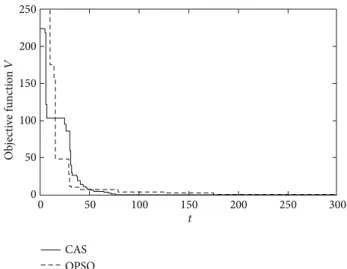
We can see that the topology matrix𝐶can be identified precisely as the time increases. To compare CAS algorithm with QPSO algorithm, we use the definition of [15] to identify the topology of Example2. The comparative result is shown in Figure4. From Figure4and Table1, we can see that although the converging speed of QPSO algorithm is a little faster than that of CAS algorithm, the converging precision of QPSO is much less than that of CAS algorithm. Obviously, the CAS-based topology identification method is more effective than the QPSO-based topology identification method. Compared with the adaptive synchronization identification approach, the CAS algorithm does not need to change the coupling
−1 0 1 2 3 4 5 6 7 8
̂c
(
t
)
t
̂c1,3
̂c3,4
̂c2,3
̂c1,2
̂c1,4
̂c2,4̂c4,2
̂c1,3
̂c3,4
̂c2,3
̂c1,2
̂c1,4
̂c2,4̂c4,2
0 50 100 150 200 250 300
Figure 3: (Color online) Estimation of a synchronous network
topology showing the valuê𝑐(𝑡)against time step𝑡.
0 50 100 150 200 250
CAS QPSO
t
0 50 100 150 200 250 300
Ob
jecti
ve fun
ctio
n
V
Figure 4: Estimation of nonsynchronous network topology
show-ing the objective function value𝑉against time step𝑡.
Table 1: Comparison between two algorithms.
Algorithms Objective value
CAS 0.317
QPSO 2.082
modes of the network topology, which has advantages in some real identification cases, for example, the biological neural network.
5. Conclusion
In this paper, a topology identification method is proposed based on the CAS algorithm. The problem of topology iden-tification is converted into that of parameter optimization. Compared with the constraints of identifying synchronous complex networks via adaptive feedback control method and the relatively poorer converging precision via QPSO-based topology identification method, the proposed method based
on CAS algorithm can identify the topology structure of complex network effectively.
Conflict of Interests
The authors declare that there is no conflict of interests re-garding the publication of this paper.
Acknowledgments
The authors would like to thank the editor and all the anonymous reviewers for their helpful advice. This work is supported by the Foundation for the Author of National Excellent Doctoral Dissertation of PR China (Grant no. 200951), the National Natural Science Foundation of China (Grant nos. 61170269, 61202362, and 61070209), the China Postdoctoral Science Foundation Funded Project (Grant no. 2013M540070), the Beijing Higher Education Young Elite Teacher Project, and the Asia Foresight Program under NSFC Grant (Grant no. 61161140320).
References
[1] A. E. Motter, C. Zhou, and J. Kurths, “Network synchronization,
diffusion, and the paradox of heterogeneity,”Physical Review E,
vol. 71, no. 1, Article ID 016116, 2005.
[2] Z. Aydin and Y. Altunbasak, “A signal processing application in genomic research: protein secondary structure prediction,” IEEE Signal Processing Magazine, vol. 23, no. 4, pp. 128–131, 2006.
[3] X. Zhu, W. Zhang, B. Yu, and W. Gong, “Identification of vul-nerable lines in power grid based on complex network theory,”
inProceedings of the International Conference on Mechatronic
Science, Electric Engineering and Computer (MEC ’11), pp. 118– 121, August 2011.
[4] J. Zhou, W. Yu, X. Li, M. Small, and J.-A. Lu, “Identifying the topology of a coupled FitzHugh-Nagumo neurobiological
network via a pinning mechanism,” IEEE Transactions on
Neural Networks, vol. 20, no. 10, pp. 1679–1684, 2009.
[5] X. Wu, “Synchronization-based topology identification of weighted general complex dynamical networks with
time-varying coupling delay,”Physica A, vol. 387, no. 4, pp. 997–1008,
2008.
[6] D. Yu, M. Righero, and L. Kocarev, “Estimating topology of
networks,”Physical Review Letters, vol. 97, no. 18, Article ID
188701, 2006.
[7] W. K. S. Tang, M. Yu, and L. Kocarev, “Identification and
mon-itoring of biological neural network,” inProceedings of the IEEE
International Symposium on Circuits and Systems (ISCAS ’07), pp. 2646–2649, May 2007.
[8] H. Liu, J.-A. Lu, J. L¨u, and D. J. Hill, “Structure identification of uncertain general complex dynamical networks with time
delay,”Automatica, vol. 45, no. 8, pp. 1799–1807, 2009.
[9] L. Chen, J. Lu, and C. K. Tse, “Synchronization: an obstructer in identifying network topology based on adaptive- feedback
control algorithm,”IEEE Transactions on Circuits and Systems
II, vol. 56, p. 310, 2009.
[10] H. Peng, L. Li, Y. Yang, and F. Liu, “Parameter estimation of
dynamical systems via a chaotic ant swarm,”Physical Review E,
vol. 81, no. 1, Article ID 016207, 2010.
[11] M. Li and W. Zhao, “Golden ratio phenomenon of random
data obeying von Karman spectrum,”Mathematical Problems
in Engineering, vol. 2013, Article ID 130258, 6 pages, 2013. [12] M. Li and W. Zhao, “Essay on Kolmogorov law of minus 5 over
3, viewed with golden ratio,”Advances in High Energy Physics,
vol. 2013, Article ID 680678, 3 pages, 2013.
[13] M. Livio,The Golden Ratio, Random House Inc., New York, NY,
USA, 2003.
[14] M. Li and W. Zhao, “On1/f noise,”Mathematical Problems in
Engineering, vol. 2012, Article ID 673648, 23 pages, 2012. [15] S.-X. Tang, L. Chen, and Y.-G. He, “Optimization-based
topol-ogy identification of complex networks,”Chinese Physics B, vol.
Submit your manuscripts at
http://www.hindawi.com
Operations
Research
Advances in
Hindawi Publishing Corporation
http://www.hindawi.com Volume 2013
Hindawi Publishing Corporation
http://www.hindawi.com Volume 2013 Mathematical Problems in Engineering
Abstract and Applied Analysis Hindawi Publishing Corporation
http://www.hindawi.com Volume 2013
ISRN Applied Mathematics
Hindawi Publishing Corporation
http://www.hindawi.com Volume 2013
Hindawi Publishing Corporation
http://www.hindawi.com Volume 2013 International Journal of
Combinatorics
Hindawi Publishing Corporation
http://www.hindawi.com Volume 2013
Journal of Function Spaces and Applications
International Journal of Mathematics and Mathematical Sciences
Hindawi Publishing Corporation http://www.hindawi.com Volume 2013
ISRN Geometry
Hindawi Publishing Corporation
http://www.hindawi.com Volume 2013 Discrete Dynamics in
Nature and Society
Hindawi Publishing Corporation
http://www.hindawi.com Volume 2013
Hindawi Publishing Corporation
http://www.hindawi.com Volume 2013 Advances in
Mathematical Physics
ISRN
Algebra
Hindawi Publishing Corporation
http://www.hindawi.com Volume 2013
Probability
and
Statistics
Journal of
Hindawi Publishing Corporation
http://www.hindawi.com Volume 2013
ISRN
Mathematical Analysis
Hindawi Publishing Corporation
http://www.hindawi.com Volume 2013
Journal of
Applied Mathematics
Hindawi Publishing Corporation
http://www.hindawi.com Volume 2013
Sciences
Hindawi Publishing Corporation
http://www.hindawi.com Volume 2013
Hindawi Publishing Corporation
http://www.hindawi.com Volume 2013
Stochastic Analysis
International Journal ofHindawi Publishing Corporation
http://www.hindawi.com Volume 2013
Hindawi Publishing Corporation
http://www.hindawi.com Volume 2013
The Scientific
World Journal
Hindawi Publishing Corporation
http://www.hindawi.com Volume 2013
ISRN Discrete Mathematics
Hindawi Publishing Corporation http://www.hindawi.com
Differential Equations
International Journal of