AENSI Journals
Australian Journal of Basic and Applied Sciences
ISSN:1991-8178
Journal home page: www.ajbasweb.com
Corresponding Author: Sudhakar Pandiarajan, Assistant Professor, Kamaraj College of Engineering and Technology, Virudhunagar-626101, India.
E-mail: [email protected]
Semantic Search Engine using Natural Language Processing
Sudhakar Pandiarajan, V.M. Yazhmozhi and P. Praveenkumar
Assistant Professor, Kamaraj College of Engineering and Technology, Virudhunagar-626101, India.
A R T I C L E I N F O A B S T R A C T Article history:
Received 25 April 2014 Received in revised form 8 May 2014
Accepted 20 May 2014 Available online 17 June 2014
Keywords:
Semantic Search engine, Natural Language processing
The World Wide Web has become colossal and its growth is also dynamic. Most of the people rely on the search engines to retrieve and share information from various resources. All the results returned by search engines are not always relevant as it is retrieved from heterogeneous data sources. Moreover a naive user finds it difficult to confirm that the retrieved results are significant to the user query. Therefore se-mantic web plays a major role in interpreting the relevancy of search results. In this work, a novel algorithm is proposed for retrieving relevant documents using semantic web based on the concept of Natural Language processing(NLP). In this proposed system, NLP is used to analyse the user query in terms of Parts of Speech. The extracted terms are compared to the domain dictionary to identify the relevant domain of the user interest. On the other hand, the retrieved documents of the user query are investigated with the help Natural language processing to identify the relevant domain. Now the documents are ranked as per the relevancy of the contents against user query. The experimental result of the proposed algorithm indicates that the accuracy of the retrieved document is 97%.
© 2014 AENSI Publisher All rights reserved. To Cite This Article: Sudhakar Pandiarajan, V.M. Yazhmozhi and P. Praveenkumar., Semantic Search Engine using Natural Language Processing. Aust. J. Basic & Appl. Sci., 8(21): 36-41, 2014
INTRODUCTION
With the increasing use of World Wide Web as an essential source of information, there is a need to work with the Semantic Web, in order to reduce the irrelevant data obtained during the search. The existing search engines do not provide do-main specific search and they simply perform keyword matching. Those search engines cannot understand the negative senses, Example: "I do not want clustering". The result set of the existing search engines for such a query would be related to clustering as they merely perform keyword matching and don't analyse the actual meaning of the user query. Other example of queries with negative senses includes "I want clustering algorithms except cobweb". The pro-posed approach using semantic search algorithm overcomes all the above stated pitfalls.
Outline of the paper:
Section 2 presents the various works on semantic web and natural language processing supportive to the proposed research. Section 3 describes the Architectural design of the proposed scheme. Section 4 illustrates the experimental results and Performance Evaluation. Section 5 depicts the conclusion and future work.
1. Related Works:
In Debajyoti Mukhopadhyay (2007) has built a semantic search engine using on-tology which is made effective by mapping the instances and the classes. Even thought the results of this research prove that the performance are good than the regular search engine, the results are proved within the domain only. In Michael J Cafarella et al. developed a search engine using natural language pro-cessing in which it out performs well in terms of producing relevant information using natural language processing. In (Dr. G.R. Karpagam and J. Uma Maheswari, 2010), had proposed a framework which is based on ontology to build the semantic search engine. The author finds the relevant document for the user query using the techniques like word stemming, ontology matching, weight assignment, rank calculation. If the approach is extended to a larger data set, the weight assignment and rank calcu-lation will become tedious. In, Xing Jiang et al. developed a semantic search engine that overcomes the problem of knowledge overhead by a query interface. In, Yuangui Lei et al. proposed a semantic web portal that has been designed to ensure the quality of the extracted metadata and it also facilitates for data querying. In Peter M. Kruse et al. had used WordNet, a lexical database to find the word senses in order to achieve semantic. But WordNet does not provide a classification of word senses in technical terms. In Rubn Lara et al. had proposed a hybrid searching technology which is the combination of ontology and traditional keyword based matching in which the drawbacks of keyword based search like stop words removal in the user query was reflected. In G.Madhu had presented a survey on the search engine's generation and role of the search engines in the intelligent web in which it insists the necessity to build semantic search engines. In S. Kalaivani, had proposed a question answering system based on the semantic searching terminology and natural language processing technique. In Xing Jiang et al. developed a full text search engine has been designed to exploit ontological knowledge for document retrieval. In Larry Kerschberg et al. recommended a methodology has been developed to capture the semantics of the users search intent into target search queries of the existing search engine.
2. Architectural Design:
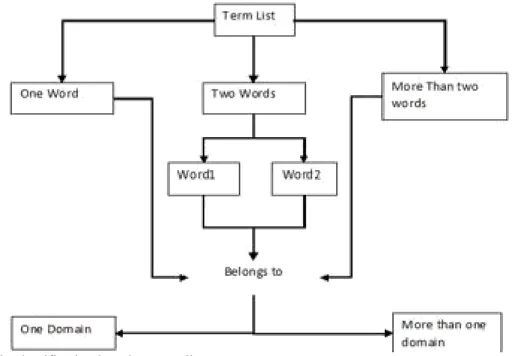
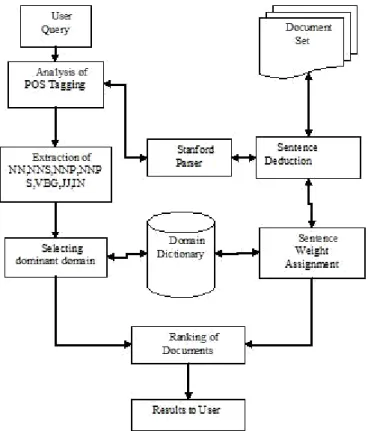
In the proposed work, Structured and Unstructured documents are maintained separately. Whenever a user query arises, it is given to Stanford Parser for POS tagging. Based on POS Tagging NN (Noun , Singular), NNS (Noun, Plural), NNP (Proper Noun, Singular), JJ (Adjective) and IN (Preposition) are extracted from user query and stored in a term list table. Decisions are taken based on the accompanying diagram. If the user query belongs to only one domain then all the documents in the repository are compared against the domain dictionary and the results are computed. On the other hand, if the user query belongs to more than one domain then the dominant domain is computed based on Fig. 1. There are 2 possible cases can occur in selecting dominant domain
Case 1: If Most of the Words belong to one domain then the same domain is taken as dominant domain
Case 2: If Equal number of Matches found with two domains then the choice are given to the user to confirm the dominant domain.
Once the dominant domain is selected, each document is split into sentences and each sentence is further divided into words. Each word is compared with term list and domain dictionary for matching. If a match is found then the "sentence weight" is incremented. The same process is continued for the whole document and cumulative document weight is calculated. If the user query contains negative words, then a negative ag is set to the user query and the process will request the user to re-enter the direct query for better retrieval of results. In this way the accuracy of the retrieval is brought out. Once all the documents weight is calculated the highest weight of the document is ranked first and given to user as a good match in the retrieved results.
Algorithm 1 - POS Tagging using NLP INPUT : User query
OUTPUT : Resultant Document Set METHOD : POS Tagging IN NLP
Step 1 : Initialize the Resultant document set RES = { } Step 2 : Initialize nounlist NL= { } Step 3 : Initialize sentencelist SL={ } Step 4 : Initialize negativelist NGL= { }
Step 5 : Initialize NEGLIST= { not, no,neither, nor, except... } Step 6 : Initialize neg ag=0, word weight=0, sentence weight=0; Step 7 : POS Tag the user query using stanford parser.
Step 8 : foreach tag obtained
Step 9 : If NL.count=1 and PL.count=0 and neg ag=0 then nd the concept under which the single noun in NL occurs in Domain Dictionary.
Step 10 : If the single noun occurs under more than one concept, display all concepts. Step 11 : As per the user selection, add that selected concept too in NL.
Step 12 : Detect sentences in the web documents using OpenNLP and store in SL Step 13 : foreach sentence sent in SL
Step 14 : If all nouns in NL occur within a sentence Step 15 : Increment weight for each match.
Step 16 : Store sentence weight of each document into SentenceWeightList SWL Step 17 : Sort the documents according to sentence weight and store it in the RES.
Step 18 : Compare each entry in the NL with word dictionary of each document
Step 18a: If a match is found then increment word weight with the count attribute's value. Step 19 : Store word weight of each document into WordWeightList WWL.
Step 20 : Sort the documents according to word weight and if that document is not in RES store it in RES Step 21 : If neg ag=1 then skip all nouns in NL and compare with the word dictionary of each document Step 21a : Store such documents into RES
Step 22 : Retrieve the ranked documents fD1,.Dng in RES to the user
Fig. 1: Domain classification based on term list.
3. Experimental Results and Discussion:
The experiment was conducted using American national corpus (anc) by in-creasing the number of documents in the repository gradually. The main factor considered for evaluation is accuracy rather than the speed. Three different scenarios are considered in evaluating the performance of the proposed system. A confusion matrix is created with various combinations of Relevant documents (RD) and Conflicting documents (CD) to analyse the system. Performance evaluation of the proposed approach is done based on the classification context scenario. Precision, Recall, Accuracy and F-measure are the major measures used for classification based performance. Precision is the probability that measure a retrieved document is relevant to the context. Precision is calculated based on the formula
Precision =
Where
TP is true positive (Correctly retrieved) TN is true negative (Correctly rejected) FP is false positive (Incorrectly retrieved) FN is false negative (Incorrectly rejected)
Recall is the probability that calculates a relevant document is retrieved in a search process. Recall is calculated based on the formula
Fig. 2: Architectural design of the proposed approach.
Accuracy is calculated based on the formula Accuracy =
First scenario creates a large number of Relevant Documents against the small number of Conflicting documents. The Second scenario creates an equal number of Relevant and Conflicting documents. The Third scenario creates a small number of Relevant Documents against with large number of Conflicting documents. All the three cases, the document set contents are increased gradually.
Table 1: Relevant Documents are higher than the Conflicting Documents. No of Documents Accuracy
F-Measure Recall
Accuracy Measure Accuracy F-Measure Recall
Recall Precision
100 0.978 0.965 0.974 0.962
200 0.975 0.963 0.972 0.96
300 0.974 0.964 0.973 0.961
400 0.974 0.962 0.971 0.957
500 0.97 0.963 0.973 0.961
600 0.967 0.962 0.974 0.964
700 0.966 0.96 0.972 0.961
800 0.968 0.962 0.973 0.962
900 0.97 0.96 0.972 0.961
1000 0.968 0.952 0.965 0.95
1500 0.964 0.958 0.962 0.951
2000 0.962 0.956 0.96 0.95
3000 0.963 0.956 0.961 0.951
5000 0.962 0.955 0.959 0.95
Table 2: Relevant Documents are equal to the Conflicting Documents. No of Documents Accuracy
F-Measure Recall
Accuracy Measure Accuracy F-Measure Recall
Recall Precision
100 0.975 0.963 0.972 0.96
200 0.974 0.961 0.97 0.958
300 0.972 0.963 0.967 0.951
400 0.974 0.96 0.962 0.955
500 0.972 0.962 0.963 0.952
600 0.97 0.963 0.965 0.952
800 0.968 0.962 0.964 0.95
900 0.964 0.96 0.96 0.948
1000 0.964 0.952 0.962 0.95
1500 0.962 0.95 0.96 0.949
2000 0.96 0.955 0.958 0.948
3000 0.96 0.952 0.955 0.95
5000 0.961 0.951 0.954 0.95
Table 3: Relevant Documents are smaller than the Conflicting Documents. No of Documents Accuracy
F-Measure Recall
Accuracy F-Measure Accuracy F-Measure Recall
Recall Precision
100 0.972 0.958 0.965 0.954
200 0.97 0.957 0.967 0.953
300 0.968 0.953 0.962 0.95
400 0.973 0.952 0.961 0.952
500 0.97 0.954 0.964 0.952
600 0.965 0.951 0.96 0.95
700 0.964 0.948 0.961 0.951
800 0.965 0.95 0.962 0.953
900 0.965 0.948 0.962 0.951
1000 0.96 0.952 0.958 0.95
1500 0.961 0.947 0.956 0.945
2000 0.958 0.952 0.957 0.946
3000 0.959 0.955 0.958 0.95
5000 0.96 0.954 0.958 0.951
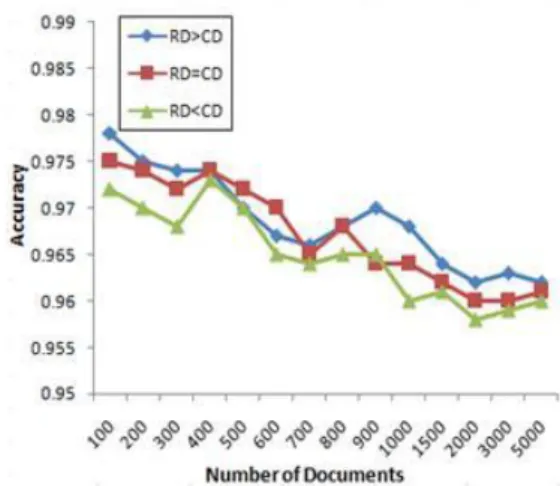
The accuracy and recall of the system with respect to the above stated 3 cases is plotted in Fig.3 and, Fig.4 respectively.
Fig. 3: Shows that the accuracy of the proposed systems is maintained between 96 % and 98 % irrespective of the number of documents
All the performance measures of the system clearly highlights that the results produced by the system in terms of all aspects are better compared with existing systems.
4. Conclusion:
In this study a new approach is proposed based on Natural language processing to understand and classify the documents based on the user query. The experimental results of the proposed systems point out that the accuracy of this system is vary in between 95 percent and 97 percent in terms of relevancy. However the time taken to classify a document is little high compared with existing search engines. In future, our system will address the existing drawbacks to compete with other search engines in terms of the time factor.
REFERENCES
A Developers Guide to the Semantic Web, Liyang Yu, Springer-Verlag (2011), ISBN: 9783642159695 A Semantic Web Primer, (Third Edition), Grigoris Antoniou, Paul Groth, Frank van van Harmelen, Rinke Hoekstra ISBN: 0262018284
Debajyoti Mukhopadhyay, Aritra Banik, Sreemoyee Mukherjee, Jhilik Bhat-tacharya, Young-Chon Kim, 2007. Article/Book:A Domain Speci c Ontology Based Se-mantic Web Search Engine, The 7th International Workshop MSPT 2007 Proceed-ings;February 5, 2007; pg no : 8189; ISSN 1975-5635, ISBN 89-8801-90-0.
Dr. G.R. Karpagam and J. Uma Maheswari, 2010. A Conceptual Framework for Ontol-ogy based Information Retrieval, International Journal of Engineering Science and Technology, 2(10): 5679-5688.
http://hakia.com/ http://swoogle.umbc.edu/
http://www.anc.org/data/masc/downloads/data-download/ https://duckduckgo.com/
Kalaivani, S., Dr. K. Duraiswamy, 2011. Personalized Semantic Search based Intelligent Question Answering System using Semantic Web and Domain Ontology, Interna-tional Conference on Advanced Computer Technology, IJCA, pp: 15-17.
Larry Kerschberg, Wooju Kim, Anthony Scime, Intelligent Web Search via Person-alizable Meta - search Agents.
Lev FinKelstein, Evgeniy Gabrilovich, Yossi Matias, Placing search in context:the concept revisited, 10th International Conference on World Wide Web, pp: 406-414.
Madhu, G., Dr. A. Govardhan, Dr. T.V. Rajinikanth, 2011. Intelligent Semantic Web Search Engines: A Brief Survey, International journal of Web and Semantic Technology (IJWesT), 2(1): 34-42.
Michal J. Cafarella, Oren Etzioni, A Search engine for natural language pro-cessing, International World Wide Web Conference Committee(IW3C2), ACM 1595930469/05/0005
Peter M. Kruse, Andr Naujoks, Dietmar Rsner, Manuela Kunze, 2005. Clever Search: A WordNet Based Wrapper for Internet Search Engines, Computing Research Repos-itory CORR, vol. Abs/cs/050.
Programming the Semantic Web, Toby Segaran, Jamie Taylor, and Colin Evans, O'Reilly, (2009), ISBN: 9780596802066.
Rubn Lara, Sung-Kook Han, Holger Lausen, Michael Stollberg, Ying Ding, Dieter Fensel, An Evaluation of Semantic Web Portals.
Stanford Parser : http://nlp.stanford.edu/software/index.shtml.
Xing Jiang, Ah-Hwee Tan, OntoSearch: A Full-Text Search Engine for the Seman-tic Web
Yuangui Lei, Vanessa Lopez and Enrico Motta, An Infrastructure for Building Se-mantic Web Portals, International Worksho on Web Information Systems Modeling (WISM 2006), pp: 283-308.