Performance Evaluation of Watermark ImageQuality by Using
DCT with Arnold transform
Er.Navdeep Sandhu
Department of Computer Science & Engineering, Amritsar College of Engineering & Technology,
Amritsar, Punjab
Er.Navneet Bawa
Department of Computer Science & Engineering, Amritsar College of Engineering & Technology,
Amritsar, Punjab
I.
I
NTRODUCTIONThe objective of digital watermarksto give copyright security with regarding intellectualasset that isinan electronic format. The actual information/logo is usuallyinsert into the image is named as digital image watermark. Digital image watermarking technique providesperceptibility.Digital Image Watermarking is prominent approach thatprovides solution to material authentication issues and digital delivery of information [1].
A.Watermarking process
The watermark is inserted into the original image .It begins with watermark computation done by using watermarking algorithms (spatial and frequency domain) and develops their corresponding private key then watermark is embed into cover image and new image formed called watermarked image an on the other side watermark is extracted by using corresponding public key. Hence the digital image watermarking techniques needs to be resistantagainst noise and security assaults.[1]
Abstract
: Digital watermarking Technique utilized to avoid Illegal copy as well as replication with in
digital media. The fast growth of World Wide Webhas created easier to deliver the data/image correct and quicker to the desired destination.The major problem in hypermedia technology is attacks on digital watermarking.In digital watermarking single attack on a given watermark image has effective outcome but multiple attacks on a given watermarked image and other watermark scrambling need to be improved. This paper evaluates a new watermarking technique using integrated approach of DCT, DWT and SVDwith Arnold Transform The proposed algorithm enhanced imperceptibility and robustness in the watermarked image which shows that the improvement in the visual quality of watermark image as well maintains theaccuracy in it.Key Words:
Watermarking; Watermarking Techniques;DCT; SVD;DWT; Arnold Transform;A growing number of companies are offering some form of stress management intervention. However, for those seeking to introduce stress management activities, too little in the way of guidance and direction has been available. This analysis aims to help organizations better understand the sources and dynamics of stress at the worksite and examines how they can reasonably assess, implement, and evaluate their stress management options. This analysis examines the inter-relationships of role conflict, role ambiguity, work-family conflict, emotional exhaustion, job satisfaction and propensity to leave in a sales environment.
Figure 1: embedding and extraction process of watermarking
B.Watermarking Techniques
Several watermarking techniques are available: 1. Discrete Cosine Transform (DCT)
2. Arnold Transformation
1. Discrete CosineTransform (DCT)
DCT converts or switches a signal from spatial domain into a frequency domain. DCT is real-valued and offers a much better approximation of a signal with few coefficients. This process reduces how big the conventional equations by discarding higher volume DCT coefficients. Essential structural information is contained in the reduced volume DCT coefficients. Thus, breaking up the high-frequency DCT coefficient and using the lighting advancement in the low–volume DCT coefficient, it'll acquire and cover the edge information from satellite images. The increased picture is reconstructed by utilizing inverse DCT and it is likely to be sharper with excellent contrast. DCT is popularly used in information pressure techniques such as for example JPEG and MPEG [4].
2. ArnoldTransformation
II.
M
ETHODOLGYThis part will explain the working of the recommended algorithm.
A. WATERMARKING EMBEDDING PROCESS
B. WATERMARK EXTRACTING PROCESS
Fig3: Flowchart of the watermarking extracting technique
III. EXPERIMENTATION AND RESULTS
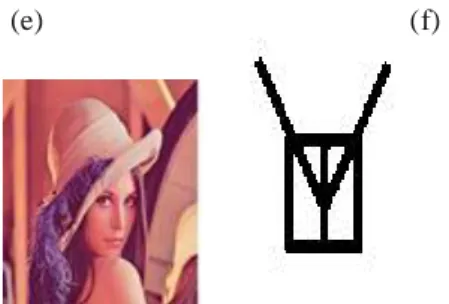
Applying various attacks on the watermarked image where lena picture is a cover image C1 and watermark W1 is embedded and various malicious attack applied on the watermarked image which may result into distortion in visual quality of the image but this recommended method provide immunity from various attacks with providing more imperceptibility and robustness against attacks.
Cover image C1 watermark image w1
Fig: 4(cover image and watermark image)
(a) (b)
Fig: 5 athe AWGN, bthe extracted watermark
(c) (d)
Fig: 6 cthe sharpening attack, the extracted watermark
(e) (f)
Fig: 7 ethe extracted watermark, ithe histogram equalization attack
(g) (h)
Fig:8 g the extracted watermark, h the gamma correction attack
The different attacks applied on the Lena image but it does not exploit visual quality of watermarked image and by applying extraction process obtained watermarked image without any distortion.
Multiple attacks (histogram equilization,awgn,sharpenning attack) are applied on the image.The watermark images extracted are:-
Experimental results using (225× 225) gray scale level image. Lena, peppers, baby, jeep and six more images are used as the cover images. In this paper all experiments are done over the lena image fig: 4. The experiments conducted by using (140× 138) watermark image.
The actual visible excellence of the watermarked picture is improved by applying the recommended watermarking method (DCT–DWT–SVD) in contrast to the existing watermarked image using (CZT –DWT-SVD) method.
After applying different attacks on taking ten different cover images and watermark images are computed through performance matrix.
A. PERFORMANCE ANYLYSIS
This paper has been implemented the proposed method in MATLAB tool u2013a. The recommended method is applied on different images. The algorithm is applied using various performance parameters Mean Square Error (MSE), Peak Signal to Noise Ratio (PSNR), structural similarity index matrix (SSSIM),Root mean square error(RMSE)andNormal cross correlation(NCC) for finding out the comparison between initial watermarked image and the extracted watermarked image from the attacked image. Here we also compare the proposed method against the present attacks like Sharpening Attack, AWGN Attack and Histogram Attack.
1) Mean square error
Mean square error used as measure ratio of picture excellence table. The expansive estimation of mean square guarantees that picture is a low quality. The MSE is the normal of the pixel distinction between two pictures.
MSE = 1
𝑎𝑏 (𝐽𝑖𝑗 − 𝐾𝑖𝑗)
2 𝑛 𝑗 =1 𝑚 𝑖=1 .
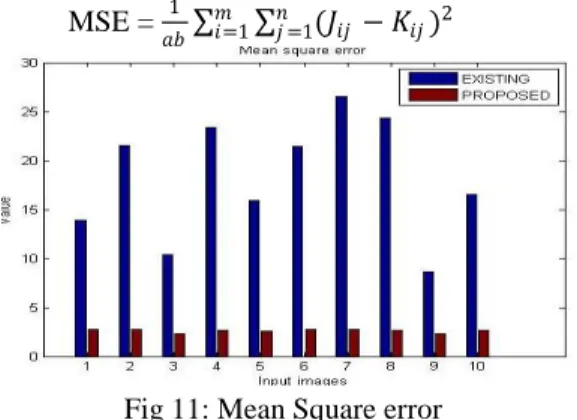
Fig 11: Mean Square error
Fig 11 shows the investigation of the mean square error of several images working with watermarking through pre –existing method (blue color) as well as watermarking with proposed method(red color).In this paper different ten cover images and watermark images are used.MSE values have been decreased which shows good quality of watermark.
2) Peak signal noise ratio
PSNR is used to estimate the imperceptibility. PSNR is utilized to gauge the corruption brought about by the watermarked impact. The PSNR, i.e. calculated within decibels characterizes the likeness between a unique picture and the reproduced picture. The greater PSNR estimations for the reproduced picture give better quality in digital watermarking.In this table different ten cover images are used whereas watermark image is same.
R = 10log10
2552
Fig 12: Peak Signal Noise Ratio
Fig 12 shows that the analysis of PSNR of several images working with watermarking through existing method (blue color) as well as watermarking with proposed method (red color). In this paper different ten cover images and watermark images are used. Have been increased which shows good quality of watermark.
3) Structural similarity index metric
The Structural Similarity Index Metric (SSIM) is a technique to compute the actuallikeness in between a pair of pictures. The actual SSIM can be regard as a high quality way of measuring among the list of pictures in contrast to, available other pictures is consider as excellent quality. TheSSIM index is actually computedon various windows associated with pictures. To evaluate in between pair of windows jand kassociated with typical dimensions N×N is:
SSIM (j, k) = 2𝜇𝑎𝜇𝑏 +𝑐1 (2𝜎𝑎𝑏+𝑐2) (𝜇𝑎2+𝜇𝑏2+𝑐1)(𝜎𝑎2+𝜎𝑏2+𝑐2)
.
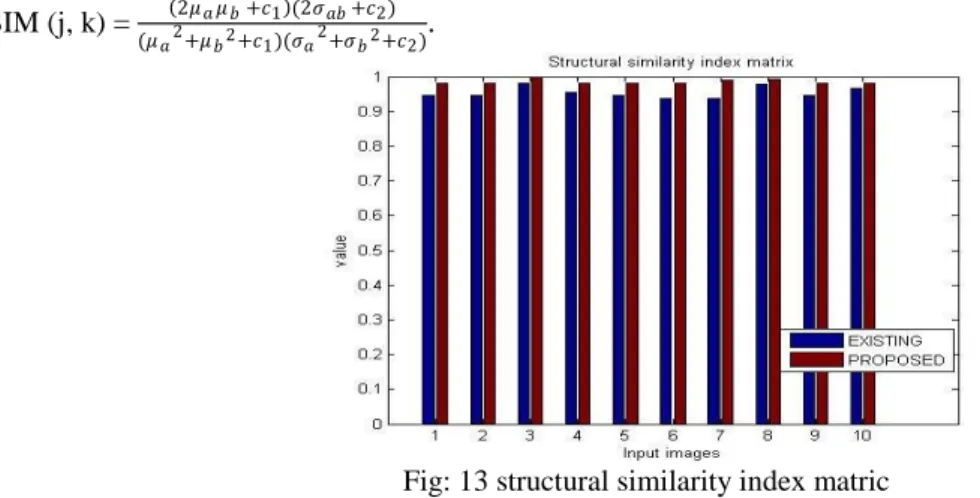
Fig: 13 structural similarity index matric
Fig 13 shows that the analysis of SSIM of several images working with watermarking through pre – existing method (blue color) as well as watermarking with proposed method (red color). In this paper different ten cover images and watermark images are used. SSIMhave been increased which shows good quality of watermark
4) Root mean square
Root Mean Square Error (RMSE) is simply employed to compute the variation in-betweenthe value (Sample and inhabitants values) estimated through a model or even an estimator and the ideals
actuallycalculated. The actual RMSDassociated with an estimator 𝜃 in regarding to an approximately parameter
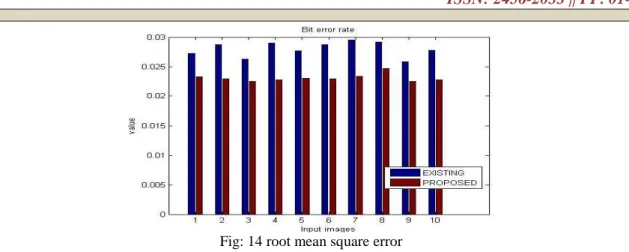
Fig: 14 root mean square error
Fig 14 shows that the analysis of RMSE of several images working with watermarking through existing method (blue color) as well as watermarking with proposed method (red color). In this paper different ten cover images and watermark images are used. Have been decreasedwhich shows good quality of watermark.
5) Bit error rate
The bit error rate (BER) is usually thequantity of bit errors for eachsystem. The bit error ratio(also BER) is actually the quantity of bit errors split through the overall amount of transmitted bits within the analyzed time period interval.
BER = 1 2erfc(
𝐸𝑏 𝑁0)
Fig; 15 mean square error
Fig 14 shows that the analysis of RMSE of several images working with watermarking through existing method (blue color) as well as watermarking with proposed method (red color). In this paper different ten cover images and watermark images are used. Have been decreased which shows good quality of watermark.
6) Normalcross correlation
Normalized cross correlation can be used to find out similarities between fused picture and registered picture is given by the following equation:
A. NCC evaluation for Additive white Gaussian noise
Fig; 16 AWGN
It is concluded that Normalized Cross-Correlation of various images using watermarking by pre-Existing Technique (Blue Color) and watermarking by Proposed Approach (Red Color) for awgn.This growthindicates the bettervisual quality of the image
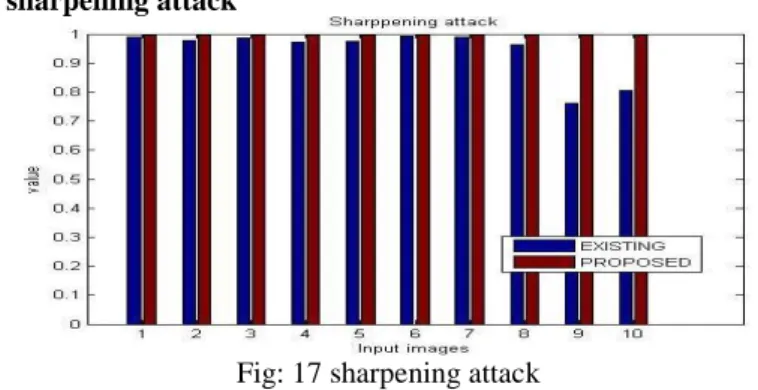
B. NCC evaluation for sharpening attack
Fig: 17 sharpening attack
It is concluded that Normalized Cross-Correlation of various images using watermarking by pre-Existing Technique (Blue Color) and watermarking by Proposed Approach (Red Color) for sharpening attack.This growth indicates the bettervisual quality of the image
C. NCC evaluation for histogram equilization
It is concluded that Normalized Cross-Correlation of various images using watermarking by pre-Existing Technique (Blue Color) and watermarking by Proposed Approach (Red Color) for histogramequalization.This growth indicates the bettervisual quality of the image
D. Gamma correction
Fig: 19 gamma correction
It is concluded that Normalized Cross-Correlation of various images using watermarking by pre-Existing Technique (Blue Color) and watermarking by Proposed Approach (Red Color) for gamma correction.This growth indicates the bettervisual quality of the image
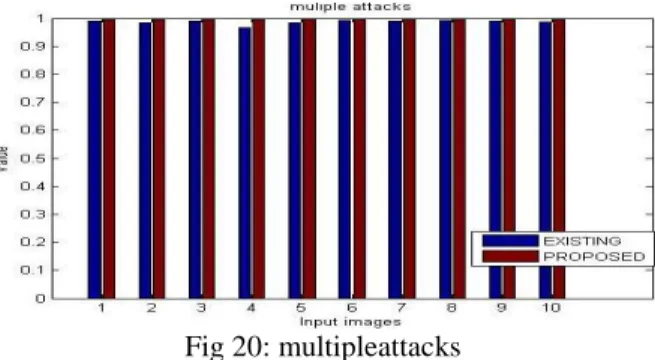
E. Multiple attacks
Fig 20: multipleattacks
It is concluded that Normalized Cross-Correlation of various images using watermarking by pre-Existing Technique (Blue Color) and watermarking by Proposed Approach (Red Color) for multiple attack.This growth indicates the bettervisual quality of the image
IV. CONCLUSION AND FUTURE WORK
The digital watermarking technique based on the DCT in combination with the DWT and SVD which makes the improvement in the visual quality of watermarked image.The implementation of( DCT-DWT -SVD )with the emergence of Arnold transform used for the watermarking scrambling. Soto evaluate the performance of proposed algorithm through the performance evaluation parameters( PSNR ,SSIM ,MSE ,RMSE ,BER and NCC).So implemented algorithm shows the increased value of PSNR,SSIM. Pre-existing PSNR was value (35.7372) dB and proposed value is (43.52119) db.As in near future we try to enhance the proposed watermarked algorithm further by using the contourlet transform and bcolonyinstead of DCT transform. Also SVD algorithm replaced by different image encryption techniques.
[2]. Qianli, Yang, and CaiYanhong, “A digital image watermarking algorithm based on discrete wavelet transform and discrete cosine transform,” IEEE International Symposium on Information Technology in Medicine and Education, vol.2, pp.1102-1105, August2012.
[3]. Shi, Hailiang, Nan Wang, Zihui Wen, Yue Wang, Huiping Zhao, and Yanmin Yang, “An RST invariant image watermarking scheme using DWT-SVD,” IEEE International Symposium on Instrumentation and Measurement, Sensor Network and Automation(IMSNA), vol.1, pp.214-217, August 2012.
[4]. b, Kaushik, et al. "A joint DWT-DCT based watermarking technique for avoiding unauthorized replication." Strategic Technology (IFOST), 2012 7th International Forum on.IEEE, 2012.
[5]. Kansal, Manie, Gursharanjeet Singh, and B. V. Kranthi. "DWT, DCT and SVD based digital image watermarking." Computing Sciences (ICCS), 2012 International Conference on.IEEE, 2012.
[6]. Raval, Keta, and S.Zafar, “Digital Watermarking with Copyright Authentication for Image Communication”, IEEE International Conference on Intelligent Systems and Signal Processing (ISSP), pp.111-116, March 2013.
[7]. Divecha, Nidhi, and N.N.Jani, “Implementation and performance analysis of DCT-DWT-SVD based watermarking algorithms for color images,” IEEE International Conference on Intelligent Systems and Signal Processing (ISSP), pp.204-208, March 2013.
[8]. Hamid Shojanazeri, Wan Azizun Wan Adnan, SharifahMumtadzah Syed Ahmad, “Video Watermarking Techniques for Copyright Protection and Content Authentication,” IEEE International Journal of Computer Information Systems and Industrial Management Applications, vol.5, pp. 652– 660, 2013.
[9]. Zhu, Yong, Xiaohong Yu, and Xiaohuan Liu, “An image authentication technology based on digital watermarking,” IEEE International Conference on Sensor Network Security Technology and Privacy Communication System (SNS & PCS), pp.179-183, May 2013.
[10]. Mehta, Sachin, et al. "A study of DWT and SVD based watermarking algorithms for patient privacy in medical images." Healthcare Informatics (ICHI), 2013 IEEE International Conference on.IEEE, 2013. [11]. Zhu, Yong, Xiaohong Yu, and Xiaohuan Liu. "An image authentication technology based on digital
watermarking."Sensor Network Security Technology and Privacy Communication System (SNS & PCS), 2013 International Conference on.IEEE, 2013.
[12]. Tun, Amy, and YadanaThein. "Digital Image Watermarking Scheme Based on LWT and DCT." International Journal of Engineering and Technology 5.2 (2013): 272.
[13]. Zebbiche, Khalil, and FouadKhelifi, “Efficient wavelet-based perceptual watermark masking for robust fingerprint image watermarking,” IET Image Processing 8, pp.23-32, January 2014.
[14]. Agoyi, Mary, ErbuğÇelebi, and GholamrezaAnbarjafari. "A watermarking algorithm based on chirp z-transform, discrete wavelet z-transform, and singular value decomposition." Signal, Image and Video Processing (2014): 1-11.
[15]. Giri, Kaiser J., Mushtaq Ahmed Peer, and P. Nagabhushan. "A channel wise color image watermarking scheme based on Discrete Wavelet Transformation." Computing for Sustainable Global Development (INDIACom), 2014 International Conference on.IEEE, 2014.
[16]. Akter, Afroja, and Muhammad AhsanUllah. "Digital image watermarking based on DWT-DCT: Evaluate for a new embedding algorithm." Informatics, Electronics & Vision (ICIEV), 2014 International C.
[17]. Tomar, Vivek, Arvind Kumar, and AnkurChoudhary. "Conception & implementation of a novel Digital image watermarking algorithm using cascading of DCT and LWT."Optimization, Reliabilty, and Information Technology (ICROIT), 2014 International Conference on.IEEE, 2014.
[19]. Cedillo-Hernández, Manuel, et al. "Robust hybrid color image watermarking method based on DFT domain and 2D histogram modification." Signal, Image and Video Processing 8.1 (2014): 49-63. [20]. Agoyi, Mary and GholamrezaAnbarjafari. "A watermarking algorithm based on chirp z-transform,