Kaitlin N. Torp. A Study of the Availability of Health Information for Teens on North Carolina Public Library Websites. A Master’s Paper for the M.S. in L.S degree. April, 2011.25 pages.Advisor: Sandra Hughes-Hassell
A large portion of teens not only get their health information from the internet but make health related decisions based on that information. Many teens are encumbered in their internet searches by filters on their school computers and monitoring parents in their homes. The public library provides an internet access point for teens free of filtering and monitoring. The public library has a history of providing health information to patrons, and many public libraries have extended that service to providing health information on the library webpages. This study sought to discover how much health information was provided specifically for teens on public library websites in North Carolina (a state with a high teen pregnancy rate and a high rate of teen HIV/AIDS diagnoses). The study
showed that only 14.3% of public library websites provided health information specifically for teens, which is not enough.
Headings:
A STUDY OF THE AVAILABILITY OF HEALTH INFORMATION FOR TEENS ON NORTH CAROLINA PUBLIC LIBRARY WEBSITES
by Kaitlin N. Torp
A Master’s paper submitted to the faculty of the School of Information and Library Science of the University of North Carolina at Chapel Hill
in partial fulfillment of the requirements for the degree of Master of Science in
Library Science.
Chapel Hill, North Carolina April 2011
Approved by
Introduction
Though the world around teenagers has changed, their reticence to talk about their
issues with adults has not. Notoriously shy when it comes to personal concerns,
teenagers have always sought out alternative sources of information to avoid the dreaded
conversation with a parent or guardian. Traditionally, teenagers have turned to each other to gather the information they need, often ignoring whether this information is true, false, or fabricated based on hearsay from a friend of a friend. This has lead to some
interesting conclusions on every subject from international politics to how babies are made.
A lack of knowledge can lead to misinformed decisions that have serious consequences. In their 2009 study of sources of sexual education for Latina women, Rojas-Guyler and King found a strong connection between reported source of sexual
education and sexual risk behaviors such as lack of condom use. The women studied reported that the most common sexual education sources were personal experience, friends, and the media: “Such a finding lends itself to potentially serious implications since sexual myths and misinformation are all too commonly spread throughout the
media and among peers” (Rojas-Guyler and King, 2009). According to the Guttmacher
Institute (2010), about 750,000 teenaged girls become pregnant every year in the United States. Even though the number has declined slightly (about 3%) each year since 2006, it
this same study, the state of North Carolina has the 14th highest pregnancy rate in the country.
Though the teen pregnancy rate is attention grabbing, this is not the only issue that teens must face related to sexuality and their bodies. Teens must also contend with
sexually transmitted infections, the emotional implications of sexual activity, and the simple need for information on what puberty entails. According to the Sexuality Information and Education Council of the United States (2009): “North Carolina ranks
5th in cases of HIV/AIDS diagnosed among young people ages 13–19 out of the 34 states with confidential, name-based HIV infection reporting”. How many of those cases could
have been prevented if teens had information about prophylactics and other strategies for preventing the spread of STDs and AIDs?
Health information is not limited to sexual health, as teens need answers to all
kinds of health questions. As they go through puberty, mental health is important to them as well. In the Kaiser Family Foundation study on how young adults use the internet to access health information, 58% of the teens studied rated “Depression or other mental illness” as a “very important” issue for their age group (Kaiser Family Foundation, 2001,
7).
No age group has embraced the internet the way teens have (Lenhart, Hitlin, and Madden, 2005). Not only were they born into a world where books exist on screens and
grocery shopping can be done with a few clicks of a mouse, but they have willingly handed over the responsibility of communicating with others and organizing themselves to the on-line world. They create avatars that allow them to talk to those who intimidate
library to do research by ignoring the books and clicking through Wikipedia links on the library computers.
Because of teens dependency on the internet, the danger that misinformation can pose to their health-related decisions, and their interest in finding health information on
the internet because of the confidentiality that it provides, it would be informative to study how much health information has been made available for teens. Though there are many websites that cater to teens’ way of accessing information, it is hard to know
whether teens are aware of these websites.
Though the public library in the past limited its information providing services to
books, it is now one of the main spaces for people without internet access to go online. It has become an important source of health information for adults who are unable to talk to a health professional or access health information at home. As cited in Gillaspy (2005),
Wood et al. (2000) found that as many as 20% of reference requests recieved by the libraries studied in the last 10 years were health related.
The next step is to analyze how health information, the internet, and public libraries go hand in hand for teens. In this study that focuses on the state of North Carolina, the public library websites of the state will be examined to find out if adequate
health information is being provided for teens.
Literature Review Teens and the Internet
Many teens appear to be tied to the internet. It is an integral part of their daily
home or a smartphone in between classes at their school. They can use public access computers in public libraries, and they can find internet connections on the computers in
their school library media centers. In a report done for the Pew Internet and American Life Project, Lenhart, Hitlin, and Madden (2005) surveyed 1,100 teens and their parents
about internet usage and discovered that by the 7th grade, middle schoolers had started to use the internet regularly to access email, social media sites, and browse for information about their interests.. By the 12th grade, 94% of users in their study reported using the
internet regularly. Of the teens that admitted to using the internet, 51% used it daily while 24% went on the internet more than once a day.
While most (87%) of the teens were able to access the internet from home, 74% said that they usually logged on from school computers and 54% said that they used the public access computers at the public library. Teens going to the public library for
internet use has actually increased since 2000 (Lenhart, Hitlin, and Madden, 2005). While some might assume that teens that are able to access the internet from
home do not have to deal with public and school library time restrictions or filters, the same study found that 54% of parents interviewed admitted to using filters on their home computers because they had children and/or teens in the house (Lenhart, Hitlin, and
Madden, 2005). Parents also set rules for internet usage in the household, often limiting the amount of time teens may use the web and checking up on what their teens have been doing online. This is easily done by the parents because 73% of teens who have internet
Of the teens that are online, 76% report using the internet as their main vehicle for news and current events (Lenhart, Hitlin, and Madden, 2005). While seeking
entertainment and playing online games takes up a large portion of their internet usage, teens are also using the internet for important matters such as researching a potential
college choice, following the campaigns of presidential candidates, and searching for health information. In 2000, 24% of teens said they would seek out health information on the internet, but in the 2008 study that number rose to 31%. Older teens were more
likely to research health information online and older girls were the most likely to seek out information about a health topic that they find hard to talk about (Lenhart, Hitlin, and
Madden, 2005).
Teens are also using the internet to communicate. They are emailing and instant messaging while they update their Facebook pages and post on message boards. Some
researchers argue that in this way, teens are formulating their own identities using their online interactions as spring boards (Bower 2006). Teens are able to expand on their
identity, that is try out multiple identities because they have an uncensored place to use their own voice in, places like blogs and chat rooms. Teens believe that on the internet everyone starts out on the same level and so there is less judgment (Ferguson 2000).
In her 2000 article, Sue Ferguson quotes Sean Saraq (director of consumer intelligence for Youth Culture) on his assessment that teens use the internet as an “appliance” rather than “technology.” In other words, teens are not about to outgrow
their internet usage because it has become invaluable to their lives. Ferguson notes that Canadian teens are using the internet primarily for communication, but one of the most
Information seeking is also an important aspect of teen internet use. Interestingly, teens do not recognize what they are doing as information seeking behavior. Teens find
the internet to be a place for entertainment, and if they are looking up news and current events, they consider this to be a part of the entertainment that the internet provides
(Weigold and Treise, 2004). They think of the internet as a place for fun and as an escape from the stressors of the offline world, which sometimes makes it hard to get them to search too in-depth for the information that they seek. If it requires too much work
they may abandon the endeavor.
Teens and Health Information on the Internet
Skopelja, Whipple, and Richwine (2008) define health literacy in their 2008 article from the Healthy People government program as the “degree to which individuals
have the capacity to obtain, process and understand basic health information and services needed to make appropriate health decisions”. They argue that just because teens are
able to use technology does not mean that teens are able to find reliable health
information and understand what they find enough to use it to their advantage. Even with internet access and a lot of free time, Skipelja et. al note that teens can have trouble
finding health information. They conclude that the ways teen search the internet is not conducive to in-depth research of a particular topic over a long period of time stating:
Additionally, Skopelja et. al found that teens had trouble formulating searches. Sometimes their search terms were one word and too short, while at other times they
were typing whole sentences that would give random results as related to different parts of their many search terms. Teens also did not check websites for accuracy, and once an
answer was found it was taken at face value (Skopelja Whipple, and Richwine 2008). Not only does it appear that teens are ill equipped to explore the information they find on the web with a discerning eye, they also want information to be entertaining.
Skopelja et al (2008) found that teens tend to pay attention more if there are “games, quizzes, and interactive and personalized health check tools” (108). They also prefer
gender- and age group-specific pages (Skopelja, Whipple, and Richwine 2008). Vargas (2005) concurs explaining that simply listing health websites on a webpage for teens is not the best way to get the information to them. Teens want an
interactive environment where they can personalize their experience and participate in their own information gathering. Vargas explains: “They prefer chat rooms and bulletin
boards because they can get their questions answered quickly and they can take part in the discussion” (19). Today’s teens have been raised on the internet, where they can voice whatever opinions they want and interact with their entertainment in many different ways, and so they look for these elements in almost all of their interactions on the web.
In the study done by Skopelja et al (2008) teachers were asked about their opinion
on the health information that is available to teens on the internet. While 58% felt that it should be easy for students to find credible health resources online, 18% of the teachers did not have faith that the students could find these credible health resources. There was
Even though teens are not experts in the realm of searching the internet for accurate health information, hat does not mean that it isn’t one of the top ways that they
get their health information. A study done in 2001 by the Kaiser Family Foundation found that of the teens that have gone online (90% of the teens studied), 75% had used
the internet to find health information. Of those 75%, 39% said that they had changed their personal behavior because of health information they had read online. The topics that teens are most interested in, listed in order of importance, were: sexual issues, drug
and alcohol abuse, sexual assault, violence, smoking, depression and other mental illness, cancer, weight loss or eating disorders, heart disease, and acne or skin care (Kaiser
Family Foundation 2001). In general (69% of teens studied), teens take their newfound internet health information and discuss it with their peers. Only slightly less (53%) of the teens said that they took the information they found and brought it up with their parents.
It seems that putting health information on the internet for teens does not lead them to solve difficult problems on their own, but rather facilitates discussion about their issues
with others.
Another interesting aspect of young adult’s internet health information experience
was that only 17% of teens studied said that they would trust the health information found online “a lot,” but 39% said that the health information they found online was
useful. Above all, what teens find the most important in their health information searches is confidentiality (82% claimed this) and they feel that the internet provides that
confidentiality for them (76% think so). In conclusion, teens are using the internet to look up health information because they feel comfortable doing so (Kaiser Family
An investigation done by Findlay in 2009 not only confirmed much of what was discovered in the Kaiser Family study but also discovered that teen crisis and help lines
(associated with mental health) were no longer being used due to teens turning to the internet for information and support. Those organizations that have added online
components have not seen a decline in use of their services by teenagers, just a change in how they are used. Teens use the online services first and eventually work up to calling in. When it comes to health it seems that teens prefer the anonymous nature of seeking
answers and information on the internet as opposed to having to actually talk to a person about their problems and questions.
Issues of Access
In Teens & Libraries: Getting it Right Walter and Meyers (2003) discuss the use
of filters by public libraries to limit internet access for children and young adults. While this seems like a good way for adults to protect youth, it can become yet another
hindrance (added to the filters on the internet at school and the monitoring done by
parents at home) to their ability to access health information. Walter and Meyers believe that filters are not effective: “at the very least, teens have the right to prove themselves
responsible Internet users. It is only fair that they be given access to the skills and knowledge to do so” (55).
This is especially relevant to health information, which often is not included on
public library websites due to self- or community-censorship. As Vargas (2005) notes, “In some communities there are political forces that would prohibit some health
Recognizing the need for teens to access health information, Hughes-Hassell, Hanson-Baldauf, and Burke (2008) conducted a study to find out how many urban public library websites offered adequate general health information to teens. This study examined urban libraries because many teens who live in urban communities live below the poverty level and only have access to health information at their local public or school library. Their findings indicated that it was uncommon for public library websites to provide health
information just for teens. They found that a lack of young adult librarians, issues with filters, concerns about quality of information and censorship concerns were the main reasons why public libraries were not providing health information on their websites. While this study focused on urban teenagers the findings have implications for all teenagers. Even though the literature supports the ideas that teens use the internet for health information seeking, it appears that many public library websites (a main source for internet access for teens) are not fulfilling this information need.
Methodology
Library, both in Granville County). Publiclibraries.com was used because it was the most comprehensive list of public libraries that could be found. According to its “About the Site” webpage, it has been cited by the U.S. Department of Education, the Library of Congress, and the Smithsonian Institution Libraries.
North Carolina was chosen as the state for this study for many reasons. North Carolina has the 14th highest pregnancy rate in the country (Guttmacher Institute, 2010).
North Carolina is also has the 5th highest rate of HIV/AIDS diagnosis in country
(Sexuality Information and Education Council of the United States, 2009). According to
e-NC, the state initiative to connect all North Carolinians to high speed internet, “32% of households with annual incomes of less than $25,000 do not have a computer or Internet access in their homes” (e-NC Authority, 2010). In 2010, 16.7% of the North Carolina
population did not have health insurance and 24.5% of persons under 18 were living in poverty (America’s Health Rankings, 2010).
Each public library website was examined for four items:
1. Specific health links provided for general library users
2. A link to NCLive provided for general library users
3. Specific health links aimed at young adults provided on a young adult library
webpage
4. A link to NCLive provided on a children’s or young adult library page
children’s services. Specific health links for the general public were located by going through the website looking for a page titled “E-resources,” “Links,” “Reference,”
“Research,” or other related titles. Health links were marked down as being specifically for teens only if they appeared on a young adult or youth services page of the library website.
Limitations
The websites were inspected for health information by a library professional and not a general library user or a young adult. If users cannot figure out how to access the
information, the information might as well not be there. A library professional will know how library websites are organized and what sections, such as “Reference” or “Online Resources,” provide access to web-based or online resources such as databases that might contain health information.
Even though Publiclibraries.com can list the credible sources that have cited it, it is impossible to know if it is the most comprehensive and up to date list of public libraries in North Carolina. There were a few occurrences of Publiclibraries.com not having the most updated URL for a county’s library website, in which case the library system had to be Googled and located in that manner. Nowhere on the Publiclibraries.com website is it stated how often the website is updated. The only indication that the website makes an attempt at staying current is the link at the bottom of the page that lets the user fill out a form to update the site about a new library.
Findings
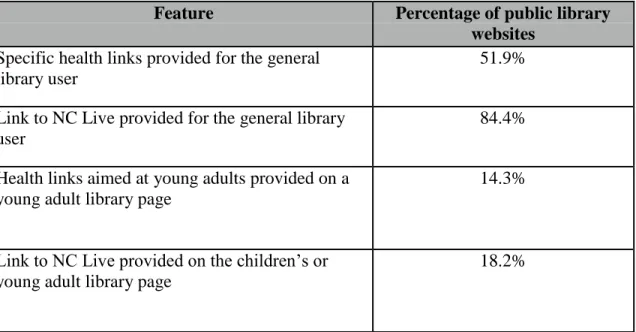
links on a webpage that was specifically designed for young adults. Slightly more (18.2%) provided a link to NCLive on a children’s or young adult library page. For general users, 51.9% of the library websites presented specific health links somewhere on the site, usually under the headings like “Useful Links,” “Reference,” or “Online Resources.” NCLive was linked on 84.4% of the library websites.
Table 1: Health Information Provided on Public Library Websites in NC
Feature Percentage of public library
websites Specific health links provided for the general
library user
51.9%
Link to NC Live provided for the general library user
84.4%
Health links aimed at young adults provided on a young adult library page
14.3%
Link to NC Live provided on the children’s or young adult library page
18.2%
for the general user. Of the websites that were not providing health information links for the young adult user or the general public, 90% did include a link to NCLive somewhere on the library website. Unfortunately, even with links to NCLive present on many of the sites, 40% did not provide health links for either the general user or teen users.
According to the Rural Data Bank created by the North Carolina Rural Economic Development Center, all of the counties in North Carolina are rural with the exception of 15 counties classified as urban. Of the rural majority, 32.8% provided specific health links for young adults. Of the urban minority, 80% provided specific health links for young adults. Clearly, urban counties are more likely to provide health links for teenagers than rural counties.
Discussion
Only 14.3% of public library websites in North Carolina provide health links aimed at young adults on a specifically young adult webpage on the library website. If websites were present, they were simply a list of links without any annotation or discussion of what exactly they offer. As Vargas (2005) explained in her study, this is not the best way to get the information to the teenagers.
Of the websites that did not provide teen-specific health information, 15.6% provided a link to NCLive on the children’s or young adult library page. Since NCLive does include health information having a link to NCLive on the children’s or young adult page could mean that conceivably a teen could access accurate and comprehensive health information from the public library website. Unfortunately, knowing what we know about the way teenagers use the internet means that it is highly unlikely that teens will be able to find the health
information and it requires searching through all the resources in the database, teens are not going to use it in that way. It is also a very dry way to search for information. There are none of the personalized and interactive components that teens are looking for.
Even when there was no health information provided specifically for young adults, there were health links provided for the general user on 51.9% of the websites. In this way, it is possible for young adults to find health information somewhere on the website. The problem with this is that though teens use the internet often, it does not mean that they are adept at finding what they need to find. Eighteen percent of teachers in the Skopelja,
Whipple, and Richwine study felt that students did not have the knowledge to find the health information that was available on the internet. The links provided for the general user suffer from the same lack of interesting form for teens that the links on the teen webpages suffered from.
Of the websites that did not provide health links for teens or general users, 90% did provide a link to NCLive somewhere on the webpage. Much like when NCLive appeared on the teen library webpages, this means that there is access to health information on the
website. The only problem is that it is not explicitly stated on the site that NCLive will lead to health information. In fact, very few of the websites explained what NCLive was. On many of the pages, there simply appeared a link for NCLive with no annotations. Even adults who have not been informed by a librarian will not understand what NCLive is and probably will not click on it when looking for health information.
rural public libraries in North Carolina are lagging in providing informative reference websites along with their in-person work.
Implications
The implications of this study are that not enough library websites provide health information for teens, and when they do, they are not presented in a manner that corresponds with how teens use the internet. For a state with high teen pregnancy and teen HIV/AIDS diagnosis rates, there is simply not enough health information available for teens to make informed health decisions.
At the very least, public library websites can include a link to Columbia University’s Go Ask Alice! website (http://www.goaskalice.columbia.edu/). This site is comprehensive, covering many topics related to sexuality, is completely confidential, and uses a question and answer format which provides a personalized experience for teens. Go Ask Alice! covers not only issues related to sexuality, but many other health related topics including alcohol and other drugs, fitness and nutrition, emotional health, and general health. According to the website, its goal is to provide “readers with reliable, accurate, accessible, culturally competent information and a range of thoughtful perspectives so that they can make
responsible decisions concerning their health and well-being” (Go Ask Alice! 2011). While Go Ask Alice! has been criticized by some for giving out too much information to teens (American Library Association, 2003), as information professionals librarians should recognize value of a website that does not censor itself in its information dissemination.
Created by Nemours, a pediatric health system, the teen page of the KidsHealth site (http://www.kidshealth.com/teens) is another website that provides accurate health
gender and the rest of the information is neatly divided into categories that teens can navigate to get the information most pertinent to their own needs. It contains interactive components like quizzes, and short reads like lists of tips for a healthier lifestyle. Each page has a button that allows the user to listen to the page content being read atloud (for teens who are
struggling readers). There is also an option to translate the site into Spanish, which is useful in a state that has seen a large increase in the Hispanic population over the last few years.
References
America’s Health Rankings. (2010). North Carolina (2010). Retrieved from
http://www.americashealthrankings.org/yearcompare/2009/2010/NC.aspx
American Library Association. (2003). Houston reexamines “Go Ask Alice” link.
American Libraries Magazine. Retrieved from http://americanlibrariesmagazine.org/
Bower, B. (2006).Growing up online. Science News, 169(24), 376-378.
Columbia Univeristy Health Services. Go ask Alice!. Retrieved from
http://www.goaskalice.columbia.edu/
e-NC Authority. (2010). e-NC: Connecting North Carolina to a better future. Retrieved
from http://www.e-nc.org/
Ferguson, S. (2000). The wired teen. Maclean's, 113(22), 38.
Findlay, S. (2009). As kids go online, help lines go quiet. Maclean's, 122(34), 21.
Guttmacher Institute. (2011). Facts on American teens’ sexual and reproductive health.
Retrieved from: http://www.guttmacher.org/pubs/FB-ATSRH.html
Hughes-Hassell, S., Hanson-Baldauf, D., & Burke, J.E. (2008). Urban teenagers, health
information, and public library websites. Young Adult Library Services, 6(4), 35-42.
Kaiser Family Foundation. (2001). Generation rx.com: how young people use the internet for
health information. Retrieved from
http://www.kff.org/entmedia/20011211a-index.cfm
Lenhart, A., Hitlin, P., & Madden, M. (2005, July 27). Teens and technology. Pew
Internet and American Life Project. Retrieved from
NC LIVE. Retrieved from http://www.nclive.org
N.C. Rural Economic Development Center. Rural data bank: county profiles. Retrieved from
http://www.ncruralcenter.org/databank/counties.php
Public libraries in the united states. Retrieved from http://www.publiclibraries.com/
Rojas-Guyler, L. and King, K.A. (2009). Sexuality education among Latinas:
Experiences, preferences, attitudes, and risk behavior. Sexuality Education: Past,
Present, and Future, Vol. 3: Principles and Practices.
Skopelja, E.N., Whipple, E.C., & Richwine, P. (2008). Reaching and teaching teens:
adolescent health literacy and the internet. Journal of Consumer Health On the
Internet, (12)2, 105-118.
Vargas, K. (2005). Teenagers, health, and the internet. Journal of Consumer Health On the
Internet, (9)3, 15-23.
Walter, V.A., & Meyers, E. (2003). Teens & libraries: getting it right. Chicago:
Appendix A
Libraries in italics are located in an urban county
*Labeled as unavailable because the online resources could not be accessed without a library card.
North Carolina Library Specific
health links provided?
Link to NC Live provided?
Health links aimed at young adults provided on a young adult library page?
Link to NC Live provided on children’s or young adult library page? Alamance County Public Libraries
(Alamance County)
No Yes No No
Alexander County Library System (Alexander County)
Yes Yes No No
Appalachian Regional Library (Ashe, Wilkes, & Watauga Counties)
Yes Yes No Yes
Beaufort-Hyde-Martin Regional Library (Beaufort, Hyde, & Martin Counties)
No Yes No No
Albemarle Regional Library (Bertie, Gates, Hertford, & Northampton Counties)
Yes Yes Yes No
Bladen County Library (Bladen County) Yes Yes No No
Brunswick County Libraries (Brunswick County)
No Yes No No
Buncombe County Public Libraries (Buncombe County)
Yes Yes No No
Burke County Public Library (Burke County)
Yes Yes Yes Yes
Cabarrus County Public Library (Cabarrus County)
Yes Yes No No
Caldwell County Public Library (Caldwell County)
No Yes No No
Catawba County Library System (Catawba County)
No Yes No No
Hickory Public Library (Catawba County) No Yes No No
Chatham County Public Libraries (Chatham County)
No Yes No No
Nantahala Regional Library (Cherokee, Graham, and Clay Counties)
Yes Yes No Yes
Cleveland County Library System (Cleveland County)
Yes Yes No No
Mauney Memorial Library (Cleveland County)
No Yes No No
Columbus County Public Library (Columbus County)
North Carolina Library Specific health links
provided?
Link to NC Live provided?
Health links aimed at young adults provided on a young adult library page?
Link to NC Live provided on children’s or young adult library page? Craven-Pamlico-Carteret Regional
Library (Craven, Pamlico, and Carteret Counties)
No No Yes No
Cumberland County Public Library and Information Center (Cumberland County)
Yes Yes Yes No
Davidson County Public Library System (Davidson County)
Yes Yes No No
Davie County Public Library (Davie County)
Yes Yes Yes Yes
Duplin County Public Library (Duplin County)
Yes No No No
Durham County Library (Durham County) Yes Yes No Yes
Edgecombe County Memorial Library (Edgecombe County)
No Yes Yes Yes
Forsyth County Public Libraries (Forsyth County)
Yes Yes No No
Franklin County Public Library System (Franklin County)
No Yes No No
Gaston-Lincoln Regional Library (Gaston and Lincoln Counties)
Yes Yes No No
Granville County Library System (Granville County)
Yes Yes No No
Greensboro Public Library (Guiliford County)
No Yes Yes Yes
High Point Public Library (Guiliford County)
Yes Yes No Yes
Halifax County Library System (Halifax County)
No No No No
Roanoke Rapids Public Library (Halifax County)
Yes No No No
Harnett County Public Library (Harnett County)
No Yes No No
Haywood County Public Library (Haywood County)
No Yes No No
Henderson County Public Library (Henderson County)
Yes Yes No No
Iredell County Public Library (Iredell County)
Yes Yes No No
Mooresville Public Library (Iredell County)
Yes Yes No No
Public Library of Johnston County and Smithfield (Johnston County)
No Yes No No
North Carolina Library Specific health links
provided?
Link to NC Live provided?
Health links aimed at young adults provided on a young adult library page?
Link to NC Live provided on children’s or young adult library page? Neuse Regional Library (Lenoir, Greene,
and Jones Counties)
No Yes Yes No
Madison County Public Library (Madison County)
Yes Yes No No
McDowell County Public Library (McDowell County)
No Yes No No
Charlotte Mecklenburg Library (Mecklenburg County)
Yes Yes No No
Southern Pines Public Library (Moore County)
No Yes No No
Braswell Memorial Library (Nash County) No Yes No Yes
Harold D. Cooley Library (Nash County) Yes No No No
New Hanover County Public Library (New Hanover County)
Yes Yes No Yes
Onslow County Public Library (Onslow County)
Yes Yes No Yes
Chapel Hill Public Library (Orange County) Yes Yes Yes No
Hyconeechee Regional Library System (Orange County)
No Yes No No
East Ablemarle Regional Library (Pasquotank, Camden, Dare, and Curritcuk Counties)
Yes No No No
Pender County Public Library (Pender County)
Yes No No No
Shephard Memorial Library (Pitt County) Yes Yes No No
Farmville Public Library (Pitt County) No No No No
Polk County Public Library (Polk County) No Yes No No
Randolph County Public Library (Randolph County)
Yes Yes No Yes
Sandhill Regional Library System (Richmond, Anson, Hoke, Montgomery, and Moore Counties)
No Yes No No
Robeson County Public Library (Robeson County)
No Yes No No
Rockingham County Public Library (Rockingham County)
No Yes No No
Rowan Public Library (Rowan County) Yes Yes No No
CMC Library Consortium (Rutherford and Polk Counties)
No Yes No No
Sampson-Clinton Public Library System (Sampson County)
Yes No No No
Scotland County Memorial Library (Scotland County)
North Carolina Library Specific health links
provided?
Link to NC Live provided?
Health links aimed at young adults provided on a young adult library page?
Link to NC Live provided on children’s or young adult library page? Stanly County Public Library (Stanly
County)
No Yes No No
Fontana Regional Library (Swain, Macon, and Jackson Counties)
Yes Yes Yes No
Transylvania County Library (Transylvania County)
No Yes No Yes
Union County Public Library (Union County)
No No No Yes
H. Leslie Perry Memorial Library (Vance County)
No Yes No No
Wake County Public Libraries (Wake County)
Unavailable* Unavailable* No No Warren County Memorial Library
(Warren County)
No Yes Yes No
Pettigrew Memorial Library (Washington, Chowan, Perquimans, and Tyrell
Counties)
Yes Yes No No
Wayne County Public Library (Wayne County)
Yes Yes No No
Wilson County Public Library (Wilson County)
No Yes No No
Avery-Mitchell-Yancy Regional Library (Avery, Mitchell, and Yancy Counties)
Yes No No No
Northwestern Regional Library System (Alleghany, Stokes, Surry and Yadkin Counties)