Technology Roadmapping Framework: Case
study of USO services in Iran
Nasrin Dastranj ICT Research Institute (ITRC)
Tehran, Iran [email protected] Tahereh Mirsaeedghazi ICT Research Institute (ITRC)
Tehran, Iran [email protected]
Kolsoom Abbasi Shahkooh ICT Research Institute (ITRC)
Tehran, Iran [email protected] Mahmood Kharrat ICT Research Institute (ITRC)
Tehran, Iran [email protected]
Received: October 16, 2016- Accepted: December 18, 2016
Abstract— Technology roadmapping is a tool for decision-makers to identify, assess and choose between different
strategic options to achieve technological objectives and help companies and industries create better understanding of their market and technological choices. In this research, a technology roadmap for planning and developing e-services in rural and least developed areas is designed. Along with development of communication infrastructure and providing access all over the country, it is necessary to create a comprehensive plan to develop e-services in rural and least developed areas. This roadmap provides a platform for participation of stakeholders from all sectors and also provides access to high quality and effective services. By using technology roadmap approach, e-services have been defined in different categories including agriculture, education, health, finance and banking, tourism, public facilities, employment and entrepreneurship, registration, environment, police and judiciary; and then characteristics and requirements of services are clarified. After specific steps to extract the required content of the roadmap, the content is mapped to the structure of the roadmap in layers of drivers, services, requirements and strategies.
Keywords- e-services, technology roadmap, rural and least developed areas, USO I. INTRODUCTION
ICT Universal Service Obligation (USO) is the obligation by international unions such as International Telecommunication Union (ITU) placed on governments to ensure that basic telecommunication services, information technologies, and postal services are accessible to all people including less developed and rural areas. Rural areas are the important part of a country and their development plays an important role in national development. According to the role of rural development in economic growth, rural development programs are very necessary in every country. In this
regard, Information and communication technology (ICT) is one of the main priorities in rural development process. Information and communication technologies will help these areas overcome isolation and also remove traditional boundaries. Besides, information technology can be effective in reverse migration from cities to rural areas.
Along with providing ICT infrastructure in rural areas, appropriate services should be designed in order to utilize provided infrastructure effectively. So, the main aim of designing technology roadmap in this paper is defining and prioritizing key services in rural and least developed areas, and also providing
common and integrated understanding to plan, implement and collaborate in the development of services. It should be noted that achieving these goals requires coordination and consensus among all related stakeholders.
Generally, the goals of providing e-services for rural and least developed areas include:
Improve the lives and welfare indicators through providing required e-services in different categories including agriculture, education, health, tourism, finance and e-government. Support business development through the
creation of necessary platforms and targeted facilities for providing e-services.
Provide effective interaction and coordination between key stakeholders in the development of e-services.
Develop local content in cyber space based on values in order to provide efficient services in rural and least developed areas.
Help to increase the employment rate and creating new job opportunities through diversification of services, increasing investment and using human capital and providing infrastructure for business activities
Provide infrastructure and related equipment to access e-services in rural and least developed areas
The approach used in this research for designing USO services is technology roadmapping. Technology roadmapping is a planning process which provides a tool for decision-makers to identify, evaluate and choose between different strategic options in order to achieve the defined objectives [1]. This approach can help to achieve better understanding of the market and make targeted decisions for businesses and industries [2,3]. Technology roadmap provides consensus on issues like vision at a specific time in the future, new products or services, enabling technologies, feasibility of providing services and technologies, skills and capabilities needed to deliver related products and services and required programs to achieve skills, products, services and technologies [4].
In the following, USO services and technology roadmap framework will be explained in section 2. Then, research methodology will be described in section 3. In section 4, steps for developing the roadmap will be clarified. Finally, in section 5, results and conclusions will be presented.
II. LITERATURE REVIEW A. USO Services
Development of electronic services is an approach to improve the standards of living in less developed regions like other parts of the country. In this regard, some countries have specific experiences in the field of information and communication technology in rural areas.
In Malaysia, as one of the most successful countries in providing USO services, universal service obligation is presented in several different periods . in this country Initial focus was on providing fixed
telephone service. Then mobile phone and high-speed Internet were considered as important subject. Currently, value added services in the areas of health, education, entrepreneurship and development of rural communities are in the first list of services.
A key focus in the development of Universal services in Europe is on public access to high-speed Internet. In Europe, this area has been emphasized more than other public services and various projects has been defined and implemented to create public access to high-speed Internet. Prototyping and pilot projects are prominent characteristics of projects in Europe. So, in many cases, rural projects have been implemented in small-scale and pilots.
In India, universal service obligation services have various scope including fixed phone, mobile phone and internet access. Key policy in developing electronic services in India is the model of public-private partnership. Thus, many rural electronic services are implemented and become operational by NGOs, public charitable organizations, or private sectors. Also, rural service centers are organized in many states in India [5]. These centers actually are places for rural people's access to electronic services. Mobile phone is one of the major platforms to access many electronic services in the areas of agriculture and health.
South Africa has defined different plans and projects for rural development with focus on information technology [6]. Telemedicine is one of those projects to overcome many of the shortcomings of health in deprived areas. The development of rural education using information technology is another project in South Africa that aims to transform the teaching-learning process in rural schools. South Africa receives support of international organizations, and also international research institutions in developing IT applications in rural areas. The development of e-health and e-learning applications are some of these cases.
One of the key areas of focus in USO services in Turkey is equipping schools with ICT tools and developing use of ICT in teaching-learning processes [7]. Schools and students are one of the most important groups of rural communities which access to technology and its applications should be facilitated for them. So, Turkey has adopted a comprehensive approach in this area. Equipping schools, Internet connection, electronic content production, teacher training and distributions of student tablets are activities that are carried out by USO budget in Turkey [8].
As experiences show, developing fixed and public telephone lines and ICT centers with high speed internet, Providing access for disabled people, knowledge sharing infrastructures, Providing widespread access to ICT services at affordable prices, access to television and radio programs, and Strong and effective communication infrastructure in rural areas to integrate these points are the most important services which countries develop based on USO budget.
In this research, technology roadmap approach is used for developing and designing USO services in Iran. In second part of the literature and also in methodology it will be described how this approach is used to design services.
B. Technology Roadmap Framework
In this paper the technology roadmap approach is used to design e-services for rural and least developed areas in Iran. Experts believe that for complex systems with multiple stakeholders, it is necessary to use methods which have high flexibility and ability to integrate different techniques [9]. In the last 30 years, technology roadmap is used as a management tool in R&D, product and technology development and communication process among a wide range of stakeholders [10]. According to definitions, technology roadmap is a way for managing, planning and developing technology at the firm, sector and national levels [11] and is used where the scale of systems is large and strategic decisions involved with future uncertainties and association of several stakeholders in the formulation, implementation, support and use of technology [1,12].
American experience shows that technology roadmapping is an effective tool for creating strategic R&D decisions. Technology roadmapping in the United States dates back to 1980 when many American companies such as Motorola used this tool to determine the best route for future markets. The government learned from companies and used the approach to focus on research and development. US Department of Energy (DoE) industries of the future is an example in using technology roadmapping in energy section. Ministry of Economy, Trade and Industry of Japan (METI) is actively developing and managing technology roadmaps for the strategy as Strategic Technology Roadmaps (STR) from 2003. These roadmaps have been developed in different areas of the industry to show future opportunities and provide reasonable methods for technology development [10]. Industry Canada launched practices related to technology roadmap in 1995 as part of its strategic plan to support innovation. Industry Canada goal in developing technology roadmap summarized in one important goal: strengthen Canadians competitiveness by helping its industries in the identification and development of innovative technologies they need to thrive in competitive global markets [13]. South Korea's technology roadmap activities taken by the National Science and Technology Commission (NSTC) started in 2002. For this purpose five main visions of science and technology were identified and then the products and operations defined for achieving them.
According to experiences, usually the roadmap framework has two key components: roadmap process and roadmap structure. Roadmap process shows the steps for creating roadmap. Roadmap structure offer multilayer graphical display that connects technologies and products to market opportunities and requirements and by having specific timeframe
reflects the changes rate related to the important timeframes.
In roadmap process, after doing the preliminary activities to prepare the roadmap team and determine the scope and boundaries, the following items should be usually extracted. [1, 13]:
Purpose statement
Industry identification and future requirements of customers
Products, services and enabling technologies key features of products and services
Timeframe for developing enabling technologies
Technology drivers and related targets Technology alternatives and best solutions Strategies and skills needed to develop and
implement identified technologies.
According to the above mentioned steps, the result will be a roadmap structure that usually consists of three main layers [12]:
1. Upper layers are related to the trends and drivers that determine the overall goals and objectives related to the activity of the roadmap, Including foreign markets, industry trends and drivers, customer and competitor insights, internal trends and drivers, key milestones, goals and limitations. 2. Middle layer is focused on the products and
services that should be developed to respond to trends and drivers in upper layer. In most cases, this layer directly deals with the evolution of products and services in terms of functions, features and performance.
3. Lower layer is related to internal and external resources that are necessary to be provided to develop required products, services and systems. This layer includes necessary capital, equipment and cooperation, technologies, skills and competencies.
Providing the content of each layer in the roadmap requires experts' opinions and stakeholders' involvement. In the next section, it will be described how the roadmap structure is designed for USO services by extracting related issues in each layer with help of expert panels.
III. METHODOLOGY
In order to provide USO roadmap framework, 4 key phases have been accomplished (Fig. 1):
Fig.1: key phases of developing USO roadmap framework
According to the first phase, the preliminary studies including the identification of current situation in rural areas have been done by the roadmap team. Steps of this phase are shown in figure 2.
Fig. 2: Preliminary activities
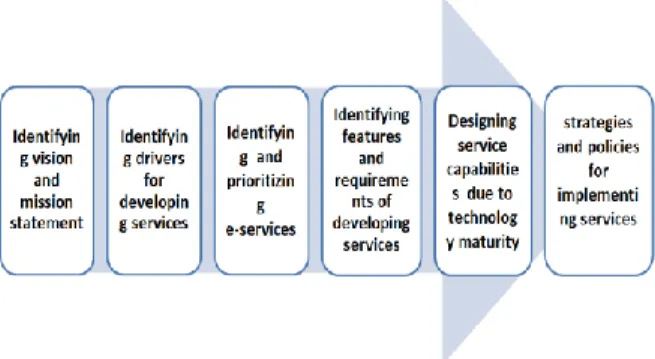
Since the completion of the content of each layer in the roadmap requires experts' opinions, the roadmap team formed the committee of experts to enter the next phase. Expert committee include representatives from government agencies, universities and the private sector comprising the Communications Regulatory Authority of The I.R (CRA), ICT Research Institute (ITRC), Virtual systems processing company, Vice-presidency for Rural development, Agricultural Research, Education & Extension Organization (AREEO), Ministry of Health and Medical education, Hi WEB company, Ministry of Agriculture Jihad, Ministry of education, Telecommunication Infrastructure Company, Tehran University, Iran Federation of IRAN Tourist Guides Association (IFTGA), Post Bank, Literacy Movement Organization, Ministry of Cooperatives, Labor and Social Welfare, Imam Khomeini Relief Foundation, Agricultural Services Specialized Holding Company, Central Organization Rural Cooperatives of Iran, Iran Technical and Vocational Training Organization, Information Technology Center of Post Company of IRAN, Department of Environment, Martyr Foundation and Veterans Affairs, Forests Range and Watershed Management Organization of IRAN. In order to receive experts' opinions, several expert panels held and efforts have been made to involve main stakeholders in the panels. The results achieved by the roadmap team, have been completed, corrected and approved using brainstorming method. 8 Panels are held as follows according to steps of roadmap process (finalized in panel1) as shown in figure 3: 1- Identifying vision and mission statement for developing rural e-services, finalizing steps of roadmap process
2- Identifying drivers for developing rural e-services 3- Identifying rural e-services
4- Identifying requirements of implementing services 5- Assessing strengths, weaknesses, opportunities and threats for developing e-services
6- Identifying the technologies needed to implement services
7- Identifying service features with regard to the development of technologies
8- Identifying strategies and policies needed to implement the services
Fig. 3: Steps of developing USO service roadmap After holding panels, the final framework of the roadmap has been prepared and the relevant reports have been provided (phase 3). Then, the results of each step are reported and the structure of the roadmap is developed.
In the final phase, the content and structure of the roadmap was sent back to expert team and key stakeholders and then by establishing meetings with representatives of experts in each area of services, the final results were confirmed and finalized.
Each step in process of developing roadmap (Fig. 3) will be explained in details in next section.
IV. USO TECHNOLOGY ROADMAP According to the steps of roadmapping process displayed in Fig.3, each step will be explained in more details in this section.
A. Identifying Vision and Mission Statement According to studies and experts' opinions, vision statement for USO roadmap is as follows:
"In horizon of 1404, rural communities based on information technology capabilities will be informed and empowered in economic and social fields, active in preserving heritage and Islamic culture of Iran and effective in gaining the economic, scientific and technological first position in the region, villages will be favorable places for living and working, entrepreneurship platform, value creation and productive employment opportunities."
Also, mission statement is stated as follows:
"Development of e-services in agriculture, education, health, tourism, finance and e-government in rural and least developed areas by effective interaction and communication between stakeholders will provide platform for private sector participation in implementation of related services. So, rural access to services in appropriate communication platforms with high quality and continuous, sustainable, effective and efficient form will increase the capabilities, skills and social participation in providing and utilization of services."
B. Identifying Drivers of developing Services Drivers for e-services development in rural and least developed areas have been identified in four
categories using PEST1 analysis. They are shown in figure 4.
Fig.4: Drivers of developing USO services Some drivers are enablers of developing services such as increasing access of rural areas to broadband Internet, developing cloud services platform and increasing access to computers and computer equipment; some are direct goals of developing services such as increasing electronic access to services, developing electronic businesses involved in providing services; and some are long term impacts that would be realized after implementing the services.
C. Identifying and Prioritizing Services
The services were extracted from different sources as following:
Comparative studies
investigating service reference models such as FEAF
Analyzing the current situation of electronic services in Iran rural areas
Identifying e-services in related governmental organizations in Iran
Gap analysis of current services with desired ones in other countries
Identifying requirements mentioned in strategic and macro documents
According to studies, electronic services are identified in 10 main categories including education, health, agriculture, tourism, finance and banking, employment, registration, public facilities, police and Judicial and environment. Each of these services along with sub-categories is shown in figure 5.
1 Political, Economic, Social and Technological
Fig.5: Categories of identified e-services
In the next step, efforts have been made to identify operational levels of services for each identified category. Also, technical and legal infrastructure and related authorities are identified. Then, services are prioritized according to different measures such as purposes of ICT ministry in Iran, priorities of related authorities, and predected budget for developing services in 5 years. Based on the measures, it is planned to implement services in 4 areas of education, health, agriculture, finance and banking in first year. Since the roadmap need to be reviewed and updated annually, planning for implementation of other categories will be started from second year.
As an example, banking and financial services is shown in roadmap structure in figure 6.
Fig.6: financial and banking e-services D. Identifying Features and Requirements of Developing Services
After extracting main categories and sub-categories of services, charactristics of services including operational services, responsible authorities for implementing services, physical and legal infrastructure and current situation of each service are identified. Also, requirements of implementing
services are defined in 5 areas including basic services, platrorms, Information and communication infrastructure, access services and management requirements (figure 7).
Fig.7: features and characteristics of services
E. Designing Service Capabilities due to Technology Maturity
For identifying technologies, major ICT trends on e-service development in rural areas are identified including Big data, Cloud computing, communication infrastructure (5G), Internet of Things (IoT) and search engine. Developments of services in different categories are investigated based on the development of technology applications. As an example, services for agriculture and education category, regarding the development of big data applications are shown in Table 1.
Table1: Agriculture and education services according to big data application
Big data technology capabilities
Service group
Statistical analysis, data mining, Text mining and web
mining
Multimedia analysis and network analysis
Mobile analysis, social network analysis, community diagnosis and
mobile community
Agriculture
Services such as advisory, agriculture insurance, educational, information and market, decision support systems, evaluation and ranking services are in this category.
Services such as weather forecast services, advanced services of care, diagnosis and treatment of plant diseases and livestock and market service, Loan and insurance services, Precision Agriculture services are in this category.
Advanced services of environmental monitoring in different areas such as natural resources, livestock, plants, etc. educational services based on social networks are in this category.
Education
Determination of the most effective thematic sequence for each learner, determining of actions related to learners with better learning and high grades, determining of effective actions for learner satisfaction and increase interaction, determining of characteristics of online learning environment that lead to better learning and personalized training courses.
Determining time of providing new topic to student, determining risk of not completing the course for learners, determining the need or time of learner to educational advice, personalizing learning courses, report of investment return for educational companies and organizations, consulting to choose career paths, identifying learning problems, improve teaching and learning experiences.
Determining time of providing new topic to student, determining risk of not completing the course for learners, determining the need or time of learner to educational advice, personalizing learning courses, report of investment return for educational companies and organizations, consulting to choose career paths, identifying learning problems, improve teaching and learning experiences, providing content proposal suitable with learners characteristics in learning on mobile and social networks.
F. Extracting Strategies and Policies for Implementing Services
In order to identify strategies for developing e-services in rural areas, SWOT analysis is used. for this purpose, effective factors are devided to two categories: Internal and External factors. Internal factors reflect strengths and weaknesses and external factors reflect opportunities and threats. The resulting strategies are prioritized based on experts opinions in 4 groups of technical infrastracture strategies, legal strategies, applications and financial and supportive strategies. Internal and external factors are shown in figure 8.
Fig.8: external and internal factors influencing USO services
After extracting the contents of the roadmap, the extracted contents mapped on layers of the roadmap and vertical connections are created. Then the structure reviewed again with experts participated in the panels and final results are confirmed. the overall structure is shown in Figure 9. The final roadmap including details of each layer is shown in Figure 10.
Fig.9: Overall structure of the roadmap
Fig.10: USO technology roadmap structure
V. CONCLUSION
In this paper technology roadmap for USO services in rural and least developed areas is designed. This roadmap can be used to identify and prioritize the key requirements for implementing e-services in rural areas; directing private sectors to move in desired routes; supplying fund with the aim of synergies and
convergence with the private sector; creating shared understanding and coordination for the planning and implementation of relevant projects; Building coalitions, coordination and inter- organizational collaboration (between universities, agencies and the private sectors) in order to develop services; and propose policy and operational guidelines for the implementation of services. In this research, e-services have been identified in the areas of agriculture, education, health, finance and banking, tourism, public facilities, employment and entrepreneurship,
registration, environment, and police and judiciary and then efforts have been made to identify current and desired services for each category through interaction with stakeholders and authorities. The realization of these services requires coordinated work of all agents involving authorities, universities and private sectors and availability of financial resources to manage the implementation of the services. The nature of this kind of approach is that the action plans in the early year is associated with greater accuracy and therefore it is necessary to revise future programs by repeating the process and comparing achieved results with possible gaps each year.
REFERENCES
[1] Ghazinoory S., Dastranj N., Saghafi F., Kulshreshtha A., Hasanzadeh A. (2016), Technology roadmapping architecture based on technological learning: Case study of social banking in Iran, Technological Forecasting and Social Change, In Press.
[2] Lee J., Lee C.-Y., Kim T.-Y. (2009), A practical approach for beginning the process of technology roadmapping, Int. J. Technol. Manag. 47 (4) 306–321. [3] Lee S., Kang S., Park Y., Park Y. (2007), Technology
roadmapping for R&D planning: the case of the Korean parts and materials industry, Technovation 27 (8) 433–445.
[4] Carvalho M.M., Fleury A., Lopes A.P. (2013), “An overview of the literature on technology roadmapping (TRM): Contributions and trends”, Technological Forecasting & Social Change 80 1418–1437.
[5] Dossani R., Jhaveri R., Misra D.C., (2005), Enabling ICT for Rural India, Asia-Pacific Research Center, Stanford University.
[6] Dzansi D. Y and Amedzo K., (2014), Integrating ICT into Rural South African Schools: Possible Solutions for Challenges, 1Department of Business Support Studies, Faculty of Management Sciences.
[7] aydogdu C., (2012), Telemedicine in Turkey: Potential, Initiatives and Obstacles, Department of Electrical and Electronics Engineering Bilkent University.
[8] O˘guz F., (2013), Universal service in Turkey: Recent developments and a critical assessment, Telecommunications Policy.
[9] Martin H., Daim T.U. (2012), “Technology roadmap development process (TRDP) for the service sector: A conceptual framework”, Technology in Society 34 (2012) 94–105.
[10] Yasunaga Y., Watanabe M., Korenaga M. (2009), Application of technology roadmaps to governmental innovation policy for promoting technology convergence, Technological Forecasting & Social Change 76, 61–79.
[11] Phaal R., Farrukh C.J.P., Probert D.R. (2004), Technology road mapping—A planning framework for evolution and revolution, Technol. Forecast. Soc. Chang. 71 (1–2), 5–26.
[12] Phaal, R., Farrukh, C. J. P., & Probert, D. R. (2010). Road mapping for Strategy and Innovation: Aligning technology and markets in a dynamic world. Institute for Manufacturing.
[13] Industry Canada (2003), technology roadmaps, Progress Report and contribution to Canada’s Innovation Strategy, center for public management. [14] Lee S., Kang S., Park Y., Park Y. (2007), Technology
road mapping for R&D planning: the case of the Korean parts and materials industry, Technovation 27 (8) 433–445.
[15] Phaal R., Muller G. (2009), an architectural framework for road mapping: towards visual strategy, Technol. Forecast. Soc. Chang. 76 (1) 39–49.
Nasrin Dastranj received her
B.Sc. in Computer Engineering from Shahid Beheshti University in 2004. She received her M.Sc. in IT Management from Alzahra University in 2010 and her Ph.D. in Science and Technology Policy from Tarbiat Modares Univeristy in 2016. She is currently assistant professor with the department of IT at ICT Research Institute (ITRC), Tehran, Iran. She is the author or a coauthor of more than 30 papers that have appeared in various journals and proceedings. Her main research interests include innovation systems, technology roadmapping and technology strategic management.
Tahereh Mirsaeedghazi
received her B.Sc. in Computer Engineering from AmirKabir University in 2001. She received her M.Sc. in IT Management from AmirKabir University in 2007. She has been working in
Iran Telecommunication
Research Center (ITRC) as a researcher for about 16 years. Within the past years, she has been actively involved in doing research in a variety of issues, such as IT Application and Services in general and rural and less developed areas e-services, e-learning and KM in particular.
Kolsoom Abbasi shahkooh
received her M.Sc. in Information Technology from university of west England Bristol in UK. She has been working in Iran telecommunication Research Center (ITRC) as a researcher for about 13 years. Her main research interests include E- government development and implementation, Enterprise Interoperability, Information Technology Foresight.
Mahmood Kharrat received
his M.Sc. Degree in Biomedical Engineering from University of Tehran, Iran. He is a member of the scientific board of IT Research Faculty at ICT Research Institute (ex. ITRC). Within the past years, he has been actively involved in doing research in a variety of issues, such as IT Applications and Services in general and rural and less developed areas e-services, e-Learning and Knowledge Management in particular and in the meantime an adjunct lecturer of e-Learning in the University of Tehran.