Owen
J.Furuseth
"If
We
Are
Really
Serious
About
Protecting
Agricultural
Land
In
North
Carolina.
.."
The need to protect agricultural land is
one of the most common themes in contemporary
land use planning. Throughout the 1970s,
planners, agriculturalists, and environ-mentalists joined together in a chorus
warning of an enormous shift of farmland in the
United States. The alarming estimates of
farmland losses, and their consequences has
prompted widespread public concern. In
response, government action toward a goal of
protecting prime agricultural land has been
extensive. By 1978 forty-seven states and
numerous local governments had adopted some type of policy aimed at protecting agricultural operations which have been under pressure for
development (Conroy, 1978: 10). At the federal level, specific legislation to preserve farm-land has not been passed; however, a number
of agencies have adopted administrative
proce-dures with language requiring the
preserva-tion of valuable agricultural acreage (Skidmore, Owings, and Merrill, 1975; Council on
Environ-mental Quality, 1976; U.S. Department of
Agriculture, 1978; U.S. Environmental
Protec-tion Agency, 1978)
.
While the protection of agricultural lands
is most often presented as axiomatic (and perhaps
this is valid), there are a variety of reasons
for protecting this resource. In the American Society of Planning Officials (ASPO) Planning Advisory Service Report, Saving Farms and Farmlands: A Community Guide, Toner suggests
ten distinctive public purposes served by
pre-servation of farms and farmlands (Toner, 1979:
1-k) . These benefits include conserving
energy, preventing urban sprawl, maintaining
open space, protection of natural systems and processes, controlling public costs,
preserving the local economic base, promoting
local self-sufficiency, preserving rural life-style, maintaining specialty crops, and
main-taining agricultural reserves.
To most citizens, however, the issue
surrounding the protection of agricultural
land revolve around two concerns: finite agricultural resources and protection of local open space. The viability of local
agricul-ture is perceived as a type of insurance for
adequate food supplies in the future, while simultaneously providing greenbelt benefits. The larger questions of economic and energy efficiency remain secondary in the public's mind.
While a number of strategies have been
suggested for protecting agricultural
re-sources, a review of the implemented programs
shows a surprising lack of variety. Most states have opted for simple indirect measures
that reduce farmland losses by first protecting
the farmer. The technique with the widest application has been the differential property
tax assessment for farmland. Currently, forty-three states have adopted this mechanism to
protect agricultural land. The underlying assumption of differential assessment is that
farmland should be taxed at use value, rather than market value. The premise being that the
higher ad valorem tax rate creates a cash flow
problem for farmers and thus forces decisions
to either get out of farming or move their
operations to areas with lower property taxes.
While the differential assessment policy has
proven politically acceptable to both farm and
non-farm interests, its effectiveness at
protecting agricultural acreage is nevertheless questionable. An increasing number of ex post studies have shown that differential tax
assessment programs, at best, do not prevent agricultural land from shifting into other
uses, but may only postpone such shifts
Owen J. Furuseth is Assistant Professor in the
Department of Geography and Earth Sciences at
the University of North Carolina in Charlotte where he teaches planning. He is presently Associate Supervisor of the Mecklenburg Soil and Water Conservation District. This
work was supported in part by funds from the
Foundation of UNCC and from the State of North
Carolina.
(Coughlin, et al., 1977; Gamble, et at., 1977;
Gustafson and Wallace, 1975; Keene, et al . ,
1976; Vogeler, 1976). Therefore, farmland
losses will continue. Consequently, planners
and policy-makers are faced with the dilemma
of continuing an ineffective, but acceptable policy or finding a new strategy to protect agricultural land uses.
AGRICULTURAL LAND
CONVERSION
INNORTH
CAROLINA
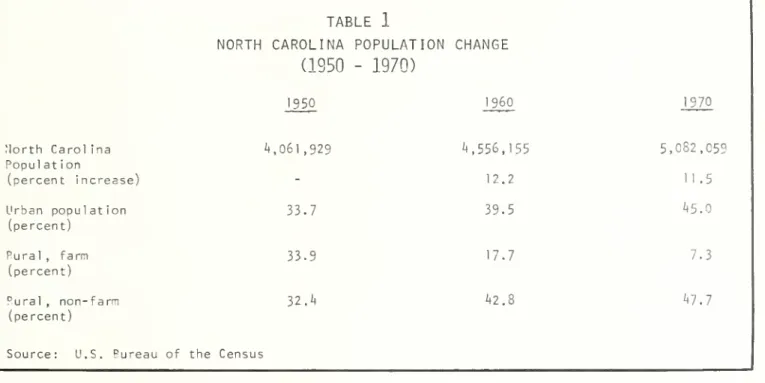
Over the past three decades North Carolina
has undergone rapid change, moving from a rural,
agricultural based economy to an increasingly
urban, industrial society (Table 1). The
effects of this change have had enormous
impacts on agricultural land use. As in other
parts of this country, population and economic expansion have created new demand for
develop-able land. Whether voluntarily or by coercion, agricultural operators in North Carolina are forced into competition with land development
interests. As pressure for buildable land
increases, land values increase in excess of
farm values. Nearby urban activities, may also generate spillover effects which further
impede normal farming operations. In response
to the potential financial gain, as well as
the uncertainty and nuisances of farming there
is an accelerating rate of land conversion. That farmland which is not developed is then
subjected to increasing pressure. An
"impermanence syndrome" may occur in the sense that farm operators curtail investments, revert
to less capital intensive operations, or idle their acreage (Berry, 1978). The end result,
which can be observed throughout North Carolina,
is increasing amounts of agricultural land
transformed to urban, vacant, or less intensive
agricu 1
tura1 use
to pasture)
.
.e. shifting from cropping
Agricultural census data confirms the
popu-lar notion that North Carolina's agricultural resources are rapidly declining. The North Carolina Conservation Needs Inventory (N.C. Inventory Committee, 1971) examined land use
patterns between 1958 and 1967. The Inventory
found that the amount of "urban and built-up"
areas increased by 662,000 acres during the study period. The represented an 82.7 percent
increase, much of which came at the expense of
agricultural land use. More recent data
examining agricultural land use, published in
the 197^* Census of Agriculture, show a con-tinuing downward trend in agricultural land
use (See Table 2). Between 1969 and 197't,
North Carolina lost almost one quarter of its
farm operations and one eighth of the
agricul-tural acreage in the state. While some of these losses are accounted for by agricultural
con-solidation and the retirement of marginal land, the major portion represents the permanent loss of prime land to urbanization.
A more detailed examination of the Census of
Agriculture shows that agricultural losses were
only slightly higher in Standard Metropolitan Statistical Areas (SMSA) of the state (Table 3).
One might hypothesize that farmland losses would
be significantly greater in urban areas; however, this was not the case. These data imply that
agricultural land losses are a serious problem, not restricted to any particular section or type of county in North Carolina, but rather state-wide. While the visual evidence of farmland
losses may be more observable in the most
heavily urbanized counties, the incremental
transfer of agricultural land in rural and
exurban areas is only slightly less.
TABLE
1NORTH
CAROLINA
(1950
POPULATION
- 1970)
CHANGE
1950 i960 1970
North Carol ina
Population
(percent increase)
4,061 ,929 4,556,155
12.2
5,082,059
11.5
Urban population
(percent)
33.7 39.5 45.0
Rural , farm
(percent)
33.9 17.7 7.3
"ural , non-farm
(percent)
32.4 42.8 47.7
Source: U.S. Bureau of the Census
TABLE
2FARMS AND
AGRICULTURAL
LAND
USE
INNORTH CAROLINA
1959 196^* 1969 197A
Total Number of Farms
(percent change)
190,567 1'48,205
-22.2
119,386 -19.i*
91,280
-23.5
Land in Farms (percent change)
15,887,72^ lA,381, 500
-9.'*
12,733,751 -11.it
11,2^*3,933 -11.6
Average Farm Size 83. 97. 107. 123.
(acres)
Proportion of N.C.
in Farms 50.6 k5.?> A0.8 36.0
(percent)
Source: North Carol ina Census of Agriculture, 197A.
DIFFERENTIAL
TAX
ASSESSMENT
IN
NORTH
CAROLINA
At the present time, pub tect agricultural resources i
is centered around the Prefer Tax Amendments (N.C.G.S. 105
enacted by the legislature in
clarifying amendments were ad
Under these revisions in the
Statute, qualifying agricultu
and horticultural lands may b
basis of present use value ra
value. The higher market val
is based on the potential hig
of land, rather than current
c action to
pro-n North Carolina
ential Property
277. 1 et seq.
)
1973. Further
ded in 1975.
State Taxation
ral , forestry,
e taxed on the ther than market
ue assessment
hest and best use
val ue.
Eligibility for enrollment in the program is dependent on meeting qualifying requirements. These requirements involve such matters as land use, acreage, ownership, income, and sound land
management. Under the existing regulations, agricultural land includes farm operations which grow crops, plants, or animals, as well
as woodlands and "wasteland" which are part of the farm unit. The definition for forest land
and horticultural land is, however, more restrictive. Only the acres actively used for
commercial production qualify for inclusion in
the program.
An additional test for all three categories is that commercial agricultural activities be
carried out "under a sound management program."
The North Carolina Department of Revenue defines>
a sound management program as "a program of
production designed to obtain the greatest net return from the land consistent with its
con-servation and long-term improvement" (N.C.
Department of Revenue, 1975: 20).
Some additional stipulations aimed at
42
including only active commercial farms in the
program are the acreage size and income
requirements. in order to qualify, agricultural
and horticultural land must comprise at least ten acres per tract and have average gross
earnings of at least $1,000 for the preceding
three years immediately prior to application. Government payments can be included in the
income calculations. Forest land has no minimum
income requirement, however, the size
require-ments increase to 20 or more acres per tract in order to qualify for the tax benefits. Both
income and size provisions are universal
com-ponents in differential tax programs designed to
filter out "hobby farmers" and non-agricultural speculators from qualifying for large tax
savings
.
A final qualifier for use value assessment
relates to farm ownership. Qualifying
agricul-tural land must be "individually owned."
Individual ownership may include natural
persons or a corporation whose owners (or
spouses or siblings) are actively engaged in
agricultural production activities. Additional
an individual owner's principal residence must
be on the agricultural land or the agricultural
land must have been owned by the owner or his family for the four years preceding application Corporate owned agricultural land must have been in the possession of the corporation or
a principal shareholder for a similar four year period. The intent of the ownership
require-ment is to restrict enrollment in the program
to traditional farming operators. As in other
states, the North Carolina program was not
designed to provide property tax relief to
corporations or real estate firms, whose
interest in agriculture is limited or short term.
ly.
For agricultural property owners meeting
TABLE
3LAND
USECHANGE:
SMSA
COUNTIES
AND NON-SMSA COUNTIES
]3Gh 197') Percent Change
Land in Farms in
North Carolina SMSA Counties
(Acres) 2,269,378 1,710,27't -21. (,%
Land In Fa rms in North Caroi ina
Non-SMSA Counties
(Acres) 12,1 12,122 9,533,659 -21 2%
Proportion of Land In
Farms in North Carolina
SMSA Counties
(Percent) A3.2 32.7
Proportion of Land in Farms
in North Carolina Non-SMSA
Counties
(Percent) 46.9 37.0
Source: Census of Agriculture, 197''.
the eligibility requirements, admission into
the program is voluntary and simple. Following the approval of the application by the local tax
office, the agricultural acreage is taxed on
the basis of its use value. Concurrently, the regular ad valorem taxes for the property are
calculated and maintained by the tax office. The difference between the two figures repre-sents the deferred taxes for the property.
A roll-bacl< provision specifies that if the
agricultural property (or any portion of the parcel) changes to a nonqualifying use, or if
the property is sold to persons outside the
immediate family, the land loses its eligibility.
Under the roll-back requirement, the owner is
liable for the deferred taxes for the preceding
three years, plus an interest penalty on the
deferred taxes. The penalty is calculated at two percent for the first month plus .75 percent
for each additional month in the program, up to
three years. The intent of the roll-bacl< and interest penalty is to reduce the economic advantage of enrolling in the program and
subsequently withdrawing when land values become
attractive. Studies of differential tax
assessment note that without roll-back mechanisms
there is no way to police speculators from
enjoying short-term tax advantages or capturing
lost revenue when land is withdrawn from the
program (Keene et al., 1976: 66-79).
Finally, enrolled property owners whose land no longer meets the differential taxation
re-quirement are required to notify the local tax office. Failure to disclose a disqualification
results in an additional penalty of ten percent
of the deferred tax and interest.
EFFECTIVENESS
OF OURCURRENT
POLICY
An evaluation of North Carolina'
assessment program begins with consi of the objectives of the program. A
states, the primary purposes of this
to provide property tax relief to ag
operations as real estate market val
and to encourage the retention of ag
land uses. Consequently, an examina
success of North Carolina's differen
tion must include measurement of the
participation and tax savings by fan
as well as the impact of the program agricultural land conversion.
s differentia 1
deration
s in other
effort ar ricultural
ues rise,
ricul tural
tion of tl"
tial
taxa-degree of
Ti operators
,
at reducing
ire
the
With the assistance of the Ad Valorem Tax Division of the North Carolina Department of Revenue, Pasour and Neuman have undertaken extensive analysis of participation in the
program and the fiscal impacts of the program since its implementation. The findings of their studies show that enrollment rates vary substantially from county to county, how-ever, statewide the total number of farmers in
the program is quite small (Neuman and Pasour, 1979)- Five years after the inception of the
program (1973-1978), hi counties lacked any
qualifying farmland in the program, while one
county (Wake County) accounted for 3't.5 percent
of all the farm tracts receiving lower taxes.
Statewide, Neuman and Pasour report that 12,599 tracts were enrolled in 1978. The tax savings to property owners were estimated to be
S2,27A,Al3 in that year. Approximately hi
spring 1980,vol. 6 no.1
jwHwmma
MHWiimamm
gM
percent of this total savings was in Wake
County.
The early experience with differential taxation reveals that the present policy has not enlisted widespread participation and
provides only marginal financial benefits to
farm operators. Recognizing this failure,
Neuman and Pasour (1979) propose that the number
of tracts qualifying for deferred taxation will increase as revaluation of the tax base in each county updates both the marl<et and use value of farmland. However, a review of the 20
counties which underwent revaluations in 1977 and 1978 demonstrates that this has not been the case to date. Some counties have experienced enormous increases in participation (e.g.
Davie, Alexander, Alamance, and Randolph), but
other counties continued to have minor or no increase in enrollment following revaluation
(e.g. Gates, Wilkes, Craven, Granville).
While it is highly probable that the number
of participants qualifying for differential taxa-tion will continue to increase, it can be
suggested that North Carolina farm operators are
not currently enthusiastic program
beneficiar-ies. Whether through misinformation or lack of
adequate rewards, the enrollment of land for
deferred property tax is low. Accordingly, the
program can be viewed as only marginally
success-ful.
Theve is public recognition of the need to preserve agricultural resources and protect open space.
Photo courtesy of USDA-Soil Conservation Service
I
As to the effectiveness of the tax program
for protecting agricultural acreage, the data are incomplete. Unfortunately, aggregate statewide
data of farmland change and dynamics are not
available at this time. The 1979 Census of
Agriculture will remedy this situation. The
upcoming census will provide us with an excellent
data source for examining the relative impact of the current program since beginning
opera-tion in 197^. Until the census data are published in 1980, what is available are scattered reports from planning agencies and county soil and water conservation districts. 1
Specific disucss
ists and planners in
counties suggest tha had on1y a neg1 igibl
land conversion in t
where almost one ha1
lower taxes are loca
involved in protecti
suggested only minim
1979) • In Mecklenbu
[Soi 1] Conservationi
Supervisors of the M
Conservation Distric
of agricultural 1and
has actually increas
Differential taxatio
any significant impa
ions with soi
1
Wake and Meek
t differential
e impact at re
hese areas, I
f of the tract ted,a county p
ng agricu 1
tura
al effectivene
rg County, the
St, Albert Cof
ecklenburg Soi
t have stated transformatio
ed during the
n is not perce
ct in Mecklenb
conse rvat
ion-enburg
taxation has
ducing
farm-n Wake County,
s receiving
1anner 1 lands
ss (Gurley,
District
fey, and the
1 and Water
that the rate
n in the county past five years,
ived as having
urg County. The inference that differential assessment policies in North Carolina are not protecting agricultural acreage is supported by findings
from other areas. The weight of evidence
from states adopting differential taxation is
that they do not provide protection for
agricul-tural resources. A 1976 report. Untaxing Open
Space, prepared for the Council on Environmental Quality, studied the effectiveness of use value
taxation in k2 states (including North Carolina). The report's conclusion included the following assessment
.
With respect to the goal of retarding the
conversion of farm and other open land,
differential assessment is marginally effective and its cost in terms of tax
expenditures in high, in most cases so high
as to render it an undesirable tool for
achieving this goal ... if the owner is indifferent ... or is actively looking for an opportunity to sell to a developer,
the tax saving from differentia1 assessment
will not have much effect in deterring him from selling (Keene et al., 1976: 115).
SOME ALTERNATIVE
RECOMMENDATIONS
The preceding discussion of North Carolina's differential taxation program outlines the
failure of the current efforts to involve large
numbers of agricultural operators in a program which would reduce the cost of farming and.
*
at least temporarily, slow farmland conversion. We, therefore, find ourselves without an
effective program to protect agricultural
resources. The seriousness of this issue
de-mands that remedial actions and long range
policies be formulated and implemented now.
In light of these conclusio
review and analysis of agricult tection programs in other parts States, same suggestions can be
developing an effective farmtan strategy. These recommendation designed to be exhaustive, but be a starting point for local p policy-makers discussing how to
tural resources in their commun
the broad issues raised will be
planners and decision-mal<ers th
state.
ns, and after a
ural land pro-of the United made for
d protection
s are not
rather simply to
1anners and
protect
agricul-ity. Hopeful 1y ,
of insight to
roughout the
IMPROVED DEFINITION OF PRIME OR VALUABLE AGRICULTURAL RESOURCES
At the present time, most policy makers are
content to define high value (i.e. prime)
agricultural land based solely on physical or income generating criteria. In the vast
majority of cases, the U.S. Soil Conservation Service's (SCS) Soil Capability Classification system is adopted as the delineator. This system
Is an interpretive classification system which
uses soil and climatic data to place delineated
soil areas into groups based on similar manage-ment options. Soils are assigned to categories
I through VIII, with Class 1 having no limitation
to cul tivation
.
Typically, the system is used to define and
delineate critical agricultural lands. These
areas are then noted on a map and become the
object of special protection. For those lands
in Capability Classes not included in the prime
category, their continued use as agriculture
does not warrant planning protection.
The problem with adopting this strategy is
twofold. First, the Soil Capability Class
system is only a crude measure of potential
agricultural productivities. The intent of
SCS in developing this measure was to provide a gross indicator of potential agricultural
"... DIFFERENTIAL TAXATION HAS HAD ONLY A NEGLIBIBLE IMPACT AT REDUCING FARMLAND
CON-VERSION , .,"
usage. Unfortunately, the power of this system
as a predictor of agricultural productivity, and,
therefore, agricultural value, has been seized
by planners looking for a tool which is both readily available and technically sound. Rather
than being a guide, the Soil Capability
Classifi-cation has become an inflexible standard, vjhich
can exclude important agricultural resources from protection. For example, the steep sloped, rocky hillsides of the North Carolina mountains
are categorized as having low agricultural
potential and would not be considered as
"the SOIL CAPABILITY CLASSIFICATION IS
INHER-ENTLY INSENSITIVE TO THE NEEDS OF SPECIALIZED
OR UNIQUE CROPS."
important agricultural resources using a Soil
Capability system, yet they are a valuable resource for growing commercial Christmas trees. The Soil Capability Classification is inherently insensitive to the needs of specialized or unique
agricultural crops.
A second problem vjith relying on Soil
Capability Classes to define valued agricultural
lands is its narrow focus on physical soil
properties. The value of land for agricultural
use requires consideration of a number of
con-textual factors, as well as soil characteristics.
The determination of critical agricultural resources must include variables which will
effect the efficiency of agricultural land use
at any specific location. Among the factors
overlooked by soil type identification schemes
are critical mass and ownership patterns. Is
there a sufficient quantity of agricultural land
owned by a limited number of individuals to
make farming economically feasible? Is there
adequate agricultural infrastructure to meet the
service needs of commercial farm operators? An
equally important question is the impact of
previous public policy and planning actions. For
example, have policy precedents, especially
capital investment decisions, promoted
urbaniza-tion in an area now deemed valuable for continued
agricultural use?
In defining those areas which should be
protected, planners must employ strategies
that recognize agricultural land use as one
component of a total countywide or regional land use system. The identification of valuable farm-land must consider the efficient operation of
the total system. A program to protect
agricul-tural resources cannot supercede private and
public sector plans already approved or
imple-mented which call for urbanization or the
idl ing of farmland .
It may be suggested that in defining
critical agricultural resources, a system
in-corporating both physical and contextual factors is an admirable model. The use of Soil Capability Classifications as a starting
point, tempered by the requirements of
specialized and unique agricultural production,
may be used to define the resource base. These
data may then be corroborated with earlier public policy actions and the characteristics
of existing farming operations. The integra-tion of these data sets will permit the
spring 1980,vol.6 no.1
MilUUUMU
«lgb
/»./
w^'
Soil Capability classifications are used to
define prime agricultural land.
Photo courtesy of USDA-Soil Conservation Service delineation of economically and physically viable agricultural resources which may be
reasonably protected.
EXPANDED MECHANISMS FOR PROTECTING AGRICULTURAL RESOURCES
Our present strategy for reducing the
con-version of agricultural land is essentially dependent on limited financial benefits to
encourage continued farming. The use of
property tax relief for protecting farmland is
an effective starting point, however, it must
be joined with other more direct measures. The
evidence, from North Carolina and other areas, shows that singular and indirect mechanisms
for controlling farmland conversion do not work.
What is required is a broadly based set of planning controls and policies, which would be supported
by indirect financial incentives. Ideally, this
package would be locally developed and implemented. The discussion of potentially promising
techniques for protecting farmlands has included
a variety of innovative ideas, such as the
transfer of development rights; fee simple purchase, with subsequent lease back, and
dev-elopment rights acquisition. While these
strategies may have merit for protecting farm-land, they remain largely untested. Moreover,
our limited experience and experimentation has
raised several serious questions. The most
serious flaw appears to be high operating costs,
compounded by questionable results. For example,
.4fi
in Suffolk County, New York a program to
pur-chase the development rights of farmland on Long Island was initiated in \31h. In Phase I,
the cost of purchasing development rights for
only 3,883 acresves $21 million (Coughlin, et al., 1977: 1^9)- Similarly, a pilot
pro-gram in Burlington County, New Jersey, calls for the purchase of "development easements"
using state monies. As of June 1, 1977, offers
on 12,000 acres of farm and woodland had been received, at a price totaling approximately
$35 million (Coughlin, et al., 1977: 162).
In both cases, the costs of operating a
comparable program, either county or
state-wide in North Carolina would be economically
and politically prohibitive.
There are, however, a variety of traditional and non-tradi
t
ional land use controls and
policies which are potentially more viable pro-tectors of farmland. Among the mechanisms which have been implemented with promising
results by local governments are exclusive
farm use (EFU) zoning, restrictive utility extension policies, and urban growth boundaries.
The exclusive farm use zone has been widely employed in California, Oregon, and parts of the Midwest. The two key components of the
EFU zone are: (1) a limited number of permitted
uses, typically restricted to agricultural or
agriculturally related activities, and (2)
large minimum parcel sizes for new subdivisions.
It should be noted, that EFU zoning is not
traditional large lot zoning, under which
agriculture is a transitional land use activity. Rather EFU zoning contains stringent standards pertaining to those uses permitted outright and
conditionally, and supports these findings with
additional restrictions, especially minimum lot
size. In Tulare County, California, for example,
the minimum parcel sizes range from 20 to 80 acres (Tulare County Planning Department, 1975).
While in Lane and Benton Counties, Oregon, the
minimum lot size requirement is kO acres.
Other mechanisms which also have demonstrated utility for protecting agricultural land include
selective public utility expansion and urban
growth boundaries. Both techniques involve the denial of urban infrastructure to areas which
have been designated for protection. The impact
"...
PROGRmS
FOR PROTECTING FARMLj^ND MUST INCLUDE MANDATORY ELEMENTS."of withholding services and facilities is to
make urban development economically
unattrac-tive. These techniques have been shown to be
highly effective when combined with EFU zoning and differential tax assessments as a
comprehen-sive program for protecting agricultural
re-sources. Two early adopters of this strategy are
New York and Oregon (Bryant and Conklin, 1976; Furuseth, I98O).
AgriculturalJ forestry, and horticultural lands
may be included under the Preferential Property Tax Amemdments, Photo courtesy of N.C. Dept. of
Natural & Economic Resources
Finally, it should be remembered that a
basic requirement for the application of any
tool or technique to control agricultural
land conversion is an accepted public policy to do so. All efforts to protect farmland must
be premised on an articulated and adopted state-ment of community support. Accordingly, policy
documents and plans must be initiated or amended
to formally recognize and accept the goal of
protecting agricultural resources. In this regard, the general land use plan is a requisite starting point for developing an effective
program.
MANDATORY PROTECTION FOR CRITICAL AGRICULTURAL RESOURCES
There is a popular adage among agricultural extension personnel that if you scratch the dirt
off of any farmer you will find a land
specu-lator underneath. Regardless of the validity of this statement, is is obvious that our present differential taxation program is extremely one-sided. Under the present system,
agricultura-lists voluntarily participating in the program
are given a set of financial benefits, with littl
or no costs. They may remain in the program
receiving a reduction of taxes, until they wish
to withdraw. The penalty at withdrawal is
minimal especially when measured against the
potential capital gains from the sale of
developable land. It is not difficult to see
why this type of program is viewed as a
limited measure, at best, for protecting
farm-1and.
In order to be effective, programs for
protecting farmland must include mandatory elements. Those programs which allow volun-tary participation or easy withdravjal are flawed. They permit speculators to
incre-mentally destroy programs by participating only so long as it is financially attractive.
It is not surprising that public confidence and support of program objectives v;anes quickly.
A mandatory program would eliminate
specula-tion, while assuring the public of program
1ongevity .
The key to implementing a mandatory pro-gram is fairness to agricultural land ovjners.
This may be accomplished by insuring that costs of mandatory farmland protection is balanced by a reasonably attractive set of benefits. In return for maintaining
agricul-tural land use, farmland owners must be
compensated with financial and other incentives. This is necessary to insure that agriculturalists
are not the "winners or losers" in a farmland protection effort, but rather that all affected
parties share the costs of the program.
INCREASED COORDINATION BETWEEN GOVERNMENTS TOWARD A GOAL OF PROTECTING FARMLAND
A final recommendation revolves around the
requirement for increased communication and
coordination between local governments and
numerous state and federal agencies. If
"all efforts to protect farmland must be
premised on an articulated and adopted statement of community support,"
locally based measures to retain farmland are
to succeed, then growth stimulating policies
and expenditures by other levels of government must accommodate local policies. The indepen-dent actions of the Farmers Home
Administra-tion, Division of Highways, or city government may have the impact of negating a countywide program to protect agricultural resources.
While the A-95 review process was designed
to remedy intergovernmental conflict, it is
not a panacea. All too often coordination
between governmental units is paid "lip service,' but not much else. Nevertheless, increased
discussions and coordination between different
levels of government are necessary for a
more broadly based and effective program
for reducing farmland losses. If the actions
taken by other governmental units reenforce
local programs, then the work of local planners
and policy-makers to implement agricultural
land policies would be more successful. State and federal agencies, and neighboring governments must become partners in protecting farmland.
CAN
FARMLAND PROTECTION
BEIMPLEMENTED
Of equal importance to the selection of a
sound strategy for protecting farmland is the
feasibility of implementation. It would make
no sense to develop a planning program which is methodologically sound, if it is not
politically feasible. Certainly, what has been developed in New York state or San
Francisco Bay area to protect agricultural resources may not be readily adaptable in
Mecklenburg or Carteret County, North Carolina. As planners, we all know that effective program implementation requires a widespread awareness and perception of need by the public.
Fortunately, available data strongly suggest
that among North Carolinians there is an interest and concern in protecting valuable agricultural resources.
Christenson's (1975
public attitudes toward
decision-making showed s
North Carolina for local
tection of natural resou how they wanted land to
future, 55 percent expre
more agricultural land u
for more agriculture was
choice for any other cat
(Christenson, 1976: 16
when the respondents wer agricultural land should
urban development, the o
64 percent, answered aff
22 percent disagreed,
statewide survey of
planning and land use trong support throughout
planning and the
pro-rces. When asked
be uti 1ized in the
ssed a desi re for
se. The preference arger than the egory of land use
17) . Not surprising 1y
,
e asked if good
be preserved from
verwhelming majority, irmatively while only
More recent surveys completed in Wilson County and Mecklenburg County show an even
stronger measure of local public support for
protecting agricultural resources. In an
attempt to obtain public attitudes of various
land use issues, the North Carolina Agricultural Extension Service conducted a mail survey of
Wilson County residents in 1976 (Stone, et al., 1976). A review of the survey findings shows
overwhelming public endorsement for the goals of protecting valuable farmland, and strong
backing for a variety of measures to implement this objective (See Table '4). One significant exception to this pattern was an obvious lack of support for purchasing the development
rights of agricultural acreage.
A detailed analysis of the Wilson County survey data revealed that support for farm-land preservation varied with geography and
demographics. For example, respondents
48
living on farms were stronger supporters of
protecting farmland (85 percent favored),
than were urban respondents (73 percent
favored). Among the respondents in age groups
over kO protection of farmland was favored by over 80 percent. However, among those in
the 18 to 29 age group, support dropped to 68 percent. A larger number of this latter
group were in the undecided category on this
issue.
The most recent public survey of atti-tudes toward agricultural resources was carried
out by the Mecklenburg Soil and Water Conser-vation District in 1978 (Mecklenburg Soil and Water Conservation District, 1978). The results of the mail survey, partially pre-sented in Table k, showed even stronger
support than was evident in Wilson County, As in Wilson County, a majority of the
Meck-lenburg respondents favored protecting the good agricultural land in the county. When questioned about specific tools to protect
farmland, the majority of those surveyed endorsed a variety of approaches. There was,
however, extensive sentiment against the
purchase of development rights. Unfortunately,
no demographic or background information is available from the Mecklenburg Survey.
The survey results from these two dissimilar
counties, as well as the statewide findings
provide evidence of continuing public support
for protecting agricultural resources. We,
as planners, must therefore not be timid in developing and presenting comprehensive programs to protect some of our most critical resources.
REFERENCES
Berry, David. 1978. "Effects of Urbanization
on Agricultural Activities." Growth and
Change. 9 (July): 2-8.
Collins, Richard. 1976. "Agricultural Land
Preservation in a Land Use Planning
Per-spective." Journal of Soil and VJater Con-servation. 31 (5): 182-189.
Conroy, Ralph. 1978. Preserving Prime Agricultural Land In The United States.
Plattsburg, New York: Institute for Man and Environment, SUNY-Plattsburgh.
Coughlin, Robert, et al. 1977. Saving The
Garden: The Preservation of Farmland And Other Environmentally Valuable Land.
Philadelphia: Regional Science Research
Institute.
Council on Environmental Quality. 1976.
Memorandum to Heads of Agencies.
Wash-ington, D.C .
Carolinaplanning
TABLE
^PUBLIC ATTITUDES TOWARD
PROTECTING
AGRICULTURAL
LAND:WILSON
COUNTY
(1976)AND
MECKLENBURG
COUNTY
(1978)Wi 1son
County-'-Agree Disagree
/•lecklenbu
Agree
rg
County-Di sag ree
Something needs to be done to help protect good agricultural land from spreading
non-farm development ... 78% 10% 83% 8%
Location of residential development needs
to be guided in order to keep the best
farmland in agriculture ... 83 9 89 6
Only the least productive agricultural
land should be developed for non-farm purposes . .
.
. - 7h 12
Good farmland needs to be protected from residential development even if such
protection reduces the value of the land , 61 20 65 21
Farmers need to be legally protected
from complaints concerning odors, noise, and dust arising from normal farm
operations . . .
53 25 Gk 19
Tax money should be used to purchase the
legal right to develop land from property owners where it is desirable to maintain
open space ..
.
17 57 h5 ko
Water and sewer lines should not be
extended into prime agricultural areas ... k2 29 66 19
If farmland is committed to remain in production, then property taxes should be assessed on its agricultural value
rather than its value in other uses ... 71 10 93 2
If property owners are given lower taxes
in agricultural land then the county
should have the right to restrict
development of the land ... - 5A 31
"A "no response" category was available to
response total 100 percent.
respondents. The sum of agree, disagree, and no
Sources: Mecklenburg Soil and Water Conservation District. 1978. Stone, 1976.
spring 1980,vol. 6 no.1 49
Derr, Donn, et al. 1977- "Criteria and
Strategies for Maintaining Agricultural
Land at the Local Level." Journal of
Soil and Water Conservation. 32 (3)
:
118-122.
Furuseth, Owen. I98O. "The Oregon
Agricul-tural Protection Program: A Review and
Assessment." Natural Resources Journal.
(forthcoming) July.
Gamble, Hays, et al. 1977- The Effective-ness of Act 319, The Pennsylvania
Farm-land and Forestland Assessment Act.
University Park, Pennsylvania: Institute for Research on Land and Water Resources, The Pennsylvania State University.
Gurley, Steve. 1979.
December k,
1979-Telephone Interview.
Gustafson, Gregory and L. Wallace. 1975.
"Differential Assessment as Land Use Policy: The California Case." Journal of the American Institute of Planners.
^y
W:
379-389.Keene, John
C,
et al. 1976. Untaxing Open Space: An Evaluation of the Effectivenessof Differential Assessment of Farms and Open Space. Washington, D.C.: Council on Environmental Quality.
Lapping, Marl<.. 1978. "Agricultural Land
Retention Strategies: Some Underpinnings." Journal of Soil and Water Conservation.
34 (3): 124-126.
Mecklenburg Soil and Water Conservation District. 1978. Report on The Protection and Preser-vation of Agricultural Land in Mecklenburg
County. Charlotte: The District.
Neuman, D.F. and E.C. Pasour, Jr.
1979-Agricultural Use-Value Taxation in North
Carolina. Raleigh: Economics Special Report Number 50, Department of Economics
and Business, North Carolina State
Univer-sity.
North Carolina Conservation Needs Inventory Committee. 1971- North Carolina Conser-vation Needs Inventory. Raleigh: Soil
Conservation Service, USDA.
North Carolina Department of Revenue. 1975.
Machinery Act of North Carolina (Governing
the Listing, Appraisal, and Assessment of
Property and Collection of Taxes on Pro-perty). Reprinted from 1975 Cumulative Supplement to General Statutes of North
Carolina. Raleigh.
North Carolina Senate. 1973- An Act to Provide
for the Classification, Appraisal, Assess-ment and Taxation of Agricultural,
Horti-cultural and Forest Land. Senate Bill
4l6. Raleigh. (As amended in 1975). Pasour, Jr.,
E.C,
et al. 1976. AgriculturalUse-Value Taxation in North Carolina 1975
and 1976. Raleigh: Economics Information
Report No. 18, Department of Economics
and Business, North Carolina State University. Skidmore, Owings, and Merrill. 1975. Economic
Impacts, A Guidance Manual for the Assess-ment of Economic Impact Due to Highway Facility Improvements. Notebook 3.
Wash-ton, D.C.: prepared for U.S. Department of
Transportation
.
Stone, PaulJ et al. 1976. Land Use and
Dev-elopment in Rural Wilson County. Raleigh:
Center for Rural Resource Development
Report No. 1, The North Carolina
Agricul-tural Extension Service.
Toner, William. 1978. Saving Farms and
Farm-lands: A Community Guide. Chicago:
American Society of Planning Officials, Planning Advisory Service Report No.
333-Tulare County Planning Department.
1975-Amendment to Rural Valley Lands Plan.
Visalia, California: County Planning Department
.
U.S. Bureau of the Census. 195Q, I960, 1970.
Census of the Population. Washington, D.C.: U.S. Government Printing Office.
U.S. Bureau of the Census. 1977- Census of
Agriculture 1974. North Carolina State and County Data. Volume 1. Part 37.
Washington, D.C.: U.S. Government Printing Office.
U.S. Department of Agriculture. 1978.
Secretary's Memorandum No. 1827, (Revised),
Statement on Land Use Policy. Washington,
D.C.: issued by Bob Bergland on October
30, 1978.
U.S. Environmental Protection Agency. 1978. EPA Policy to Protect Environmentally
Significant Agricultural Lands. Washington,
D.C.: issued September 8, 1978.
Vogeler, Ingolf. 1976. The Effectiveness
of Differential Assessment of Farmland
in the Chicago Metropolitan Area.
Springfield, Illinois: Office of Research
and Planning, State of Illinois.
White, Brian, et al. 1977. An Analysis of Use-Value Taxation in Wake and Wilson Counties,
North Carolina, 1976. Raleigh: Economics Information Report No. 50, Department
of Economics and Business, North Carolina State University.