Open Forum Infectious Diseases
Open Forum Infectious Diseases®
Rotavirus Vaccine Schedules and Vaccine Response
Among Infants in Low- and Middle-Income Countries:
A Systematic Review
Joann F. Gruber,1 Lucinda M. Gruber,3 Rachel Palmieri Weber,4 Sylvia Becker-Dreps,2 and Michele Jonsson Funk
Departments of 1Epidemiology and 2Family Medicine, University of North Carolina at Chapel Hill, Chapel Hill, North Carolina; 3Mayo School of Graduate Medical Education – Internal Medicine,
Mayo Clinic, Rochester, Minnesota; and 4RTI International-UNC Evidence-based Practice Center, Cecil G. Sheps Center for Health Services Research, University of North Carolina at Chapel Hill,
Chapel Hill, North Carolina
Background. Rotavirus vaccine schedules may impact vaccine response among children in low- and middle-income countries (LMICs). Our objective was to review the literature evaluating the effects of monovalent (RV1) or pentavalent rotavirus vaccines schedules on vaccine response.
Methods. We searched PubMed, Web of Science, Embase, and ClinicalTrials.gov for eligible trials conducted in LMICs compar-ing ≥2 vaccine schedules and reporting immunologic response or efficacy. We calculated seroconversion proportion differences and geometric mean concentration (GMC) ratios with 95% confidence intervals.
Results. We abstracted data from 8 eligible trials of RV1. The point estimates for seroconversion proportions difference ranged from −0.25 to −0.09 for the 6/10-week schedule compared with 10/14. The range for the 6/10/14- compared with 10/14-week sched-ule was −0.02 to 0.10. Patterns were similar for GMC ratios and efficacy estimates.
Conclusions. The commonly used 6/10-week RV1 schedule in LMICs may not be optimal. Further research on the effect of rotavirus schedules using clinical endpoints is essential.
Keywords. infant; rotavirus; vaccine; vaccine schedule; viral gastroenteritis.
Rotavirus vaccination has been recommended for all infants worldwide [1]. As of May 2016, 81 countries, including 44 low- and middle-income countries (LMICs), have introduced rota-virus vaccines into their national immunization programs [2]. Most of these countries use 1 of the 2 oral rotavirus vaccines avail-able globally: the monovalent ([RV1] Rotarix; GlaxoSmithKline Biologicals, Rixensart, Belgium) or pentavalent ([RV5] RotaTeq; Merck & Co., Inc.; Kenilworth, NJ) rotavirus vaccine [3, 4].
The efficacy of RV1 and RV5 is low in LMICs (39%–59%) [5–7] and could be due to a number of factors including the following: interference by maternally acquired antibodies, gut microbiota composition, interference from oral polio vaccine (OPV), and/or altered enteric immunity due to the burden of coinfections and malnutrition among infants in LMICs [8]. Potential interference by maternal antibodies seems plausible
because some studies have reported high correlations (0.57– 0.86) between anti-rotavirus immunoglobulin (Ig) G antibody levels in mothers and infants in LMICs [9, 10] and the poten-tial for IgG antibodies to interfere with RV1 immune response [11, 12]. Infants in LMICs are often undernourished and have repeated exposure to a variety of enteric pathogens. This may result in chronic environmental enteropathy, which can lead to altered enteric immunity [13]. In addition, infants in LMICs are administered OPV rather than the inactivated polio vac-cine, and OPV has been reported to interfere with the immune response to both RV1 and RV5 [14, 15]. These factors combined could require different timing and number of doses of RV1 or RV5 to improve the performance of these vaccines in LMICs.
Rotavirus vaccines schedules (the timing and number of doses received) are easily measured and were varied among some trials conducted in LMICs. To assess the current literature on the poten-tial impact of the timing of vaccine schedules on vaccine response, we conducted a systematic review of randomized control trials conducted before 2016 that compared 2 or more rotavirus vaccine schedules of either RV1 or RV5 among infants in LMICs.
METHODS
Study Selection
This review was conducted after PRISMA guidelines [16]. Only randomized Phase II, III, and IV trials of RV1 or RV5
R E V I E W A R T I C L E
© The Author 2017. Published by Oxford University Press on behalf of Infectious Diseases Society of America. This is an Open Access article distributed under the terms of the Creative Commons Attribution-NonCommercial-NoDerivs licence (http://creativecommons.org/licenses/ by-nc-nd/4.0/), which permits non-commercial reproduction and distribution of the work, in any medium, provided the original work is not altered or transformed in any way, and that the work is properly cited. For commercial re-use, please contact [email protected] DOI: 10.1093/ofid/ofx066
Received 28 February 2017; editorial decision 28 March 2017; accepted 3 April 2017. Presented in part: 32nd Annual International Society for Pharmacoepidemiology, Dublin, Ireland.
conducted in a LMIC were eligible for this review (PICOS Table in Supplemental Table 1). Trials had to be conducted among infants who were randomized to receive a complete RV1 or RV5 series (≥2 doses of RV1 or ≥3 doses of RV5) with ≥2 different dosing schedules of treatment; final rotavirus vaccine dose had to be given by 24 weeks (RV1) or 32 weeks (RV5) of age. A dif-ferent dosing schedule was defined as a change in the number or timing of doses of RV1 or RV5 (eg, for RV1, 6/10- versus 6/10/14-week schedules). All trials had to report measures of immunogenicity (anti-rotavirus IgA antibody concentrations as either seroconversion proportion, geometric mean concen-trations or geometric mean titers) or efficacy against severe rotavirus gastroenteritis (RVGE) (polymerase chain reaction [PCR]-confirmed, wild-type) and be written in English. Data Sources and Searches
Medline (using PubMed), Embase, and Web of Science were searched on January 19, 2016 for the terms “Rotarix” or “RIX4414” or “RotaTeq” or “WC3” and the name of all the LMICs (Supplemental Table 2). In addition, ClinicalTrials.gov was searched on February 9, 2016 using the term “rotavirus.” Supplemental Table 2 contains the exact searches performed.
We removed duplicate articles/records from the search results. Before title and abstract review of each article, we searched for missing abstracts manually. Articles without abstracts available were automatically advanced to full-text review. Two reviewers (J.F.G. and L.M.G.) screened the title and abstract of each article according to the PICOS table criteria. We retrieved and dually reviewed full-texts of articles if either reviewer determined the abstract should be evaluated further. Dual review was also completed for studies and published articles identified in the ClincalTrials.gov search. Any discrepancies between reviewers were resolved by a third reviewer (S.B.-D.).
Data Abstraction and Quality Assessment
We abstracted data from all trials meeting the inclusion cri-teria. Immunogenicity and efficacy data were abstracted into a standardized table by J.F.G. and then verified by L.M.G. for each trial. For RV1, seroconversion proportion was defined as the proportion of participants with anti-rotavirus IgA antibody concentrations ≥20 U/mL 1 month after completing all RV1 doses (among those who were seronegative before vaccination). For RV5, seroconversion proportion was defined as the propor-tion of participants with at least a 3-fold rise in anti-rotavirus IgA antibody titer from baseline to 1 month after completing all RV5 doses. One-month geometric mean concentrations or titers were abstracted for RV1 and RV5, respectively. If blood samples were not collected in the month after vaccination, 2-month seroconversion proportion and geometric mean con-centration or titer were abstracted.
To assess the potential bias of each included trial, J.F.G. and R.P.W. independently reviewed each trial using a standard-ized risk of bias tool. Any discrepancies in the responses were
discussed until consensus was reached. Each trial was classified as “low,” “medium,” or “high” risk of bias.
For studies missing sample size for immunogenicity end-points, corresponding authors were contacted and asked to pro-vide the sample size. If sample sizes were unavailable, they were estimated from the available information and identified as such in the results. Otherwise, raw data related to immunologic and clinical endpoints were presented as they were published. Data Analysis
Differences in seroconversion proportions with corresponding 95% confidence intervals and ratios of geometric mean con-centrations or titers with corresponding 95% confidence inter-vals were estimated between groups with different RV1 or RV5 schedules. This was done using the reported or estimated sam-ple size, seroconversion proportion, and geometric mean con-centrations or titers extracted from each trial. Because different schedules could be evaluated across trials, the most commonly used schedules were compared with a common referent group and were presented in figures whereas comparisons of less common schedules were presented in tables. All analyses were conducted using SAS version 9.4 (SAS Institute, Cary, NC).
RESULTS
There were 822 articles and 183 ClinicalTrials.gov records identified through the searches (Supplemental Figure 1). After deduplication, 639 abstracts from the database search were screened, 580 of which were excluded. Review of 59 full-text articles and 183 ClinicalTrials.gov records resulted in the inclu-sion of 10 articles [5, 11, 12, 17–23] representing 8 unique trials. Missing Information
In National Clinical Trial (NCT)00346892 [21], sample size was unavailable, but the number randomized was provided. We used an exclusion/dropout rate of 30%, which was the exclusion/ dropout rate in another trial (NCT00383903 [23]) conducted in South Africa around the same time period, to estimate the sample sizes of each group. Likewise, we were unable to determine the sample size for the immunogenicity cohort in Malawi from trial NCT00241644 [5, 18]. The sample size was estimated using the estimate of seroconversion proportion and 95% confidence inter-val to solve for the standard error and sample size. In addition, one trial, Clinical Trials Registry of India (CTRI)-2012-02-002454, did not report 95% confidence intervals for seroconversion pro-portion [19]. Exact confidence intervals were estimated using the sample size and seroconversion proportion estimate.
Study Characteristics
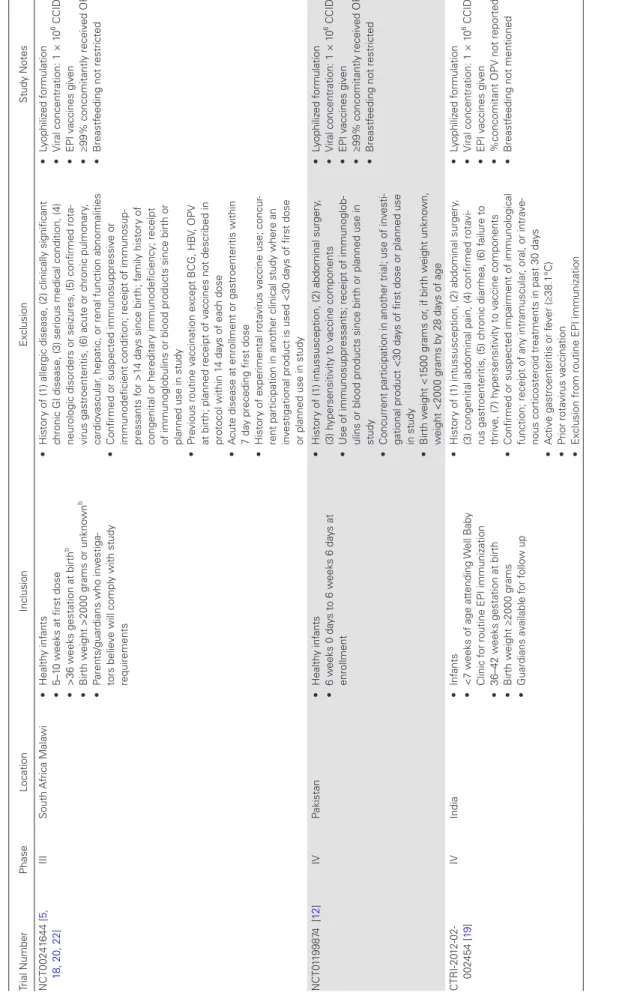
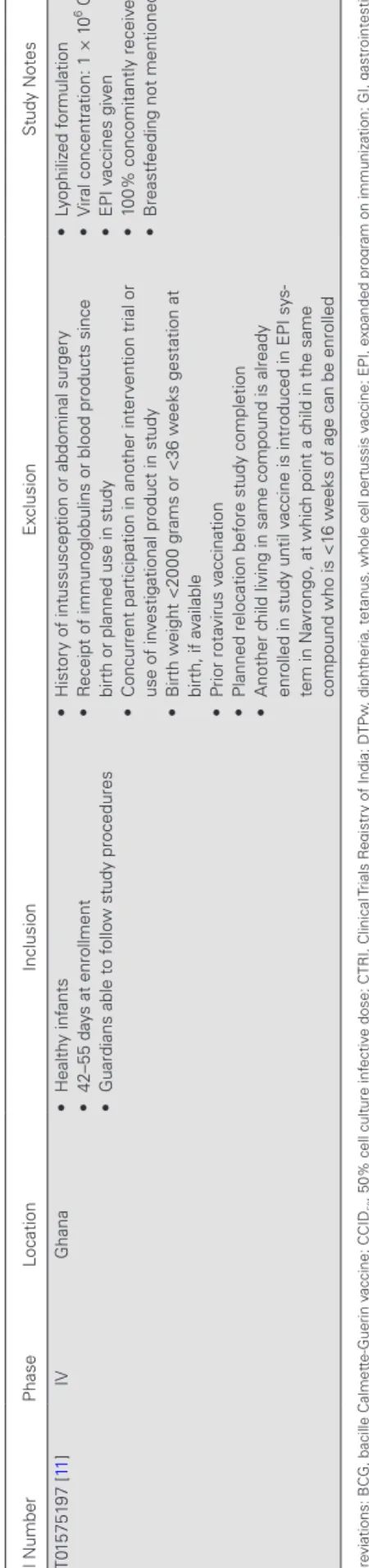
Table 1.
Characteristics of Included T
rials and T
rial Populations (N = 8)
Trial Number Phase Location Inclusion Ex clusion St udy Notes NCT0 0346892 [ 21 ] II South Africa • Health y inf ants • 5–1 0 w
eeks at first dose
• HIV -confirmed negativ e mother a • Histor
y of (1) allergic disease, (2) clinically significant
chronic GI disease, (3) serious medical condition
•
Confirmed or suspected immunosuppressiv
e or
immunodeficient condition
•
R
eceipt of treatment prohibited b
y protocol • Ly ophiliz ed f ormulation •
Viral concentration: 1 × 1
0
5.6 CCID
50 • EPI v accines giv en • 10 0% concomit antly receiv ed OPV (group 1) • 10 0% concomit antly receiv ed IPV (group 2) • Breastf
eeding not restricted
NCT0 0383903 [ 23 ] II South Africa • Health y inf ants • 5–1 0 w
eeks at first dose
•
≥36 w
eeks gest
ation at birth
• HIV -confirmed negativ e mother • Histor
y of (1) allergic disease, (2) clinically significant
chronic GI disease, (3) serious medical condition, (4) polio disease
•
Confirmed or suspected immunosuppressiv
e or
immunodeficient condition (including HIV)
•
R
eceipt of treatment prohibited b
y protocol • Ly ophiliz ed f ormulation •
Viral concentration: 1 × 1
0
6.0 CCID
50 • EPI v accines giv en • 10 0% concomit antly receiv ed OPV • Breastf
eeding not restricted
NCT0 0345956 [ 17 ] II Vietnam • Health y inf ants • 6–1 0 w eeks • Birth w eight >20 00 grams • Histor
y of allergic disease or suspected reaction
•
Chronic administration (since birth) of immunosup
-pressants or immune-modifying dr
ugs
•
Planned v
accinations outside of protocol e
xcept DTPw
,
HB
V, and OPV v
accines within 1
4 da
ys of eac
h dose
•
Concur
rent participation in another clinical st
udy
where an in
vestigational product is used <30 da
ys
of first dose or where an
y pharmaceutical product is
used in st
udy
•
Liquid f
ormulation
•
Viral concentration: 1 × 1
0
6.0 CCID
50 • EPI v accines giv en • 10 0% concomit antly receiv ed OPV • Breastf
eeding not mentioned
NCT0 0432380 [ 17 ] II Philippines • Health y inf ants • 5–1 0 w
eeks at first dose
• Birth w
eight >20
00 grams
•
Histor
y of allergic disease or suspected reaction
•
Chronic administration of immunosuppressants or immune-modifying dr
ugs 6 months bef
ore first dose;
confirmed or suspected immunosuppressiv
e or immu
-nodeficient condition; receipt of immunoglobulins or blood products since birth or planned use in st
udy
•
Planned v
accinations outside of protocol e
xcept DTPw
,
HB
V, and OPV v
accines within 1
4 da
ys of eac
h dose
and BCG at birth according to local EPI guidelines
•
Concur
rent participation in another clinical st
udy; use
of in
vestigational product <30 da
ys of first dose or
planned use in st
udy
•
A
cute disease at enrollment
•
Liquid f
ormulation
•
Viral concentration: 1 × 1
0
6.0 CCID
50 • EPI v accines giv en • 10 0% concomit antly receiv ed OPV • Breastf
Trial Number Phase Location Inclusion Ex clusion St udy Notes NCT0 0241 644 [ 5 , 18 , 20 , 22 ] III South Africa Mala wi • Health y inf ants • 5–1 0 w
eeks at first dose
•
>36 w
eeks gest
ation at birth
b
•
Birth w
eight >20
00 grams or unkno
wn
b
•
Parents/guardians who in
vestiga
-tors belie
ve will comply with st
udy
requirements
•
Histor
y of (1) allergic disease, (2) clinically significant
chronic GI disease, (3) serious medical condition, (4) neurologic disorders or seizures, (5) confirmed rot
a-vir
us gastroenteritis, (6) acute or c
hronic pulmonar
y,
cardio
vascular
, hepatic, or renal function abnormalities
•
Confirmed or suspected immunosuppressiv
e or
immunodeficient condition; receipt of immunosup
-pressants f
or >1
4 da
ys since birth; f
amily histor
y of
congenit
al or heredit
ar
y immunodeficiency; receipt
of immunoglobulins or blood products since birth or planned use in st
udy
•
Pre
vious routine v
accination e
xcept BCG, HB
V, OPV
at birth; planned receipt of v
accines not described in
protocol within 1
4 da
ys of eac
h dose
•
A
cute disease at enrollment or gastroenteritis within 7 day preceding first dose
•
Histor
y of e
xperiment
al rot
avir
us v
accine use; concur
-rent participation in another clinical st
udy where an
in
vestigational product is used <30 da
ys of first dose
or planned use in st
udy • Ly ophiliz ed f ormulation •
Viral concentration: 1 × 1
0
6 CCID
50 • EPI v accines giv en • ≥99% concomit antly receiv ed OPV • Breastf
eeding not restricted
NCT0
11
9987
4 [
12 ] IV Pakist an • Health y inf ants • 6 w eeks 0 da
ys to 6 w
eeks 6 da
ys at
enrollment
•
Histor
y of (1) int
ussusception, (2) abdominal surger
y,
(3) h
ypersensitivit
y to v
accine components
•
Use of immunosuppressants; receipt of immunoglob
-ulins or blood products since birth or planned use in study
•
Concur
rent participation in another trial; use of in
vesti
-gational product <30 da
ys of first dose or planned use
in st udy • Birth w eight <1 50
0 grams or
, if birth w
eight unkno
wn,
w
eight <20
00 grams b
y 28 da
ys of age
• Ly ophiliz ed f ormulation •
Viral concentration: 1 × 1
0
6 CCID
50 • EPI v accines giv en • ≥99% concomit antly receiv ed OPV • Breastf
eeding not restricted
CTRI-20 12-02-002454 [ 19 ] IV India • Inf ants • <7 w
eeks of age at
tending W ell B ab y Clinic f
or routine EPI immunization
•
36–42 w
eeks gest
ation at birth
• Birth w eight ≥20 00 grams • Guardians a vailable f or f ollo w up • Histor
y of (1) int
ussusception, (2) abdominal surger
y,
(3) congenit
al abdominal pain, (4) confirmed rot
avi
-rus gastroenteritis, (5) c
hronic diar
rhea, (6) f
ailure to
thriv
e, (7) h
ypersensitivit
y to v
accine components
•
Confirmed or suspected impairment of immunological function; receipt of an
y intramuscular
, oral, or intra
ve
-nous corticosteroid treatments in past 30 da
ys
•
A
ctiv
e gastroenteritis or f
ev er (≥38.1°C) • Prior rot avir us v accination • Ex
clusion from routine EPI immunization
• Ly ophiliz ed f ormulation •
Viral concentration: 1 × 1
0
6 CCID
50 • EPI v accines giv en • %concomit
ant OPV not reported
c
•
Breastf
eeding not mentioned
Table 1.
licensed concentration concomitantly with routine vaccines, including OPV. Most trials had similar inclusion and exclusion criteria for the study populations. Half of the trials were con-ducted in Asian LMICs whereas the other half were concon-ducted in African LMICs. Several of the trials conducted in Africa were conducted in South Africa. All trials had medium or low risk of bias (Supplemental Table 3). Trials (N = 3) with a medium risk of bias had moderate to high attrition and/or did not adequately describe the method of treatment randomization.
Intermediate Outcomes
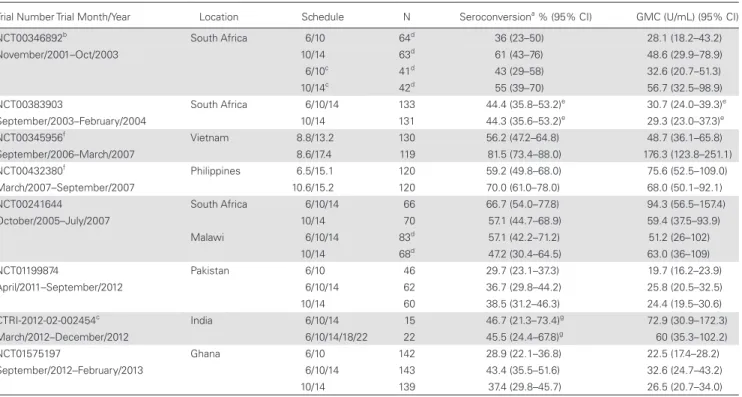
Seroconversion proportions and geometric mean concentra-tions were available for all trials (Table 2). The seroconversion proportion ranged from approximately 0.3 to approximately 0.8 across the different schedules evaluated by country and trial. Geometric mean concentrations of postimmunization anti-ro-tavirus IgA ranged from 19.7 U/mL to 176.3 U/mL across dif-ferent schedules by country and trial.
Differences in Seroconversion Proportions
Differences in seroconversion proportions comparing 6/10- versus 10/14-week schedules and 6/10/14- versus 10/14-week schedules are presented in Figure 1. In general, seroconversion proportions for the 6/10-week schedule were lower than for the 10/14-week schedule. Only 2 of these estimated differences, trial NCT00346892 in South Africa [21] and NCT01575197 in Ghana [11], were statistically significantly different than the null (no difference between schedules). By contrast, serocon-version proportions for the 6/10/14-week schedule were simi-lar or slightly higher than seroconversion proportions for the 10/14-week schedule.
Differences in the less commonly used schedules are pre-sented in Table 3. There was no difference in seroconversion proportions between the 6/10/14- and 6/10/14/18/22-week schedules in India. However, there was a statistically significant lower seroconversion proportion for the 8.8/13.2-week sched-ule compared with the 8.6/17.4-week schedsched-ule in Vietnam. The seroconversion proportion for the 6.5/15.1-week schedule was lower than the 10.6/15.2-week schedule, although not statisti-cally significant.
Ratios of Geometric Mean Concentrations
The ratios of geometric mean concentration levels comparing the 6/10- and 6/10/14-week schedules to the 10/14-week sched-ule are presented in Figure 2. These ratios followed a similar pattern to the differences in seroconversion proportions. In gen-eral, the geometric mean concentration was lower, although not statistically significantly lower, for the 6/10- versus 10/14-week schedules. Similar to the results for difference in seroconversion proportion, the geometric mean concentrations were similar or slightly higher for 6/10/14- versus 10/14-week schedules.
For less commonly used schedules, the geometric mean con-centration was significantly lower for 8.8/13.2-week schedule compared with the 8.6/17.4-week schedule. The responses were
Trial Number Phase Location Inclusion Ex clusion St udy Notes NCT0 15751 97 [ 11 ] IV Ghana • Health y inf ants • 42–55 da
ys at enrollment
•
Guardians able to f
ollo
w st
udy procedures
•
Histor
y of int
ussusception or abdominal surger
y
•
R
eceipt of immunoglobulins or blood products since birth or planned use in st
udy
•
Concur
rent participation in another inter
vention trial or
use of in
vestigational product in st
udy
•
Birth w
eight <20
00 grams or <36 w
eeks gest
ation at
birth, if a
vailable • Prior rot avir us v accination •
Planned relocation bef
ore st
udy completion
•
Another c
hild living in same compound is already
enrolled in st
udy until v
accine is introduced in EPI sy
s-tem in Na
vrongo, at whic
h point a c
hild in the same
compound who is <1
6 w
eeks of age can be enrolled
• Ly ophiliz ed f ormulation •
Viral concentration: 1 × 1
0
6 CCID
50 • EPI v accines giv en • 10 0% concomit antly receiv ed OPV • Breastf
eeding not mentioned
Abbre
viations: BCG, bacille Calmet
te-Guerin v
accine; CCID
50
, 50% cell cult
ure inf
ectiv
e dose; CTRI, Clinical
Trials R
egistr
y of India; DTPw
, diphtheria, tet
anus, whole cell pert
ussis v
accine; EPI, e
xpanded program on immunization; GI, gastrointestinal; HB
V,
hepatitis B v
accine; HIV
, human immunodeficiency vir
us; IPV , inactiv ated polio vir us v accine; NCT
, National Clinical
Trial; OPV
, oral polio v
accine.
aHIV st
at
us w
as only confirmed af
ter 20
02 rot
avir
us season.
bSouth Africa
only
.
cExact percent
age not reported; the recommended polio sc
hedule from the Indian
A
cadem
y of P
ediatrics Commit
tee on Immunization is OPV (birth, 6 months, and 9 months) and IPV (6, 1
0, 1
4 w
eeks).
Table 1.
Difference (95% CI)
–0.09 (–0.27, 0.09) NCT01199874 Pakistan
NCT01199874 Pakistan NCT01575197 Ghana
NCT01575197 Ghana
NCT00241644 Malawi† NCT00346892 South Africa*†
NCT00241644 South Africa
NCT00383903 South Africa§ NCT00346892 South Africa*†‡ –0.17 (–0.27, –0.07)
–0.25 (–0.44, –0.06)
–0.12 (–0.31, 0.07)
–0.02 (–0.19, 0.15)
0.06 (–0.05, 0.17)
0.10 (–0.06, 0.26)
0.10 (–0.07, 0.26)
0.00 (–0.12, 0.12)
–0.4 –0.2 0.2
Seroconversion Difference (95% CI) 6/10/14 vs. 10/14 6/10 vs. 10/14
0.4 0.0
Trial Number and Country
Figure 1. One-month seroconversion proportion differences comparing different monovalent (RV1) rotavirus vaccine schedules from 5 trials conducted in low- and middle-income countries with concomitantly administered oral polio vaccines unless otherwise indicated. *RV1 viral concentration 105.6; †Estimated sample size used; ‡Concomitant inactivated polio vaccine; §2-month seroconversion difference. CI, confidence interval.
Table 2. One-Month Seroconversion Percentage and GMCs by Trial and Country for Different Schedules of the Monovalent Rotavirus Vaccine Administered Concomitantly With Routine Vaccines, Including Oral Polio Vaccines Unless Otherwise Indicated
Trial Number Trial Month/Year Location Schedule N Seroconversiona % (95% CI) GMC (U/mL) (95% CI)
NCT00346892b South Africa 6/10 64d 36 (23–50) 28.1 (18.2–43.2)
November/2001–Oct/2003 10/14 63d 61 (43–76) 48.6 (29.9–78.9)
6/10c 41d 43 (29–58) 32.6 (20.7–51.3)
10/14c 42d 55 (39–70) 56.7 (32.5–98.9)
NCT00383903 South Africa 6/10/14 133 44.4 (35.8–53.2)e 30.7 (24.0–39.3)e
September/2003–February/2004 10/14 131 44.3 (35.6–53.2)e 29.3 (23.0–37.3)e
NCT00345956f Vietnam 8.8/13.2 130 56.2 (47.2–64.8) 48.7 (36.1–65.8)
September/2006–March/2007 8.6/17.4 119 81.5 (73.4–88.0) 176.3 (123.8–251.1)
NCT00432380f Philippines 6.5/15.1 120 59.2 (49.8–68.0) 75.6 (52.5–109.0)
March/2007–September/2007 10.6/15.2 120 70.0 (61.0–78.0) 68.0 (50.1–92.1)
NCT00241644 South Africa 6/10/14 66 66.7 (54.0–77.8) 94.3 (56.5–157.4)
October/2005–July/2007 10/14 70 57.1 (44.7–68.9) 59.4 (37.5–93.9)
Malawi 6/10/14 83d 57.1 (42.2–71.2) 51.2 (26–102)
10/14 68d 47.2 (30.4–64.5) 63.0 (36–109)
NCT01199874 Pakistan 6/10 46 29.7 (23.1–37.3) 19.7 (16.2–23.9)
April/2011–September/2012 6/10/14 62 36.7 (29.8–44.2) 25.8 (20.5–32.5)
10/14 60 38.5 (31.2–46.3) 24.4 (19.5–30.6)
CTRI-2012-02-002454c India 6/10/14 15 46.7 (21.3–73.4)g 72.9 (30.9–172.3)
March/2012–December/2012 6/10/14/18/22 22 45.5 (24.4–67.8)g 60 (35.3–102.2)
NCT01575197 Ghana 6/10 142 28.9 (22.1–36.8) 22.5 (17.4–28.2)
September/2012–February/2013 6/10/14 143 43.4 (35.5–51.6) 32.6 (24.7–43.2)
10/14 139 37.4 (29.8–45.7) 26.5 (20.7–34.0)
Abbreviations: CI, confidence interval; CTRI, Clinical Trials Registry of India; GMC, geometric mean concentration; Ig, immunoglobulin; NCT, National Clinical Trial.
aPercentage of seronegative participants with postvaccination anti-rotavirus IgA antibody concentrations of ≥20 U/mL.
bVaccine with viral concentration of 1 × 105.6 median cell culture infective dose.
cConcomitant inactivated polio vaccine.
dExact sample size not reported; sample size estimated.
eTwo-month seroconversion percentage/GMC.
fLiquid formulation of vaccine.
similar or slightly higher for the 6/10/14-week schedule com-pared with the 6/10/14/18/22-week schedule. The responses were also similar or slightly higher for the 6.5/15.1-week sched-ule compared with the 10.6/15.2-week schedsched-ule.
Comparison of Efficacy
One trial (NCT00241644 [5, 18, 20, 22]), conducted in South Africa and Malawi, reported vaccine efficacies by schedule using clinical outcomes (Table 4). In South Africa, the 6/10/14-week schedule had slightly higher efficacy compared with the 10/14-week schedule. However, these efficacy estimates, particularly for the second year and cumulative 2-year efficacy, had large variability. In Malawi, the efficacy for the 6/10/14-week sched-ule was largely indistinguishable from the 10/14-week schedsched-ule for the first-year efficacy, but the 6/10/14-week schedule had
a numerically higher efficacy compared with the 10/14-week schedule during the second year, although the estimates were very imprecise.
DISCUSSION
Overall, a small body of literature reported the effect of RV1 or RV5 schedules on vaccine immunogenicity or efficacy in LMICs. We identified 8 trials, all of which evaluated different schedules of RV1. These studies had relatively similar inclusion and exclusion criteria.
In general, the 6/10-week schedule was not as immunogenic as the 10/14-week schedule in LMICs. A 3-dose RV1 schedule at 6/10/14 weeks had similar or slightly higher immunogenicity and efficacy compared with a 2-dose schedule at 10/14 weeks. Table 3. Summary of Seroconversion Proportion Differences and Ratios of GMCs by Trial and Country of the Monovalent Rotavirus Vaccine for Vaccine Schedules Less Commonly Reported
Trial Number
Trial Month/Year Location Schedule Seroconversion Proportion Difference (95% CI) Ratio of GMC (95% CI)
CTRI-2012-02-002454a India 6/10/14 0.01 (−0.32 to 0.34) 1.2 (0.4 to 3.3)
March/2012–December/2012 6/10/14/18/22 (Reference) (Reference)
NCT00345956b Vietnam 8.8/13.2 −0.25 (−0.36 to −0.14) 0.3 (0.2 to 0.4)
September/2006–March/2007 8.6/17.4 (Reference) (Reference)
NCT00432380b Philippines 6.5/15.1 −0.11 (−0.23 to 0.01) 1.1 (0.7 to 1.8)
March/2007–September/2007 10.6/15.2 (Reference) (Reference)
Abbreviations: CI, confidence interval; CTRI, Clinical Trials Registry of India; GMC, geometric mean concentration; NCT, National Clinical Trial.
aConcomitant inactivated polio vaccine.
bLiquid formulation of vaccine.
GMC Ratio (95% CI)
NCT01199874 Pakistan
NCT01199874 Pakistan NCT01575197 Ghana
NCT01575197 Ghana
NCT00241644 Malawi† NCT00346892 South Africa*†
NCT00241644 South Africa
NCT00383903 South Africa§ NCT00346892 South Africa*†‡
1.0 (0.7, 1.5) 1.6 (0.8, 3.2) 0.8 (0.3, 2.0) 1.2 (0.8, 1.8) 1.1 (0.8, 1.5) 0.6 (0.3, 1.2) 0.6 (0.3, 1.1) 0.6 (0.5, 0.9) 0.8 (0.6, 1.1)
0.25 0.5 1 2 4
Ratio of Geometric Mean Concentrations (95% CI) 6/10/14 vs. 10/14 6/10 vs. 10/14
Trial Number and Country
However, as mentioned previously, this was a relatively small body of evidence, and the estimates for each schedule within each trial had a large amount of variability. Consequently, mod-erate differences that appear between different vaccine sched-ules may be due to random variability. More importantly, these studies, in large part, relied on immunogenic assessment of the response to the vaccine. Currently, there is no known correlate of protection for anti-rotavirus IgA levels [24, 25]. Therefore, even an association between vaccine schedule and immunogenicity does not provide evidence of a difference in disease protection. However, the pattern observed in the immunogenicity data was similar to the pattern seen with clinical outcomes in one trial, although the 6/10-week and 10/14-week schedules were not compared using clinical outcomes.
The results of this compiled evidence are consistent with the hypothesis that immune response to vaccination may be dampened or negated by maternal antibodies, differences in profiles of microbiota, or other immunologic factors. However, by assessing vaccine schedule alone, it is impossible to know the mechanism through which this effect, if it exists, occurs. Maternal antibodies passively acquired in utero (anti-rotavi-rus IgG) may partially, or fully, inhibit the immune response to rotavirus vaccine doses given at 6 weeks. Although transpla-centally acquired antibodies decay exponentially with a half-life of approximately 35 to 40 days, there is considerable individual variability in the rate of clearance [26]. In addition, the critical level at which maternally acquired antibody concentrations are low enough to elicit a robust immune response to rotavirus vac-cines in infants is unknown. One study has examined the clear-ance rate of passively acquired anti-rotavirus antibodies in 54 Mexican infants and found a gradual decline until 4 months of age and then an increase in anti-rotavirus IgG, likely due to the infant’s active immunity to rotavirus infections [27]. Another study of the natural history of rotavirus infection found that children with maternal antibodies in cord blood were less likely to experience symptomatic rotavirus infection before 3 months of age compared with those without maternal antibod-ies [28]. Furthermore, one study in India even demonstrated the ability of pre-existing anti-rotavirus IgG antibodies in infant blood to neutralize the effect of a new rotavirus vaccine (ORV-116E) [29]. These data suggest it is possible passively acquired antibodies could interfere with the immunologic response to
rotavirus vaccines given to very young infants. However, other infant characteristics, including the microbiota of young infants in LMICs and other factors affecting enteric immunity, may influence any effect of vaccine schedules that is observed.
The implementation of immunization programs for rotavi-rus vaccines is extremely complex. Currently, the World Health Organization recommends that rotavirus vaccines be given as soon as possible after 6 weeks of age [30] and that 62% of the 37 LMICs administering RV1 in their routine immunization pro-gram use the 6/10-week schedule [2, 31]. The 6/10-week sched-ule may not be as immunogenic as the 10/14-week schedsched-ule, which suggests vaccination could start at 10 weeks rather than 6 week. However, in some LMICs countries, initial vaccination is already delayed, and there is concern that starting vaccina-tion later may lead to prolonged vaccinavaccina-tion time or missing vaccination altogether. In addition, due to the potential fear of increased risk of intussusception [32], there is a recommenda-tion that RV1 and RV5 be given before 32 weeks if at all possi-ble [30]. Furthermore, the timing of first rotavirus infection is thought to occur early in LMICs (median 6–9 months) [33]. It is important that rotavirus vaccines be provided in a timely man-ner to prevent severe RVGE. Although the additional dose at 14 weeks could improve immunogenicity, the additional capacity and cost associated with this decision may not be justified based on the current evidence.
There are some limitations and strengths of this systematic review. This is the first review to summarize data on RV1 or RV5 schedules and the impact it has on vaccine response among children in LMICs. We were limited in our ability to report and use the exact sample size for some trials, but we did evaluate the effect of schedule on vaccine response. This will be helpful given the paucity of data in low-resource settings at this time. In addi-tion, we were able to present comparisons not directly reported in some trials and to estimate seroconversion proportion dif-ferences and ratios of geometric mean concentrations using the same methods to ease comparison across trials. The summari-zation of these data highlights the importance of assessing the effect of RV1 and RV5 schedules on vaccine performance using clinical endpoints, because there is the potential that schedules could affect the incidence of severe RVGE, and alterations in schedules could result in the prevention of more severe RVGE episodes.
Table 4. Rotavirus Vaccine Efficacy Against Severe Rotavirus Gastroenteritis Comparing Different Schedules From Trial NCT00241644
Location Schedule Na One Year Efficacy (95% CI) Second Year Efficacy (95% CI) Cumulative Two-Year Efficacy (95% CI)
South Africa 10/14 971 72.2 (40.4 to 88.3) 3 (−43 to 82) 32 (−71 to 75)
6/10/14 973 81.5 (55.1 to 93.7) 76 (−143 to 100) 85 (35 to 98)
Malawi 10/14 525 49.2 (11.1 to 71.7) 2.6 (−101.2 to 52.6) 34.0 (−2 to 57.7)
6/10/14 505 49.7 (11.3 to 72.2) 33.1 (−48.6 to 70.9) 42.3 (8.8 to 64.0)
Abbreviations: CI, confidence interval.
CONCLUSIONS
In conclusion, 8 trials have assessed the impact of different RV1 schedules on vaccine response in LMICs, whereas none have reported information for RV5 schedules. Seroconversion pro-portions and geometric mean concentrations were generally lower for the 6/10-week schedule compared with the 10/14-week schedule. The administration of 3 doses of RV1 on the 6/10/14-week schedule had similar or slightly higher sero-conversion proportions, geometric mean concentrations, and efficacies against severe RVGE compared with the 10/14-week schedule. The commonly used 6/10-week schedule of RV1 in LMICs may not be optimal for protection. Further research on the effect of RV1 and RV5 schedules using clinical endpoints is critical, because if altering schedules could confer better pro-tection, even small improvements gained by altering vaccine schedules could translate into the prevention of thousands of severe RVGE episodes each year.
Supplementary Data
Supplementary materials are available at Open Forum Infectious Diseases
online. Consisting of data provided by the authors to benefit the reader, the posted materials are not copyedited and are the sole responsibility of the authors, so questions or comments should be addressed to the corre-sponding author.
Acknowledgments
We thank health science librarian Rachael Posey for assistance with selecting the search keywords and executing the literature searches.
Disclaimer. The content is solely the responsibility of the authors and does not necessarily represent the official views of the National Institutes of Health (NIH).
Financial support. S. B.-D. was funded in part by NIH Grant 1R56A1108515-01. M. J. F. is funded in part by the National Center for Advancing Translational Sciences (NCATS), NIH, through Grant Award Number UL1TR001111.
Potential conflicts of interest. J. F. G. was employed as a research assis-tant at Merck & Co., Inc. (January to December 2014) working on analysis related to Merck’s rotavirus vaccine (RotaTeq). The manuscript presenting results were published in January 2017. S. B.-D. has an investigator-initiated award from Pfizer and has served as a consultant for Pfizer for work on pneu-mococcal vaccines. M. J. F. receives investigator-initiated research funding and support as Principal Investigator from the NIH National Heart Lung and Blood Institute (R01 HL118255) and Reagan Udall Foundation; M. J. F. also receives funding as Co-Investigator from the NIH National Institute on Aging (R01 AG023178), the NIH NCATS (1UL1TR001111), AstraZeneca, and the Patient Centered Outcomes Research Institute (1IP2PI000075). M. J. F. does not accept personal compensation of any kind from any phar-maceutical company, although she receives salary support from the Center for Pharmacoepidemiology in the Department of Epidemiology, Gillings School of Global Public Health (current members: GlaxoSmithKline, UCB BioSciences, Merck & Co., Inc.). All authors have submitted the ICMJE Form for Disclosure of Potential Conflicts of Interest. Conflicts that the edi-tors consider relevant to the content of the manuscript have been disclosed. References
1. Meeting of the immunization Strategic Advisory Group of Experts, April
2009--conclusions and recommendations. Wkly Epidemiol Rec 2009;
84:220–36.
2. Path. Rotavirus vaccines overview. Available at: http://sites.path.org/rotavirusvac-cine/country-introduction-maps-and-spreadsheet/. Accessed 24 August 2016.
3. GlaxoSmithKline. Highlights of Prescribing Information: Rotarix (Rotavirus Vaccine, Live, Oral. Available at: https://www.gsksource.com/pharma/content/ dam/GlaxoSmithKline/US/en/Prescribing_Information/Rotarix/pdf/ROTARIX-PI-PIL.PDF. Accessed 9 May 2017.
4. Merck & Co. Inc. Highlights of Prescribing Information: RotaTeq (Rotavirus Vaccine, Live, Oral, Pentavalent. Available at: https://www.merck.com/product/ usa/pi_circulars/r/rotateq/rotateq_pi.pdf. Accessed 9 May 2017.
5. Madhi SA, Cunliffe NA, Steele D, et al. Effect of human rotavirus vaccine on severe diarrhea in African infants. N Engl J Med 2010; 362:289–98.
6. Armah GE, Sow SO, Breiman RF, et al. Efficacy of pentavalent rotavirus vac-cine against severe rotavirus gastroenteritis in infants in developing countries in sub-Saharan Africa: a randomised, double-blind, placebo-controlled trial. Lancet 2010; 376:606–14.
7. Zaman K, Dang DA, Victor JC, et al. Efficacy of pentavalent rotavirus vac-cine against severe rotavirus gastroenteritis in infants in developing countries in Asia: a randomised, double-blind, placebo-controlled trial. Lancet 2010; 376:615–23.
8. Patel M, Shane AL, Parashar UD, et al. Oral rotavirus vaccines: how well
will they work where they are needed most? J Infect Dis 2009; 200(Suppl
1):S39–48.
9. Chan J, Nirwati H, Triasih R, et al. Maternal antibodies to rotavirus: could they interfere with live rotavirus vaccines in developing countries? Vaccine 2011; 29:1242–7.
10. Becker-Dreps S, Vilchez S, Velasquez D, et al. Rotavirus-specific IgG antibodies from mothers’ serum may inhibit infant immune responses to the pentavalent rotavirus vaccine. Pediatr Infect Dis J 2015; 34:115–6.
11. Armah G, Lewis KD, Cortese MM, et al. A randomized, controlled trial of the impact of alternative dosing schedules on the immune response to human rotavi-rus vaccine in rural Ghanaian infants. J Infect Dis 2016; 213:1678–85. 12. Ali SA, Kazi AM, Cortese MM, et al. Impact of different dosing schedules on the
immunogenicity of the human rotavirus vaccine in infants in Pakistan: a rand-omized trial. J Infect Dis 2014; 210:1772–9.
13. Naylor C, Lu M, Haque R, et al. Environmental enteropathy, oral vaccine failure and growth faltering in infants in Bangladesh. EBioMedicine 2015; 2:1759–66.
14. Emperador DM, Velasquez DE, Estivariz CF, et al. Interference of monovalent, bivalent, and trivalent oral poliovirus vaccines on monovalent rotavirus vaccine immunogenicity in rural Bangladesh. Clin Infect Dis 2016; 62:150–6.
15. Ciarlet M, Sani-Grosso R, Yuan G, et al. Concomitant use of the oral pentavalent human-bovine reassortant rotavirus vaccine and oral poliovirus vaccine. Pediatr Infect Dis J 2008; 27:874–80.
16. Moher D, Liberati A, Tetzlaff J, Altman DG. Preferred reporting items for system-atic reviews and meta-analyses: the PRISMA statement. J Clin Epidemiol 2009; 62:1006–12.
17. Anh DD, Carlos CC, Thiem DV, et al. Immunogenicity, reactogenicity and safety of the human rotavirus vaccine RIX4414 (Rotarix) oral suspension (liquid for-mulation) when co-administered with expanded program on immunization (EPI) vaccines in Vietnam and the Philippines in 2006–2007. Vaccine 2011; 29:2029–36.
18. Cunliffe NA, Witte D, Ngwira BM, et al. Efficacy of human rotavirus vaccine against severe gastroenteritis in Malawian children in the first two years of life: a randomized, double-blind, placebo controlled trial. Vaccine 2012; 30(Suppl 1):A36–43.
19. Kompithra RZ, Paul A, Manoharan D, et al. Immunogenicity of a three dose and five dose oral human rotavirus vaccine (RIX4414) schedule in south Indian infants. Vaccine 2014; 32(Suppl 1):A129–33.
20. Madhi SA, Kirsten M, Louw C, et al. Efficacy and immunogenicity of two or three dose rotavirus-vaccine regimen in South African children over two consecutive rotavirus-seasons: a randomized, double-blind, placebo-controlled trial. Vaccine 2012; 30(Suppl 1):A44–51.
21. Steele AD, De Vos B, Tumbo J, et al. Co-administration study in South African infants of a live-attenuated oral human rotavirus vaccine (RIX4414) and poliovi-rus vaccines. Vaccine 2010; 28:6542–8.
22. Steele AD, Neuzil KM, Cunliffe NA, et al. Human rotavirus vaccine Rotarix™ pro-vides protection against diverse circulating rotavirus strains in African infants: a randomized controlled trial. BMC Infect Dis 2012; 12:213.
23. Steele AD, Reynders J, Scholtz F, et al. Comparison of 2 different regimens for reactogenicity, safety, and immunogenicity of the live attenuated oral rotavirus vaccine RIX4414 coadministered with oral polio vaccine in South African infants. J Infect Dis 2010; 202(Supp l):S93–100.
25. Parashar UD, Alexander JP, Glass RI. Prevention of rotavirus gastroen-teritis among infants and children. Recommendations of the Advisory
Committee on Immunization Practices (ACIP). MMWR Recomm Rep 2006;
55:1–13.
26. Sato H, Albrecht P, Reynolds DW, et al. Transfer of measles, mumps, and rubella antibodies from mother to infant. Its effect on measles, mumps, and rubella immunization. Am J Dis Child 1979; 133:1240–3.
27. Espinosa LE, Ruiz-Gomez J. [Persistence of transplacental antibodies against rotavirus in children less than 6 months of age]. Boletin Medico del Hospital Infantil de Mexico 1980; 38:595–8.
28. Georges-Courbot MC, Monges J, Beraud-Cassel AM, et al. Prospective longitu-dinal study of rotavirus infections in children from birth to two years of age in Central Africa. Ann Inst Pasteur Virol 1988; 139:421–8.
29. Appaiahgari MB, Glass R, Singh S, et al. Transplacental rotavirus IgG interferes with immune response to live oral rotavirus vaccine ORV-116E in Indian infants. Vaccine 2014; 32:651–6.
30. Rotavirus vaccines. WHO position paper - January 2013. Wkly Epidemiol Rec 2013; 88:49–64.
31. World Health Organization. WHO vaccine-preventable diseases: monitoring sys-tem. 2016 global summary. Available at: http://apps.who.int/immunization_mon-itoring/globalsummary/schedules. Accessed 24 August 2016.
32. Zanardi LR, Haber P, Mootrey GT, et al. Intussusception among recipients of rota-virus vaccine: reports to the vaccine adverse event reporting system. Pediatrics 2001; 107:E97.
![Table 1.Characteristics of Included Trials and Trial Populations (N = 8) Trial NumberPhaseLocationInclusionExclusionStudy Notes NCT00346892 [21]IISouth Africa• Healthy infants • 5–10 weeks at first dose • HIV-confirmed negative mothera](https://thumb-us.123doks.com/thumbv2/123dok_us/8277150.2192051/3.891.190.722.63.1086/characteristics-included-populations-numberphaselocationinclusionexclusionstudy-iisouth-healthy-confirmed-negative.webp)