Highly
Efficient
Gene
Editing
of
Cystic
Fibrosis
Patient-Derived
Airway
Basal
Cells
Results
in
Functional
CFTR
Correction
Shingo
Suzuki,
1,6Ana
M.
Crane,
1,6Varada
Anirudhan,
1,6Cristina
Barillà,
1Nadine
Matthias,
1Scott
H.
Randell,
2Andras
Rab,
3Eric
J.
Sorscher,
3Jenny
L.
Kerschner,
4Shiyi
Yin,
4Ann
Harris,
4Matthew
Mendel,
5Kenneth
Kim,
5Lei
Zhang,
5Anthony
Conway,
5and
Brian
R.
Davis
11InstituteofMolecularMedicine,UniversityofTexasHealthScienceCenteratHouston,Houston,TX77030,USA;2DepartmentofCellBiologyandPhysiology,The
UniversityofNorthCarolinaatChapelHill,ChapelHill,NC27599,USA;3DepartmentofPediatrics,EmoryUniversitySchoolofMedicine,Atlanta,GA30322,USA; 4DepartmentofGeneticsandGenomeSciences,CaseWesternReserveUniversity,Cleveland,OH44106,USA;5SangamoTherapeutics,Richmond,CA94804,USA
There is a strong rationale to consider future cell therapeutic approaches for cysticfibrosis (CF) in which autologous prox-imal airway basal stem cells, corrected for CFTR mutations, are transplanted into the patient’s lungs. We assessed the pos-sibility of editing theCFTRlocus in these cells using zinc-finger nucleases and have pursued two approaches. Thefirst, muta-tion-specific correction, is a footprint-free method replacing theCFTRmutation with corrected sequences. We have applied this approach for correction ofDF508, demonstrating restora-tion of mature CFTR protein and funcrestora-tion in air-liquid inter-face cultures established from bulk edited basal cells. The sec-ond is targeting integration of a partial CFTRcDNA within an intron of the endogenousCFTRgene, providing correction for allCFTRmutations downstream of the integration and ex-ploiting the nativeCFTRpromoter and chromatin architecture for physiologically relevant expression. Without selection, we observed highly efficient, site-specific targeted integration in basal cells carrying variousCFTRmutations and demonstrated restored CFTR function at therapeutically relevant levels. Significantly, Omni-ATAC-seq analysis revealed minimal impact on the positions of open chromatin within the native CFTR locus. These results demonstrate efficient functional correction of CFTR and provide a platform for further ex vivoandin vivoediting.
INTRODUCTION
There is still much to be learned about turnover of cells in the human airway, as well as the identity of potential stem/progenitor cells responsible for overall pulmonary architecture and maintenance. There is an emerging consensus, however, that pseudo-stratified epithelial tissue of the human proximal airway contains basal cells capable both of self-renewing cell division, as well as differentiation to other specialized cells, including ciliated and secretory cells. As such, proximal airway basal cells serve as a major class of stem/pro-genitor cells within the proximal airway.1–4 Thus, there is strong rationale to consider future cell therapeutic approaches for CF in
which autologous proximal airway basal cells, corrected for CFTR gene mutations, are transplanted into the lungs of affected CF pa-tients. To that end, our objective has been to prepare a population ofCFTRcorrected, patient-specific airway basal cells, which retain the ability to develop pseudo-stratified airway epithelium with restored CFTR function. Several groups, including our own, have uti-lized various methods to directly correct or compensate for CFTR mutations in relevant cell types via editing or gene transfer.5–21
There is currently uncertainty about the relative contribution of different cell types to overall CFTR activity in the airway epithelium. Does the rare ionocyte population expressing high levels of CFTR dominate22,23or do other more abundant luminal cell types (secretory
or ciliated), which apparently express CFTR at lower levels per cell, also contribute?24 Importantly, the aforementioned cell types are derived from airway basal stem cells, which justifies our editing focus.2,3,22
It is important to consider frequencies at which cells in the CF airway would need to be corrected, either as a consequence of transplantation of edited airway basal cells or directin vivoediting, for therapeutic benefit. Johnson et al.25reported that as few as 6%– 10% corrected cells was sufficient to restore CF chloride ion trans-port levels to normal. A second study showed that 5% of pseudos-tratified epithelial cells expressingCFTRcorrected the CF chloride transport defect.26However, these two studies used highly efficient viral vector promoters to express CFTR and therefore it cannot be
Received 18 October 2019; accepted 23 April 2020;
https://doi.org/10.1016/j.ymthe.2020.04.021. 6These authors contributed equally to this work.
Correspondence:Brian R. Davis, Institute of Molecular Medicine, University of Texas Health Science Center at Houston, Houston, TX 77030, USA.
E-mail:[email protected]
Correspondence:Anthony Conway, Sangamo Therapeutics, Richmond, CA 94804, USA.
assured that comparable results would be obtained in differentiated human airway epithelia where CFTR is under the control of its endogenous promoter. In mixing experiments of human airway cells in air-liquid interface (ALI) cultures, it was reported that 20% of non-CF cells mixed into a background of 80% DF508/
DF508 cells yielded CFTR chloride current at levels 70% of wild-type levels.27These data supported the concept that even a small
fraction of cells expressing CFTR from the endogenousCFTRlocus would be sufficient to correct the chloride transport defect in CF cells.27
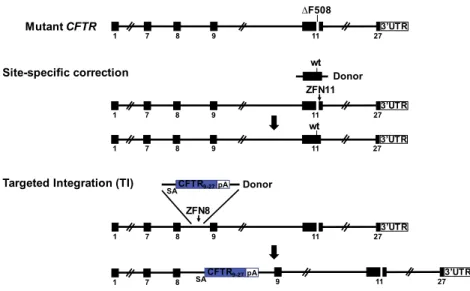
The two approaches forCFTRgene editing in CF airway basal cells pursued by this study are shown inFigure 1. Our rationale for per-forming gene editing specifically of the endogenousCFTRlocus
re-flects an intent to achieve expression of the correctedCFTRgene at close to physiologic levels. Thefirst approach is site-specific correc-tion ofCFTRmutations; namely, a footprint-free method replacing mutantCFTRsequences with the corrected sequences (Figure 1A). Because CF is a recessive disease, correction of only oneCFTRallele per cell would be sufficient for rescue of CFTR function. Site-specific correction ofCFTRmutations in the endogenous gene is expected to result in physiologically appropriate levels of CFTR protein and func-tion. However, site-specific correction typically requires a distinct set of sequence-directed nuclease and oligonucleotide donor reagents for eachCFTRmutation. Because approximately 2,000 different CF-asso-ciated mutations have been reported, the sequence-specific approach would only seem justified for the most frequently occurring variants such asDF508. The second approach is homologous recombination-mediated targeted integration (TI) of a codon optimized partialCFTR cDNA (also denoted as a “super-exon”)5,7 preceded by a splice acceptor (SA) and followed by a polyadenylation (pA) sequence, within an intron of the endogenous CFTR gene (Figure 1B). This approach is capable of providing correction for allCFTRmutations downstream of the targeted partial CFTR cDNA integration site. Furthermore, by targeting cleavage of the genomic DNA within in-tronic versus exonic sequences, the possibility that nuclease-induced A
B
Figure 1. Site-Specific Editing of CF Airway Basal Cells
(A) Site-specific correction ofDF508 mediated by tar-geted nuclease cleavage with wild-type DNA template serving as donor. (B) Integration ofCFTR9-27cDNA (en-coding exons 9–27), preceded by a splice acceptor (SA), followed by polyadenylation (pA) sequences, and flanked by homology sequences, intoCFTRintron 8; the spliced mRNA joins endogenous exon 8 with the exon 9–27 transgene.
indels will adversely impact uncorrected alleles is minimized. With the objective of achieving physiologically regulated levels of CFTR expres-sion and function, this approach would also benefit, in principle, from endogenous CFTR promoter activity and native chromatin archi-tecture, provided that TI of the partialCFTRcDNA does not disrupt chromatin architecture in edited cells.
RESULTS
Feeder-free Expansion of Primary Airway Basal Cells with Retention of CFTR Function
Starting with early passage primary human airway epithelial cells from explanted CF or non-CF lungs, wefirst compared feeder-free culture methodologies for their ability to expand airway basal cells for numerous passages while retaining functional capability. Both the previously reported dual SMAD inhibition medium28and Pneu-macult Ex-Plus medium allowed for continuous proliferation to at least passage 12 (p12; corresponding to 35–37 population doublings [PDs]; Figure S1A) while retaining markers characteristic of basal cells (e.g., CD49f, NGFR;Figure S1B). In order to assay functionality, expanded cells at various passage numbers were plated onto porous membranes and subject to ALI culture to assess development of well-differentiated airway epithelium. With increasing passage num-ber, particularly for the dual SMAD inhibition culture, we noted pro-gressive loss of ciliated cells, as measured by acetylated tubulin ( Fig-ure S1C). In order to measure CFTR ion transport function, ALI cultures were subjected to Ussing chamber assays. Airway basal cells expanded under Pneumacult Ex-Plus culture conditions exhibited robust levels of CFTR function through at least p8, while basal cells expanded in dual SMAD cultures exhibited lower levels of activity (Figures S1D and S1E). Under either culture condition, further passaging beyond p8 resulted in decreased levels of CFTR-dependent transepithelial transport (Figure S1E). Based on the above, we chose to perform our gene-editing manipulations on airway basal cells maintained maximally until p6 to p8 (18–25 PDs) in the Pneuma-cult Ex-Plus medium.
Sequence-Specific Correction ofDF508 Mutation
Zinc-finger nucleases (ZFNs), targeted to recognize and cleaveCFTR
A B
C D
E F
G
Figure 2. Sequence-SpecificDF508 Correction with Restoration of Mature CFTR Protein Expression and Function
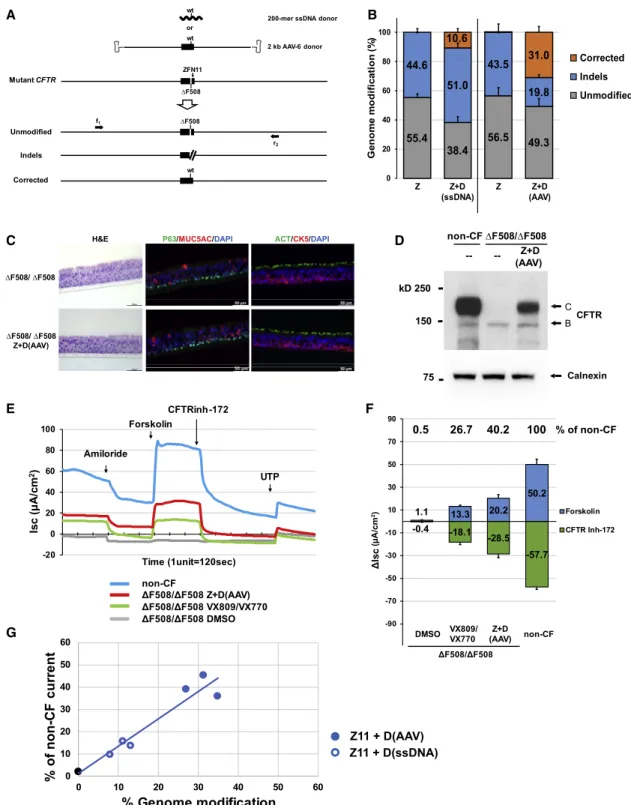
(A) Schematic of sequence-specificDF508 correction strategy. ZFNs were designed to site-specifically recognize and cleaveCFTRDF508 sequences in exon 11 (ZFN11). Two donors carrying correctingCFTRsequence are shown: a single stranded 200-mer oligo DNA donor (ssDNA) and 2 kb AAV-6 donor (containing 1,963 bp of wild-type CFTRsequence spanning exon 11). Three anticipated outcomes are represented as unmodified, indels, and corrected. Primers f1and r2, located outside the 1,963 bp donor
CFTR protein (band B;Figure 2D), whereas non-CF ALI cultures primarily exhibited the mature, fully-glycosylated, membrane-bound form of CFTR (band C; Figure 2D). Importantly, the AAV-6 editedDF508/DF508 cultures demonstrated the emergence of band C, corresponding to the presence of correctedCFTRalleles in the treated cells (Figures 2D andS4). Electrophysiological mea-surement of CFTR channel function was performed via Ussing chamber analysis. InFigure 2E, tracings for a representative exper-iment are presented; results of several experexper-iments are presented in Table S2A and summarized in Figure 2F and Table S2B. As ex-pected, non-treatedDF508/DF508 cultures exhibit negligible forsko-lin-activated CFTR current (Figure 2F). ALI cultures derived from
DF508/DF508 cells treated with ZFNs plus AAV-6 donor exhibited CFTR-dependent current (20.2±3.5mA/cm2(Figure 2F), robustly blocked by the CFTR channel inhibitor (CFTRinh-172;Figures 2E and 2F). This level of restored CFTR activity in edited cultures is significant in two respects. First, this level of rescue in bulk-treated
DF508/DF508 cultures (with a mean correction efficiency of 31.0%; Figure 2B) is 40.2% of that seen in the non-CF culture (50.2 ± 4.7mA/cm2;Figure 2F). Second, this activity is 152% of that result-ing from exposure of non-editedDF508/DF508 cells to the clinically approved CFTR modulators VX-809 and VX-770 (13.3± 0.9mA/ cm2; Figure 2F). This particular combination of modulators has been shown to be of therapeutic benefit in DF508/DF508 CF pa-tients31and thus provides a metric against which the CFTR activity
in the edited DF508/DF508 cells can be compared. Thus, by both measures (% of non-CF, % of VX-809/VX-770 treated DF508/
DF508), CFTR function resulting from this efficiency of DF508 correction is meaningful (seeDiscussion).
Similar analysis of ALI cultures derived from the 200-mer ssDNA donor-corrected airway basal cells (mean correction frequency of 10.6%;Figure 2B;Table S1) also demonstrated restored expression of mature CFTR protein (Figure S4), albeit at lower levels. For ssDNA donor edited cells, the level of CFTR current was 13.2% of the non-CF control (Tables S2A and S2B). However, rescue in this case did not reach the level of the VX-809/VX-770 treated
DF508/DF508 control (21.3% of the non-CF control; Tables S2A and S2B). For sequence-specific DF508 correction, we observed an approximately linear correlation (R2= 0.92) between the fre-quency of correction and level of restored CFTR current ( Fig-ure 2G). Taken together, these data, comparing the ssDNA and AAV-6 donors, support the importance of achieving significant levels of editing.
tubulin (ACT) for ciliated cells. Representative 40images in transverse section staining. Scale bar, 50mm (panels). (D) Western blotting of CFTR. Sequence-specificDF508 correction restores expression of mature, fully glycosylated CFTR protein (band C). Calnexin, loading control. (E) Representative trace of short circuit current (Isc) from 4 samples tested: DMSO-treated, VX-809/VX-770 pre-treated and Z+D-treated CF (DF508/DF508), and non-CF evaluated by Ussing chamber analysis. (F) Summary of CFTR chloride current stimulated by forskolin and inhibited by CFTR inhibitor 172 (CFTR inh-172). Difference of Isc (Dlsc) (mA/cm2
) before and after treatments are calculated from traces represented by (E). Values ofDlsc from samples listed inTable S2are summarized and shown (mean±SD, n = 3 experiments). (G) Restored CFTR activity as function of gene-editing frequency. The blue symbols reflect results from individualDF508/DF508 cell experiments with sequence-specific correction ofDF508 utilizing either ssDNA or AAV-6 donor. CFTR activity (forskolin-induced) for each experiment is expressed as % of non-CF (e.g., seeTable S2A). Frequency of genome modification for each experiment is fromTable S1. Shown in open and filled blue circles are results ofDF508 correction forDF508/DF508 cells with ssDNA and AAV-6 donors, respectively; the black filled circle is fromDF508/DF508 cells. Linear regression forDF508 sequence-specific correction experiments resulted in an R2
= 0.92. correctionoftheDF508mutation,weevaluatedtwotypesofdonor
sequencesencodingwild-typeCFTRsequence.First,weco-delivered single-stranded (ss) 200-mer oligo DNAs together with the ZFN mRNAs viaelectroporation(Figure 2A).Thessoligo,centeredon theDF508mutation,includedthewild-typerestoring“CTT”bases (Figure S2A) spanned by approximately 100 bases of homology sequenceoneitherside.Inordertoachievemaximallevelsof correc-tionwhileretainingcellviability,optimizationwasperformedwith respect to amountof ZFN mRNA (data not shown) and ssDNA donoroligo(e.g.,Figures S2BandS2C).Nextgenerationsequencing (NGS)wasutilizedtoquantifythefrequencyofDF508CFTRalleles exhibitingeithernomodification,indels,orcorrection(Figures 2A and 2B, Table S1). Delivery of ZFN mRNA alone resulted in 44.6%±2.4%ofCFTRallelesexhibitingindels.WhenssDNAdonor wasco-deliveredwithZFNmRNA,thefrequencyofDF508 correc-tionwas10.6% ±2.6%(allediting frequenciesare expressedona per CFTRallelebasis)(Figure2B;TableS1).Wesoughttomodify ourmethodologyinordertoachievesignificantlyhigherefficiencies ofcorrection.Tothisend,weutilizedalongerdonor(2.0kb,again centeredonthecorrecting“CTT”bases),butinthiscasedeliveredvia adeno-associated virus type 6 (AAV-6) (Figure 2A); AAV-6 was selectedduetoitsfavorabletropismforthelung.29,30Optimization wasagainperformed, inthiscasefocused ontheamountofZFN andtheAAV-6dose(Figure S2D).DeliveryofZFNmRNAvia elec-troporationfollowedimmediatelythereafterbyAAV-6donor trans-ductionresultedinacorrectionefficiencyof31.0%±4.0%(Figure2B; Table S1).
Sequence-Specific DF508 Correction Restores Mature CFTR
ProteinExpressionandFunction
InordertoassessthefunctionalconsequencesofDF508correction, cellseditedwiththe2kbAAV-6donorweretransferredontoporous supports andsubjectedtoALIculture conditionstogenerate well-differentiatedairwayepitheliumcontainingbasalcells(p63,keratin 5), secretory cells (mucin 5AC), ciliated cells (acetylated tubulin, FOXJ1), and ionocytes(FOXI1; Figures 2Cand S3).Importantly, themanipulationsrequiredforeditingdidnotalterthedevelopment ofthepseudostratifiedepithelium.Forexample,cellularcomposition ofthederivedepithelium(i.e.,%basalcells,%secretorycells,% cili-ated cells, % ionocytes) was not affected by the manipulations (Figure S3).
As expected, ALI cultures derived from unmanipulated DF508/
Efficient TI ofSA-CFTR9-27-pAintoCFTRIntron 8 ofDF508/
DF508 Airway Basal Cells
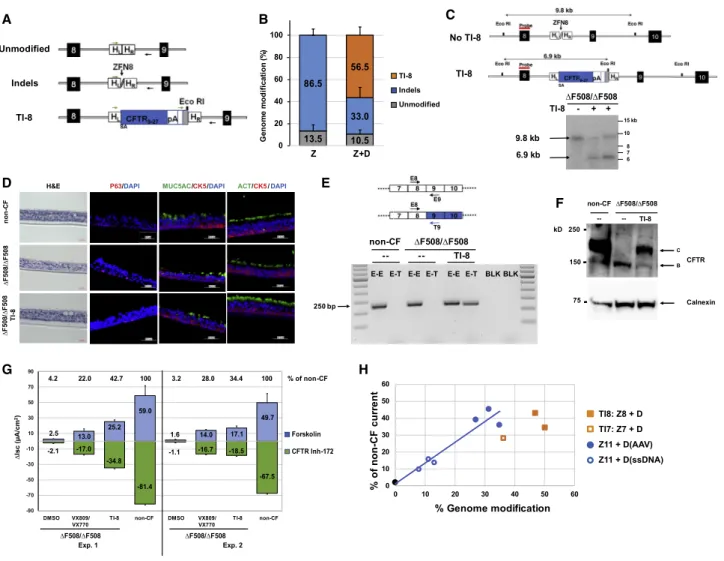
We selected CFTR intron 8 to demonstrate proof of principle for the homologous recombination-mediated TI approach. ZFNs targeting CFTR intron 8 were designed and verified in K562 cells (data not shown). In order to facilitate simultaneous quantification of both the TI and indel frequencies in the same population of edited cells, an intron 8 specific primer, followed by a random sequence and an EcoRI site (to permit a rapid assessment of TI), was incorporated into the donor immediately downstream of the SA-CFTR9-27-pA cassette (Figure 3A); PCR amplification would yield a PCR product of identical size as that from unmodified cells and NGS would permit an accurate determination of TI and indel rates. We note the down-stream primer was positioned outside of donor sequences to only amplify from transgene sequences integrated at the targeted site ( Fig-ure 3A). Electroporation-mediated delivery of intron 8 ZFN mRNA toDF508/DF508 airway basal cells was followed almost immediately by AAV-6 transduction of SA-CFTR9-27-pA. Initial evidence for sequence-specific TI ofSA-CFTR9-27-pAinto intron 8 came from up-stream inside-outside PCR amplification (Figure S5A) and from EcoRI digestion of downstream PCR amplicons (Figure S5B). These results were quantified by NGS, with TI rates of 56.5% ± 7.4% observed 4 days post editing (Figure 3B;Table S3A). Efficient intron 8 TI was confirmed by Southern blotting of genomic DNA isolated from the editedDF508/DF508 cells (Figure 3C).
TI ofSA-CFTR9-27-pAintoCFTRIntron 8 ofDF508/DF508 Airway
Basal Cells Restores Mature CFTR Protein Expression and Function
Edited cells were plated in ALI cultures to develop well differentiated epithelium as described previously. In the one experiment for which we performed the analysis, we observed roughly comparable fre-quencies of intron 8 TI in basal cells prior to plating in the ALI cul-tures (50.1%) versus frequency of correction in mature, well differen-tiated airway epithelium in ALI cultures (43.9%) (Table S3B). The TI editing and minimal expansion required for early passage airway basal cell cultures also did not adversely affect the ability to establish well-differentiated airway epithelium comprising basal, secretory, and ciliated cells (Figure 3D). Successful TI-mediated correction of bulk cultures was confirmed by detection ofCFTRtransgene mRNA ( Fig-ure 3E) and by restoration of CFTR band C protein (Figure 3F). Us-sing chamber assays from two independent experiments demon-strated restoration of forskolin-activated CFTR currents in intron 8 TI cultures (Figure 3G; sample trace inFigure S5C). CFTR current levels in edited cells from two independent experiments were 34.4% to 42.7% of the level seen in non-CF cultures (Figure 3G). Further-more, the mean level of restored CFTR channel activity was 157% of the level seen forDF508/DF508 cultures exposed to VX-809/VX-770 (Figure 3G). Thus, with our current TI efficiency, we are in a ther-apeutically relevant range for a mixed population of corrected and un-correctedDF508/DF508 cells.
We also evaluated, in a limited number of experiments, the TI strategy for intron 7 by delivery of intron 7 specific ZFNs followed
shortly thereafter by AAV-6 delivery of a donor construct now including CFTR exons 8 to 27 (SA-CFTR8-27-pA). Evidence for intron 7 TI,first suggested via EcoRI digestion (Figure S6A), was confirmed by NGS (Figure S6B). Successful targeting was confirmed by expression of the transgenic mRNA (Figure S6C), restored CFTR band C protein (Figure S6D), and restored CFTR current (Figure S6E; sample trace in Figure S5C). This demon-strates that potential effectiveness of the TI approach is not limited to intron 8.
The level of TI-8 or TI-7 restored CFTR function inDF508/DF508 cells, as a function of editing efficiency, is shown inFigure 3H. These results confirm significant CFTR functional restoration with the TI approach. Given the limited number of experimental data points for either the sequence-specific correction or TI approaches, it is pre-mature to draw anyfirm conclusions, However, the tendency of the TI data points to perhaps lie slightly below the sequence-specific trendline suggests that further improvements may be possible (see Discussion).
CFTRIntron 8 TI Preserves the Open Chromatin Structure of the
DF508/DF508CFTRLocus
A B C
D E
F
G H
Figure 3. EfficientSA-CFTR9-27-pATI intoCFTRIntron 8 ofDF508/DF508 Airway Basal Cells
(A) Schematic of site-specific targeted editing ofCFTRintron 8. Unmodified and indel diagrams highlightCFTRgenomic sequences between exons 8 and 9 (black boxes; not to scale). TI-8 diagram shows intron 8 TI of human codon optimizedCFTR9-27cDNA preceded by a splice acceptor, followed by bovine growth hormone (bGH) pA sequence, and flanked by 313 bp homology left (HL) and 351 bp homology right (HR) intron 8 sequences. Arrows indicate oligos amplifying unmodified, indel,
or TI-8 events and used to quantify frequency of each by NGS. (B) The percentage of genome modification (mean±SD) determined by NGS (Table S3A) from five independent TI-8 experiments (utilizing the AAV-6 donor at either 2106
or 6106
viral genomes [vg]/cell). There was no enhancement of TI efficiency as one increased the amount of donor. Efficiency was measured 4 days after the delivery of ZFNs targeting intron 8 (ZFN8) followed immediately by AAV-6CFTR9-27cDNA donor. Z, ZFN8 alone; Z+D, ZFN8 and AAV-6 donor. (C) Southern blot analysis of TI-8. The schematic shows the expected genomic organization of non-targeted (no TI-8) and targeted (TI-8) alleles with the expected sizes resulting from EcoRI digestion. The non-targeted allele yields a 9.8 kb band while the TI-8 allele yields a 6.9 kb band due to the new EcoRI site in theCFTR9-27cDNA donor construct. (D) H&E staining and immunostaining of well-differentiated airway epithelium in ALI culture. Representative images of cross sections fromDF508/DF508 or TI-8DF508/DF508. Immunostaining shows major epithelial cell types: basal cell (CK5 and P63), secretory cells (MUC5AC), and ciliated cells (ACT). 40images, scale bar, 50mm. (E) Detection of transgeneCFTR9-27mRNA. Schematic of endogenous and transgeneCFTRmRNA is shown here. Primer T9 recognizes codon-optimized transgene exon 9 sequence only (blue) while Primer E9 recognizes endogenous exon 9. A 250 bp E8-T9 RT-PCR amplicon, evidence of the chimeric endogenous-transgeneCFTRmRNA, was present only in the TI-8DF508/DF508 sample. (F) Restoration of fully glycosylated CFTR protein via TI-8. Western blots of protein lysates harvested at 4 weeks of ALI culture. Band C, representing the mature, fully glycosylated form of CFTR, is present in non-CF, absent inDF508/DF508 cells, and restored in TI-8DF508/DF508. Calnexin, loading control. (G) CFTR functional assay in ALI cultures at 4 weeks. TI-8DF508/DF508 cells show the restoration of CFTR function measured asDlsc (mA/cm2
Efficient TI Restores Mature CFTR Protein Expression and
Function in Airway Basal Cells CarryingCFTRPremature
Termination Codon Mutations
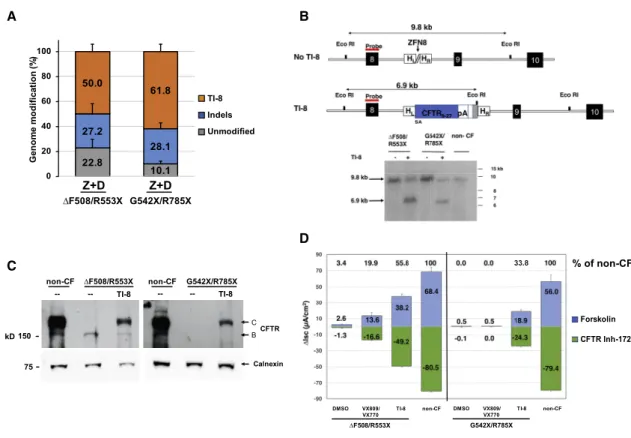
TI strategies as described here are highly relevant toCFTRmutations resulting in little-or-no CFTR protein (for example, due to premature termination codons [PTCs] or splicing defects); i.e., variants not otherwise responsive to CFTR modulators. Evidence for sequence-specific TI of SA-CFTR9-27-pA into intron 8 of DF508/R553X or G542X/R785X airway basal cells was obtained from 50inside-outside PCR amplification (Figure S7A). Amplification using 30PCR followed by EcoRI digestion was consistent with efficient TI (Figure S7B). NGS confirmed highly efficient TI in both the DF508/R553X (50.0% ± 6.0%) and G542X/R785X (61.8%±6.0%) airway basal cells (Tables S3C and S3D;Figure 5A), and efficient intron 8 TI was confirmed by Southern blot analysis (Figure 5B). Successful TI-mediated correc-tion in the edited cultures was further established by restoracorrec-tion of CFTR band C protein (Figure 5C). Ussing chamber assays demon-strated restoration of forskolin-activated CFTR current in intron 8
TI ALI cultures at levels 55.8% of non-CF cultures for DF508/ R553X and 33.8% of non-CF for G542X/R785X cultures (Figure 5D; sample traces in Figures S7C andS7D). These results demonstrate that targeted correction of PTC containing airway cells results in sig-nificant restoration of CFTR channel activity, either when the PTC occurs in combination withDF508 or with a second PTC.
DISCUSSION
primary airway basal stem cells; these levels of correction resulted in restored CFTR function for the basal cell-derived airway epithelium. Future studies will be required to determine how to prepare the CF airways for receipt and integration of the edited airway basal cells and how best to maximize the frequency of corrected cells in the re-sulting engrafted airway tissue.33–35
ForDF508-specific correction utilizing AAV-6 donor delivery, we achieved correction to wild-type in approximately 30% of CFTR alleles. These editing results are generally similar to those recently reported for correction ofDF508 in nasal and bronchial primary epithelial cells mediated by CRISPR/Cas9 together with AAV-6.11 This 30% correction frequency corresponds to between 30% (if both DF508 alleles per cell are restored) and 60% (if only one
DF508 allele is corrected per cell) of target cells demonstrating correction. In principle, molecular characterization of individual basal cells or single-cell-derived basal cell clones could provide a more accurate quantitative assessment of correction (or indels) on a per cell basis;36this will be addressed in future studies.
Impor-tantly, neither the manipulations required for editing (i.e.,
electro-poration, AAV-6 transduction) nor the editing itself (i.e., correc-tion, indels) altered the development or cellular composition of the derived pseudostratified epithelium. Studies of various CFTR mutations suggest that even very modest levels of CFTR gene correction may provide therapeutic benefit. For example, as little as 4.7% of the normal level of wild-typeCFTRmRNA is sufficient to result in a milder form of CF.37In another study, 8% of wild-type CFTRtranscripts was suggested to be sufficient for normal lung function.38 According to this measure, even our modest 10.6% ±2.6% DF508 correction efficiency with the ssDNA oligo donor, resulting in 13.2%±3.2% of wild-type current levels, might offer partial therapeutic benefit. The restoration of CFTR activity to levels 40.2%±4.7% of non-CF, resulting from AAV-6 delivery of the 2 kb donor approximates a therapeutically beneficial range, and exceeds the CFTR activity resulting from VX-809/VX-770 treatment (26.7% ±3.6% of non-CF). Whereas the restoration of CFTR activity in edited cultures is presumably due only to the frac-tion of cells with correcfrac-tion, it is possible that modulators act more generally. Administration of the VX-809/VX-770 drug combina-tion to homozygousDF508 patients resulted in improvements in
A B
C
D
Figure 5. Efficient TI-8 Correction in CF Airway Basal Cells CarryingCFTRPTC Mutations
FEV1, reduced rate of pulmonary exacerbations, reduced events leading to hospitalization, and reduced use of intravenous antibiotics.31
For sequence-specificDF508 correction, we observed an approxi-mately linear correlation (R2 = 0.92) between the frequency of
DF508 correction and level of restored CFTR current (Figure 2G). In mixing experiments of primary human airway cells, 10%:90%, 20%:80%, and 60%:40% mixtures of non-CF:DF508/DF508 cells yielded CFTR chloride current at levels 35%, 70%, and 100% that of non-CF cells;27a linear relationship between CFTR current and % non-CF cells was maintained up to approximately 20% non-CF cell percentages.27 On first examination, our levels of CFTR activity, as a function of gene-corrected cells, might appear to be somewhat lower than would be predicted by the mixing exper-iments. However, it is difficult to make direct comparisons of this type since it is currently unknown precisely what percentage of our cells were corrected at both CFTR alleles (corresponding to the non-CF cells utilized in the mixing experiment described above) versus at only a singleCFTRallele per cell (corresponding to a car-rier state). Although it might be assumed that carcar-rier state cells would have CFTR activity similar to that of non-CF cells, it has been suggested that presence of the DF508 protein can adversely affect the processing and chloride channel function of the wild-type CFTR protein.39
While the mutation-specific editing approach achieved efficient correction and restored CFTR activity, there are at least two poten-tial drawbacks to this strategy. First is the potenpoten-tial requirement for a new set of editing reagents (e.g., sequence specific nuclease and donor) for each mutation or small region spanning several muta-tions. Although this may be warranted for a common mutation such asDF508, development of editing materials and performance of clinical trials for each individual variant would be difficult. Second, even in the presence of donor, a significant frequency of CFTR alleles with nuclease-induced indels was observed; based on other editing studies,36 as well as our own experience (data not shown), introduction of indels at both alleles is expected to occur with some frequency. ForCFTRmutations occurring within exon sequences (e.g.,DF508), such residual indels would need to be examined to ensure there are not unintended consequences, for example the potential loss of response to current or future modulators.
As an alternative strategy capable of treating airway basal cells car-rying various CFTR mutations, we demonstrated efficient TI of CFTRpartial cDNA sequences intoCFTRintrons 7 and 8. Wefirst showed successful intron 8 TI inDF508/DF508 cells at efficiencies 56.5%±7.4% as measured 4 days after editing. Again, the manipula-tions required for highly efficient editing (mean allele modification of 56.5% for TI and 33.0% for indels) did not adversely affect the ability to establish well-differentiated airway epithelium. Intron 8 TI of
DF508/DF508 cells restored CFTR function to levels 34.4%–42.7% of non-CF.
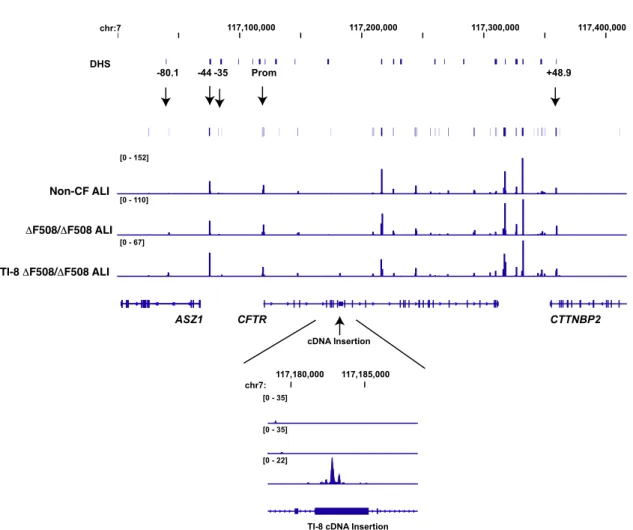
By targeting integration of aCFTRpartial cDNA to the endogenous CFTRlocus, our intent was to retain, to the greatest extent possible, the regulated level and pattern of expression of the native gene. Importantly, Omni-ATAC-seq analysis of the DF508/DF508 TI-8 ALI culture revealed no apparent alteration in the pattern of open chromatin at previously identified regulatory sites within theCFTR locus. This result is encouraging with respect to maintaining physio-logically regulated transgene expression. We also demonstrated suc-cessful TI and restoration of CFTR activity for TI-7. It is likely that the overall reduced TI-7 efficiency (with respect to TI-8) is due to the lower activity of the intron 7 ZFNs (with respect to the intron 8 ZFNs;Figures 3B andS6B)
Recently, there have been important advances in development of CF modulators (e.g., the recently available triple drug combination) potentially providing significant therapeutic benefit to the vast major-ity of CF patients.40,41Consequently, increased focus is now being devoted to developing novel therapeutic approaches for the 7% of CF patients who are unable to benefit from modulators, due to an insufficient amount of CFTR protein (e.g., due to PTCs or splicing mutations). We thus applied the TI methodology to restore CFTR function in CF airway basal cells carrying PTCs. Again, we demon-strated highly efficient TI-8 at frequencies 50.0% ± 6.0% and 61.8%±6.0% inDF508/R553X and G542X/R785X cells, respectively (Figures 5A and 5B). After differentiation in ALI culture, restoration of both CFTR protein (Figure 5C) and function (Figure 5D) were observed.
In this project we evaluated TI for both introns 7 and 8. There are several considerations relevant to determining which CFTRintron is optimal for TI. One consideration would be to maximize the num-ber of CF patients (or CFTR mutations) that could, in principle, benefit from site-specific TI. We note that intron 8 TI, for example, would provide correction for 89.1% of the CF-causingCFTRalleles listed in the CFTR2 database: https://www.cftr2.org/ (March 2019 version). Notably, this includesDF508, several of the most common PTCs such as G542X, R785X, and W1282X, and common splicing mutations such as 3,849 + 10 kb C > T. A second consideration is the size of the requisiteCFTR partial cDNA and whether this can be appropriately delivered with a chosen vector. Although intron 1 targeting would appear to be preferred (by providing correction for all downstream mutations), limitations on packaging size for AAVs (4.7 kb) potentially precludes incorporating SA-CFTR2-27-pA together with homology arms of sufficient size for efficient homology directed repair. A third aspect comprises the need to achieve integra-tion without disrupting activity of critical CREs and the chromatin architecture of theCFTR.
difficulty in obtaining greater than the 6107cells estimated to be required for engraftment in a human lung.33,46There is compelling clinical evidence that small airways are a critical site of early obstruc-tion and disease.47We expect that our studies using basal cells from the large airways (bronchi) will be representative of basal cells from bronchioles—an assertion that will require formal testing in the future.
With the objective of generating CFTR-corrected patient-specific airway basal stem cells, we have performed gene editing directly in minimally expanded primary airway basal cells. It would, in principle, be possible tofirst correct forCFTRmutations in CF patient induced pluripotent stem cells (iPSCs) and then derive airway basal cells, provided that robust differentiation protocols can be developed. Whereas earlier work by our group and others utilized sequence-spe-cific editing for correction of CF iPSCs,6,9,16the TI of partialCFTR cDNAs, as reported here, would represent a more generalizable approach.5,7 Finally, we note that although theCFTRgene-editing strategies pursued in the present studies were exclusively evaluated on airway basal cellsex vivo, it is possible that these tools, appropri-ately vectored, may eventually be applied forin vivocorrection.
MATERIALS AND METHODS
Complete methods can be found in theSupplemental Information online. All primary/secondary antibodies and oligos used in this report are listed inTables S5andS6, respectively. Human subject re-view was performed by University of Texas Health Science Center institutional review committee.
Culture of Airway Basal Cells
Passage 1 CF and non-CF airway epithelial cells in this study were ob-tained from the Tissue Procurement and Cell Culture core facility at the University of North Carolina (Chapel Hill, NC, USA). Lungs were obtained following informed consent under UNC Office of Human Research Ethics/Institutional Review Board Study #03-1396 and cells were isolated as previously described.48Basal cells were cultured with Pneumacult-Ex Plus medium (StemCell Technologies, Vancouver, BC, Canada) on plates pre-coated with 804G cell-conditioned me-dium (CM) and maintained at 37C in humidified air with 5% CO2. At 50%–70% confluence, cells were dissociated by trypsinization and either re-plated at a 1:10 ratio or directly utilized for gene editing.
Gene Editing
Gene editing of basal cells was performed by electroporation-medi-ated delivery of ZFN mRNA (2–3mg per reaction) followed immedi-ately by AAV-6 donor transduction. Electroporations in this study were performed with the BTX ECM 830 electroporation generator (Harvard Apparatus, Holliston, MA, USA). The ZFN mRNA-electro-porated cells were immediately transduced with AAV-6 donor at a multiplicity of infection (MOI) of 2 6 106viral genomes per cell (vg/cell) overnight. Alternatively, for single-strand oligo DNA donors (ssDNA), basal cells were co-electroporated with ZFN mRNA and ssDNA and directly plated. All donor DNA sequences are shown in theSupplemental Information(donor DNA sequences). previouslynotedthatthelevelofCFTRactivity,asafunctionof
edit-ingfrequencyforeitherTI-7orTI-8(Figure 3H),wasperhaps sugges-tiveofareductionrelativetothatresultingfromthesamefrequency ofsite-specificcorrection.Toquantitatively assesswhatfractionof CFTR mRNA transcripts from targeted alleles were spliced from theendogenousexon8tothetransgenicexon9(thusincluding trans-geniccorrectivesequences)versusalternativesplicingdownstreamto the endogenous exon 9 (including only endogenous mutant se-quences), weexaminedseveralsingle-cell-derivedclonesexhibiting homozygousintron8TI(FiguresS8A–S8C).QuantitativeRT-PCR demonstrated that the majority (58.0%–89.9%; depending on the clone) ofCFTR transcriptsexhibited thedesired splicing fromthe endogenous exon 8 into the corrective human codon optimized exon9sequences;however,10.1%–42.0%oftranscriptsdid,infact, reflect splicing across the corrective exon sequences directly into endogenousmutantexon9sequences(FigureS8D).Afailureto cap-tureonly correctivecDNAsequences inCFTR mRNA transcripts fromsuccessfullytargetedalleleswouldpotentiallyresultinreduced levelsofCFTRproteinandactivityasafunctionofeditingfrequency. This finding perhaps suggests room for improvement in the TI strategy(e.g.,strengthening eitherthespliceacceptor sequenceor, alternativelythepoly-adenylationsequencetomaximizetermination oftranscription).Inaddition,itispossiblethatouruseofnon-native aminoacid-encodingtransgenesequences(i.e.,humancodon opti-mized)mayinfluencetheefficiencyofgeneratingtheappropriately foldedCFTRproteinnecessaryforfunctionalactivity.42
Foranygene-editingapproach,itisimportanttoassessthenature andincidenceofoff-targeteffectsthatcouldpotentiallyaffect thera-peutic safety. Weexperimentally identifiedvia unbiased genome-wideoligonucleotidecapture,inK562cells,potentialoff-targetsites (Table S4)fortheintron8-specificZFNsemployed intheediting experimentsreportedinthisstudy;43wethenquantitativelyassessed the incidence ofoff-target indels inZFN-treated primary DF508/
DF508airwaybasalcells(Figure S9A).Thisvalidatedtheoccurrence of indels at varying frequency at 10 of the previously identified off-targetsites.Althoughallofthesesiteslieinintergenicorintronic sequences (Figure S9A),wechoseto optimizetheZFNdesign, in ordertoreducethefrequencyofsuchoff-targetindels,whilestill re-taining recognition ofthe same intended target sequences.44 The improvedintron8ZFNsmaintainedefficienton-targetcleavagewhile exhibitingasignificantlyreducedincidenceofoff-targetindels( Fig-ure S9A).Importantly,theoptimizedZFNsfacilitated intron8 TI ofDF508/DF508airwaybasalcells(FiguresS9BandS9C)atlevels similartotheoriginalZFNs.
Assessment of Genome Modification
The efficiency of induction of on-target indels, sequence-specific correction, and targeted integration was assessed quantitatively through NGS deep sequencing on the Illumina platform. Examples of sequencing data are uploaded in supplemental datafiles (Data S1 andS2). Additionally, targeted integration was confirmed by South-ern blot analysis.
In VitroDifferentiation of Basal Cells at Air Liquid Interface (ALI)
200,000 airway basal cells were seeded on a 6.5 mm Transwell with 0.4 mm pore polyester membrane inserts (Corning, Corning, NY, USA) pre-coated with 804G-CM and subject to air liquid interface culture with Pneumacult-ALI medium (StemCell Technologies) for up to 4 weeks. Fully differentiated airway epithelia were confirmed by hematoxylin and eosin (H&E) staining and immunofluorescence analysis.
Molecular and Functional Analysis
ALI-cultured cells were assayed forCFTRmRNA expression with RT-PCR, CFTR protein expression via western blotting, and the func-tional CFTR correction by Ussing chamber analysis as described pre-viously with modification.16
Omni Assay for Transposase Accessible Chromatin and Deep Sequencing
Omni-ATAC-seq was performed on 50,000 cells as described previ-ously with minor modifications.49Omni-ATAC-seq libraries were
purified with Agencourt AMPure XP magnetic beads (Beckman Coulter, Brea, CA, USA) with a sample to bead ratio of 1:1.2, and eluted in Buffer EB (Hilden, Germany). Libraries were pooled and sequenced on a HiSeq4000 machine (Illumina, San Diego, CA, USA) with 100 bp paired end reads. Data were processed by the ENCODE-DCC/atac-seq-pipeline. A custom genome was con-structed using the Reform package (ver. August 2019) (https:// github.com/gencorefacility/reform) to insert the partial cDNA sequence into the hg19 genome build.
SUPPLEMENTAL INFORMATION
Supplemental Information can be found online athttps://doi.org/10. 1016/j.ymthe.2020.04.021.
AUTHOR CONTRIBUTION
Conceptualization: B.R.D., A.C., A.H.; Project Administration: B.R.D., A.C., E.J.S., A.H.; Supervision: S.S.; Funding Acquisition: B.R.D., A.C., E.J.S., A.H., S.H.R.; Methodology: S.S., A.M.C., N.M.; Investigation: S.S., A.M.C., V.A., N.M., C.B., A.R., J.L.K., S.Y., M.M., K.K.; ZFN Design: L.Z.; Resources: S.H.R.; Writing–Original Draft: B.R.D., A.C., S.S., A.M.C., A.H.; Writing–Review & Editing: B.R.D., A.C., S.S., A.M.C., C.B., A.H., S.H.R., J.L.K., E.J.S.
CONFLICTS OF INTEREST
A.C., M.M., K.K., and L.Z. are employees of Sangamo Therapeutics.
ACKNOWLEDGMENTS
We gratefully acknowledge funding agencies enabling this study: Cystic Fibrosis Foundation (CFF): SANGAM16X0 to A.C., DA-VIS15XX0 and DAVIS17XX0 to B.R.D., RANDEL15XX0, RAN-DEL17XX0, and BOUCHE15RO to S.H.R., and HARRIS15/17XX0, HARRIS16G0, and HARRIS18P0 to A.H.; National Institutes of Health (NIH): R01 HL139876 to E.J.S. and B.R.D., DK065988 to S.H.R., and R01 HL094585 to AH; and UTHealth Pulmonary Center of Excellence to B.R.D. We also acknowledge histological sample preparation by Dr. Zhengmei Mao (UTHealth Microscopy Core Fa-cility), Dr. Susan Reynolds for guidance and discussions, and Dr. Hongmei Mou for guidance on the dual SMAD inhibition expansion methodology and providing the 804G cell line.
REFERENCES
1.Hogan, B.L., Barkauskas, C.E., Chapman, H.A., Epstein, J.A., Jain, R., Hsia, C.C., Niklason, L., Calle, E., Le, A., Randell, S.H., et al. (2014). Repair and regeneration of the respiratory system: complexity, plasticity, and mechanisms of lung stem cell function. Cell Stem Cell15, 123–138.
2.Rock, J.R., Onaitis, M.W., Rawlins, E.L., Lu, Y., Clark, C.P., Xue, Y., Randell, S.H., and Hogan, B.L. (2009). Basal cells as stem cells of the mouse trachea and human airway epithelium. Proc. Natl. Acad. Sci. USA106, 12771–12775.
3.Rock, J.R., Randell, S.H., and Hogan, B.L. (2010). Airway basal stem cells: a perspec-tive on their roles in epithelial homeostasis and remodeling. Dis. Model. Mech.3, 545–556.
4.Hong, K.U., Reynolds, S.D., Watkins, S., Fuchs, E., and Stripp, B.R. (2004). Basal cells are a multipotent progenitor capable of renewing the bronchial epithelium. Am. J. Pathol.164, 577–588.
5.Harrison, P.T., Hoppe, N., and Martin, U. (2018). Gene editing & stem cells. J. Cyst. Fibros.17, 10–16.
6.Firth, A.L., Menon, T., Parker, G.S., Qualls, S.J., Lewis, B.M., Ke, E., Dargitz, C.T., Wright, R., Khanna, A., Gage, F.H., and Verma, I.M. (2015). Functional gene correc-tion for cysticfibrosis in lung epithelial cells generated from patient ipscs. Cell Rep. 12, 1385–1390.
7.Bednarski, C., Tomczak, K., Vom Hövel, B., Weber, W.M., and Cathomen, T. (2016). Targeted integration of a super-exon into the cftr locus leads to functional correction of a cysticfibrosis cell line model. PLoS ONE11, e0161072.
8.Merkert, S., Bednarski, C., Göhring, G., Cathomen, T., and Martin, U. (2017). Generation of a gene-corrected isogenic control iPSC line from cysticfibrosis pa-tient-specific iPSCs homozygous for p.Phe508del mutation mediated by TALENs and ssODN. Stem Cell Res. (Amst.)23, 95–97.
9.Suzuki, S., Sargent, R.G., Illek, B., Fischer, H., Esmaeili-Shandiz, A., Yezzi, M.J., Lee, A., Yang, Y., Kim, S., Renz, P., et al. (2016). Talens facilitate single-step seamless sdf correction of f508del cftr in airway epithelial submucosal gland cell-derived cf-ipscs. Mol. Ther. Nucleic Acids5, e273.
10.Maule, G., Casini, A., Montagna, C., Ramalho, A.S., De Boeck, K., Debyser, Z., Carlon, M.S., Petris, G., and Cereseto, A. (2019). Allele specific repair of splicing mutations in cysticfibrosis through AsCas12a genome editing. Nat. Commun.10, 3556.
11.Vaidyanathan, S., Salahudeen, A.A., Sellers, Z.M., Bravo, D.T., Choi, S.S., Batish, A., Le, W., Baik, R., de la, O.S., Kaushik, M.P., et al. (2020). High-efficiency, selection-free gene repair in airway stem cells from cysticfibrosis patients rescues cftr function in differentiated epithelia. Cell Stem Cell26, 161–171.
12.Jennings, S., Ng, H.P., and Wang, G. (2019). Establishment of aDF508-CF promye-locytic cell line for cysticfibrosis research and drug screening. J. Cyst. Fibros.18, 44–53.
13.Ruan, J., Hirai, H., Yang, D., Ma, L., Hou, X., Jiang, H., Wei, H., Rajagopalan, C., Mou, H., Wang, G., et al. (2019). Efficient gene editing at major cftr mutation loci. Mol. Ther. Nucleic Acids16, 73–81.
induced pluripotent stem cells using designed zincfinger nucleases. Stem Cells Dev. 22, 595–610.
15.Valley, H.C., Bukis, K.M., Bell, A., Cheng, Y., Wong, E., Jordan, N.J., Allaire, N.E., Sivachenko, A., Liang, F., Bihler, H., et al. (2019). Isogenic cell models of cystic
fibrosis-causing variants in natively expressing pulmonary epithelial cells. J. Cyst. Fibros.18, 476–483.
16.Crane, A.M., Kramer, P., Bui, J.H., Chung, W.J., Li, X.S., Gonzalez-Garay, M.L., Hawkins, F., Liao, W., Mora, D., Choi, S., et al. (2015). Targeted correction and restored function of the CFTR gene in cysticfibrosis induced pluripotent stem cells. Stem Cell Reports4, 569–577.
17.Sinn, P.L., Hwang, B.Y., Li, N., Ortiz, J.L.S., Shirazi, E., Parekh, K.R., Cooney, A.L., Schaffer, D.V., and McCray, P.B., Jr. (2017). Novel GP64 envelope variants for improved delivery to human airway epithelial cells. Gene Ther.24, 674–679. 18.Cooney, A.L., Thornell, I.M., Singh, B.K., Shah, V.S., Stoltz, D.A., McCray, P.B., Jr.,
Zabner, J., and Sinn, P.L. (2019). Novel aav-mediated gene delivery system corrects cftr function in pigs. Am. J. Respir. Cell Mol. Biol.61, 747–754.
19.Cmielewski, P., Donnelley, M., and Parsons, D.W. (2014). Long-term therapeutic and reporter gene expression in lentiviral vector treated cysticfibrosis mice. J. Gene Med. 16, 291–299.
20.Yan, Z., McCray, P.B., Jr., and Engelhardt, J.F. (2019). Advances in gene therapy for cysticfibrosis lung disease. Hum. Mol. Genet.28(R1), R88–R94.
21.Steines, B., Dickey, D.D., Bergen, J., Excoffon, K.J., Weinstein, J.R., Li, X., Yan, Z., Abou Alaiwa, M.H., Shah, V.S., Bouzek, D.C., et al. (2016).CFTRgene transfer with AAV improves early cysticfibrosis pig phenotypes. JCI Insight1, e88728. 22.Montoro, D.T., Haber, A.L., Biton, M., Vinarsky, V., Lin, B., Birket, S.E., Yuan, F.,
Chen, S., Leung, H.M., Villoria, J., et al. (2018). A revised airway epithelial hierarchy includes CFTR-expressing ionocytes. Nature560, 319–324.
23.Plasschaert, L.W.,Zilionis, R., Choo-Wing, R., Savova, V., Knehr, J., Roma, G., Klein, A.M., and Jaffe, A.B. (2018). A single-cell atlas of the airway epithelium reveals the CFTR-rich pulmonary ionocyte. Nature560, 377–381.
24.Okuda, K., Kobayashi, Y., Dang, H., Nakano, S., Barbosa Cardenas, S.M., On, V.K., Kato, T., Chen, G., Gilmore, R.C., Chua, M., et al. (2019). Regional regulation of cftr and ionocyte expression in normal human airways. 2019 North American CF Conference, Nashville TN, Pediatric Pulmonology,54, Abstract 48.
25.Johnson, L.G., Olsen, J.C., Sarkadi, B., Moore, K.L., Swanstrom, R., and Boucher, R.C. (1992). Efficiency of gene transfer for restoration of normal airway epithelial function in cysticfibrosis. Nat. Genet.2, 21–25.
26.Goldman, M.J., Yang, Y., and Wilson, J.M. (1995). Gene therapy in a xenograft model of cysticfibrosis lung corrects chloride transport more effectively than the sodium defect. Nat. Genet.9, 126–131.
27.Farmen, S.L., Karp, P.H., Ng, P., Palmer, D.J., Koehler, D.R., Hu, J., Beaudet, A.L., Zabner, J., and Welsh, M.J. (2005). Gene transfer of CFTR to airway epithelia: low levels of expression are sufficient to correct Cl- transport and overexpression can generate basolateral CFTR. Am. J. Physiol. Lung Cell. Mol. Physiol.289, L1123– L1130.
28.Mou, H., Vinarsky, V., Tata, P.R., Brazauskas, K., Choi, S.H., Crooke, A.K., Zhang, B., Solomon, G.M., Turner, B., Bihler, H., et al. (2016). Dual smad signaling inhibition enables long-term expansion of diverse epithelial basal cells. Cell Stem Cell19, 217–231.
29.Limberis, M.P., Vandenberghe, L.H., Zhang, L., Pickles, R.J., and Wilson, J.M. (2009). Transduction efficiencies of novel AAV vectors in mouse airway epithelium in vivo and human ciliated airway epithelium in vitro. Mol. Ther.17, 294–301.
30.Yan, Z., Lei-Butters, D.C., Keiser, N.W., and Engelhardt, J.F. (2013). Distinct trans-duction difference between adeno-associated virus type 1 and type 6 vectors in hu-man polarized airway epithelia. Gene Ther.20, 328–337.
31.Wainwright, C.E., Elborn, J.S., Ramsey, B.W., Marigowda, G., Huang, X., Cipolli, M., Colombo, C., Davies, J.C., De Boeck, K., Flume, P.A., et al.; TRAFFIC Study Group; TRANSPORT Study Group (2015). Lumacaftor-ivacaftor in patients with cystic
fibrosis homozygous for phe508del cftr. N. Engl. J. Med.373, 220–231.
32.Swahn, H., and Harris, A. (2019). Cell-selective regulation of cftr gene expression: Relevance to gene editing therapeutics. Genes (Basel)10, E235.
33.Ghosh, M., Ahmad, S., White, C.W., and Reynolds, S.D. (2017). Transplantation of airway epithelial stem/progenitor cells: A future for cell-based therapy. Am. J. Respir. Cell Mol. Biol.56, 1–10.
34.Milman Krentsis, I., Rosen, C., Shezen, E., Aronovich, A., Nathanson, B., Bachar-Lustig, E., Berkman, N., Assayag, M., Shakhar, G., Feferman, T., et al. (2018). Lung injury repair by transplantation of adult lung cells following preconditioning of recip-ient mice. Stem Cells Transl. Med.7, 68–77.
35.Farrow, N., Cmielewski, P., Donnelley, M., Rout-Pitt, N., Moodley, Y., Bertoncello, I., and Parsons, D. (2018). Epithelial disruption: a new paradigm enabling human airway stem cell transplantation. Stem Cell Res. Ther.9, 153.
36.Park, S.H., Lee, C.M., Dever, D.P., Davis, T.H., Camarena, J., Srifa, W., Zhang, Y., Paikari, A., Chang, A.K., Porteus, M.H., et al. (2019). Highly efficient editing of the b-globin gene in patient-derived hematopoietic stem and progenitor cells to treat sickle cell disease. Nucleic Acids Res.47, 7955–7972.
37.Ramalho, A.S., Beck, S., Meyer, M., Penque, D., Cutting, G.R., and Amaral, M.D. (2002). Five percent of normal cysticfibrosis transmembrane conductance regulator mRNA ameliorates the severity of pulmonary disease in cysticfibrosis. Am. J. Respir. Cell Mol. Biol.27, 619–627.
38.Chu, C.S., Trapnell, B.C., Curristin, S.M., Cutting, G.R., and Crystal, R.G. (1992). Extensive posttranscriptional deletion of the coding sequences for part of nucleo-tide-binding fold 1 in respiratory epithelial mRNA transcripts of the cysticfibrosis transmembrane conductance regulator gene is not associated with the clinical man-ifestations of cysticfibrosis. J. Clin. Invest.90, 785–790.
39.Tucker, T.A., Fortenberry, J.A., Zsembery, A., Schwiebert, L.M., and Schwiebert, E.M. (2012). TheDF508-CFTR mutation inhibits wild-type CFTR processing and function when co-expressed in human airway epithelia and in mouse nasal mucosa. BMC Physiol.12, 12.
40.Keating, D., Marigowda, G., Burr, L., Daines, C., Mall, M.A., McKone, E.F., Ramsey, B.W., Rowe, S.M., Sass, L.A., Tullis, E., et al.; VX16-445-001 Study Group (2018). Vx-445-tezacaftor-ivacaftor in patients with cysticfibrosis and one or two phe508del al-leles. N. Engl. J. Med.379, 1612–1620.
41.Middleton, P.G., Mall, M.A., Drevínek, P., Lands, L.C., McKone, E.F., Polineni, D., Ramsey, B.W., Taylor-Cousar, J.L., Tullis, E., Vermeulen, F., et al.; VX17-445-102 Study Group (2019). Elexacaftor-tezacaftor-ivacaftor for cysticfibrosis with a single phe508del allele. N. Engl. J. Med.381, 1809–1819.
42.Kim, S.J., Yoon, J.S., Shishido, H., Yang, Z., Rooney, L.A., Barral, J.M., and Skach, W.R. (2015). Protein folding. Translational tuning optimizes nascent protein folding in cells. Science348, 444–448.
43.Tsai, S.Q., Zheng, Z., Nguyen, N.T., Liebers, M., Topkar, V.V., Thapar, V., Wyvekens, N., Khayter, C., Iafrate, A.J., Le, L.P., et al. (2015). GUIDE-seq enables genome-wide profiling of off-target cleavage by CRISPR-Cas nucleases. Nat. Biotechnol. 33, 187–197.
44.Miller, J.C., Patil, D.P., Xia, D.F., Paine, C.B., Fauser, F., Richards, H.W., Shivak, D.A., Bendaña, Y.R., Hinkley, S.J., Scarlott, N.A., et al. (2019). Enhancing gene editing spec-ificity by attenuating DNA cleavage kinetics. Nat. Biotechnol.37, 945–952.
45.Butler, C.R., Hynds, R.E., Gowers, K.H., Lee, Ddo.H., Brown, J.M., Crowley, C., Teixeira, V.H., Smith, C.M., Urbani, L., Hamilton, N.J., et al. (2016). Rapid expansion of human epithelial stem cells suitable for airway tissue engineering. Am. J. Respir. Crit. Care Med.194, 156–168.
46.Hayes, D., Jr., Kopp, B.T., Hill, C.L., Lallier, S.W., Schwartz, C.M., Tadesse, M., Alsudayri, A., and Reynolds, S.D. (2019). Cell therapy for cysticfibrosis lung disease: Regenerative basal cell amplification. Stem Cells Transl. Med.8, 225–235.
47.Rosenow, T., Ramsey, K., Turkovic, L., Murray, C.P., Mok, L.C., Hall, G.L., Stick, S.M., and Arest, C.F.; AREST CF (2017). Air trapping in early cysticfibrosis lung dis-ease-Does CT tell the full story? Pediatr. Pulmonol.52, 1150–1156.
48.Fulcher, M.L., and Randell, S.H. (2013). Human nasal and tracheo-bronchial respira-tory epithelial cell culture. Methods Mol. Biol.945, 109–121.