warwick.ac.uk/lib-publications
Manuscript version: Author’s Accepted Manuscript
The version presented in WRAP is the author’s accepted manuscript and may differ from the
published version or Version of Record.
Persistent WRAP URL:
http://wrap.warwick.ac.uk/111125
How to cite:
Please refer to published version for the most recent bibliographic citation information.
If a published version is known of, the repository item page linked to above, will contain
details on accessing it.
Copyright and reuse:
The Warwick Research Archive Portal (WRAP) makes this work by researchers of the
University of Warwick available open access under the following conditions.
Copyright © and all moral rights to the version of the paper presented here belong to the
individual author(s) and/or other copyright owners. To the extent reasonable and
practicable the material made available in WRAP has been checked for eligibility before
being made available.
Copies of full items can be used for personal research or study, educational, or not-for-profit
purposes without prior permission or charge. Provided that the authors, title and full
bibliographic details are credited, a hyperlink and/or URL is given for the original metadata
page and the content is not changed in any way.
Publisher’s statement:
Please refer to the repository item page, publisher’s statement section, for further
information.
Date of publication xxxx 00, 0000, date of current version xxxx 00, 0000.
Digital Object Identifier 10.1109/ACCESS.2017.DOI
Privacy-Aware Reversible Watermarking
in Cloud Computing Environments
CHING-CHUN CHANG1, (Student Member, IEEE), CHANG-TSUN LI2, (Senior Member, IEEE),
AND YUN-QING SHI3, (Life Fellow, IEEE)
1Department of Computer Science, University of Warwick, United Kingdom (e-mail: [email protected]) 2School of Computing and Mathematics, Charles Sturt University, Australia (e-mail: [email protected])
3Department of Electrical and Computer Engineering, New Jersey Institute of Technology, United States (e-mail: [email protected])
Corresponding author: C.-C. Chang (e-mail: [email protected]).
This work was supported by the Marie Skłodowska-Curie actions of the EU Horizon 2020 programme through the project entitled ‘Computer Vision Enabled Multimedia Forensics and People Identification’ (Project No. 690907, Acronym: IDENTITY).
ABSTRACT As an interdisciplinary research between watermarking and cryptography, privacy-aware reversible watermarking permits a party to entrust the task of embedding watermarks to a cloud service provider without compromising information privacy. The early development of schemes were primarily based upon traditional symmetric-key cryptosystems, which involve an extra implementation cost of key exchange. Although recent research attentions were drawn to schemes compatible with asymmetric-key cryptosystems, there were notable limitations in the practical aspects. In particular, the host signal must either be enciphered in a redundant way or be pre-processed prior to encryption, which would largely limit the storage efficiency and scheme universality. To relax the restrictions, we propose a novel research paradigm and devise different schemes compatible with different homomorphic cryptosystems. In the proposed schemes, the encoding function is recognised as an operation of adding noise, whereas the decoding function is perceived as a corresponding denoising process. Both online and offline content-adaptive predictors are developed to assist watermark decoding for various operational requirements. A three-way trade-off between the capacity, fidelity and reversibility is analysed mathematically and empirically. It is shown that the proposed schemes achieve the state-the-art performance.
INDEX TERMS Cloud computing, cyber security, homomorphic cryptosystems, information privacy, reversible watermarking, signal denoising, statistical inference, variational method.
I. INTRODUCTION
T
HE past decades have witnessed the phenomenal preva-lence of public cloud services. The seemingly unlimited storage and computational capacity of the cloud have opened up opportunities for businesses and individuals to entrust their data to cloud service providers. Meanwhile, the rapid development of cloud computing technology has also raised privacy and security concerns. A powerful solution against cyber security threats is to obfuscate the classified documents through encryption [1]. On the other hand, although encryp-tion algorithms are widely used to protect the confidential information, some desirable functionalities might be unreal-isable for the encrypted data. In response to this issue, there was a surge of research interest in secure signal processing in the encrypted domain [2]–[4]. As an emerging topic in this research field, privacy-aware watermarking has attracted a lot of attention in recent years. For the reason that manywatermarking algorithms are proprietary properties, there are restrictions for commercial purposes and the availability to the general public is rather limited. An efficient solution is to request an authorised cloud service provider to encode the watermark into the given digital media, not only due to the high computational capacity of the cloud, but also the legiti-mate consent to carry out the algorithms. On the other hand, since the cloud server is regarded as a semi-honest entity that may collect some information from the digital contents, data privacy should be taken into account. Therefore, the research of privacy-aware watermarking addresses the problem of entrusting the task of watermarking to a cloud server without compromising data privacy. This research trend is also known as watermarking in the encrypted domain.
informa-encrypter encoder decrypter
key watermark key
Alice Charlie Alice
host signal encrypted signal
marked and
encrypted signal marked signal
b
channel
(noise)
Alice Bob
marked signal
(noisy)
marked signal
a
b
decoder
(noisy)
watermark
Bob (noisy)
marked signal
(noisy)
host signal
a
[image:3.576.62.514.72.246.2]b
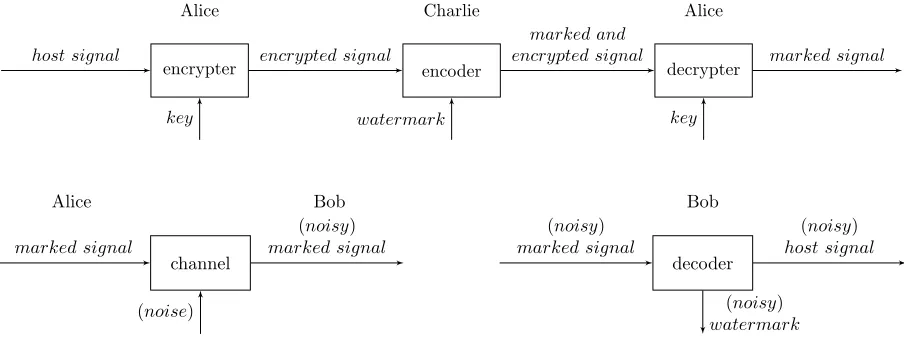
FIGURE 1. The proposed watermarking protocol. A transmitter Alice wants to protect a signal through embedding a watermark, which can be fulfilled by a cloud service provider Charlie. Then, a marked signal is transmitted over a insecure channel to a recipient Bob who is able to verify the authenticity of the received signal through analysing the extracted watermark and reproduce the original signal.
tion associated with the host media (e.g. digital identity or signature). In general, there are three parties involved in a watermarking protocol: a sender who encodes the watermark into the host media, a recipient who decodes the watermark from the marked media, and an adversary who has a mali-cious intent against the protocol. The malimali-cious party is often modelled as a noisy channel between the encoder and the decoder. The watermarking strategy can be either fragile or robust against the channel noise depending on the applica-tions. Conventionally, robust watermarking is applicable to copyright protection [5]–[8], whereas fragile watermarking is advantageous to data authentication [9]–[12]. Neverthe-less, fragile watermarking, as a temper detection technique, contradict itself by inevitably inflicting distortions upon the content of media. Although the distortions are generally imperceptible, the effect could be arguable in particular cir-cumstances featuring a strict integrity requirement, especially when the host media is used for military reconnaissance or medical diagnosis. Considering these potential applications, the notion of reversible watermarking was introduced in order to permit the reproduction of the original content once the authenticity of media is verified [13]–[20].
Consider a watermarking protocol as illustrated in Fig. 1, where a sender Alice wants to communicate a digital content to a receiver Bob over an insecure channel. In order to resist malicious tampering, Alice has to embed a signature, which is sensitive against manipulations, into the content prior to dispatching it to Bob. Supposing that Alice, as a general individual, has no permission or resources to employ the watermarking algorithm, the task of watermarking has therefore to be entrusted to a licensed cloud server Charlie. As a general presumption, Charlie is an honest-but-curious party who would not deviate from the protocol specifications, though on the other hand has the interest in learning the privacy information of the content. Hence, due to privacy
concerns, Alice encrypts the content prior to commissioning it to Charlie for watermarking. In summary, to utilise the complementary advantages of watermarking and cryptogra-phy, it is of great significance to develop a secure reversible watermarking system that enables the watermarking function to be operated by a licensed third party in the encrypted domain in order to preserve privacy.
The challenge of reversible watermarking in the encrypted domain is a rather difficult one. Considering that the message is concealed by encryption, we are not able to observe, analyse, and exploit data redundancy. One of the very first schemes utilises the electronic codebook (ECB) mode of block ciphers to encipher the data, which preserves the data redundancy by reusing the secret key for each block while compromising the security strength [21]. To overcome the se-curity weakness, the researchers have developed schemes for a variety of secure cryptosystems. For instance, an attempt was made by encoding watermarks into data encrypted by the cipher block chaining (CBC) mode [22]. In a similar manner, some methods were proposed to encode watermarks into data encrypted by steam cipher [23]–[25]. In essence, these early schemes were based upon the research outcomes of lossless compression of the encrypted data [26]–[28]. Apart from this, the early development of schemes was primarily compatible with symmetric-key cryptosystems [29]–[31]. Accordingly, these schemes are confronted with a practical issue that a secret key must be pre-shared between the sender and the recipient. In order to communicate the secret key, a secure channel resistant to eavesdropping or a secure key exchange protocol must be established. Any of these solutions comes with extra costs in implementation.
In contrast to symmetric-key algorithms, asymmetric-key algorithms, also known as public-key cryptosystems, relax the restriction by using a publicly distributed key for en-cryption and a secret key known only to the recipient for
decryption. Over the last few years, the watermarking re-search has extended to manage ciphers generated by public-key algorithms. The first class of strategy encrypts the data in such a manner that the input to the encryption function has a value range that is far smaller than it should be. Consider that each individual pixel is an input to be enciphered. The value range of pixels is between0and255for8-bit greyscale images, while the message space of a given cryptosystem is, for example, between 0andN, whereN is the product of two large primes. Therefore, the input space defined by the watermarking shceme is much smaller than the actual mes-sage space defined by the cryptosystem. In implementation, a number of zeros are concatenated to the end of the input message to assure the length of input conform with message space. As a consequence, zero paddings can be viewed as additional redundancy for accommodating the payload in the encrypted domain [32]–[34]. It is nevertheless deficient for the following reasons. First, redundant bits are appended and thus the system is not space-efficient. Second, from some viewpoints it is considered problematic since the amount of padded redundancy is at least equivalent to that of the payload in most cases. One may even simply append the pay-load information after the host signal rather than performing complex computation to trade the pre-appended redundancy for the payload. Third, it is insecure since the watermark can be easily filtered out by decryption. To overcome these deficiencies, we suggest to encrypt a bit-stream of sufficient length each time, instead a single sample with zero-padding. The second class of strategy, though following the space-saving principle, requires a specific type of pre-processing to be applied prior to encryption. It utilises either truncation [35] or self-embedding [36] to shrink the range of sample values and then encrypts a sufficient number of samples each time. As a result, although the input space seems to be equal to the message space defined by the cryptosystem, the actual input space is much smaller. For instance, initially the sample values range from0 to255and yet subsequent to data pre-processing the possible values reduce into a subrange. The reserved space can then be exploited to accommodate the payload in the encrypted domain. This class of strategy, also known as reserving room before encryption, was first devel-oped for watermarking schemes to work in conjunction with symmetric-key cryptosystems [37]–[39]. The practicality of this strategy is however limited because a specific type of pre-processing must be applied to the data. To remove this restriction, we suggest to manage data without any specific pre-processing.
In this paper, we address the problem of entrusting the task of watermarking to a cloud service provider without compromising information privacy. Considering the secu-rity threats of symmetric-key cryptosystems, we study re-versible watermarking schemes compatible with public-key cryptosystems. The recent development of schemes requires the host data either to be enciphered in a redundant fashion or to be pre-processed prior to encryption. In response to this, we propose a novel research paradigm to overcome the
aforementioned shortcomings. Two schemes are proposed to cope with ciphers generated by two types of homomorphic cryptosystems, respectively. The first scheme is constructed based upon multiplicative homomorphism and provides high content fidelity as well as high flexibility in watermarking capacity. The second scheme is devised based upon addi-tive homomorphism and achieves an optimal reversibility. In addition to this, both online and offline content-adaptive predictors are introduced to assist watermark decoding. The former type of predictor is based upon variational method and utilises an iterative algorithm to approximate the signal, while the second type of predictor is based upon statistical inference and pre-trains a probability table for signal estima-tion. Experimental results shows that the proposed predictors achieve the state-of-the-art performance. In summary, several positive contributions and improvements are made, which are briefly outlined as follows:
• Modern public-key cryptosystems are adopted to avoid the security risks and implementation costs of key ex-change.
• Reversible watermarking schemes compatible with dif-ferent types of partially homomorphic cryptosystems are studied.
• Storage efficiency is considered by encrypting a suffi-ciently long sequence of bits, instead of a single sample with redundant zero padding, each time.
• Specific type of data pre-processing prior to encryption is not required, which enhances the practicality and universality.
• Both online and offline content-adaptive predictors are developed with flexibility for various operational re-quirements.
The remainder of this paper is organised as follows. Sec-tion II discusses various cryptosystems and how to apply them on digital images. Section III introduces the proposed watermarking scheme for multiplicative homomorphic cryp-tosystem. Section IV further derives a scheme for addi-tive homomorphic cryptosystem. Section V studies content-adaptive predictors based upon variational method and statis-tical inference. Section VI evaluates the scheme performance and makes comparisons with state-of-the-art algorithms. Sec-tion VII concludes our work and outlines the direcSec-tions for future research.
II. PRELIMINARIES
be the public and private keys of the RSA cryptosystem, respectively, such thateanddsatisfy the condition that
e·d≡1 (modφ(N)), (1) whereφis Euler’s phi function,i.e.φ(N) = (p−1)(q−1). The RSA cryptosystem defines an encryption function
c≡me (mod N), (2)
and a decryption function
m≡cd (modN), (3)
where m denotes the message and c denotes the cipher. Consider the goal of generating the encrypted result which, when decrypted, matches the product of two messages m1 andm2 through the operations upon the ciphersc1 andc2. This goal can be achieved by multiplying two ciphers as
c1·c2≡(m1e)·(m2e) (modN) ≡(m1·m2)e (mod N).
(4)
In other words,
D(E(m1)· E(m2)) =m1·m2, (5) whereE(·) andD(·)denote the encryption and decryption functions, respectively.
The RSA cryptosystem is limited, however, by solely permitting the multiplication of messages. As a consequence, to design homomorphic encryption algorithms that permit various mathematical operations upon ciphers has been one of the active research areas, within which there are substantial achievements such as ElGamal [42], Okamoto–Uchiyama [43], and Damgård–Jurik [44] cryptosystems. Among a va-riety of historical antecedents, the Paillier cryptosystem has been widely used as an example of additive homomorphism [45]. The system consists of three phases: key generation, encryption, and decryption. In the key generation phase, we choose two large primes p and q. Then, we compute N = pq andλ = lcm(p−1, q−1), where ‘lcm’ stands for least common multiple. Next, we select a random integer g∈Z/N2Z∗and calculate
µ≡(L(gλ (modN2)))−1 (modN),
(6)
where
L(x) =x−1
N . (7)
As a result, the public key is (n, g)and the private key is
(λ, µ). In the encryption phase, let m be a message to be encrypted andrbe a randomly selected integer, wherem, r∈ Z/NZ. The ciphertext is then computed as
c≡gm·rN (modN2). (8)
In the decryption phase, the plaintext message is deciphered by
m≡L(cλ (mod N2))
·µ (mod N). (9)
Let m1 and m2 be two messages and c1 and c2 be two ciphers. To produce the cipher of sum of m1 andm2, we calculate the product ofc1andc2and obtain
c1·c2≡(gm1·r1N)·(gm2·r2N) (modN2) ≡g(m1+m2)·(r
1·r2)N (mod N2).
(10)
To yield the cipher of product ofm1andm2, we compute the exponentiation ofc1bym2such that
cm2
1 ≡(gm1·r1N)m2 (mod N2)
≡g(m1·m2)·(rm2
1 )N (mod N
2). (11)
As an alternative expression, we write
D(E(m1)· E(m2)) =m1+m2, (12) and
D(E(m1)m2) =m1·m2. (13) It can be observed that the size of encrypted data is expanded as the message space isM=Z/NZand the ciphertext space isC=Z/N2Z∗.
As aforementioned, when encrypting a digital image, it is not advisable to consider each pixel as an individual message. Generally, the value range of pixels is far smaller than the message space, as the latter is associated with large prime numbers, which provokes dispensable redundancy. Apart from this, if the watermark is embedded into the addition redundancy created by encryption, it will be filtered out by decryption, which limits the applicability of the schemes. There are several possible approaches to image encryption without expanding image files, for example, converting the image into bit-stream and encrypting a segment of sufficient length each time. In order to preserve the visual significance, we propose to encipher each bit-plane separately. Let I denote an8-bit digital image such that
I= (b1||b2||. . .||b8), (14) where ‘||’ is the concatenation operator andb1,b2,. . ., and b8are eight different bit-planes. For each bit-plane
bi= (bi,1||bi,2||. . .), (15) we sample a sufficiently long bit-stream each time to form a message, which is then encrypted into a cipher. Supposing that the message space of a given cryptosystem isZ/NZ, a message is therefore a decimal number oflog2N bits, or of blog2Ncbits more precisely, considering that the former is not necessarily an integer.
The watermarking process is performed sequentially upon the selected messages until all the payload is embedded, while the unselected ones remain intact. Due to the fidelity constraint, we only change the messages converted from insignificant bit-planes. Intuitively, it seems that the optimal choice should be to select messages of the least significant bit-plane. However, by considering the decoding process, it is necessary that the selected messages are formed by some well-predictable bits. We shall see the reason behind this
encrypter x
encoder
E(x)
decrypter
E(y)
decoder
y xˆ
w wˆ
[image:6.576.79.500.76.152.2]Alice Charlie Bob
FIGURE 2. Watermarking procedures for a selected symbol. Letxbe a host symbol andwbe a watermark symbol. Alice encryptsxintoE(x). Charlie encodes
E(x)withwintoE(y). Bob decryptsE(y)intoyand then decodes it intoxˆandwˆ.
later. To pave the way for the following presentation, let us assume that the messages for watermarking have been determined. The map to record the locations of selected messages serves as the watermarking key. In the following paragraphs, we will discuss separately how we cope with ciphers generated by different types of cryptosystems.
III. MULTIPLICATIVE HOMOMORPHISM
Let us recapitulate the problem statement. Let Alice denote a sender, Bob a recipient, and Charlie a cloud server. Suppose that Alice wants to deliver to Bob a digital file in which a watermark is embedded for authentication purposes. Due to various constraints (e.g.proprietary issues), Alice has to entrust the task of watermarking to Charlie by providing the encrypted file and the watermark. The encryption key is publicly known, while the decryption key is only known to Bob. We assume that the watermark payload is a sequence of compressed and encrypted digits such that only the intended recipient Bob is able to decode it.
Consider the objective of embedding watermarks into ci-phers generated by a multiplicative homomorphic cryptosys-tem such as RSA. The preliminary procedures are as follows. To begin with, the host data is divided into binary sequences of the length in accordance with the message space of the given cryptosystem. Then, each sequence is transformed into an integer called a symbol. After encryption, a sufficient number of enciphered symbols are selected to carry the watermark payload. We suppose that the selected symbols are all composed of bits in thel-th bit-plane. To meet the fidelity requirement, the change of bits in thel-th bit-plane must not provoke a significant degradation to the visual quality of the image. For conciseness, we describe only how a single host symbol is processed, as shown in Fig. 2.
Letpandqbe two large primes andN =p·q. The alphabet of watermark symbols is defined as the set of k distinct positive integers up toNthat are coprime toN. Accordingly, we are able to embed log2kbits of watermark information per host symbol. The number of positive integers up to N that are relatively prime toNcan be calculated by Euler’s phi functionφ(N) = (p−1)(q−1)and thusk ≤φ(N). This alphabet, denoted byW ={wi}ki=0−1, is pre-shared between Alice and Bob and serves as a codebook so that different payloads can be represented by different watermark symbols.
Let a host symbol bex ∈ Z/NZand a watermark symbol be w ∈ W. To begin with, Alice encryptsxintoE(x)and uploads it along with E(w) to Charlie. The watermarking process is then operated by
E(y)≡ E(x)· E(w)≡ E(w·x) (modN). (16) After that, the marked and encrypted symbol E(y)is down-loaded and sent to Bob and is then decrypted into
y≡ D(E(y))≡w·x (modN). (17) Note that we strictly let w0 = 1 in practice in order to minimise the average distortion. That is, when w = w0, the marked symbol will be kept intact. The distortion only occurs whenw =wi,∀i 6= 0, is embedded. We know that
there exists a unique modular multiplicative inverse of an arbitrary integeramoduloN if and only ifgcd(a, N) = 1. Since W is a subset of all integers that are coprime to N, we can construct the setW ={w−i1}k−
1
i=0 that comprises of the corresponding unique inverses. We generate k possible candidates forxin such a way that each is given by
xi≡y·w−i 1 (mod N). (18)
The above congruence can be rewritten as
xi ≡x·w·wi−1 (modN). (19)
Thus, we see that xi = x if and only if wi−1 = w−1. In
other words, if we are able to distinguishxfromkpossible candidates{xi}ki=0−1, then we can determinewjointly. Recall that a selected symbol is composed of bits that can be estimated with a certain degree of accuracy from some other correlated bits. Let us denote an estimated symbol forxby
˜
x. Therefore, the originalxis determined by
ˆ
x= arg min
xi
∆(xi,x˜), (20)
the estimation accuracy is related to the fidelity parameterl. Hence, we summarise that
Capacity∝k,
Fidelity∝l−1,
Reversibility∝l·k−1.
(21)
Example. Let us demonstrate the scheme with an example as follows. Assume thatp= 11,q= 19, andN = 209. Let a payload bit be encoded by
w=
(
w0, if the bit is0, w1, if the bit is1,
wherew0andw1 can be any two numbers coprime to209.
Note that w0 is strictly set to one in practice and we let w1 = 3 in this example. Suppose that Alice has a host
symbolx= 100and wants to embed a bit one. As a result, the watermark symbol is given byw = w1. By encryption,
Alice outputsE(x) = E(100). After watermarking, Charlie producesE(y)≡ E(3)·E(100) mod 209. By decryption, Bob obtainsy= 91, which is computed by
91≡3·100 mod 209.
The modular multiplicative inverses ofw0andw1arew−01=
1andw−1
1 = 70, respectively. Hence, two candidates forx
arex0= 91andx1= 100, which are computed by
91≡91·1 mod 209,
100≡91·70 mod 209,
respectively. Suppose that the approximation ofxisx˜= 102. We determine the value ofxas that of the closest candidate tox˜in terms of the Hamming distance and the value ofwas that of the one whose inverse yields the minimum Hamming distance. The distances are calculated by
∆0= ∆(91,102) = 5,
∆1= ∆(100,102) = 1,
and therefore the decoding results arexˆ= 100andwˆ = 3.
It can be observed that the wrong candidate is, theoreti-cally, a random integer. Thus, ifN is sufficiently large and the number of candidates to distinguish from is relatively small, then it is unlikely that randomly drawn integers would be closer to the approximation of the correct one than the correct one itself.
IV. ADDITIVE HOMOMORPHISM
We have seen that the reversibility of the previous scheme is managed by the minimum distance between possible candi-dates and the correct one, which is random in this very case when only the multiplicative homomorphism is permitted. To achieve a better performance, let us consider embedding watermarks into ciphers produced by an additive homomor-phic cryptosystem such as the Paillier cryptosystem. For this type of cryptosystem, there exists an optimal strategy to maximise the Hamming distance between candidates in a
special case that only one bit is embedded per symbol and there are only two candidates to be distinguished from in the decoding process (i.e.k = 2). Certainly, there is always a trade-off. In this case, it is the non-trivial data expansion from the message space to the cipher space due to homomorphic encryption and a little compromise on the fidelity due to distance maximisation.
Before proceeding further, let us introduce another view-point of this research problem, as diagramed in Fig. 3. Let Alice be a sender and Bob be a recipient. There are two communication channels between the two parties: a noiseless channel and a noisy channel. Let us assume that the noiseless channel is much more expensive than the noisy one, which complies with our intuition. Suppose that a message can be decomposed into several pieces of components and each component is transmitted over one of the channels. Alice wants the communication cost to be as low as possible. Bob, on the other hand, requires that the core idea of the message must be clear and comprehensible regardless of some errors induced by the channel noise. In other words, the noisy components must not lead to the misunderstanding upon the core idea of the message. Moreover, Bob hopes that the errors can be corrected from the context given by the other correct components. Suppose that each message component is concealed in a safe envelope during the transmission. Nevertheless, the noisy channel is still capable of adding noise to the components even without opening the envelope, imagining that raindrops pass through the envelope and wet the letter.
This research problem is analogous to that of reversible watermarking in the encrypted domain in the following senses. First, the noisy channel is analogous to the water-marking function. Second, the reciprocal of the communi-cation cost corresponds to the watermarking capacity. Third, the requirement of preserving the core idea of the message is equivalent to the fidelity constraint of watermarking. Last, the context-based error correction is akin to the decoding process that jointly detects the payload and recovers the host media. The task of error correction will be easy if the noisy channel always modifies the components to those of the opposite meaning in the presence of noise. The reason is that given a certain context, it is much easier to sense an antonym of a word than a synonym of that word. Hence, our objective is to construct a noisy channel that always maps components to their farthest counterparts in the presence of noise, that is to say,
E(y) =
(
E(x), if no noise occurs,
E(¯x), otherwise, (22) where x¯ is the farthest counterpart of x. Let xbe a non-negative integer composed of bits from a certain bit-plane andx¯be the bitwise complement ofx. Although the Paillier cryptosystem does not permit homomorphic bitwise comple-ment operation upon the encrypted data, we are still able to obtainE(¯x)by
E(¯x)≡ E(2t−1)· E(x)−1
≡ E(2t−1−x) modN2, (23)
components noiseless
channel
encrypted components
encrypted
components components
components noisy
channel
encrypted components
encrypted
components components
demux
host signal
encrypter decrypter mux noisy signal
[image:8.576.43.532.67.158.2]Alice Bob
FIGURE 3. Watermarking as noise adding. Alice demultiplexes and encrypts the host signal into encrypted components and then sends each component over either a noiseless or noisy channel. Bob decrypts and multiplexes the received components into a noisy signal.
wheret=blog2Ncbe the number of bits used to describex. We will prove thatx¯= 2t−1−xlater. Hence, the encoding process is carried out by
E(y)≡
(
E(x) modN2, ifw= 0, E(2t−1)· E(x)−1modN2, ifw= 1, (24) and the decoding process is performed by
(x, w) =
(
(y,0), if∆(y,y˜)<∆(¯y,y˜),
(¯y,1), otherwise, (25) wherey¯is the bitwise compliment ofy,y˜is the approxima-tion ofy, and∆is the measure of the Hamming distance. Lemma. Let xbe a non-negative integer,x¯ be the bitwise compliment ofx, andt = blog2Ncbe the number of bits
used to describex. Then,x¯= 2t
−1−x.
Proof. Let us prove that
x+ ¯x= 2t−1
such that
x⊕x¯= 11. . .1
| {z } tbits
, ∀x,x¯∈Z/2tZ,
where⊕denotes the bitwise XOR operation. This is proved by the fact that integer addition is equivalent to bitwise XOR and2t
−1 = 20+ 21+
· · ·+ 2t−1= 11. . .1
| {z } tbits
.
V. CONTENT-ADAPTIVE PREDICTORS
Let us demonstrate how to implement the estimation mech-anisms in a practical sense. Suppose that the host data is a digital image. Recall that we have to estimate the symbols in order to activate the decoding process. A symbol is defined as an integer converted from some randomly drawn bits from thel-th bit-plane. Therefore, the objective is to estimate those selected bits. A possible strategy is to estimate the pixel itself. This strategy is advantageous in terms of the implementa-tion cost since there are a lot of image reconstrucimplementa-tion tools available already, such as the total variation denoising algo-rithm [46]. Nonetheless, most content-adaptive predictors are ‘online’ processing algorithms and thus it is computationally demanding for the decoder to perform those algorithms. In response to this, we further devise an ‘offline’ processing
mechanism that efficiently infers the l-th bit of the given pixel by a pre-learned lookup table. The approach is derived from the Bayesian inference. We remark that these online and offline algorithms can be viewed as a classic example of space-time tradeoff. We begin with the implementation of the total variation denoising algorithm and then continue with the formulation of the Bayesian inference.
A. TOTAL VARIATION DENOISING
Let us consider a marked image as a noisy signal. The result of noise removal can be perceived as our expectation of the original signal. Recall that when the l-th bit-plane is taken as the watermarking channel, thel-th bit of each modifiable pixel is either flipped or kept intact. Therefore, by comparing the marked image with its denoised counterpart, we are able to infer whether an observed pixel has been modified or not. For instance, suppose that a pixel u is used to carry a watermark bit. At the receiving end, we want to know whetheru=u0oru=u1, whereu0andu1denote the pixel values by setting thel-th bit ofuto0and1, respectively. By applying a denoising technique, we obtain an approximation of u denoted by u˜. We contend that the value of u is the one that minimises the Euclidean distance betweenuandu˜. Letube a sequence of pixels to carry a watermark bit and
˜
ube an approximation of it. In practice, we tend to use an appropriately long sequence of pixels to carry one single bit of information in order to minimise the error rate, although, on the other hand, compromising the embedding rate. To decide whetheru=u0oru=u1, we calculate
∆0=ku0−u˜k1=
X
i
|u0,i−u˜i|,
∆1=ku1−u˜k1=
X
i
|u1,i−u˜i|,
(26)
noisy image andu(x, y)the pixel values of the desired clean image forx, y∈Ω. Hence,
u0(x, y) =u(x, y) +n(x, y), (27) where n(x, y) denotes the additive noise with zero mean and standard deviationσ. The objective is to remove nand reconstructufromu0. The variational model is to minimise
Z Z
Ω|∇
u|dx dy, (28)
subject to
1 2
Z Z
Ω
(u−u0)2dx dy=σ2. (29) By introducing a Lagrange multiplierλ, this problem can be converted into an unconstrained optimisation problem, which is to minimise the functional
J[u] =
Z Z
Ω|∇
u|dx dy+λ 2
Z Z
Ω
(u−u0)2dx dy. (30) Let us express the above equation in a compact form by
J =
Z Z
ΩL
(Ω, u,∇u)dΩ. (31) To minimiseJ, we find the partial derivatives ofL, which are given by ∂L ∂u = ∂ ∂u λ
2(u−u
0)2=λ(u
−u0), (32) and
∂L ∂∇u =
∂L ∂ux
+ ∂L
∂uy
= ∇u
|∇u|, (33) where
∂L
∂ux
= ∂
∂ux|∇
u|= ∂
∂ux q
u2
x+u2y
= ∂
∂ux
ψ12 =ψ− 1
2ux= ux
|∇u|,
(34)
and similarly
∂L ∂uy
= ∂
∂uy|∇
u|= ∂
∂uy q
u2
x+u2y
= ∂
∂uy
ψ12 =ψ−12u
y=
uy
|∇u|.
(35)
Note that we letψ=u2
x+u2y. By substituting these into the
Euler-Lagrange equation
∂L
∂u −
d dΩ(
∂L
∂∇u) = 0, (36) we obtain
λ(u−u0)− ∇ · ∇u
|∇u| = 0. (37) Therefore, the steepest descent equation forJis given by
∂u
∂t =λ(u−u
0)
− ∇ · ∇u
|∇u|, (38)
uSW uW uN W
uS uO uN
[image:9.576.331.503.56.231.2]uSE uE uN E
FIGURE 4. A given pixeluOand its correlated neighbouring pixelsuN,uS,
uW,uE,uN W,uN E,uSW anduSE.
and thus at the timetwe update
ut+1=ut+∂ut
=ut+∂t(λt(ut−u0)
− ∇ · ∇u
t
|∇ut|),
(39)
where
∇ · ∇u |∇u| =
∂ ∂x
ux q
(ux)2+u2y
+ ∂
∂y uy q
u2
x+u2y
. (40)
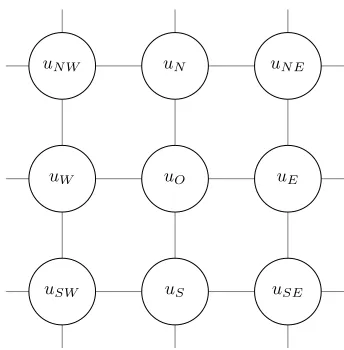
At a given pixeluO, letuN,uS,uW anduEdenote its four
neighbouring pixels at north, south, west and east directions respectively, as illustrated in Fig. 4. To simplify the notations, we denote the four neighbouring pixels altogether by uP,
whereP ∈Λ ={N, S, W, E}. In the following, we present the numerical method for updatinguOvia gradient descent.
The algorithm is performed iteratively until it converges to a stable state or the default maximum number of iterations is reached. For each iteration, the numerical approximation of uOis computed by
utO+1=utO+ ∆t·(λt(utO−u
0
O)−
1
h
∇ut O
|∇ut O|
), (41) where ∆t and h are set to 1 in our implementation. For convenience, we set λt to a fixed small number instead of updating it dynamically (λt= 0.001). We discretise
∇utO
|∇ut O|
'X
P∈Λ
uP−utO p
(uP−utO)2+ξ2P+
, (42)
where
ξN =
(uW +uN W)−(uE+uN E)
4 ,
ξS =
(uW +uSW)−(uE+uSE)
4 ,
ξW =
(uN+uN W)−(uS+uSW)
4 ,
ξE=
(uN+uN E)−(uS+uSE)
4 ,
(43)
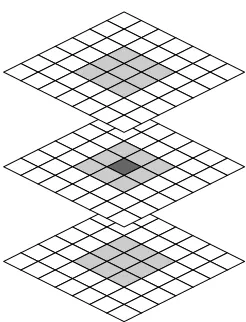
FIGURE 5. A given bit (coloured in dark grey) and its correlated neighbouring bits (coloured in light grey).
and is a very small number to avoid a zero divisor in practice.
B. BAYESIAN INFERENCE
A statistical approach to estimate thel-th bit of a pixel given a certain context is to collect a large number of samples under the same context and see which case, either that the bit is0or
1, is observed more frequently. This method will, however, encounter the so-called curse of dimensionality when the context is in a high dimensional space. That is, the amount of data required to support the sampling grows exponentially with the dimensionality of context. As aforementioned, a pixel is correlated to its eight immediate neighbours, which implies that the l-th bit of a given pixel is correlated to other 7 bits of that pixel and 8 bits of each neighbouring pixel. In total, there are 71correlated bits, which represent
271different contexts. In this case, we require an enormous amount of data so that there are sufficient samples for each context.
In order to reduce the dimensionality of context, we model that thel-th bit of a given pixel is correlated to its immediate neighbouring bits on the current and the two adjacent planes, as illustrated in Fig. 5. For the least significant bit-plane, we consider only the bits on the current and the second least significant bit-planes. For the most significant bit-plane, we consider only the bits on the current and the second most significant bit-planes. There are8correlated bits on the current bit plane,9 on each of the two adjacent bit-planes. For a bit on the second to the seventh bit-plane, it has 26
correlated bits and thus226possible contexts. For a bit on the first or last bit-plane, there are17correlated bits and accord-ingly217 contexts. The number of contexts is significantly reduced and yet the estimation is still remarkably accurate as demonstrated experimentally later. Let us denote the bit to be estimated byband the collection of correlated bits, or the context, byΘ. According to the Bayes’ theorem, we compute
P(b= 0|Θ)∝P(Θ|b= 0)P(b= 0),
P(b= 1|Θ)∝P(Θ|b= 1)P(b= 1), (44)
where P(b)is the prior probability of the hypothesis of b, P(Θ|b)is the likelihood of observing the evidenceΘgiven the hypothesis ofb, andP(b|Θ)is the posterior probability of the hypothesis ofbgiven the observed evidenceΘ. Therefore, the inference about the value ofbis made by
˜b= arg max
b∈{0,1}
P(b|Θ). (45)
[image:10.576.95.218.55.216.2]As a result, we learn the Bayesian probability table from a large number of image samples and predict the bits by the lookup table, as illustrated in Table 1.
TABLE 1. Bayesian probability table, in which each column represents a possible context and each row represents a possible bit value.
Θ1 Θ2 · · · b= 0 P(b= 0|Θ1) P(b= 0|Θ2) · · · b= 1 P(b= 1|Θ1) P(b= 1|Θ2) · · ·
VI. EXPERIMENTS
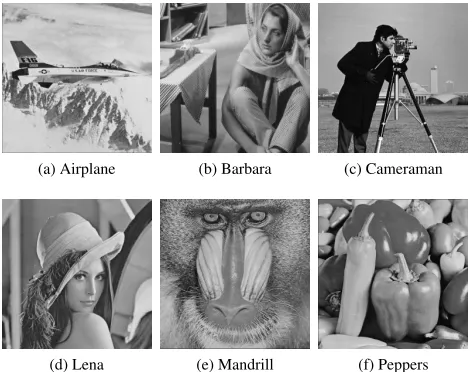
In the following experiments, we test the schemes on 8-bit greyscale images of size 512 ×512, as shown in Fig. 6. We use the RSA and the Paillier cryptosystems as examples of multiplicative and additive homomorphic cryptosystems, respectively. Two prime numbers for the cryptosystems are p= 7907andq= 7919so that the bit-length of message is blog2pqc= 25. Accordingly, for each bit-plane of an image, we convert every segment of25bits into a decimal number in order to fit the encryption function, where the marginal bits are negligible. The number of iterations for the total variation algorithm is set to2000since empirically it produces stable results. The Bayesian probability table is learned from a thou-sand image samples in the BOSSBase [47]. We begin with the analysis of three-way trade-off between capacity, fidelity, and reversibility. Then, we make comparisons between the proposed schemes and the state-of-the-art. The capacity is represented by the number of bits embedded in an image, whereas the fidelity and reversibility are measured by the peak signal-to-noise ratio (PSNR). Letui,j anduˆi,j denote
a pixel and its noisy counterpart respectively, whereiandj specify the pixel coordinates. The PSNR (in dB) is defined as
PSNR= 10×log10
2552
MSE. (46) where the mean square error (MSE) is calculated by
MSE= 1 512×512
512
X
i=1 512
X
j=1
(ui,j−uˆi,j)2. (47)
The fidelity is quantified by the PSNR between the original and the marked images, and in a similar manner, the re-versibility is evaluated by the PSNR between the original and the recovered images. For further analysis, we also measure the reversibility in terms of the number of bit errors in the following discussions.
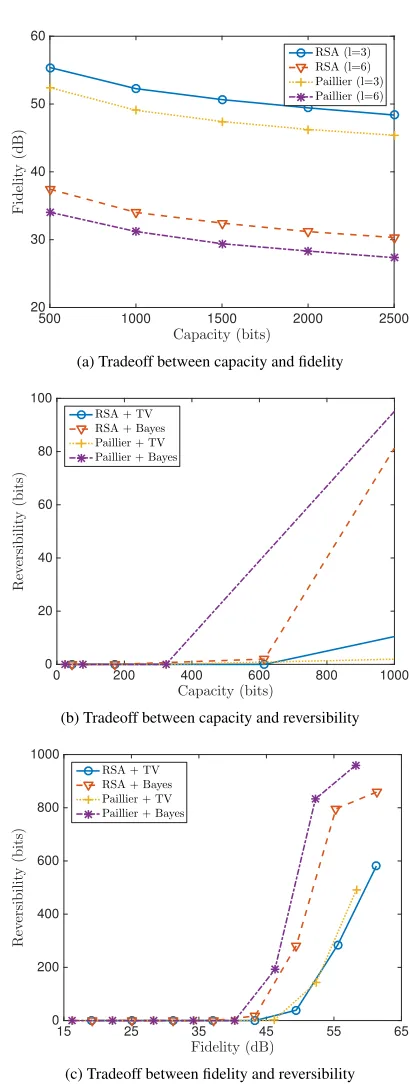
RSA-based scheme achieves higher fidelity than the Paillier-based scheme under the same capacity (2000 bits). The reason is straightforward: when the noise occurs, the former only introduces a random distortion while the latter inflicts a maximal distortion. Note that the fidelity is not content-dependent according to our scheme design. The impact of the selection of different bit-planes as the watermarking channel is shown in Table 2. It is intuitive that the fidelity of marked images decreases drastically when a more significant bit-plane is engaged to carry watermark information.
• Capacity-reversibility trade-off:The trade-off between capacity and reversibility is illustrated in Fig. 7(b). To assess the capacity-reversibility trade-off, we control the capacity by selecting different bit-planes for watermarking in such a way that the fidelity remains at48 dB, and then observe the change of reversibility. Note that here we express the reversibility in terms of the number of bit errors in order to amplify the trend. If the reversibility is quantified by the PSNR, the proportionality may be indeterminate since a higher decoding error rate does not necessarily mean a lower visual quality. For instance, several errors occur on an insignificant bit-plane may still result in a higher visual quality than a single error on a relatively significant bit-plane. It is observed that the reversibility decreases as the capacity increases. It is due to the fact that we embed less amount of information into the more significant bit-plane and more amount into the less significant bit-plane in order to keep the fidelity at a fixed level.
• Fidelity-reversibility trade-off: The trade-off between capacity and reversibility is illustrated in Fig. 7(c). In a similar way, we evaluate the fidelity-reversibility trade-off by setting the capacity to 2000bits, controlling the fidelity with the selection of encodable bit-plane, and observing the change of reversibility. It is evident that the Paillier-based scheme is advantageous in terms of the reversibility compared to the RSA-based scheme. This is because that the Paillier-based scheme inflicts a stronger noise to the host media, which is more distinguishable and removable than a faint noise imposed by the RSA-based scheme. On top of that, it is shown that the predictor based on total variation achieves higher reversibility than the predictor based on the Bayesian inference. Moreover, it can be observed that the reversibility is inversely proportional to the fidelity.
More comprehensive experimental results are demon-strated in Table 3, where a variety of images are tested with every possible combination of encoding and decoding mechanisms. It is witnessed that the error-free performance is achievable in practice. It can be observed that the error rate generally approaches zero when embedding payloads into a comparatively more significant bit-plane. From the previous analyses, we conclude that
• Capacity is inversely proportional to fidelity.
• Capacity is inversely proportional to reversibility.
• Fidelity is inversely proportional to reversibility.
• The RSA-based scheme preserves higher fidelity than the Paillier-based scheme.
(a) Airplane (b) Barbara (c) Cameraman
[image:11.576.301.537.69.255.2](d) Lena (e) Mandrill (f) Peppers
FIGURE 6. Greyscale test images of size512×512with256tonal options.
• The Paillier-based scheme achieves higher reversibility than the RSA-based scheme.
• The predictor based on total variation is more content-adaptive and results in higher reversibility than that based on Bayesian inference.
• The predictor based on Bayesian inference consumes less computational power in decoding than that based on total variation.
In the following, we compare the scheme performance with the state-of-the-art. We begin by classifying the existing reversible watermarking schemes compatible with public-key cryptosystems [32]–[36], as presented in Table 4. As far as we are aware, our work is one of the pioneering research on the schemes compatible with public-key homomorphic cryptosystems under the condition that neither additional bit padding nor specific pre-processing is undertaken. Although schemes addressing this strictly defined problem are hardly found, we remark that this design principle was followed in the earlier literature of schemes based on traditional symmetric-key cryptosystems. In order to make paralleled and meaningful comparisons, the proposed schemes are com-pared with those under the same, or at least similar, research constraint [48]–[50]. We test the fidelity and reversibility be-tween different schemes by embedding randomly generated
2000bits into various host images. It is observed from Table 5 that the visual qualities of various host images are similar for any listed encoding algorithm and thus it is evident that the fidelity is not content-dependent. Yet, different schemes and configurations result in different fidelity. It is shown that the RSA-based and Paillier-based schemes preserves com-paratively high fidelity when embedding payloads into the third bit-plane. From Table 6, we can further observe that the proposed schemes achieve relatively high reversibility, espe-cially when using the total variation technique for decoding. When the sixth bit-plane is used as the embedding channel, the proposed schemes show the error-free performance on
500 1000 1500 2000 2500
Capacity (bits)
20 30 40 50 60
F
id
el
it
y
(d
B
)
RSA (l=3) RSA (l=6) Paillier (l=3) Paillier (l=6)
(a) Tradeoff between capacity and fidelity
0 200 400 600 800 1000
Capacity (bits)
0 20 40 60 80 100
R
ev
er
si
b
il
it
y
(b
it
s)
RSA + TV RSA + Bayes Paillier + TV Paillier + Bayes
(b) Tradeoff between capacity and reversibility
15 25 35 45 55 65
Fidelity (dB)
0 200 400 600 800 1000
R
ev
er
si
b
il
it
y
(b
it
s)
RSA + TV RSA + Bayes Paillier + TV Paillier + Bayes
[image:12.576.52.257.46.589.2](c) Tradeoff between fidelity and reversibility
FIGURE 7. The three way trade-off between capacity, fidelity, and reversibility measured on the image Lena.
most of the test images. Even when embedding payloads into the third bit-plane, the reversibility is higher than the average in most cases. The experimental results show that the proposed schemes achieve a remarkable balance between fidelity and reversibility under the given capacity constraint. On top of this, the proposed schemes share the advantages of the modern public-key cryptosystems.
TABLE 2. Fidelity evaluation of RSA-based and Paillier-based schemes by using different bit-planes as the watermarking channel. It shows the PSNR (in dB) of the marked image Lena.
RSA Paillier
l= 1 67.59 64.25
l= 2 61.19 58.41
l= 3 55.46 52.43
l= 4 49.46 46.28
l= 5 43.27 39.86
l= 6 37.58 34.22
l= 7 31.18 28.09
l= 8 25.31 21.96
(a) Capacity: 500 bits
RSA Paillier
l= 1 64.32 61.28
l= 2 58.32 55.10
l= 3 52.17 49.23
l= 4 46.29 43.39
l= 5 40.32 37.20
l= 6 34.11 31.25
l= 7 28.41 25.28
l= 8 22.37 19.12
(b) Capacity: 1000 bits
RSA Paillier
l= 1 62.53 59.70
l= 2 56.55 53.42
l= 3 50.61 47.62
l= 4 44.40 41.47
l= 5 38.48 35.33
l= 6 32.56 29.49
l= 7 26.57 23.53
l= 8 20.29 17.53
(c) Capacity: 1500 bits
RSA Paillier
l= 1 61.29 58.23
l= 2 55.57 52.26
l= 3 49.41 46.26
l= 4 43.32 40.31
l= 5 37.08 34.18
l= 6 31.18 28.32
l= 7 25.09 22.18
l= 8 19.05 16.30
(d) Capacity: 2000 bits
VII. CONCLUSION
[image:12.576.371.471.101.509.2]TABLE 3. Reversibility evaluation of different combinations of encoding and decoding components. It shows the PSNR (in dB) and the number of bit errors of the recovered images in which2000random bits are embedded.
Airplane Barbara Cameraman Lena Mandrill Peppers PSNR NUM PSNR NUM PSNR NUM PSNR NUM PSNR NUM PSNR NUM
l= 1 65.38 403 63.10 667 71.61 102 63.75 581 62.36 795 62.82 715
l= 2 64.38 135 59.20 417 81.24 3 60.90 285 56.53 760 58.43 500
l= 3 69.10 13 59.18 112 ∞ 0 64.06 39 52.44 489 56.41 205
l= 4 ∞ 0 60.90 20 ∞ 0 ∞ 0 50.22 216 56.41 10
l= 5 ∞ 0 63.60 3 ∞ 0 ∞ 0 54.21 23 ∞ 0
l= 6 ∞ 0 ∞ 0 ∞ 0 ∞ 0 ∞ 0 ∞ 0
l= 7 ∞ 0 ∞ 0 ∞ 0 ∞ 0 ∞ 0 ∞ 0
l= 8 ∞ 0 ∞ 0 ∞ 0 ∞ 0 ∞ 0 ∞ 0
(a) RSA + TV
Airplane Barbara Cameraman Lena Mandrill Peppers PSNR NUM PSNR NUM PSNR NUM PSNR NUM PSNR NUM PSNR NUM
l= 1 62.85 706 61.82 886 67.51 249 62.02 859 61.90 882 61.68 915
l= 2 59.24 404 56.09 830 74.06 16 56.32 796 55.68 917 55.83 882
l= 3 62.04 60 52.93 434 ∞ 0 54.89 282 49.93 876 51.23 645
l= 4 ∞ 0 55.76 61 ∞ 0 61.60 17 45.54 599 54.33 87
l= 5 ∞ 0 61.60 4 ∞ 0 ∞ 0 45.42 160 ∞ 0
l= 6 ∞ 0 ∞ 0 ∞ 0 ∞ 0 49.88 15 ∞ 0
l= 7 ∞ 0 ∞ 0 ∞ 0 ∞ 0 ∞ 0 ∞ 0
l= 8 ∞ 0 ∞ 0 ∞ 0 ∞ 0 ∞ 0 ∞ 0
(b) RSA + Bayes
Airplane Barbara Cameraman Lena Mandrill Peppers PSNR NUM PSNR NUM PSNR NUM PSNR NUM PSNR NUM PSNR NUM
l= 1 64.30 253 60.78 569 74.53 24 61.41 492 59.37 787 60.09 667
l= 2 68.00 27 58.62 234 ∞ 0 60.76 143 54.06 669 56.46 385
l= 3 ∞ 0 63.28 20 ∞ 0 73.28 2 50.87 348 58.16 65
l= 4 ∞ 0 ∞ 0 ∞ 0 ∞ 0 50.68 91 ∞ 0
l= 5 ∞ 0 ∞ 0 ∞ 0 ∞ 0 ∞ 0 ∞ 0
l= 6 ∞ 0 ∞ 0 ∞ 0 ∞ 0 ∞ 0 ∞ 0
l= 7 ∞ 0 ∞ 0 ∞ 0 ∞ 0 ∞ 0 ∞ 0
l= 8 ∞ 0 ∞ 0 ∞ 0 ∞ 0 ∞ 0 ∞ 0
(c) Paillier + TV
Airplane Barbara Cameraman Lena Mandrill Peppers PSNR NUM PSNR NUM PSNR NUM PSNR NUM PSNR NUM PSNR NUM
l= 1 59.60 746 58.42 979 65.64 186 58.51 960 58.42 981 58.31 1004
l= 2 57.11 331 52.69 916 ∞ 0 53.10 833 52.32 999 52.41 977
l= 3 65.15 13 51.45 305 ∞ 0 53.46 192 46.60 932 48.32 626
l= 4 ∞ 0 59.48 12 ∞ 0 ∞ 0 42.61 584 55.36 31
l= 5 ∞ 0 ∞ 0 ∞ 0 ∞ 0 45.33 78 ∞ 0
l= 6 ∞ 0 ∞ 0 ∞ 0 ∞ 0 ∞ 0 ∞ 0
l= 7 ∞ 0 ∞ 0 ∞ 0 ∞ 0 ∞ 0 ∞ 0
l= 8 ∞ 0 ∞ 0 ∞ 0 ∞ 0 ∞ 0 ∞ 0
(d) Paillier + Bayes
encrypted data and improves the space efficiency. In addition to this, we suggest to encrypt different bit-planes separately in order to control the fidelity factor. Any specific data pre-processing is not required in order to promote the practicality and universality. For the RSA-like cryptosystems that per-mit multiplicative homomorphic computation, the proposed scheme is flexible in terms of embedding capacity. As for the Paillier-like cryptosystems that allow additive operation as well as partial multiplicative operation, we propose a scheme which is optimal with respect to the reversibility. Furthermore, we develop content-adaptive predictors based on variational method and statistical inference for assisting watermark decoding. Both online and offline prediction
al-gorithms are provided in order to suit different operational requirements. We remark that the decoding errors are in-evitable from a theoretical point of view and yet in practice the error rate approaches zero at a low expense of the fidelity and capacity. Experimental results show that the proposed schemes achieve remarkable balance between fidelity and reversibility under the given capacity constraint. From our perspective, it is of great significance to develop privacy-aware watermarking methodology suitable for a variety of modern cryptosystems. On top of this, more practical appli-cations, such as privacy protection in the Internet of Things, deserves further investigation.
TABLE 4. Classification of reversible watermarking schemes compatible with public-key cryptosystems.
Proposed Wuet al.[32] Wuet al.[33] Li and Li [34] Zhanget al.[35] Xiang and Luo [36]
Bit-padding No Yes Yes Yes No No
Pre-processing No No No No Yes Yes
TABLE 5. Fidelity comparison with the state-of-the-art. It shows the PSNR (in dB) of the marked images in which2000random bits are embedded. Airplane Barbara Cameraman Lena Mandrill Peppers
RSA (l= 3) 49.27 49.32 49.47 49.43 49.13 49.19
RSA (l= 6) 31.13 31.08 31.31 31.18 31.32 31.19
Paillier (l= 3) 46.18 46.36 46.10 46.25 46.26 46.23
Paillier (l= 6) 28.14 28.37 28.17 28.32 28.26 28.16
Zhang [48] 41.11 41.04 40.98 41.06 41.04 41.0
Wu and Sun (l= 3) [49] 46.30 46.16 46.33 46.29 46.16 46.27
Wu and Sun (l= 6) [49] 28.25 28.39 28.25 28.43 28.38 28.22
[image:14.576.53.526.267.397.2]Liao and Shu [50] 41.12 41.04 41.05 41.04 41.03 41.04
TABLE 6. Reversibility comparison with the state-of-the-art. It shows the PSNR (in dB) and the number of bit errors of the recovered images in which2000random bits are embedded.
Airplane Barbara Cameraman Lena Mandrill Peppers PSNR NUM PSNR NUM PSNR NUM PSNR NUM PSNR NUM PSNR NUM RSA + TV (l= 3) 69.10 13 59.18 112 ∞ 0 64.06 39 52.44 489 56.41 205
RSA + TV (l= 6) ∞ 0 ∞ 0 ∞ 0 ∞ 0 ∞ 0 ∞ 0
RSA + Bayes (l= 3) 62.04 60 52.93 434 ∞ 0 54.89 282 49.93 876 51.23 645
RSA + Bayes (l= 6) ∞ 0 ∞ 0 ∞ 0 ∞ 0 49.88 15 ∞ 0
Paillier + TV (l= 3) ∞ 0 63.28 20 ∞ 0 73.28 2 50.87 348 58.16 65
Paillier + TV (l= 6) ∞ 0 ∞ 0 ∞ 0 ∞ 0 ∞ 0 ∞ 0
Paillier + Bayes (l= 3) 65.15 13 51.45 305 ∞ 0 53.46 192 46.60 932 48.32 626
Paillier + Bayes (l= 6) ∞ 0 ∞ 0 ∞ 0 ∞ 0 ∞ 0 ∞ 0
Zhang [48] 55.09 71 48.93 169 54.38 85 57.10 28 46.16 309 54.57 47
Wu and Sun (l= 3) [49] ∞ 0 58.58 59 ∞ 0 69.30 5 50.03 423 57.66 73
Wu and Sun (l= 6) [49] ∞ 0 ∞ 0 ∞ 0 ∞ 0 ∞ 0 ∞ 0
Liao and Shu [50] 60.73 13 57.57 23 67.56 3 62.46 7 52.54 70 58.13 20
ACKNOWLEDGEMENT
The authors would like to thank Mr Yijun Quan for the valuable discussions on mathematical derivations, and Dr Kaimeng Chen for the helpful technical assistance. The authors would also like to thank anonymous reviewers for their critical comments and suggestions on improving the presentation and organisation of this paper.
REFERENCES
[1] C. E. Shannon, “Communication theory of secrecy systems,” Bell Syst. Tech. J., vol. 28, no. 4, pp. 656–715, Oct. 1949.
[2] R. L. Lagendijk, Z. Erkin, and M. Barni, “Encrypted signal processing for privacy protection: Conveying the utility of homomorphic encryption and multiparty computation,” IEEE Signal Process. Mag., vol. 30, no. 1, pp. 82–105, Jan. 2013.
[3] C. Aguilar-Melchor, S. Fau, C. Fontaine, G. Gogniat, and R. Sirdey, “Recent advances in homomorphic encryption: A possible future for signal processing in the encrypted domain,” IEEE Signal Process. Mag., vol. 30, no. 2, pp. 108–117, Mar. 2013.
[4] M. Barni, G. Droandi, and R. Lazzeretti, “Privacy protection in biometric-based recognition systems: A marriage between cryptography and signal processing,” IEEE Signal Process. Mag., vol. 32, no. 5, pp. 66–76, Sept. 2015.
[5] I. J. Cox, J. Kilian, F. T. Leighton, and T. Shamoon, “Secure spread spectrum watermarking for multimedia,” IEEE Trans. Image Process., vol. 6, no. 12, pp. 1673–1687, Dec. 1997.
[6] I. J. Cox, M. L. Miller, and A. L. McKellips, “Watermarking as communi-cations with side information,” Proc. IEEE, vol. 87, no. 7, pp. 1127–1141, July 1999.
[7] B. Chen and G. W. Wornell, “Quantization index modulation: A class of
provably good methods for digital watermarking and information embed-ding,” IEEE Trans. Inf. Theory, vol. 47, no. 4, pp. 1423–1443, May 2001. [8] C.-C. Chang, P. Tsai, and C.-C. Lin, “SVD-based digital image watermark-ing scheme,” Pattern Recognition Letters, vol. 26, no. 10, pp. 1577–1586, July 2005.
[9] D. Kundur and D. Hatzinakos, “Digital watermarking for telltale tamper proofing and authentication,” Proc. IEEE, vol. 87, no. 7, pp. 1167–1180, July 1999.
[10] M. U. Celik, G. Sharma, E. Saber, and A. M. Tekalp, “Hierarchical watermarking for secure image authentication with localization,” IEEE Trans. Image Process., vol. 11, no. 6, pp. 585–595, June 2002.
[11] C.-T. Li, “Digital fragile watermarking scheme for authentication of JPEG images,” IEE Proc. - Vision, Image Signal Process., vol. 151, no. 6, pp. 460–466, Dec. 2004.
[12] C.-C. Chang, Y.-S. Hu, and T.-C. Lu, “A watermarking-based image ownership and tampering authentication scheme,” Pattern Recognition Letters, vol. 27, no. 5, pp. 439–446, Apr. 2006.
[13] C. W. Honsinger, P. W. Jones, M. Rabbani, and J. C. Stoffel, “Lossless recovery of an original image containing embedded data,” U.S. Patent 6 278 791, Aug. 21, 2001.
[14] J. Fridrich, M. Goljan, and R. Du, “Invertible authentication,” in Proc. SPIE, vol. 4314, San Jose, CA, USA, Jan. 2001, pp. 197–208.
[15] J. Tian, “Reversible data embedding using a difference expansion,” IEEE Trans. Circuits Syst. Video Technol., vol. 13, no. 8, pp. 890–896, Aug. 2003.
[16] A. M. Alattar, “Reversible watermark using the difference expansion of a generalized integer transform,” IEEE Trans. Image Process., vol. 13, no. 8, pp. 1147–1156, Aug. 2004.
[17] Z. Ni, Y.-Q. Shi, N. Ansari, and W. Su, “Reversible data hiding,” IEEE Trans. Circuits Syst. Video Technol., vol. 16, no. 3, pp. 354–362, Mar. 2006.
[image:14.576.266.535.421.736.2][19] Y. Yang, X. Sun, H. Yang, C.-T. Li, and R. Xiao, “A contrast-sensitive reversible visible image watermarking technique,” IEEE Trans. Circuits Syst. Video Technol., vol. 19, no. 5, pp. 656–667, May 2009.
[20] W.-L. Tai, C.-M. Yeh, and C.-C. Chang, “Reversible data hiding based on histogram modification of pixel differences,” IEEE Trans. Circuits Syst. Video Technol., vol. 19, no. 6, pp. 906–910, June 2009.
[21] W. Puech, M. Chaumont, and O. Strauss, “A reversible data hiding method for encrypted images,” in Proc. SPIE, vol. 6819, San Jose, CA, USA, Feb. 2008, pp. 68 191E–1–68 191E–9.
[22] Z. Qian, X. Zhang, Y. Ren, and G. Feng, “Block cipher based separable reversible data hiding in encrypted images,” Multimedia Tools Appl., vol. 75, no. 21, pp. 13 749–13 763, Nov. 2016.
[23] X. Zhang, “Separable reversible data hiding in encrypted image,” IEEE Trans. Inf. Forensics Security, vol. 7, no. 2, pp. 826–832, Apr. 2012. [24] X. Zhang, Z. Qian, G. Feng, and Y. Ren, “Efficient reversible data hiding
in encrypted images,” J. Visual Commun. Image Representation, vol. 25, no. 2, pp. 322–328, Feb. 2014.
[25] Z. Qian and X. Zhang, “Reversible data hiding in encrypted images with distributed source encoding,” IEEE Trans. Circuits Syst. Video Technol., vol. 26, no. 4, pp. 636–646, Apr. 2016.
[26] M. Johnson, P. Ishwar, V. Prabhakaran, D. Schonberg, and K. Ramchan-dran, “On compressing encrypted data,” IEEE Trans. Signal Process., vol. 52, no. 10, pp. 2992–3006, Oct. 2004.
[27] D. Schonberg, S. C. Draper, C. Yeo, and K. Ramchandran, “Toward compression of encrypted images and video sequences,” IEEE Trans. Inf. Forensics Security, vol. 3, no. 4, pp. 749–762, Dec. 2008.
[28] D. Klinc, C. Hazay, A. Jagmohan, H. Krawczyk, and T. Rabin, “On compression of data encrypted with block ciphers,” IEEE Trans. Inf. Theory, vol. 58, no. 11, pp. 6989–7001, Nov. 2012.
[29] W. Hong, T. S. Chen, and H. Y. Wu, “An improved reversible data hiding in encrypted images using side match,” IEEE Signal Process. Lett., vol. 19, no. 4, pp. 199–202, Apr. 2012.
[30] Z. Qian, X. Zhang, and G. Feng, “Reversible data hiding in encrypted images based on progressive recovery,” IEEE Signal Process. Lett., vol. 23, no. 11, pp. 1672–1676, Nov. 2016.
[31] F. Huang, J. Huang, and Y.-Q. Shi, “New framework for reversible data hiding in encrypted domain,” IEEE Trans. Inf. Forensics Security, vol. 11, no. 12, pp. 2777–2789, Dec. 2016.
[32] H.-T. Wu, Y.-M. Cheung, and J. Huang, “Reversible data hiding in Paillier cryptosystem,” J. Visual Commun. Image Representation, vol. 40, pt. B, pp. 765–771, Oct. 2016.
[33] X. Wu, B. Chen, and J. Weng, “Reversible data hiding for encrypted signals by homomorphic encryption and signal energy transfer,” J. Visual Commun. Image Representation, vol. 41, pp. 58–64, Nov. 2016. [34] M. Li and Y. Li, “Histogram shifting in encrypted images with public key
cryptosystem for reversible data hiding,” Signal Process., vol. 130, pp. 190–196, Jan. 2017.
[35] X. Zhang, J. Long, Z. Wang, and H. Cheng, “Lossless and reversible data hiding in encrypted images with public-key cryptography,” IEEE Trans. Circuits Syst. Video Technol., vol. 26, no. 9, pp. 1622–1631, Sept. 2016. [36] S. Xiang and X. Luo, “Reversible data hiding in homomorphic encrypted
domain by mirroring ciphertext group,” IEEE Trans. Circuits Syst. Video Technol., vol. 1, no. 99, pp. 1–12, Aug. 2017.
[37] K. Ma, W. Zhang, X. Zhao, N. Yu, and F. Li, “Reversible data hiding in encrypted images by reserving room before encryption,” IEEE Trans. Inf. Forensics Security, vol. 8, no. 3, pp. 553–562, Mar. 2013.
[38] W. Zhang, K. Ma, and N. Yu, “Reversibility improved data hiding in encrypted images,” Signal Process., vol. 94, pp. 118–127, Jan. 2014. [39] X. Cao, L. Du, X. Wei, D. Meng, and X. Guo, “High capacity reversible
data hiding in encrypted images by patch-level sparse representation,” IEEE Trans. Cybern., vol. 46, no. 5, pp. 1132–1143, May 2016. [40] R. L. Rivest, L. Adleman, and M. L. Dertouzos, “On data banks and
privacy homomorphisms,” in Foundations of Secure Computation, R. A. DeMillo et al., Eds. Academic Press, 1978, pp. 169–180.
[41] R. L. Rivest, A. Shamir, and L. Adleman, “A method for obtaining digital signatures and public-key cryptosystems,” Commun. ACM, vol. 21, no. 2, pp. 120–126, Feb. 1978.
[42] T. Elgamal, “A public key cryptosystem and a signature scheme based on discrete logarithms,” IEEE Trans. Inf. Theory, vol. 31, no. 4, pp. 469–472, Jul. 1985.
[43] T. Okamoto and S. Uchiyama, “A new public-key cryptosystem as secure as factoring,” in Proc. Int. Conf. Theory Appl. Cryptographic Techn. (EUROCRYPT), Espoo, Finland, May 1998, pp. 308–318.
[44] I. Damgård and M. Jurik, “A generalisation, a simplication and some applications of Paillier’s probabilistic public-key system,” in Proc. Int. Workshop Practice Theory Public Key Cryptography (PKC), Feb. 2001, pp. 119–136.
[45] P. Paillier, “Public-key cryptosystems based on composite degree resid-uosity classes,” in Proc. Int. Conf. Theory Appl. Cryptographic Techn. (EUROCRYPT), Prague, Czech Republic, May 1999, pp. 223–238. [46] L. I. Rudin, S. Osher, and E. Fatemi, “Nonlinear total variation based noise
removal algorithms,” Physica D: Nonlinear Phenomena, vol. 60, no. 1, pp. 259–268, Nov. 1992.
[47] P. Bas, T. Filler, and T. Pevný, “Break our steganographic system: The ins and outs of organizing BOSS,” in Proc. 13th Int. Workshop Inf. Hiding, Prague, Czech Republic, May 2011, pp. 59–70.
[48] X. Zhang, “Reversible data hiding in encrypted image,” IEEE Signal Process. Lett., vol. 18, no. 4, pp. 255–258, Apr. 2011.
[49] X. Wu and W. Sun, “High-capacity reversible data hiding in encrypted images by prediction error,” Signal Process., vol. 104, pp. 387–400, Nov. 2014.
[50] X. Liao and C. Shu, “Reversible data hiding in encrypted images based on absolute mean difference of multiple neighboring pixels,” J. Visual Commun. Image Representation, vol. 28, pp. 21–27, Apr. 2015.
CHING-CHUN CHANGis a PhD candidate at
the Department of Computer Science, University of Warwick, UK. He received the BBA degree in information management from National Central University, Taiwan, in 2015. He engaged in a short-term scientific mission supported by Euro-pean cooperation in science and technology ac-tions at the Faculty of Computer Science, Otto von Guericke University Magdeburg, Germany, in 2016. He participated in a research and innovation staff exchange scheme supported by Marie Skłodowska-Curie actions at the Department of Electrical and Computer Engineering, New Jersey Institute of Technology, USA, during 2017. He has been a visiting scholar at the School of Computer and Mathematics, Charles Sturt University, Australia, since 2018. His research interests include digital watermarking, steganography, secret sharing, applied cryptography, and multimedia security.
CHANG-TSUN LIreceived the BEng degree in electrical engineering from the National Defence University (NDU), Taiwan, in 1987, the MSc de-gree in computer science from the Naval Postgrad-uate School (NPS), USA, in 1992, and the PhD degree in computer science from the University of Warwick, UK, in 1998. He was an associate professor of the Department of Electrical Engi-neering at the NDU, Taiwan, during 1998-2002, and a visiting professor of the Department of Computer Science at the NPS, USA, in the second half of 2001. He was a professor of the Department of Computer Science at the University of Warwick, UK, until January 2017. He is currently a professor of the School of Computing and Mathematics, Charles Sturt University, Australia. His research interests include multimedia forensics, biometrics, bioinformatics, data mining, machine learning, image processing, computer vision, and pattern recognition. The outcomes of his multimedia forensics research have been translated into award-winning commercial products protected by a series of international patents and have been used by a number of police forces and courts of law around the world. He is currently an associate editor of IEEE Access, the EURASIP Journal of Image and Video Processing and IET Biometrics. He involved in the organisation of many international conferences and workshops and also served as a member of the international program committees for several international conferences. He is also actively contributing keynote speeches and talks at various international events.