A framework for argumentation-based negotiation
Carles Sierraz ?, Nick R. Jenningsz, Pablo Noriegay ??, Simon Parsonsz
z
Department of Electronic Engineering, Queen Mary and Westfield College, University of London, London E1 4NS, UK.
fC.A.Sierra, N.R.Jennings, [email protected] y
Artificial Intelligence Research Institute, IIIA. Spanish Scientific Research Council, CSIC. Campus UAB, 08193 Bellaterra, Barcelona, Spain.
fsierra, [email protected]
Abstract. Many autonomous agents operate in domains in which the co-operation of their fellow agents cannot be guaranteed. In such domains negoti-ation is essential to persuade others of the value of co-opernegoti-ation. This paper de-scribes a general framework for negotiation in which agents exchange proposals backed by arguments which summarise the reasons why the proposals should be accepted. The argumentation is persuasive because the exchanges are able to alter the mental state of the agents involved. The framework is inspired by our work in the domain of business process management and is explained using examples from that domain.
Keywords: Automated negotiation, Argumentation, Persuasion.
1 Introduction
Negotiation is a key form of interaction in systems composed of multiple autonomous agents. In such environments, agents often have no inherent control over one another and so the only way they can influence one another’s behaviour is by persuasion. In some cases, the persuadee may require little or no convincing to act in the way desired by the persuader, for example because the proposed course of action is consistent with their plans. However, in other cases, the persuadee may be unwilling to accept the pro-posal initially and must be persuaded to change its beliefs, goals or preferences so that the proposal, or some variant thereof, is accepted. In either case, the minimum require-ment for negotiation is for the agents to be able to make proposals to one another. These proposals can then either be accepted or rejected as is the case in the contract net pro-tocol [17], for instance. Another level of sophistication occurs when recipients do not just have the choice of accepting or rejecting proposals, but have the option of making
?
On sabbatical leave from IIIAy
thanks to a Spanish MEC grant PR95-313. Research partially supported by the Spanish CICYT project SMASH, TIC96-1038-C04001.
??
counter offers to alter aspects of the proposal which are unsatisfactory [16]. An even more elaborate form of negotiation—argumentation-based—is that in which parties are able to send justifications or arguments along with (counter) proposals indicating why they should be accepted [11, 13, 18]. Arguments such as: “this is myfinal offer, take it or leave it”, “last time this job cost $5, I’m not going to pay $10 now”, and “the job will take longer than usual because one of the workers is off sick” may be necessary to change the persuadee’s goals or preferences.
This paper deals with argumentation-based negotiation. Because this is a large re-search topic [9, 19] we limit our scope to argumentation between computational agents where a persuader tries to convince a persuadee to undertake a particular problem solv-ing task (service) on its behalf. We outline the components of a formal model for the process of argumentation-based negotiation which can ultimately be used to build ne-gotiating agents for real world applications. While we draw on our previous work in this area, in this paper we shift our attention from the mechanisms for generating counter proposals [16] and those for generating and interpreting arguments [13] to the social aspects of the negotiation. Moreover, we take advantage of the work on Dialogical Frameworks introduced in [12] to define the static aspects of the negotiation process: shared ontology, social relations, communication language and protocol. We define a minimal notion of the stateof an agent which captures the evolutionary character of negotiation—enabling the resulting model to recognise different types of arguments that agents can make in support of their proposals. Finally, we indicate how these argu-ments can be generated and interpreted by agents.
In the paper we discuss three types of illocutions: (i)threats—failure to accept this proposal means something negative will happen to the agent; (ii)rewards—acceptance of this proposal means something positive will happen to the agent; and (iii)appeals— the agent should prefer this option over that alternative for this reason. We realise these are a subset of the illocutions that are involved in persuasive negotiation (see [9] for a list based on psychological research), but our emphasis is in providing an overarching framework in which the key components of argumentation can be described, rather than providing an exhaustive formalisation of all the argument types which can be found in the literature. We illustrate these constructs through a running example introduced in the following section. The main contribution of this work is, therefore, to provide a formal framework in which agents can undertake persuasive negotiation to change each other’s beliefs and preferences using an expressive communication language. Moreover, the framework is neutral with respect to the agent’s internal architecture and imposes few constraints on its formal resources.
2 Argumentation in Business Process Management
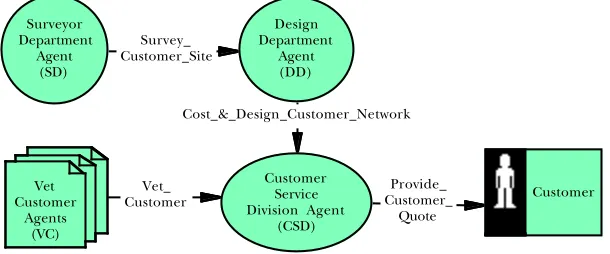
pro-cess receives a customer service request as its input and generates as its output a quote specifying how much it would cost to build a network to realise that service. Here we consider a subset of the agents involved in this activity: the customer service divi-sion (CSD) agent, the design dividivi-sion (DD) agent, the surveyor department (SD) agent, and the various agents who provide the out-sourced service of vetting customers (VC agents). A full account of all the agents and their negotiations is given in [16].
Provide_ Customer_
Quote Cost_&_Design_Customer_Network Survey_
Customer_Site
Vet_ Customer
Customer Service Division Agent
(CSD) Design Department
Agent (DD) Surveyor
Department Agent
(SD)
Customer Vet
Customer Agents
[image:3.612.138.443.147.274.2](VC)
Fig. 1.Agent system for BT’s “
Provide Customer Quote
” business process. The direction of the arrow indicates who provides the service labelling the arrow to whom.Thefirst stages of the Provide Customer Quote service involve the CSD agent cap-turing basic information about the customer and vetting the customer in terms of their credit worthiness. The latter service is performed by one of the VC agents and ne-gotiation is used to determine which one is selected. If the customer fails the vetting procedure, then the quote process terminates. Assuming the customer is satisfactory, the CSD agent maps their requirements against a service portfolio. If the requirements can be met by a standard off-the-shelf portfolio item then an immediate quote can be offered based on previous examples. In the case of bespoke services the process is more complex. The CSD agent negotiates with the DD agent for the service of costing and de-signing the desired network service. To prepare a network design it is usually necessary to have a detailed plan of the existing equipment at the customer’s premises. Sometimes such plans might not exist and sometimes they may be out of date. In either case, the DD agent determines whether the customer site(s) should be surveyed. If such a survey is warranted, the DD agent negotiates with the SD agent for the Survey Customer Site service. This negotiation differs from the others present in this scenario in that the two agents are part of the same department. Moreover, the DD agent has a degree of author-ity over SD. Agent negotiation is still required to set the timings of the service, but the SD agent cannot simply refuse to perform the service. On completion of the network design and costing, the DD agent informs the CSD agent which informs the customer of the service quote. The business process then terminates.
Type Id Parties Content Comments
Threaten 1 CSD-VCsMatch the offer I have from another VC, otherwise I’llbreak off this negotiation. Threaten to terminate current nego-tiation thread.
2 CSD-VCsMake sure you get back to me in the specior I won’t involve you in future rounds of bidding.fied time periodThreaten to terminate all future ne-gotiation threads.
3 DD-SD If you cannot complete the service sooner, I’ll inform yourboss that we missed the deadline because of you. Threaten to inform outside party of(perceived) poor performance.
Reward 4 CSD-DD If you produce this design by this time we’ll be able to getthe quote to our major customer ahead of time. Indicate positive effect of perform-ing action by specified time.
5 CSD-VCsIf you vet this customer by this time, I’ll make sure you’reinvolved in subsequent rounds of bidding. Promise future involvement for ac-cepting current proposal.
Appeal 6 CSD-VCs Last time you vetted this customer, it took this length of
time and cost this much. Appeal to precedent.
7 CSD-DD You must complete this design within 48 hours becausecompany policy says customers must be responded to within this time frame.
Appeal to (company’s) prevailing practice.
8 VC-CSD This customer may be intime is needed to carry out a higher quality vetting.financial trouble, therefore moreAppeal to (CSD’s) self interest.
9 DD-CSD The design will take longer than normal because one of oursurveyors is on holiday this week. Revealing new information.
[image:4.612.154.495.54.281.2]10 SD-DD Customer has many premises and they all need to be sur-veyed, thus this service will take longer than normal. Revealing new information.
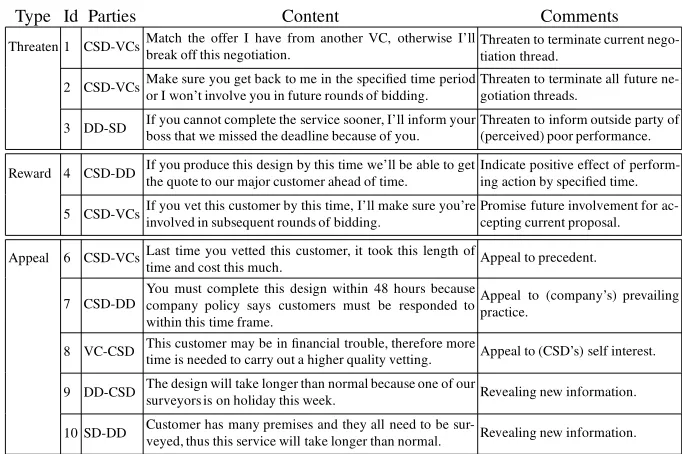
Fig. 2.Sample arguments in the BT application.
service); (ii) the power relations [2] between the negotiators—most negotiations are peer-to-peer, but the DD and SD negotiation over the Survey Customer Site service is an example of boss-to-subordinate negotiation; and (iii) the organisational relationship of the negotiators—some negotiations are between agents of the same organisation (e.g. the CSD, DD and SD agents), while others are between agents of different organisations (e.g. the CSD and VC agents). Our experience in the domain shows that the argumen-tation between agents can be captured by the three types of argument mentioned in the Introduction—threats, rewards and appeals. Some examples of such arguments are given in Figure 2.
3 Negotiation model
Our model describes the process of a single encounter negotiation between multiple agents over a deal. Deals are always between two agents, though an agent may be en-gaged simultaneously in negotiation with many agents for a given deal. Negotiation is achieved through the exchange of illocutions in a shared communication language
CL
. The actual exchange of illocutions is driven by the participating agents’individualneeds and goals—something that will not be part of this negotiation model. Neverthe-less, this exchange is subject to someminimal shared conventionson the intended usage of the illocutions in
CL
, and a simple negotiation protocol. These conventions relate to:1. The elements that are relevant for the negotiation of a deal—in the form ofissues
2. The rationality of the participating agents—in terms of some form of preference relationships or utility functions which enable the agents to evaluate and compare different proposals.
3. The deliberation capability of the participating agents—in the form of an internal
statein which the agent may register the history of the negotiation as well as the
evolution of its own theoretical elements on which its decisions are founded. 4. The minimal shared meaning of the acceptable illocutions—this is captured in the
way that areceived illocution should be interpreted when heard by an agent, and by making explicit the conditions that enable an agent to use (or ‘generate’) a given illocution at a given time.
A minimal set of concepts which are necessary to represent the static components in automated negotiation are presented in Section 3.1, and the dynamic components—the concepts of a negotiation thread and a negotiation state—are introduced in Section 3.2. Social aspects that are relevant for persuasive arguments are dealt with in Section 3.3, and the process of interpreting and generating illocutions is illustrated in Section 3.4.
3.1 A Basic Negotiation Ontology
Negotiation requires communication between the agents and, for it to be unambiguous, each agent must have a unique identifier. We denote the set of identifiers of the agents in-volved in a negotiation as
Agents
3
. The agents involved in a negotiation will have a va-riety of social relationships with one another. These relationships have an important im-pact upon the persuasion and argumentation process. For instance, prestigious speakers have a large persuasive impact and peers can be persuaded more easily than non-peers [9]. To model this characteristic, we assume that a general and shared social relation is defined between the agents. This relation can be modelled as a binary function over a set of social roles, denoted asRoles
. In the BT scenario, for example,Roles
would be:fCustomerContractorBossPeer
g. Finally, we assume that agents, whenne-gotiating, interchange illocutions in a common communication language
CL
defined over a set of illocutionary particles whose propositional content is expressed in a shared logical languageL
4
. The precise nature ofL
is unimportant in our model (e.g. it could be a propositional language or a modal language), however it must contain at least the following:1. Variables. To represent the issues under negotiation. They have to be variables
be-cause issues need to be bound to different values during negotiation.
2. Constants. To represent values for the issues under negotiation. A special constant
‘?’ is needed to represent the absence of value, and allow for underdefined proposals between agents. (Note this constant does not mean “don’t care”.)
3In practice, this set may change dynamically (e.g. new vetting companies may be created and
old ones may disappear). However, since this process can be seen as independent from the negotiation process, our model is presented with respect to afixed set.
4In practice, agents often have heterogeneous information models and so need to use one of the
3. Equality. To specify the value of an issue under negotiation.
4. Conjunction. To define complex sentences.
All of these features are necessary to express the kinds of sentences involved in the negotiation proposals discussed in this paper. An example of such a sentence is:
(
Price
=$10
)^(Quality
=High
)^(Penalty
=?)where ‘
Price
’, ‘Quality
’, and ‘Penalty
’ are the issues under negotiation and so are represented as variables; ‘$10
’, ‘High
’, and ‘?’ are values for those issues and so areconstants; ‘=’ denotes equality; and ‘^’ denotes conjunction. However, the language
defined so far is not expressive enough to describe everything that is involved in a negotiation. In particular, to ‘reason’ and ‘argue’ about offers it is necessary at the very least to have some way of expressing preferences between offers. Offers are formulae in
L
, hence the most obvious way of representing preferences between formulae would be as a second-order relation inL
. However, this would mean thatL
would be a higher-order logic, with the associated computational problems of such logics [6]. As a result we prefer to express preferences as a meta-languageML
with the following minimum requirements:1. Quoting functions. To represent formulae in
L
as terms inML
.2. A preference meta-predicate. To express preferences between formulae in
L
.For example, given the sentences
Price
=$10
, andPrice
=$20
inL
, we canexpress a preference for thefirst over the second as:
Pref
(equal
(dPrice
ed$10
e)equal
(dPrice
ed$20
e))where ‘
equal
’ is the quoting inML
of the predicate ‘=’ inL
, and ‘Pref
’repre-sents the preference meta-predicate. In the remainder of the paper, instead of writing
equal
(dPrice
ed$10
e)the more compact representationdPrice
=$10
eis used.The common communication language,
CL
, accounts for the set of illocution-ary particles necessillocution-ary to model the set of illocutionillocution-ary acts we study in this pa-per. The acts can be divided into two sets,I
nego
corresponding to negotiation parti-cles (those used to make offers and counter offers) andI
pers
corresponding to per-suasive particles (those used in argumentation).I
nego
= fofferrequestacceptreject
withdrawg,I
pers
=fappealthreatenrewardg. Other illocutions couldconceivably be brought into
CL
but the present set is sufficient for our purposes. The negotiation dialogue between two agents consists of a sequence of offers and counter offers containing values for the issues. These offers and counteroffers can be just conjunctions of ‘issue
=value
’ pairs (offer) or can be accompanied bywhere
'
is the argument—a formula inL
or inML
, or an illocution inCL
—that agenta
communicates tob
in support of a formula (which may be a formula either inL
orML
). All types of appeal adhere to this structure. The differing nature of the ap-peal is achieved by varying the'
inL
orML
or by varyingnot
]'
inCL
—not
'
isunderstood as the fact that action
'
does not take place. threatenand rewardare simpler because they have a narrower range of interpretations. Their structure,
threaten(
ab
not
]1
not
]2
t
)andreward(ab
not
]1
not
]2
t
)is recursivesince formulae
1
and2
again may be illocutions inCL
. This recursive definition allows for a rich set of possible (illocutionary) actions supporting the persuasion. For instance, agent DD can threaten agent SD that it will inform SD’s boss about SD’s incompetence if SD does not accept a particular deal:threaten(
DDSD
not
accept(SD
DD
time
=24h
t
2
)appeal(
DD
Boss of SD
SD
=incompetent
not
accept(SD
DD
time
=24h
t
2
)t
3
)t
1
)Having introduced all the components, we can now describe our dialogical framework for persuasive negotiation.
Definition 1. ADialogical Frameworkis a tuple
DF
=hAgentsRolesRLML
CLTime
i, where1.
Agents
is a set of agent identifiers. 2.Roles
is a set of role identifiers.3.
R
:Agents
Agents
!Roles
, assigns a social role to each pair of agents. Socialrelations can therefore be viewed as a labelled graph.
4.
L
is a logical language5
satisfying the requirements mentioned above.Deals
(L
)denotes the set of all possible conjunctive formulae in
L
over equalities between issues and values, i.e.x
1
=v
1
^:::
^x
n
=
v
n.
Deals
?
-fr ee(
L
)Deals
(L
)excludes ‘?’ as an acceptable value in a deal.
5.
ML
is a metalanguage overL
satisfying the requirements mentioned above. 6.CL
is the language for communication between agents. Givenab
2Agents
andt
2Time
it is defined as:(a) if
2Deals
(L
)thenrequest(abt
)2CL
.(b) if
2Deals
?
-fr ee(
L
)thenoffer(abt
),accept(abt
),reject(ab
t
)2CL
.(c) withdraw(
abt
)2CL
.(d) if
1
2
2CL
, 2L
ML
, and'
2L
ML
CL
then threaten(
ab
not
]1
not
]2
t
), reward(ab
not
]1
not
]2
t
), appeal(ab
not
]'t
)2CL
.7.
Time
is a discrete totally ordered set of instants.Note that the time stamp, which appears as the last argument in all illocutions, will be omited when there is no ambiguity.
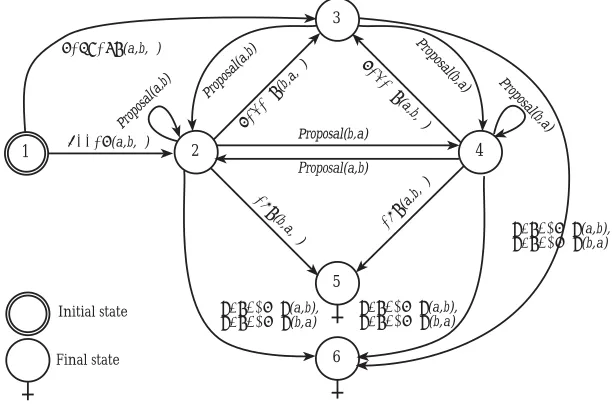
Agents can use the illocutions in
CL
according to the following negotiation protocol (see Figure 3):5In keeping with the spirit of specifying a framework which is neutral with respect to the agent
1. A negotiation always starts with adeal proposal, i.e. anofferorrequest. In
requestillocutions the special constant ‘?’ may appear. This is thought of as
a petition to an agent to make a detailed proposal byfilling the ‘?’s with defined values.
2. This is followed by an exchange of possibly many counter proposals (that agents
mayreject) and many persuasive illocutions.
3. Finally, aclosingillocution is uttered, i.e. anacceptorwithdraw.
4 2
3
1
5
6
offer(a,b,φ)
request(a,b,φ)
Proposal(a,b)
Proposal(b,a)
accept
(b,a, φ)
accept
(a,b, φ) reject
(a,b, φ) reject
(b,a, φ)
Proposal(b,a)
Proposal(a,b)
Proposal(a,b)
Proposal(b,a)
withdraw(a,b),
withdraw(b,a)
withdraw(a,b),
withdraw(b,a)
Initial state
Final state
withdraw(a,b),
[image:8.612.172.478.159.362.2]withdraw(b,a)
Fig. 3.Negotiation protocol. Inaccept(
xy'
)andreject(xy'
)illocutions'
always referto the last proposal.
Proposal
(xy
)stands for any illocution constructed with any of thefollow-ing particles:offer,threaten,reward,appeal, and between agents
x
andy
. We omit the time stamp in the illocutions.3.2 Negotiating agents
The Dialogical Framework described in the previous section represents the static com-ponents of the negotiation model—those that arefixed for all negotiations. This section presents the dynamic elements—those that change as a particular negotiation proceeds. Although our model aims to be as neutral as possible about the agent architecture, in order to capture essential aspects of persuasion it is necessary to assume that the agents have memory and are deliberative. Memory is expressed by means of an evolving
ne-gotiation statewhich, in turn, requires the notion of anegotiation thread[12] to capture
the history of the negotiation dialogue between a pair of agents.
Definition 2. ANegotiation Threadbetween agents
ab
2Agents
, at timet
2Time
,noted
#
t a$b, is a finite sequence (ordered on
Time
) of the form hx
tj di!ei
:
t
j
t
i1.
x
t j di!ei2
CL
,2.
d
ie
i2f
ab
g, the thread contains only illocutions between agentsa
andb
,3.
d
i 6=e
i, the illocutions arebetweenagents, and
4. if
t
k< t
l thenissues
(x
tk d
i !e
i
)
issues
(x
tl d j!e j
), where
issues
(x
)representsthe set of issues mentioned in illocution
x
. That is, we assume monotonicity over the set of issues under negotiation, so that once an issue has been brought into the negotiation, it is never supressed. We will use ellipsis whenever useful to make more compact expressions.We denote the last illocution in a thread as
#
. We say a negotiation thread#
isactiveif#
is not anacceptorwithdrawillocution.In an extension to our previous work [16], we want to capture the idea that new issues may arise during the negotiation process. This is necessary because we consider that one of the main ways in which an agent may persuade another about the desirability of a particular proposal is to introduce new issues that have hitherto not featured in the thread. This means that we need an explicit representation of the set
of issues an agent is aware of. Preferences also evolve. This may be becauseevolves or because the agent is persuaded to change its preferences. Thus the agent’s internal theoryT
, which includes its preferences inML
and a set of other formulae inL
modelling the domain, must be explicitly represented in the agent’s state. In this model we do not impose any specific requirements onT
. Hence the following definition:Definition 3. ANegotiation Statefor an agent
a
at timet
is any 3-tuples
=hTH
i,where
–
is afinite collection of negotiable issues.–
T
L
ML
, is a theory in the common languages.–
H
, the negotiation history, is the set of all negotiation threads involving agenta
. That is,H
=f#
i$a
j
i
2Agents
g.All possible negotiation states for agent
a
will be denoted byS
a. As an illustration ofhow these notions are used, consider the following example:
Example 1. The CSD agent is negotiating with a
V C
iagent for the Vet Customerser-vice for company A. The CSD agent proposes that the serser-vice be completed for
$10
and should take 24 hours.V C
i responds that company A is known to be infinancialdifficulty and therefore a more time consuming and expensive vetting should be under-taken (Figure 2, id 8). Moreover, in order to meet the deadline,
V C
iwill need to delaythe vetting of another BT customer (company B) for which an agreement has already been reached. This dialogue may be represented in
CL
as the sequence:1. offer(
CSDV C
i
Company
=
A
^price
=$10
^time
=24h
t
1
)2. appeal(
V C
i
CSD
Company
=
A
^price
=$20
^time
=48h
Financial Status
=bad
^Quality vetting
=high
t
2
)3. appeal(
V C
i
CSD
Company
=
B
^delay
=24h
This example shows how the range of issues
involved in the negotiation is extended (the delaying of the vet customer service for company B) and how new information (the fact that company A is known to be infinancial difficulty) can be brought to bear. This revelation of information means that the CSD agent extends its domain theoryT
(to include the fact that A may not be creditworthy).3.3 Persuasive agents
As the previous example already showed, the illocutionary acts in
CL
built fromI
pers
allow arguments to be made in support of a deal. The basic building block for argumentation is appeal(ab
not
]'t
)whereab
2Agents
, 2L
ML
,and
'
2L
ML
CL
. This is read as “agenta
wants agentb
to add toits current theory with argument
not
]'
supporting it”. The other persuasiveillocu-tionary acts,threaten(
ab
not
]1
not
]2
t
)andreward(ab
not
]1
not
]2
t
)with
1
2
2CL
, can contain arguments as long as1
and/or2
are appeals, or,recursively, contain appeals.
The interpretation of a persuasive argument for a formula determines whether the hearing agent changes its theory. To make a choice the agent considers the (possibly conflicting) arguments coming from other agents, and from itself, as proofs generated by its own theory. In our domain, and in other work on MAS [2], the social role between the agents is a determining factor in deciding which argument should be preferred. Hence, an authority relation is derived from the social roles and this is then used as the mechanism for comparing arguments. Precisely which social roles correspond to a power relation between the agents depends on the particular domain. In this scenario, for example, the role ‘contractor’ determines a power relation between the CSD agent and the vetting companies. To build a directed graph representing the authority that one agent has over another, we take the labelled graph associated with the social relation
R
, remove the links labelled with non-power roles, and add the necessary links to make the relation transitive. Hence the following definition:Definition 4. Given a Dialogical Framework
DF
=hAgentsRolesRLMLCL
Time
i and a set of authority rolesPower
Roles
, we define theauthority graph,AG
Agents
Agents
, forDF
as:1. If
R
(ab
)2Power
then(ab
)2AG
2. If(
ab
)(bc
)2AG
then(ac
)2AG
We say an authority graph is well defined if it is acyclic.
The authority graph encodes the authority relation—or lack of it, since in general AG is not totally connected—between any two agents. Now, our position is that in this domain the ‘power’ of an argument is determined solely by the authority of the agents which contribute formulae to its construction. Hence, it is necessary to extend the notion of authority from a relation between agents, as captured in the authority graph, to a relation over sets of agents which will be used to establish which arguments to prefer. There are two obvious ways of defining such a relation. We say that a set of agents
A
exists
a
2A
such that(ba
) 2AG
. And thatA
haslower maximum authoritythanB
,A
<max
B
, if and only if for alla
2A
there existsb
2B
such that(ba
)2AG
.Thus, intuitively, the order<
min
assumes that if any formula used in the argument wasproposed by somebody low in the authority graph the argument is weak, while<
max
assumes that as soon as any formula in the argument is proposed by somebody high in the authority graph the argument is strong. Obviously other authority relations might also be proposed. From now on we refer to any authority relation by the symbol<.
In its most general form an argument is a proof for a formula [1]. We assume that all agents share the same deductive systems for
L
(`L) and ML ( `
ML). Hence, in this
restricted context, a proof can be represented as the conjunction of all the formulae used in it because it can be reconstructed by the agent receiving it. An argument is then a formula
'
2L
ML
CL
that might be constructed from atomic formulaepresent initially in the theory of the agent or obtained in previous negotiation encounters from different agents. Assuming the existence of a function
Support
:L
ML
CL
!2Ag entsthat gives the agents whose formulae are used in the construction of an
argument, or the agent that uttered the illocution when
'
2CL
. We can use the socialrole of those agents to decide how forceful an argument is.
Fundamental to this view of decision making is the idea that one argument may attack another [3]. We represent the fact that an argument
Arg
supports a formula'
as a pair(Arg'
)and the fact that the argument pair(Arg
1
'
1
)attacks (Arg
2
'
2
)byAttacks
((Arg
1
'
1
)(Arg
2
'
2
)). The precise meaning ofAttacks
depends stronglyon the concrete languages
L
andML
being used. For the purpose of this paper we follow Dung [3] in assuming that it is a primitive notion, because our focus is on how to resolve the effect of an attack no matter how it is defined.Definition 5. Given the two argument pairs (
Arg
1
'
1
) and (Arg
2
'
2
) such thatAttacks
((Arg
1
'
1
) (Arg
2
'
2
)) then (Arg
1
'
1
) will be preferred to (Arg
2
'
2
),which we write as (
Arg
2
'
2
) (Arg
1
'
1
), if and only ifSupport
(Arg
2
) <Support
(Arg
1
). When (Arg
2
'
2
) 6 (Arg
1
'
1
)and(Arg
1
'
1
) 6 (Arg
2
'
2
)wesay that an agent is indifferent with respect to the arguments—and denote this by
(
Arg
1
'
1
)(Arg
2
'
2
).The agents use argumentation as the means to decide how to interpret incoming and generate outgoing illocutions. On receiving an argument pair(
Arg
1
'
1
)that is notat-tacked by any argument pair(
Arg
2
'
2
)built from its current theory, an open-mindedagent may simply add the argument
Arg
1
and the formula'
1
to its theory. In contrast, a more conservative agent may not accept a proposition unless it comes from a higher authority. WhenAttacks
((Arg
1
'
1
)(Arg
2
'
2
))the most preferred (in the sensede-fined above) argument pair is kept. If(
Arg
1
'
1
)(Arg
2
'
2
)some additional criteriamust be applied to decide which to keep, for instance epistemic entrenchment [4].
Example 2. The DD and SD agents are negotiating over the Survey Customer Site
ser-vice. DD proposes that the service should be completed within 24 hours. SD indicates that one of its surveyors was planning to go on holiday and so the survey will take 48 hours (Figure 2, id 9). DD indicates that it must have the service completed within 24 hours. In
CL
this is expressed as:2. appeal(
SDDDtime
=48hsurveyor
(Smith
)^holiday
(Smith
)t
2
)3. appeal(
DDSDtime
=24htime
=24ht
3
)In this example, SD issues an appeal to DD for more time to complete the survey ser-vice. DD rejects this argument saying the service must be completed within 24 hours. SD now has two arguments that attack one another:
Attacks
((surveyor
(Smith
)^holiday
(Smith
)time
= 48h
)(time
= 24htime
= 24h
)). It resolves them byreferring to its authority graph which indicates that the authority of DD’s argument is more powerful than its own (since DD is its boss, that is, (
DDSD
) 2AG
)and therefore it must do whatever is necessary to ensure the service is completed within 24 hours. That is,
Support
(surveyor
(Smith
)^holiday
(Smith
)) = fSD
g,Support
(time
= 24h
) = fDD
g and given that (DDSD
) 2AG
we have that (surveyor
(Smith
)^holiday
(Smith
)time
=48h
)(time
=24htime
=24h
)because in our example f
SD
g < fDD
g (using either of the measures mentionedabove).
3.4 Interpretation and Generation of Illocutions
For pragmatic reasons, we separate the definition of the semantics of illocutions into two different operations,
I
andG
(see examples 3 and 4). The former implements the negotiation-state transition associated with hearing a given illocution, while the latter determines the illocutionary action to be taken in a particular state.The underlying idea is that any illocution may introduce new issues into a negotia-tion, while appeals may, in addinegotia-tion, modify the preference relationships and the agent’s theory. However, the actual effect of an illocution depends on the agent’s interpretation of the utterances it receives. This interpretation process is highly domain-specific and is also dependent upon the internal structures present in the agent architecture. For this reason, we illustrate how our framework can be used to define a comparatively simple open-minded agent. Naturally this does not prescribe how all agents should behave, but rather exemplifies the concepts of our model which can be used to define many other types of agent.
The illocution interpretation function
I
for an open-minded agent is based on the following intuitions:– Every illocution extends the corresponding thread in the negotiation history
6
. In this way, for example, complete illocutionary histories allow agents with total recall to be modelled. Forgetful agents can then be modelled by discarding part of the negotiation thread.– All illocutions may introduce new issues into the negotiation.
– Appeals may change an agent’s preference relationship. They may change the the-ory as well by extending it with the formulae of the argument in the appeal, pro-vided that the current theory cannot build attacking arguments for the appeal.
6However, we do not update agents’ theories in this minimal semantics because we wish to
Example 3. Open-minded Interpretation. Given a communication language
CL
, a dia-logical frameworkDF
, and the set of all possible negotiation statesS
b for an agentb
,the interpretation function for anopen-minded agentis defined by
I
:CL
S
bDF
!S
bsuch that—havings
=(
TH
),H
=f#
i$b
j
i
2Agents
g, and ‘^’ representingconcatenation— we have
7
:1.
I
((abt
)s
df
)=(issues
()T
H
;#
b $a+
#
0 b $a)
with
2I
nego;#
0 b$a
=
#
b$a^
(abt
)2.
I
(threaten(ab
not
] 1not
] 2t
)
s
df
)=(
issues
(1)issues
(2)TH
;#
b$a+
#
0 b$a)
with
#
0 b$a=
#
b$a^threaten(
ab
not
] 1not
] 2t
)
3.
I
(reward(ab
not
] 1not
] 2t
)
s
df
)= (issues
(1
)
issues
( 2)
TH
;#
b$a +
#
0 b$a
)
with
#
0 b$a=
#
b$a^reward(
ab
not
] 1not
] 2t
)
4.
I
(appeal(ab
not
]'t
)s
df
)=( 0T
0H
;
#
b $a +#
0 b $a )with
#
0 b$a=
#
b$a^appeal(
ab
not
]'t
)ifno(
Arg
)built fromT
such thatAttacks
((not
]'
)(Arg
))then
0=
issues
( )issues
('
);if
'
2L
ML
thenT
0=
T
+ +'
elseT
0=
T
+else
0 =;T
0
=
T
Finally, an agent
a
’s specification must include a way of computing the next illocution to be uttered in the negotiation thread. That is a functionG
:S
a
DF
!CL
needs tobe defined. This function must conform with the protocol depicted in Figure 3 and can conveniently be represented as a collection of condition-action rules, where the action is an illocutionary action. How an agent chooses which illocution to utter depends on many factors: the history of the negotiation, the active goals of the agent, or its theory, and it also depends on the way that particular agent interprets those illocutions. The following example illustrates a simple negotiation dialogue between two agents and contains a fragment of a
G
function.Example 4. We use an expanded version of the argument presented in Example 2 to
illustrate specific instances of illocution generation and interpretation functions. Given the two initial illocution interchanges:
1. offer(
DDSDtime
=24h
^service
=Survey Customer Sitet
1
)2. appeal(
SDDDtime
=48hsurveyor
(Smith
)^holiday
(Smith
)t
2
)We show two decisions taken by two different types of agent; an ‘authoritarian’ DD agent which exploits its social power (and threatens to inform the company chairman that SD did not agree to complete the task within 24h), and a ‘conciliatory’ DD agent which resorts to an explanatory appeal (that it is company policy that quotes must be handled within 24h):
3.1 Authoritarian:threaten(
DDSD
not
accept(SD
DD
time
=24h
t
3
)appeal(
DDChairman
not
accept(SD
DD
time
=24h
t
3
)t
4
)) 73.2 Conciliatory:appeal(
DDSDtime
=24hBT Policy Time
=24ht
3
)The
G
function of an ‘obedient’ SD agent that, whenever possible, does what it is told could include the following decision rules where ‘self’ represents the agent interpreting the illocution:if
#
x$self=threaten(
x
self
not
accept(self
x
) 2)and(
x
self
)2AG
and
can do
()thenaccept(self
x
)if
#
x$self=threaten(
x
self
not
accept(self
x
) 2)and(
x
self
)2AG
and not
can do
()then 0=
compute counter oer
(s
DF
);offer(self
x
0)
if
#
x$self=appeal(
x
self
'
)and!:'
2T
thenappeal(self
x
:'
)Assuming that
can do
(time
=24h
^service
=Survey Customer Site
)is true, bysubcontracting the task say, the dialogue with the authoritarian DD ends with:
4.1 accept(
SDDDtime
=24h
^service
=Survey Customer Sitet
4
)On the other hand, if we assume that the rule
BT Policy Time
=24h
$Fully staed
is true and DD utters 3.2, the agent could reply with:4.2 appeal(
SDDD
not
(BT Policy Time
=24h
)not Fully staed
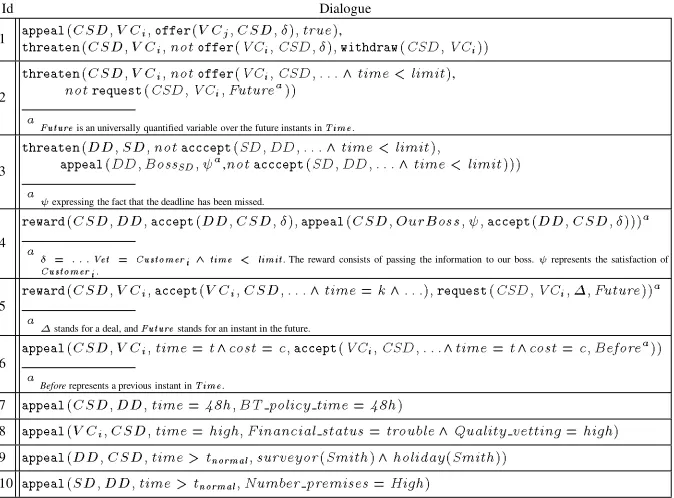
)To further illustrate the power of our framework, Figure 4 shows the representation in
CL
of the arguments presented in Figure 2.Id Dialogue
1 appeal
(
CSD VCioffer(
VCjCSD)
true)
, threate n(
CSD VCi
not
offer(VC
iCSD
)
withdraw(CSD
VC
i))
2
threate n
(
CSD VCinot
offer(VC
iCSD
:::^time
<limit)
,not
request(CSD
VC
iFuture
a))
aFutureis an universally quantified variable over the future instants inTime.
3
threate n
(
D D SDnot
acccept(SD
DD
:::^time
<limit)
appeal(DD
Boss
SDa
,
not
acccept(SD
DD
:::^time
<limit)))
a
expressing the fact that the deadline has been missed.
4
reward
(
CSD D D accept(
D D CSD)
appeal(
CSD O ur B oss accept(
D D CSD)))
a a=:::Vet =Customeri^time< limit. The reward consists of passing the information to our boss.represents the satisfaction of Customeri.
5
reward
(
CSD VCiaccept(
VCiCSD :::^time = k
^:::)
request(CSD
VC
iFuture))
a astands for a deal, andFuturestands for an instant in the future.
6
appeal
(
CSD VCitime = t
^cost = c
accept(VC
iCSD
:::^time = t
^cost = c
Before
a))
aBeforerepresents a previous instant inTime.
7 appeal
(
CSD D Dtime = 48h
BT policy time = 48h)
8 appeal
(
VC iCSD
time = high
Financial status = trouble
^Quality vetting = high)
9 appeal
(
D D CSDtime
>t
normalsurveyor(Smith)
^holiday(Smith))
[image:14.612.159.496.332.581.2]10 appeal
(
SD D Dtime
>t
normalNumber premises = High)
4 Related Work
Much of the existing work on agent-based negotiation is rooted in game theory, e.g. [15]. Although this approach has produced significant results, and has been successful in many negotiation domains, it embodies a number of limiting assumptions about the agents’ knowledge and utility functions. Even when this approach is extended, as in [11], to cope with conditions that change over time, it does not address the problem of how these changes can be accomplished by one agent influencing another, nor does it cope with the problem of introducing new issues into negotiations. Changing prefer-ences through persuasion, in multi-agent systems, was addressed in Sycara’s seminal work on labour negotiation [18], work extended and formalised by Krauset al.[10]. However, this work is set within the context of a particular agent architecture, assumes afixed and shared domain theory, and deals withfive particular types of argument (threats, rewards, appeals to precedent, appeals to prevailing practice, and appeals to self-interest). Furthermore, Krauset al.do not deal with the introduction of new issues or imperfect rationality. In contrast, our model accommodates partial knowledge, im-perfect rationality and the introduction of new negotiation issues—which are relevant features in many application domains—while only imposing minimal requirements on agents’ internal states and using a general rhetorical language.
We should also acknowledge the differences between our work and the use of ar-gumentation to explain how a single agent reasons. In the former, an agent argues with itself to establish its beliefs. In our work arguments are used by one agent in order to change another agents’ beliefs and actions. The other important difference is that the mechanism for resolving conflicts between arguments in single agent argumentation is often built into the logical language in which arguments are constructed and is based upon some intuitive notion of what is correct in the world at large. In contrast, we keep this mechanism at the meta-level and ground it in knowledge about the domain. This has the dual advantage of ensuring that conflicts are resolved in a way that is known to be suitable for our domain whilst allowing new conflict resolution mechanisms to be easilyfitted into the model in different domains.
5 Conclusion
and generation functions. Secondly, we have reflected an agent’s preferences, and the changes in those preferences, simply as sentences and updates in the agent’s theory
T
. Further work is required to tie these preferences to notions of rationality, in particular to standard ideas of expected utility. Finally, we make the simplifying assumption that negotiating agents have a common notion of deduction. This may be inadequate for some domains, in which case it will be necessary for agents to be able to discuss what rules of inference are appropriate.References
1. S. Benferhat, D. Dubois, and H. Prade. Argumentative inference in uncertain and inconsis-tent knowledge bases. InProc 9th Conf on Uncertainty in AI, pages 411–419, 1993. 2. C. Castelfranchi. Social Power: A Point missed in Multi-Agent, DAI and HCI. In
Y. Demazeau and J. P. M¨uller, editors,Decentralised AI, pages 49–62. Elsevier, 1990. 3. P. M. Dung. On the acceptability of arguments and its fundamental role in nonmonotonic
reasoning, logic programming and n-person games. Artificial Intelligence, 77:321–357, 1995.
4. P. G¨ardenfors.Knowledge in Flux. MIT Press, Cambridge, MA, 1987.
5. F. Giunchiglia and L. Serafini. Multilanguage hierarchical logics (or: How we can do with-out modal logics).Artificial Intelligence, 65:29–70, 1994.
6. W. D. Goldfarb. The undecidability of the second-order unification problem. Theoretical Computer Science, 13:225–230, 1981.
7. T. R. Gruber. The role of common ontology in achieving sharable, reusable knowledge bases. In J. A. Allen, R. Fikes, and E. Sandewall, editors,Proc. of the Second Int. Conf. on Principles of Knowledge Representation and Reasoning, 1991.
8. N. R. Jennings, P. Faratin, M. J. Johnson, T. J. Norman, P. O’Brien, and M. E. Wiegand. Agent-based business process management. International Journal of Cooperative Informa-tion Systems, 5(2&3):105–130, 1996.
9. M. Karlins and H. I. Abelson.Persuasion. Crosby Lockwood & Son, London, UK, 1970. 10. S. Kraus, M. Nirkhe, and K. Sycara. Reaching agreements through argumentation: a logical
model (preliminary report). InDAI Workshop’93, pages 233–247, 1993.
11. S. Kraus, J. Wilkenfeld, and G. Zlotkin. Multiagent negotiation under time constraints. Ar-tificial Intelligence, 75:297–345, 1995.
12. P. Noriega and C. Sierra. Towards layered dialogical agents. InProceedings of the ECAI’96 Workshop Agents Theories, Architectures and Languages, ATAL’96, number 1193 in LNAI, pages 157–171, 1996.
13. S. Parsons and N. R. Jennings. Negotiation through argumentation—a preliminary report. InProc. Second Int. Conf. on Multi-Agent Systems, pages 267–274, 1996.
14. A. S. Rao and M. P. Georgeff. BDI agents: From Theory to Practice. InProc 1st Int Conf on Multi-Agent Systems, pages 312–319, 1995.
15. J. S. Rosenschein and G. Zlotkin. Rules of Encounter. MIT Press, Cambridge, USA, 1994. 16. C. Sierra, P. Faratin, and N. R. Jennings. A service-oriented negotiation model between
autonomous agents. InMAAMAW’97, number 1237 in LNAI, pages 17–35, 1997.
17. R. G. Smith and R. Davis. Frameworks for cooperation in distributed problem solving.
IEEE Trans on Systems, Man and Cybernetics, 11(1):61–70, 1981.
18. K. P. Sycara. Persuasive argumentation in negotiation. Theory and Decision, 28:203–242, 1990.